



 Arguments







2012 SkS Weekly Digest #35
Posted on 3 September 2012 by John Hartz
SkS Highlights
As befitting an article about a milestone event in the Earth's rapidly changing climate system, Neven's Why Arctic sea ice shouldn't leave anyone cold generated the most comments of the articles posted this past week. Coming in a close second is Dana's Matt Ridley - Wired for Lukewarm Catastrophe. Dana's Realistically What Might the Future Climate Look Like? rounded out the top three.
Toon of the Week
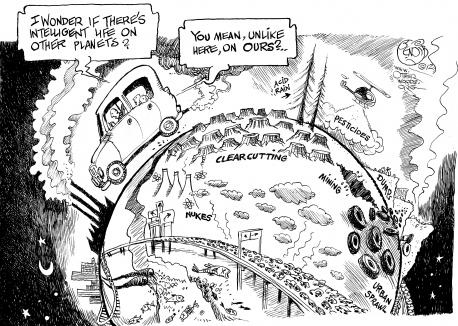
Broken Planet by Khalil Bendib created for Other Words
Quote of the Week
"We must acknowledge that the debate over climate change, like almost all environmental issues, is a debate over culture, worldviews, and ideology." - Andrew J. Hoffman
Source: Climate Science as Culture War by Andrew J. Hoffman, Stanford Social Innovation Review, Fall 2012 [H/T to Daniel Graig's blog, Climate of Change]
Feedback Corner
Excluding SkS, Wikepedia, and the IPCC, what websites do you frequent in order to learn more about the science of climate change?
Anouncement of the Week
The American Meteorological Society released an updated Statement on Climate Change (also available here in pdf form), replacing the 2007 version that was in effect. The statement provides a brief overview of how and why global climate has changed in recent decades and will continue to change in the future. It is based on the peer-reviewed scientific literature and is consistent with the majority of current scientific understanding as expressed in assessments and reports from the Intergovernmental Panel on Climate Change, the U.S. National Academy of Sciences, and the U.S. Global Change Research Program.
Fingerprints
- Extreme downpours on the rise in Rhode Island, says report by Stephanie Turaj, Block Island times, Aug 26, 2012
- Media Advisory: Arctic sea ice breaks lowest extent on record, US National Snow and Ice Data Center (NSIDC), Aug 27, 2012
- Bark Beetles Take Advantage of Global Warming by Kara Rogers, Facts Matter, Encyclopaedia Britannica Blog, Aug 27, 2012
- For Peat’s Sake: Record Temperatures And Wildfires In Eastern Russia Drive Amplifying Carbon-Cycle Feedback , Climate Progress, Aug 31, 2012
- Kashmir’s Melting Glaciers May Cut Ice With Sceptics by Athar Parvaiz, Inter Press Service (IPS) News Agency, Aug 31, 2012
- Heart Of The Arctic: A Dispatch From Ground Zero For Climate Change (PHOTOS) by Ralph Lee Hopkins, The Huffington Post, Sep 1, 2012
- That Sinking Feeling by David Dudenhoefer, Indian Country Today Media Network, Sep 1, 2012
Blog Post of the Week
- How Can Islam Help Us Tackle Climate Change? by Arwa Aburawa, e-International relations, Aug 24, 2012
The Week in Review
- Potential methane reservoirs beneath Antarctica by John Hartz
- Arctic Sea Ice Extent: We're gonna need a bigger graph by Daniel Bailey
- Realistically What Might the Future Climate Look Like? by Dana
- Will the Wet Get Wetter and the Dry Drier? by Rob Painting
- Matt Ridley - Wired for Lukewarm Catastrophe by Dana
- New research from last week 34/2012 Ari Jokimäki
- Arctic sea ice breaks lowest extent on record by John Hartz
- Why Arctic sea ice shouldn't leave anyone cold by Neven
Coming Soon
- New research from last week 35/2012 (Ari Jokimäki)
- Obama, Romney, and Various National Climate Policies Around the Globe (Dana)
- Online map shows over 100 years of local US weather (simonf)
- Record Arctic Sea Ice Melt to Levels Unseen in Millennia (Dana)
- Climate Change and the Weightier Matters: a Christian view on global warming (John Cook)
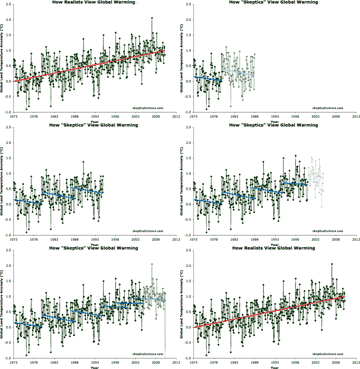
- Going Up the Down Escalator (Dana)
- Skeptic Magazine vs. Heartland and Monckton Cherry-picked Denialism (AlexC and Dana)
- Doffing the cryosphere cap: a new source of Arctic methane? (Andy S)
SkS in the News
Daniel Bailey's Arctic Sea Ice Extent: We're gonna need a bigger graph was re-posted on Climate Progress, as was Dana's Realistically What Might the Future Climate Look Like?.
SkS Spotlights
AKSYON KLIMA PILIPINAS, or simply Aksyon Klima, is a dynamic and fast-evolving network of civil society organizations (CSO’s) in the Philippines that banded together to grapple more effectively with the serious threats posed by the global climate crisis on our highly vulnerable country and people. Although member organizations carry diverse perspectives and separate agendas for social, political, economic or environmental development, they share a common recognition that climate change is an urgent cross-cutting issue and work collectively to address climate concerns at various levels and in various arenas.


 0
0  0
0


Comments