Global cooling - Is global warming still happening?
The skeptic argument...
It's cooling
"In fact global warming has stopped and a cooling is beginning. No climate model has predicted a cooling of the Earth – quite the contrary. And this means that the projections of future climate are unreliable." (source: Henrik Svensmark)
What the science says...
| Select a level... |
Basic
|
Intermediate
| |||
| All the indicators show that global warming is still happening. | |||||
When looking for evidence of global warming, there are many different indicators that we should look for. Whilst it's natural to start with air temperatures, a more thorough examination should be as inclusive as possible; snow cover, ice melt, air temperatures over land and sea, even the sea temperatures themselves. A 2010 study included 10 key indicators, and as shown below, every one of them is moving in the direction expected of a warming globe.
The question of global warming stopping is often raised in the light of a recent weather event - a big snowfall or drought breaking rain. Global warming is entirely compatible with these events; after all they are just weather. For climate change, it is the long term trends that are important; measured over decades or more, and those long term trends show that the globe is still, unfortunately, warming.
Last updated on 18 August 2010 by AdamK.

Arguments


Basic
Intermediate


For those animals that produce multiple offspring, the "choice" as to how many there will be is made at the beginning of the breeding cycle well before the conditions that will support the increased numbers that eventuate are evident, to man at least.
It is not a case of always producing multiple births and the excess perish, animals that normal carry one offspring, or at times miss breeding altogether, will suddenly carry multiple embryo's.
Another example that is often observed is water birds building nests at elevations that seem to account for the coming seasonal water level.
I don't see this as strange, as whilst most people are becoming even more oblivious to coming change, (how many people need to be told by the TV news that it's going to rain whilst others sense it days, even weeks ahead), the change when it eventuates is not a spontaneous happening, but the culmination of a long process where subtle indicators begin to appear well before the eventual outcome.
This is witnessed by our increasing ability to produce more accurate short and long range forecasts, the difference between those who have limited ability, and those who seem to have an uncanny ability, is that the latter have discovered what the most relevant indicators are, that combined produce an accurate prediction.
Whist man must rely on formulas and theories in order to bring it all together, and this is the important bit, it is all based on measurements that are taken from the physical world.
Now taking the forecasting of SST's as an example, some researchers believe they now have the ability to accurately forecast perhaps two years ahead.
That means that the indicators they are tracking this very day are changing in such a way, that they indicate the beginning of a process leading to an eventual outcome in two years time.
It may well be that that process is already well advanced, but man's ability to sense it, and thus measure it is still very limited.
Thus if we accept that what occurs at any point in time is not a spontaneous event, (even though some people always seem to get soaked because they didn't have a clue it was going to rain), but instead a result of a long ongoing process, don't you think that at least some of the animals that live in that physical world are also able to sense well ahead of time, those subtle changes that we are only finally learning to map and understand.
Probably not. But what is strange is the ability of deniersphere bloggers to trumpet an event like this as if it means something. From the post,
Small numbers of juvenile harp seals are typically found each winter stranded along the coast of the northeastern United States. But this year, well over 100 adult harp seals – not juveniles – have been spotted … In some areas they’re reporting three times the normal number of sightings ...
WUWT omits the part of the article where we learn that “the number of harp seals found in the northwest Atlantic” is “9 million.”
So a hundred lost seals are news for Watt$ and co. But the 8,999,900 who know where they are don't get a mention. Now that's a cherrypick!
We can agree that Harp seals appearing in small numbers in the Northern USA are not an indication of global cooling.
"Don't trust any of those elitist scientists and their modern, new-fangled, hoity-toity instruments and measurements - nature knows the truth and we will trust them to reveal their secret knowledge to those who we want to believe can understand what they are trying to say to us. Until anyone can actually speak to nature and interpret it, we can never be disproved and can believe what our internet gurus and blog scientists tell us !"
We are talking about science here man. Can you propose a mechanism by which these sensory-special organisms actually predict changes in climate? Weather maybe, and of course seasonal changes, but climate?
There has been no warming of the atmosphere since 2001.
http://www.woodfortrees.org/plot/hadcrut3vgl/from:2001/plot/hadcrut3vgl/from:2001/trend
Since there has been millions of tons of CO2 emitted why is that ?
The models say that there is a warming offset by aerosols causing no overall warming. To get the warming desired the aerosols are projected to disappear and the temperature climb. [Does that about cover it ?]
Does anyone have a link to a graph of aerosol emissions ?
Does anyone have a way of determining how much a ton of aerosols affects the temperature of earth ? [Or does each modeler tweak the values to suit his model sensitivity ?]
Or has the argument shifted to "the heat is being radiated out to space" or hidden in the oceans below the top 700 M ? [anywhere that it isn't causing much if any warming ?]
[DB] Please separate these questions into individual comments placed on more appropriate threads; as constructed this comment amounts to a Gish Gallop & thus needs no refuting. Thanks!
Let's look at this a bit more broadly, shall we?
Start year Trend
1850 - 2000 Positive
2001 - 2005 Negative
2006 - 2008 Positive
2009 - 2010 Negative
So... you can find a negative trend from seven of the past 161 years to present. None of which shows a statistically significant trend, because they were all within the past decade.
There have been much more pronounced 'cooling' trends in past decades despite rising CO2 levels. There is nothing at all surprising about that or the current downturn... because CO2 is not the only thing which impacts atmospheric temperatures.
(-Snip-)!
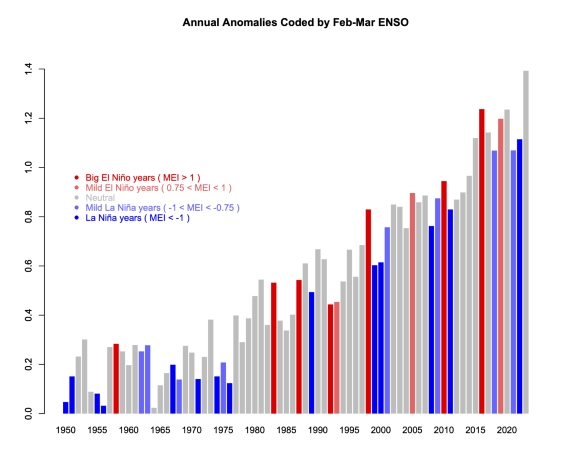
The reason that we have failed to warm since 2001 is that the ocean currents [PDO] have turned negative and we will have more La Nina's than El Nino's for 20 to 30 more years.
http://www.cpc.ncep.noaa.gov/products/analysis_monitoring/ensostuff/ensoyears.shtml
Notice that since 2000 the El Nino's have about balanced the La Nina's and it has warmed in the former and cooled in the latter.
2011 is a la Nina year and 2012 is predicted to be one too so it will be cooler probably for many years.
The slow warming is of interest only to climatologists and in no way is a problem for mankind.
(-Snip-).
[DB] "The slow warming is of interest only to climatologists and in no way is a problem for mankind."
Unsupported, and off-topic, handwaving. See the "It's not Bad" thread.
Moderation complaints snipped.
http://www.woodfortrees.org/plot/hadcrut3vgl/from:2001/plot/hadcrut3vgl/from:2001/trend"
Why not use all four temperature data sources ?
There, you will find that the two smallest trends (which are negative) are HadCrut and RSS, while the larger (positive) trends are GISS and UAH.
Why do you prefer the HadCrut figures ?
Please read Spencer Weart's The Discovery of Global Warming. Then come back here and go step by step through this site, like a true skeptic, trying to refute your own beliefs/arguments, and see what you discover.
Hint: The globe has not been cooling. You might try actually reading the post on which you are commenting.
No the wookie doesn't win because the wookie's base premise is incorrect: 2010 tied for Warmest Year on Record. Although since you like to cherry pick, here's 2011's hottest summer on record.
I entirely agree. There is a 1/2 ° C warming trend superimposed on a 60 year sine wave from ocean currents, but we cannot discuss this on this thread it is contrary to the "let the wookie appear to win policy"!
The reason that we have failed to warm since 2001 is that the ocean currents [PDO] have turned negative and we will have more La Nina's than El Nino's for 20 to 30 more years.
http://www.cpc.ncep.noaa.gov/products/analysis_monitoring/ensostuff/ensoyears.shtml
Notice that since 2000 the El Nino's have about balanced the La Nina's and it has warmed in the former and cooled in the latter.
2011 is a la Nina year and 2012 is predicted to be one too so it will be cooler probably for many years.
The slow warming is of interest only to climatologists and in no way is a problem for mankind.(-Snip-).
[DB] Your sudden, laser focus on short, statistically insignificant timescales is rather puzzling, given your earlier comment:
Repetitive complaints about moderation snipped.
Unsupported summary musings (i.e., handwavings) struck out. Please stick to the science, please.
Nicely cherry-picked year. Well done. And naturally ending in a La Nina. Also well done.
Here's the raw data, with your trends (for all data sources).
Trying to ignore your cherry-pick of HadCrut data (and noting that two out of the four datasets show positive trends, i.e. warming), what do you base your prediction of "20 to 30 more years" on ?
By the way, although I haven't analysed the data, the Japanese Meteorological Agency's dataset seems to show a positive trend since 2001 too. Any thoughts ?
Any thoughts, NETDR ?
*************
Since my point is that the sine wave has turned negative and that we have entered a time of cooling because of more La Nina's than El Nino's the short term cooling is entirely germane.
http://www.woodfortrees.org/plot/hadcrut3vgl/from:2005/plot/hadcrut3vgl/from:2005/trend
http://www.cpc.ncep.noaa.gov/products/analysis_monitoring/ensostuff/ensoyears.shtml
A negative PDO doesn't guarantee all La Nina's it just means the dice are loaded.
The El Nino of 2010 caused a blip of warming. Since 2011 is a La Nina year and predictions seem to predict that 2012 will be too.
http://www.cpc.noaa.gov/products/analysis_monitoring/lanina/images3/nino34SSTMon.gif
It doesn't make much sense to focus on the 1978 to 1998 warming since conditions have changed since then.
The sea level has gone down by 1/4 inch in the last year or so as you might expect if it were cooling. [short term]
http://sealevel.colorado.edu/
I contend that we are at the start of a 20 to 30 year cooling cycle.
Yet just here, you posited that it has failed to warm since 2001. So we are ... 10 years into your 20-30 year cooling? And we just had the hottest year on record.
Funny kind of cooling, that.
I very much hope you are right; sadly your reasoning is very shaky. Looking at time series data and detecting a pattern does not mean that the pattern inquestion has any physical basis, but without a physical basis there is no good reason to think that the pattern will continue intop the future.
In the case of the cycles linked to PDO, the problem is that there have been changes in other forcings, so how can you tell that the cycle is real rather than being the result of changes in other forcings that have coincided to form what appears to be a cycle and a bit of an oscillation? You can't tell by statistical means which is which (as correllation does not imply cuasation), you can only tell the difference via physics. So, has anyone produced a physical model that reproduces the observed cycle as a result of PDO, rather than as a result of known changes in the other forcings, such as solr forcing? I think you will find the answer to that question is "no", simply becuase once you include physics into the argument it quickly becomes apparent that PDO can have caused little of the observed variation.
You will need to study what is being said here rather carefully before commenting ...
The most informative plot I have seen compares gradients derived from 30 year trends calculated on a moving basis every month.
This is not a plot of temperatures ...
I have added the yellow trend line which shows a decrease in the gradient over the 100+ year period. No one can call this cherry picking - it's nearly all the data we have.
The reason for the decline in gradient is that the ~1000 year natural trend (evident in other data) is roughly sinusoidal and is approaching a maximum within 200 years. The decline should increase a little so the trend itself is cyclic and should pass through zero when that maximum occurs, for which temperatures look like being about 0.8 to 1.0 degree higher than at present.
About 100 years ago sea surface temperatures were increasing at a rate of about 0.6 deg.C per decade, whereas now the yellow trend line shows they are only increasing at a rate of about 0.5 deg.C per decade. This I suggest is also supported by the fact that the second maximum gradient is lower than the first, meaning the world saw faster warming in the past when carbon dioxide levels were lower.
Whatever you might think or say about whether the "Little Ice Age" or the "Medieval Warming Period" were worldwide phenomena, neither is the current warming period uniformly worldwide. (It was slightly warmer in the Arctic, for example, in the 1940's.)
But there can be no doubt that worldwide mean temperatures were warmish in the 12th century and coolish in the 17th century. When we see that long-term natural trend rates are only of the order of 0.5 deg.C per century, the scenario of alternate natural rises and falls of the order of 2 to 2.5 deg.C over periods of 500 years is far from implausible.
The data from which that "hockey stick" was invented came from land based tree ring data. Land surfaces contain only about 1/15th of the thermal energy (wrongly called "heat") that is in the oceans. Hence sea surface temperatures are a far better indication of what's happening. Actual temperature measurements in islands like Northern Ireland could be indicative of sea surface trends and these show a linear trend since 1792 - also increasing by about 0.6 deg.C per century.
So there is clear evidence that rates of the order of 0.6 deg.C per century have been the norm since the Little Ice Age and have not increased at all due to industrialisation.
If you want us to overthrow one of the most fundamental laws of science, your going to have to show us more than a single cycle in some cherry picked data. And contrary to your claim, the Sea Surface Temperature data is not all the data there is. Last time I looked, the Earth's surface included both continents and an Arctic Ice Cap, inclusion of which would definitely change the trend line of the thirty year trends you show. (HadSST is not the only sea surface temperature product either.)
I am not proposing a theory when I am merely using a logical statistical and mathematical approach to analysing all sea surface data since 1900 and saying there is no evidence of any increase in the rate of increase about 100 years ago compared with current rates.
Whichever way you look at the data, there is only a rise of the order of 0.05 to 0.06 deg.C per decade on average since 1900. Nothing suggests that an extrapolation to 2100 should exhibit a faster rate of increase in the underlying trend.
If you produce any other analysis of that sea surface data since 1900 which shows a sound reason for a rise of significantly more than, say, 0.6 deg.C over the next 88 or 89 years until the year 2100 I will take my hat off to you if I can't fault your logic. Go for it! Here is the source of the original plot.
Indeed, there was no reason to not show the Hadley Marine Air Temperature data (HadMAT) which extends back to 1856:
Doing so shows sixty years of declining sea temperatures terminating at the start of your "logical and mathematical approach". As sixty years is the duration of one cycle that you have purportedly detected, a sixty year period of declining sea temperatures resoundingly falsifies your model as a predictor of past, and hence presumably future sea surface temperatures.
Perhaps it is time you stopped plagiarizing Bob Tisdale by giving him blame for this analysis (there is no credit about it), and started relying on analysts who do not cherry pick their data.
Tamino came up for a name for this sort of statistical analysis that ignores data and ignores physics - mathturbation. I do not particularly like the term, but in this case it definitely applies.
(Source for HadISST and HadMAT graphs: Rayner et al, 2003)
Your analysis of Cotton's copious mistakes is spot on. However, tamino may have come up with many great things, but that particular term originated with economists. This definition predates tamino's 2011 usage by some 5 years.
Note these attributes of those who indulge:
...a combination of intellectual laziness and mistaken arrogance ...
'Nuff said.
However, most of the 8000 years worth of slow glacial advance that has occurred has been erased in just a few decades. Something (aka anthropogenic CO2) is working against the natural forcing and winning. It appears that your 1000 year cycle has been supercharged. I would post charts and links, but I am not sure how to do this with my limited computer skills.
you move up the baseline and then you tell the earth is cooling....
http://ow.ly/9u8GZ
If one were to believe the latest trend, it would imply that we believe athletes are getting fatter and slower.
Check it out and tell me what you think.
I'm interested in why the rate of warming in the Northern Hemisphere is faster than the rate of warming in the Southern Hemisphere.
Is it due to the following factors:
a. The greater proportion of land to water surface in the North.
b. The fast-spinning ring of air over the Arctic which affects the jet stream that helps drive the movement of winter storms.
c. The localised effect of positive feedbacks such as Arctic amplification.
Are these factors correct? Are there any other factors influencing this phenomenon?
And now, 2012 (to date) is the hottest year on record.
Science marches ever forward...;=/...and puts another nail in the denialista's insistence that there's "been no warming since 2001."
Sigh....
"And now, 2012 (to date) is the hottest year on record."
Not globally. I think you mean for the USA it's the warmest so far. Globally it will make the top ten, but won't approach the record. That of course doesn't mean that warming has stopped- it hasn't.
Mail
Maybe this is the best thread here for this question. I found elsewhere on the net a plot of temperature versus year since 1850, attributed to SKS. I have determined that it is an average of 11 data sets...HadCrut, Giss, NOAA, RSS, UAH, NCEPRI, NCEPCFSR,NCEPTCR,ERA-40,ERA-interim. Only on the graph published someplace in SKS, however, is also fitted a red curve to the averaged data with an R squared given.
Does anyone know what function this fit is to? Perhaps a best fit logarithm? I don't know how to find the graph on SKS in any of the many threads here, but hopefully someone else will know the answer.
Thanks,
CuriousD.
[Source - found by using the SkS search for "graphics" and looking at a few links, primarily SkS Climate Graphics]
If so, the various temperature records are simply aligned to a common baseline as stated in the graph, and the dark line is the average (again, as stated in the graph).
If you know of a graph with an additional overlaid fit, please give the URL and context, as vague references are less than useful.