



 Arguments









Is the CO2 effect saturated?
What the science says...
| Select a level... |
 Basic
Basic
|
 Intermediate
|
 Advanced
| ||||
|
The notion that the CO2 effect is 'saturated' is based on a misunderstanding of how the greenhouse effect works. |
|||||||
CO2 effect is saturated
"Each unit of CO2 you put into the atmosphere has less and less of a warming impact. Once the atmosphere reaches a saturation point, additional input of CO2 will not really have any major impact. It's like putting insulation in your attic. They give a recommended amount and after that you can stack the insulation up to the roof and it's going to have no impact." (Marc Morano, as quoted by Steve Eliot)
At-a-Glance
This myth relies on the use (or in fact misuse) of a particular word – 'saturated'. When someone comes in from a prolonged downpour, they may well exclaim that they are saturated. They cannot imagine being any wetter. That's casual usage, though.
In science, 'saturated' is a strictly-defined term. For example, in a saturated salt solution, no more salt will dissolve, period. But what's that got to do with heat transfer in Earth's atmosphere? Let's take a look.
Heat-trapping by CO2 in the atmosphere happens because it has the ability to absorb and pass on infra-red radiation – it is a 'greenhouse gas'. Infra-red is just one part of the electromagnetic spectrum, divided by physicists into a series of bands. From the low-frequency end of the spectrum upwards, the bands are as follows: radio waves, microwaves, infrared, visible light, ultraviolet, X-rays, and gamma rays. Gamma rays thus have a very high-frequency. They are the highest-energy form of radiation.
As our understanding of the electromagnetic spectrum developed, it was realised that the radiation consists of particles called 'photons', travelling in waves. The term was coined in 1926 by the celebrated physicist Gilbert Lewis (1875-1946). A photon's energy is related to its wavelength. The shorter the wavelength, the higher the energy, so that the very high-energy gamma-rays have the shortest wavelength of the lot.
Sunshine consists mostly of ultraviolet, visible light and infra-red photons. Objects warmed by the sun then re-emit energy photons at infra-red wavelengths. Like other greenhouse gases, CO2 has the ability to absorb infra-red photons. But CO2 is unlike a mop, which has to be wrung out regularly in order for it to continue working. CO2 molecules do not get filled up with infra-red photons. Not only do they emit their own infra-red photons, but also they are constantly colliding with neighbouring molecules in the air. The constant collisions are important. Every time they happen, energy is shared out between the colliding molecules.
Through those emissions and collisions, CO2 molecules constantly warm their surroundings. This goes on all the time and at all levels in the atmosphere. You cannot say, “CO2 is saturated because the surface-emitted IR is rapidly absorbed”, because you need to take into account the whole atmosphere and its constant, ongoing energy-exchange processes. That means taking into account all absorption, all re-emission, all collisions, all heating and cooling and all eventual loss to space, at all levels.
If the amount of radiation lost to space is equal to the amount coming in from the Sun, Earth is said to be in energy balance. But if the strength of the greenhouse effect is increased, the amount of energy escaping falls behind the amount that is incoming. Earth is then said to be in an energy imbalance and the climate heats up. Double the CO2 concentration and you get a few degrees of warming: double it again and you get a few more and on and on it goes. There is no room for complacency here. By the time just one doubling has occurred, the planet would already be unrecognisable. The insulation analogy in the myth is misleading because it over-simplifies what happens in the atmosphere.
Please use this form to provide feedback about this new "At a glance" section. Read a more technical version below or dig deeper via the tabs above!
Further details
This myth relies on the use of a word – saturated. When we think of saturated in everyday use, the term 'soggy' comes to mind. This is a good example of a word that has one meaning in common parlance but another very specific one when thinking about atmospheric physics. Other such words come to mind too. Absorb and emit are two good examples relevant to this topic and we’ll discuss how they relate to atmospheric processes below.
First things first. The effect of CO2 in the atmosphere is due to its influence on the transport of 'electromagnetic radiation' (EMR). EMR is energy that is moving as x-rays, ultraviolet (UV) light, visible light, infrared (IR) radiation and so on (fig. 1). Radiation is unusual in the sense that it contains energy but it is also always moving, at the speed of light, so it is also a form of transport. Radiation is also unusual in that it has properties of particles but also travels with the properties of waves, so we talk about its wavelength.
The particles making up radiation are known as photons. Each photon contains a specific amount of energy, and that is related to its wavelength. High energy photons have short wavelengths, and low energy photons have longer wavelengths. In climate, we are interested in two main radiation categories - firstly the visible light plus UV and minor IR that together make up sunshine, and secondly the IR from the earth-atmosphere system.
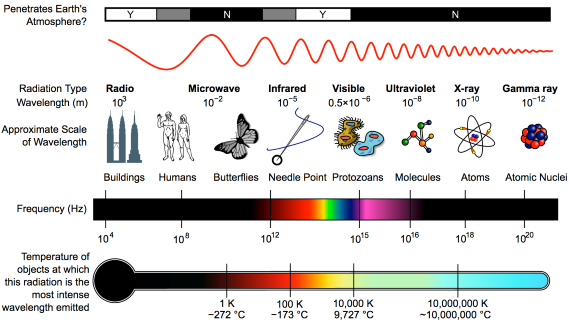
Fig. 1: diagram showing the full electromagnetic spectrum and its properties of the different bands. Image: CC BY-SA 3.0 from Wikimedia.
CO2 has the ability to absorb IR photons – it is a 'greenhouse gas'.So what does “absorb” mean, when talking about radiation? We are all familiar with using a sponge to mop up a water spill. The sponge will only absorb so much and will not absorb any more unless it's wrung out. In everyday language it may be described, without measurements, as 'saturated'. In this household example, 'absorb' basically means 'soak up' and 'saturated' simply means 'full to capacity'. Scientific terms are, in contrast, strictly defined.
Now let's look at the atmosphere. The greenhouse effect works like this: energy arrives from the sun in the form of visible light and ultraviolet radiation. A proportion reaches and warms Earth's surface. Earth then emits the energy in the form of photons of IR radiation.
Greenhouse gases in the atmosphere, such as CO2 molecules, absorb some of this IR radiation, then re-emit it in all directions - including back to Earth's surface. The CO2 molecule does not fill up with IR photons, running out of space for any more. Instead, the CO2 molecule absorbs the energy from the IR photon and the photon ceases to be. The CO2 molecule now contains more energy, but that is transient since the molecule emits its own IR photons. Not only that: it's constantly colliding with other molecules such as N2 and O2 in the surrounding air. In those collisions, that excess energy is shared with them. This energy-sharing causes the nearby air to heat up (fig. 2).
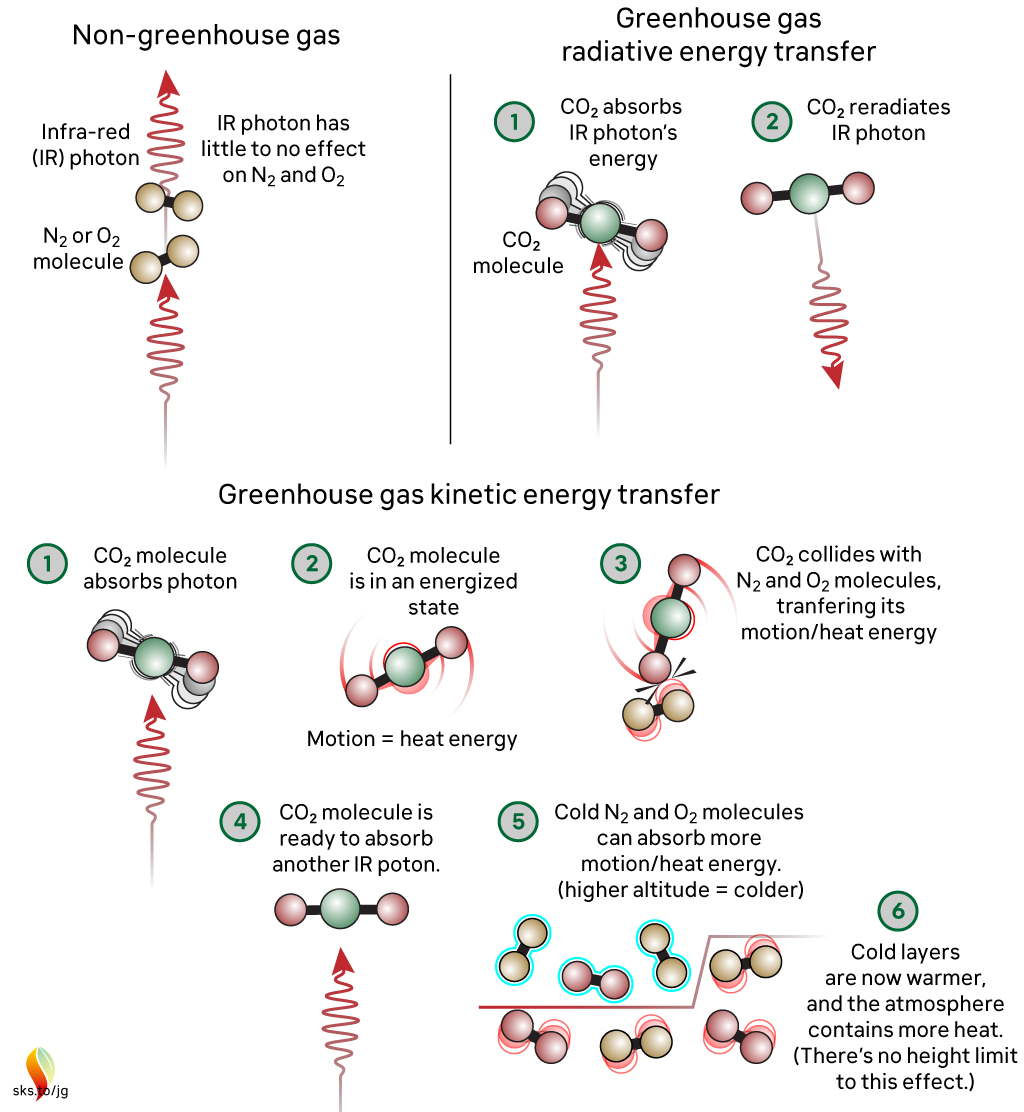
Fig. 2: The greenhouse effect in action, showing the interactions between molecules. The interactions happen at all levels of the atmosphere and are constantly ongoing. Graphic: jg.
The capacity for CO2 to absorb photons is almost limitless. The CO2 molecule can also receive energy from collisions with other molecules, and it can lose energy by emitting IR radiation. When a photon is emitted, we’re not bringing a photon out of storage - we are bringing energy out of storage and turning it into a photon, travelling away at the speed of light. So CO2 is constantly absorbing IR radiation, constantly emitting IR radiation and constantly sharing energy with the surrounding air molecules. To understand the role of CO2, we need to consider all these forms of energy storage and transport.
So, where does 'saturation' get used in climate change contrarianism? The most common way they try to frame things is to claim that IR emitted from the surface, in the wavelengths where CO2 absorbs, is all absorbed fairly close to the surface. Therefore, the story continues, adding more CO2 can’t make any more difference. This is inaccurate through omission, because either innocently or deliberately, it ignores the rest of the picture, where energy is constantly being exchanged with other molecules by collisions and CO2 is constantly emitting IR radiation. This means that there is always IR radiation being emitted upwards by CO2 at all levels in the atmosphere. It might not have originated from the surface, but IR radiation is still present in the wavelengths that CO2 absorbs and emits. When emitted in the upper atmosphere, it can and will be lost to space.
When you include all the energy transfers related to the CO2 absorption of IR radiation – the transfer to other molecules, the emission, and both the upward and downward energy fluxes at all altitudes - then we find that adding CO2 to our current atmosphere acts to inhibit the transfer of radiative energy throughout that atmosphere and, ultimately, into space. This will lead to additional warming until the amount of energy being lost to space matches what is being received. This is precisely what is happening.
The myth reproduced at the top – incorrectly stating an analogy with roof insulation in that each unit has less of an effect - is misleading. Doubling CO2 from 280 ppm to 560 ppm will cause a few degrees of warming. Doubling again (560 to 1130 ppm) will cause a similar amount of additional warming, and so on. Many doublings later there may be a point where adding more CO2 has little effect, but recent work has cast serious doubt on that (He et al. 2023). But we are a long, long way from reaching that point and in any case we do not want to go anywhere near it! One doubling will be serious enough.
Finally, directly observing the specific, global radiative forcing caused by well-mixed greenhouse gases has - to date - proven elusive. This is because of irregular, uncalibrated or limited areal measurements. But very recently, results have been published regarding the deep reinterrogation of years of data (2003-2021) from the Atmospheric Infrared Sounder (AIRS) instrument on NASA's Aqua Satellite (Raghuraman et al. 2023). The work may well have finally cracked the long-standing issue of how to make finely detailed, consistent wavelength-specific measurements of outgoing long-wave radiation from Earth into space. As such, it has opened the way to direct monitoring of the radiative impact (i.e. forcing + feedback) of greenhouse gas concentration changes, thereby complimenting the Keeling Curve - the longstanding dataset of measured CO2 concentrations, down at the planet's surface.
Note: Several people in addition to John Mason were involved with updating this basic level rebuttal, namely Bob Loblaw, Ken Rice and John Garrett (jg).
Last updated on 31 December 2023 by John Mason. View Archives
 Compare it to the obsolete one referenced in the article above from Harries 2001
 Anderson et al. say the best estimate is the red curve (dof-wtd cells). Pay careful attention to the differences. Measured CO2 effect can be seen close to the left edge of both figures. The difference between the wavenumber 750-900 cm-1 range and wavenumber 710 cm-1 is about 1.5 K in both figures, but in the improved analysis it turns out only 0.4 K is due to decreased OLR intensity in the CO2 wing, while there is a 1.1 K increase in the low frequency (most transparent) part of the atmospheric window.
As surface temperature between 1970 and 1996 increased less than that (and temperature in the mid-troposphere even less), it can only mean photosphere height in this spectral range decreased during this period. It is consistent with balloon radiosonde data, which show decreasing atmospheric specific humidity above the 700 mbar level (while it was increasing closer to the surface).
There is an even more striking difference between the two analyses above the O3 absorption line, in the high frequency part of the atmospheric window. According to Anderson at al. brightness temperature anomaly here is 1-1.5 K less than at lower frequencies (while Harries puts them about to the same level).
The same is true for the relative depths of the CO2 and CH4 notches.
All this boils down to the conclusion that while the CO2 effect may not be fully saturated at the wings, it is almost negligible compared to methane (which is not saturated) and is counteracted to a considerable degree by water vapor (negative feedback).
Anderson et al. say the best estimate is the red curve (dof-wtd cells). Pay careful attention to the differences. Measured CO2 effect can be seen close to the left edge of both figures. The difference between the wavenumber 750-900 cm-1 range and wavenumber 710 cm-1 is about 1.5 K in both figures, but in the improved analysis it turns out only 0.4 K is due to decreased OLR intensity in the CO2 wing, while there is a 1.1 K increase in the low frequency (most transparent) part of the atmospheric window.
As surface temperature between 1970 and 1996 increased less than that (and temperature in the mid-troposphere even less), it can only mean photosphere height in this spectral range decreased during this period. It is consistent with balloon radiosonde data, which show decreasing atmospheric specific humidity above the 700 mbar level (while it was increasing closer to the surface).
There is an even more striking difference between the two analyses above the O3 absorption line, in the high frequency part of the atmospheric window. According to Anderson at al. brightness temperature anomaly here is 1-1.5 K less than at lower frequencies (while Harries puts them about to the same level).
The same is true for the relative depths of the CO2 and CH4 notches.
All this boils down to the conclusion that while the CO2 effect may not be fully saturated at the wings, it is almost negligible compared to methane (which is not saturated) and is counteracted to a considerable degree by water vapor (negative feedback).
 Between 1970 and 1996 atmospheric CO2 concentration as measured at the Mauna Loa Observatory has increased from 325.68 ppmv to 362.35 ppmv.
 The match is reasonably good considering Anderson processed many more spectra, attained finer spectral resolution, smaller error bars and also covers a larger area.
And Brindley et al. show even less decrease in brightness temperature in the CO2 wing (at the left edge) than Anderson et al. do. Practically none at all, while both analyses show increase in the window and decrease in the methane band (the curve is above or below zero, respectively).
So. How does Fig. 1. Harries 2001 come about?
It is the difference between the spectrum above and a theoretical spectrum where radiative effects of changes in water vapor distribution along with sea surface and atmospheric temperatures are taken into account, but GHG concentrations (other than H2O, and only for radiance calculation purposes) are kept constant.
Therefore their finding is not "direct experimental evidence" in any reasonable sense of the word. It can't be better than their theoretically derived spectrum used for adjustment.
I quote the full passage dealing with this theoretical derivation from the extended abstract, because it is essential.
"3. SIMULATION METHODOLOGY
Pentad mean global temperatures and specific humidity fields representative of two twenty-seven month intervals centred on the operational periods of the two instruments, running from April 1969 to June 1971, and April 1996 to June 1998 were generated using the HadleyCentre Atmospheric Model version 3 (HADAM3).
HADAM3 comprises the atmospheric portion of the Hadley Centre Coupled Climate Model, with 19 levels in the vertical, and a horizontal resolution of 2.5° latitude x 3.75° longitude.
The model was forced by observed sea surface temperatures taken from the Global Sea Ice and Sea Surface Temperature (GISST) data set, and also included the effects of changes in trace gases, and a parameterisation of volcanic and solar forcing over the period considered. In order to quantify the impact of model uncertainties, four realizations of the atmospheric state were provided.
Using the model geophysical fields along with representative values of trace gas concentrations for each period, radiance spectra were calculated for each grid point and month at 1 cm-1 resolution over the wavenumber range 600-1400 cm-1 by the MODTRAN3.7 radiative transfer code. These 1 cm-1 radiances were then degraded to 2.8 cm-1 resolution using the IRIS instrument function and converted to the equivalent BT".
The take home message is they have used various data sources for their theoretical calculations, but neither atmospheric temperatures nor specific humidity fields were measured, they were derived by running HADAM3 (four times).
They do not verify if HADAM3 is correct or not, they assume it. See: "Assuming that HADAM3 correctly captures etc., etc."
It means their result is neither measured nor verified. It is assumed.
Have a careful look at Fig. 3 (a) in Brindley 2001 please. This is the theoretical spectrum to be subtracted from the measured one to arrive at Fig. 1. Harries 2001.
You will notice H2O forcing is the decisive factor. Influence "SST only" (measured) is neutral, "T only" (not measured) overfills the CO2 notch in measured spectrum, while "H2 only" (not measured) is an exaggerated mirror image of it, if subtracted, re-creates the notch.
Therefore what you see in Fig. 1. Harries 2001 is the result of HADAM3 computations and has only extremely weak relation to IRIS or IMG data.
As we do not have actual specific humidity measurements along the entire air column over the East Pacific for the IRIS period and there is no way to go back in time and recover it, their result is utterly unverifiable.
When I was young, inherently unverifiable propositions used to belong to other realms of the human endeavor, not science.
The match is reasonably good considering Anderson processed many more spectra, attained finer spectral resolution, smaller error bars and also covers a larger area.
And Brindley et al. show even less decrease in brightness temperature in the CO2 wing (at the left edge) than Anderson et al. do. Practically none at all, while both analyses show increase in the window and decrease in the methane band (the curve is above or below zero, respectively).
So. How does Fig. 1. Harries 2001 come about?
It is the difference between the spectrum above and a theoretical spectrum where radiative effects of changes in water vapor distribution along with sea surface and atmospheric temperatures are taken into account, but GHG concentrations (other than H2O, and only for radiance calculation purposes) are kept constant.
Therefore their finding is not "direct experimental evidence" in any reasonable sense of the word. It can't be better than their theoretically derived spectrum used for adjustment.
I quote the full passage dealing with this theoretical derivation from the extended abstract, because it is essential.
"3. SIMULATION METHODOLOGY
Pentad mean global temperatures and specific humidity fields representative of two twenty-seven month intervals centred on the operational periods of the two instruments, running from April 1969 to June 1971, and April 1996 to June 1998 were generated using the HadleyCentre Atmospheric Model version 3 (HADAM3).
HADAM3 comprises the atmospheric portion of the Hadley Centre Coupled Climate Model, with 19 levels in the vertical, and a horizontal resolution of 2.5° latitude x 3.75° longitude.
The model was forced by observed sea surface temperatures taken from the Global Sea Ice and Sea Surface Temperature (GISST) data set, and also included the effects of changes in trace gases, and a parameterisation of volcanic and solar forcing over the period considered. In order to quantify the impact of model uncertainties, four realizations of the atmospheric state were provided.
Using the model geophysical fields along with representative values of trace gas concentrations for each period, radiance spectra were calculated for each grid point and month at 1 cm-1 resolution over the wavenumber range 600-1400 cm-1 by the MODTRAN3.7 radiative transfer code. These 1 cm-1 radiances were then degraded to 2.8 cm-1 resolution using the IRIS instrument function and converted to the equivalent BT".
The take home message is they have used various data sources for their theoretical calculations, but neither atmospheric temperatures nor specific humidity fields were measured, they were derived by running HADAM3 (four times).
They do not verify if HADAM3 is correct or not, they assume it. See: "Assuming that HADAM3 correctly captures etc., etc."
It means their result is neither measured nor verified. It is assumed.
Have a careful look at Fig. 3 (a) in Brindley 2001 please. This is the theoretical spectrum to be subtracted from the measured one to arrive at Fig. 1. Harries 2001.
You will notice H2O forcing is the decisive factor. Influence "SST only" (measured) is neutral, "T only" (not measured) overfills the CO2 notch in measured spectrum, while "H2 only" (not measured) is an exaggerated mirror image of it, if subtracted, re-creates the notch.
Therefore what you see in Fig. 1. Harries 2001 is the result of HADAM3 computations and has only extremely weak relation to IRIS or IMG data.
As we do not have actual specific humidity measurements along the entire air column over the East Pacific for the IRIS period and there is no way to go back in time and recover it, their result is utterly unverifiable.
When I was young, inherently unverifiable propositions used to belong to other realms of the human endeavor, not science.
 And caption:
"a, Observed IRIS and IMG clear sky brightness temperature spectra for the central Pacific (10° N–10° S, 130° W–180° W). b, Top, observed difference spectrum taken from a; middle, simulated central Pacific difference spectrum, displaced by -5 K; bottom, observed difference spectrum for 'near-global' case (60° N–60° S), displaced by –10 K. c, Component of simulated spectrum due to trace-gas changes only. 'Brightness temperature' on the ordinate indicates equivalent blackbody brightness temperature."
Since you are not comparing equivalent data, your analysis and conclusions are moot.
And caption:
"a, Observed IRIS and IMG clear sky brightness temperature spectra for the central Pacific (10° N–10° S, 130° W–180° W). b, Top, observed difference spectrum taken from a; middle, simulated central Pacific difference spectrum, displaced by -5 K; bottom, observed difference spectrum for 'near-global' case (60° N–60° S), displaced by –10 K. c, Component of simulated spectrum due to trace-gas changes only. 'Brightness temperature' on the ordinate indicates equivalent blackbody brightness temperature."
Since you are not comparing equivalent data, your analysis and conclusions are moot.
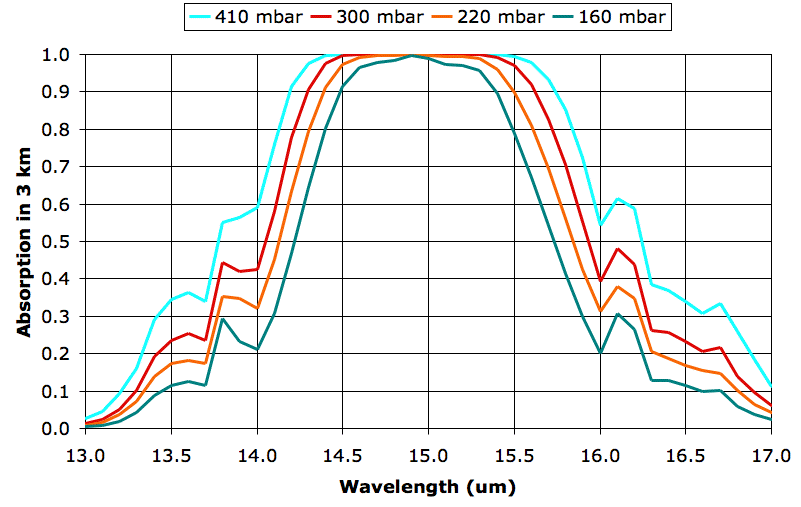 For your convenience: 14 μm is wavenumber 710 cm-1, the lower frequency limit in the Harries graph. The 160 mbar level is above 13 km altitude.
The really important question is the relation between radiative effects of a saturated absorber (like CO2) and an unsaturated one like CH4 which has a strong absorption line centered near wavenumber 1300 cm-1 (7.7 μm) with its own wings, but is not saturated at the line center, that is, thermal IR radiation has some chance to escape to space from the surface even there.
Anderson's difference spectra (and raw difference spectra of Harries as well) show a much more pronounced decrease of brightness temperature in the methane band compared to the almost negligible one in the carbon dioxide wing.
To bring them to comparable levels, one needs to assume unmeasured quantities like changes in atmospheric moisture and temperature fields behave in a certain way and adjust difference spectra accordingly. That step is not measurement, that's theoretical derivation using an extremely convoluted and basically unpublished, intrinsically unverifiable theory called CRUTEM3, embodied in thousands of lines of low quality computer code.
So. We of course know (from first principles) that the CO2 effect is not saturated (in the wings of the absorption band centered at 667 cm-1). The same way we do know Earth is not a sphere. But would it follow from this proposition it must be flat?
For your convenience: 14 μm is wavenumber 710 cm-1, the lower frequency limit in the Harries graph. The 160 mbar level is above 13 km altitude.
The really important question is the relation between radiative effects of a saturated absorber (like CO2) and an unsaturated one like CH4 which has a strong absorption line centered near wavenumber 1300 cm-1 (7.7 μm) with its own wings, but is not saturated at the line center, that is, thermal IR radiation has some chance to escape to space from the surface even there.
Anderson's difference spectra (and raw difference spectra of Harries as well) show a much more pronounced decrease of brightness temperature in the methane band compared to the almost negligible one in the carbon dioxide wing.
To bring them to comparable levels, one needs to assume unmeasured quantities like changes in atmospheric moisture and temperature fields behave in a certain way and adjust difference spectra accordingly. That step is not measurement, that's theoretical derivation using an extremely convoluted and basically unpublished, intrinsically unverifiable theory called CRUTEM3, embodied in thousands of lines of low quality computer code.
So. We of course know (from first principles) that the CO2 effect is not saturated (in the wings of the absorption band centered at 667 cm-1). The same way we do know Earth is not a sphere. But would it follow from this proposition it must be flat?
 That means that if you do not have clear skies, IR radiation from clouds across the spectrum will be significant. They may or may not obscure the absorption band for any particular greenhouse gas. Whether it does or not will depend on the altitude of the cloud and the effective altitude of emission for that particular greenhouse gas,ie, the average altitude from which IR photons emitted from that gas escape to space. But because the emissions from the clouds come from across the spectrum, and in particular the wavelengths at which various GHG emit photons, it will become difficult, or even impossible in the presence of clouds to determine how much of the reduction in emissions at those wavelengths is due to the increased concentration of a Green House Gas, and how much is due to the cloud.
The point is that Harries is trying to detect any reduction in emissions due to increase green house gas concentrations, if there are any such reductions. Therefore like any good scientist he uses data that restricts the number of independent variables which might obscure the relationship he is looking for.
The problem appears to be that you are looking for some sort of silver bullet approach to science, and that is not how science works. Well, occasionally it is. The graphs above are cast iron proof that Green House Gases effect the Earth's energy balance, and hence that there is a greenhouse effect. They do not by themselves show how strong that greenhouse effect is, and nor do they show that the greenhouse effect will be strengthened by increasing the concentration of Green House Gases. Haries has found proof that increasing the concentration of GHG does increase the strength of the greenhouse effect, ie, the CO2 is not saturated and that their is an enhanced green house effect.
You seem to want him to also show exactly the strength of the enhanced greenhouse effect, but he cannot do that with the data provided, and nor does he try to. He is only attempting to show, and does show, one thing - that enhancing GHG concentrations reduces top of atmosphere emissions in the wavelength of absorption/emission by those Green House Gases.
You would be astonished at how many denialist arguments are falsified by that simple observation.
That means that if you do not have clear skies, IR radiation from clouds across the spectrum will be significant. They may or may not obscure the absorption band for any particular greenhouse gas. Whether it does or not will depend on the altitude of the cloud and the effective altitude of emission for that particular greenhouse gas,ie, the average altitude from which IR photons emitted from that gas escape to space. But because the emissions from the clouds come from across the spectrum, and in particular the wavelengths at which various GHG emit photons, it will become difficult, or even impossible in the presence of clouds to determine how much of the reduction in emissions at those wavelengths is due to the increased concentration of a Green House Gas, and how much is due to the cloud.
The point is that Harries is trying to detect any reduction in emissions due to increase green house gas concentrations, if there are any such reductions. Therefore like any good scientist he uses data that restricts the number of independent variables which might obscure the relationship he is looking for.
The problem appears to be that you are looking for some sort of silver bullet approach to science, and that is not how science works. Well, occasionally it is. The graphs above are cast iron proof that Green House Gases effect the Earth's energy balance, and hence that there is a greenhouse effect. They do not by themselves show how strong that greenhouse effect is, and nor do they show that the greenhouse effect will be strengthened by increasing the concentration of Green House Gases. Haries has found proof that increasing the concentration of GHG does increase the strength of the greenhouse effect, ie, the CO2 is not saturated and that their is an enhanced green house effect.
You seem to want him to also show exactly the strength of the enhanced greenhouse effect, but he cannot do that with the data provided, and nor does he try to. He is only attempting to show, and does show, one thing - that enhancing GHG concentrations reduces top of atmosphere emissions in the wavelength of absorption/emission by those Green House Gases.
You would be astonished at how many denialist arguments are falsified by that simple observation.
 Given that you need to look at the likely impacts of such a climate sensitivity. Ignore the impacts for 450 ppm (the current notional limit on CO2 increases for the international community). Rather consider the business as usual (A2) scenario for the end of this century, which will result in over 800 ppm of CO2. At 800 ppm, even with a climate sensitivity of 1.5 degrees C per doubling of CO2, the Earth's temperature will rise over 2 degrees C. At 2 degrees C there is an expected 50/50 chance that the Great Barrier Reef will be destroyed. At 2 degrees C there is an expected 50/50 chance that the Amazon Rainforest will be destroyed. And these are not on/of states. Even if they survive they will survive in severally degraded conditions.
That level of ecosystem collapse is not consistent with a flourishing civilization. If our civilization survives that level of ecosystem collapse, it will be a hard, unpleasant skin of our teeth affair.
And that is for a climate sensitivity so low that we have a less than 1 in 20 chance of being that lucky. More likly we will be looking at a 4.5 degree increase, an increase of the same order as the difference between glacial and interglacial temperatures, and which will have similarly large impacts on ecosystems and habitability.
As an aside, the anvil head thunderstorm does negate the effect of CO2 over the region of the thunderstorm, but only by imposing a much stronger greenhouse effect.
Given that you need to look at the likely impacts of such a climate sensitivity. Ignore the impacts for 450 ppm (the current notional limit on CO2 increases for the international community). Rather consider the business as usual (A2) scenario for the end of this century, which will result in over 800 ppm of CO2. At 800 ppm, even with a climate sensitivity of 1.5 degrees C per doubling of CO2, the Earth's temperature will rise over 2 degrees C. At 2 degrees C there is an expected 50/50 chance that the Great Barrier Reef will be destroyed. At 2 degrees C there is an expected 50/50 chance that the Amazon Rainforest will be destroyed. And these are not on/of states. Even if they survive they will survive in severally degraded conditions.
That level of ecosystem collapse is not consistent with a flourishing civilization. If our civilization survives that level of ecosystem collapse, it will be a hard, unpleasant skin of our teeth affair.
And that is for a climate sensitivity so low that we have a less than 1 in 20 chance of being that lucky. More likly we will be looking at a 4.5 degree increase, an increase of the same order as the difference between glacial and interglacial temperatures, and which will have similarly large impacts on ecosystems and habitability.
As an aside, the anvil head thunderstorm does negate the effect of CO2 over the region of the thunderstorm, but only by imposing a much stronger greenhouse effect.







Climate Myth...