



 Arguments







A basic overview of Antarctic ice
Posted on 29 November 2010 by robert way
Skeptic arguments that Antarctica is gaining ice frequently hinge on an error of omission, namely ignoring the difference between land ice and sea ice.
In glaciology and particularly with respect to Antarctic ice, not all things are created equal. Let us consider the following differences. Antarctic land ice is the ice which has accumulated over thousands of years on the Antarctica landmass itself through snowfall. This land ice therefore is actually stored ocean water that once fell as precipitation. Sea ice in Antarctica is quite different as it is generally considered to be ice which forms in salt water primarily during the winter months.
In Antarctica, sea ice grows quite extensively during winter but nearly completely melts away during the summer (Figure 1). That is where the important difference between antarctic and arctic sea ice exists. Arctic sea ice lasts all the year round, there are increases during the winter months and decreases during the summer months but an ice cover does in fact remain in the North which includes quite a bit of ice from previous years (Figure 1). Essentially Arctic sea ice is more important for the earth's energy balance because when it melts, more sunlight is absorbed by the oceans whereas Antarctic sea ice normally melts each summer leaving the earth's energy balance largely unchanged.
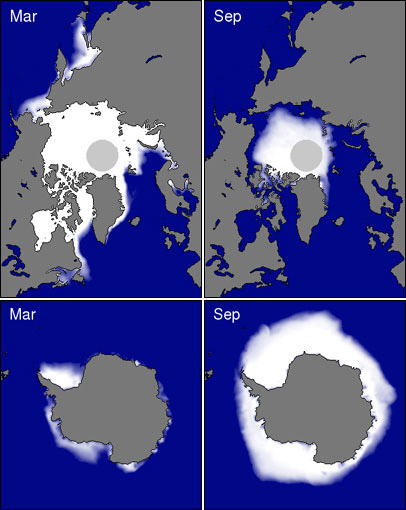
Figure 1: Coverage of sea ice in both the Arctic (Top) and Antarctica (Bottom) for both summer minimums and winter maximums
Source: National Snow and Ice Data Center
One must also be careful how you interpret trends in Antarctic sea ice. Currently this ice is increasing and has been for years but is this the smoking gun against climate change? Not quite. Antarctic sea ice is gaining because of many different reasons but the most accepted recent explanations are listed below:
i) Ozone levels over Antarctica have dropped causing stratospheric cooling and increasing winds which lead to more areas of open water that can be frozen (Gillet 2003, Thompson 2002, Turner 2009).
and
ii) The Southern Ocean is freshening because of increased rain, glacial run-off and snowfall. This changes the composition of the different layers in the ocean there causing less mixing between warm and cold layers and thus less melted sea ice (Zhang 2007).
All the sea ice talk aside, it is quite clear that really when it comes to Antarctic ice, sea ice is not the most important thing to measure. In Antarctica, the most important ice mass is the land ice sitting on the West Antarctic Ice Sheet and the East Antarctic Ice Sheet.
Therefore, how is Antarctic Land-ice doing?
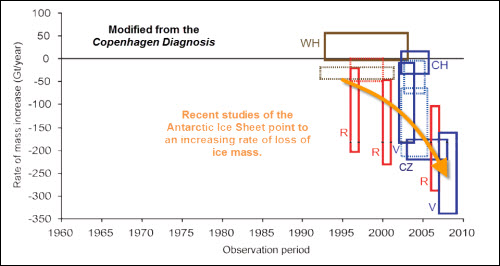
Figure 2: Estimates of Total Antarctic Land Ice Changes and approximate sea level contributions using many different measurement techniques. Adapted from The Copenhagen Diagnosis. (CH= Chen et al. 2006, WH= Wingham et al. 2006, R= Rignot et al. 2008b, CZ= Cazenave et al. 2009 and V=Velicogna 2009)
Estimates of recent changes in Antarctic land ice (Figure 2) range from losing 100 Gt/year to over 300 Gt/year. Because 360 Gt/year represents an annual sea level rise of 1 mm/year, recent estimates indicate a contribution of between 0.27 mm/year and 0.83 mm/year coming from Antarctica. There is of course uncertainty in the estimations methods but multiple different types of measurement techniques (explained here) all show the same thing, Antarctica is losing land ice as a whole, and these losses are accelerating quickly.
NOTE: This post is the Basic Version (written by Robert Way) of the skeptic argument "Antarctica is gaining ice". This post means we now have basic rebuttals for all of the top ten skeptic arguments. More impressively, the prolific Skeptical Science authors have written basic rebuttals to 65 skeptic arguments in total. Go team!
Lastly, just a reminder that Robert Way has also written a comprehensive post on the measurement of land ice loss from Antarctica which puts the recent study by Wu et al into perspective (anyone wishing to cite the Wu study is recommended to read Robert's post first).


 0
0  0
0






Comments