



 Arguments







Tom Harris' Carleton University Climate Misinformation Class
Posted on 10 May 2012 by dana1981
A few months ago, the Canadian Committee for the Advancement of Scientific Skepticism (CASS) issued a report regarding a slew of climate misinformation being taught at Carleton University in Ottawa, Canada by Tom Harris. Somehow Harris, who is an engineer and communications specialist with zero climate research experience, and is the Executive Director of the Heartland Institute-funded International Climate Science Coalition, was put in the position to teach a class on climate and Earth science at Carleton University. More recently, Harris has taken to denouncing what he terms "climatism," which appears to be a disparaging synonym for "climate science." How an anti-climate science engineer was made lecturer of a climate science class at Carleton University is something of a mystery, and a poor decision by the university.
The CASS report followed the growing trend of climate misinformation debunkings using the Skeptical Science database. In this post we will examine just a few of the myths identified by CASS as regrettably being used by Harris to misinform Carleton University students.
Galactic Cherries
A popular climate myth, coming in at #21 on the list of most used climate myths, is that global warming is being caused by galactic cosmic rays. The reason this myth is so popular is that it's a relatively new hypothesis, and thus has only been investigated by climate researchers in recent years. However, the vast majority of studies on the subject have found little if any relationship between galactic cosmic rays and global temperatures.
That didn't stop Harris from exhibiting one of the 5 characteristics of scientific denialism to claim otherwise in his lectures - cherrypicking. As John Cook wrote two years ago in describing this denialism characteristic,
"[cherrypicking] involves selectively drawing on isolated papers that challenge the consensus to the neglect of the broader body of research..."
This is precisely how Harris taught his class, picking out the few scientific studies which seemed to indicate a relationship between cosmic rays and global temperatures, and completely neglecting to mention the vast majority of studies finding little to no correlation between the two. More importantly, galactic cosmic ray flux on Earth has been flat on average over the past six decades, and therefore could not be responsible for a long-term global warming trend over that period. As Figure 1 shows, starting around 1925, the cosmic ray increase lagged behind the temperature increase, and temperatures continued to rise after 1970 while cosmic ray flux did not.
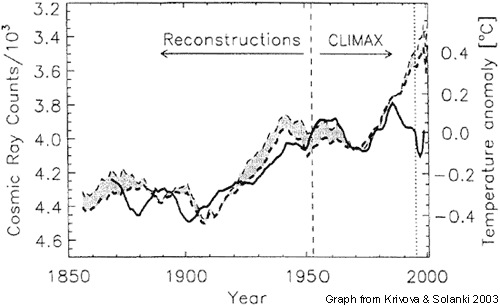
Figure 1: Reconstructed cosmic radiation (solid line before 1952) and directly observed cosmic radiation (solid line after 1952) compared to global temperature (dotted line). All curves have been smoothed by an 11 year running mean (Krivova 2003).
Additionally, there was a record high cosmic ray flux observed in 2009 (Figure 2). The hypothesis espoused by Harris claims that cosmic rays are supposed to cause cooling by increasing cloud cover, yet 2009 was one of the hottest years on record.
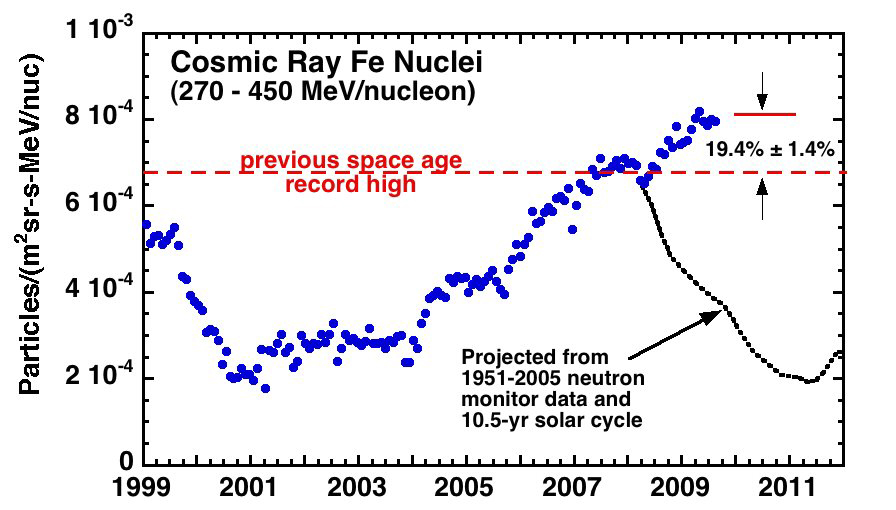
Figure 2: Record cosmic ray flux observed in 2009 by the Advanced Composition Explorer (NASA)
Harris chose simply not to teach these inconvenient facts to his students, instead only presenting the cherrypicked bits of information which seemed to support the case he wanted to present them.
Downplaying the Human Influence on Climate
Along similar lines as his cosmic ray cherrypick, Harris decided to toss physics aside and claim that human effects on the climate are too small to measure.
"Until we understand natural cycles of climate without humans, it’s very very tough to tease out what affect humans are having because it’s much smaller. It’s not the big carrier wave that nature is doing anyways, it’s a smaller affect on top of that...There isn’t a good correlation between temperatures and CO2 over the record."
This myth fails on two levels. First, as Richard Alley has discussed, CO2 has historically been the principle control knob for the Earth's temperature, and the current human influence on the climate involves a rapid increase in the amount of CO2 and other greenhouse gases in the atmosphere. Second, many different studies have shown that the human influence on global temperatures has dominated the natural influence over the past century, especially over the past half-century (Figure 3). Once again, Harris neglects to mention the vast body of scientific research and literature which contradicts the assertions he makes in his lectures.
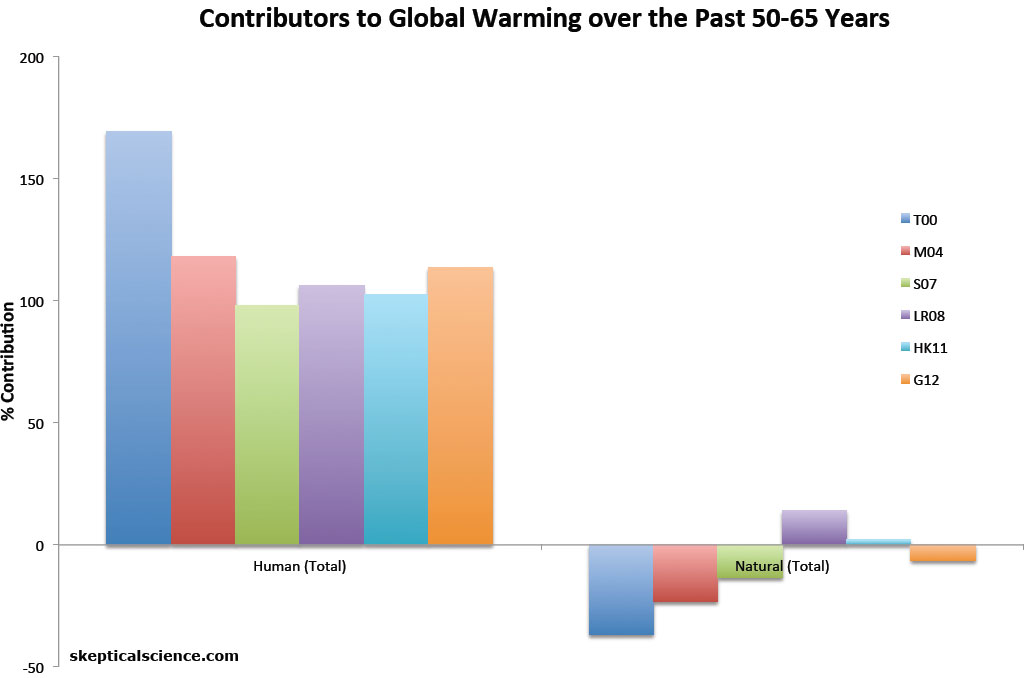
Figure 3: Net human and natural percent contributions to the observed global surface warming over the past 50-65 years according to Tett et al. 2000 (T00, dark blue), Meehl et al. 2004 (M04, red), Stone et al. 2007 (S07, green), Lean and Rind 2008 (LR08, purple), Huber and Knutti 2011 (HK11, light blue), and Gillett et al. 2012 (G12, orange).
Denying the CO2 Control Knob Again
CASS caught Harris downplaying the influence of CO2 on climate once again, repeating the myth that water vapor is the most important greenhouse gas.
"[the] most important greenhouse gas is water vapour...."
Harris of course neglects to mention that the amount of water vapor in the atmosphere is dictated by the temperature of the atmosphere - water vapor is a feedback, not a forcing. Thus something else has to initiate global warming before water vapor can kick in and amplify it. This inconvenient fact makes it very difficult to argue that water vapor is "the most important" greenhouse gas.
Indeed, as Lacis et al. (2010) noted in a paper titled Atmospheric CO2: Principal Control Knob Governing Earth's Temperature (emphasis added),
"Ample physical evidence shows that carbon dioxide (CO2) is the single most important climate-relevant greenhouse gas in Earth’s atmosphere. This is because CO2, like ozone, N2O, CH4, and chlorofluorocarbons, does not condense and precipitate from the atmosphere at current climate temperatures, whereas water vapor can and does...Without the radiative forcing supplied by CO2 and the other noncondensing greenhouse gases, the terrestrial greenhouse would collapse, plunging the global climate into an icebound Earth state."
Once again, Harris failed to accurately portray the body of scientific research and evidence, which contradicts the information he taught his students.
CO2 is a Pollutant
Harris also decided to delve into the realm of laws and policy, repeatedly claiming that CO2 is not a pollutant.
"Carbon dioxide of course is a greenhouse gas, but it is not a pollutant. it’s invisible, odourless, it’s essential to plant photosynthesis...It’s not a pollutant and it’s probably a benefit....The debate of course is not whether it’s a pollutant – because it’s not a pollutant. Carbon footprint is not a pollution..."
In fact, CASS documents Harris claiming that CO2 is not a pollutant at least four times, showing two additional videos in which it is again claimed that CO2 is not a pollutant, and also twice claiming that another greenhouse gas - nitrous oxide - is not a pollutant.
Why, in a class entitled "Climate Change: An Earth Sciences Perspective", is Harris so focused on the legal and policy issue of the definition of a pollutant? As it so happens, CO2 and other greenhouse gases are indeed pollutants, at least based on the U.S. Clean Air Act. The U.S. Environmental Protection Agency correctly determined that greenhouse gases meet the definition of air pollutants because they pose a threat to public health and welfare through climate change, and Canadian scientific organizations certainly concur with this conclusion. However, the definition of this term is primarily a legal question, and thus it is puzzling why Harris placed so much emphasis on the issue in a climate and Earth science class.
It's also worth noting that while we often hear this argument from climate denialists that CO2 isn't a pollutant because it's tasteless and odorless, human sensory perceptions generally have little to do with whether a substance is is deemed a pollutant. As noted above, pollutants are characterized by the threat they pose to public health and welfare, not based on whether they're ugly or stinky.
Denying Settled Science
In his lectures, Harris even goes as far as to deny some of the most settled aspects of climate science.
"...the majority of the rise of CO2 has nothing to do with humans....One of the things I find astounding about this whole climate debate is that some of the most basic tenets – you know, the idea that CO2 rise is mainly caused by humans, the idea that temperature rise is definite, its occurring, - many of these things are either not true or are simply unknown, or highly debatable."
Of course we know for a fact that the planet is warming, and similarly there simply is no question that the CO2 increase is due to human emissions. The easiest way to prove this is through a simple accounting approach (i.e. see Cawley 2011) - human emissions are roughly twice as large as the increase in atmospheric CO2 (most of the rest is absorbed by the oceans, which leads to ocean acidification). Harris disputes this with yet another cherrypick:
"I’m getting emails now from scientists, one in particular from Poland, who just authored a paper with a guy from Norway, very leading scientists on CO2 studies, who say that they’ve shown in fact the majority of the rise of CO2 has nothing to do with humans."
Once again Harris rejects the body of scientific evidence in favor of one paper which somebody emailed him about, and apparently expects his students to exhibit the same lack of skepticism.
Climate Denial 101
We have only touched on a few of the many climate myths identified in Harris' lectures by CASS, who in fact documented over 100 such myths in their report. Tamino also takes Harris to task for his minsinformation regarding warming in the United States in a recent Open Mind post.
Harris' Carleton University course was clearly less of a climate and Earth science class and more of a climate cherrypicking denial class, teaching students how to ignore the vast body of scientific evidence and only consider the few bits of information which appear to support one's pre-determined conclusion. However, such denial is entirely anti-science, and this behavior should certainly not be taught in a university classroom. Hopefully Carelton University will learn from this error and disservice to their students.









- How is it that you have no qualification to teach such a course, yet you object to a critique by people you regard as untrained?
- Can you provide names for the people you refer to who are unethical and for those who are the untrained?
- Do you regard the teaching of such a university course by an unqualified person to be ethical?
- Who do you (an unqualified person) regard as sufficiently well trained to assess the accuracy of the information you gave to your students?
- Does your association with the Heartland Institute create a conflict of interest when teaching?
- Was the information you gave your students in accord with current, published, peer-reviewed science, or did it run counter to the mainstream?
- Who assigned student grades following the course?
Just askin', you unnerstand.TC: Offensive comment snipped.
[DB] Please note that posting comments here at SkS is a privilege, not a right. This privilege can and will be rescinded if the posting individual continues to treat adherence to the Comments Policy as optional, rather than the mandatory condition of participating in this online forum.
Moderating this site is a tiresome chore, particularly when commentators intentionally submit offensive comments. We really appreciate people's cooperation in abiding by the Comments Policy, which is largely responsible for the quality of this site.
Finally, please understand that moderation policies are not open for discussion.
Please take the time to review the policy and ensure future comments are in full compliance with it. Thanks for your understanding and compliance in this matter.
There is another exact copy saved of the EPA Endangerment and Causing or Contributing Findings for Greenhouse Gases under Section 202(a) of the Clean Air Act document here:
http://schuhlaw.com/endangerment.html
It appears that the EPA does not provide this outline anymore. I hope this helps you out!
I think the best way to understand how ridiculous and dishonest the attack on my Carleton course above is is to watch my TV interview on the topic:
https://www.youtube.com/watch?v=Zeb5XWjSKlA
Case closed.
Tom Harris, your "case closed" video again fails completely to show any case of mistaken argument by your accusers. Rather, you resort yet again to the ad hominen argument that because your accusers are biologists, ergo they must be wrong. This in a news report that talks of "the gospel of global warming", which repeatedly shows banners of "Green & Mean", "Enviro-fanatic crusade", and "Greenie Smear Job". You are not responsible for the actions of the news program. However, that you draw attention to the video rather than apologize for involvement in a program which is clearly a tawdry smear job, rife with misrepresentations and logical errors is damning to your case. That your involvement consists merely in attempts to laugh of the accusations, and to damn by argumentum ad hominen suggests that (as above) you have nothing substantial to say in your defense.
Perhaps it is case closed afterall, for it is hard to see either your case or your reputation recovering should that video become widely known.
Most of the attacks against the course were not worthy of anything more than laughter. The video has a fair number of hits (2410). Will you help it "become widely known?" Hope so.
Here is is agin:
https://www.youtube.com/watch?v=Zeb5XWjSKlA
[PS] Then perhaps you would care to supply some actual substance with references as to why you think the attacks were laughable. This site is to discuss science. Participation depends on adherence to the comments policy.
It turns out that Scholar's and Rogues has an excellent series dissecting Tom Harris's prevarications and hypocrissies. So far we have:
Tom Harris – hypocritical peddler of deceitful climate change editorials
Tom Harris’ recent commentaries rife with errors and illogic
Tom Harris places absurd limits on scientific truths and elevates ignorance to equal knowledge
Tom Harris distorts the maturity of global warming science and imagines expertise where little exists
Tom Harris’ commentaries intended to impede, not advance, public understanding of climate science
The series has one more post to go, and is written by Brian Angliss. Tom Harris makes an appearence on comments.
Tom wrote a letter to the editor of the local paper where I live. It was an anti Earth day piece. He made secveal common denialist points. I wrote a rebuttal refuting each point he made (very easy) but only about half of my short letter made it into the paper. It was the Vancouver Province.
Newspapers are biased: it's hard not to be when all human relations is tribal.
Saying that a well worded short letter to the editor is hardly ever published because it can't be easily edited: hence the success of online forums and the associated troll phenomenon! Saying that well worded short letters than can't be easily edited into non-meaningful blather have real bite but only over time.. go democracy!
Vancouver Province is definetly biased against climate science. I was mildly suprised to see my letter made it in at all.
Mr. Tom Harris had a stint at Carleton University after which MacLeans published an article called:
“Professor criticized for course denying climate change”
Tom Harris is not a professor and never has been one. MacLeans should publish a disclaimer to inform readers of this egregious mistake, since only highly educated academics with PhD’s deserve this title, not Mr. Harris (who has an MA in Engineering).
His expertise in anthropogenic climate change - none.
Mr. Tom Harris lectured for a short time at Carleton University before he was unceremoniously removed for teaching his anti-anthropogenic climate change rhetoric. MacLeans also doesn’t mention that Mr. Tom Harris and several organizations he has been affiliated with, have been funded by fossil fuel industries…clearly a conflict of interests.
For MacLeans to call Mr. Harris a professor is a travesty. A professor has the highest educational rank at universities and research institutions. They are experts in their areas of expertise and are accomplished and recognized academics. They are scholars with doctorate degrees (typically Ph.D. degrees) who teach in universities. They conduct original research and teach grads and undergrads in areas of their expertise. They publish advanced original research in peer reviewed journals in their fields. A professor may also serve as a public intellectual, offering opinions to media and in other forums on current issues and other complex matters that require expert illumination, which Mr. Harris endeavours to do but fails miserably at, owing to his lack of education on the subject and financial interests in the fossil fuel industry. After much work, a professor may become tenured which allows him or her academic freedom. It is beneficial for society and academy in the long run if scholars are at liberty to examine, hold, and advance controversial views without fear of dismissal, however it must be emphasized that only tenured professors are afforded this freedom since they have the education, peer reviewed publications, extensive experience and overall knowledge required to intellectually select and teach such materials.
Mr. Harris has never put in the several years of education required to become a professor. He has never put in the hard work and time required for research or writing advanced scholarly studies that are published in peer reviewed journals. Mr. Tom Harris opted to teach controversial ideas, without the required education, peer reviewed publications, experience or overall knowledge. Doing so is allowed only to tenured professors for reasons already discussed.
[PS] Note that in North America, "professor" just means any university teacher, quite different to usage in British/Australasian unis.
Moderator:
No, I'd go with Terry11's statement that Harris was never a professor. Canada may differ from the U.S. - in Canada, the title "professor" is usually reserved for people that have been hired as full-time employees of the university, and generally into tenure-track positions. There are usually three stages:
Outside of the tenure-track system, you can get sessional lecturers. They can be hired as full-time staff (usually in the form of a sabbatical replacement), or on a per-course basis. The expectation is teaching, not research. Young academics may get stuck in the sessional loop for a few years, waiting for tenure-track positions to open up - and can't advance their research careers due to the teaching demands, which makes them less competitive compared to fresh meat recent PhD graduates.
Harris was a sessional lecturer, replacing Tim Patterson (who was a professor).
Bob Loblaw @42, Harris is referred to as a professor in the rate your professor website, and in the Canadian magazine, MacLean's. I would say, therefore, it is quite open under Canadian usage to refer to him as such. That is, referring to Professor Harris is not an error. Neither, however, is it mandatory under Canadian usage, given that the CASS report does not directly refer to him as such (although it does contain a quotation referring to him as a professor).
To the moderator: The link to the CASS report in the first sentence of the OP is now dead. The report can currently be found here:
http://junkscience.com/wp-content/uploads/2012/02/cassreportclimatechangedenialintheclassroom.pdf
Tom Curtis:
It may be common in colloquial usage, but the definitions I use are typical of life in academia in Canada - albeit based on my own personal knowledge from 20 years ago when I was active in the system.
If you look at the job postings linked at the Canadian Association of University Teachers web page, you'll see that tenure-track or tenure-stream positions mention "professor" (usually assistant) or "faculty", while other postings may mention "instructor" or "lecturer" positions. I didn't read every ad, but I was hard-pressed to find one that used "professor" that wasn't tenure-track.
In the department I was in, sessionals and instructors did not participate in the department's faculty meetings, and did not have any of the obligations of committee work, student supervision, etc. that were expected of "professors".
In the USA many college level teachers are part-timers called adjunct faculty. (I am adjunct at a local community college, adjuncts are also common at local 4 year colleges). Adjuncts are at the bottom of the feeding scale at colleges. It is not unusual for more than 25% of the classes to be taught by adjuncts. All the students call me professor and I doubt that they know who is adjunct and who is full time. Harris was probably hired as an adjunct professor. The system is very exploitative, adjuncts can only support themselves if they have an alternate full time jos (I teach at a local high school). I know several people who are trying to survive on adjunct pay and it is very much a struggle for them.
...with all due respect to the moderator,
after I postEd a comment regarding Tom Harris being incorrectly labelled as a "professor", the moderator posted underneath that a professor "just means any university teacher". This is absolutely not true. There are several ranks regarding the positions teachers hold in Canadian universities and "professor" is the highest. The same can be said for those in the U.S. Professors have worked hard to deserve this rank and the rank of professor acknowledges that fact. This known fact can easily found by a simple google search for those who aren't sure. Here are just two from Wikipedia.
https://en.m.wikipedia.org/wiki/Academic_ranks_in_Canada
https://en.m.wikipedia.org/wiki/Academic_ranks_in_the_United_States
[PS] Fixed link. Please learn to do this yourself with link tool in the comment editor. Also note other comments on this subject.
Michael:
That seems to illustrate another difference in terminology between Canada and the U.S. In Canada, the label "adjunct professor" is typically applied to people with full-time jobs in research elsewhere, who establish a collaboration with a department at a university - often with one or two individual "real" professors in that department. They share research projects, participate in graduate student supervision, perhaps grant applications, etc. An adjunct professor rarely teaches anything, and I'm pretty sure they don't get paid anything.
To become an adjunct professor, one must have a sponsor within the department who will support the bid, and the department (and maybe the Faculty or the Research office) will review the application to see if it is in the interest of the university. The appointment may be term-limited, in which case you have to reconsider after a few years. At least, that is the way it was when I was a lowly assistant professor 25 years ago.
It is remotely possible that Tom Harris might have been an adjunct at one time, but he is not now on Carleton U's Dept. of Earth Science list of adjuncts. Tim Patterson is still included on their list of faculty members. [If Tom Harris was an adjunct, all I can say is "shame on my alma mater".)
Wandering around over there, I notice that they also have a list of "contract instructors". The word "professor" appears twice on that page: in the link to the "Adjunct Professors" page, and a link to "Distinguished Research Professor". They certainly don't seem to advertise the possibility that contract instructors are professors of any kind.
Terry11:
Inserting links is a bit counter-intuitive here. Although there is a nice little chain link on the "Insert" tab, nowhere does it explain that you have to select some text first before the chain icon becomes active. The steps are:
Tom Curtis:
Regarding Tom Harris being listed as a prof on the "rate your professor" website...anyone can add a name as a professor on that site and then rate them. It is very possible that a student was mistaken about Tom Harris' ranking at Carleton Uinversity and then added him as a prof. Other students would follow suit and rate him also. Tom Harris himself said he was a sessional lecturer. To end all arguments on this subject, Mr. Harris isn't academically qualified to be a professor...not even close.
Bob Loblaw:
Thank you for the info regarding links Bob.
Regarding Mr. Tom Harris' position at Carleton U, you can rest assured that your alma mater did not at any time have him teaching as a professor. He himself stated that he was a "sessional lecturer". He isn't anywhere close to having the academic qualifications required to be a professor which I mentioned in an earlier post. He has an MA in engineering. The funny thing about Tom is, he doesn't correct anyone who accidently gives him a title that he is not entitled to, including the title "Dr.". His only experience lecturing at a university was that short stint at Carleton, which he was unceremoniously removed from. Some of the climate denier groups have been guilty of portraying Tom as something more than he really is, which may be where some of the confusion stems from.