



 Arguments







Lean and Rind Estimate Human and Natural Global Warming
Posted on 11 January 2012 by dana1981, KR
In a paper a few years back, Lean and Rind (2008) performed a very similar study to one we recently examined from Foster and Rahmstorf (2011), filtering out short-term effects on global temperature to tease out the human and natural contributions to global warming. To accomplish this, the scientists used a multiple linear regression (MLR) analysis to determine the contributions of the El Niño Southern Oscillation (ENSO), solar activity, and anthropogenic influences on the measured global surface temperature changes.
Their key finding - the contribution of each effect to the observed global surface warming trends over the four periods in question - is shown in Figure 1.
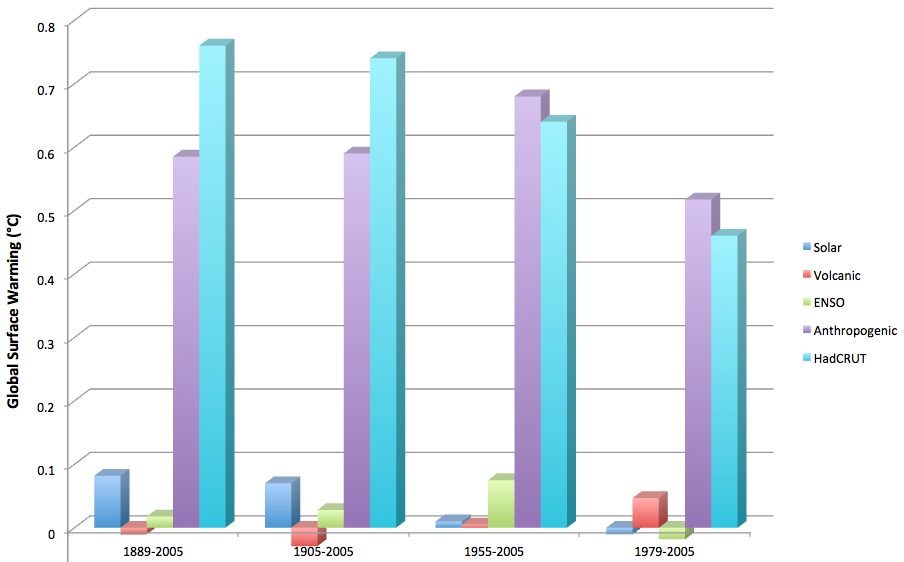
Figure 1: Contributions of solar activity (dark blue), volcanic activity (red), ENSO (green), and anthropogenic effects (purple) to global surface warming (HadCRUT observations shown in light blue), according to Lean and Rind (2008).
Multiple Linear Regression Background
MLR (see here and here for information and examples) is a technique of analyzing the contributions of multiple independent influences upon a dependent variable (in this case, temperature). "Independent" means that the contributors are not correlated, that (for example) the influence of ENSO cannot be replicated by summing up solar and volcanic changes, because they have quite different variations over time. MLR gives an indication of the relative influence of various contributors over the temperature, and what happens to temperature when a contributor changes. Analyzing what is left over (the "residuals") after summing the various contributions shows whether the most significant contributions are being considered.
Any large trend or variation left in the regression residuals would indicate that other, uncorrelated, factors are in play. However, as both Lean and Rind (2008) and Foster and Rahmstorf (2011) have shown, once solar and volcanic influences, anthropogenic warming, and ENSO variations are accounted for, there is very little variation left.
Note that an MLR analysis with small residuals does not necessarily indicate causal relationships - but it does indicate that the causal factors for the temperature changes are quite well correlated with the indices used in the analysis.
Methods
While Foster and Rahmstorf limited their analysis to the past 32 years (since the start of the satellite temperature record), Lean and Rind performed their analysis over a range of timeframes: from 1889 to 2006, 1905 to 2005, 1955 to 2005, and 1979 to 2005.
Lean and Rind describe their methods thusly:
"Using the most recently available characterizations of ENSO, volcanic aerosols, solar irradiance and anthropogenic influences, we perform multiple linear regression analyses to decompose 118 years (11 complete solar cycles) of monthly mean surface temperature anomalies into four components. The decomposition is conducted for the global signals, and on a 5° x 5° latitude-longitude grid to determine the corresponding geographical patterns. We repeat the analysis for the NCEP and satellite epochs to establish that the approach is robust for datasets of different lengths, and we examine the evolution of decadal power in the natural influences to assess their projections onto each other as sources of error in prior results. Our results yield trends in the four individual global surface temperature components over the past 25, 50 and 100 years"
To evaluate the contribution of ENSO, Lean and Rind used the Multivariate ENSO Index (MEI), augmented with an index derived from Japan Meteorologial Agency sea surface temperatures. The effects of volcanic aerosols were estimated from data compiled by the NASA Goddard Institute for Space Studies (GISS), and solar irradiance was based primarily on sunspot data.
Results
Lean and Rind estimated the anthropogenic forcing based on the net effect of eight different components, including greenhouse gases, land use and snow albedo (reflectivity) changes, and tropospheric aerosols. The Lean and Rind reconstructed contributions to global temperature changes from each component is shown in Figure 2.
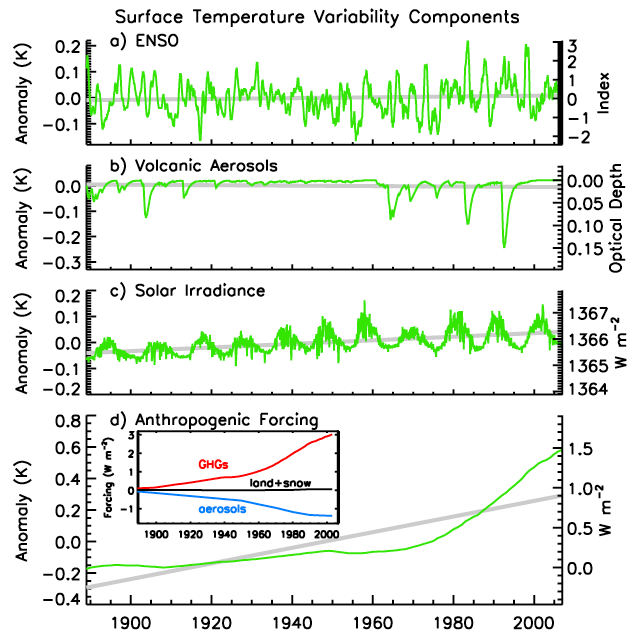
Figure 2: Lean and Rind reconstructions of the contributions to monthly mean global surface temperatures by individual natural and anthropogenic influences. The right hand axes give the native scales of each influence, and the left hand axes give the corresponding temperature change determined from the multiple regression analysis. The grey lines are trends for the whole interval. The inset in Figure 2d shows the individual greenhouse gases, tropospheric aerosols and the land surface plus snow albedo components that combine to give the net anthropogenic forcing.
Table 1 shows the resulting contributions to the global surface temperature changes which are illustrated graphically in Figure 1 [Note: click on Table 1 for a larger version].
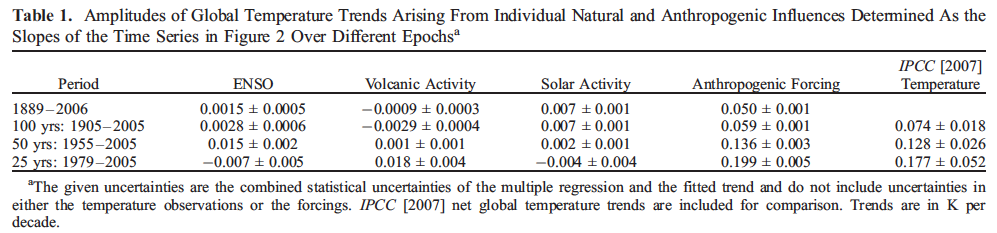
Although the timeframes examined in this study and by Foster and Rahmstorf are somewhat different (the former ending in 2005, the latter ending in 2010), the estimated contributions from the various factors since 1979 are similar. Foster and Rahmstorf estimated a -0.015°C per decade contribution from ENSO, 0.020°C per decade from volcanoes, and -0.019°C per decade from solar activity (compared to -0.007, 0.018, and -0.004°C per decade, respectively, in the Lean and Rind analysis). The solar and ENSO cooling contributions have increased as a response to the extended solar minimum between 2005 and 2010, and the strong La Niña of 2008, respectively.
We can also convert the values in Table 1 to percentages, to estimate the contributions of each effect to the observed warming (Table 2).
Table 2: Percent contribution to global surface warming from each effect assessed in Lean and Rind (2008)
| Period | Warming | Anthropogenic | ENSO | Volcanic | Solar |
| 1889-2006 | 0.76°C | 78% | 2.3% | -1.4% | 11% |
| 1905-2005 | 0.74°C | 80% | 3.8% | -3.9% | 9.5% |
| 1955-2005 | 0.64°C | 106% | 12% | 0.8% | 1.6% |
| 1979-2005 | 0.48°C | 112% | -4.0% | 10% | -2.3% |
Conclusion - Humans are Driving Global Warming
The fundamental conclusion in Lean and Rind's paper is that the observed global warming over the past century, and especially over the past 25-50 years, is predominantly human-caused:
"None of the natural processes can account for the overall warming trend in global surface temperatures. In the 100 years from 1905 to 2005, the temperature trends produce by all three natural influences are at least an order of magnitude smaller than the observed surface temperature trend reported by IPCC [2007]. According to this analysis, solar forcing contributed negligible long-term warming in the past 25 years and 10% of the warming in the past 100 years"
One key aspect of this type of study is that it makes no assumptions about various solar effects. Any solar effect (either direct or indirect) which is correlated to solar activity (i.e. solar irradiance, solar magnetic field [and thus galactic cosmic rays], ultraviolet [UV] radiation, etc.) is accounted for in the linear regression. Both Lean and Rind and Foster and Rahmstorf found that solar activity has played a very small role in the observed global warming. Bottom line - it's not the sun.
Similar to the remaining warming trend in Foster and Rahmstorf (2011) after the short-term noise was filtered out, Lean and Rind found a very steady human-caused global warming trend from 1979 to 2005 (Figure 2d, green line), having contributed to more warming than has been observed over that period. In short, the recent global warming is predominantly human-caused.
Note: the Lean and Rind results have been incorporated into the rebuttals to It's the sun (Intermediate and Advanced), A drop in volcanic activity caused warming, and It's El Niño.


 0
0  0
0






Comments