What evidence is there for the hockey stick?
The skeptic argument...
Hockey stick is broken
“In 2003 Professor McKitrick teamed with a Canadian engineer, Steve McIntyre, in attempting to replicate the chart and finally debunked it as statistical nonsense. They revealed how the chart was derived from "collation errors, unjustified truncation or extrapolation of source data, obsolete data, incorrect principal component calculations, geographical mislocations and other serious defects" -- substantially affecting the temperature index.” (John McLaughlin)
What the science says...
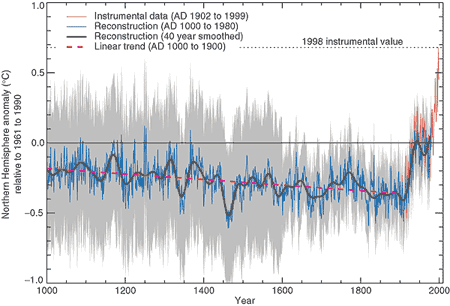
The "hockey stick" describes a reconstruction of past temperature over the past 1000 to 2000 years using tree-rings, ice cores, coral and other records that act as proxies for temperature (Mann 1999). The reconstruction found that global temperature gradually cooled over the last 1000 years with a sharp upturn in the 20th Century. The principal result from the hockey stick is that global temperatures over the last few decades are the warmest in the last 1000 years.

Figure 1: Northern Hemisphere temperature changes estimated from various proxy records shown in blue (Mann 1999). Instrumental data shown in red. Note the large uncertainty (grey area) as you go further back in time.
A critique of the hockey stick was published in 2004 (McIntyre 2004), claiming the hockey stick shape was the inevitable result of the statistical method used (principal components analysis). They also claimed temperatures over the 15th Century were derived from one bristlecone pine proxy record. They concluded that the hockey stick shape was not statistically significant.
An independent assessment of Mann's hockey stick was conducted by the National Center for Atmospheric Research (Wahl 2007). They reconstructed temperatures employing a variety of statistical techniques (with and without principal components analysis). Their results found slightly different temperatures in the early 15th Century. However, they confirmed the principal results of the original hockey stick - that the warming trend and temperatures over the last few decades are unprecedented over at least the last 600 years.

Figure 2: Original hockey stick graph (blue - MBH1998) compared to Wahl & Ammann reconstruction (red). Instrumental record in black (Wahl 2007).
While many continue to fixate on Mann's early work on proxy records, the science of paleoclimatology has moved on. Since 1999, there have been many independent reconstructions of past temperatures, using a variety of proxy data and a number of different methodologies. All find the same result - that the last few decades are the hottest in the last 500 to 2000 years (depending on how far back the reconstruction goes). What are some of the proxies that are used to determine past temperature?
Changes in surface temperature send thermal waves underground, cooling or warming the subterranean rock. To track these changes, underground temperature measurements were examined from over 350 bore holes in North America, Europe, Southern Africa and Australia (Huang 2000). Borehole reconstructions aren't able to give short term variation, yielding only century-scale trends. What they find is that the 20th century is the warmest of the past five centuries with the strongest warming trend in 500 years.

Figure 3: Global surface temperature change over the last five centuries from boreholes (thick red line). Shading represents uncertainty. Blue line is a five year running average of HadCRUT global surface air temperature (Huang 2000).
Stalagmites (or speleothems) are formed from groundwater within underground caverns. As they're annually banded, the thickness of the layers can be used as climate proxies. A reconstruction of Northern Hemisphere temperature from stalagmites shows that while the uncertainty range (grey area) is significant, the temperature in the latter 20th Century exceeds the maximum estimate over the past 500 years (Smith 2006).

Figure 4: Northern Hemisphere annual temperature reconstruction from speleothem reconstructions shown with 2 standard error (shaded area) (Smith 2006).
Historical records of glacier length can be used as a proxy for temperature. As the number of monitored glaciers diminishes in the past, the uncertainty grows accordingly. Nevertheless, temperatures in recent decades exceed the uncertainty range over the past 400 years (Oerlemans 2005).

Figure 5: Global mean temperature calculated form glaciers. The red vertical lines indicate uncertainty.
Of course, these examples only go back around 500 years - this doesn't even cover the Medieval Warm Period. When you combine all the various proxies, including ice cores, coral, lake sediments, glaciers, boreholes & stalagmites, it's possible to reconstruct Northern Hemisphere temperatures without tree-ring proxies going back 1,300 years (Mann 2008). The result is that temperatures in recent decades exceed the maximum proxy estimate (including uncertainty range) for the past 1,300 years. When you include tree-ring data, the same result holds for the past 1,700 years.

Figure 6: Composite Northern Hemisphere land and land plus ocean temperature reconstructions and estimated 95% confidence intervals. Shown for comparison are published Northern Hemisphere reconstructions (Mann 2008).
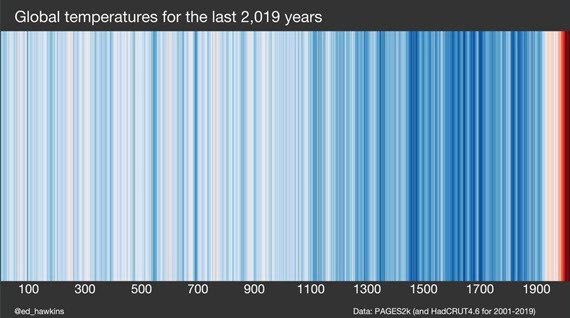
Paleoclimatology draws upon a range of proxies and methodologies to calculate past temperatures. This allows independent confirmation of the basic hockey stick result: that the past few decades are the hottest in the past 1,300 years.
Last updated on 20 July 2010 by John Cook.

Arguments


The Ljungqvist data directly contradicts you, see the New temperature reconstruction thread. Current temperatures are higher than anything in the last millenium.
From your second link, Oppo 2009, the abstract states - "Reconstructed SST was, however, within error of modern values from about ad 1000 to ad 1250, towards the end of the Medieval Warm Period. SSTs during the Little Ice Age (approximately ad 1550–1850) were variable, and approx 0.5 to 1 °C colder than modern values during the coldest intervals." (emphasis added)
The Greenland GISP2 data is interesting, and very limited. See the entire discussion at Crux of a Core, multiple parts. Primarily, that is not a global record.
Please - read the works you link to. Currently you appear to just be making stuff up.
But please note that, as Rob Painting pointed out, the MWP was not uniform spatially:
Portions of the world were fairly warm during the MWP, portions were much cooler. The global temperature was not as warm as present, and you are cherry-picking spot measurements.
All proxies could be considered cherry-picks, as we do not have a uniform global coverage.
I do not know how you could possible make that statment recarding the Lundqvist paper, as it clearly states, "The highest average temperatures in the reconstruction are encountered in the mid to late tenth century," and "The temperature of the last two decades, however, is possibly higher than during any previous time in the past two millennia, although this is only seen in the instrumental temperature data and not in
the multi-proxy reconstruction itself."
Portions of the globe have cooled during the twentieth century, but that does not mean that global temperatures have decreased.
In the Ljungqvist paper he is speaking about the proxies, which don't extend directly to the present. So your argument about the last few decades amounts to claiming that proxy and instrumental data cannot be joined, despite overlap periods where they can be calibrated. I don't believe that's even remotely justifiable.
Also note that, as stated in Ljungqvist 2010: "Our temperature reconstruction agrees well with the reconstructions by Moberg et al. (2005) and Mann et al. (2008) with regard to the amplitude of the variability as well as the timing of warm and cold periods, except for the period c. ad 300–800, despite significant differences in both data coverage and methodology."
So - you're trying to use Ljungqvist, who agrees with Mann and Moberg, to argue against Mann and Moberg regarding the MWP??? That argument simply doesn't hold up.
The Lundqvist paper covers the period up to 1999, so it includes the warmest year in the instrument record.
You need to read the paper (and your quotes) carefully. You are stating that timing and variability agree. However, the paper shows similar proxy temperatures at both the end of the 10th and 20th centuries.
You also seem to contradict yourself in your first sentence about the Lundqvist paper to which I presented.
"The Lundqvist paper covers the period up to 1999, so it includes the warmest year in the instrument record."
In some instrumental data sets you mean. And it doesn't however include the warmest decade (the last ten years). Also, the paper states, "The proxy reconstruction itself does not show such an unprecedented warming but we must consider that only a few records used in the reconstruction extend into the 1990s." The proxy data for the last decades of the study are weaker than the for the rest of it. The instrumental data trumps the proxy data for that time frame.
Again, they concluded (with qualifications) that the decades since 1990 seem to be warmer than at any time during the last 2,000 years for the NH. The "highest temperature in the reconstruction" does not mean the highest temperature in the last 2,000 years. They are quite clear about that.
No I didn't Jonathon (@ 95). I've highlighted how easy it is for those that wish to misrepresent the science to do so by selecting individual proxies that support a particular preconceived interpretation.
Happily proper scientists continue to make considerable efforts to include as many verified proxies as possible to maximise the spatial coverage to allow assessment of at least hemispheric paleotemperature evolution on the millenial timescale. I'm sure you'd agree that it would be dumb to try to infer something about global or hemispheric temperatures from a single site in the Sargasso sea, particulalry when we have some rather good information that this is rather senstive to changes in the Meridonal overturning circulation that have no necessary relationship to global scale temperatures....
Oh, wait, if you go by Mann 2010 you're right. That teeny tiny little sliver of western South America has cooled fractionally, along with ocean off the coast of Antarctica. You're right. Any proxy would be a cherry pick if it doesn't include those two critical spots on the globe.
Over a longer time period, there are more areas.
http://journals.ametsoc.org/doi/pdf/10.1175/JCLI3709.1
However, I do not think anyone would use just the data from the southern U.S. to from the conclusion that the globe has cooled.
I echo your sentiments Chris about using a single site.
Divergence is a discrete phenomenon that causes some trees in some places to show slow growth due to non-temperature factors. But it is certainly not valid to claim that trees that don't show divergence (i.e. are not overtly impacted by those unknown factors) are sufficient for reconstructions "because we all know it has gotten warmer". The last part in quotes is ture, but the first part does not follow. It is equally possible that those faster growing trees are impacted positively by another unknown factor.
The crux of the problemn with Briffa 2000 is not divergence but inadequate numbers of cores.
Please follow this link. Note the date and time. Some of us prefer to live in the present, but to plan for the future, not just for ourselves but also for future generations.
I'm disgusted that you chose to defend McIntyre's vitriolic and hateful comments-- and now seem to be trying to use them as a reason or "in" to challenge the dendro plaeo records. It seems to me that you agree with his propaganda on this file? Have you applied, as your moniker suggests, skepticism, or just one-sided skepticism like Pielke et al. do? Surely you aware of the multiple, paleo hockey sticks out there?
From your paper (emphasis mine):
You did not look at the date and time did you? :) If you think it is OK for McIntyre liken paleo climate scientists to crack cocaine addicts, then by all means go ahead. You honestly think that it is perfectly OK for someone to use that kind of language in a scientific discussion. Got it.
Maybe you ought to direct your questions to Dr. Briffa, but I would caution you that you are operating under the dangerous assumption that the information that you have been fed by Mr. McIntyre is accurate.
Seriously. 'Crack cocaine'? For PROXY temperature values since 1988? You do realize that we have these things called thermometers, right?
"It is equally possible that those faster growing trees are impacted positively by another unknown factor."
Sounds a lot like "unknown unknowns" to me. You're arguing that these trees agree with the instrumental/proxy record both recently and farther into the past millennium, yet you think there's a 50/50 chance that the trees are measuring the wrong thing but accidentally coming out with the right result?
For that to be true, you need to believe two things: 1) that the trees measured past climate proxies well, yet broke down in the past 50 years, like the trees of the divergence problem. 2) that the trees which agree with the recent instrumental record have, within the last 50 years, picked up a new signal, not present in their palaeo records which drives their temperature record up very like the instrumental series.
Or you could simply agree that these trees are succeeding in picking up the recent temperature series as they did with pre-1950 temperatures. In that way, the trees agree with many other independent proxy records as well as instrumental temperatures. It's hardly 'equally probable', that the trees have these two suspiciously coincident unknowns.
It shows what you get if you take your information from McIntyre...
CB, is there a thermometer in Yamal? Briffa used the HadCrut grid cell which is not remotely similar to most local instrument measurements (mostly flat in the last part of the 20th century). Even for that grid cell temperature, there are other better-correlated series.
Skywatcher, "ancient" only because Briffa did not release his data for almost 10 years. A handful of trees matching up to a coarse grid cell is not a sign of agreement particularly when other series have a better match to local temperatures (not gridded) temperatures. My first two links in #91 both show that.
"Skywatcher, "ancient" only because Briffa did not release his data for almost 10 years"
SImply not true. You are, again, believing uncritically what Mr. McIntyre is feeding you. I could show you why you are wrong, but I would prefer that you be a true skeptic and discover the truth on this matter yourself.
I'm saddened by this Eric, I used to consider you one of the more informed and reasonable "skeptics", but your actions of late have soured that.
[DB] Sorry guys. Just fingered him & took action.
He is now claiming on his website that his posts are being deleted because we cannot refute his arguments. That is a lie. His arguments where considered fully and resoundingly rebutted previously on SkS as they also have on Science of Doom (where he has also been banned for repeated violation of comments policy).
I note that there is no posting permitted on his website. By his logic that lack of permission to post an argument means the argument cannot be refuted, his refusal to allow comments is sufficient proof that his arguments have been refuted.
Less facetiously, if anyone believes there is any credibility to Doug Cotton's arguments, by all means present them on an appropriate thread, and in compliance with the comments policy. I enjoy shooting sitting ducks.
It is possible that there are good reasons for decentred PCA to be the technique of choice for some types of analyses and that it has some virtues that I have so far failed to grasp, but I remain sceptical.
Is using a decentred PCA the norm in paleo reconstructions or was it just MBH98?
Decentered means are frequently used in Principle Component Analysis (PCA), and have been for a number of different analysis areas. See a quick look at Google Scholar. The various arguments I have seen about decentering have failed to show that use of decentered means invalidates MBH98, or even significantly changes the results. See Wahl 2007 as linked in the original post.
While McIntyre 2004 was able to generate some 'hockey-sticks' from red noise, analysis of the eigenvalues for those shows that McIntyre was looking at noise (low correlation, lots of fairly low value components), while the MBH98 data components have only a couple of very large eigenvalues. That's how you determine whether you are looking at actual correlations (MBH98) or just noise (McIntyre).
I will note that MBH98 was a pioneering paper in terms of the reconstructions - much work has followed on in both reconstruction techniques, additional and improved proxies, etc. See Mann 2007 for a partial review. All of the work supports the late 20th century being as warm or warmer than anything in the last 1200 years, and warming faster than anything we have data for.
There may well be statistical arguments for/against decentered means in this field, but again - none of them invalidate the multiply confirmed results.
---
What's really stunning (IMO) about this entire discussion is the 'skeptic' focus on a paper published over a decade ago, while a dozen later works using several different methods (with what should be refined techniques), are getting the same results.
It's the equivalent of someone in an active field of professional research criticizing what somebody did in grade school - even though all work done since then agrees...
I completely agree with your comment. That said, I'm still interested in the whole MM03 vs MBH debacle.
I can't find the original reference, I think it may be one of Tamino's vaporised posts, but here's the context from everyone's favourite website.
[DB] Links to the once-lost Tamino/Open Mind posts can be found in this post here:
http://www.skepticalscience.com/Open_Mind_Archive_Index.html
The post you seek is located here:
http://web.archive.org/web/20080911215131/http://tamino.wordpress.com/2008/08/10/open-thread-5-2/
The specific portion of the thread in question begins here:
http://web.archive.org/web/20080911215131/http://tamino.wordpress.com/2008/08/10/open-thread-5-2/#comment-21873
Principal Component Analysis.
Tristan - From that discussion: "It appears [Jolliffe] now discredits decentering, and he's entitled to his opinion. But the hockey stick remains when using centered PCA, and when using no PCA at all. The claim that it's nothing but "utterly bogus artifacts" is what's really bogus." - Tamino
For those who are interested in the subject, Tamino has a fairly extensive discussion of Principal Component Analysis (PCA) which is still on the intertubes here: Part 1 and Part 2
[DB] Tamino also deals with the PCA/non-PCA kerfluffle in this post at RealClimate:
http://www.realclimate.org/index.php/archives/2010/07/the-montford-delusion/
You guys are champs. Thanks a lot.
Current Link (broken):
http://www.ncdc.noaa.gov/paleo/pubs/
Suggested Link:
http://www.ncdc.noaa.gov/paleo/data.html
I used the Gergis image from RealClimate, and the Mann image from the SkS site, and there seems to be some interesting agreement periods. For example, the sharp drops in proxy temperatures around 1350 and 1460 are present in both records, as near as I could see.
From what I understand, sometimes the NH and SH temperatures will march together, and other times be out of phase. Perhaps SkS could discuss the two proxy records, comparing the temperature swings, written by someone knowledgeable of likely temperature swings over the last 1200 years.
The link for the 'NOAA Paleoclimatology Reconstructions Network' returns a 'forbidden' message.
The Tamino 'Not Alike' link also goes nowhere (not found).
There is an awesome new post on RealClimate about tree rings, soundly refuting McIntyre and other critics.