





Communicating climate science in plain English
Posted on 4 August 2010 by John Cook
A few weeks ago, I received an email from Australian astrophysicist Michael Ashley who had just read a post on Real Climate about the need to communicate climate science at different levels. He was particularly struck by one comment that proposed having a slider at the top of climate articles where the reader could select the technical level of the article. Michael suggested the Skeptical Science iPhone app could have a similar slider allowing people to choose the level of explanation. My initial reaction was horror at the sheer amount of work involved in such an endeavour. But over the next few weeks, the idea grew in my mind to the point where it became irresistable. I think I just got inceptioned!
So against my better judgement, I'm now planning to completely overhaul Skeptical Science. For all the skeptic arguments, there will now be three different levels for each rebuttal. I'm not sure what headings will be used for each level but it will be something like this:
- Easy: explaining the climate science in plain English, the way you'd explain it to someone in an elevator or at a pub. So the response needs to be short, simple, understandable to the average person
- Medium: this goes a little deeper, discusses the evidence in more detail, provides links to peer-reviewed papers without necessarily going into the nitty gritty of the methodologies or technical aspects of the science.
- Hard: this might contain detailed mathematics, equations, methodologies on how measurements are taken, the nitty gritty of data is processed, etc.
Currently, I'd rate all the current rebuttals at 'Medium' level. So the most important stage of this new system will be to parse all the existing rebuttals into shorter, simpler versions written in plain English. I already went through this process with a handful of skeptic arguments for the Irregular Climate podcast. It's been an interesting and learning experience, trying to boil several pages of dense content into a few paragraphs of plain English that you can read out aloud without sounding like a robot (well, at least I hope I don't sound like a robot). A good example of 'Medium' versus 'Easy' would be the blog post on 1998 cherry picking versus the boiled down podcast transcript.
I'd also like to include hard/advanced versions of each rebuttal. Websites that operate at this level are Tamino's Open Mind, Real Climate and Kelly O'Day's Climate Charts & Graphs. Kelly O'Day has already graciously agreed to adapt some of his blog posts into more technical rebuttals. I'm hoping some of the other more technical climate bloggers might also be willing to adapt their blog posts into rebuttals (hint, hint). Probably the closest thing to this level at Skeptical Science would be some of Peter Hogarth's posts, as Peter likes to delve into the technical aspects of how measurements are taken (which is understandable as that's what he does for a living). Often his blog posts read like a peer-reviewed review paper. However, I've been constantly holding him back, asking him to trim his text, remove the technobabble, keep it simple. Well, Peter, the leash is coming off :-)

How the tabs might look with the 3 level system.
Restructuring the database and reprogramming the website to include tabs (as shown above) is fairly straightforward. The iPhone app on the other hand is another matter. I asked Shine Technologies whether it would be possible to incorporate a slider system in the iPhone app and they said yes but create the data first. So first things first, I have to get to work on the content. Nevertheless, I couldn't resist doing a mock-up of how it might look on the iPhone (quick disclaimer: Shine Tech are the gurus at designing sexy iPhone interfaces):
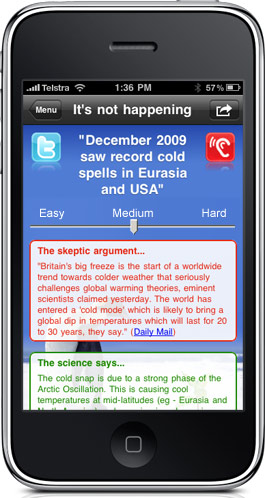
How I imagine the iPhone app would work is the Easy option would be selected by default. They can then slide up to Medium to get a bit more meat or if they're a glutton for punishment, continue onto the Hard level. If there's no Hard version, that option would be greyed out. Now a Skeptical Science iPad app doesn't exist (yet) but I couldn't resist doing a mock-up of how it might look here (a guy can dream):
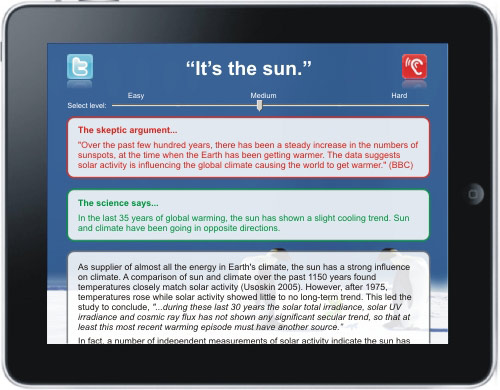
So I have two requests from Skeptical Science readers:
- Feedback on the slider system: I welcome suggestions on how this might work. Is there better terminology than "Easy/Medium/Hard"? I like the more whimsical "Plain English/Slightly Technical/Boffin Technobabble" but it's both too wordy for the iPhone and well, a bit silly. Perhaps "Basic/Intermediate/Advanced"? Thoughts on this and the 3 level system in general is welcome.
- Help write the different versions of the rebuttals: there are currently 119 skeptic rebuttals which need to be parsed into Easy and Hard versions. Other rebuttals of these same skeptic arguments exist on other blogs so if you're a blogger who has already written a simpler or more technical version and don't mind reposting on Skeptical Science, your contribution would be much appreciated (and credited, of course). Or if you'd like to help convert my rebuttals into simpler, plain English, your help is very welcome!
I know what most of you are thinking: "I'm not qualified to write about climate science". I've learned over the years that it's often the non-scientist who is best able to express climate science in a way that the average person can understand. No offense to any scientists reading this but sometimes you boffins have trouble boiling down your science into plain, simple terms (Kevin Judd is an exception to this rule). Making climate science accessible to the general public is of crucial importance these days so I urge you all, scientist and layperson, to consider contributing to this effort.
Currently, I'm programming a discussion forum for Skeptical Science authors. What will happen next is if anyone volunteers to help out, I'll grant you access to the forum where there'll be discussion on how to approach this whole process and coordinate our efforts. This will also be a place where we can post our attempts at plain English climate science and other authors can give feedback and suggestions, as well as discuss the general issues of climate science communication.
If you're interested in helping, please either post a comment below or directly email me.

Arguments


Given that the current rebuttals might be characterized as intermediate. What amount of information might the basic version entail?
I am starting to think you are not human. Do you sleep? :)
I could also imagine in a lot of cases people asking questions about the easy and medium versions of an argument and being told to view the hard version.
That said, John, I applaud your tireless efforts to make this site more and more useful in communicating and discussing science.
Snarkier version: "High School", "College", "Graduate School".
In terms of the tab parlance, something along the lines of:
1. Basic
2. Medium
3. In-Depth
The nomenclature used won't really matter, but the K.I.S.S. Principle (Keep It Simple [or you're] Stupid) applies to the tab labels as well (even or the In-Depth level tab). And readability on a small screen is paramount.
The impact of this will be immense.
You must sleep even less than me,
The Yooper
I'm not sure I'm as superhuman as you are, but I'd be happy to have a go at drafting a few "basic" articles. I don't know the science as in-depth, but maybe that's a good thing.
So I would vote for using it on the archived skeptic arguments, and using Basic/Intermediate/Advanced as the terminology.
Rather than worrying at this stage about the exact labels, it might help to set out in more detail the characteristics of each category. This would help us all to start thinking along the same lines and have a clearer idea of what is in your mind, rather than just our interpretation of your headings.
We will know better what to call each category when we have a clearer idea of what they look like.
For example, the first category might (only might, note! I have only spent a few moments on these scribbles.) be as follows:
- straightforward statement of the point. Two or three sentences at most, perhaps.
- general indication of where the evidence comes from, eg. from Antarctic boreholes.
- when this point was established, eg. CO2 greenhouse effect: demonstrated experimentally in mid 19th C.
The second category might:
- expand the basic statement,
- indicate the history of the point, how the argument developed,
- indicate the experimental history,
- indicate the counter arguments and work on addressing them,
-
The third category would then be a more thorough discussion, including the maths, the references to the key papers, etc.
... Sorry: being called away to something else now!
From a personal view the idea of splitting comments would likely cause those more knowledgeable and have a better understanding to not read and therefore answer questions or statements in the "lower divisions", which I find very valuable.
Naming the three categories must be done carefully, and is a subject worthy of the thought given by others above. You don't want your users to feel like "Dummies" when they go for the basic explanation.
I'd be very interested to take a crack at a few of the arguments. How exactly do I submit my proposed text? As a comment?
As to the user interface, I would suggest using three tabs instead of the slider. (A slider is more appropriate to a situation where there is a continuum of possible values. Since this particular situation is limited to three possible values, it seems like the wrong analogy.)
Early next week, I'll start a forum where all the authors can get together and first discuss the general approach, terminology, etc. Then I'm thinking the way authors submit proposed text is to first submit it as a new thread in the forum. That way, other authors can offer feedback/suggestions and the text can be honed before it gets 'officially published'.
But like any social media experiment, who knows how this will evolve - first step is get the forum going then see what happens.
This is an excellent idea. I'm doing a bit of blogging on climate science and trying to get things explained in everyday terms these days. As post #22 says, it's often very effective to use commonsense everyday context: analogy too can be extremely useful. The critical bit is to explain things accurately, so far as the most up-to-date science is concerned, without sounding patronising. I've worked on-and-off for some years in doing such interpretation in the Earth Sciences - especially hardrock geology - and I fully appreciate the size of the task you have set yourself from experience. I wish you all the best with it.
I've been so disturbed by the efforts of the politically-motivated anti-science opposition that I'm determined to move from geology to climate outreach as a career-change. Climate science - indeed, Mankind - needs all the help it can get in terms of improved public understanding.
Cheers - John
Personally I like the terms "basic", "intermediate" and "advanced" (or in-depth, advanced might sound too snotty) levels.
1) Basic-- a one or two liner. Didn't someone recently do that for you, or at least a few of the arguments?
2) Intermediate-- the current level of discussion as it appears on your web-site, maybe some of the jargon and more technical stuff taken out.
3) Advanced-- something you would expect to read in a journal; could also include a list of references.
I like suggestions made by Davidhs @20 regarding the content for each of the three categories.
John, I was thinking, some readers here and SS app users would probably find it useful to have access to a glossary, or even better, hyperlinks to a glossary, for some of the more technical terms (terms that we scientists might think are basic, but which are confusing or too technical for lay people, one example that comes to mind is "albedo"). A glossary might be superfluous/redundant though-- if you don't get the terminology, go down one level. So maybe a glossary would be more appropriate for the SS site.
Wow, what a cool idea this is, wish I weren't so busy right now, or else I'd hop right in and contribute.
I agree about a tab interface. I've seen several GUI's with inappropriate sliders for discrete steps, and users keep trying to place the slider between those values.
http://www.museumprofessionals.org/forum/member-articles/2424-writing-exhibit-labels.html
http://www.serrellassociates.org/labelwriting.html
John's explanations are quite accessible to anybody with a high school diploma and the sheer amount of work involved in redoing the site is going to be a massive distraction.
I think discussion threads here prove beyond a doubt that going from "Easy" to "Hard" changes nobody's mind, or at least is overwhelmingly ineffective. We do that continuum every day, in a countless myriad of ways. We can witness the same futility on a number of other websites devoted to this subject.
Once you find yourself arguing with somebody over easy science you may as well give up because you're not arguing science, you're arguing ideology or something else. More explanation, more amplification, more detail is useless.
If a one-liner backed by an argument of the kind found in the existing rebuttals does not work you may as well give up.
John keeps a lot of stats. I don't know if any are available on moving people from "I don't believe it" to "Ah, I see" but I suspect they're perfectly dismal whether we can produce them or not.
Not to say there's no point to SkS, not at all. If somebody's just got the wrong impression and is curious about the subject they're going to "get it" when steered to a little information, a little being all that's necessary.
So concentrate on getting the one liners down, concentrate on providing a path to the classic rebuttals, concentrate on tuning the classic rebuttals, keeping them fresh, that's my suggestion.
To convey more information, to get the same effect of tabs and the like, cultivate references at the end of the standard rebuttals. The curious will certainly find them, the argumentative simply don't care.
"John's explanations are quite accessible to anybody with a high school diploma"
I have various anecdotal evidence that this isn't the case. I have friends and family with high school or higher levels of education that have trouble understanding the explanations on my site. My wife Wendy (tertiary education, an Arts degree... not that there's anything wrong with that :-) often complains that it gets too technical. The climate communication workshop run by Jan Dash also suggests the detail is too complicated for the average person on the street.
So there is a definite need for plain English versions of the rebuttals. The emphasis here, the most important element of the multi-level system, is the Easy version. In my mind, the Hard version is almost an optional extra (although when I suggested having just the Easy and Moderate versions, one scientist I was speaking too insisted having the Hard version was important too).
Believe me, I don't go looking for more work to keep myself busy. When this idea was first suggested to me, I tried to put it out of my mind. Too much trouble! But the more I thought about it, the more I saw the need for plain English versions. We need to be communicating the realities of climate science to the general public in a way they can understand. If we're not reaching the average person, then what's the point?
That's a question the folks at Coca-Cola might have paused on before deciding on "New Colk" vs. "Updated Coke" vs. "Slightly Different Product in a Slightly Different Can."
There are also indications that repeated or amplified explanations actually are counterproductive to changing beliefs, something that would call the notion of graduated explanations into question.
If something can be done to the site that -rationally- attacks the underlying problem of dealing with "skeptic" psychology, that would be worth effort. A rearrangement hinging on what we thought we knew about skeptics 10 years ago not so much.
"John's explanations are quite accessible to anybody with a high school diploma..."
I'll go you one further, Doug. I never earned even a high school diploma and I find his explanations very accessible :-)
As far as I can tell, the most useful thing I learned in high school was touch typing. The important stuff happened earlier and elsewhere. My Dad refused to directly answer questions, always gave me some pointer in the direction of finding out by myself.
Speaking of which, will the translators be included in the group given access to the discussion forum? I think it might generally help us to discuss strategies for translating the arguments and to try and keep the translations as current as possible.
Haven't really thought through how to approach translations with the new system. Don't want to put too much stress on you guys :-) That'll be something to discuss on the forum.
John's explanations are quite accessible to anybody with a high school diploma and the sheer amount of work involved in redoing the site is going to be a massive distraction.
******************************************************
Unfortunately a High School diploma does not mean much nowadays as far as level of education is concerned.
I think that desired effect can be achieved with lower effort and without disadvantages by changing format of the articles.
It should start with "Executive summary" - which is basically a simplified and highly compressed version of the main article. Then the normal article would follow, written in the "middle" level. If a more technical description should be useful for some part of text, then one can use boxes, or hyperlinks to supplementary material containing in-depth technical explanations.
In this proposed scheme everything is in the single place, the discussion can be coherent and one can simply skip unnecesary fragments.
Regarding fragmentation, whatever you do don't divide comments. Their only practical utility in terms of improving public understanding is to serve as an illustration for lurkers of who has the more coherent grasp on reality so to that end they're worthwhile. Breaking 'em up would vastly increase the amount of effort needed to derive any benefit from comments threads.
Putting on my advertising copy-writer hat, I'll go for 'in brief / in full / in depth' as short labels for the three tabs. The problem with 'easy' is that it makes the reader feel rather inadequate. I prefer 'in full' for medium as it suggests that this is a comprehensive answer, while 'in-depth' suggests no stone is left unturned.
I'll do my best to come up with some easy versions of some of the rebuttals for consideration. I'll leave the in depth explanations to others!
You might want to reassess the "need" for an advanced highly technical section.
People who are interested in the "in depth" stuff should be following the links to the peer reviewed papers themselves (rather than just taking our word for it). I suspect the "need" for higher detail is more of a "want" belonging to the author and a small group of regular commentators.
There is however a definate need for easy and medium levels of explanation, as this site is an excellent gateway for regular people to understand climate science.
I think the greatest strength of this site is its engagement of folks variously placed on the 'alarmist-warmist-sceptical-denialist' spectrum in respectful dialogue.
Keeping the language simple and accessible is in fact a major intellectual challenge not to be underrated.
Observations:
The Yooper
If there is a forum for translators, it would be interesting to have a specific sub-forum for each language.
Regarding the terminology, I'm not a native English speaker, but I would choose "Basic/Intermediate/Advanced" (I also prefer tabs rather than a slider).
Cheers!
Re the translator forum, yes, will probably have one for each language.
Re the many features, I'm getting lost too - it's really getting to the point where I can no longer put off adding drop downs to the navigation links.
Green circle
Blue square
Black diamond
especially due to the irony of using ski symbols to denote Global Warming technicalities. More importantly, aren't these symbols universal? (chime in all continents)
While Doug Bostrom makes valid points for the mature/set-in-their-ways (stubborn) audience, I would pose that this level of classification will be beneficial to youth seeking to learn more on the topic. They can start where they are comfortable and delve in as deep as they'd like. And the importance of reaching youth cannot be overstated.
Oh, please, no, or at least make 'em require a click. Automatic drop-downs are the equivalent of cheesy embedded audio, spontaneous browser behavior almost invariably aggravating.
I'm "Mr. Negative" today, looks like. How about a straw poll on drop-downs? Everybody agrees with me that the site should not pulse and shrink like a puffer fish as we move our mice around, right? :-)





