



 Arguments
Software
Resources
Comments
The Consensus Project
Translations
About
Support







Latest Posts
- 2026 SkS Weekly Climate Change & Global Warming News Roundup #47
- Skeptical Science New Research for Week #47 2026
- We can’t decarbonize if we can’t build
- 12 free reports about climate change for COP31
- The fix is still in
- 2026 SkS Weekly Climate Change & Global Warming News Roundup #46
- Skeptical Science New Research for Week #46 2026
- Oil companies spent over $2 million on Meta ads in the lead-up to the midterms
- Fact brief - Does solar development eliminate more U.S. jobs than it creates?
- Missing the boat on extreme event attribution
- 2026 SkS Weekly Climate Change & Global Warming News Roundup #45
- Skeptical Science New Research for Week #45 2026
- Mitch McConnell’s climate legacy
- Climate change helps insects devour more crops even as farmers spray more pesticides
- Off-grid data centers have 60-80% higher emissions
- 2026 SkS Weekly Climate Change & Global Warming News Roundup #44
- Skeptical Science New Research for Week #44 2026
- Climate change plus a super El Niño could add up to a record-wet winter for California
- Fact brief - Do nearby wind turbines decrease home values by an average of 75%?
- How not to detect warming acceleration
- 2026 SkS Weekly Climate Change & Global Warming News Roundup #43
- Skeptical Science New Research for Week #43 2026
- As El Niño fuels drought in Panama, trees help ranchers maintain their water supply
- Climate Trunk - Daily Life
- The strongest El Niño in a thousand years?
- 2026 SkS Weekly Climate Change & Global Warming News Roundup #42
- Skeptical Science New Research for Week #42 2026
- Climate Trunk - Governance
- Fact brief - Does onshore wind power need subsidies to compete with fossil fuels?
- How Hurricane Isaias broke through to become the first Atlantic hurricane in an extremely quiet 2026 season

Climate Science Glossary
 Return to glossary list
IPCC AR4 WG1 Chapter 5 Figure 5.4
Also: IPCC AR4 WG1 Chapter 5 Figure 5.4
Energy content changes in different components of the Earth system for two periods (1961–2003 and 1993–2003)
Full Caption for Figure 5.4
Figure 5.4. Energy content changes in different components of the Earth system for two periods (1961–2003 and 1993–2003). Blue bars are for 1961 to 2003, burgundy bars for 1993 to 2003. The ocean heat content change is from this section and Levitus et al. (2005c); glaciers, ice caps and Greenland and Antarctic Ice Sheets from Chapter 4; continental heat content from Beltrami et al. (2002); atmospheric energy content based on Trenberth et al. (2001); and arctic sea ice release from Hilmer and Lemke (2000). Positive energy content change means an increase in stored energy (i.e., heat content in oceans, latent heat from reduced ice or sea ice volumes, heat content in the continents excluding latent heat from permafrost changes, and latent and sensible heat and potential and kinetic energy in the atmosphere). All error estimates are 90% confidence intervals. No estimate of confidence is available for the continental heat gain. Some of the results have been scaled from published results for the two respective periods. Ocean heat content change for the period 1961 to 2003 is for the 0 to 3,000 m layer. The period 1993 to 2003 is for the 0 to 700 m (or 750 m) layer and is computed as an average of the trends from Ishii et al. (2006), Levitus et al. (2005a) and Willis et al. (2004).
References
All IPCC definitions taken from Climate Change 2007: The Physical Science Basis. Working Group I Contribution to the Fourth Assessment Report of the Intergovernmental Panel on Climate Change, Annex I, Glossary, pp. 941-954. Cambridge University Press.






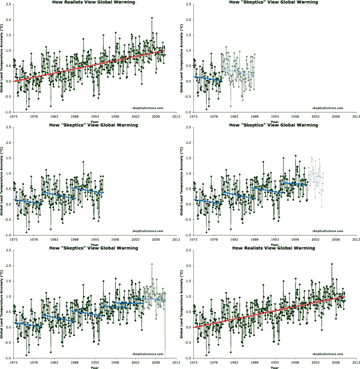
THE ESCALATOR
(free to republish)