



 Arguments







IEA: Renewables will be world’s top power source ‘by 2026’
Posted on 12 August 2025 by Guest Author
This is a re-post from Carbon Brief by Simon Evans
Renewable energy will overtake coal to become the world’s top source of electricity “by 2026 at the latest”, according to new forecasts from the International Energy Agency (IEA).
The rise of renewables is being driven by extremely rapid growth in wind and solar output, which topped 4,000 terawatt hours (TWh) in 2024 and will pass 6,000TWh by 2026.
Wind and solar are increasingly under attack from populist politicians on the right, such as US president Donald Trump and Reform in the UK.
Nevertheless, they will together meet more than 90% of the increase in global electricity demand out to 2026, the IEA says, while modest growth for hydro power will add to renewables’ rise.
With nuclear and gas also reaching record highs by 2026, coal-fired generation is set to decline – driven by falls in China and the EU – meaning that power-sector emissions will decline, too.
The chart below illustrates these profound shifts in the global electricity mix – in particular, the meteoric rise of renewables, driven by wind and solar.
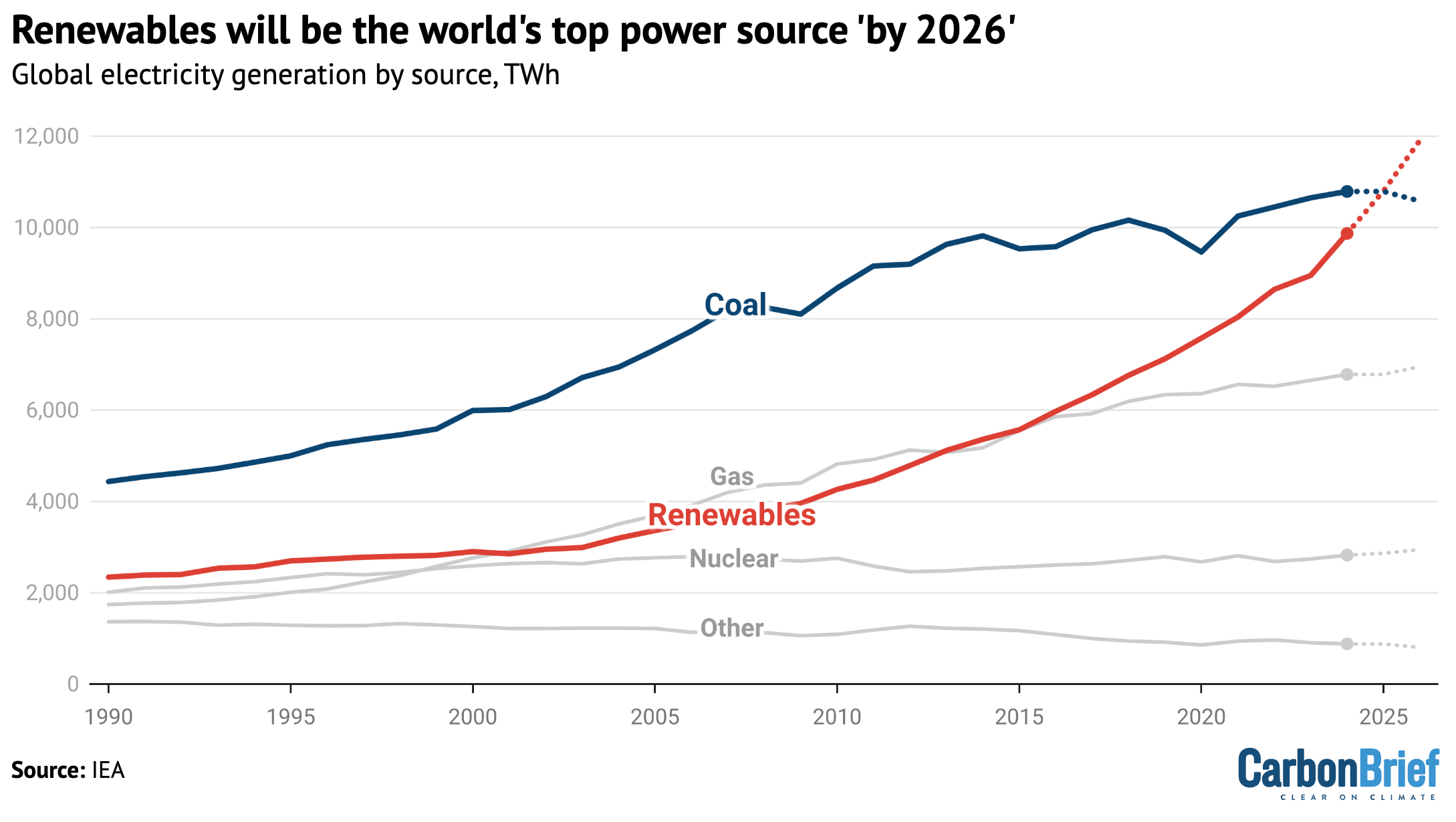 Global electricity generation by source, terawatt hours, 1990-2026. Figures for 2025 and 2026 are projections. Renewables include wind, solar, hydro, bioenergy and geothermal. Source: IEA electricity mid-year update 2025.
The IEA says that renewables could overtake coal as early as this year, depending on weather-related impacts on the output of wind and hydro capacity.
It adds that the switch will happen by 2026 “at the latest”, when renewables are expected to make up 36% of global power supplies, against just 32% from coal – the fuel’s lowest share in a century.
The share of global electricity generation coming from wind and solar combined will rise from 1% in 2005 and 4% in 2015 to 15% in 2024, 17% in 2025 and nearly 20% in 2026.
The global reduction in coal-fired electricity generation will result from declines in China and the EU, which will only be partially offset by increases in the US, India and other Asian nations.
The IEA attributes the coming decline of coal to “continued renewables growth and higher coal-to-gas switching in multiple regions”. It says gas power will rise by 1.3% this year and next.
For nuclear, the IEA says that the new record output will result from plant restarts in Japan, “robust” output in France and the US, as well as new reactors in China, India and South Korea.
The shift to wind and solar is happening despite global electricity demand being forecast to grow much faster over the next two years – at 3.3% and 3.7%, respectively – than the 2.6% average for 2015-2023.
The IEA says new demand is coming from industry, domestic appliances, growing use of air conditioning, ongoing electrification of heat and transport, as well as the expansion of data centres.









Comments