



 Arguments







Ice-Free Arctic
Posted on 7 November 2010 by Riccardo
Talking about ice-free arctic often triggers a lot of shouts and accusations of catastrophism. Yet, we know that the arctic has already been ice-free in summer before. We know it's possible, what is left to understand are the conditions which may produce such an event.
There is evidence (Polyak et. al 2010) that current conditions of an extensively glaciated Arctic were established at the beginning of the Pleistocene, about 3 million years ago. The quaternary glacial-interglacial cycles, governed by orbital cycles, are reflected in the Arctic sea ice extension. At times, average temperature has been 3-5 °C higher than present and totally or almost totally ice-free conditions during summer occured.It is thought that the main driver of these ice retreats is summer insolation at high latitudes, though regional effects (e.g. the presence of large ice sheets) produce geographically non uniform or delayed retreats. The last occurrence of a maximum in northern high latitude summer insolation was about 10 thousand years ago. It was a generally warmer than present period, but not uniformly so, and the temperature north of 60° was a couple of degrees centigrade above present (Kaufmann 2004).
A recent review on arctic ice variability suggests that "the seasonal Arctic sea ice cover was strongly reduced during most of the early Holocene and there appear to have been periods of ice-free summers in the central Arctic Ocean". This finding lowers the "threshold" for an ice-free summer to a few degrees centigrade of warming.
This fact may come as a surprise. Indeed, IPCC projections of summer arctic sea ice extent, while showing an overall decrease, do not show ice-free conditions up to at least the end of 21st century.
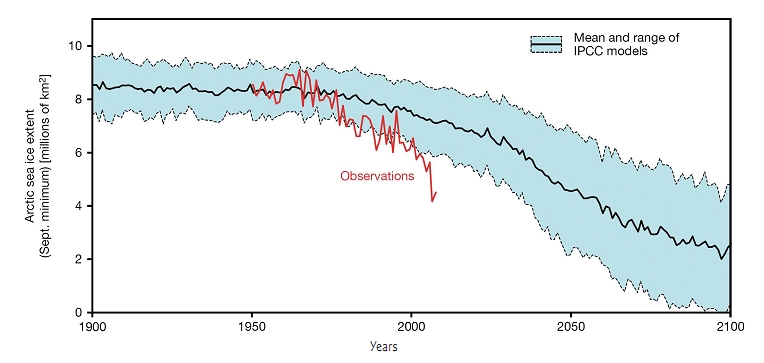
Observed (red) and modeled September Arctic sea ice extent (Copenhagen Diagnosis 2009)
But as the figure itself shows, the projections do not agree well with the real world. Measurements of the ice extent (red curve, updated to 2008) show a much steeper decrease in the last 30 years. Modelling results have shown that "abrupt reductions are a common feature of these 21st century simulations". Ice albedo feedback and increased ocean heat transport are identified as the culprits of these abrupt reductions.
An anticipated consequence of the ice albedo feedback is that the september minimum ice extent reduction trend should at first increase. At some point, the remaining ice extent becomes too small for its reduction to have a significant amplification effect and the decreasing trend slows down. We can easily check where we're now by looking at the NSIDC september ice extent.
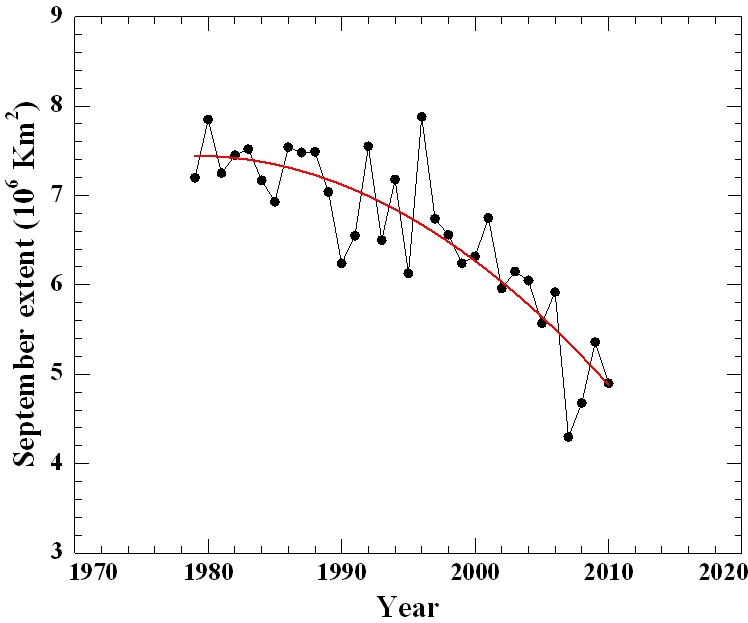
NSIDC september arctic sea ice extent (black) with a second order polynomial fit (red).
The linear fit (not shown) gives a trend of 80,000 square kilometers of sea ice extent loss per year or about 12% of the average over the full period per decade. But the analysis of the residuals shows that a second order polynomial is more appropiate. Then, we can confidently say that over the period 1979-2010 the downward trend has accelerated.
In summary, we know that a summer ice-free arctic is possible, that it does not require extremely high temperature, that we're not far from there, and that the downward trend is accelerating. So, why should we be surprised when scientists say that in a few decades we'll easily sail to the North Pole in September?


 0
0  0
0 This requires more intense melt seasons, followed by a widespread refreeze forming 'new ice'. New ice melts more rapidly than old ice.
 Let me note it is possible to burn coal with no soot output while it is impossible to burn it without producing CO2. Eliminating black carbon emissions is not even prohibitively expensive. It is routinely done in Europe and to a somewhat lesser extent in the US of A.
Some background material:
JOURNAL OF GEOPHYSICAL RESEARCH, VOL. 110, D04204, 2005
doi:10.1029/2004JD005296
Distant origins of Arctic black carbon: A Goddard Institute for Space Studies ModelE experiment
Dorothy Koch and James Hansen
"The (former) Soviet Union (FSU) was implicated as a major source of Arctic haze in many studies. Novakov et al. [2003] found that black carbon emissions from the FSU in the late 1990s was less than 1/4 their peak levels of 1980. European emissions are also about 1/3 their levels in the 1970s. However China and India have doubled their BC emissions since the late 1970s. Thus BC emissions are more heavily weighted toward south Asia than they were in the 1970s and 1980s, when many of the Arctic haze studies took place."
Let me note it is possible to burn coal with no soot output while it is impossible to burn it without producing CO2. Eliminating black carbon emissions is not even prohibitively expensive. It is routinely done in Europe and to a somewhat lesser extent in the US of A.
Some background material:
JOURNAL OF GEOPHYSICAL RESEARCH, VOL. 110, D04204, 2005
doi:10.1029/2004JD005296
Distant origins of Arctic black carbon: A Goddard Institute for Space Studies ModelE experiment
Dorothy Koch and James Hansen
"The (former) Soviet Union (FSU) was implicated as a major source of Arctic haze in many studies. Novakov et al. [2003] found that black carbon emissions from the FSU in the late 1990s was less than 1/4 their peak levels of 1980. European emissions are also about 1/3 their levels in the 1970s. However China and India have doubled their BC emissions since the late 1970s. Thus BC emissions are more heavily weighted toward south Asia than they were in the 1970s and 1980s, when many of the Arctic haze studies took place."







Comments