



 Arguments







Recent Comments
Prev 2589 2590 2591 2592 2593 2594 2595 2596 2597 2598 2599 2600 2601 2602 2603 2604 Next
Comments 129801 to 129850:
-
chris at 19:48 PM on 11 May 2009Climate's changed before
Gincko There is a weak statistical relationship between volcanic activities and ENSO with an enhanced probability of El Nino-like conditions in the winter following a volcanic eruption. Contemporary interest in this idea comes from a study published in Nature a few years back [*]. More recent research [**,***] supports a weak correlation and indicates that it is only the most vigorous volcanic eruptions that result in ejection of volcanic aerosols into the stratosphere that produce significant effects on ocean circulation. Of course this effect has nothing whatsoever to do with the heat from the volcanoes per se! That is just silly. As you say, the geothermal flux is simply too weak, although I believe there is some evidence that undersea crustal heat flow can influence ocean mixing and thus help to draw warmth down to the deeper oceans in a warming world (???). Obviously anyone asserting a contribution of geothermal heating to global warming should provide evidence not that this very weak geothermal flux exists, but that this has increased in line with periods of known global warming (like now!). The advocates of that notion seem reluctant to come up with any such evidence…. The weak relationship between strong volcanic eruptions and ENSO is due to the aerosolic load and its effects on radiative solar forcing.. I have to say I haven’t read the papers in detail, so the exact mechanism isn’t clear to me. If I have time I’ll have a more detailed look… [*]J. B. Adams et al (2003) Proxy evidence for an El Niño-like response to volcanic forcing. Nature 426, 274-278 abstract: Past studies have suggested a statistical connection between explosive volcanic eruptions and subsequent El Niño climate events1, 2. This connection, however, has remained controversial3, 4, 5. Here we present support for a response of the El Niño/Southern Oscillation (ENSO) phenomenon6, 7 to forcing from explosive volcanism by using two different palaeoclimate reconstructions of El Niño activity8, 9 and two independent, proxy-based chronologies of explosive volcanic activity5 from ad 1649 to the present. We demonstrate a significant, multi-year, El Niño-like response to explosive tropical volcanic forcing over the past several centuries. The results imply roughly a doubling of the probability of an El Niño event occurring in the winter following a volcanic eruption. Our empirical findings shed light on how the tropical Pacific ocean–atmosphere system may respond to exogenous (both natural and anthropogenic) radiative forcing. [**] Emile-Geay J et al. (2008) Volcanoes and ENSO over the past millennium. J. Climate 21, 3134-3148. abstract: The controversial claim that El Nino events might be partially caused by radiative forcing due to volcanic aerosols is reassessed. Building on the work of Mann et al., estimates of volcanic forcing over the past millennium and a climate model of intermediate complexity are used to draw a diagram of El Nino likelihood as a function of the intensity of volcanic forcing. It is shown that in the context of this model, only eruptions larger than that of Mt. Pinatubo ( 1991, peak dimming of about 3.7Wm(-2)) can shift the likelihood and amplitude of an El Nino event above the level of the model's internal variability. Explosive volcanism cannot be said to trigger El Nino events per se, but it is found to raise their likelihood by 50% on average, also favoring higher amplitudes. This reconciles, on one hand, the demonstration by Adams et al. of a statistical relationship between explosive volcanism and El Nino and, on the other hand, the ability to predict El Ni no events of the last 148 yr without knowledge of volcanic forcing. The authors then focus on the strongest eruption of the millennium (A. D. 1258), and show that it is likely to have favored the occurrence of a moderate-to-strong El Nino event in the midst of prevailing La Nino-like conditions induced by increased solar activity during the well-documented Medieval Climate Anomaly. Compiling paleoclimate data from a wide array of sources, a number of important hydroclimatic consequences for neighboring areas is documented. The authors propose, in particular, that the event briefly interrupted a solar-induced megadrought in the southwestern United States. Most of the time, however, volcanic eruptions are found to be too small to significantly affect ENSO statistics. [***]Christiansen B (2008) Volcanic eruptions, large-scale modes in the Northern Hemisphere, and the El Nino-southern oscillation. J. Climate 21, 910-922 . abstract: The author analyzes the impact of 13 major stratospheric aerosol producing volcanic eruptions since 1870 on the large-scale variability modes of sea level pressure in the Northern Hemisphere winter. The paper focuses on the Arctic Oscillation (AO) and the North Atlantic Oscillation (NAO) to address the question about the physical nature of these modes. The hypothesis that the phase of the El Nino-Southern Oscillation (ENSO) may control the geographical extent of the dominant mode in the Northern Hemisphere is also investigated, as well as the related possibility that the impact of the eruptions may be different according to the phase of ENSO. The author finds that both the AO and the NAO are excited in the first winter after the eruptions with statistical significance at the 95% level. Both the signal and the significance are larger for the NAO than for the AO. The excitation of the AO and the NAO is connected with the excitation of a secondary mode, which resembles an augmented Pacific-North American pattern. This mode has opposite polarity in the Atlantic and the Pacific and interferes negatively with the AO in the Pacific and positively in the Atlantic in the first winter after the eruptions, giving the superposition a strong NAO resemblance. Some evidence is found that the correlations between the Atlantic and the Pacific are stronger in the negative ENSO phase than in the positive phase, although this difference is not statistically significant when all data since 1870 are considered. The author does not find any evidence that the impact of the volcanic eruptions is more hemispheric in the negative than in the positive ENSO phase. -
ginckgo at 14:39 PM on 11 May 2009Climate's changed before
#106: Crustal heat contributes relatively negligible amounts to the system. Certainly not enough to significantly influence ocean currents. In today's Icehouse climate they are primarily driven by Thermohaline circulation, which in itself is driven by the creation of cold saline waters in polar regions. I have never heard of any correlation between ENSO and tectonic factors. I'd like to see the data for that. Plus, tectonics doesn't fluctuate on ENSO time scales, nowhere near. I don't even know where to start on the last paragraph - not even wrong comes to mind. -
ginckgo at 13:37 PM on 11 May 2009Volcanoes emit more CO2 than humans
Volcanoes don't drive ocean currents. Read up on thermohaline circulation. -
ginckgo at 12:42 PM on 11 May 2009Human CO2 is a tiny % of CO2 emissions
@#4: "Oceanic CO2 release decreases the acidity of sea water and carbonate fixing biota do better and lock up more CO2 allowing more CO2 to enter the oceans." This is wrong. CO2 absorbed by water generally INCREASES the acidity, thus lowering the ability of organisms to secrete carbonate. And where they do secrete it, it dissolves more readily once they are dead. The only saving grace here may be that calcium carbonate has an inverse solubility relative to temperature, i.e. as temperature goes up, solubility decreases. -
chris at 08:15 AM on 11 May 2009It's the sun
Re #348/350 I was talking about the PETM (Paleo-Eocene Thermal Maximum. You should try to be a bit more specific/explicit in your discourse! The PETM had nothing to do with the collision of the African and Eurasian plates (see post # 329 on this thread) and is characterised by a massive spike in the atmospheric CO2 concentration (possibly originally in the form of methane) and is contemporaneous with the opening up of the North Atlantic at the nascent plate boundary. The warm Eocene period is itself very likely due to high CO2 concentrations as indicated by proxy CO2 measurements from sediments from those periods [**]. Likewise the long, slow cooling in the middle to late Eocene is associated with a continual slow decrease in atmospheric CO2 concentrations as indicated by proxy CO2 measures from cores [***]. There’s very little evidence that it is heat from (changes in) tectonic activity that generates warming above background levels. The geothermal flux is just too small (around 0.1 W/m2 compared to the greenhouse-augmented solar flux absorbed by the Earth’s surface of over 150 W/m2). Nevertheless recent evidence supports a fundamental role for plate tectonics and continental drift in Eocene warming/cooling. In this case it is the Northward movement of the Indian plate towards Asia that is proposed as the source of the slow, slow ramp up of atmospheric CO2 (and associated warming) and the slow,slow loss of CO2 that progressed into the Oligocene and gave the world Antarctic glaciation. The scenario is as follows [****]: a. As the Indian plate drifted Northwards through the late Mesozoic and into the early Cenozoic (Paleozoic-early Eocene [*]), the carbonate-rich deposits on the ocean floor of the Asiatic margin of the Tethys ocean were subducted beneath the Asiatic plate resulting in their decarbonation and the steady release of CO2 over millions of years. Around 65 MYA and lasting for about 1 million years the massive Deccan traps formation was created in the centre-West of the “Indian” continent as basaltic outpouring from eruption of a mantle plume. b. This “CO2 factory” ceased around 50 MYA as the ocean between the continents was consumed. Continental collision resulted in strong uplift in the collision zone, producing enhanced rainfall. c. The movement of the Indian continent and its massive Deccan Trap into the equatorial belt, together with the enhanced rainfall arising from mountain formation produced strong weathering. Basaltic rocks like the Deccan are strong consumers of CO2 (5-10 times more CO2 consumed compared to granitic rocks under similar weathering conditions). From around 50 MYA through to the late Eocene, CO2 levels dropped, the Earth cooled and 35 MYA or so ago the Earth was sufficiently cool for a substantial ice cap to form in Antarctica….. ([*]for a temporal evolution of global temperature during these periods see: http://en.wikipedia.org/wiki/File:65_Myr_Climate_Change.png) [**] T. K. Lowenstein and R. V. Demicco (2006) Elevated Eocene Atmospheric CO2 and Its Subsequent Decline Science 313, 1928-9. abstract: Quantification of the atmospheric concentration of CO2 ([CO2]atm) during warm periods of Earth's history is important because burning of fossil fuels may produce future [CO2]atm approaching 1000 parts per million by volume (ppm). The early Eocene (~56 to 49 million years ago) had the highest prolonged global temperatures of the past 65 million years. High Eocene [CO2]atm is established from sodium carbonate minerals formed in saline lakes and preserved in the Green River Formation, western United States. Coprecipitation of nahcolite (NaHCO3) and halite (NaCl) from surface waters in contact with the atmosphere indicates [CO2]atm > 1125 ppm (four times preindustrial concentrations), which confirms that high [CO2]atm coincided with Eocene warmth. [***]M. Pagani et al. (2005) Marked Decline in Atmospheric Carbon Dioxide Concentrations During the Paleogene Science 309, 600-603. abstract: The relation between the partial pressure of atmospheric carbon dioxide (pCO2) and Paleogene climate is poorly resolved. We used stable carbon isotopic values of di-unsaturated alkenones extracted from deep sea cores to reconstruct pCO2 fromthe middle Eocene to the late Oligocene (45 to 25 million years ago). Our results demonstrate that pCO2 ranged between 1000 to 1500 parts per million by volume in the middle to late Eocene, then decreased in several steps during the Oligocene, and reached modern levels by the latest Oligocene. The fall in pCO2 likely allowed for a critical expansion of ice sheets on Antarctica and promoted conditions that forced the onset of terrestrial C4 photosynthesis [****] D. V. Kent and G. Muttoni (2008) Equatorial convergence of India and early Cenozoic climate trends Proc. Natl. Acad. Sci. USA. 105, 16065-16070 abstract: India's northward flight and collision with Asia was a major driver of global tectonics in the Cenozoic and, we argue, of atmospheric CO2 concentration (pCO2) and thus global climate. Subduction of Tethyan oceanic crust with a carpet of carbonate-rich pelagic sediments deposited during transit beneath the high-productivity equatorial belt resulted in a component flux of CO2 delivery to the atmosphere capable to maintain high pCO2 levels and warm climate conditions until the decarbonation factory shut down with the collision of Greater India with Asia at the Early Eocene climatic optimum at ≈50 Ma. At about this time, the India continent and the highly weatherable Deccan Traps drifted into the equatorial humid belt where uptake of CO2 by efficient silicate weathering further perturbed the delicate equilibrium between CO2 input to and removal from the atmosphere toward progressively lower pCO2 levels, thus marking the onset of a cooling trend over the Middle and Late Eocene that some suggest triggered the rapid expansion of Antarctic ice sheets at around the Eocene-Oligocene boundary. -
pdt at 07:22 AM on 11 May 2009Are sea levels rising?
"But if the trend is changing where do you draw the line?" You can draw any line you want, you just can't use it to extrapolate into the future. You need a climate model for that. -
Mizimi at 06:46 AM on 11 May 2009Climate sensitivity is low
Have a read: http://www.john-daly.com/forcing/review.htm which has commentaries on Hug & Barrett's presentation on climate sensitivity. You can access the original paper direst from the web page. -
BarryW at 04:07 AM on 11 May 2009Are sea levels rising?
But if the trend is changing where do you draw the line? if you take the whole period of your first chart you get 3.2, but if you just take the portion relative to JASON you get about 2.3. Is JASON or TOPEX data skewed, or are we seeing the rate drop significantly? With temperature not increasing in the 21st century (so far) the drop in sealevel change doesn't seem abnormal or just noise. -
BarryW at 03:48 AM on 11 May 2009Is the climate warming or cooling?
Yes, decadal periods are too short to determine whether there are long term trends. If you calculate trends using 30 yrs over the length of the Hadley global anomaly data you get the following: Total number of trends calculated: 1551 total positive trends 994 total negative trends 560 total trends gt .1 deg per decade 444 Which leads to the question is not if the climate is warming but how much? Here is a plot of the trends in Deg/Yr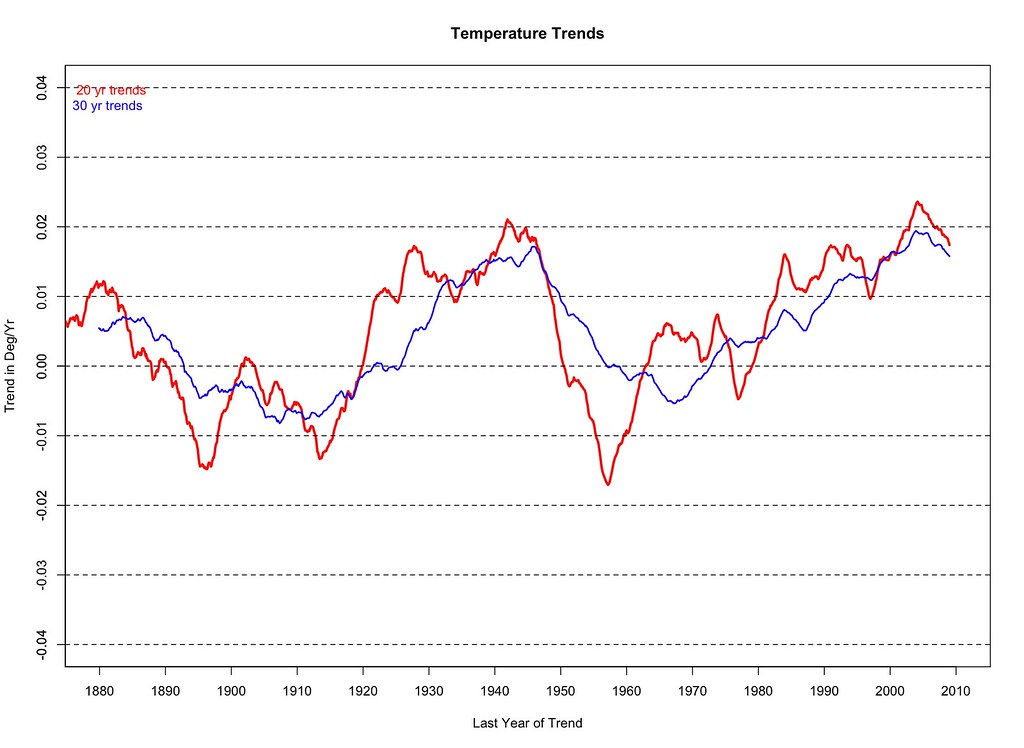 Notice the peaks at 60 yr intervals. Even if the temps are going up on the long term it appears we are due for a decrease over the next 30 years, which is not going to do much for those that are trying to promote changes based on near term measurements.
-
Philippe Chantreau at 03:04 AM on 11 May 2009How to cherry pick your way to Antarctic land ice gain
Tree, your argument is flawed on several counts. First there is the fact that the overwhelming majority of climate scientists do not dispute at all the reality of AGW. Second is the fact that the overwhelming majority of "skeptics" are not scientists. Most of the ones who are come from different areas of practice. The true dissenting climate scientist are a very small minority. Their ideas, when they have any alternative to propose, have not been ignored. You're equating a "wealth of scientific papers" with rethoric. That does not make any sense. The problem stated in the post you refer to is exactly that what is contained in a wealth of scientific papers can not be so easily communicated as good rethoric, no matter how empty. WA earlier had a great example of rethoric by calling 21% of the past 2 years "much." Anyone reading that and not bothering to actually look at the data could easily interpret it as "most of the time" although it is quite far from it. By using this one little word, WA can convey the message (without actually saying so) that most of the past 2 years saw positive anomaly, although the data shows exactly the opposite. -
Ron Cram at 00:35 AM on 11 May 2009Is the climate warming or cooling?
John, you are quite correct that start and end dates can change statistical results dramatically. These are issues that need to be discussed. But they need to be discussed, in part, within the context of relevant physical theories. For example, everyone knows about the warm period from 1975 to 2007. The climate regime shift that occurred in 1975 was very strong. A similarly strong climate regime shift happened in about 1942 from a warm period to a cool period. This is discussed in the 2002 Bratcher and Giese paper http://www.agu.org/pubs/crossref/2002/2002GL015191.shtml Based on observations Bratcher and Giese made in 2002, they predicted a return to a cool climate regime "soon" based on observations they made on the oscillation in the tropical Pacific ocean. Others have written about the link between shifts in the PDO from its cool phase to warm phase in 1975. And the PDO did shift back into a cool phase in late 2007. While one can claim the planet was still warming from 1999 to 2007, it is very hard to ignore the strong drop in temperature between 2007 and 2008. It will take time to see if this is the start of a persistent trend. But to be honest, looking at surface temps is not really a good metric for monitoring climate change. James Hansen wrote about the radiative imbalance due to anthropogenic CO2 and claimed the earth's energy budget was out of balance causing the oceans to warm and this stored heat was "heat in the pipeline" that would show up in the atmosphere later. I really do not like this way of thinking about it. The oceans are an important part of the climate system. In fact, because water stores heat so much more efficiently than the atmosphere, the ocean is the best place to monitor climate change. If Jim Hansen is correct that OC2 has caused the earth's energy budget to be out of balance, the oceans should be warming year over year consistently. After all, where else can the heat go? But Josh Willis from JPL has published on this. The oceans have not warmed since 2003. This is a significant finding because the start and end dates do not play a big role. Because of the nature of the physics involved, warming should be measurable year over year consistently because the signal is significantly more than noise, this is THE most important climate metric we can study. Roger Pielke, an ISI highly cited climatologist, has blogged on this at http://climatesci.org/2009/02/09/update-on-a-comparison-of-upper-ocean-heat-content-changes-with-the-giss-model-predictions/ Ocean heat content really gets to the heart of the issue of "warming vs. cooling." It should be discussed more often. -
theTree at 18:45 PM on 10 May 2009How to cherry pick your way to Antarctic land ice gain
I'd like to comment in the first paragraph: "I would suggest that scientists are not always completely effective at communicating their science to the average person. Global warming skeptics, on the other hand, have a wide range of rhetorical techniques that are quite successful in sowing doubt." Whilst I'm still without an opinion on anthropogenic climate change (through lack of knowledge on this complex subject), this opener certainly rings alarm bells with me. Chiefly: 1. Having 'scientists' on the one hand and 'global warming skeptics' on the other. This suggests that skeptics aren't scientists and proponents are. This is no more accurate than the reverse: that most proponents are layman and skeptics are scientists. Consider the hoards of ill informed protesters... 2. The assertion that global warming skeptics are adept at rhetoric whilst proponents struggle in this area. The wealth of scientific papers supporting anthropogenic climate change, plus the unrelenting media support, contradicts this. As the authors personal views are so obvious, I immediately worry there will be a bias in the text. And, in a complex subject area where bias and misinformation is rife, its not something I as a confused layman can afford! And aside from anything else, it makes someone still considering a skeptical point of view feel alienated and patronized - hardly the point of this website. Its a good article, but the absolute need for objectivity shouldn't be forgotten, no matter what gets publicized elsewhere. -
Quietman at 03:19 AM on 10 May 2009Climate's changed before
This is why we get a warning when El Nino is beginning by volcanic eruptions in Chile. It's not the volcano that causes El Nino, it's just a symptom of the tectonic activity and it's accompanying vulcanism. And I have to stop for now since my grandson is having a tamtrum and I can't think straight with the noise. -
Quietman at 03:14 AM on 10 May 2009Climate's changed before
The temperature of the ocean floor is variable. The depths have a thinner crust in general so transfer more heat and the volcanic active areas transfer heat from the magma directly to the water. The proximate temps change rapidly simply because the the amount of cold water available to sink this heat. But just like applying heat to the bottom of a pot of water, convection currents are created in both up and down directions. Some of these are fairly constant coming from the ocean depths but some are highly variable where volcanic activity exists and this can be at any depth along the ridges. At times of eruptions or even just increased plate movement the heat released into the water increases and either creates a new current or strengthens the existing current. As explained in the volcano thread, the ENSO is a real time example of this very driver. The subduction of the pacific plate under the Andes slows and speeds up in an irregular cycle. It's irregular because of the continental crust being uneven densiity and shape and made of materials of various ores with different melting points. -
Quietman at 02:59 AM on 10 May 2009Climate's changed before
The changes in climate from changes in the Earth are not immediately obvious unless you realize that ocean currents have a much stronger effect than air currents. This is because the atmosphere is not efficient as a buffer, ie. GHGs are not as efficient as the ocean (or any body of water) at storing energy including heat. What is key to understanding how oceans drive climate is the convection currents (upwelling and downwelling currents). We know that ocean temperatures are not globally uniform. Some bodies of water are warmer or cooler than others. But what is more important is that the depths are different temperatures and the colder water sinks while the hotter water rises. Simple. Next comes the more complex part. -
Quietman at 02:45 AM on 10 May 2009It's the sun
Patrick Re: "I do not see any reason to expect changes in the geothermal heat flux itself to have a significant climateic impact on regional to global scales over most of geologic time." See the maps I posted links to on page 14 here and the additional maps in the "Climate's changed before" thread. I'll try to explain in that thread. -
Patrick 027 at 14:36 PM on 9 May 2009It's the sun
I accept tectonic drivers of climate on the millions of years time scale via geographical changes (directly forcing climate changes, also shaping some aspects of the carbon cycle) and geologic CO2 emissions. (Obviously this can all affect biological evolution and that will have climatic effects as well.) (I also accept that climate can affect geology - an example is that dry conditions have something to do with the heights achieved by the Andes, though I forget the details (lack of erosion leading to less sediment fed into the subduction zone?)) I do not see any reason to expect changes in the geothermal heat flux itself to have a significant climateic impact on regional to global scales over most of geologic time. -
Quietman at 03:38 AM on 9 May 2009It's the sun
Patrick As we discussed in the Volcano thread, Continental Drift was considered a steady gradual process until quite recently. Not we know that it is not. The recent increase alone is proof of that (I won't rehash details here). I know that you do not accept the hypothesis of a tectonic driver of climate, this is understandable as it is an opposing hypothesis, but I think with a little more study it will prove to be important to understanding climate. -
tommybar at 03:16 AM on 9 May 2009Is the climate warming or cooling?
Often I've heard how 1934 was the hottest year in US climate records. Often in response, people will say then that 1998, and closely behind 2005 are the warmest 'global' recorded years. Take a look at this: http://www.globalwarmingart.com/wiki/Image:GHCN_Temperature_Stations_png The vast majority of sites going back over 90 years are in the continental USA. So, the long term records are really only good for the USA and parts of western Europe. These areas have also become much more urbanized over these time periods, so the UHI effect is very important. Now days we have a much more 'global' temperature gathering network. So, I have to wonder--how do we know what the true global temperatures were, say in the 30's? i.e., if we had the capabilities then to record remote locations, that 'global' temperature may have been higher--or even lower. There seems to be so much in our temperature records that are suspect. The US shows a definite cooling trend, with the 'global' trend there as well--so I'd say it's cooling now after a couple of decades of warming. Going back further, I think a lot of guess work come's into play. -
Patrick 027 at 03:03 AM on 9 May 2009It's the sun
Sometimes the possibilities for unknown quantities can be bracketed by known quantities. Most of the geothermal heat escaping the Earth is through slow conduction through rock, not generally subject to rapid fluctuations (mere 1000s of years) on a regional or global scale. (Depending on how deep hydrothermal circulations penetrate, that portion of heat transport may be locally quite variable, but it depends on some more steady supply of heat from below.) From the thermal conductivity and thermal gradients, a heat flux can be estimated. The average concentrations of major heat producing radioactive isotopes has been estimated in various rock types. Understanding of geophysics, geochemistry, plus data, yields an understanding of how those isotopes are likely distributed within the Earth; generally, they are concentrated in the crust (especially continental crust) relative to the mantle, and especially relative to the core. Mantle convection rates can be estimated from continental drift; there is also seismography and physics. Core convection (at least partly driven by latent heat of inner core growth, compositional variations formed by inner core growth, and cooling from above) is linked the the magnetic field. Possible long-term global cooling rates can be bracketed by evidence of past tectonic behavior and knowledge of heat sources (including tidal deformation). Etc, Etc, etc... PS while one point in space and time has only one measurable value of each of the electric field and the magnetic field, spatial variations can be analyzed mathematically (Fourier analysis) to find linearly superimposed components that have various wave vectors. Systems that resonant at different frequencies will detect different parts of the spectrum. Photons with different energies will be absorbed or emitted by associated energy transitions. -
tommybar at 02:45 AM on 9 May 2009Is the climate warming or cooling?
Often I've heard how 1934 was the hottest year in US climate records. Often in response, people will say then that 1998, and closely behind 2005 are the warmest 'global' recorded years. Take a look at this: http://www.globalwarmingart.com/wiki/Image:GHCN_Temperature_Stations_png The vast majority of sites going back over 90 years are in the continental USA. So, the long term records are really only good for the USA and parts of western Europe. These areas have also become much more urbanized over these time periods, so the UHI effect is very important. Now days we have a much more 'global' temperature gathering network. So, I have to wonder--how do we know what the true global temperatures were, say in the 30's? i.e., if we had the capabilities then to record remote locations, that 'global' temperature may have been higher--or even lower. There seems to be so much in our temperature records that are suspect. The US shows a definite cooling trend, with the 'global' trend there as well--so I'd say it's cooling now after a couple of decades of warming. Going back further, I think a lot of guess work come's into play. -
Olympus Mons at 00:10 AM on 9 May 2009Is the climate warming or cooling?
Hi Steve and David. Sorry for having upset you both. Was not intentionally. English is not my native language (I’m Portuguese) so I have to concede that although I can not see how or when I have trolled (if I really know what that is) I might really have. Based on previous paragraph I will assume that calling someone troll is not really “Foul language, trolling, personal attacks or non-relevant links will be deleted” , because the moderator as allow it to be in here. About WA, thank you David for even considering It could be the same person. I’m sort of honored. PS: actually I think me and WA (given the obvious differences) are made of the same cloth (hope I get it right) and actually we were born like this. It’s how our brain is sort of organized. Same is truth for you and Steve. Your brains are “organized” the way they are and that has a huge influence on how you perceive reality. But that is my turf and, in there, Im pretty sure you would be upset. Oh boy, you both would, really quickly. -
Quietman at 15:14 PM on 8 May 2009Arctic sea ice melt - natural or man-made?
Lee I don't understand 508/509 so I'll ignore it. 510 I do understand. I worked in an emissions testing lab for 10 years before going out in the field. According to the Federal Register the goal is to limit CO, NOx and HC by converting it to CO2 and water vapor as the end product of combustion. Why would we intentionally produce pollution? The answer is that it is not pollution and is a very weak GHG. May I suggest a quick read of this A sensitive subject Nature Reports Climate Change Published online: 30 April 2009 | doi:10.1038/climate.2009.41 -
Gord at 14:28 PM on 8 May 2009It's the sun
Quiteman - I agree. I, generally, covered this in my first Post #243, where I identified the Earth's molten core as an energy source. I think the number of under-sea volcanos and vents remains a largely unknown quantity. AGW'ers and others have simply dismissed this source of energy as insignificant. It certainly contributes some warming. -
David Horton at 10:56 AM on 8 May 2009Is the climate warming or cooling?
Steve, I got into trouble, earlier in this thread from ... You are quite right to call OM on trolling, and WA is also trolling, as I suggested (and I have suspicions of homer). Neither (if they are indeed separate people) are adding anything other than denialist talking points. Over and over. -
Quietman at 08:23 AM on 8 May 2009Climate's changed before
Patrick These maps show the progression of the 3rd Ice Age (Carboniferous-Permian) beginning before it's onset in the Devonian through the End of the Permian. Devonian Early Carboniferous Late Carboniferous Permian These two maps show the 4th Ice Age (current) and the modern world (current interglacial): Current Ice Agea> Current Interglacial I already posted the Eocene and Miocene in the "It's the Sun" thread so I wont repeat them here. Compare the Ice Age maps to the earlier Ice Age and you can see easily how different the earth was and how unlikely another glacation actually is at this point. Think about it. What do you think caused the long extreme cycles in the late part of the this age? -
Quietman at 07:58 AM on 8 May 2009It's the sun
Gord In all fairness I need to point out that the earth's vulcanism kept alive by gravitational stress* is a second but much weaker heat source. * work energy converted to heat + residual heat from the formation of the earth. References are listed in the Volcano thread. -
Quietman at 07:41 AM on 8 May 2009It's the sun
Correction to 327 and 348 PETM was not intended, Eocene Optimim was intended, the PETM marks a spike that begins the EO when prosimians such as Eosimias were evolving in China shortly after India met Eurasia. In the first map Africa and India are have not closed the gap. VERY active tectonics, unbelieveably active movements of continental masses. Geologically speaking super fast. PE of the Earth. -
Steve L at 07:09 AM on 8 May 2009Is the climate warming or cooling?
Dear RG, go to this "hottest arguments" part of this website and look up your favorite skeptic arguments: http://skepticalscience.com/argument.php The "we're coming out of an ice age" argument is currently number 26, I believe. To Homer: I failed to find you a citation of a scientific paper, so I'm resorting to rhetoric: permafrost is melting from the top down, not the bottom up; same with the oceans; etc -- heating from the earth's core is not consistent with observations. To OM: Yours are the actions of a troll. Specify exactly what you want to argue about, choose the appropriate venue, and use scientific arguments. Changing topics, throwing in needless character assassinations, and simply calling explanations "Jokes" is a waste of everyone's time. -
Dan Pangburn at 01:46 AM on 8 May 2009Models are unreliable
Since 2000, atmospheric carbon dioxide has increased 18.4% of the increase from 1800 to 2000. According to the average of the five reporting agencies, the trend of average global temperatures since 1998 shows no increase and since 2002 the trend shows a DECREASE of 0.8°C/century. This separation shows the lack of connection between atmospheric carbon dioxide increase and average global temperature. Many Climate Scientists are completely unaware of some relevant science and understand other relevant science poorly (it’s not in their curriculum). The missing science proves that added atmospheric carbon dioxide has no significant influence on average global temperature. See my pdf linked from http://climaterealists.com/index.php?tid=145&linkbox=true for the proof. Or email at danpangburn@roadrunner.com As the atmospheric carbon dioxide level continues to increase and the average global temperature doesn’t it is becoming more and more apparent that many climate scientists have made an egregious mistake and a whole lot of people have been mislead. -
Dan Pangburn at 01:37 AM on 8 May 2009It's the sun
The Solar Grand Maximum that went on for about 70 years has ended. The 30 year or so PDO uptrend that combined with the Solar Grand Maximum to produce the late-20th-century temperature run up has started its 30 year downtrend. The PDO downtrend combined with the quiet sun is going to result in continued planet cooling. The sun has not been this quiet this long since 1913. Sunspot changes may be a catalyst for cloud changes and therefore have much greater influence than TSI. -
John Cross at 01:03 AM on 8 May 2009Are sea levels rising?
Hey John: interesting post - you could almost call it fractal skepticism since it is almost like the "no warming since 1998" argument but on a different scale. Wondering Aloud: I have not seen AIT, but I believe that Gore does not put a time frame on the 20 foot rise. Regards, JohnResponse: LOL, 'fractal skepticism'. Just when I thought this website couldn't get any nerdier, you've just taken it up a notch. Kudos, John :-) -
cold beer please at 23:53 PM on 7 May 2009CO2 lags temperature
Temps drive CO2. That position stands. Amplifying effect - could be a thousand things! Studies on the ability of CO2 to "reflect" infrared show that the ability to reflect(absorb) does NOT impove with denser concentrations once past a certain level. This means that Co2 is done with it's "Amplifying effect" once a cetain CO2 level is acheived under normal conditions - I would assume that has to do with the wavelength itself and not CO2. (call in the phycisists) http://nov55.com/ntyg.html -
cold beer please at 22:51 PM on 7 May 2009Arctic icemelt is a natural cycle
Two recent Arctic Ice updates: Beginning in early January 2009, sensor drift caused an underestimation of ice that grew until the error was finally caught in the mid-February. Internet visitors who look to the NSIDC for data sent emails to the center and, it became clear that there was a significant problem—sea-ice-covered regions were showing up as open ocean. (See NSIDC) MORE . . . (May 4, 2009) Ice in the Arctic is often twice as thick as expected, report surprised scientists who returned last week from a major scientific expedition. The scientists - a 20-member contingent from Canada, the U.S., Germany, and Italy - spent one month exploring the North Pole as well as never-before measured regions of the Arctic. Among their findings: Rather than finding newly formed ice to be two metres thick, "we measured ice thickness up to four metres," stated a spokesperson for the Alfred Wegener Institute for Polar and Marine Research of the Helmholtz Association, Germany's largest scientific organization. http://network.nationalpost.com/np/blogs/fpcomment/archive/2009/05/04/lawrence-solomon-deep-arctic-ice-surprises-scientific-expedition.aspx More info to come from Polar 5. -
cold beer please at 22:26 PM on 7 May 2009There is no consensus
AND on May 6, 2009 - this from Great Britain. Interview: Just two years ago, Mike Hulme would have been about the last person you'd expect to hear criticising conventional climate change wisdom. Back then, he was the founding director of the Tyndall Centre for Climate Change Research, an organisation so revered by environmentalists that it could be mistaken for the academic wing of the green movement. Since leaving Tyndall - and as we found out in a telephone interview - he has come out of the climate change closet as an outspoken critic of such sacred cows as the UN's IPCC, the "consensus", the over-emphasis on scientific evidence in political debates about climate change, and to defend the rights of so-called "deniers" to contribute to those debates. . . More here: http://www.theregister.co.uk/2009/05/06/mike_hulme_interview/ -
cold beer please at 22:17 PM on 7 May 2009There is no consensus
Frankly, I think the Skeptics have won point #3 onthis list at this time in history - there is less and less "consensus" Japan, Jan 2009, has walked away from the IPCC "Japan's boffins: Global warming isn't man-made Climate science is 'ancient astrology', claims report" that from http://www.theregister.co.uk/2009/02/25/jstor_climate_report_translation/ More . . . Kanya Kusano is Program Director and Group Leader for the Earth Simulator at the Japan Agency for Marine-Earth Science & Technology (JAMSTEC). He focuses on the immaturity of simulation work cited in support of the theory of anthropogenic climate change. Using undiplomatic language, Kusano compares them to ancient astrology. After listing many faults, and the IPCC's own conclusion that natural causes of climate are poorly understood, Kusano concludes: "[The IPCC's] conclusion that from now on atmospheric temperatures are likely to show a continuous, monotonic increase, should be perceived as an unprovable hypothesis," he writes. -
homer at 13:44 PM on 7 May 2009Is the climate warming or cooling?
I would like to add a comment about averages - they are made up of extremes. Perhaps humans get caught up with their own existance, particularly if it is possible that change is a 'threat' to their stable lifestyle. I would be very surprised if the climate remained the same. One area which has been little discussed with global warming is the 'reflective ability of clouds'. As the temp and humidity go up more cloud reflects radiation, so limiting further absorption within the lower atmosphere. Expansion of the tropical zones ought to occur. If the sun is not responsible for variation seen ,could the slight increase in temp be coming from within the earth rather than exterior ? Why assume core activity remains constant ? For 'olympus mons' on feedback - observe a specie of tree which may have existed in an area for say several million years. If its climatic zone is specific then it stands as an example of 'averaging' the seasons over a much greater span than our personal memories. Thank you for the opportunity. -
Quietman at 12:33 PM on 7 May 2009It's the sun
"chris at 19:00 PM on 29 April, 2009 Re #327 Your timings and causes are incorrect Quietman. The collision of the African and Eurasian plates that "squeezed out" the Tethys Ocean and drove the crumpling and nappe formation that raised the Alps occurred 20-ish million years ago. It had nothing to do with the PETM." I guess that you should take that up with Dr. Chris Beard (Ph.D.) since I took that right out of his book "The Hunt for the Dawn Monkey". It happens to be key to the study of primate evolution and how we got to Africa from Asia. The mountains did not rise until well after the collision and are not proof that the collision took place as late as only 20 million years ago, especially since our ancestors were in Africa MUCH earlier. Morotopithecus was already bipedal and walking around Africa 23 million years ago. Early Eocene Map (Before landbridge) Miocene Map (after landbridge) Better stick to subjects that your familiar with. Oh wait, I forgot, you not familiar with those facts either. -
Rick Gibson at 07:49 AM on 7 May 2009There's no empirical evidence
Let me see if I understand this. This seems to be the argument. First, CO2 levels are rising. Second, CO2 is a greenhouse gas. Third, during the last 30 years, global temperatures have been rising. Fourth, the things that ordinary cause temperatures to rise -- such as increased solar activity -- are not causing the current rise in temperature. Therefore, increased C02 is causing global warming. Of these four points, I believe that no one disputes one and two. Yes, CO2 levels are rising. Yes, CO2 is a greenhouse gas. I do not think anyone denies either of those two assertions. But, there are a number of points that I think an honest scientist would want to explore. How much is CO2 rising, compared to the past? Do we have more or less CO2 now than we did in various past times? When we put more CO2 into the air, what happens to it? Does it get absorbed by the ocean, or does it stay in the air forever? What other things in the atmosphere are increasing or decreasing? I would feel much more confidence in the global warming theory if they would address points of this sort, which seem like pretty obvious questions to me. But, for the moment, lets just say that points one and two are basically undisputed. I believe that is true. Point three is the pivot the argument. The whole theory stands or falls on it. It is basically saying that there is a huge, unexplained increase in global temperatures in the last 30 years, which we have to explain. But is that true? First off, during the last ten years, there has been no increase. Of course, one can say -- and it is true -- that a ten year period means little or nothing in climate science. But think about that. If ten years means nothing, why is 30 years of such huge importance? If the whole theory rests on 30 years, but 10 of those years are AWOL, how good is the theory? And how can we say that the usual suspects do not explain the increase, when there has been no increase for ten years? What we are basically talking about is a twenty year trend, which stopped ten years ago. So what? Excuse me, but I have read enough climate science to realize that 10 or 20 year trends do not mean much. Most climate cycles operate over 100s if not 1000s of years.Response: "CO2 is a greenhouse gas. I do not think anyone denies either of those two assertions"
Sadly, there are many who deny the assertion that CO2 is a greenhouse gas, even despite observations of an enhanced greenhouse effect. Much of the discussion on this website of late have been on that topic alone.
"during the last ten years, there has been no increase"
Statistically, this isn't true, the trend in global temperature has still been increasing. Don't fall into the trap of comparing single points in a noisy signal - that is not the way to determine a long term trend. More importantly, the physical reality is that the planet is still accumulating heat. There is still an energy imbalance. Satellites and ocean heat measurements find more energy is still coming in than going out. -
Rick Gibson at 07:28 AM on 7 May 2009Is the climate warming or cooling?
I completely agree with the substantive points made in this essay. I disagree, however, with its conclusion. Let me explain. The basic point made in this essay is that many factors influence temperature change over a time frame of a few years to a decade. Thus, decade long data does not necessarily tell us anything. I totally agree. But, from that you conclude, therefore the skeptics are wrong. No, that conclusion does not follow from your evidence. What your evidence indicates is that the temperature data from the last decade does not prove anything one way or the other. It does not prove the skeptical case. It also does not prove the global warming case. It simply proves nothing. You also do not address the real issue, which is, if we want to assess the theory of global warming, what time frame for climate data is, in fact, relevant? As I understand it, the basic skeptic's case is as follows. There are many natural trends in global climate, which generally operate on a time frame of centuries, not decades. The world, in general, had a cooling period, which bottomed out at roughly the time of the American Revolution. Since then, with some ups and downs, the long-term trend has been up. The global warming theories say that this long trend proves their theory. However, the skeptical answer is that this upward trend: (a) started before the Industrial Revolution; and (b) is a natural trend, which should be expected, after the prior natural downturn. What is the scientific answer to those skeptical points? -
Gord at 18:11 PM on 6 May 2009It's the sun
Patrick - If "refusing to be resonable" includes denying the validity of the fundamental Laws of Science, then I am guilty as charged. Unfortunately, you have confirmed that you are in denial of established science. Too bad. -
Gord at 11:25 AM on 6 May 2009It's the sun
Interference "In physics, interference is the addition (superposition) of two or more waves that result in a NEW WAVE pattern." "The principle of superposition of waves states that the resultant displacement at a point is equal to the vector sum of the displacements of different waves at that point. If a crest of a wave meets a crest of another wave at the same point then the crests interfere constructively and the resultant wave amplitude is greater. If a crest of a wave meets a trough of another wave then they interfere destructively, and the overall amplitude is decreased." http://en.wikipedia.org/wiki/Interference ------------------- Electromagnetic radiation "Interference is the superposition of two or more waves resulting in a NEW WAVE pattern. If the fields have components in the same direction, they constructively interfere, while opposite directions cause destructive interference." http://en.wikipedia.org/wiki/Electromagnetic_wave ------------------------------- The Resultant Electromagnetic Vector Field is the ONLY EM field that can be measured at any single point. It is, in fact, a NEW WAVE produced by interference and the component parts cannot be measured at a single point. The Resultant EM Field will be continuous if the components are continuous. For Heat Transfer by Radiation between bodies, as long as each body has a temperature, the resultant EM field will be continuous. If one body maintains a temperature that is warmer than the cooler body the continuous resultant EM Field will only propagate from warm to cold. There will be zero EM wave propagation from cold to warm and therefore there will be zero energy transfer from the cold body to the warm body. Just like the 2nd Law of Thermodynamics clearly states. -
Patrick 027 at 09:54 AM on 6 May 2009It's the sun
"You only seem to only read the "parts" you want to see." No, as you can now see, I was getting to that. But no matter, I doubt you'll try to understand the physics. You're just wrong, Gord. There's no use arguing with someone who refuses to be reasonable, so that's it. We're done. -
Patrick 027 at 09:50 AM on 6 May 2009It's the sun
"Note that the Electromagnetic Force is also one of the four fundamental forces ....as is Gravity." Did I ever say otherwise? My point was that the second law of thermodynamics does not operate on the same level - there is no 'second law of thermodynamics' field or force, etc. It is a consequence of the statistics of disorganized processes (whatever forces are involved in those processes). ""The electromagnetic force is one of the four fundamental forces. The other fundamental forces are: the strong nuclear force (which holds quarks together, along with its residual strong force effect that holds atomic nuclei together to form the nucleus), the weak nuclear force (which causes certain forms of radioactive decay), and the gravitational force. All other forces are ultimately derived from these fundamental forces."" (http://en.wikipedia.org/wiki/Electromagnetic_force) I've known that since before I was 10. ""In physics, the electromagnetic force is the force that the electromagnetic field exerts on electrically charged particles. It is the electromagnetic force that holds electrons and protons together in atoms, and which hold atoms together to make molecules. The electromagnetic force operates via the exchange of messenger particles called photons and virtual photons.""...""The electromagnetic force is the one responsible for practically all the phenomena one encounters in daily life, with the exception of gravity." " (http://en.wikipedia.org/wiki/Electromagnetic_force) I've also known that for a long time. I know that the energy flux of an electromagnetic wave is described by the Poynting vector, which is the cross product of the electric and magnetic field vectors - perhaps multiplied by a constant; I don't have all the details memorized but I do understand the concept. ""In physics, a photon is an elementary particle, the quantum of the electromagnetic field and the basic "unit" of light and all other forms of electromagnetic radiation. It is also the force carrier for the electromagnetic force. The effects of this force are easily observable at both the microscopic and macroscopic level, because the photon has no rest mass; this allows for interactions at long distances"" (http://en.wikipedia.org/wiki/Photon ) Yep, I've known that for a long time, too. "Photons DO NOT PROPAGATE BY THEMSELVES...THEY REQUIRE AN ELECTROMAGNETIC FIELD FOR PROPAGATION." "Photon energy is "Carried" by propagating Electromagnetic Fields." This may be splitting hairs, but I think the label 'photon' applies to a wave packet in electric and magnetic fields, so it is a but redundant to say that a photon needs electromagnetic fields to propagate. But I agree that photons do propagate by waves in electromagnetic fields. "EM Fields are Vector Fields and follow Vector Addition Mathematics." "Photon energy can ONLY be carried in the direction of propagation of the EM field." "If the EM field has a magnitude of zero...it CANNOT CARRY any Photon energy." "If two opposing EM Fields are summed....the Resultant Vector Field can only have ONE magnitude and only ONE direction of propagation." "When summing opposing fields produced by Hot and Cold objects, the Resultant Vector Field will ALWAYS propagate from the Hot object to the Cold object." What happens when two wave packets (photons) go by each other in opposite directions. Their fields linearly superimpose. So do their associated Poynting vectors. There may be a moment in space and time where the energy flux is zero. BUT, the wave packets, in their linear superposition, continue to propagate and move on. Each photon continues along with its energy. "There is ZERO EM Field propagation from Cold to Hot and therefore ZERO PHOTON ENERGY can flow from Cold to Hot." This may be splitting hairs, but if you insist on only ever using the resultant field and not any contributing components, then you cannot say that the field propagation from cold to hot is zero if the field propagation from hot to cold is nonzero. If you are refering to the same field each time, then if the energy flux positive in one direction, the energy flux must be negative in the opposite direction. Hence, the resultant field propagation from cold to hot is negative. (***... in a vacuum and in most ordinary materials. It is possible to have a material with a negative index of refraction, and in such a case, group velocity (which is in the same direction as the energy flux) can be opposite the phase propagation. See also 'metamaterials'.) "Further, there is no difference between Electromagnetic Fields produced by macroscopic radiators or microscopic radiators. They both are described by the same Electromagnetic Field physics." Yes, of course. But your apparent assumption that the only meaningful energy flux is that of the total electromagnetic field doesn't make as much sense when dealing with wave packets emitted and absorbed over time intervals smaller than the time of propagation, and it doesn't make as much sense when dealing with macroscopic effects of microscopic processes. If you have two antenna and they are continuously emitting and absorbing electromagnetic radiation with no variance in time (outside of the wave cycles themselves), then I suppose taking the energy flux of each set of waves emitted by each antenna individually may seem less meaningful than taking the total energy flux of the electromagnetic field, which - except for the wave cycles themselves - will always be of one value and will always be in one direction (at any one point in space, or zero. BUT the energy transitions that emit and absorb photons are generally quantized, and a macroscopic object can have many available energy transitions (pairs of occupied and unoccupied energy levels) within any given interval of the spectrum; the density of associated states and the strength of their interaction with photons (in emission and absorption - there is a physical symmetry in that, by the way) help determine optical properties. There can also be many energy transitions (pairs of occupied and unoccupied states) that cannot emit or absorb photons, but in some such pairs, one of the states may also in a pair of states that forms an energy transition that could emit or absorb a photon. Whether an energy transition is available for emiting or absorbing a photon depends on which of the pair of states is occupied. As with the distribution of internal energy among molecules and among their available degrees of freedom (for the energies available - some degrees of freedom are quantized and require a minimum energy available to contribute to heat capacity), there is a tendency for energy to be distributed among states (including photons) in a particular way (for photons, blackbody radiation) when in local thermodynamic equilibrium (a statistical equilibrium, in which individual energy transitions are still occuring, but the reverse transitions occur at the same rate - this equilibrium requires that a sufficient fraction of each set of energy states is occupied so that the rate at which transitions from those states to other states is high enough to balance the rate of the reverse transitions). The point here is, the "two opposing EM Fields" each consist of many individual photons that are emitted from one object and absorbed in the other (and not all in the same set of opposing directions; they are generally emitted and can be absorbed over a wide range of directions, with exchange among objects generally only limited by the solid angle each encompasses relative to points on the other's surface). Summing the two EM fields in a macroscopic average describes the resultant energy flux on a macroscopic scale, but this does not mean that individual photon emissions and absorptions do not both occur in both objects. And on the microscopic scale, these photons' linear superposition can fluctuate, just as the density of a gas fluctuates on a molecular scale (molecules are concentrations of mass). "This is NOT a "miraculous event" as you seem to believe!" Each individual photon is emitted, and then over some nonzero time, propagates to where it is absorbed. If you insist this path never goes from macroscopic colder to macroscopic warmer, then I would like to know either: How is the emission or nonemission of a photon determined by nonlocal conditions at a future time? or: How is the absorption or nonabsorption of a photon determined by nonlocal conditions in the past (because a single photon does not carry information within itself about the temperature of the object which emitted it, only the specific energy transition that emitted it; and remember, in a macroscopic object in local thermodynamic equilibrium, some molecules are more energetic than others, etc.)? -
Gord at 09:36 AM on 6 May 2009It's the sun
Patrick - You only seem to only read the "parts" you want to see. You missed this part: There is ZERO EM Field propagation from Cold to Hot and therefore ZERO PHOTON ENERGY can flow from Cold to Hot. This is NOT a "miraculous event" as you seem to believe! This is also why the 2nd Law does not use the word "net" in it's description and uses "not possible". This completely complies with the 2nd Law of Thermodynamics, Heat Transfer equations and validates the Law of Conservation of Energy. ------------------- This confirms what I have been saying all along: -The 2nd Law of Thermodynamics is correct as written (surprise, surprise). -The Heat Transfer equations are correct as written (surprise, surprise). -The Law of Conservation of Energy is violated if there is any flow of energy from cold to hot (surprise, surprise). -Back Radiation from a colder atmosphere cannot reach the warmer Earth's surface and cause warming (surprise, surprise). -Trenberth's Energy Budget violates both the 2nd Law of Thermodynamics, the Law of Conservation of Energy and actual measurements. and, - AGW is SCIENTIFIC FRAUD. -
GMB at 07:30 AM on 6 May 2009Human CO2 is a tiny % of CO2 emissions
We don't want the ocean to absorb all the CO2. If the oceans absorb it all the rest of the biosphere cannot get the benefit out of it. It would be a great tragedy if the oceans were just absorbing it all. But the good news is as you say. The oceans are only absorbing some of the excess. Thats good luck. Only a complete retard would say otherwise. -
GMB at 07:27 AM on 6 May 2009Human CO2 is a tiny % of CO2 emissions
"As for human CO2 emissions, about 40% is being absorbed, mostly by the oceans. The rest remains in the atmosphere. As a consequence, atmospheric CO2 is at its highest level over the past 800,000 years (Brook 2008). A natural change of 100ppm takes 5,000 to 20,000 years. The recent increase of 100ppm has taken just 120 years." Hang on a minute. Where are you getting THAT from? How are you assuming that? I've never found a CO2 proxy record that comprehensive? If we had such a record we could bring this racket to a close with a bit of luck. What are you going on for that hyper-confident statement? Is it the ice-cores? Or is it just some bogus model that someone plugged into the computer. Obviously if humans have contributed to higher levels thats a good thing. THAT is what the science says. And it doesn't say anything else. -
Patrick 027 at 04:52 AM on 6 May 2009It's the sun
"If two opposing EM Fields are summed....the Resultant Vector Field can only have ONE magnitude and only ONE direction of propagation."..."When summing opposing fields produced by Hot and Cold objects, the Resultant Vector Field will ALWAYS propagate from the Hot object to the Cold object." Thank you, Gord, for finally admitting that there are opposing fields from the Hot and Cold objects. I don't know why you made such a fuss about Kiehl and Trenberth giving the opposing fields - you could have just done the math to find the resultants. -
Gord at 21:41 PM on 5 May 2009It's the sun
Patrick - You said.... "I suspect your work with electromagnetic waves was limited to the macroscopic level (and perhaps had nothing to do with thermal emissions, but rather with emission of waves due to some work input - organized electrical currents and magnetic fields, etc.). For shorter wavelengths, particularly those in which the bulk of radiant energy is emitted thermally at temperatures typical of the Earth and atmosphere, or at any higher temperatures, it is convienient to think of photons. Feel free to take a vector sum of energy fluxes from all linearly superimposed electromagnetic waves if you want to - there is nothing wrong with that, you will get the net energy flux, but this does not change the fact that photons often go by the same location in space in many directions, including opposite directions,...." And, You said... "Your interpretation of it requires miraculous events - that an object emits or does not emit a photon depending on the temperature of another object at some distance and at a future time." "It is not as fundamental as gravity and electromagnetism,...." "It is not a result of some 'physical force' that actually drives heat from a hot object to a cold object in the same way that gravity pulls matter together and electromagnetism describes the interaction of charged particles, etc." ---------- Your statements show that you do not understand Radiative Heat transfer, or even more generally, Electromagnetic Field transfer of energy. Photons DO NOT PROPAGATE BY THEMSELVES...THEY REQUIRE AN ELECTROMAGNETIC FIELD FOR PROPAGATION. Heat Radiation Radiation is heat transfer by the emission of electromagnetic waves which CARRY energy away from the emitting object. http://hyperphysics.phy-astr.gsu.edu/hbase/thermo/stefan.html#c2 --- Properties of electromagnetic waves "An electromagnetic wave, although it CARRIES no mass, does CARRY energy." "A more common way to handle the energy is to look at how much energy is CARRIED by the wave from one place to another." http://physics.bu.edu/~duffy/PY106/EMWaves.html --- Photon energy is "Carried" by propagating Electromagnetic Fields. EM Fields are Vector Fields and follow Vector Addition Mathematics. Photon energy can ONLY be carried in the direction of propagation of the EM field. If the EM field has a magnitude of zero...it CANNOT CARRY any Photon energy. If two opposing EM Fields are summed....the Resultant Vector Field can only have ONE magnitude and only ONE direction of propagation. When summing opposing fields produced by Hot and Cold objects, the Resultant Vector Field will ALWAYS propagate from the Hot object to the Cold object. There is ZERO EM Field propagation from Cold to Hot and therefore ZERO PHOTON ENERGY can flow from Cold to Hot. This is NOT a "miraculous event" as you seem to believe! This is also why the 2nd Law does not use the word "net" in it's description and uses "not possible". This completely complies with the 2nd Law of Thermodynamics, Heat Transfer equations and validates the Law of Conservation of Energy. --------------- Further, there is no difference between Electromagnetic Fields produced by macroscopic radiators or microscopic radiators. They both are described by the same Electromagnetic Field physics. Note that the Electromagnetic Force is also one of the four fundamental forces ....as is Gravity. Electromagnetic force "The electromagnetic force is one of the four fundamental forces. The other fundamental forces are: the strong nuclear force (which holds quarks together, along with its residual strong force effect that holds atomic nuclei together to form the nucleus), the weak nuclear force (which causes certain forms of radioactive decay), and the gravitational force. All other forces are ultimately derived from these fundamental forces." "In physics, the electromagnetic force is the force that the electromagnetic field exerts on electrically charged particles. It is the electromagnetic force that holds electrons and protons together in atoms, and which hold atoms together to make molecules. The electromagnetic force operates via the exchange of messenger particles called photons and virtual photons." "The electromagnetic force is the one responsible for practically all the phenomena one encounters in daily life, with the exception of gravity." http://en.wikipedia.org/wiki/Electromagnetic_force --- Photon "In physics, a photon is an elementary particle, the quantum of the electromagnetic field and the basic "unit" of light and all other forms of electromagnetic radiation. It is also the force carrier for the electromagnetic force. The effects of this force are easily observable at both the microscopic and macroscopic level, because the photon has no rest mass; this allows for interactions at long distances" http://en.wikipedia.org/wiki/Photon ---------------- This post demonstrates how little you actually understand about Electromagnetic Fields and how they relate to Radiative Heat transfer and the 2nd Law of Thermodynamics. Your posts are rife with errors and it is a tedious task to point them all out....and, this post was just a minor start. Of course, you will probably produce a great deal of unsupported rambling opinions and then try to re-write the definitions posted above. Comedy is one of your strong points. -
ginckgo at 15:11 PM on 5 May 2009A Great Science Fiction Writer Passes - Goodbye Dr. Crichton
Actually all the novels I've read by Crichton are heavily founded on either misunderstood or misrepresented 'science', so much so that I'd be tempted to not class them as 'science fiction' any more than Star Wars is science fiction. Even worse, there is a strong undercurrent of distrust and even denigration of a perceived scientific elite, plus a fair amount of ignorance of the scientific method. Yes, his books are great page turners, but they are less useful to learn about science, than the Da Vinci Code is to learn about history.
Prev 2589 2590 2591 2592 2593 2594 2595 2596 2597 2598 2599 2600 2601 2602 2603 2604 Next






