



 Arguments







The war in Iran shows us another cost of our fossil-fuel economy
Posted on 16 March 2026 by Guest Author
This is a re-post from The Climate Brink by Andrew Dessler
When people debate the cost of fossil fuels versus renewables, the conversation almost always centers on the price at the pump or the cost per kilowatt-hour on your electricity bill. That’s understandable — those are the costs you can see. But they’re not the whole story.
The rest of the story are subsidies. In most discussions, it’s laser-focused on subsidies for renewable energy, not fossil fuels. But fossil fuels get enormous subsidies. Those are deeply hidden, though, spread across government budgets, healthcare systems, and military spending in ways most people can’t connect back to their energy choices.
To the extent that they do get attention, most of it goes to the implicit subsidy for fossil fuels from climate change and air pollution, which economists have valued at trillions of dollars per year.
But there’s another hidden subsidy that few talk about: national security. And right now, as oil prices surge in response to U.S. strikes on Iran, that cost is impossible to ignore.
the subsidy nobody talks about
The United States spends more than $81 billion every single year just to protect the global supply of oil.
That figure comes from Securing America’s Future Energy (SAFE), a nonpartisan national security organization led by retired senior military officers. They calculated that about one fifth of the entire Department of Defense base budget exists, at least in part, to keep oil flowing through vulnerable choke points like the Strait of Hormuz, the Suez Canal, shipping lanes in the South China Sea.
That’s $81 billion — every year — and it doesn’t appear on your gas station receipt. It’s a subsidy, paid by taxpayers, that makes oil look far cheaper than it actually is. Spread across U.S. oil consumption, it works out to roughly $11 per barrel, or about 28 cents per gallon, hidden in the defense budget. For a typical fill up, that subsidy amounts to $5 per tank.
This subsidy is just to be ready to fight. Then there are the actual wars we’ve fought over the oil supply. For example, the 2003 Iraq War’s cost was estimated to be $3 trillion — nearly $10,000 per American.
When you add it all up, fossil fuels are not cheap. They’ve never been cheap. We’ve just been brilliant at hiding the costs — in the defense budget, in emergency rooms, in FEMA disaster relief, etc.
fossil fuels are our pimp
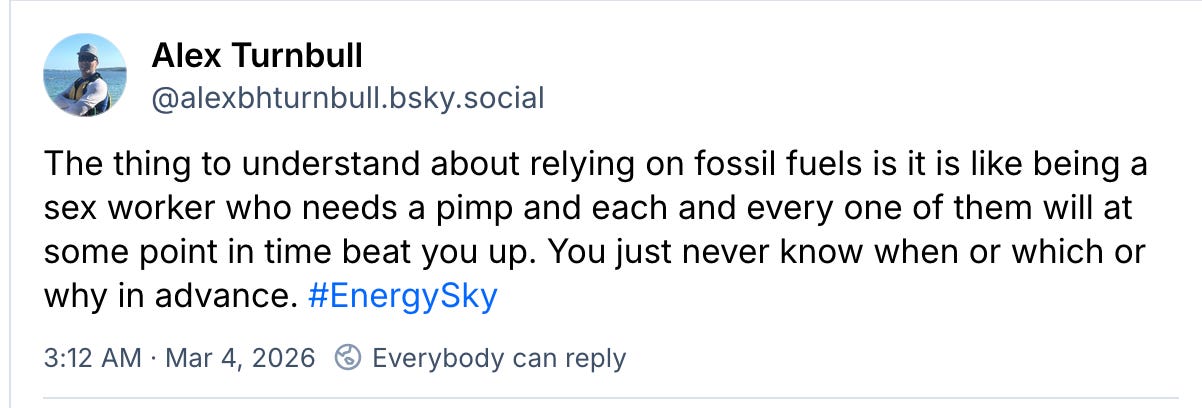
But despite spending trillions protecting global oil routes, we remain economically vulnerable to disruption in oil supplies.
Why? Because oil is a globally priced commodity: everyone pays the same price. When something disrupts supply anywhere in the world, prices go up everywhere — including in the U.S.
This occurs despite the United States being the largest oil producer in the world.
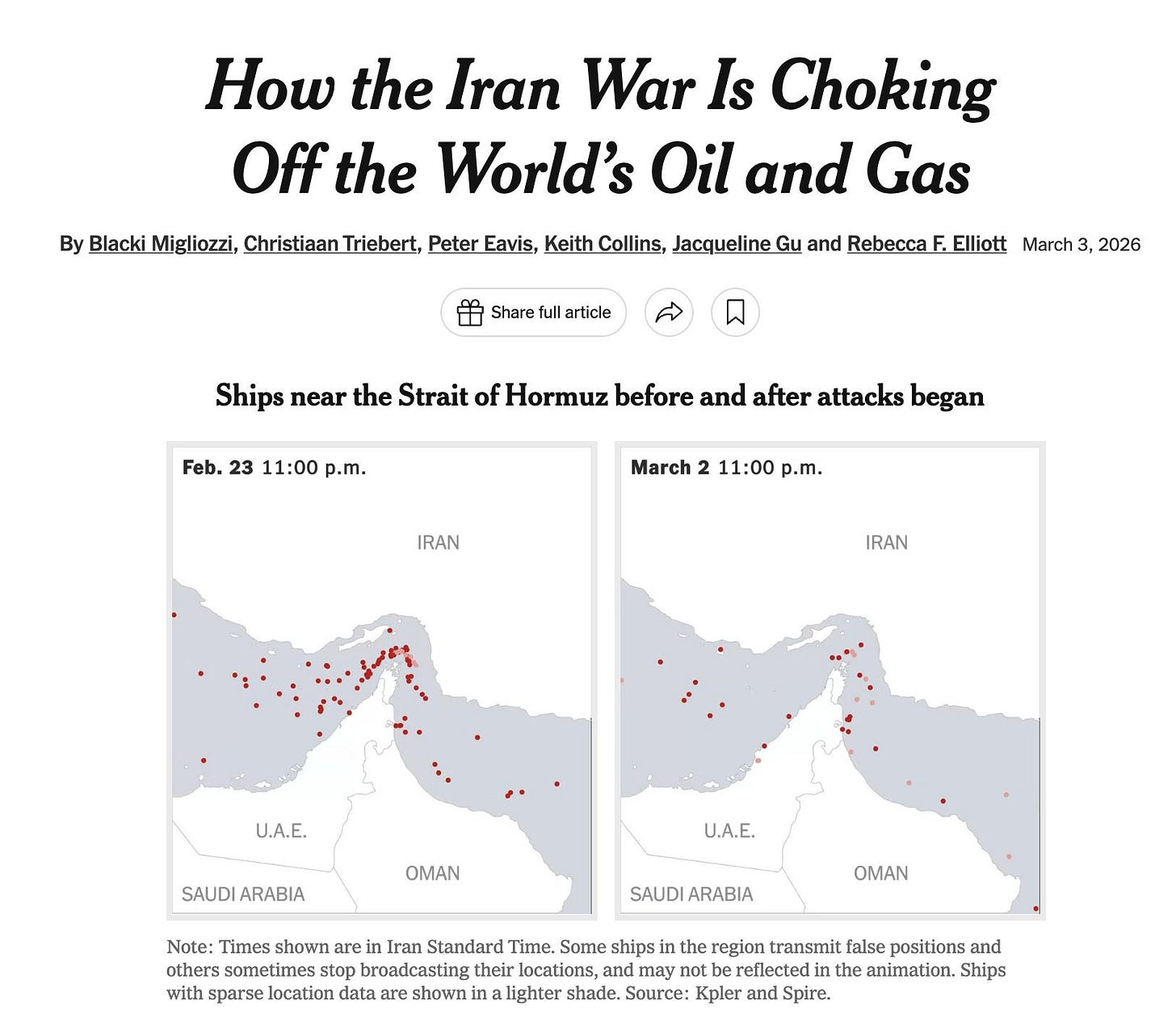
We saw this play out in real time just last week. Following U.S. and Israeli strikes on Iran, oil prices surged. Gas prices are following. And this was before the conflict escalated to directly threaten the Strait of Hormuz — a waterway through which roughly 20% of the world’s petroleum flows every day.
real energy security
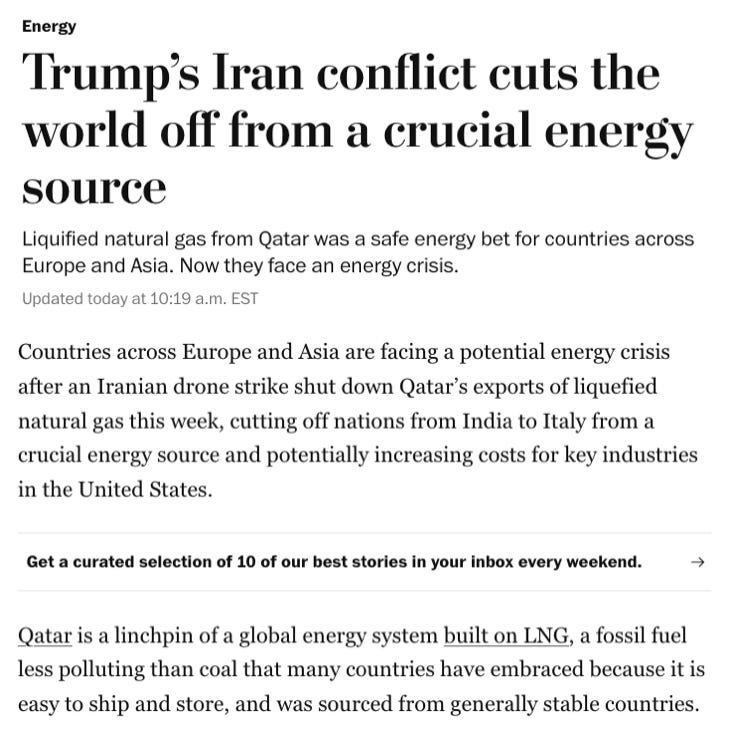
Fossil fuel pushers don’t want you to understand this. And they particularly don’t want you to recognize that the price of solar energy and wind energy is not affected by events in the Middle East. A missile strike on Iranian oil infrastructure has zero effect on the cost of generating electricity from a solar panel in Texas or a wind turbine in Iowa. The “fuel” — sunlight and wind — is free, domestic, and geopolitically inert.
This is one of the key reasons China is pushing electric vehicles with government industrial policy so strongly. They import most of their oil and this has created an enormous geopolitical risk. Electric vehicles, charged by rapidly growing solar energy, is an important way China is addressing the national security problems of fossil fuels.
In many parts of the country and world, solar and wind are now the cheapest sources of new electricity generation — full stop. Not because of subsidies (though those exist but are likely smaller than those for fossil fuels), but because the underlying economics have shifted irreversibly.
Renewable energy is the only credible path to energy and economic security. “Drill, baby, drill” is a fantasy — and an expensive one. More drilling means more pain, not more security.
time to move on
It’s worth pausing to appreciate what fossil fuels made possible. They powered our civilization for the last 200 years. But the transition to renewable energy isn’t a rejection of that legacy — it’s the next chapter. And it’s a better one.







The moral and capitalistic rot in the USA is changing the world, thank goodness the corporations don't own sunlight and the wind. www.youtube.com/watch?v=y_q741QO_m0&t=183s