



 Arguments







Recent Comments
Prev 2631 2632 2633 2634 2635 2636 2637 2638 2639 2640 2641 2642 2643 2644 2645 2646 Next
Comments 131901 to 131950:
-
DWP at 12:48 PM on 13 May 2008It's the sun
Well it's a complicated topic, as usual in climate, and I was skipping over most of that complexity above (especially the important role of clouds!). It's fascinating though, espeically as it is a way of probing how the models are simulating climate versus reality. The canonical reference is Easterling et al., Science, 1997 (p. 364-367). However, anyone who looks into this should also look at the updated work. For example, I'd suggest Stone and Weaver, Geophys. Res. Lett. 2002, v. 29, p. 1356; Braganza et al., Geophys. Res. Lett. 2004, v. 31, L13217; and the summary in the 2007 IPCC report of Working Group 1, in particular, Figures 3.2 and 3.11 and the discussion of those. -
Craig Allen at 10:06 AM on 13 May 2008Is Pacific Decadal Oscillation the Smoking Gun?
I posted the following at RealClimate, but folks may be interested here. The following article is about the ‘Weather Olympics’ that will be run alongside the Beijing Olympics, in which international teams will compete to predict Beijing’s weather with 36hr forecasts. >> Teams prepare for weather Olympics Perhaps we similarly need an annual climate forecasting competition. There could be multiple events: 1. Global average temperature. 2. Regional average temperatures. 3. Arctic and antarctic ice extent prediction. 4. Glacial extent. 5. El Nino/La Lina prediction, along with predictions for a bunch of other such phenomena. etc. And where appropriate there could sub-events for different time periods or for trends rather then absolute values. Then we’ll be able to see who’s models and theories stack up to the cold hard facts of reality the best. There seems to be resistance to ideas like this among the scientific community. Not sure why. Climatologists are having trouble getting the general non-scientific community to take the science seriously, rather than the guff from denialists. Something like this would distill the work in a way the public could understand and in a manner that the media would run with. -
Wondering Aloud at 01:14 AM on 13 May 2008CO2 lags temperature
lest we forget. http://www.geocraft.com/WVFossils/Carboniferous_climate.html -
Wondering Aloud at 00:54 AM on 13 May 2008Has solar cycle 24 begun?
Now you're scaring me. -
frankbi at 21:47 PM on 12 May 2008Models are unreliable
"all the facts in Poptech's post are verifiable. I learned them in school." I don't think that's what "verifiable" means. As always, the "criticisms" of climate models are devoid of any concrete, testable facts. -- bi, International Journal of Inactivism, http://frankbi.wordpress.com/ -
DWP at 14:35 PM on 12 May 2008It's the sun
Good article, but I'd suggest augmenting it with two other points showing that the recent warming is not due to the sun: 1) If the surface warming was due to the sun, you'd expect the entire depth of the atmosphere to be warming. However if the surface warming is due to the release of anthropogenic greenhouse gases, you'd expect the stratosphere to cool, partly due to decreasing stratospheric ozone (which heats the stratosphere by absorbing incoming solar UV radiation) but more because increasing GHGs in the stratosphere more efficiently radiate that ozone-absorbed heat, leading to a net cooling above the tropopause. Observations from satellites show that the stratosphere is cooling, which directly contradicts the hypothesis that the warming is coming from the sun, but agrees with the hypothesis that the warming is coming from greenhouse gases. 2) If the warming were due to the sun, you'd expect the increased shortwave input to the Earth to result in more warming during the day than at night. If the warming were due to anthropogenic greenhouse gases, you'd expect nighttime temperatures to increase more than daytime, since nighttime temperatures are more directly influenced by downward longwave radiation emitted by the atmosphere (as greenhouse gas concentrations increase, they warm and emit more downward longwave radiation, warming the surface). Observations in fact show more nighttime warming than daytime warming. Keep up the good work.Response: DWP, find me some peer reviewed studies highlighting point 2 and I'll be more than happy to do a post on the topic. As for point 1 on the cooling stratosphere, that's another topic on the to-do list :-) -
cce at 05:06 AM on 12 May 2008Is Pacific Decadal Oscillation the Smoking Gun?
GISS does not diverge noticeably from the other temperature series. If any series diverges from the others, it's UAH which shows the least amount of warming. http://cce.890m.com/temp-compare.jpg http://cce.890m.com/giss-vs-all.jpgResponse: Thanks for the links - here's what the second graph looks like:
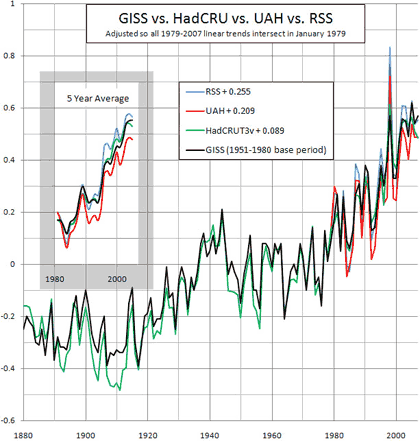
-
Dodo at 20:17 PM on 11 May 2008Do 500 scientists refute anthropogenic global warming?
Professor Sugden should be adviced to take note of Richard Feynman's attitude towards science: Any time we come up with something new, our responsibility as scientists is to try find out what is wrong with it. (Don't have the exact quote at hand, but i am sure it was better in the original wording). Now everybody is more concerned about who belongs to which tribe in the climate war than about trying to find out how they themselves might have erred. After every new paper one should ask: how could this be falsified? If that can be answered, we are talking science, if not, politics. -
Dodo at 19:23 PM on 11 May 2008Is Pacific Decadal Oscillation the Smoking Gun?
You write: "The long term warming trend indicates the total energy in the Earth's climate system is increasing." Actually, the trend you are talking about is a snapshot of the lower troposphere at about 2 meters altitude (plus an estimate of average sea surface temp). It gives us very little information about the total energy content in the oceans, which are at least an order of magnitude greater as energy reservoirs as the atmosphere. Btw., why do you keep using the GISS temperature data which diverges notably from the other temp time series? Don't you trust HadCRUT or the satellite MSU series, because they show less warming? Or do you have strictly methodological arguments for your choice?Response: A good point - the ocean contains something like 84% of the heat absorbed by the earth and it's long term trend is a good measure of the climate's energy imbalance. Hansen 2005 uses the warming oceans to calculate the net forcing at 0.85Wm-2. As for why I use GISS over others, for the sake of this discussion, only GISS and HadCRUT go back to the start of the century. Both show an overall warming trend so the argument of a long term energy imbalance is the same regardless of which dataset you use.
GISS covers the entire globe whereas HadCRUT omits polar regions so you could argue GISS Temp offers a more complete picture of 'global' warming. But in actuality, I just haven't got around to downloading and parsing all the different datasets. Lucia at rankexploits.com takes the average of the 4 major datasets (GISS, HadCRUT, RSS and UAH) which is an interesting approach. -
Geoff Larsen at 09:32 AM on 11 May 2008Is Pacific Decadal Oscillation the Smoking Gun?
John, in relation to PDO/ENSO, you are aware, I guess, of Roy Spencer’s theory on internal radiative forcing. From the 2nd link below, “Internal radiative forcing refers to any change in the top-of-atmosphere radiative budget resulting from an internally generated fluctuation in the ocean-atmosphere system that is not the direct result of feedback on temperature“. He has an article in print in the Journal of Climate. From his homepage: - http://www.weatherquestions.com/Roy-Spencer-on-global-warming.htm “Our latest article, "Potential Biases in Feedback Diagnosis from Observational Data: A Simple Model Description", has been accepted for publication in Journal of Climate. It uses a simple climate model to show how daily noise in the Earth's cloud cover amount can cause feedback estimates from observational data to be biased in the positive direction, making the climate system look more sensitive to manmade greenhouse gas emissions than it really is”. Also: - “I have asked the editor of the Bulletin of the American Meteorological Society to consider publishing a paper I have written entitled, "Evidence for Internal Radiative Forcing of Climate Change". I believe that this paper addresses the single most important issue neglected by the U.N.'s Intergovernmental Panel on Climate Change (IPCC): Natural climate variability generated within the climate system in the form of INTERNAL radiative forcing. This paper is a generalization of our paper that has just been accepted for publication in Journal of Climate, and describes how mixing up of cause and effect when observing natural climate variability can lead to the mistaken conclusion that the climate system is more sensitive to greenhouse gas emissions than it really is. It also shows that a small change in cloud cover hypothesized to occur with the El Nino/La Nina and Pacific Decadal Oscillation modes of natural climate variability can explain most of the major features of global average temperature change in the last century, including 70% of the warming trend. While this does not prove that global warming is mostly natural, it provides a quantitative mechanism for the (minority) view that global warming is mostly a manifestation of natural internal climate variability. (This paper is sure to be controversial, and it will be interesting to see how difficult it will be to get published.)” In relation to this see also his post in Climate Science: - http://climatesci.org/2008/04/22/internal-radiative-forcing... If his theory is essentially correct then: - 1. Much of the Net forcing (w/m2) in your chart above, since the 1970’s, can be attributed to internal radiative forcing. 2. Feedback to GHG forcing is much less, or even –‘ve. The latter implies sensitivity to 2 X CO2 of less than 1C. 3. If the PDO has changed to a longer term , –ve phase, with a dominant presence of La-Ninas over El- Ninos, then we are in for a sustained period of less warming or even cooling. 4. Over the longer term the ocean cycles will probably cancel out but we are left with a much smaller increase in radiative forcing & feedback, due to GHG’s, then we have been led to believe. The mistake has been to “extrapolate” the recent warming as if it was almost all due to GHG’s. 5. The theory probably needs to be expanded to include all the major ocean fluctuations. -
Quietman at 13:42 PM on 10 May 2008Is Pacific Decadal Oscillation the Smoking Gun?
John I do not believe that there is a single smoking gun anywhere, or conversely, there are many smoking guns. Re: "oscillations cause short term internal variability but don't explain the long term trend which is caused by the energy imbalance" in your response. The North Atlanyic long cycle is not a short term effect. See A Pervasive 1470-Year Climate Cycle in North Atlantic Glacials and Interglacials: A Product of Internal or External Forcing?. And as for the record El Nino year of 1998, see Predictable Winter Climate in the North Atlantic Sector During the 1997-1999 ENSO Cycle. It seems that these record years are a product of various cycles overlapping at just the right time. -
Robert S at 13:37 PM on 10 May 2008There is no consensus
Paledriver (54), You misunderstood me: Frankbi said this "Remember the claim that there were 19,000 scientists disputing global warming? During the New York denialist conference ("2008 International Conference on Climate Change"), it turned out there were only _19_ scientists. Looks like the number 19,000 is off by a factor of 1,000." I responded to that point with this "Beyond that, the 19,000 scientists are not all in climate related field, but apparently the Scientific American did some "crude extrapolating" and found roughly 200 climate researchers in the bunch. Again, not 19,000, but still a respectable number." The 200 were supposedly from the OISM petition. And the link in your post at 56 is basically the same thing as frankbi's link at 53. -
Quietman at 13:14 PM on 10 May 2008Is Pacific Decadal Oscillation the Smoking Gun?
Steve L I posted some links on El Nino / La Nina in the Volcano thread that you might find interesting. In summary, it says that a volcanic eruption in the Andes always precedes an El Nino. CO2 is released when a volcano erupts as well. But the real impact is the El Nino itself (record highs). -
paledriver at 06:10 AM on 10 May 2008There is no consensus
since the topic in this forum is "the consensus" I thought I'd forward this http://www.desmogblog.com/500-scientists-with-documented-doubts... -
Steve L at 03:25 AM on 10 May 2008Is Pacific Decadal Oscillation the Smoking Gun?
gx, thank you for disabusing me of the notion I was promoting. I don't remember where I was told that the CO2 in '98 came from the ocean (I think it was a commenter at CA). It shows how much more valuable comments are when they include links to relevant primary literature. However, I still wonder about the reduction in CO2 associated with Pinatubo, and given that different parts of the ocean can be sources while the rest is a sink, I wonder if there is a non-negligible effect on the noise in CO2 trend from oceans. Your links suggest another interesting thing. The stronger effect of forest burning says something about the scale of forest burning for agriculture, don't they? I would assume that there are trends in agricultural burning, but it's trends in precipitation that are observed in atmospheric CO2. -
Wondering Aloud at 00:32 AM on 10 May 2008There is no consensus
Phillippe I don't see where you get the idea that the rate of increase of CO2 is unprecedented, or even relevent. It is supposed to be atmospheric content that makes the difference and by those standards we are not at or near anything extreme. So that argument doesn't work. But I guess that is another thread. -
Wondering Aloud at 00:22 AM on 10 May 2008It's the sun
SA When you talk about "tipping points" you are taking yourself very far beyond the idea of science. Carbon Dioxide levels have been many times what they are today without ever finding this supposed point so I'm not too concerned with it. I think it is nearly certain that the overall feedback effect is not a positive number, that is kept very quiet because it blows an enormous hole in the panic. I have no trouble with "oil money" if you have no trouble with the IPCC. Which owes it's entire existence to the pre-formed conclusion that CO2 causes warming. Or to the more than 100 times greater money, usually tax money, spent on the other side of the issue. This is a log in your own eye issue if ever there was one. I also don't quite follow how evidence that CO2 does not cause the problem you fear is reason to control it even more tightly. Ignored in all of this of course are all the questions that should probably come first like is warming good or bad or would greater CO2 benefit the biosphere? -
AnthonySG1 at 20:34 PM on 9 May 2008Al Gore got it wrong
Seems Gore was wrong afterall: http://scienceandpublicpolicy.org/images/stories/papers/monckton/monckton-gores_10_errors_old_and_new.pdf http://www.johnstonsarchive.net/environment/gore.html http://scienceandpublicpolicy.org/monckton/goreerrors.html http://article.nationalreview.com/?q=YmFiZDAyMWFhMGIxNTgwNGIyMjVkZjQ4OGFiZjFlNjc= -
AnthonySG1 at 20:25 PM on 9 May 2008Antarctica is gaining ice
OK smarties. If Antarctica is overall losing ice, then how do you explain the data? http://arctic.atmos.uiuc.edu/cryosphere/IMAGES/current.area.south.jpg The Arctic doesn't seem to be doing so bad anymore, also: http://arctic.atmos.uiuc.edu/cryosphere/IMAGES/current.area.jpgResponse: Note: the rebuttal above has been updated since this comment was posted, incorporating later references and clarifying that sea ice and land ice are two separate phenomena. Antarctica is losing land ice at an accelerating rate. Sea ice around Antarctica is increasing. The reasons for sea ice increasing in a warming Southern Ocean are complex and described in detail above. -
rcglinsk at 15:22 PM on 9 May 2008Models are unreliable
Poptech, nice job of trying to help people understand what computer modeling is and what it can do. Folks, if a climate model doesn't predict past data 100% perfectly then it's useless. You can create an infinite number of different mathematical models that will predict any data series 100% perfectly. To deserve any respect these climate models must predict the previous data perfectly as a start, none should even be thought about unless it does that, and then it has to predict the future better than a simple polynomial fit that also perfectly predicts past data. Frankbi, all the facts in Poptech's post are verifiable. I learned them in school. His analysis is spot on. -
Quietman at 08:53 AM on 9 May 2008Can animals and plants adapt to global warming?
chris I agree to some extent but feel that CO2 does not play as big a role as you indicate. Its primarily a feedback mechanism and needs something to feedback from, that is why there is a lag to temp increases. Asd you mentioned Milankovitch cycles, these appear to be a major climate driver but not the only one. Then there is the Fairbridge sea level cycles and his last hypothesis about solar (system) cycles, about which Mackey did a paper on after Dr. Fairbridge passed away. AGW is about an artificial CO2 feedback but there is also a very real natural CO2 feedback mechanism. PS - In my original comment "interesting" was in reference to the potential comments opened up by this particular subject which I am much more familiar with than climate science. -
gx at 18:19 PM on 8 May 2008Is Pacific Decadal Oscillation the Smoking Gun?
About April anomaly,over land Asian exceptional anomaly has greatly reduced while antarctica interior has been warm this month,oceans are warming slowly despite la nina rapid decline(there is a 2-3 months lag beetwen ocean temps and ENSO) thus do not expect a very warm month as March(neither cold anyway). RSS satellite data are stable due to land cooling compensated by ocean warming but satellite data are more sensitive to tropical SST change and less to land surface anomaly... RSS land and ocean data: MSU Land Temp MSU Ocean Temp And some information about MSU vs tropical SST -
paledriver at 08:13 AM on 8 May 2008There is no consensus
#52, Robert S., I don't know where you got 200 climate researchers were there, but there are over 20,000 climate scientists in the U.S. alone according to the AGU, so even there were 200 in attendance, and assuming they were all skeptics, that's still only about 1%. That would qualify as an overwhelming consensus in my book. -
gx at 22:50 PM on 7 May 2008Is Pacific Decadal Oscillation the Smoking Gun?
co2 interannual varibility is mostly due to tropical land fluxes,droughts and fire in the Amazon basin and Indonesia during el nino are the main driver not ocean release/absorption: http://www.atmos-chem-phys.org/3/1919/2003/acp-3-1919-2003.html http://cat.inist.fr/?aModele=afficheN&cpsidt=16775977Response: Those are both interesting papers, thanks for the links. -
Steve L at 12:59 PM on 7 May 2008Is Pacific Decadal Oscillation the Smoking Gun?
Responding to the possibility of atmospheric CO2 declining this year ... well, the 1998 El Nino was associated with higher CO2 concentrations (presumably due to the Pacific releasing it or failing to absorb much due to warm surface temperature). Also, after Pinatubo there wasn't much increase in CO2 (despite the volcanic release), I guess because it was colder and the ocean surface absorbed more CO2? I wonder if the size of the economy can be reconstructed from trends in CO2 concentrations? That's presumably another factor that COULD contribute to a lower-than-expected CO2 concentration in 2008, although I greatly doubt it. -
tbandrow at 02:13 AM on 7 May 2008Is Pacific Decadal Oscillation the Smoking Gun?
I don't think anyone doubts that global temperatures will continue to rise. After all we're continually enhancing the levels of atmospheric greenhouse gas levels, and temperatures are already on their way up to a new equilibrium level "set" by the enhanced greenhouse gas levels already up there. Some people do have that doubt. So, what I'm trying to do is set up an actual conditions of a simple experiment. John's been super enough to basically describe his view of things and its certainly mainstream enough. La Nina ends, and global temperatures will rise for it through the year. If the temperatures rise, then, yeah for Hansen and friends. current models are more validated and the sunspot people made a prediction that failed. we have a weak solar cycle, low flux and sunspots, and the earth's temperature still goes up. That would pretty much do it. If the temperatures fall, though, then yeesh, there's work to do. If there is some sort of mechanism driving the climate than a lot more science needs to be done. But, at least there is a, double yeah for Hansen and friends because they at least have some software base that will need to be adjusted to reflect new things learned. I am skeptical of global warming per se, but that doesn't mean I oppose the use of computer models as a means of encoding scientific knowledge. Rather, I just think the current models suck. It's been my experience that most experts in some other field are horrible programmers, and I'm a computer programmer. I had a look at Hansen's GCM, and although my FORTRAN is very rusty, what they have in there just seems absurd. Some other climate models seem to use the same sort of analytical and modelling techniques used by the finance industry, and that's been a 200 billion dollar fiasco -so far-. I have a sort of a dream that I'm going to write a GCM that doesn't suck and so this immediate experiment interests me. So, I'm not coming from the perspective of denial because a lot of people of a left wing ilk are pushing it. Rather, I see an opportunity for my capitalist friends to really cash in on climate by offering someday a -better model-. So, to other skeptics, I would say, if you don't like the model that is out there kicking out global warming predictions, make one that is more accurate. If you can't, then get out of the climate business and let the pros do their jobs. -
chris at 22:42 PM on 6 May 2008Can animals and plants adapt to global warming?
Quietman We know reasonably well well why ice ages occur. In the general case, major glacial epochs (we're in one now) are associated with low atmospheric CO2 levels. For example the present glacial epoch began during the Miocene. The early Miocene glacial period around 20 million years ago (mya) is associated with the late Oligocene-early Miocene decrease in atmospheric CO2....the middle Miocene climate optimum (so-called) with a rise of atmospheric CO2, and then the late-Miocene expansion of the East Antarctic ice sheet is associated with a drop in atmospheric CO2 around 14 mya [*****] Of course these glacial periods also require other factors...for example the Miocene glaciations that heralded the start of the cool period which we're still in, wouldn't have occurred (or at least not to the same extent) without a land mass in the Antarctic for ice to build up on.... Likewise the earliest glacial epoch on Earth more than 3 billion years ago was likely the result of the evolution of the first photosynthetic organisms that produced oxygen which eventually (after turning enormous amounts of oceanic iron salts into iron oxide) destroyed (oxidised) the high methane concentrations that was then "helping" to warm the early Earth. As for the ice age cycles within the current glacial periods, these are also quite well understood, as I'm sure you know. They result from the slow cyclic variations in the orbital properties of the Earth (google Milankovitch cycles) that result in slow and small variations in the pattern of solar irradiation on the Earth. These cycles have associated variations in greenhouse gas concentrations (especially CO2). I think it's quite clear that we are in an interglacial period which still has quite a few thousand years to "run". [*****]e.g. Kurschner WM et al. (2008) The impact of Miocene atmospheric carbon dioxide fluctuations on climate and the evolution of terrestrial ecosystems; Proc. natal. Acad. Sci. USA 105, 449-453. Abstract: "The Miocene is characterized by a series of key climatic events that led to the founding of the late Cenozoic icehouse mode and the dawn of modern biota. The processes that caused these developments, and particularly the role of atmospheric CO2 as a forcing factor, are poorly understood. Here we present a CO2 record based on stomatal frequency data from multiple tree species. Our data show striking CO2 fluctuations of approximate to 600-300 parts per million by volume (ppmv). Periods of low CO2 are contemporaneous with major glaciations, whereas elevated CO2 of 500 ppmv coincides with the climatic optimum in the Miocene. Our data point to a long-term coupling between atmospheric CO2 and climate. Major changes in Miocene terrestrial ecosystems, such as the expansion of grasslands and radiations among terrestrial herbivores such as horses, can be linked to these marked fluctuations in CO2." -
John Cross at 11:34 AM on 6 May 2008Is Pacific Decadal Oscillation the Smoking Gun?
Chris: some comments about your point (i). The PDO came about from fishery research in Alaska so I suspect that the warm / cool is a local description (and not really a useful one either). My guess is that we will start to see the term positive and negative phase used more and more. Keep in mind the idea of the PDO is only about 10 years old. Regards, John -
chris at 05:43 AM on 6 May 2008Is Pacific Decadal Oscillation the Smoking Gun?
Some general comments and questions about this thread. There are a number of things that I'm confused about: (i) All of these ocean oscillations (El Nino's, La Nina's and the Pacific Decadal oscillation) act to modulate the global surface temperature through the redistribution of solar energy with respect to the ocean surface and depths. In El Nino years, for example, warm surface waters spread across large parts of the equatorial Pacific with a suppression of cold water upwelling of the West coast of S. America. So the Earth's surface temperature rises a tad during the period of this phenomenon....however the contribution to any long term trend (e.g. drien by greenhouse-warming) is close to zero. However, according to your Figure 2, the warm phase of the PDO seems to be associated with reduced sea surface warmth overall. Apparently the PDO is identified with respect to the pattern of sea surface temperatures near the NW coast of the US and Canada. But this seems a highly localized affair! Unless something untoward is happening on the other half of the globe (hidden in Figure 2), I don't understand what's going on. I actually assumed that you might have mislabelled Figure 2 a and b, but apparently not. It does look a bit odd to me...much larger areas of red and dark red in the "cool" phase of the PDO.. (ii) What are the predictable elements of the PDO in the analysis of Keenlyside et al? I had a quick read through their paper and it doesn't seem obvious to me. In other words what is it about the PDO that is sufficiently predicatble that Keenlyside are basing their projections on its future behaviour? It's not particularly cyclic (see your Figure 1), so what is it? Anybody got a simple explanation? (iii) Keenlyside et al [Nature 453, 84-88, 2008; link in Johns summary at the top of the thread] seems slightly problematic to me. In their Figure 4 (top of page 87), their "hindcast/forecast" shows zero global warming between 1985 and 2000. They consider the latter parts of this period as "verification". I would conclude that their "verification" has failed somewhat! Their "forecast" indicates that the period between 1985 and 2005 should give a temperature increase of around 0.1 oC. That's much smaller than the measured global temperature rise during this period... again that might be taken to indicate that their "forecast" isn't actually that good. (iv) A general point. I wonder whether the efforts at short-medium term "forecasting" are premature, or if not premature, might be being taken out of context. If there are stochastic elements of the climate system that are not well-defined [see point (ii)], aren't these "forecasts" similar to "guesses"? Modelling seems a rather good way of assessing the equilibrium temperature increase in response to various greenhouse gas emission scenarios, and giving us some indication of the time scale of temperature increase and the geographical distribution of excess warmth. But rather detailed forecasts of the Earth's temperature evolution over periods of a few years to decades seems problematic to me. I can understand the value of these efforts in (a) the continuing development of modelling efforts and (b) as a test of our understanding of the various elements of the climate system and their interactions, and so on...but they really need to be understood in those terms I would have thought. I don't think they should be considered as "true forecasts" in the wider sense. They're certainly not "predictions", although unfortunately many will consider them to predictions, and will no doubt be ready to jump on them when the forecasts turn out not to be correct... -
chris at 04:58 AM on 6 May 2008Is Pacific Decadal Oscillation the Smoking Gun?
tbandrew, re your comments: ["LaNina ended in April. Are you standing by the assertion that global temperatures will continue to rise now that that has happened? If they do decline, then what is the cause? And, what would you say if the Mauna Loa CO2 measurements for this year actually -decline-."] I don't think anyone doubts that global temperatures will continue to rise. After all we're continually enhancing the levels of atmospheric greenhouse gas levels, and temperatures are already on their way up to a new equilibrium level "set" by the enhanced greenhouse gas levels already up there. The point of this thread is that internal variability in the climate system (El Nino's, La Nina's, and more specifically to this thread, the Pacific Decadal oscillation) might act to counter the greenhouse-induced surface temperature rise for a while. Of course if the sun "decides" to burn a tad cooler or we have a serious bout of volcanic activity, then greenhouse-induced warming will be delayed further....but one cannot massively enhance the concentration of atmospheric greenhouse gases and not expect that the world will warm.. And it's rather unlikely that the atmospheric CO2 levels will decline during 2008. They're already well above 2007 levels. Why should they decline? What's your proposed mechanism whereby addiding CO2 to the atmosphere will result in a decreaed level of atmospheric CO2, particularly as the oceans absorption of CO2 is already becoming somewhat less eficient?? here's the data: http://www.esrl.noaa.gov/gmd/ccgg/trends/ (either view the Mauna Loa data or scroll down the page for the globally averaged sea surface CO2 data). -
John Cross at 03:41 AM on 6 May 2008Is Pacific Decadal Oscillation the Smoking Gun?
Tbandrow: In regards to the temperatures, I would be surprised if they continued to grow. I am actually expecting a small decline in April's temperature - only because the March temperature was so large. I do not expect them to return to the January / February levels. In regards to the CO2 levels, if there is no annual growth in the CO2 levels then I will be extremely surprised. Regards, JohnResponse: The Australian Bureau of Meteorology have updated their Southern Oscillation Index and La Nina continues to subside. So as a broad guesstimate, I expect April's temperatures to be around level to March, possibly slightly higher depending on whether they get Africa's data this month and whether Russia's massive heat wave continues. -
Quietman at 02:11 AM on 6 May 2008Is Pacific Decadal Oscillation the Smoking Gun?
tbandrow Good points. But how about the gases and particulates from burning buildings, burning fuel and supply dumps, burning vehicles and ships and the gases from the ammunition of all types expended. Being a combat veteran I am somewhat familiar with the effects of a combat zone and its a dirty place. Just think about the Kuwait conflict where Sadam burned the oil fields. That is a lot of emissions all at once. In WW2 the allies burned a lot of oil fields. But, like I said, its just a thought. -
tbandrow at 01:06 AM on 6 May 2008Is Pacific Decadal Oscillation the Smoking Gun?
The reference to WW2 is figure 4. The confilct in Europe began in 1936 and the Pacific conflict slightly earlier. An interesting anomaly that could easily have been AGW due to the wartime industry and the conflict itself. Just a thought. You might have us on climate but your history suffers for it! Fuel demands were much, much lower then. By way of example, the US Army back then used 1/16th of the fuel of the fuel it uses today. Vehicles are heavier today, and faster. Jet engines gobble fuel. There were no helicopters in World War II. http://www.strategypage.com/htmw/htlog/articles/20080404.aspx This isn't to say that the USA fought WWII by itself, but, if anyone gobbled fuel during WWII, it was the USA. The Japanese and Germans both had tremendous fuel problems. Germany couldn't get fighters aloft for lack of fuel, and its own offensives often stalled for the same reason. By the end of the war, Japan was reducing to sending capital ships on suicide missions because they didn't have the fuel to actually operate them. Also, no army was as well mechanized as the US Army was. The German logistical train had a lot of steam engines and horse drawn transport, whereas the USA operated a lot of trucks. The Russians had a big, mechanized army too, and used a fair amount of fuel - but they didn't operate strategic bombers and a giant navy the way the USA did. domestically, the USA rationed gasoline "is this trip really necessary". Most passenger transport was by rail. If you look at most of the rail transport in the USA, you will see a lot of steam locomotives being pressed back into service. In fact, FDR actually forced some loco companies to keep making steam engines rather than diesels (which ultimate lead to their postwar demise), because coal was more available and steam was at least well understood. But locomotives are awefully cheap on CO2 compared to cars. I mean, a big steam engine of the day -might- make about about 2000 horsepower, (the biggest, Big Boy, was about double that), or about the power of 10 of today's car and not even close to the power of a single jet engine on a fighter aircraft. But out of that horsepower, you would pull a rail line that could probably be many, many passenger cars. The UP BigBoys pulled freight trains that were measured in -miles-. Moral of the story is, the cheapest way to go green is to build more rail lines and use more trains. -
tbandrow at 00:19 AM on 6 May 2008Is Pacific Decadal Oscillation the Smoking Gun?
That's all well and good, but earlier, you wrote to discredit the sunspot series, and you predicted that: a) the current drop in global temperatures was due to La Nina, AND b) that, once LaNina ended, global temperatures would continue that rise. LaNina ended in April. Are you standing by the assertion that global temperatures will continue to rise now that that has happened? If they do decline, then what is the cause? And, what would you say if the Mauna Loa CO2 measurements for this year actually -decline-.Response: My assertion was that the sharp cooling from Jan 2007 to Jan 2008 would reverse when La Nina reverses. I still expect that to occur (in fact, I believe it's currently occuring). If CO2 levels at Mauna Loa fell this year, it would be an interesting result. However, that is one station - if the global average of CO2 levels fell this year, I would be very surprised. -
Craig Allen at 17:13 PM on 5 May 2008Is Pacific Decadal Oscillation the Smoking Gun?
How are the forcings in plot 4 estimated?Response: The net forcing is the result of combining all the following forcings:

NASA GISS have links to further resources:
You can find out more at their Forcings in GISS Climate Model page. -
Quietman at 05:45 AM on 5 May 2008Is Pacific Decadal Oscillation the Smoking Gun?
John Cook Re your response to Steve L.: Deniers love it, the skeptics simply expected it. The trend forcast as 10 years is conservative. I have read that the trend down would last through 2040 and then resume upwards. I have also seen that it will have an inverse peak around 2022. Lets hope they are right as it give us a reprieve.Response: The global cooling predictions through to 2040 are usually based on predictions of cooling solar activity. I would treat those with healthy skepticism. I also hope they're right but don't think it likely (or frankly very possible). -
Quietman at 05:29 AM on 5 May 2008Is Pacific Decadal Oscillation the Smoking Gun?
John Cross The reference to WW2 is figure 4. The confilct in Europe began in 1936 and the Pacific conflict slightly earlier. An interesting anomaly that could easily have been AGW due to the wartime industry and the conflict itself. Just a thought. In figure 3 the correllation can also be seen to some extent but not in the trend line. It makes it clear that other factors are involved. -
Quietman at 02:46 AM on 5 May 2008Can animals and plants adapt to global warming?
chris On cycles and explanations for previous extinctions: I used those 2 articles simply because they were the most recent, not actually the most relavent. As you are aware the idea of extinction cycles is just hypotheses, while the idea of climate cycles has good evidence. In the case of the KT event, some paleontologists have pointed out that the dinosaurs were in decline from about 70 million years ago due to climate stress. The effect of the Deccan Traps and the Yucatan impact seem to be a fatal blow but most likely not within a cyclic extinction (my view). The PT event also involved an impact and the Siberian Traps but did they actually cause the climate change or again were they a coincidence that simply made things worse? The issue of clarity in climate cycles is simply that there are too many of them and not all of them identified as yet. Why do ice ages occur? Of the 4 major iceages why are they of different lengths and what causes their end. Are we now coming out of an ice age of merely within an interglacial? There are definate cycles involved but we still have a long way to go in understanding them. And I agree, Global warming does seem to be directly related to extinctions and I believe that it is the speed not the temperatures that are relavent. The warming slopes are much steeper than the cooling slopes, not allowing enough time for species to adapt. I simply disagree that mankind is the direct cause. But I feel that our mistakes have only made things worse. -
Quietman at 02:14 AM on 5 May 2008Can animals and plants adapt to global warming?
chris Thank you for the responses. My personal position is not as extreme as you might believe, in fact its closer to yours than average, I just don't get emotional about it. As I said, we, as a species, have made mistakes by not taking better care of the habitats that we live in and should attempt to correct these mistakes. I am not saying that the answer is to do nothing, but pointing out that our concentration should be on area that needs it the most like the Amazon deforestation issue. What I attempted to point out with polar bears is that they are adaptable, they are not actually in danger of extinction while other species are. With limited resources we should concentrate on the species that are both truely endangered and of greater benefit to both ourselves and out habitats. In doing so we will also be helping less endangered species like the polar bear. Barry Brook is pointing out the endangered areas, of SE Asia. While concerned, I feel we need to look in our own back yards first. By helping the ecology here we can do our small part. This however does not mean that I believe that extinctions over the past 10K years are not natural or that the endangered animals currently under stress were not already under stress, just more so. -
chris at 08:07 AM on 4 May 2008Can animals and plants adapt to global warming?
Quietman, On cycles and explanations for previous extinctions: Hunting around for the latest press releases and popular science articles as all-encompassing “explanations” for past events isn’t very helpful or scientific. Scientific explanations require a set of rather more self-consistent data and theoretical frameworks. A very recent paper that indicates that dinosaurs may not have had the genes for generating brown adipose tissues (the article in Science Daily that you urled), does not suddenly become the explanation for the demise of the dinosaurs, let alone the more widespread extinctions associated with the end-Cretaceus events! The possible lack of adipose tissue in dinosaurs certainly wasn’t the cause of end-Cretaceous extinction of ammonites, mosasaurs, plesiosaurs, various birds and mammals, plants and invertebrates, and so on.. In fact, if you read the paper referred to in your popular news article [N. V. Mezentseva et al (2008) “The brown adipocyte differentiation pathway in birds: an evolutionary road not taken”; BMC Biology 6 (17) 21 April 2008], you’ll see that the authors don’t mention dinosaur extinction at all (the words “extinct” or “extinction” don’t appear in their paper). No doubt the popular press article that you urled was “sexed up” by an editor to give it a punchy general appeal. The fact is that the end Cretaceous extinctions were not due to the possible lack of brown adipose tissue in dinosaurs, although that might or might not have contributed to the demise of that particular order. Regarding the dinosaurs, it’s rather more likely that the widescale attenuation of photosynthetic activity for a few years following an extraterrestrial impact was more than sufficient to kill off large herbivores and their predators. For the extinction event overall, the evidence indicates a combination of an extraterrestrial impact with a long term tectonic events associated with the Deccan Traps formation in non-India as the likely causal factors [e,g Beerling et al (2002); Keller (2005); Kelley (2007)]. But was the end-Cretaceous extinction part of a regular “cycle” of extinctions? The evidence isn’t very strong. You describe Wikramsinghe and Napier as indicating a 36 million year (my) cycle of extraterrestrial impacts that relate to passage of the solar system through the galactic plane. That paper isn’t available yet apparently, but a recent similar study by Napier [“evidence for cometary bombardment episodes” Mon. Not. R. Astron. Soc. 366, 977-982 (2006)] doesn’t present that compelling a case for a regularity of impacts. And after all, in the paper you previously cited as evidence of the cyclic nature of extinctions [Rohde and Muller, Nature 434, 208 (2005 )], the extinction “cycle” was supposed to be 62 my. You presumed from that study that we are “presently in one now” (i.e. an extinction, since the period is 62 my, and the last one was around 65 mya). However if the extinctions are actually supposed to “cycle” with a 36 my, then we shouldn’t be in an extinction now at all! So which is it? I suspect the problem relates to the search for “cycles”. The cosmic ray fluxers look at the extinction record and see a 140 my “cycle”; the astrobiologists “see” a 36 my “cycle”; Rohde and Muller “see” a 62 my “cycle”. It’s rather easy to “fit” sinusoidal variations into very sparse data sets (rather few extinction events; rather few impact craters; rather limited fossil record). I don’t have any problem with the possibility that there might be regular variations in the cometary intensity due to passage of the solar system through the plane of the Galaxy. The problem is that the evidence isn't that compelling, and there is really only one extinction event (end-Cretaceous) that has good evidence for a causal impact event. More compelling (to me!) is the data that focuses carefully on the extinction events themselves to identify features of the contemporaneous geological record to determine potential associated geological and environmental effects. When one does this, the most regular correlate of extinctions is tectonic events (doesn’t necessarily indicate causality of course!). A very recent reanalysis of the argon-argon dating “clock” has established, for example, that the massive Permian Triassic extinction correlates with the massive volcanic events associated with the formation of the Serbian Traps (see Science 25th April 2008)]. The end-Cretaceous extinction (dinosaurs et al) correlates with the tectonic events associated with the Deccan Traps formation. The Paleo-Eocene Thermal Maximum extinctions with the tectonic events associated with the opening up of the North Atlantic at a plate boundary. The Triassic-Jurrasic extinction (201.6 mya) associates with the massive volcanic outpourings of the central Atlantic magmatic province…and so on... Are these tectonic events governed by grand “cycles”. There’s no evidence for such a cycle, nor is there evidence for any causal attribute of periodicity in these processes. Actually, when one boils down the essential correlates of extinctions as these are best defined, the evidence indicates that global warming (as the result of the release of greenhouse gases) seems to accompany most extinction events, and that’s one of the compelling reasons for attempting to get to grips with these difficult to study events in the deep history of the Earth! ---------------------------------------------- Beerling DJ et al. (2002) An atmospheric pCO(2) reconstruction across the Cretaceous-Tertiary boundary from leaf megafossils; Proc. Natl. Acad. Sci. USA 99 (12): 7836-7840 Keller G (2005) Impacts, volcanism and mass extinction: random coincidence or cause and effect?; Austral. J. Earth Sci 52 725-757. Kelley S. (2007) The geochronology of large igneous provinces, terrestrial impact craters, and their relationship to mass extinctions on Earth ; Journal of the Geological Society 164, 923-936 etc.. -
chris at 07:57 AM on 4 May 2008Can animals and plants adapt to global warming?
Quietman, There are two issues here. One is the reality of our present impact on the biosphere and the additional consequences of global warming on a natural world suffering the effects of habitat destruction and fragmentation. That's what Barry Brook's article is about. The second is about the causes of previous extinctions and the possibility of cyclic causal factors. These can be addressed separately, since while past extinctions are clouded in various uncertaintites, the present extinction is not. So I'll address the current extinction in this post and the possibility of cyclic contributions to past extinctions in another. Notice that the possible contributions to past major extinctions are (whether cyclic or not) variously: tectonic events; catastrophic extraterrestrial impacts; changes in greenhouse gas concentrations (CO2; methane) resulting in global warming or cooling that may be associated with tectonic events or impacts; sea level changes; variations in the cosmic ray flux...(we might come up with some others...) NONE of these apply to the current extinction event even 'though the enhanced greenhouse contribution is likely increasingly to do so (that's the subject of this thread if you remember!). The last several thousand years, and especially the last several hundred years has NOT seen extinction-level tectonic events, extraterrestrial impacts, massive sea level changes, very large and persistent changes in the cosmic ray flux; large changes in greenhouse gas levels and so on... So the current extinctions are not a consequence of any of these, nor a consequence of any unspecified grand "cycles". They’re a result of mankind’s impacts on the biosphere, especially habitat destruction and fragmentation. Let's not pretend that we don't know what we do know! The problem with the attempt at passive dissociation from these realities is that it leads to a rather disinterested acceptance of events that might very well be in our control to address. So let's look at these: (i) You consider that our part in these processes (direct extirpation of species by hunting or persecution; habitat destruction and fragmentation; more recently, massive release of greenhouse gases) is a natural one. That certainly applies in the past; however not only is that an unhelpful notion in the present context (it lends to passive acceptance of issues we might otherwise address productively), but at some point that notion breaks down, at the very least at whatever time in our history we start to recognise the wider consequences of our actions, and it’s implications for our futures. So it’s not really “natural” anymore by most generally recognized meanings of the term. But however we might semanticize our present situation ("natural"/"non-natural"), the fact is that we might decide to address the problems since we recognise and understand these. We might choose to address policy that limits destruction of habitats and allows these to extend somewhat; we might take further measures to protect ocean species by setting up protected no-fishing respite zones in the manner that is being undertaken already; we might take measures to limit greenhouse gas emissions, and to curb human population growth...in fact we have to do some of these sooner or later…the only meaningful long term future for mankind is one based on stable populations in societies fueled by renewable energy sources for example, and that future starts rather soon! (ii) you suggest that we shouldn't "help" polar bears since they’re apparently a "competitor to us as a species" and "we share the same habitat" and "eat the same food" and "we should concentrate on saving species that are beneficial to us". Fair enough...but what a dismal philosophy if I may say so. After all why not kill off all species that we can't productively convert into domesticated animals for food, furs, milk, and other bits and pieces? And in what way is the polar bear a "competitor" which "shares or habitat" (Arctic continental margins and sea ice?) and eats the same food (seals?)? Mankind has co-existed pretty comfortably with polar bears and there's no reason why we can't continue to do so. It may be that the polar bear is doomed because its habitat is not going to survive the likely destruction of Arctic sea ice. But let’s recognize that that will be a diminishing prospect for us and the natural world and one that we might take careful note of, especially in relation to more effective protection of wilderness areas. There is a philosophical issue here of which Barry Brook’s article highlights one side and your posts highlight a rather extreme other. On the one hand, we can make mature and rational attempts to inform ourselves about the natural world, our place within it and our impacts, as indicated by careful observations and analysis, and then address these in relation to concerns about our wellbeing and that of our near descendants (who will themselves have to address these issues)… ..or on the other hand, we can sit back and wash our hands of the whole affair, using as justification for our passivity, pseudoscience notions of “natural” “cycles”, which we are apparently helpless to explain and understand. -
Steve L at 04:06 AM on 4 May 2008Is Pacific Decadal Oscillation the Smoking Gun?
Dear Johns, my immediate impressions follow: First, comments in the links regarding abilities to forecast El Nino, etc, seem a bit optimistic; also, it seems quite early to have any confidence in a forecast of PDO. Second, who named the 'warm' and 'cool' phases of the PDO phenomenon? Must have been North Americans? Third, Pinatubo caused the low forcing in 1992, and I suppose El Chichon caused the downspike in 1983. Google helped me find Agung in 1963 -- is that the cause of the mid-60s downspike? One can go to lots of internet locations to find discussion of the quality of temperature measurements; what's the best place to look to learn about reconstructed estimates of forcing?Response: Re the accuracy of the new model's predictions of El Nino, PDO and North Atlantic short term behaviour, this is the most ironic element of the whole situation. These are new models testing new methods - inevitably, they'll be refined and improved over time and there'll be inaccuracies. And yet as they're predicting results the skeptics like (eg - cooling in the short term), the skeptics suddenly have lost their skepticism for climate models - or at least for these results.
Re forcing reconstructions, there are links to papers and people at the NASA GISS page on forcings. -
John Cross at 03:47 AM on 4 May 2008Is Pacific Decadal Oscillation the Smoking Gun?
Quietman: Are you talking about Figure 4? If so, I see the spot you are talking about. I could also make an argument for an earlier period of say about 1905 to 1925 - but I tend not to trust forcing estimates from that early. NewYorkJ: Thanks for the links. I had a skim through but have booked marked it to go back to and read in more depth when I have the time. Regards, John -
NewYorkJ at 03:05 AM on 4 May 2008Is Pacific Decadal Oscillation the Smoking Gun?
Regarding the Keenlyside forecast, most media reports are missing a key piece - that the temperature projection converges with the IPCC projection within 20 years. http://climateprogress.org/wp-content/uploads/2008/05/nature5-1.jpg http://climateprogress.org/2008/05/02/nature-article-on-cooling-confuses-revkin... -
Quietman at 00:50 AM on 4 May 2008Is Pacific Decadal Oscillation the Smoking Gun?
Johns I see that there is a lack of correllation from the beginning of WW2 through a couple years past its end. Otherwise it appears to be a faily good match.Response: Looking at Hansen 2005's model hindcasts, they also show less correlation around the 1940's. I'm guessing it's due to internal variability - possibly strong El Nino at the time? I haven't looked at it in detail yet though (but plan to for a future post on mid-century cooling). -
Quietman at 13:53 PM on 3 May 2008Can animals and plants adapt to global warming?
chris Since you chose the KT event as an example, I can addrss that event. The cyclic influences, Sun's Movement Through Milky Way Regularly Sends Comets Hurtling, Coinciding With Mass Life Extinctions *1. This gives a slightly xhorter cycle than the Berkely study. But the dinosaurs were already in decline before the Yucatan impact and before the eruption of the Deccan Traps due to a cooling climate which they could not adapt to. Their problem was that Dinosaurs Probably Lacked Tissue To Generate Heat *2. Vulcanism and the impact pushed them over the edge. There are a lot of forcing cycles for climate change and for extinctions vulcanism and impact cycles also must be included (see Johns PDO title, the solar titles and the volcanos title for just a few). *1 Adapted from materials provided by Cardiff University *2 Adapted from materials provided by New York Medical College -
stephen at 13:36 PM on 3 May 2008Do 500 scientists refute anthropogenic global warming?
You guys might have heard about this, but there are some very annoyed scientists around now that they have discovered their names are on the list without permission. They are also very annoyed at having their science twisted around to suit Heartland's purposes e.g. "I am horrified to find my name on such a list. I have spent the last 20 years arguing the opposite." Dr. David Sugden. Professor of Geography, University of Edinburgh" -
Quietman at 10:53 AM on 3 May 2008Is Pacific Decadal Oscillation the Smoking Gun?
John Nicely done. A similsr post on the Atlantic long cycle will help complete the picture (I know, more work).Response: Not to mention ENSO and the various other oceanic cycles. But the answer is essentially the same - oscillations cause short term internal variability but don't explain the long term trend which is caused by the energy imbalance. -
Quietman at 06:45 AM on 3 May 2008Human fingerprint on atmospheric CO2
A chart here shows the percentages -
Quietman at 03:24 AM on 3 May 2008Misinterpreting a retraction of rising sea level predictions
John You might be interested in this relevant article: Stay cool about short-term climate forecasts posted Thursday, May 01, 2008.Response: This is addressed in Is Pacific Decadal Oscillation the Smoking Gun?


Prev 2631 2632 2633 2634 2635 2636 2637 2638 2639 2640 2641 2642 2643 2644 2645 2646 Next








