Arguments







Recent Comments
Prev 2558 2559 2560 2561 2562 2563 2564 2565 2566 2567 2568 2569 2570 2571 2572 2573 Next
Comments 128251 to 128300:
-
Sam Spade at 09:42 AM on 26 October 2009Extreme weather isn't caused by global warming
BUSH ADMINISTRATION LINKS EXTREME WEATHER TO GLOBAL WARMING Droughts, heavy rain, heat waves, wildfires and intense hurricanes are more likely to affect North America because of global warming's effect on extreme weather, the Bush Administration's Climate Change Science Program said Thursday. There's high confidence that the frequency and intensity of extreme weather events has already been influenced by global warming, and even greater confidence that more expensive, damaging and deadly weather is to come as temperatures continue to rise... Free Republic June 20, 2008 Always remember the extreme weather/global warming mantra: "No particular weather event...can be blamed on something so general." -
Tom Dayton at 04:20 AM on 26 October 2009How do we know CO2 is causing warming?
Henry Pool wrote: "Global warming is not in doubt, but you must admit that there could be a number of causes other than CO2, not least the variation in light that we have from the sun." No, Henry, variation in light from the Sun cannot be the cause of the recent global warming. See the Skeptical Science post It’s the sun. -
Tom Dayton at 04:15 AM on 26 October 2009How do we know CO2 is causing warming?
Have patience, Henry. You have asked several questions and made several incorrect statements, so several of us have been responding to those. If you want the answer to only one question, ask just that one question. My comment 105 actually is part of the answer to your latest question. Philippe Chantreau and Riccardo (multiple replies) already answered you well, but I'll try rephrasing for you. Part of our difficulty in answering you clearly is that you used the terms "reflected" and "mirror," which imply scattering, which is a completely different phenomenon than the absorption and re-emission that is the basis of CO2's greenhouse effect. Don't use those terms "reflected" and "mirror." You wrote:Yes it is true that carbon dioxide causes some warming but it also blocks a lot of sunlight especially due to its absorptions bands in the 1 - 5 um range. If I look at it carefully it looks to me that it is pretty much evens, i.e. the cooling could be as much as the warming effect.
Your impression of the graph is incorrect; the absorption of the downgoing and upgoing radiation do not even out. The absorption above 4 um unequivocally outweighs the absorption below, so the absorption of upgoing radiation unequivocally outweighs the absorption of downgoing radiation. Print that graph and use a ruler to draw a vertical line connecting the two x-axis tick marks for 3 um, and do the same connecting at 4 um. Notice that the sum of the areas of the CO2 absorption gray bumps clearly is greater above 4 um than below, and is nearly zero in the downgoing/upgoing overlap between 3 and 4 um. You also wrote "We need actual figures from actual measurements taken during actual experiments." Yes, and you have been looking at them all along. That graph was created from those experimental data. Philippe Chantreau pointed you to just one of many scientific papers that describe how those data are gotten. If you search the internet for "iacono and clough 1995" you will find the abstract of that paper. At the bottom of that paper you will find the pointer "Many of the results from the spectral calculations reported here are archived at the Carbon Dioxide Information and Analysis Center for use by the community." If you search the internet for "Carbon Dioxide Information and Analysis Center," you easily will find it, though I already pointed you to its World Data Center for Atmospheric Trace Gases. Those huge volumes of experimental data also are used by the SpectralCalc.com online calculator/grapher that I pointed you to. The "stories" by Spencer Weart that I pointed you to and that you dismissed out of hand, are important because they describe the gathering of that experimental data that you are asking about. A bibliography of scientific peer-reviewed papers describing the gathering of the experimental data is pointed to by John Cook at the top of this article, in the green box labeled "Acknowledgements." (It's the AGW Observer site.) It's important for you to realize that the summary graph is not what scientists actually use to calculate the net of absorption and re-emission of downgoing versus upgoing radiation. Instead they use the actual, very detailed, data that were used to create that high-level graph. So eyeballing the graph can yield only an approximate conclusion. More important is that the calculation of the net cannot be done even from a single set of those numbers. Instead, there is a set of those data for each of the many, many layers of the atmosphere--layers that differ in temperature, pressure, mixture of gases, and other factors. The "layers" I'm talking about are not just troposphere versus stratosphere, but instead the many layers within each of those. Those detailed calculations are described in the "stories" about saturation that I pointed you to in my previous comment. -
Riccardo at 03:01 AM on 26 October 2009How do we know CO2 is causing warming?
PaulK, maybe i missed your point in the statement "if the imaginary Earth does indeed act like a black body emitter". Do you mean a body with infinite absorption and emissivity equal to 1? Only in this case you would have a constant temperature because there is no way to change the output flux. "we cannot accept a solution which leads to ever-increasing accumulation of energy". Where is the infinite accumulation of energy in my secondo statement? The energy sent back toward the surface which is what acctually causes temperature increase? -
Henry Pool at 01:32 AM on 26 October 2009How do we know CO2 is causing warming?
Tom, did you miss the my latest question that I posted? Forget about temp. and pressures, it is irrelevant for my argument. CO2 is 100% diffused into the air so the way for radiation up is the same as the way it comes down from the sun. The only difference is the wavelengths. Weart only has nice stories but no figures. Here is my question to you and John again: Now what would you do if anyone came to you and said: listen ozone is causing serious warming of the planet i.e. upgoing thermal radiation from earth at 10 um is being blocked. We have to get rid of it! I am sure the answer you would give him: yes, it is true that ozone causes some warming but it also blocks a lot of sunlight from the sun, especially in the UV range! You must be an idiot to think we have to get rid of it. Likewise I am answering you now: yes it is true that carbon dioxide causes some warming but it also blocks a lot of sunlight especially due to its absorptions bands in the 1 - 5 um range. If I look at it carefully it looks to me that it is pretty much evens, i.e. the cooling could be as much as the warming effect. Now it is up to you (the scientists working on this problem) and the people responsible for putting the CO2 in the air (the oil companies) to do the research that will prove that I am right or wrong in my assessment. We do not need stories or reflections. We need actual figures from actual measurements taken during actual experiments. And if the oil comapanies will not give us the results, then we must sue them, blaming them for global warming, like we did with the cigarette companies. I am sure that if we take this route we will quickly have the answers that I am looking for. -
Ned at 23:22 PM on 25 October 2009CO2 is not the only driver of climate
RSVP writes: The article states: "Is this cloud cooling in addition to pre-industrial levels? If so, -0.7 Wm-2 represents an incremental change, whereas the statement, 'The radiative forcing from CO2 is +1.66 Wm-2' gives the impression that this value represents the TOTAL forcing from CO2 (a value associated with pre industrial levels and otherwise)." *All* of the forcings listed are perturbations relative to pre-industrial levels. There's no sleight-of-hand going on here. -
canbanjo at 21:24 PM on 25 October 2009CO2 is not the only driver of climate
Hi, a bit off thread, but just listened to BBC radio 4 - a piece by Clive James on scepticism. http://www.bbc.co.uk/radio4/programmes/schedules/fm from about 7mins 40s to 9mins 40s on global warming. Unfortunately although he admits to knowing nothing about global warming, he seems to believe he is enough of an authority to conclude that there is no consensus, that the science is not settled and that there are only scientists either for, or against. Awful. -
RSVP at 19:48 PM on 25 October 2009CO2 is not the only driver of climate
This is definitely more balanced in its approach and thus makes a good argument for focussing on CO2. However... 1) Almost sounds like deforestation has a cooling effect. Hard to believe, especially if you happen to compare forests with asphalt parking lots and roads or even gravel. 2) The article states: "The trend in cloud cover is one of increasing albedo which means a cooling effect of -0.7 Wm-2." Is this cloud cooling in addition to pre-industrial levels? If so, -0.7 Wm-2 represents an incremental change, whereas the statement, "The radiative forcing from CO2 is +1.66 Wm-2" gives the impression that this value represents the TOTAL forcing from CO2 (a value associated with pre industrial levels and otherwise). ''''''''''''''''''''''' PS. I am not a CO2 lover. Personally I think there is a problem of CO2 toxicity just from looking at the numbers, regardless of warming effects. -
Tom Dayton at 19:02 PM on 25 October 2009How do we know CO2 is causing warming?
Henry Pool wrote:There is strong absorption at 14-15. It leads to some of earth's radiation not being emitted. Note that oxygen also has a very weak band here and water also absorbs here. These 2 gases have much higher concentrations than carbon dioxide so it is difficult to see or know exactly what the influence of the carbon dioxide on its own.
Henry, the apparent overlap of absorption wavelengths by CO2 and water vapor is just that--only apparent due to the low resolution of that graph. Early investigators were misled by the same thing, because their crude equipment and methods could not reveal the gaps and spikes that really exist inside those apparently solid bands, especially at low temperature and pressure. But then starting in the 1940s:Scientists were especially struck to find that at low pressure and temperature, each band resolved into a cluster of sharply defined lines, like a picket fence, with gaps between the lines where radiation would get through.(24) The most important CO2 absorption lines did not lie exactly on top of water vapor lines. Instead of two overlapping bands, there were two sets of narrow lines with spaces for radiation to slip through. So even if water vapor in the lower layers of the atmosphere did entirely block any radiation that could have been absorbed by CO2, that would not keep the gas from making a difference in the rarified and frigid upper layers. Those layers held very little water vapor anyway. (Quoted from Spencer Weart's The Discovery of Global Warming, the chapter The Carbon Dioxide Greenhouse Effect.)
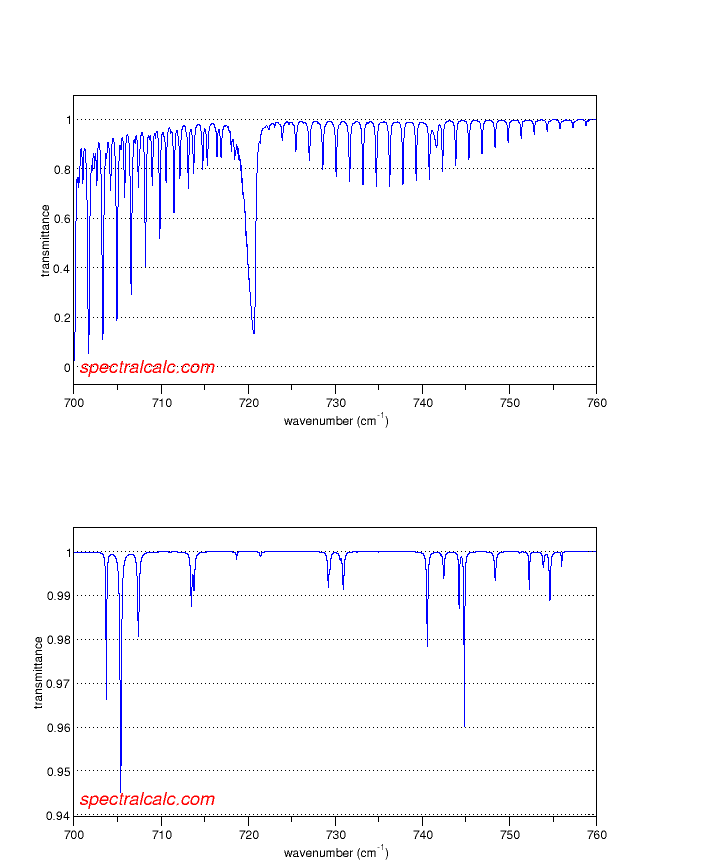
An example of magnified graphs was created by "Phil. Felton" and linked from his comment on RealClimate. His example is a magnification of the 15 um wavelength where CO2's absorption has an apparently solid bump on the lower resolution picture from GlobalWarmingArt.com. I think his top graph is CO2 and his bottom graph is water vapor. (The axes of those graphs are transmittance--the reverse of the lower resolution graph's axes being absorption.) But in fact, there is no single graph that is correct for all temperatures and pressures. The ones we've been looking at in our conversation on this Skeptical Science site not only are too low resolution to show the gaps, but they are too integrated across all temperatures and pressures. In reality, you need a different graph for each combination of temperature and pressure. You can create your own plots with the SpectralCalc.com online calculator. Instructions and examples are on Rabett Run. A clearer graphic example is in his post on Pressure Broadening. You should continue following the story of how scientists became able to deal with all those dependencies on temperature and pressure, by reading Weart's A Saturated Gassy Argument. Find the paragraph that starts "Still more persuasive," and read from there down. Then read Part II. -
Henry Pool at 18:20 PM on 25 October 2009How do we know CO2 is causing warming?
thanks Tom! But let me not go off in a tangent now, I merely wanted to say that all original CO2 (from whence life and vegetation came) was produced during volcanic activity which does produce heat so there must be a causal link between the heat of a planet and CO2 content no matter how small or big that correlation coefficient (CO2 versus heat from volcanic activity) may be. So ice core analysis alone is not enough (for me). Global warming is not in doubt, but you must admit that there could be a number of causes other than CO2, not least the variation in light that we have from the sun. But like I said,I am keeping my mind open. I did go through all the papers mentioned by John in this article but I did not come across the answer to my question. The papers only talk about the warming effect of carbon dioxide, not the cooling effect. In fact, the absorptions of carbon dioxide in the near infra red and the cooling effect of carbon dioxide are completely ignored. As did the paper you advised me to read. Now what would you do if anyone came to you and said: listen ozone is causing serious warming of the planet i.e. upgoing thermal radiation from earth at 10 um being blocked. We have to get rid of it! I am sure the answer you would give him: yes, it is true that ozone causes some warming but it also blocks a lot of sunlight from the sun, especially in the UV range! You must be an idiot to think we have to get rid of it. Likewise I am answering you now: yes it is true that carbon dioxide causes some warming but it also blocks a lot of sunlight especially due to its absorptions bands in the 1 - 5 um range. If I look at it carefully it looks to me that it is pretty much evens, i.e. the cooling could be as much as the warming effect. Now it is up to you (the scientists working on this problem) and the people responsible for putting the CO2 in the air (the oil companies) to do the research that will prove that I am right or wrong in my assessment. We do not need stories or reflections. We need actual figures from actual measurements taken during actual experiments. And if the oil comapanies will not give us the results, then we must sue them, blaming them for global warming, like we did with the cigarette companies. I am sure that if we take this route quickly we will have the answers that I am looking for. -
RSVP at 17:11 PM on 25 October 2009Working out climate sensitivity
Chris The paper seeks a single number to describe "climate sensitivity" which according to the author appears to be around 3 degrees C, (although a lot of variance is admitted). Even though the narrative BEGINS with "climate sensitivity", the only forcing being considered is the effects of CO2 operating as an atmospheric greenhouse gas. I am not inventing this. The UNITS of this elusive number represents: degrees C of the "Earth's" temperature rising for a doubling of CO2 concentration. I do not find the information you are referring to in this article, regardless of whether 100 or 1000 other papers cover this subject, indicating a difference between what one imagines is writen and what actually is writen. (actually now a days it doesnt matter, since all you have to do is press REFRESH and you might find the content altered). If the narrative was implying that this forcing was considered in isolation,Response: The strict definition of climate sensitivity is the equilibrium change to global temperature if the climate experienced a radiative forcing of 3.7 Wm-2. This doesn't mean the forcing comes solely from CO2. In fact, it certainly doesn't as CO2 is not the only driver of climate. But the term 'doubling of CO2' is used because it is more meaningful than the figure 3.7 Wm-2. -
neilperth at 14:11 PM on 25 October 2009Extreme weather isn't caused by global warming
"There is growing empirical evidence that warming temperatures cause more intense hurricanes, heavier rainfalls and flooding, increased conditions for wildfires and dangerous heat waves". Does the above statement mean that the studies which show that there is no apparent link between temperature rise and hurricanes, rainfall, flooding, fires and heatwaves, are somehow not scientific ? -
Sam Spade at 12:51 PM on 25 October 2009Hurricanes aren't linked to global warming
FACTORS INHIBITING HURRICANES ...while water temperature is the most important factor in tropical cyclone dynamics, many other environmental factors affect these storms. These include: the deep warm water; moisture availibility; weak wind shear; a source of rotation, and no land interaction/landfall. Only when all these factors exist can a hurricane reach its maximum potential intensity for a given water temperature. In fact, few hurricanes reach their potential because some inhibiting factor exists. Furthermore, global warming could enhance some negative influences regionally; an ensemble of 18 global climate models show that wind shear and dry air will increase in the Atlantic, while in contrast the opposite occurs in the west Pacific where environmental factors favor more hurricanes. Therefore, anthropogenic warmer oceans do not necessarily correlate to increased tropical cyclone activity or stronger hurricanes globally. Climate models give mixed results on whether the average storm intensities will change, but most show evidence for some increase in intensity. Pat Fitzpatrick, Hurricanes and Climate...~2007 One inhibiting factor is the El Nino, a body of relatively warm equatorial water in the eastern Pacific. Absent for the past few years, it is expected to bring weak to moderately warm water to the South American west coast. A characteristic of El Nino is westerly winds in the upper troposphere that act to shear the tops off Atlantic easterly waves coming off the African Coast, preventing them from growing into named storms or hurricanes... However, this (weak to moderate) El Nino will fall well short of the one that occurred in 2007, limiting the season's total named storms to seven. From William Gray's 2001 hurricane forecast Working in a strategically located lagoon off Puerto Rico, Donelly and Woodruff compiled the long record (cores, 2007) of strong hurricanes in the Atlantic region. The 5,000 year record identified two factors that appeared to heighten Atlantic activity: weak El Ninos in the tropical Pacific and strong monsoons in West Africa. Scientists have established that strong El Ninos can stunt hurricane activity by causing strong high-altitude winds that inhibit hurricane formation. Other reseaqrchers have identified that storms over western Africa generate atmospheric waves that move into the Atlantic and provide "seedlings" for hurricane development... Oceanus Feb 13, 2009 -
PaulK at 10:51 AM on 25 October 2009How do we know CO2 is causing warming?
Riccardo #102 I think you have taken a part of what I said out of context. I stated that: "If the imaginary Earth does indeed act like a black body emitter, then the temperature at TOA [in our imaginary model] should be exactly the same as before more CO2 was added (Stefan-Boltzman), since the total flux, we agree, has to be exactly equal to our conveniently constant solar flux." Note the conditional clause. I am trying to stay within basic physics here. If the Earth at TOA acts like a blackbody, then, by definition, the total flux is solely a function of temperature (Stefan-Boltzmann), as is the wavelength of maximum emission intensity (Wien's Law). Since under our simplified model we have a constant ingoing and outgoing radiation, then the temperature at TOA must be exactly equal to the temperature before CO2 addition. If not, then our simplified Earth at TOA is not behaving like a blackbody. Hence my question regarding the relevance of the application of Stefan-Boltzmann in your view of the universe. Your second paragraph talks about energy, and your argument is plausible if we consider just a single packet of energy. However, in order to restore equilibrium to our simple system we have to balance ingoing and outgoing POWER rather than energy at our TOA, so we cannot accept a solution which leads to ever-increasing accumulation of energy within the troposphere. Hence, to achieve radiative balance in POWER AND to observe a dip in net flux at CO2 wavelengths, the energy in the CO2 wavebands must be CONTINUOUSLY dissipated into other wavelengths. A simple return of photons downwards is fine for a while, but eventually they have to find their way back up again (and out of the system). If not, then I still cannot see an alternative to kinetic thermalisation. -
Patrick 027 at 10:39 AM on 25 October 2009It's the sun
Correction/Clarification: What I refered to as an "emission distribution" in comment 501 and perhaps subsequent if not prior comments: --------- "This can be extended farther. Suppose we are interested in the absorption of I#f. For all the fractions of dw that are scattering or reflection cross sections per unit area, the fate of those fractions of I#f can be traced farther, through successive scatterings and reflections, until every last bit is absorbed. This will be a distribution of dw that may extend outside of the path and over other paths, perhaps over some volume. It is the distribution of the absorption of I#f(O). Assuming local thermodynamic equilibrium within each unit volume, It is also the distribution of the emission of I#b(O) - multiplying the distribution density by I#bb(T) and integrating over the distribution gives the I#b(O) value, where I#bb(T) is the blackbody intensity (normalized relative to refraction) as a function of T, however it varies over space." "I#f(O) also has an emission distribution that can be found, tracing back in the opposite direction from point O." ---------- It should be clear that by "emission distribution", I was refering to a distribution in visibility, which, when weighted by the blackbody radiant intensity for the temperature at each location and then integrated over volume, would give the radiant intensity coming from the direction considered at the location considered. However, this is more correctly called the "weighting function", which avoids confusion, since it would also make sense to think that the emission distribution IS the blackbody radiation intensity weighted by the weighting function. -
Steve L at 10:02 AM on 25 October 2009CO2 is not the only driver of climate
Hi John, in the previous post you linked to a good website for tracking current CO2 levels. Before that you linked to a website dedicated to solar cycle 24. Do you know if there's a one-stop-shop for tracking current levels or recent trends for more of the forcings?Response: A one stop shop would be nice. I know Climate Charts & Graphs is moving in that direction, adding links to data sources and tutorials on how to analyse the data. NASA GISS offer all the forcing data online but it ends at 2005. If anyone knows of other useful links to forcing data, please post a comment. -
Riccardo at 09:44 AM on 25 October 2009How do we know CO2 is causing warming?
PaulK, in comment #96: "the temperature at TOA should be exactly the same as before more CO2 was added". No, it's not. More energy is absorbed (more on this later), temperature increases and blackbody emission follows untill balance; you need to increase emission (temperature) to reach balance. Nothing puzzling here. What is puzzling you (correct me if i'm wrong) is that you associate more absorption with more emission and then you can't see how more CO2 can increase temperature without violating Kirchhoff law. What you miss here is that IR radiation comes from the earth surface, is abosorbed in the atmosphere and part of it is sent back toward the surface. No need of a collisional mechanism to dissipate energy directly to kinetic energy. Infact, you didn't find it in the radiation trasnfer scheme of Kiel and Trenberth. Then you'll have less energy in the CO2 bands and more in the background blackbody emission. Also in comment #96: "since most of this energy loss would take place close to the ground and be overwhelmed by convective forces". But a measurable amount of energy find it's way through the atmosphere, so we have no near surface confinement of the absorbed energy. -
Tom Dayton at 09:43 AM on 25 October 2009How do we know CO2 is causing warming?
Henry Pool wrote:The current paper shows increase in down going longwave radiation. This again may have a number of causes - whatever it is that is causing more heat on earth.. For all I know it could be aeroplanes or rockets or whatever.
. No, Henry, it cannot be aeroplanes or rockets or whatever. It is greenhouse gases, as evidenced by the empirical measurements that show the radiation signatures of greenhouse gases. That's right there in the original post at the top of this page:Evans 2006 takes this analysis further. By analysing high resolution spectral data, the increase in downward radiation can be quantitatively attributed to each of several anthropogenic gases. The results lead the authors to conclude that "this experimental data should effectively end the argument by skeptics that no experimental evidence exists for the connection between greenhouse gas increases in the atmosphere and global warming." If you need more details, you need merely click that link to read the extended abstract of that Evans (& Puckrin) paper.
-
paravantis at 09:36 AM on 25 October 2009It's Urban Heat Island effect
Former Skeptic, I cannot say anything of value about WIND although it seems REASONABLE to expect that wind would affect the intensity of UHI. I certainly will have much more to say in about 2 years from now, when the PhD I supervise will be near completion. Did you have something in mind that I failed to read? -
Tom Dayton at 09:28 AM on 25 October 2009Volcanoes emit more CO2 than humans
Regarding the leaking of heat from the Earth's interior, from volcanoes, rifts, and everything else, both above and below water, here are some sources of info: A summary is in section 17.4.1, Global heat flow, of Mussett & Khan's Looking into the Earth: An Introduction to Geological Geophysics (2000, Alan E. Mussett & M. Aftab Khan, page 279, free online partial preview). 71% of the Earth interior's heat loss is from ocean-covered surface; you can see a breakdown in section 7.4, Worldwide heat flow: total heat loss from Earth, especially Table 7.3 on page 286, of Fowler's The Solid Earth: An Introduction to Global Geophysics (2nd Edition, 2005, C.M.R. Fowler, free online partial preview). An even more detailed breakdown, even across types of undersea crust, is in Pollack, Hurter, & Johnson (1993, Heat Flow from the Earth's Interior: Analysis of the Global Data Set, Reviews of Geophysics, Vol. 31(3), pages 267-280, full text available for free). A more recent source that is just as technical as the 1993 Pollack, Hurter, and Johnson article is the 2005 book chapter by Jaupart and Mareschal, Constraints on Crustal Heat Production from Heat Flow Data (in R.L. Rudnick (Ed.), The Crust, pages 65-84, free online partial preview). A summary of how the experts calculate the heat flow from the crust that is covered by oceans are in that same Fowler book, section 7.5, Oceanic Heat Flow, starting on page 288 (free online partial preview). Details are in that same 1993 Pollack, Hurter, & Johnson article (full text available for free) and that same 2005 book chapter by Jaupart and Mareschal (free online partial preview). Those experts say that the total heat from the Earth's interior arriving at the Earth's surface (covered by land plus covered by sea) is about 0.09 watts coming out of each square meter from the Earth's interior. That's about 10,000 time less than the energy from the Sun (1,370 watts/m^2 on the sunlit side). That is such an inconsequential amount that any changes in it since 1850 cannot possibly have any significant effects on global temperature, compared to the other forcings such greenhouse gases and even solar variability. Furthermore, the observations of heat loss from the Earth's interior have not revealed any significant changes in the time frame of anthropocentric global warming. So heat emission from the Earth's interior simply is not a significant player in the era of anthropocentric global warming. -
Tom Dayton at 09:19 AM on 25 October 2009How do we know CO2 is causing warming?
Henry Pool, you wrote in #93:...nobody really knows how many kilojoules of energy are leaking into the oceans.... If there are scientists who claim to know how much energy goes into the oceans from that activity they must be speculating, yes? So the correlation with warmer weather could be there.... Ask any expert.
The experts are not speculating. They actually measure. A summary is in section 17.4.1, Global heat flow, of Mussett & Khan's Looking into the Earth: An Introduction to Geological Geophysics (2000, Alan E. Mussett & M. Aftab Khan, page 279, free online partial preview). 71% of the Earth interior's heat loss is from ocean-covered surface; you can see a breakdown in section 7.4, Worldwide heat flow: total heat loss from Earth, especially Table 7.3 on page 286, of Fowler's The Solid Earth: An Introduction to Global Geophysics (2nd Edition, 2005, C.M.R. Fowler, free online partial preview). An even more detailed breakdown, even across types of undersea crust, is in Pollack, Hurter, & Johnson (1993, Heat Flow from the Earth's Interior: Analysis of the Global Data Set, Reviews of Geophysics, Vol. 31(3), pages 267-280, full text available for free). A more recent source that is just as technical as the 1993 Pollack, Hurter, and Johnson article is the 2005 book chapter by Jaupart and Mareschal, Constraints on Crustal Heat Production from Heat Flow Data (in R.L. Rudnick (Ed.), The Crust, pages 65-84, free online partial preview). A summary of how the experts calculate the heat flow from the crust that is covered by oceans are in that same Fowler book, section 7.5, Oceanic Heat Flow, starting on page 288 (free online partial preview). Details are in that same 1993 Pollack, Hurter, & Johnson article (full text available for free) and that same the 2005 book chapter by Jaupart and Mareschal (free online partial preview). Those experts say that the total heat from the Earth's interior arriving at the Earth's surface (covered by land plus covered by sea) is about 0.09 watts coming out of each square meter from the Earth's interior. That's about 10,000 time less than the energy from the Sun (1,370 watts/m^2 on the sunlit side). That is such an inconsequential amount that any changes in it since 1850 cannot possibly have any significant effects on global temperature, compared to the other forcings such greenhouse gases and even solar variability. Furthermore, the observations of heat loss from the Earth's interior have not revealed any significant changes in the time frame of anthropocentric global warming. So heat emission from the Earth's interior simply is not a player in the era of anthropocentric global warming. -
Sam Spade at 06:29 AM on 25 October 2009Hurricanes aren't linked to global warming
HISTORICAL HURRICANE FREQUENCY ..........Landsea et al, 2009 (From NYT Aug12, 2009) The researchers studied storms that played themselves out at sea, either in a day or two or over a longer period, from 1878 to 2008. By the late 19th century, they estimated meterologists missed perhaps two of the larger storms each year, and by the 1950s they were picking up on average all but one each year. Yet the researchers estimate that a century ago, as many as 80 percent of short-lived storms came and went without ever being officially noticed. Over all, they conclude, storm counts have not changed in the last century. ..........Mann et al, 2009 (Ditto) ...used a mathematical model of hurricane activity and measurements of sediment to estimate how often major storms struck the Gulf and Atlantic Coasts of the United States in the last 1500 years. ...the researchers worked with sediment samples from Puerto Rico, the Gulf Coast and the Atlantic Coast from Florida to New England. Although current numbers are relatively high, they say, both analytical methods suggest that a period of high storm frequency, possibly even higher than today's, began in the year 900 and lasted until 1200 or so. ..........Lund et al, 2009 September 22, 2009 Clemson University press release: Hurrican Frequency Is Up, But Not Their Strength... In a new study, Clemson University researchers have concluded that the number of hurricanes and tropical storms in the Atlantic Basin is increasing, but there is no evidence that their individual strengths are any greater than storms of the past or that the chances of a U.S. strike are up. ...studied changes in the tropical cycle record in the North Atlantic between 1851 and 2008. "This is a hot button issue in the argument for global warming," said Lund. "Climatologists reporting to the U.S. Senate as recently as this summer testified to the exact opposite of what we find. Many researchers have maintained that warming waters of the Atlantic are increasing the strength of these storms. We do not see evidence for this at all, however we do find that the number of storms has recently increased." The study represents one of the first rigorous statistical assessments of the issue with uncertainty margins calculated in... While the study did conclude that more storms are being documented, researchers found no evidence of recent increases in U.S. landfall strike probability of the strongest hurricanes. Lund notes that "because these types of storms are so uncommon, it will take many years of data to reliably assess this issue." -
chris at 05:53 AM on 25 October 2009Working out climate sensitivity
not really RSVP. "Other readers" can read your post and determine themselves what you said! You said: " Would'nt it be more accurate to dissect this problem a little by breaking out the forcings and feedback into separate paths, and isolating each factor, each with its own particular coefficient?" and the answer is that this has been done to a rather extraordinary extent (see citations/links in my post above) and you said: "...the lumping does not lump all the forcing factors, it basically makes CO2 the ONLY factor" however, the use of a generalized "climate sensitivity" certainly doesn't "make CO2 the only forcing".. it's pretty simple RSVP. If you think I've misrepresented your post why not explain why you think so. (I'm not a lawyer btw...I'm a scientist, and do try to communicate meaning carefully. If I've messed up in this case you can simply explain why). -
RSVP at 05:14 AM on 25 October 2009Working out climate sensitivity
chris It is clear that you are simply trying to confuse other readers about what I said. Are you a lawyer? -
PaulK at 04:29 AM on 25 October 2009How do we know CO2 is causing warming?
Ricardo #94 Further to the above, I was right that Kiel and Trenberth do not account for loss of radiative intensity via kinetic thermalisation, but I did note from one of their presentation diagrams in a 1997 presentation that they too seem to expect that an increase in CO2 will lead to a reduction in net OLW round the CO2 principal frequencies. Still puzzled. -
Tom Dayton at 04:12 AM on 25 October 2009How do we know CO2 is causing warming?
Henry Pool, you wrote:Because Mauna Loa is nearby a volcano, I thought it is perhaps not the best place to measure CO2. I did not see any other graphs. But I will accept your word for it that the other places show the same results.
The Scripps Institution of Oceanography's FAQ Isn't the Mauna Loa record influenced by CO2 emitted by the volcano? answers:If one looks at the minute-by-minute data from Mauna Loa, one finds rare occasions when the CO2 is elevated from emissions from fumaroles upwind on the mountain. The fumaroles are emitting constantly, so the timing of the events depends on wind direction and not changes in volcanic activity. These events impact only a tiny faction of the data and are easily distinguished from rest of the record. The reported version of the Mauna Loa record has been “filtered” to remove these events, as well as other certain other local effects, as described in the early publications (see Keeling 1960 Tellus paper.)
For more details, see NOAA's How we measure background CO2 levels on Mauna Loa. You don't have to accept my word that CO2 measurements are globally consistent. "The Global Monitoring Division of NOAA/Earth System Research Laboratory has measured carbon dioxide and other greenhouse gases for several decades at a globally distributed network of air sampling sites (Conway, 1994)." They publish a graph of those measurements under a graph of the Mauna Loa measurements, so you can compare them for yourself. Scroll down that page to the section "Trends in Atmospheric Carbon Dioxide - Global". Nor is NOAA the only organization that measures CO2; see a compilation of data from organizations based all around the world, at the World Data Centre for Greenhouse Gases. -
PaulK at 03:55 AM on 25 October 2009How do we know CO2 is causing warming?
Riccardo #94, Thanks again. My model (or more likely my understanding of the model you present) is taking me to several paradoxes. If we continue to examine the mental model of a grossly simplified imaginary earth, we can consider emission at TOA, rather than from surface of the Earth. If the imaginary Earth does indeed act like a black body emitter, then the temperature at TOA should be exactly the same as before more CO2 was added (Stefan-Boltzman), since the total flux, we agree, has to be exactly equal to our conveniently constant solar flux. (The adjustment would be in the lapse rate and the height of TOA.) Since there is no physical mechanism to "order" the increased CO2 to cease or decrease transmission at the TOA temperature, am I correct in assuming that you are asserting that even our imaginary Earth cannot be treated as a black-body transmitter and Stefan-Boltzman is not applicable - even in the simple zero dimension calculations used to estimate the effect of a GH forcing? Secondly, if the expectation of a fall in net flux at the CO2 principle frequencies is correct, then that implies a continuous process of loss of energy over time in those bandwidths to other bandwidths. While some switch to overlapping vibrational frequencies of other atmospheric components via photon transfer seems to be perfectly plausible, the remaining continuing energy loss from these wavelengths would have to be in the form of kinetic thermalisation from the CO2 to other non-dipolar molecules. No? And if this is the case, then that implies a "bottom-up" heating effect along the lines proposed by Heinz Hug. It would also imply a very small sensitivity of temperature to CO2 (since most of this energy loss would take place close to the ground and be overwhelmed by convective forces). I think I retained a copy of a Kiel and Trenberth paper on radiative calculations. I will go back and check, but from memory, the calculation is based on a layer by layer radiative transfer and flux adjustment against a fixed vertical clear-skies temperature profile - no kinetic thermalisation allowed. Where am I going wrong here? -
Tom Dayton at 03:43 AM on 25 October 2009How do we know CO2 is causing warming?
Henry Pool, you wrote that the IPCC "took all the gases that absorb infra red as positive forcing. 'This must be the cause, what else can it be?'" No, they did not. See the new Skeptical Science post CO2 is not the only driver of climate. -
HumanityRules at 00:55 AM on 25 October 2009Increasing CO2 has little to no effect
The graph you show is not "The resultant change in outgoing radiation was as follows" as you state. What it is the data that has been manipulated to highlight the drops in radiance in the regions of the spectra that are absorbed by CO2 and CH4 (and other trace gases). The fact that no area of the graph goes above the 0 point (dotted line). The real observed data shows a large region of the spectra above the 0 line. You can see this in the original Harris 2001 paper (unfortunately subscription) or Fig 3 in the Chen paper (free access). What this says is there are other parts of the spectra which are letting more energy escape from the planet in 2006 than in 1970. if you take the CO2 part of the spectra in isolation this would suggest greater energy retention (global warming). If you highlighted just the positive areas (say spectra from 800-1000) you would conclude greater energy radiance (global cooling). If you took the whole of the spectra I'm not sure whether you'd conclude greater or less radiance in more recent years. Why don't people look at the whole of the spectra and what would be the explanation for greater radiance at other wavelengths? I accept that this analysis might be way of highlighting the CO2 'signature' in the spectra I don't see how you can conclude global warming without analysis of the whole wavelength spectra.Response: Harries 2001 does look at the full infrared spectrum except for wavelengths less than 700nm (which happens to be where a large portion of the CO2 absorption occurs). The observed changes in the spectrum from 1970 to 2006 are consistent with theoretical expectations. As the atmosphere warms, more infrared radiation is radiated to space. However, less infrared radiation escapes at CO2 wavelengths. The net effect is that less total radiation escapes out to space.
This is independently confirmed by surface measurements which find the net result is more longwave radiation returning back to the Earth's surface (Philipona 2004, Evans 2006). It's also confirmed by ocean heat measurements which find the oceans have been accumulating heat since 1950 (Murphy 2009). -
chris at 00:38 AM on 25 October 2009Working out climate sensitivity
You're going round in circles RSVP. Of course the forcing from each factor has been isolated "each with its own coefficient". There's dozens, if not hundred's, of papers that parameterize individual forcings. You can read examples of this here: http://pubs.giss.nasa.gov/docs/2005/2005_Hansen_etal_1.pdf or here: J. L. Lean and D. H. Rind (2008) How natural and anthropogenic influences alter global and regional surface temperatures: 1889 to 2006 Geophys. Res. Lett. 35, L18701 http://www.agu.org/pubs/crossref/2008/2008GL034864.shtml and some of the recent threads on this site address this specific question, as you surely must have noticed; see for example, Figure 2 here: http://www.skepticalscience.com/Measuring-Earths-energy-imbalance.html Notice that "lumping all the forcing factors" obviously doesn't "make CO2 the ONLY factor". In fact you've made a rather meaningless statement. Lumping all the forcing factors gives each of the factors its own contribution according to the determined parameterization. I think you might be referring to the definition of a generalized "climate sensitivity" which is defined as the warming response at equilibrium to a given radiative imbalance (or forcing). This climate sensitivity is essentially independent of the specific forcing associated with the radiative imbalance (solar, volcanic aerosol, anthropogenic aerosol, greenhouse gas etc.). So you can’t pretend that this somehow makes CO2 “the ONLY forcing”, when it obviously doesn’t. -
Riccardo at 23:27 PM on 24 October 2009How do we know CO2 is causing warming?
PaulK, "if there is in reality a net loss of flux at the CO2 frequencies at TOA, where do you expect to see the compensating gains in the rest of the spectrum and WHY?" You are basically correct. One should indeed expect a reduction at the CO2 absorption wavelength, not more emission. To simplify the picture, think at the measured spectrum as the thermal emission from the earth minus the absorption of the atmosphere, hence more absorption means less radiation intesity loss to space. The real process is a bit more complicated because you cannot separate absorption and emission (Kirchhoff, indeed) and one needs to consider what happens layer by layer (what is emitted upward is again in part abosrbed by the layer above, and so on); nevertheless, the general idea is still correct. If you let your immaginary earth reach equilibrium, the fluxes need to be in balance, as you correctly say. What is missing at the CO2 wavelength will appear as background because the earth is warmer than before. You don't see the effect in Harris paper because of some factors affecting the measurement system and other related to the real atmosphere. -
RSVP at 23:21 PM on 24 October 2009Working out climate sensitivity
From what I can tell, the sensitivity relationship being sought here relates to a simplified control model, basically one giant block that lumps all forcings and feedbacks into a single transfer function (for the entire planet!). Would'nt it be more accurate to dissect this problem a little by breaking out the forcings and feedback into separate paths, and isolating each factor, each with its own particular coefficient? Or would this reveal too much about what is really going on? I suspect that this approach was not taken due to the real complexity of the problem. Furthermore, the choice to describe things probabilistically only diffuses the truth of the matter that much more. Ironically, the math uses incertainty to establish the certainty of an idea, or allow some wiggle room if things dont pan out, etc. (In actually, the lumping does not lump all the forcing factors, it basically makes CO2 the ONLY factor, which is fairly unrealistic.) Would we all then be freezing to death today if there was no CO2 in the atmosphere? -
chris at 22:30 PM on 24 October 2009What does past climate change tell us?
Re #28 thingadonta Yes there’s good evidence of a couple of “rapid” excursions of atmospheric CO2 levels well above the background CO2 levels during the Jurassic; see, for example, Figure 3 of: http://droyer.web.wesleyan.edu/PhanCO2(GCA).pdf However it’s wrong to state that there was no significant change in earth temperature. At least the earlier event has been studied in some detail and is associated with marked global warming, ocean anoxia, extinctions, and a carbon isotope excursion consistent with a massive release of C13-depleted carbon back into the atmosphere. This is similar to events at the PaleoEocene Thermal Maximum, and is indicative of extreme burning of biomass-derived carbon (coal seams, terrestrial wildfires) and/or release of methane into the atmosphere (e.g. [*]). The earth does have a ” 'c02-thresholded' now in its current climate state”. This refers to the concentration of CO2 and other greenhouse gases above which cool states, or states with permanent land ice, is not possible (this also depends on the location of continents since build up of ice at the poles is promoted if there are polar land masses like Antarctica and Greenland). For example it’s considered that polar ice caps are unsustainable at atmospheric CO2 equivalents above around 750 ppm under present conditions, and the Greenland ice cap is likely committed to melt at atmospheric CO2 equivalents above around 280 ppm (i.e. we expect to lose the Greenland ice cap in the future, although, unless there are some catastrophic mechanisms involving breakup that accelerate the process, it will take a long time to melt); (e.g. [**]). The reason that these greenhouse gas thresholds are considerably lower now than in the past is because the sun is quite a bit brighter now than in the past. During the Jurassic the solar constant was around 2% lower than now (it remorselessly increases as time advances), and so greenhouse gas concentrations had to be higher in order to sustain any particular surface temperature. [*] Cohen AS, Coe AL and Kemp DB (2007) The late Palaeocene-Early Eocene and Toarcian (Early Jurassic) carbon isotope excursions: a comparison of their time scales, associated environmental changes, causes and consequences J. Geol. Soc. 164, 1093-1108 http://jgs.lyellcollection.org/cgi/content/abstract/164/6/1093 [**] DeConto, RM et al (2008) Thresholds for Cenozoic bipolar glaciations Nature 652-655. http://www.nature.com/nature/journal/v455/n7213/abs/nature07337.html -
Henry Pool at 21:58 PM on 24 October 2009How do we know CO2 is causing warming?
Tom, let me take it from the top now, & don't get mad at me if I don't agree, OK?: I agree with the third picture. But A (= reflected by the atmosphere), for a large part means the green house gasses working to keep us cooler, yes? Are we agreed on that? Do you see that the cooling comes with the warming? Did you see that the info they give on page 2 is terribly confusing? But they warn you not to worry about that because the graph is "not important". Can you honestly say that that is good science? To me, it seemed they want to hide the cooling effect. As far as volcanic activity is concerned: it is mostly in the oceans. The mid atlantic ridge is one big volcano. In the pacific we exploded all these atomic bombs. Hence all these earth quakes and tsunamis? Who knows. So, really, we dont know exactly how much volcanic activity is going on down there, nobody really knows how many kilojoules of energy are leaking into the oceans. Go watch Iceland or Hawaii if you want to get an impression, because these are 2 places with volcanic activity that stick out, the rest is deep down below under water, going all around the earth. 70% of earth is ocean and most volcanic activity is there. If there are scientists who claim to know how much energy goes into the oceans from that activity they must be speculating, yes? So the correlation with warmer weather could be there. It is not impossible. Those eruptions on land that caused cooling are not the majority - most volcanic activity is in fact far beneath the surface of the oceans. Ask any expert. Ok, to me, because Mauna Loa is nearby a volcano, I thought it is perhaps not the best place to measure CO2. I did not see any other graphs. But I will accept your word for it that the other places show the same results. As far as the graph is concerned: true, it does not change the results. What irritated me was Al Gore and them arranging the two graphs of the CO2 increase and the global warming increase in such a way that it looks the same. Like that,I can also prove anything that I want to prove. The current paper shows increase in down going longwave radiation. This again may have a number of causes - whatever it is that is causing more heat on earth.. For all I know it could be aeroplanes or rockets or whatever. I donot know yet. I still have an open mind. But the point is: we know that global warming is happening. That is not under dispute. What I doubt is that the carbon dioxide is the cause. On balance, I think CO2 causes as much cooling as it does warming. And I have not seen any definitive proof of results of testing where a comparison was made in a balance sheet.. I can quote at least two people who agree with my interpretation (of the greenhouse effect) and I am stunned that you do not see it this way. Are you saying that the quote in Wikipedia is wrong? (see my posting in 82) I will check those references you gave later. Maybe John Cook can tell me where to look to see the answer to my simple question, (about the nett effect) As this is just my hobby, I don't have that much free time.I do not see the answer in those references, there are just too many variables. We only need to know: what is the cooling effect of CO2 and what is warming effect? Other stuff is not relevant. That is why I chose to blog in this subject: How do we know for sure the problem of global warming is caused by carbon dioxide? I am not convinced yet. But maybe I want to keep things simple, so that I can still understand it? But if I cannot understand it, how can government officials (who have no chemical back round) make the right choices? -
chris at 20:55 PM on 24 October 2009What does past climate change tell us?
re #27: HumanityRules, let me go back to my vision for a future and compare it with yours, since we seem to share the ideal of economic and societal advance in poor countries. I suggested that a huge investment in sustainable energy sources (especially solar power, with some carefully considered biofuel production etc.) is the likely way that economic advance might be realised in these countries. You consider that unworthy of comment. So let’s be a little more specific. Solar power is a truly massive potential source of power. Despite the fact that it’s in relative infancy, it produces around 16 GW of power worldwide. This is a tiny proportion of the total human energy use (~15 TW), but the potential for expansion, especially in regions of the world with high surface solar flux, is huge (the solar flux at the surface is equal to ~10,000 x the total world energy use, so we need to tap a tiny proportion of this to make massive inroads into replacing fossil fuels with solar, not to mention other sustainables). There are already solar power plants in the US, Spain (lots), Germany, Portugal, Korea….when completed the solar thermal power station in Gujarat in India will be the largest in the world…a 2GW solar plant is being built in Mongolia; there are major projects approved for large solar plant in Egypt, Mexico, Morocco….etc. etc. I’d like to know why you consider that these technologies should be left out of the equation for sub-Saharan Africa. Likewise, careful approaches to biofuel production has considerable potential. Brazil gets nearly 20% of its automotive fuel from (bio)ethanol…the production of ethanol in the US is now a large industry employing many hundreds of thousands of people. Again I’d like to know your reasons for dismissing this (and geothermal, wind, hydroelectric where this is still untapped, wave …) from your future for economic expansion in sub-Saharan Africa. The countries in this region are starting from a very, very low base in terms of current energy use – expanding this with a strong focus on sustainable energy is an obvious means of economic advance. On the other hand, your vision is seemingly based on a truly massive expansion of fossil fuel use. Speaking of the poor regions of the world you say you “aspire to see them have everything we have, and more”. Fine, but what specifically do you mean by that? At present each US citizen releases 19 metric tons (mt) of CO2 into the atmosphere each year. Is that level of fossil fuel consumption in your aspiration for the world? If so, CO2 emissions will rise to around 5 times current emissions, and our civilizations will be committed to a hellish short future with extremely rapid warming and sea level rise, unstoppable destruction of the tropical rainforests, until we run out of oil (in around 10 years), gas (30 years) and eventually even coal (~80 years). Then we’re pretty much back to the stone age… Or might your aspirations be more along the lines of Switzerland (5.6 mt CO2 per person per year). Then CO2 emissions would only double, the rate of adverse consequences would be slowed somewhat, and we’d have a rather larger number of decades before the fossil fuels were used up and the populations return to the stone age… So you have to be a bit clearer about your vision. I don’t think yours (massive expansion of fossil fuel use to promote industrialisation such that everyone has “everything we have, and more”) can avoid apocalyptic scenarios. On the other hand we know without any doubt whatsoever that the only long term future for mankind is one based on sustainable energy production. I’d like to know why you don’t consider it appropriate to consider the latter. -
PaulK at 20:44 PM on 24 October 2009How do we know CO2 is causing warming?
Riccardo #86 You wrote"You should consider the background (the parts of the spectrum where there is no absorpion) and the absorption peaks separately. Indeed, they are due to different processes: the former is an emission process and is related (among other things) to temperature, the latter is an absorption process and is related to CO2 concentration." Thanks for this. I am in learning mode. If I consider a very simple model of completely constant solar irradiation, an Earth in radiative balance with constant albedo, and I perturb the system by throwing in additional CO2 and then allow the system to re-establish radiative equilibrium, then I would expect that integrating across the resulting TOA emission spectrum to obtain total outgoing flux should yield by definition a value equal to the (constant) incoming solar flux. If one finds a dip in flux at the principal frequencies of CO2, then it must be compensated by an increase in other parts of the spectrum for the integral to balance. The Harries papers appear to show a net reduction in flux over the bandwidths examined and a large dip at the absorption frequencies of CO2 and methane (author's comments on the problem noted). My confusion is arising in part because I would not automatically expect to see a dip in TOA emissions at the CO2 frequencies. (The increased path length should slow down radiative transfer at those frequencies, but yield the same number of photons and the same net flux at top of atmosphere (TOA). I would expect the flux to be the same or even marginally higher because of the increased emissive presence of CO2 in the drier upper atmosphere (Kirchoff?). My question can then be summarised as follows: if there is in reality a net loss of flux at the CO2 frequencies at TOA, where do you expect to see the compensating gains in the rest of the spectrum and WHY? -
Henry Pool at 19:45 PM on 24 October 2009How do we know CO2 is causing warming?
Thanks Tom! I will study all this and get back to you. -
Tom Dayton at 18:39 PM on 24 October 2009How do we know CO2 is causing warming?
Henry Pool, I linked specifically to section 1, Primer and History. In that section, the third figure from the top is a greatly simplified diagram of incoming and outgoing energy. Regarding your comment 87: "Page 9": Al Gore did not analyze ice cores. Al Gore is not a scientist. He just does a good job of educating people about scientists' research. You wrote:So when there is more volcanic activity, should we not expect a temperature rise? There is an awful amount of heat released when volcanoes explode. So that explains that correlation.
No, it doesn't; see the "Skeptic Argument" list at the top of this page you are reading right now? That's where you'll find a response to the argument It’s volcanoes (or lack thereof). You wrote:Page 7: Why always measure carbon dioxide at Mauna Loa - so nearby an active volcano? Are there no other places? The graph does not have 0 ppm on, so it gives a bit of an extra slope upwards that should not be there.
In fact, CO2 is measured in lots of other places; one list of the locations and ways of measuring is at the web site of the Carbon Dioxide Information Analysis Center at Oak Ridge National Laboratory. Mauna Loa is the most frequently listed when a short, simple explanation is the goal, because it is one of the most pristine and continuously measured sites, and its values well match the average of all the other sites. As for the graph's lack of a 0, in fact that is completely inconsequential--literally, inconsequential--with regard to the slope. Maybe you're confused because you think what matters is how sloped the line looks to the human eye. But in fact the visual appearance is irrelevant, because the statistics describing the line are what are actually used. You wrote:Page 6: Almost 100 years ago, Svante Arrhenius predicted that carbon dioxide in the atmosphere would cause warming up. In the meantime, carbon dioxide has increased even more than he expected, but the Earth hasn't warmed as much as he thought it would (applying his formula). Why did no one check his eperiments with modern day equipment?
It seems you are not really reading the material, but only skimming very superficially. This very page you are reading right now is filled with exactly that modern, empirical, evidence. Maybe what you're wanting is something like The Carbon Dioxide Greenhouse Effect section of Spencer Weart's history of The Discovery of Global Warming. You wrote:It seems to me what they did in the IPCC report is to compare the concentrations of the gases in 2005 with 1750. Then they assigned a measure of relative radiative forcing to the so-called greenhouse gasses depending on the increase in concentrations measured. But this is like working at the problem from the wrong end! That is assuming that you are 100% sure what the cause is (of global warming) and then trying to work your way backwards to find a solution to the problem. They took all the gases that absorb infra red as positive forcing. "This must be the cause, what else can it be?"
No. That's what this entire post by John Cook is about. Read it again. Click on the links he provides to his earlier posts. Don't just skim. You wrote:So here is how best to describe the greenhouse effect:Where we have absorption the molecule can except one or two photons from the radiation (and it gets a little warmer), but once this transaction is completed the molecule at that frequency becomes sort of like a mirror: it blocks any further radiation forcing it backwards to where it came from. It cannot allow the radiation to pass through anymore. Don't make it more difficult or confusing than what it is.
You are incorrect. It does not block futher radiation. It is not in any way like a mirror. That's just not how it works. Really. See The CO2 effect is saturated. If you want a detailed explanation, start with A Saturated Gassy Argument and then read its Part II: What Angstrom Didn't Know. You wrote:So my question to all the scientists who worked on this problem is still the same: what is nett effect? How were the tests done to determine that the warming effect of carbon dioxide is greater than its cooling effect? Where are those figures?
The answers to those questions have been right in front of you all along. That's what all these web sites describe. The empirical measurements described in John Cook's article at the top of this very same page you are reading right now, have been used to find the net effect. The diagrams of the Earth's incoming and outgoing energy show exactly those factors, with the resulting net effect--the Earth's "energy balance." (A more detailed diagram is in the IPCC's FAQ 1.1. See the Skeptical Science article Measuring Earth's Energy Imbalance. -
Riccardo at 18:24 PM on 24 October 2009How do we know CO2 is causing warming?
Henry Pool, you jumped off science all in a while; indeed, you're inventing a new one. I stick on the good old one and there's no answer I can give you. But i don't want to be told that i do not motivate what i say, i'll give you a few example. Just a few, going through all of them is not worth the effort. Page 9: correlation between volcanoes emissions and glacial cycles. Blatantly false, look at the numbers of CO2 emission from volcanoes; and also at how the earth orbit works. Page 7: CO2 measured only at Mauna Loa. Ridiculous, there are stations all over the world. Ad the slope of a curve is its first derivative whatever the axis you choose, it's just a metter of showing or hiding something. Page 6: the very same Arrhenius experiment has been performed countless times. We now know the abosrption coefficient with great precision over several order of magnitudes. Page 3-4: the picture you give of the basics of spectroscopy (you used this word) are naive. Two photon processes, "act like a mirror", come on ... i'm making it as difficult as it is in any standard undergraduate textbook. And so on, and on, and on ... But I can answer to the simple question "what is the net effect?": no matter which freak processes you immagine are at play, it's warming, no doubt. -
Henry Pool at 16:37 PM on 24 October 2009How do we know CO2 is causing warming?
PS: Sorry Tom, I did not understand you here: "Take special note of the third figure" - what figure were you referring to? I did not see anything in this paper like that. -
Henry Pool at 15:31 PM on 24 October 2009How do we know CO2 is causing warming?
OK, Let us take Tom's paper "(The Global warming debate") and work it through backwards to front. pages: 10-13: there is no doubt that global warming is happening. I do not doubt it. Page 9: ice core analysis:Al Gore and them apparently analysed ice cores going back to as far as 650000 years. Then they said, and I quote (from the movie): " whenever the carbon dioxide was higher the climate was warmer." So I asked myself: but why were there periods in history (before man and any kind of major human activities) when the carbon dioxide was higher? Well, where does all carbon dioxide come from? It comes from volcanic activities! That is why life came into existence. Water and carbon dioxide are like our father and mother. So when there is more volcanic activity, should we not expect a temperature rise? There is an awful amount of heat released when volcanoes explode. So that explains that correlation. Page 7: Why always measure carbon dioxide at Mauna Loa - so nearby an active volcano? Are there no other places? The graph does not have 0 ppm on, so it gives a bit of an extra slope upwards that should not be there. Page 6: Almost 100 years ago, Svante Arrhenius predicted that carbon dioxide in the atmosphere would cause warming up. In the meantime, carbon dioxide has increased even more than he expected, but the Earth hasn't warmed as much as he thought it would (applying his formula). Why did no one check his eperiments with modern day equipment? Anyway, it appears to me that subsequent followers have always assumed that his theory must have some truth in it. Eventually, the whole theory really became something like this: let us have a planet, add more carbon dioxide, see if the temperature goes up, it did, so that must be it! I also studied the IPCC report. It seems to me what they did in the IPCC report is to compare the concentrations of the gases in 2005 with 1750. Then they assigned a measure of relative radiative forcing to the so-called greenhouse gasses depending on the increase in concentrations measured. But this is like working at the problem from the wrong end! That is assuming that you are 100% sure what the cause is (of global warming) and then trying to work your way backwards to find a solution to the problem. They took all the gases that absorb infra red as positive forcing. "This must be the cause, what else can it be?" Page 5: The beaver story can apply to other possible causes - I touched on one possible other cause for global warming in my post at 80. Page 3-4: The graphs are familiar, they are the same ones that I have been referring you to before. Do place these two graphs on top of one another. Now for example: Look at the absorption of oxygen and ozone at 10 um. At this wavelength there is no absorption coming from either the water or carbon dioxide. Can you see that this absorption at 10 causes a dent in the radiation at 10 coming out from earth? So here is how best to describe the greenhouse effect:Where we have absorption the molecule can except one or two photons from the radiation (and it gets a little warmer), but once this transaction is completed the molecule at that frequency becomes sort of like a mirror: it blocks any further radiation forcing it backwards to where it came from. It cannot allow the radiation to pass through anymore. Don't make it more difficult or confusing than what it is. Page 2: the solar Radiation graph is very important. I have a slightly better one that goes a bit into more detail. The explanation given on page 2 is very poor. Let me re-write this a bit: The top of the yellow is the radiation what has been measured above the atmosphere (it follows a lobsided curve). The top of the red is what was measured at sea level on a clear day. The difference (=yellow surface area) is the radiation that was either absorbed (i.e. turned into heat), reflected (or 'blocked") or scattered by the atmosphere before reaching the surface of earth. The gaps (= yellow surface area - I refer to this as cooling or the anti greenhouse effect) are caused by the combined efforts of ozone, oxygen, water and carbon dioxide. So the same gases that cause the greenhouse effect are also causing the cooling (or anti greenhouse) effect. Without it, even more radiation from the sun would be slammed into heads and into our oceans. Note that the absorption of a molecule at a certain wavelength does not have to be strong to cause a blocking or "mirror" effect.The width is important. So now let us look at the absorptions of carbon dioxide together: Cooling: We have the first absorption at 1.4um.It shows a blocking effect (= yellow surface) on my graph. We have a 2nd absorption at 1.7 or 1.8 um. It shows a blocking effect (= yellow surface) on my graph. We have another absorption at around 2 um. It shows a yellow area being caused in my graph and your graph of page 2. We have another absorption of carbon dioxide at just before 3 - it shows a cooling effect (i.e. yellow surface area) on my graph We have strong absorption between 4 and 5 um. It falls of the scale on both (solar radiation) graphs, but we know that between 4 and 5 um there is still about 0.5% radiation coming from the sun (according to my table). We now go to warming (greenhouse effect) We have strong absorption between 4 and 5 um. It appears that a little bit of earth's radiation is being blocked by this but the spectral intensity of earth is still low between 4 and 5. There is strong absorption at 14-15. It leads to some of earth's radiation not being emitted. Note that oxygen also has a very weak band here and water also absorbs here. These 2 gases have much higher concentrations than carbon dioxide so it is difficult to see or know exactly what the influence of the carbon dioxide on its own. So my question to all the scientists who worked on this problem is still the same: what is nett effect? How were the tests done to determine that the warming effect of carbon dioxide is greater than its cooling effect? Where are those figures? -
thingadonta at 13:04 PM on 24 October 2009What does past climate change tell us?
"Ironically, when skeptics cite past climate change, they're in fact invoking evidence for climate sensitivity and net positive feedback. Higher climate sensitivity means a larger climate response to CO2 forcing. Past climate change is actually evidence that humans can affect climate now". No, large climate response to CO2 doesnt necessarily follow from higher climate sensitivity. Note that skeptics agree with high climate sensitivity (eg ice ages as a result of small solar/orbital changes etc), they just think that c02/greenhouse gases are not a major part/factor in it, ie they think greenhouse gases are being articifially enhanced in past (and present) climate analyses(largely as part of an agenda). EG. Please explain how c02 was up to 5000ppm in the Jurassic and there was no significant change in earth temperatures/runaway greenhouse?. (the argument on this site earlier of c02 'thresholding' for various periods in earth climate history is weak, because you could just as well say the earth has 'c02-thresholded' now in its current climate state).Response: To answer your question re higher CO2 levels in the Jurassic, during this period, solar activity was also lower than current solar levels. The combined effect of sun and CO2 matches well with climate. -
Steve L at 10:51 AM on 24 October 2009Working out climate sensitivity
Re #8: No, it just means that hotter things give off more heat, which is the answer to your second question in #2. -
Riccardo at 10:33 AM on 24 October 2009Working out climate sensitivity
PaulK, it's not an a priori assumption; it is consistent with at least three thing (the first three i can think of :) ) 1) it's consistent with what is known on paleoclimate 2) it's what you expect in a strongly coupled system 3) this behaviour is reproduced in climate models Having said this, it's clear that it's just a usefull aproximation with a limited range of validity to compare different forcings. -
Riccardo at 10:18 AM on 24 October 2009How do we know CO2 is causing warming?
PaulK, I'll give my take assuming i understood your question correctly. You should consider the background (the parts of the spectrum where there is no absorpion) and the absorption peaks separately. Indeed, they are due to different processes: the former is an emission process and is related (among other things) to temperature, the latter is an absorption process and is related to CO2 concentration. As for the background, it is a blackbody-like emission and is contaminated by various effects (listed in the paper). In principle, it is expected to increase with warming, as you correctly say. As for the peaks, you expect more absorption as CO2 concentration increases (roughly independent on temperature for small increases) and then a reduction of the intensity reaching the detector. Here, instead, you apparently think in term of emission as well and then expect an increase. -
djb95054 at 09:45 AM on 24 October 2009Working out climate sensitivity
Regarding Lindzen/Choi: "Increased ocean temperatures do increase the amount of radiation lost to space - if the Earth is in positive energy imbalance, the planet will accumulate heat, oceans will warm, the earth will radiate more energy to space until it approaches radiative equilibrium again. This is discussed in more detail in the Climate Time Lag post. ]" Does that mean that Lindzen/Choi is correct when they calculate sensitivity to be 0.5 degrees C? -
PaulK at 09:29 AM on 24 October 2009Does model uncertainty exagerate global warming projections?
The graphic posted above is entertaining but does not reflect the possiblity of a negative feedback effect. Lindzen (2009) deduces a negative feedback from empirical observation (OLW vs DeltaT). The Dessler and Zhang paper deduces a negative feedback based on a two point comparison (in a period of decreasing temperature), but uses a model-derived kernel of flux derivatives to support the conclusion, making the argument somewhat circular. What other empirical evidence is there to counter Lindzen's argument?Response: Here is a summary of empirical evidence for positive feedback systems. Here is a summary of the peer reviewed literature on net positive feedback (aka climate sensitivity). -
PaulK at 09:09 AM on 24 October 2009Working out climate sensitivity
I would ask a simple question: why is there an assumption that all forcings should result in the same climate sensitivity? At the simplest level, I could suggest that if a large part of a change in TSI is absorbed as additional (UV absorbed) energy in the stratosphere, and an internal forcing results in ocean heat release and hence cloud formation, and a GHG forcing results in an increased pathlength for photons riding a CO2 principal frequency, then why shold we assume that the power to temperature ratio is the same for all three? -
PaulK at 08:41 AM on 24 October 2009How do we know CO2 is causing warming?
Thanks to all for this blog. I am grateful for finding it, in that it appears to be able to accommodate dissenting views without immediately resorting to abuse and non-sequiturs. I read the series of Haries papers, and have a serious question about the interpretation of the results. I should first of all offer my congratulations to the succession of authors who have heroically tried to reconcile and calibrate three different datsets into a meaningful composite comparison. My question is this: if it is CO2 causing the warming why would one expect a signature that shows a dip in OLW flux at peak CO2 frequency and an overall reduction in the MODTRANS integral of emissions? My understanding of the theory of AGW was that increasing CO2 should slow down emission at the principal frequencies of CO2 and increase the temperature at TOA to bring the radiative balance back into equilibrium. This suggests that the integral should be about greater over the period measured after 27 years of temperature increase, rather than reduced as the graph implies. It further suggests to me that the radiation at CO2 principal frequencies should be increased rather than reduced, since under the "saturated gassy argument" we should have more CO2 in the upper stratosphere - implying greater emission at the principal frequencies. Can anyone clear up my confusion here? On a separate point, it seems to me that we should now have several years of high quality satelite data across a broad frequency band. Why have we not yet seen a "3D picture" showing 2-D waveband vs time and temperature. This would surely help to close the conversation one way or the other? -
Riccardo at 06:02 AM on 24 October 2009How do we know CO2 is causing warming?
Henry Pool, your terminology definitely confuses me. I can not understand what an anti-greenhouse effect is nor what you mean by "blocking" or absorption or "mirror". Also some concepts appear to be messed up. You say "But now for you to say to me that the radiation from the sun that is being "blocked" by carbon dioxide is irrelevant surely is the same as saying that the greenhouse effect is irrelevant?" Can you see any difference between the light coming from the sun and the radiation coming from the earth surface and atmosphere? Also reflection, scattering and absorption appear to be used out of context. Probably following Tom Dayton advice is the best you can do.
Prev 2558 2559 2560 2561 2562 2563 2564 2565 2566 2567 2568 2569 2570 2571 2572 2573 Next