



 Arguments







Zeke's 2026 and 2027 global temperature forecasts
Posted on 22 December 2025 by Zeke Hausfather
This is a re-post from The Climate Brink
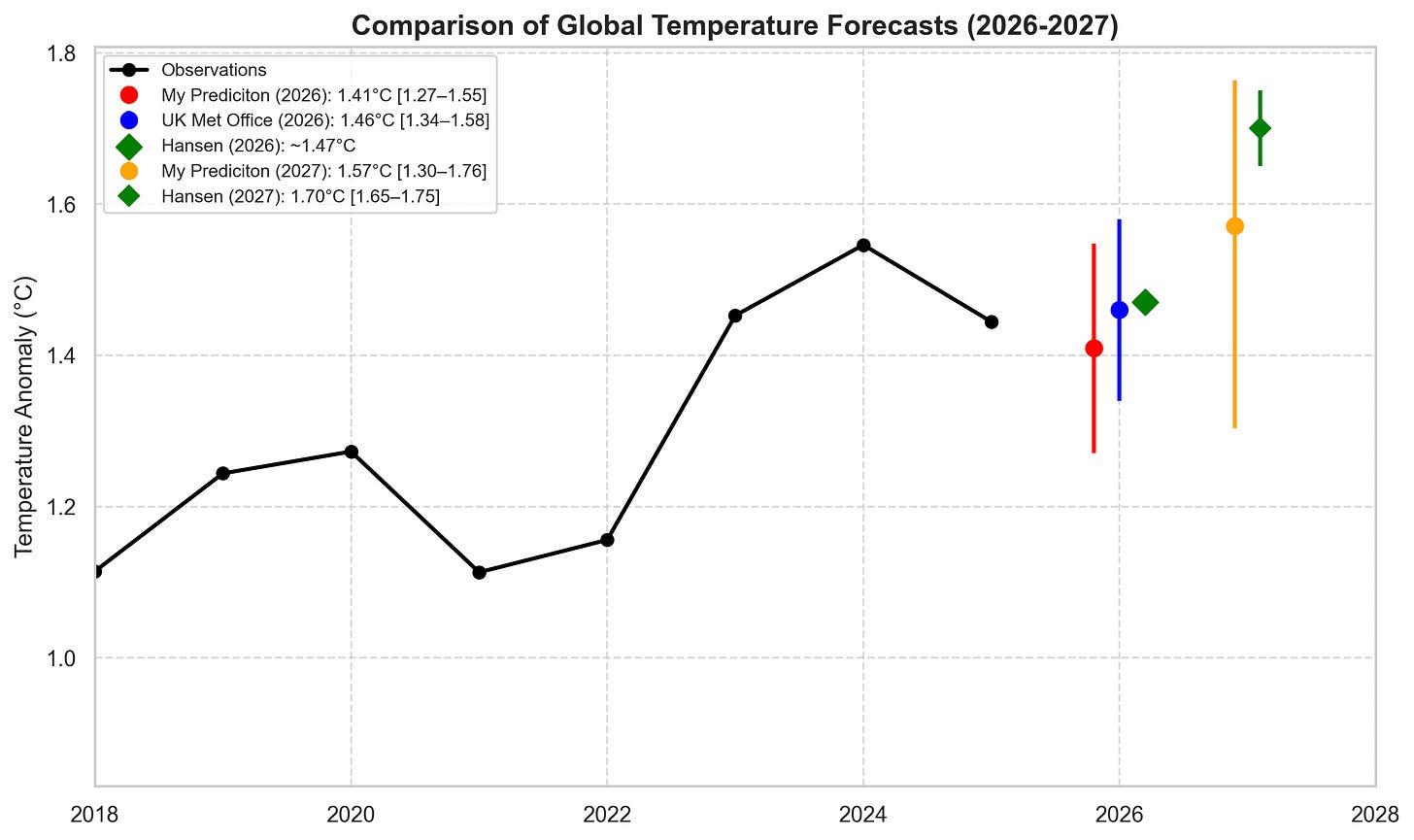
Tis the season for global temperature forecasts. The UK Met Office recently released their 2026 prediction, estimating that it is most likely to end up as the second warmest year on record at 1.46C (with a range of 1.34C and 1.58C) relative to the 1850-1900 preindustrial baseline period.1 This is likely warmer than both 2023 and 20252 and with a small chance of being warmer than 2024.
Not to be outdone, James Hansen released his estimate that 2026 temperatures will also be around 1.47C in the GISTEMP dataset (albeit using a somewhat different 1880-1920 baseline)3, with the 12 month average dipping down to around 1.4C in the coming months before rising back up by year’s end.
Hansen also adds a prediction for 2027 at 1.7C (1.65C to 1.75C), albeit with the caveat that this refers to the peak 12-month warming during the year rather than the annual average. The prediction is based on an assumed El Nino developing in late 2026 – something that models have suggested is increasingly likely in recent weeks.
I’ve long done year-ahead predictions of global mean surface temperatures (included in the Carbon Brief annual state of the climate report). I base it on a linear regression model that uses a year count, the prior year’s temperature, the latest monthly temperature, and the predicted ENSO (El Nino / La Nina) conditions of the first three months of the coming year, as these factors tend to be the most predictive historically.
The model is fit on historical data since 19704 using the WMO average of six datasets,5 and I’ve slightly tweaked the model this year to include a squared term for the year count to ensure it is not forced to be too linear (though the effects of this change are minor).
For 2026 I expect global temperatures to be around around 1.41C, with a 95% confidence interval of 1.27C to 1.55C. This means that it is almost certain to be one of the top-4 warmest years, but quite unlikely to exceed 2024’s record. Global temperatures in 2026 will be slightly suppressed by modest La Nina conditions in the tropical Pacific early in the year, while a late-developing El Nino (if it occurs) will primarily affect 2027 temperatures.
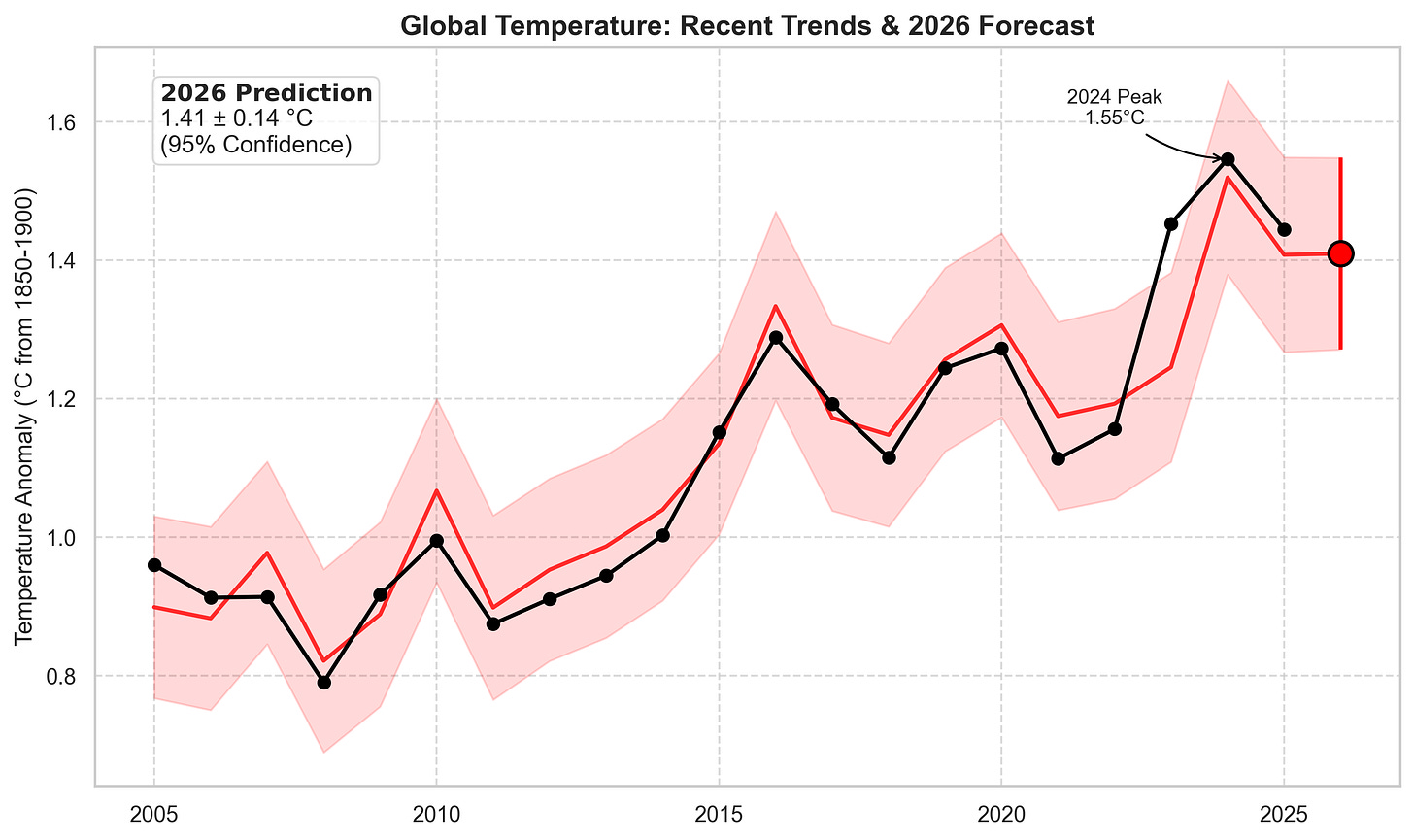
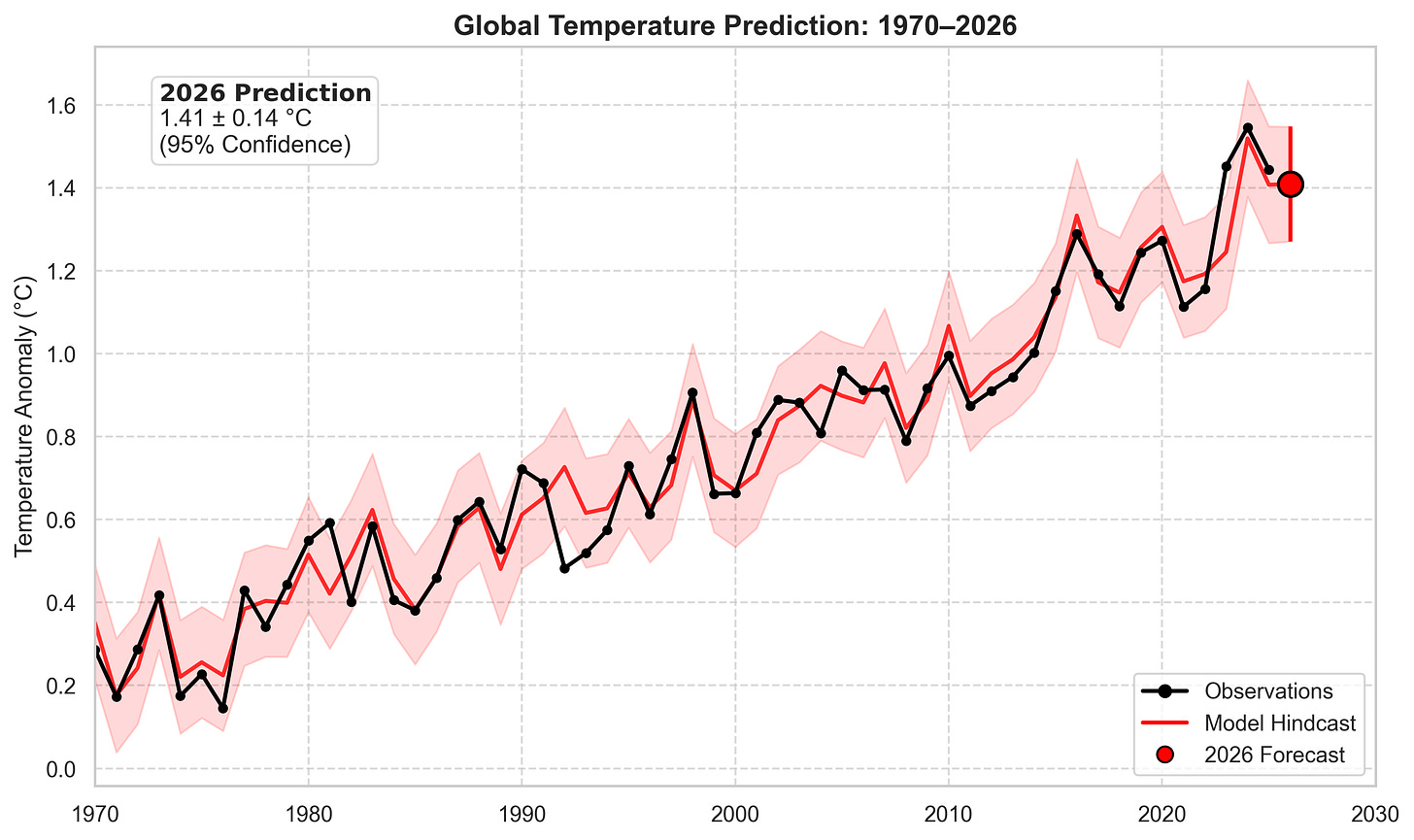
This model generally does a good job at predicting past calendar years using the same set of predictors (e.g. no actual data from the year except for Jan-March ENSO state). We can see this if we extend the hindcast back to 1970, where all years are within the model envelope with the exception of 1992 (when Pinatubo’s eruption resulted in significant unexpected cooling) and 2023 (which remains a bit of a mystery).
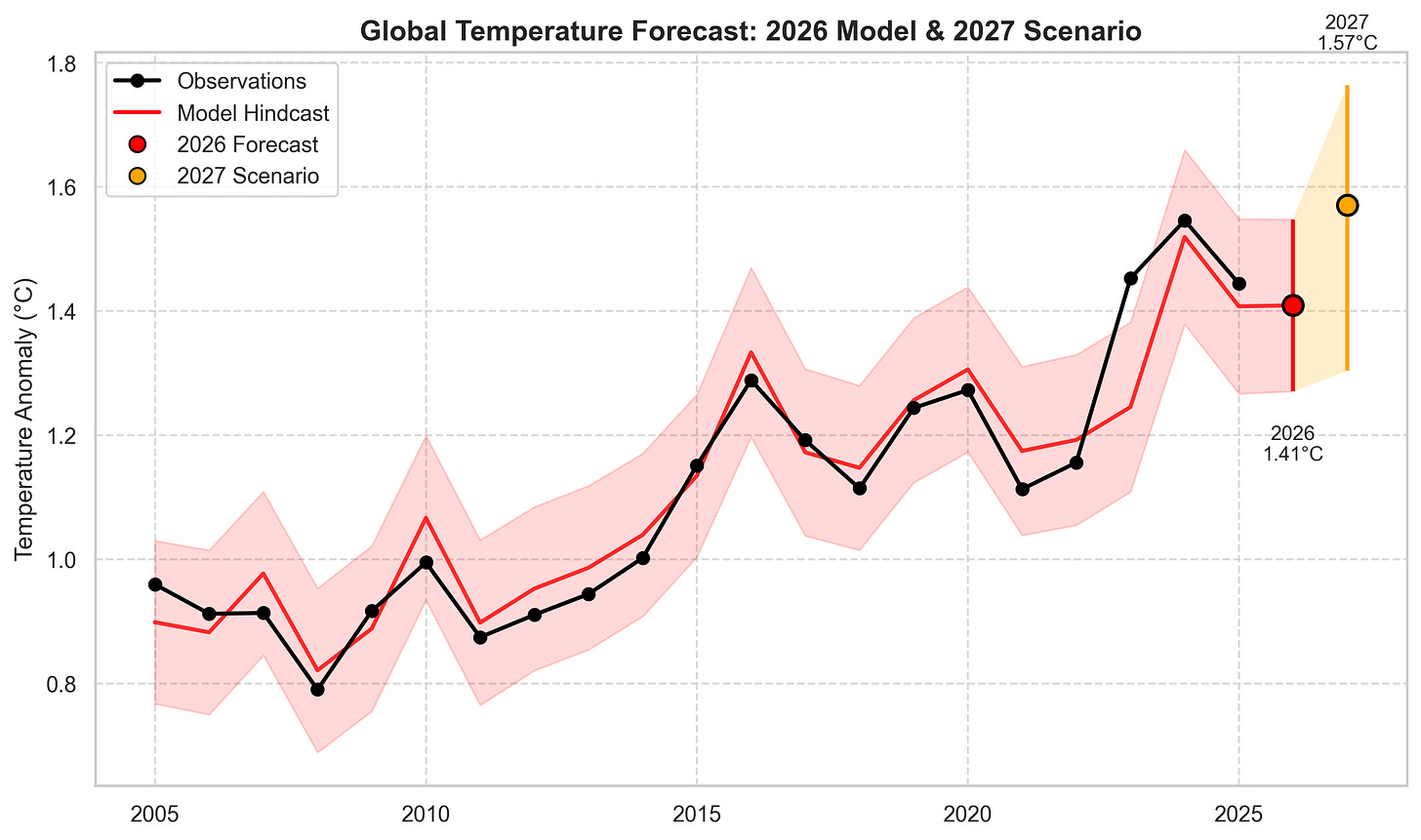
Predicting temperatures two years ahead is a bit more of a challenge. Here I’ve adopted a somewhat different approach of using the current warming level and the rate of warming (0.27C/decade) that we estimated in the Forster et al 2025 paper as a starting point. I’ve further assumed a boost of 0.1C in global mean surface temperatures from an assumed moderately strong El Nino event in the central estimate, though the error bars encompass no El Nino (0C boost) to a very strong El Nino (0.15C boost).
This gives a central estimate of 1.57C for 2027, albeit with error bars wide enough to ride an elephant though (1.30C to 1.76C!) given the difficulty of accurately predicting ENSO state that far into the future.
My central estimate of 1.57C is a bit lower than Hansen’s 1.7C, in part because I’m assuming a moderately strong El Nino and somewhat lower warming rates (0.27C/decade in Forster et al) then the 0.31C/decade that Hansen assumes. But his estimates remain within my (admittedly large) prediction error bars.
The fun part about making these short term forecasts is that we won’t have to wait that long to see how well they play out. The less fun part is that we are all forecasting a future rate of warming well above the ~0.2C per decade that has characterized the post-1970 period.









Tis the season to be jolly, tralala, tralala, lal,lal,lar... Occasionally I still get optimistic but less frequently now. I agree with Zeke's conclusion {from a link above} "Consilience of evidence
If we were solely relying on drawing trend lines through cherry-picked periods in surface temperature records, I too would be pretty skeptical about making strong claims regarding a recent acceleration in warming.
But we don’t just have surface temperatures:
Acceleration in surface temperatures is more readily apparent and significant when removing natural variability.
Our climate models expect a faster rate of warming under current policy scenarios.
We have a clear mechanism in declining aerosol emissions to explain a recent acceleration.
Acceleration is apparent in both ocean heat content and earth energy imbalance measurements.
In my view this consilience of evidence tips the scale toward pretty clear acceleration in recent years. I hope I am wrong – I’d prefer to live in a world where the rate of warming was flat or falling – but the evidence is becoming too strong to ignore." Here is his link from the re-post article above, www.theclimatebrink.com/p/the-great-acceleration-debate
But as I have learnt, delving into the links and especially the comments to those links,reveal many new avenues of thought.
This link from comments from the James Hansen's link on his recent estimates (above), has really lined up with my thoughts. Can anybody explain to me why this author Steven J Newbury is wrong? theuaob.substack.com/p/the-agency-trap-why-we-must-fail
prove we are smart@1,
Your request for "proof" is a bit off the subject of climate..
This Steven J. Newbury describes himself as an "Amateur Anthropogenic Entropy Theorist and Free Software developer." His (latest?) web presence dates back a month and sports 41 posts allegedly of non-trivial substance. These are not good signs.
He cannot write for nuts: another bad sign.
The particular post you link-to manages to tell us he:-
He then deigns to provide his "uncomfortable truth" that "we cannot 'manage' our way to survival" and that the "best case" would be that we initiate a human catastrophe to stop us "strip-min(ing) the biosphere down to the bedrock."
The employment of thermodynamical principles within non-thermodynamical circumstances is not a robust use of the physics. Such use is pure analogy and prone to the usual panoply of pitfalls for analogies. Talking 'energy use' simply dresses such analogy in pseudo-science.
His argument is really simply that the current trajectory of mankind is pointing to some really bad outcomes. You could use such projections to point to, say, pre-industrial mankind drowning in horse shit. Or perhaps to consider that the increasing ability of humanity to wage destructive war and the use of such war over ideological differences would reach the point where we can and thus eventually will inevitably destroy ourselves.
Or you could argue that humanity is today gaining access to new technologies that are exceedingly dangerous which our societies are entirely ill-equipped to harness in any way safely. Or you could argue that the nation states around the world will be unable to mitigate the emerging climate crisis and then be unable to cope with that climatic crisis and instead resort to military force precipitating an even worse crisis. And if not the emerging climate crisis, how about the emerging ecological crisis? Or one of the multitude of resource crises (of which 'energy' is but one)? And maybe a future malthusian crisis could yet reappear despite the passing of 'peak-baby'.
I'm sure Steven J. Newbury could happily invoke such threats into his "Grand Agency" bad and "Ground Agency" good. But really? Is this idea that we can chill out and be good if only we could precipitate the revolution which allows a utopian society to appear and flourish on the bones of today's world. Is there in some manner a metaphorical island we can inhabit and grow, fat like the Kākāpō, a species which only had laughing owls to fear as long as they stayed nocturnal? And in that analogised setting, was suddenly nature actually no longer red in tooth and claw?
You've probably guessed by now, I'm of the opinion that this little essay of
Steven J. Newbury is pretentious twaddle.
Prove @1 :
Gotta agree with MAR @2 : The Newbury substack comments are rather bizarre in their construction. Like A.I. generated !
"Acceleration" of global warming is arguable ~ but "linear" rise is bad enough, as it is !
Prove we are smart @1
Regarding a possible acceleration of global warming since around 2015. The following might be of interest and looks to me like a reliable analysis of the situation.
Grant Foster and Stefan Rahmstorf
Orono, ME, USA 3
Potsdam Institute for Climate Impact Research, Potsdam, Germany
Abstract. Recent record-hot years have caused a discussion whether global warming has accelerated, but previous analysis found that acceleration has not yet reached a 95% confidence level given the natural temperature variability. Here we account for the influence of three main natural variability factors: El Niño, volcanism, and solar variation. The resulting adjusted data show that after 2015, global temperature rose significantly faster than in any previous 10-year period since 1945.
www.researchgate.net/publication/389855619_Global_Warming_has_Accelerated_Significantly
There is a pdf file of the complete paper.
Basically they are saying the surface temperature record shows strong signs of an acceleration since around 2015, but it hasn't quite reached a 95% statistically significant level but if you separate out the underlying anthropogenic warming trend by ignoring el nino, the solar cycle and volcanic activity the underlying anthropogenic warming trend has definitely accelerated with good statistical significance:
MAR, good comment. I would say 90% pretentious twaddle, 10% grain of truth. Regarding the 10% grain of truth. Our current trajectory is looking bad. In terms of population numbers and economic growth and industrial culture clearly has us heading towards a resource crisis where we could potentially run short of energy and various important minerals. More specifically these things could start to become ominously expensive to extract. This all seems well known and relatively uncontroversial.
Surely the most likely outcome is that there will be some shortages of energy and materials and we will be forced to prioritise things and ration things and do a lot of recycling. There may be a drop in standard of living. Its impossible to say how much, because there are so many unknown variables like population trends and discoveries of new mineral deposits and technological substitution. I could be a very small drop in standard of living or quite drastic.
The economic system will change in some way and economic growth will be forced to or stop slow by shortages of resources. Humanity will not just lie down helplessly and give up. It will mitigate and adapt in some way. Capitalism may morph into something different but then again it might not. Capitalism does not strictly speaking need endless gdp growth.
The alternative is to be proactive to avoid shortages emerging in the first place. But this would require our generation to make drastic and urgent voluntary cuts in our use of energy and materials to make what is left last a very long time, without rising in price too much. Or we could make drastic cuts in the size of our population.
Well good luck persuading humanity to all volunteer to live like poor people or kill of about 5 billion people. I'm sure that will be adopted with enthusiasm. And any drastic cuts in consumption could cause massive levels of unemployment so we are caught between a rock and a hard place. And such a plan is very risky because we cant even quantify the problem beyond saying we will likely run short of some things eventually sometime.
People also talk about abandoning capitalism and having another go at something socialist. Im very suspicious of any sort of planned utopian solutions to the resource problem, having seen how disastrous communism was. I dont oppose all socialist ideas. For example there is a strong place for some government provision of services but I think the concept of private property is so entrenched that its unlikely to change. I certainly dont believe it should change.
Or another alternative is we do both adaptation and proactive change: For example we are adopting renewable energy, which does have the virtue its not reliant on non renewable resources like burning coal. This leaves such resources for other uses like petrochemicals.
Its a very complex issue. Clearly we need to change our ways, and this will either be forced on us by deteriorating circumstances or we will be a bit more proactive about it.
I would just add we could encourage people to make at least small voluntary cuts to their levels of consumption. Everything helps and I think it would be prudent and not compromise lifestyles excessively.
However even this plan doesn't look that achievable, given our addiction to consumption and how even small cuts to consumption tend to cause recessions and unemployment. So I'm a bit cynical I guess, and I'm inclined to think consumption will only fall if and when shortages emerge.
@2 MA Rodger "His argument is really simply that the current trajectory of mankind is pointing to some really bad outcomes. You could use such projections to point to, say, pre-industrial mankind drowning in horse shit."
I never read that story before-a funny shitless outcome for technology and fossil fuels saving the cities, the twist to that is the savior is now the villain and an existential threat to, well,everything. ???????????? Human health
Extreme heat increases risks for vulnerable groups, including pregnant women and infants.
Heatwaves, air pollution, and the spread of diseases all worsen as temperatures rise.
???? Economies
Countries face major economic losses from reduced productivity, damaged infrastructure, and disrupted supply chains.
For example, Cyprus could lose up to €29 billion from its GDP by 2050 without action.
????️ Ecosystems & wildlife
Species that depend on stable climates — like mountain meadow animals or cool-stream amphibians — are already struggling as their habitats change or disappear.
????⚡ Water and energy systems
Asia’s water and power systems are being hit hard by floods, droughts, and extreme weather, putting millions at risk and requiring trillions in adaptation spending.
???? Communities & infrastructure
Rising sea levels, stronger storms, and more frequent wildfires threaten homes, roads, and essential services.
NASA notes that effects like sea ice loss, glacier melt, and more intense heat waves are already happening and will worsen.
???? Food security
Droughts, heat, and unpredictable weather reduce crop yields and disrupt food supply chains.
????️ Earth’s natural systems
Global assessments highlight extreme weather, biodiversity loss, and destabilization of Earth’s systems as top long-term risks for humanity.
There is no argument the earth temperature is still rising,in fact,arguably accelerating. All the nation states are playing in an international poker game,where everyone is cheating. The unfriendly USA is openly and aggressively war mongering for Venezuela's heavy crude and more than eyeing off the sovereign nation of Greenland for its particular usefulness.
All the responders opinions agree that last link I mentioned is complete "pretentious twaddle". I see something else. I see tipping points of no return happening on our watch. I see a tragedy from a thousand cuts to our biosphere. I see political leaders too "involved" with corporations/big business and election cycles to plan sincerely.
Worst of all,the consumer has only a little appetite for a meaningful change to their bubble. The commodification of everything and the insidious media manipulation means a continuation of an economical system driving us all towards that cliff.
At least 6@ nigelj adds a little realism to it all. I don't have an answer to turn societies to less comforts, we need to be less capitalistic and more community minded and that goes against most western countries lifestyles.
Just a clarification on my previous comments. In no way am I dismissing the climate change problem. I was only concerned about the resource scarity issue, and this ultimately apples regardless of whether we use renewable energy (preferably) or fossil fuels. Althought it does appear that renewables are more sustainable than fossil fules longer term because the sun and wind is a limitless form of energy.