


 Arguments







Recent Comments
Prev 2590 2591 2592 2593 2594 2595 2596 2597 2598 2599 2600 2601 2602 2603 2604 2605 Next
Comments 129851 to 129900:
-
Quietman at 15:13 PM on 11 April 2009Volcanoes emit more CO2 than humans
Patrick That is exactly what I am working to find. The oceans are still largely big unknowns. The benefit of this entire AGW argument is that now scientists in many unrelated fields are looking harder at the evidence and investigating deeper. That government site that posted a hypothesis for the volcanic nature for the root cause for ENSO led me to look into ocean floor research and I find it's all recent research. The nature of volcanic ejecta along subduction zones lends support for the hypothesis IMO. It's recycled seafloor. -
Patrick 027 at 14:46 PM on 11 April 2009It's the sun
Gord - I also saw somewhere above that you mentioned backradiation from the atmosphere being the basis of AGW theory. A couple clarifications: First: what is a theory. Some others have explained it perhaps better than I could and I will provide links to those explanations at a later time. For now, I must point out that for a body of understanding to have the title of theory, it is generally necessary to be about a 'big, general topic'. For example: The theory of biological evolution, the theory of quantum mechanics, the theory of general relativity. The understanding of human evolution is part of the theory of evolution; there is not a seperate theory of human evolution, because that is a specific instance of something more general (that's not to say that human evolution is identical to all evolution, but variations in how different organisms have or are evolving will be a part of evolutionary theory). With regards to AGW, this is an instance of climate phenomena, that is encompassed by climate theory. Within climate theory is the understanding of the greenhouse effect. Perhaps that might be called a theory in itself (theory of the atmospheric greenhouse effect on planets) - however, anthropogenic global warming is a specific instance of this, and the full effects of global warming require other aspects of climate theory (fluid dynamics, etc.) to be understood. However, any understanding of cause and effect must be considered theoretical - without theory, all we have is patterns with no explanation of how and why (see Hume). In that sense, the understanding of AGW is the theory of AGW, but in this case, 'theory' is not part of a title of a specific body of understanding, but the name of a kind of thing - that kind of thing being 'understanding'. --- Second: Backradiation necessarily does occur as part of a greenhouse effect, and it does have important effects. However, the greater control of surface temperature and temperature in general within the troposphere comes from radiative forcing at the tropopause level. A change in radiative forcing at any level is a forced change in radiant flux at that level. A change in radiant flux causes an imbalance, so that heat must be accumulating or will be depleted below that level. A change in radiative forcing can be caused by a change in LW optical properties (as in changes in the greenhouse effect caused by increasing CO2), a change in SW optical properties (changes in albedo), or changes in SW absorption below that level caused by changing incident solar radiation. Equilibrium is restored when resulting temperature changes cause changes in radiant fluxes so as to restore balance. Radiant feedbacks are caused by changes in optical properties caused by climate change (in the shorter term: clouds, humidity, snow, ice, vegetation, dust, vertical and horizontal temperature distribution); these feedbacks amplify or reduce the climate change necessary to restore balance. Radiative forcing at the tropopause level is important to the surface because, however the resulting accumulation in heat below that level is initially distributed, changes in convection that respond to it tend to spread the heating effect vertically, so that the surface and all levels of the troposphere tend to warm or cool together. Changes in the moist convective lapse rate in the tropics (the temperature decrease with height that is of neutral stability to moist convection) are a feedback, reducing the surface temperature increase relative to that in the mid-to-upper troposphere. In polar regions, the air is generally stable to localized convection (especially/(particularly?) near the surface and especially in winter), as heat is transported sideways from lower latitudes, while strong positive feedbacks enhance heating at the surface, so the surface warming tends to be greater than warming higher in the atmosphere at higher latitudes in general. The stratosphere in general tends to cool off with an increased greenhouse forcing because the upper atmosphere radiates more strongly to space and recieves less heat from below when LW opacity is increased (when LW opacity increases, the cooler troposphere blocks more radiant heat coming from the warmer surface, and, depending on initial optical properties, the upper colder troposphere may also block more radiant heat coming from the lower troposphere). -
Patrick 027 at 14:10 PM on 11 April 2009It's the sun
Gord - It might help to go over the budget line by line (and elimate any wasteful programs that don't work, and provide more funding where good necessary programs are underfunded :) ): From: Kiehl and Trenberth http://www.atmo.arizona.edu/students/courselinks/spring04/atmo451b/pdf/RadiationBudget.pdf (All in W/m2): (PS most solar radiation is SW (shortwave) radiation, with wavelengths shorter than about 4 microns. Essentially all terrestrial radiation - radiation emitted by most of the Earth and atmosphere at their typical temperatures (the thermosphere is very optically thin - nearly transparent in general at relevant wavelengths for emission - and absorbs a very tiny fraction of total SW absorption - and so does not contribute much to this energy budget) is longer than about 4 microns; this is called LW (longwave) radiation.) --- 1. Total climate system: energy fluxes at top of the atmosphere: Absorption of solar radiation: 342 (incident) - 107 (reflected) = 235 (67 absorbed in atmosphere + 168 absorbed at surface) Emission of LW (longwave) radiation to space: 235 (195 from the atmosphere + 40 from the surface) solar energy in = 235 = 235 = LW energy out at the top of the atmosphere 2. Energy budget of the atmosphere: LW emissions from atmosphere: to space: 165 + 30 = 195 to the surface (back radiation): 324 total LW cooling of atmosphere: 324 + 195 = 519 Atmospheric heating: by LW radiation from surface: 350 by convection from surface: 102 (78 latent heat + 24 sensible heat) solar heating: 67 total atmospheric heating: 350 + 102 + 67 = 519 total heating of atmosphere by surface and sun = 519 = 519 = total LW cooling of atmosphere. No energy generated or destroyed in the atmosphere when in equilibrium. 3. Energy buget of the surface: Surface cooling: LW emission: 390 (350 absorbed by atmosphere + 40 directly to space) convective cooling: 102 (78 latent heat (evaporation) + 24 sensible heat) total surface cooling: 390 + 102 = 492 Surface heating: LW absorbed from atmosphere (back radiation): 324 solar heating: 168 total surface heating: 324 + 168 = 492 total heating of surface by sun and atmosphere = 492 = 492 = total cooling of surface to atmosphere and space by convection and LW emission. No energy generated or destroyed at/in the surface when in equilibrium. --- If there were an imbalance anywhere (in reality there are always imbalances, but over time, either in the global average of vertical layers, or for each location - accounting for horizontal heat transfer by winds and currents, they tend to average to zero except for changes associated with longer-term climate changes), heat would be accumulated or depleted, tending to cause (in the absence of sufficient latent heat of phase changes, etc.) temperature changes, which change the LW emissions, tending to bring energy fluxes toward balance. Bear in mind that Kiehl and Trenberth's budget is an approximation, and they point out in the paper that there is some significant uncertainty regarding how solar heating is distributed between the atmosphere and surface; I think any corrections in solar heating distribution would be mainly balanced by corrections in the convective transfer of heat from the surface to the atmosphere (technically, the heat must be conducted/diffused first into the air immediately next to the surface (which allows for some relatively small difference between the surface temperature and the air temperature effectively at the surface, considering the scale of the atmosphere as a whole), but convection takes it from there). Although they also use an approximation of the surface having perfect emissivity in the LW portion of the spectrum; this is a good first approximation, but I think it is actually somewhere between 0.9 and 1, so the radiation emitted by the surface is a little less than 390 (but still in that range) - however, depending on how emissivity varies by wavelength, this also means that some backradiation is reflected from the surface, so the total upward LW radiation at the surface will not be reduced as much as the emission from the surface will be for a downward correction of emissivity. Also, they did these calculations for globally-representative conditions, which will not always be globally averaged conditions because some effects vary nonlinearly (this is not a critism of their work - they discuss this in the paper). On that point, some correction in the opposite direction as that for imperfect emissivity might be made for surface LW emission because - as I recall from what I read - they used a global average surface temperature. When emissivity does not vary much over wavelength, total emission over the spectrum of relevant wavelengths is proportional to the fourth power of temperature, so horizontal spatial variability at any level tends to increase LW emission from that level for a given area-averaged temperature. Interestingly, the general tendency is for spacial variability to be reduced at the surface in response to global warming (because the positive feedback are particularly strong where snow cover and ice cover are reduced), which means a (slightly?) greater surface temperature increase will be required to produce the same change in global average surface LW emission (but there is also convection: see below). In the mid-to-upper troposphere, however, the general trend is for the warmer areas to warm more (in association with changes in the latent heating of the air due to greater humidity supply, etc, due to higher temperatures.), so less warming at that level in the global average would be required to produce the same global average change in LW emissions from those levels. These are examples of feedbacks. (Do not make the mistake of assuming climatologists have ignored them - although something can be ignored if it is very small in comparison to some other things - for example, the exact size of Lake Champlaign (sp?) in New York may have an effect on local climate but global climate - at least for sufficiently long term climate states (which, more than just being averages, actually encompass patterns in shorter-term variability - chaotic, cyclical, or otherwise) - is not generally sensitive to such a detail). -
Patrick 027 at 10:27 AM on 11 April 2009It's the sun
Forget the last two paragraphs; that was prep work to come up with an appropriate comparison. -
Patrick 027 at 10:26 AM on 11 April 2009It's the sun
Quietman - remember comments 467,469: http://www.skepticalscience.com/Arctic-sea-ice-melt-natural-or-man-made.html What happens when you take 1 gram at 150,000 K and toss it into a pile of mass 30,000,000,000,000,000 g. What is the temperature change of the 30,000,000,000,000,000 g? Assuming similar specific heat values, it would be around 0.000000000005 K. 1/30,000 mol in 1 g; 1/30 mol in 1 L, 1000/30 +~ 30 mol / cubic m. 30 mol* 10,000 m /10,000 cm2/m2 = 30*6.02*10^23 / 6 = 30*10^23; 1000*10^23 by mass, 10^26 div by 30e6 s/yr = 10^20/30 = 100*10^18/30 = ~ 3e18 ratio 3e18 , 100 years, 3e16 = 30e15, -
Patrick 027 at 05:45 AM on 11 April 2009It's the sun
Gord - Just to be absolutely clear: My point that there is a refrigerator in the sky (probably many at any given moment, actually) was really just an interesting aside; it has little to do with the overall energy budget as mapped out in Kiehl and Trenberth (a paper I have looked at more than once in the past; I'm glad you've had the chance to read it). "If there were a "refigerator in the sky" heat would flow from the colder atmosphere to the Solar Oven's focal point where this energy would be concentrated." That's only true with some additional specifications. There are both heat engines and refrigerators in the sky. Temperature variations produce pressure variations that cause air to accelerate so as to tend to lift warmer air and allow cooler air to sink. Kinetic energy can allow air to flow from low pressure to high pressure in some ocassions, having the opposite effect - this is when kinetic energy does work, is converted to heat energy, and drives a refrigerator. Meanwhile there is the coriolis effect which causes air to accelerate sideways in proportion to it's speed, depending on latitude, etc... -------- "For both time periods cooling should be possible because all bodies emit thermal radiation by virtue of their temperature. So the heat should be radiated outward." Ask yourself this: If the atmosphere above were hotter (And sufficiently opaque - let's say cloudy) than the solar cooker, the solar cooker would not cool off by radiating upward. But why? It is not because it stops radiating altogether, because: "all bodies [ with nonzero absorptivity and nonzero emissivity ] emit thermal radiation by virtue of their temperature.". Remember those trees and buildings continue to radiate as well, and that does not change if the temperature changes (unless material properties change as a result - the obvious example is that if the trees get to hot, they'll combust, etc.) The reason the solar cooker would not cool off in that case is NOT because it suddenly stops radiating thermal energy, but because the atmosphere is radiating a greater amount back. Now back to the more usual situation: The atmosphere does radiate some thermal energy back to the surface, because it is not 100% transparent at all relevant wavelengths, and it is not so cold as to be at absolute zero. If it were that cold, or if it were 100% transparent so as to reveal to the surface the entirety of the dark of space, that solar cooker would cool off much faster - not because it radiates more, but because it would now recieve essentially ZERO radiation from above. (PS It would actually be necessary to raise the atmospheric temperature (over all vertical levels) to somewhat above the surface temperature in order to balance the emitted radiation with back radiation, because at the same temperature, the atmosphere (at least in the absence of clouds or very high specific humidity) is partially transparent over a range of wavelengths from about 8 to 12 microns.) If you still don't believe me, consider this: Imagine the Earth's surface is a hot magma ocean (it may well have been that shortly after planetary formation). Suppose it is glowing red hot, as we would expect based on it's temperature. Suppose the atmosphere is such that some of this glow is visible from space. This is the thermal radiation emitted due to the Earth's surface's temperature. But it is only red hot - it cannot cool to the sun, which is about white hot. Does this mean that the Earth is not visible from the sun? Not easily, but you'll still see it with a good enough telescope - let's say you're a superhuman with a super telescope and both survive such conditions. Photons from the Earth are reaching the Sun. There is a flow of heat from the Earth to the Sun. It just happens to be less than the flow of heat from the Sun to the Earth. The Earth is cooler than red hot, but it does emit thermal radiation to space, and a small fraction reaches the sun - it is only small because the sun does not surround the Earth but only fills a small solid angle as seen from the Earth. --- ""There are only two significant energy sources that can directly affect the Earth's temp: 1. The Sun 2. The Earth's molten core." " ... "If these two energy sources were elliminated, the Earth would cool to near absolute zero." Why would the Earth cool if energy sources were eliminated? Might it be because it would continue to radiate to space as a function of it's temperatures, rather than simply shut down such radiation as a result of the loss of the sun? ---- "All the energy radiated by the Earth and the atmosphere could still NEVER EXCEED the 342 w/m^2 Solar Energy!" Using Kiehl and Trenberth's numbers, because only 235 W/m2 are absorbed by the Earth, only 235 W/m2 can be emitted by the Earth to space - if the temperature of the Earth is not changing (ie there is no net gain or loss of heat, or sufficient rearrangements of heat energy, etc...). But that is the radiant flux to and from the Earth as a whole, including the atmosphere. The entirety of the 390 W/m2 radiated by the surface does not go to space; the great majority is absorbed by the atmosphere. To a first approximation, none of the backradiation from the atmosphere goes to space, either. At no point in Kiehl and Trenberth's diagram is energy being created or destroyed (except the sun - but that's a conversion of energy, not creation ex nihilo) or is the second law of thermodynamics being broken. -
Patrick 027 at 04:54 AM on 11 April 2009Volcanoes emit more CO2 than humans
But what evidence is there that this volcanic activity varies sufficiently on the relevant time scales to have any detectable climatic effect on the relevant time scales. -
Quietman at 03:05 AM on 11 April 2009Volcanoes emit more CO2 than humans
Patrick The volcanic aerosol forcing is not what I am pointing out at all. That really does not apply to volcanism along the seafloor ridges at all. My use of terrestrial volcanos is only to show the increase in vulcanism overall. It is the underwater vulcanic activity that I am concerned with. The Earth is mostly covered by water and in that water are many more volcanos than at the surface as they run the length of the ridges that more than encircle the earth. -
Quietman at 02:58 AM on 11 April 2009It's the sun
Patrick "Temperatures of the plasma at the earth are found to be about 150,000°K" Magnetic holes allow some of this heat in. Gord Interesting points. -
Gord at 23:18 PM on 10 April 2009It's the sun
Patrick - I forgot to include this. If there were "a refigerator in the sky" the atmosphere would have to be warmer than the Earth. A refigerator transfers heat from objects inside to the Radiating Tubes at the back. The Radiating Tubes are warmer than the surrounding air....so heat is transfered to the air. The atmosphere is, obviously, cooler than the Earth.....therefore...there IS NO REFIGERATOR IN THE SKY! -
Gord at 19:58 PM on 10 April 2009It's the sun
Patrick - Re: Your posts #259 and #260 You said that "THERE IS a refrigerator in the sky" and "Going just by the excerpt that you provide, there is no proof that radiant heat is not recieved by the surface from the atmosphere." I disagree with both your statements. This contradicts the actual measurements conducted at the Physics Dept.of Brigham Young University, Utah clearly which shows this: (Reposted from #248) ------------------------ Solar Cookers and Other Cooking Alternatives "The second area of solar cookers I looked at was their potential use for cooling. I tested to see how effective they are at cooling both at night and during the day. During both times, the solar cooker needs to be aimed away from buildings, and trees. These objects have thermal radiation and will reduce the cooling effects. At night the solar cooker needs to also be aimed straight up towards the cold sky. During the day the solar cooker needs to be turned so that it does not face the Sun and also points towards the sky. For both time periods cooling should be possible because all bodies emit thermal radiation by virtue of their temperature. So the heat should be radiated outward. Cooling should occur because of the second law of thermodynamics which states that heat will flow naturally from a hot object to a cold object. The sky and upper atmosphere will be at a lower temperature then the cooking vessel. The average high-atmosphere temperature is approximately -20 °C. So the heat should be radiated from the cooking vessel to the atmosphere." http://solarcooking.org/research/McGuire-Jones.mht This link shows that heating cannot occur from the atmosphere. In fact, the article shows how to COOL items placed in the Solar Oven at NIGHT AND DAY! All you have to do is point the Oven away from the Sun during the Day and the Oven will transfer heat from the WARM object in the Oven to the COOLER atmosphere! It can even be used to produce ICE when the ambient air temp is +6 deg C! "If at night the temperature was within 6 °C or 10°F of freezing, nighttime cooling could be used to create ice. Previous tests at BYU (in the autumn and with less water)achieved ice formation by 8 a.m. when the minimum ambient night-time temperature was about 48 °F." This confirms the validity of 2nd Law of Thermodynamics....heat energy CANNOT flow from Cold to Warm objects. And, there is no Refigerator in the sky to force energy flow from Cold to Warm. ------------------- The Trenberth Energy Budget shows that the Solar Radiation absorbed by the surface of the Earth is 168 Watts/m^2 and reflected by the surface is shown to be 30 Watts/m^2. Both these figures add up to 198 Watts/m^2 and would be available to any Solar Oven. The Trenberth Energy Budget shows that the Back Radiation flowing from the colder atmosphere and absorbed by the Earth's surface to be 324 Watts/m^2. (The Back Radiation ABSORBED by the Earth is, supposed, to Heat the Earth according to the AGW theory) Notice that the Back Radiation EXCEEDS the Solar Radiation (the only energy source)! Solar ovens (parabolic mirrors) have no problem concentrating the Solar radiation at it's focal point producing very high temperatures. Parabolic mirrors will concentrate IR energy (Back Radiation) the same way. Notice the authors of the paper state: "During both times, the solar cooker needs to be aimed away from buildings, and trees. These objects have thermal radiation and will reduce the cooling effects. At night the solar cooker needs to also be aimed straight up towards the cold sky. During the day the solar cooker needs to be turned so that it does not face the Sun and also points towards the sky." If there were a "refigerator in the sky" heat would flow from the colder atmosphere to the Solar Oven's focal point where this energy would be concentrated. In Fact, according to Trenberth, the Back Radiation exceeds the Solar Radiation and is 163% GREATER THAN THE SOLAR RADIATION. If there really was a "refigerator in the sky"...The water at the focal point would NOT freeze, it would HEAT UP.....even MORE than it does with Solar Energy! --- Further, the authors have correctly attributed the freezing of the water as complying with the 2nd Law of Thermodynamics: "For both time periods cooling should be possible because all bodies emit thermal radiation by virtue of their temperature. So the heat should be radiated outward. Cooling should occur because of the second law of thermodynamics which states that heat will flow naturally from a hot object to a cold object. The sky and upper atmosphere will be at a lower temperature then the cooking vessel. The average high-atmosphere temperature is approximately -20 °C. So the heat should be radiated from the cooking vessel to the atmosphere." --- There, clearly, is no "refigerator in the sky"....and the results of the actual measurements absolutely confirm the validity of the 2nd Law. "Second Law of Thermodynamics: It is not possible for heat to flow from a colder body to a warmer body without any work having been done to accomplish this flow. Energy will not flow spontaneously from a low temperature object to a higher temperature object." http://hyperphysics.phy-astr.gsu.edu/hbase/thermo/seclaw.html#c3 So, we have an actual measurement that complies with the 2nd Law....this is not a surprising result! ------------------------------- ---------------------------- Patrick...you said... "Just to be absolutely clear: "Unless the Earth "created" energy....It cannot radiate more energy than it receives." It IS NOT radiating more than it recieves. You insist the sun is the only source of energy here, which is essentially true (geothermal and tidal heating are minute in comparison), but you seem to be forgetting about it here. The surface gets heat from the sun and the atmosphere. The atmosphere gets heat from the sun and the surface." Again, I disagree with the logic of your statement: 1. Trenberth's Energy Budget does not include ANY other energy source other than the SUN! 2. The Earth and the atmosphere receive their energy from the SUN. 3. The Earth and the atmosphere ARE NOT ENERGY SOURCES. Like I have stated in my Post #243... -------------- "There are only two significant energy sources that can directly affect the Earth's temp: 1. The Sun 2. The Earth's molten core. If these two energy sources were elliminated, the Earth would cool to near absolute zero. The Earth's atmosphere is NOT an energy source. The AGW'ers have produced an Energy Budget Diagram (which excludes the Earth's molten core, so I will as well) The Sun is the ONLY energy source in the following diagram. Here is a link to Kevin Trenberth's paper: Earth’s Annual Global Mean Energy Budget http://www.atmo.arizona.edu/students/courselinks/spring04/atmo451b/pdf/RadiationBudget.pdf --------------- The Law of Conservation of Energy is very clear..."ENERGY CAN NEVER BE CREATED OR DESTROYED" The In-comming Solar radiation (in Trenberth's paper) is only 342 w/m^2 and it is the ONLY ENERGY SOURCE. Even if ALL this energy (342 w/m^2) reached the Earth's surface and was ABSORBED it is IMPOSSIBLE for the Earth or the Atmosphere to radiate more than 342 w/m^2! Your posts seem to dispute this fact, but as part of your logic you have also violated the 2nd Law of Thermodynamics. Adding fluxes that include "a refrigerator in the sky" to force the Back Radiation to be absorbed by the Earth is the Violation of the 2nd Law. The actual measurements conducted at the Physics Dept.of Brigham Young University, Utah prove this. Further, "a refigerator in the sky" still would need energy to operate and it would have to come from the SUN! All the energy radiated by the Earth and the atmosphere could still NEVER EXCEED the 342 w/m^2 Solar Energy! -
Patrick 027 at 14:48 PM on 10 April 2009It's the sun
Because many common processes do not involve nuclear reactions, thermodynamic properties are often calculated without taken into account entropy and free energy associated with nuclear reactions. This essentially leaves those processes out of the defined system. Without changing the definition of the system, nuclear reactions would occur outside the system and potentially add to and/or take from the system mass, energy, and entropy; alternatively, one can evaluate the thermodynamics of nuclear reactions as part of a system. -
Patrick 027 at 14:41 PM on 10 April 2009It's the sun
Gord - (continued): ... When that colder air comes into contact with the hot object, the greater thermal energy of the hot object's particles (molecules, etc.) is such that collisions on average transfer energy to the colder air molecules; however, at any given temperature, there is a distribution of energies of the particles, and occasionally, an energetic molecule in the cold air will collide with a less energic molecule of the hot object. Taken all such collisions as a subset of the whole process, one finds a transfer of energy from the cold air to the hot object. This is less than the reverse transfer by all other collisions. And so on with thermal diffusion through the air. Random particle motions tend to spread out particles from one area over time. Collisions are very important, but even without them, over time, heat will diffuse outward from a hot region and inward to a cold region; the same mechanism tends to result in mixing of substances, such as when the aroma of bread spreads out in the air (although convective transport - turbulent mixing, as opposed to molecular diffusion - is often important as well in that process). But this motion is random, which means that some particles with greater energy will occassionaly approach the hotter region, etc. Also, most molecules at any given time will have some thermal energy (or else they would not be moving and so diffusion would be impossible), so the less energetic molecules that diffuse into the hot region still carry some thermal energy with them; it just happens to be, on average, less than the energy which is being taken away. Notice that thermodynamics deals with temperature and thermal energy, which deals with the kinetic energy of a distribution of random particle motions, that approaches an equilbrium DISTRIBUTION as energy becomes 'thermalized' - maximizing the entropy for a given amount of energy and reducing the free energy so that the substance as a whole can be described with a single temperature (in the absence of collisions, seperate populations of particles could move through each other while retaining their initial temperatures). Thus, thermodynamics necessarily involves statistics and probability distributions; the net effects are the sums of many individual random events. The most succinct way to state the second law of thermodynamics is that the entropy of a closed isolated system never decreases; it can decrease if the system is not closed or not isolated and interactions occur such that the production of entropy elsewhere allows a reduction in entropy in the system. The flow of entropy is equal to the flow of heat energy divided by temperature. When heat energy flows from hot to cold, the entropy of the cold body increases more than the entropy of the hot object decreases because the same heat energy entering the cold body brings more entropy per unit energy into the cold body than it takes upon leaving the hot body. A heat engine works by converting some heat to work (free energy); this can be done when there is a temperature difference. Heat energy flows in at a high temperature (low entropy per unit energy), some of it is converted to work (essentially zero entropy per unit energy), and the remainder flows out at a cold temperature (high entropy per unit energy). Entropy tends to increase; the maximum possible efficiency of a heat engine - the ratio of work produced per unit heat inflow at the hot temperature - is determined by what would conserve entropy. A smaller amount of heat energy flowing out at a colder temperature can carry the same entropy as a larger amount of heat energy flowing at a higher temperature, and the difference in energies is the available free energy. (If a heat engine were run off of an isolated source of cold (ice cubes), then the efficiency could be defined instead as the work per unit heat outflow at the cold temperature. This will generally be a different value than the other efficiency.) A heat engine working in reverse is a heat pump - a refrigerator if the enhancement of cold is the purpose. The maximum coefficient of performance possible is determined by what would just conserve entropy; for the same difference in temperature, it involves the same ratio of free energy to heat flow at the high temperature and free energy to heat flow at the cold temperature as those for a heat engine, except the coefficients of performance are the reciprocals of those ratios. Entropy also increases when two substances are mixed, and variations in composition can be a source of free energy - for example, in reverse osmosis, work is done to remove salt from water. Osmosis could be used to generate usefual energy from the mixing of fresh water and salt. Of course, there are other complexities; entropy depends on temperature and mixing can produce a change in the thermal energy. In general, any process (physical, chemical, etc.) can happen spontaneously if, taking into account diffusion, changes of state, changes of heat energy and temperature, pressure, etc, the total entropy increases. Thermodynamic equilibrium occurs when entropy is maximized (for a system in isolation - no mass or heat inflow or outflow); a system that is not in thermodynamic equilibrium possesses some available free energy; rather than destroying the free energy approaching thermodynamic equilibrium, one could allow a much smaller increase in entropy while extracting work from the system, until a different equilibrium is reached (it won't be the same equilibrium because the system has exchanged at least energy with it's surroundings). Kinetic barriers may exist that prevent a system from spontaneously reaching thermodynamic equilibrium or slow that process; such barriers can be used to regulate processes to preserve free energy; in some chemical and physical reactions, catalysts can form a tunnel through such barriers, making the barrier much smaller. --- You refer to this website: http://solarcooking.org/research/McGuire-Jones.mht in your comment 248 above. Going just by the excerpt that you provide, there is no proof that radiant heat is not recieved by the surface from the atmosphere. What is demonstrated is that this radiant heat flux is less than that upward from the surface (and the solar cooker). The excerpt even contains a statement that substances (depending on optical properties) thermally emit radiation according to their temperature. This emission only goes all the way to zero when the temperature goes all the way to zero - or when the substance is perfectly transparent and/or reflective. At any given wavelength, a material will emit radiation as a function of temperature and the material's emissivity; at local thermodynamic equilibrium, emissivity = absorptivity, and emissivity cannot be less than 0 or greater than 1. A perfect blackbody has emissivity = absorptivity = 1. Blackbody radiation intensity (energy flux per unit area per unit solid angle - multiplying by the cosine of the angle from the perpendicular to a surface and integrating over all directions that pass through the surface from one side to another gives the radiant flux per unit area from or passing through the surface in that direction relative to the surface) at any given wavelength, per unit wavelength, increases at all wavelengths as temperature increases, but increases much more at shorter wavelengths. -
Steve L at 10:43 AM on 10 April 2009Why is Antarctic sea ice increasing?
This is an interesting post, John. Your blogposts have been missed in my free time. Something that comes to my mind is: "Is this a strong negative feedback?" -
David Horton at 10:04 AM on 10 April 2009Why is Antarctic sea ice increasing?
Ah, that explains it. Who can think like a "skeptic"? -
Patrick 027 at 06:33 AM on 10 April 2009It's the sun
Another example of NET heat flow that you might have more familiarity with: If you have a hot object and a cold object in a room and turn a fan on to circulate the air, convection will tend to bring heat from the hot object and to the cold object. However, unless the air is ever at absolute zero, there will be some heat energy transported to the hot object; it will just be less than what is removed (air leaving the hot object will be hotter than air approaching it, but the air approaching it can have some non-zero temperature, and thus does have some heat energy, and when it comes into contact with the surface, heat energy can be exchanged in both directions as molecules bounce against each other, but the net effect is to transfer heat from the hotter object to the cooler air). -
Patrick 027 at 06:24 AM on 10 April 2009It's the sun
Just to be absolutely clear: "Unless the Earth "created" energy....It cannot radiate more energy than it receives." It IS NOT radiating more than it recieves. You insist the sun is the only source of energy here, which is essentially true (geothermal and tidal heating are minute in comparison), but you seem to be forgetting about it here. The surface gets heat from the sun and the atmosphere. The atmosphere gets heat from the sun and the surface. Here's why: Start at absolute zero on Earth, so nothing is radiating any energy. Turn on the sun. The surface and atmosphere now recieve heat. Neither is radiating any heat. Thus they are gaining thermal energy. Temperatures increase. Temperatures increase until the surface and atmosphere combined radiate to space the same amount of energy per unit time that they together absorb from the sun. But within that system, there is additional radiation back and forth, because the atmosphere absorbs some of the radiation from the surface, and the atmosphere radiates some energy downwards (in fact, different parts of the atmosphere radiate energy to and from each other, and because the lower atmosphere is generally warmer than the upper atmosphere (the thermosphere, etc, is a very small fraction and doesn't have much direct effect on energy budgets of other layers), the atmosphere actually radiates more strongly downwards than upwards - it looks warmer from below than from above because the cooler upper atmosphere blocks some radiation from the warmer layers beneath, and vice versa in the other direction)). The surface temperature will rise (or fall) until it's combined heat loss from radiation and convection balances it's heat gain from the sun and atmosphere. Each layer of the atmosphere will also have changes in temperature until it's heat loss by convection and radiation balances it's heat gain from convection and radiation, including radiation from the sun. -
Patrick 027 at 06:08 AM on 10 April 2009It's the sun
THERE IS a refrigerator in the sky - in which, above the tropopause, kinetic energy emanating from below does work, lifting colder air and pushing warmer air down. Because of changes in pressure, rising air cools adiabatically and sinking air warms up adiabatically - in this adiabatic process, there can be a net reduction or gain in thermal energy as some kinetic energy is either produced or consumed (does work). When warm air rises past sinking cold air, the average temperature decreases; the change in thermal energy corresponds to a gain in kinetic energy. The reverse can happen, and has importance particularly above the tropopause; it is most obvious in the mesosphere, where circulation driven by kinetic energy from below cools off the coldest air. But that involves a rather small amount of energy and can be ignored to a first approximation in accounting for the heat energy budget of the climate system. The radiant heat transfered from the atmosphere to the surface is less than that transferred from the surface to the atmosphere, and that does not violate any physical laws. -- "I don't see any mention of "NET" heat flow." Okay, but that's what they mean. The world doesn't make sense if otherwise - why? Consider this: if the sun were next to a blue-hot star, would the sun (that part of it facing the blue-hot star) go dark simply by being next to the other star? Does no light from the sun reach any star that is hotter? With a powerful enough telescope, I am quite sure you could see the sun from Sirius. What you are saying suggests otherwise, that the sun's light must not reach anywhere where temperatures are greater than the sun's photosphere. That when there is a lightning bolt, any photons from the sun must avoid it. --- Where is energy being created? Add up all the thermal fluxes into the surface, out of the surface, and you will see they are equal (for equilibrium conditions). Do the same for the atmosphere; you will find the same result. The atmsophere and surface both radiate in each other's directions and recieve some of each other's emissions. This happens because while one is colder than the other, niether is at absolutely zero, nor is either perfectly transparent at all relevant wavelengths. The atmosphere does thermally emit radiation, and some of it reaches the surface. -
Patrick 027 at 04:19 AM on 10 April 2009Volcanoes emit more CO2 than humans
It is true that volcanic aerosol forcing has an effect on NAM and SAM. But you've been refering to alternative pathways... Of course there could be seafloor material in Alaskan volcanos - it's associated with subduction of the Pacific plate. A constant rate of subduction would give rise to episodic volcanic eruptions, because it is not in their nature to erupt slowly and continuously. If you take a jar of sand and pour it out at a constant rate to form a sandpile, there will be small avalanches and occasional large avalanches off the side of the sandpile as it grows. That's not to say that all variations in volcanic eruptions must be due to chance or that plate motions are constant. (though they cannot move faster or slower or change directions with any persistence over intermediate time scales.) But look at the graph at the top of this site. What was the climate doing between 1880 and 1940? -
MattJ at 02:46 AM on 10 April 2009Why is Antarctic sea ice increasing?
I have an idea. Even better than "the warm satisfaction of guessing it" would be the even warmer satisfaction of seeing the article re-written to include the latest information. As it is, too many readers will not see the point of it. There is nothing to "sink your teeth into". Finally, I promise that this warmer satisfaction will not contribute to AGW;)Response: Agreed, will update the article. I'll give a clue - as I read the paper, my immediate thought was "this is the first question my skeptic readers will ask when I post this article" (Quietman, Wondering Aloud, I'm looking at you). -
Quietman at 01:03 AM on 10 April 2009Volcanoes emit more CO2 than humans
Patrick Re: "But **what** is it that convinces you so? " Maps of the Arctic Ocean Floor. The Locations of the trenches. The increased volcanic activity. The seafloor material in the ejecta from Alaskan volcanos. Portions of Oceans cooling while anomalous areas are heating. ALL point to a very active tectonic spreading and subduction in the arctic and a severe change in ocean currents. -
Gord at 21:22 PM on 9 April 2009It's the sun
Re: Post # 253 Patrick - Here is the 2nd Law of Thermodynamics: "Second Law of Thermodynamics: It is not possible for heat to flow from a colder body to a warmer body without any work having been done to accomplish this flow. Energy will not flow spontaneously from a low temperature object to a higher temperature object." http://hyperphysics.phy-astr.gsu.edu/hbase/thermo/seclaw.html#c3 I don't see any mention of "NET" heat flow. I do see the words "not possible" though.....unless work is done to accomplish this flow. Work would involve the natural creation of an equivalent "refrigerator in the sky" which does not exist. This is proven by actual measurements conducted at the Physics Dept.of Brigham Young University, Utah. (see my post #246) ------ Also, you have not addressed the fact that "the Sun is the ONLY energy source" in Trenberth's energy budget diagram. Unless the Earth "created" energy....It cannot radiate more energy than it receives. This the most basic fundamental physics. Clearly, the 390 w/m^2 that the surface of the Earth radiates exceeds the in-comming Solar radiation of 342 w/m^2. Unless you have a different "definition" of the Law of Conservation of Energy ("ENERGY CAN NEVER BE CREATED OR DESTROYED") then 390 is greater than 342 and therefore VIOLATES the Law of Conservation of Energy. -
David Horton at 19:41 PM on 9 April 2009Why is Antarctic sea ice increasing?
Ah, I was expecting at least a tee shirt with "I guessed the right answer on Skeptical Science and all I got was this tee shirt" written on it. -
David Horton at 14:18 PM on 9 April 2009Why is Antarctic sea ice increasing?
There is a prize John?Response: No prize other than the warm satisfaction of guessing it. But now I'm starting to feel the weight of expectation - it wasn't that big a question and I'm regretting talking it up (particularly as Phillipe Chantreau's questions in #15 were much more interesting than mine) :-) -
David Horton at 07:52 AM on 9 April 2009Why is Antarctic sea ice increasing?
Oh well, I'll try for the prize. One obvious question is - how much sea ice build up since 2004? Another is - if less sea ice leads to "to a decrease in salt rejection from ice" then when sea ice builds up, this trend should be reversed. That is we should see an oscillation, not a trend. -
chris at 07:42 AM on 9 April 2009Misinterpreting a retraction of rising sea level predictions
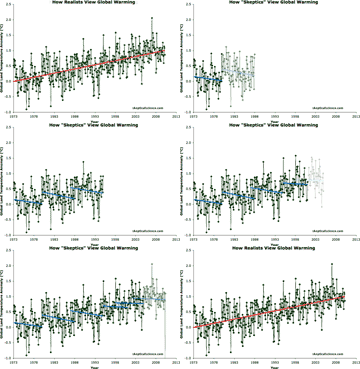
re #21Unless there is a clear and continuous upwards trend in a set of data, applying a linear trend to it means absolutely nothing
Not really HS. A linear trend is a linear trend. The whole point of determining a linear trend over a significant time period (7 or 10 or 11 or whatever years), is to establish significant progression of a variable in the context of stochastic variability ("noise").If 1998 was such an "anomalous year" why do the values from 2002 to 2007 statistically differ very little from the 1998 value, and how does this fact support a "warming" trend?
That's the point, HS. 1998 was anomalously warm; the strong El Nino raised the global temperature by around 0.2 oC above the trend. Now (2002 through 2007) the global temperature has reached the anomalously warm temperature of 1998 without the warming "pulse" of a strong El Nino... ..that's how the warmth of 2002-2007 supports a warming trend. It's about 0.2 oC warmer in this period than the equivalent period 10 years previously. -
tommybar at 00:39 AM on 9 April 2009Why is Antarctic sea ice increasing?
For one thing--Antarctica is massive. Is the ice build up in one particular area, and not so much in another? -
Brendon Eishold at 20:55 PM on 8 April 2009Why is Antarctic sea ice increasing?
From what I understood from the paper the warmer air and ocean temps means the sea ice forms more slowly which reduces the salt rejection which weakens convective overturning. This would suggest to me that autumnal ice formation would be slower than normal and that the spring thaw would come later. Thing is over the last couple of years, at least, the amount of ice in autumn has been well above the long term average. This last summer the ice went right back to around average levels but currently ice levels are again well above average, up near 1 millions sq km's above normal. This means there has been a rapid increase in new ice through the autumn. Am I missing something? -
Philippe Chantreau at 15:06 PM on 8 April 2009Why is Antarctic sea ice increasing?
Paragraph d of the paper clearly shows that P is not nearly as much a factor as the increased stratification, although you're right in the sense that it is a factor. I don't know what you have in mind, John. I am nowhere close to your background in physics but questions I have would be the following: since the net increase is due more to less melt than more growth, there should be some seasonal variations corresponding to that, i.e. increased summer extent, and also decreased amplitude between summer and winter. Is it visible in the data? Since there is decreased convection from the deeper ocean, there should be a relative increase of heat content at greater depths, is it the case (not sure there are datasets for that)? Finally, this appears to be bound to change at some point. How much of an equilibrium is it really? What happens when the upper layer is disturbed? Shouldn't the underlying water at some point get warm enough to displace the lower salinity layer? Then what happens? Now are you going to tell us what your question was or keep us hanging :-)? -
Patrick 027 at 14:40 PM on 8 April 2009It's the sun
"Ultimately the kinetic energy is lossed to friction," I meant "lost" "but it involves a rather small amount of energy in comparison to the thermal energy budget of the climate system." And so one can, at least on the large scale and in general, approximate the thermal energy budget without considering conversion to and from kinetic energy. -
Patrick 027 at 14:27 PM on 8 April 2009It's the sun
Gord - in case this helps visualize the situation: if I'm the white hot object and you're the red hot object, that the net direct thermal radiation exchange between them must be from me to you and not the reverse does not imply that there is no radiation in the opposite direction, for if it did, it would imply that I could not see you. The second law of thermodynamics actually implies that at any given wavelength, if you can see me, then I can see you. An optical filter could be used so that my yellow and blue wavelengths would reach you but neither of us could see each other's red wavelengths. For that matter, you're emissivity and absorptivity (they must be equal if at local thermodynamic equilibrium, and if not in local thermodynamic equilibrium, then otherwise cool objects might appear hot - as in fluorescence, etc. - the second law of thermodynamics would still apply but there would be some flow of energy not associated with a simple measure of temperature in that case (work, free energy, etc.)) could be zero at those shorter wavelengths, and then I couldn't see you and, since you wouldn't absorb any of my shorter-wavelength radiation, you wouldn't 'see me' either; the point being that seeing each other is a two way street - if I am smaller or have lower emissivity at any given wavelength, that reduces the direct radiative energy exchange in both directions between us, as I would emit less to you and absorb less from you, etc. (PS what if my shorter wavelengths were blocked by an obstacle but the red wavelengths could pass between us - well, the net radiant energy flux would still be from me to you because for a given emissivity (as a function of wavelength that is not changing in this scenario), radiant intensity increases at all wavelengths as temperature increases; it only increases much more at shorter wavelengths. If a blue hot object were in between us and it were opaque, we couldn't see each other; there would be no direct radiant energy flux between us (at the wavelengths for which this occurs). If it were transparent, we couldn't see it and it couldn't see us; our radiation would pass through it and it would be as if it weren't there. If it were perfectly reflective, we'd only see ourselves (in that direction), and effectively radiating to objects with the same temperature and getting the same back (in that direction). If it were somewhere in between, one could describe the total radiant energy flow among the three objects as the sum of three parts: the direct radiant exchange between you and me, the direct exchange between you and the blue-hot object, and the direct exchange exchange between me and the blue-hot object; each individually has a net energy transfer from warmer to cooler; the total gain or loss by each depends on the optical properties and temperatures (and sizes and distances, etc.) of all three. Yes, with radiation, what you see is what you get; the exchange of energy among objects of finite size, with neither enveloping the other, (as opposed to two infinite sheets or concentric spheres) that are farther apart, is smaller because they appear smaller to each other. The intensity - the radiant flux per unit solid angle (analogous to how bright an object looks within a given unit of the field of view) - is conserved in the absence of absorption, emission, and reflection and scattering (it is even conserved during refraction in the absence of those other things). What if there is no net energy exchange? If you wrap a white hot object in perfect mirrors (that have zero thermal conductivity and are not fluids), there is no net energy flow, but if you stepped inside the white hot object, you'd see radiation coming from the object and going back to the object equally in any two opposite directions. --- The sun heats the Earth and atmosphere. Earth loses heat to the atmosphere and space. There are convective fluxes from the surface to the troposphere. There are radiative fluxes among the surface, space, and all levels of the atmosphere; there is net radiant cooling to space from both the surface and all parts of the atmosphere, which is about equal to the total radiant fluxes from the surface and all parts of the atmosphere, since space is radiating very little (it looks like a blackbody near absolute zero). This is in total balanced by solar heating, but not everywhere, because there are net radiant fluxes among the surface and levels of the atmosphere, which all combined, and combined with convection, including horizontal heat transport, averaged over the year and over interannual variability, for a steady long-term climate, balance the spatial displacment between solar heating and longwave cooling to space. The flow of entropy is equal to thermal energy divided by temperature; for radiant energy, the entropy gained or lossed by an object by radiation is equal to the radiant energy gained or lossed divided by the temperature of the object. The direct net radiant energy fluxes between any pairing of subdivisions of the climate system is from warmer to cooler (provided the subdivisions are defined to be small enough so that they are each approximately isothermal within themselves - remember, 'local thermodynamic equilibrium'), which insures that, following the flow of energy, entropy is increasing, and as energy is conserved, entropy does not decrease. That satisfies the second law of thermodynamics. Of course the entropy of the climate system can fluctuate up and down a little as the flow of entropy and energy to space can fluctuate; this does not violate the second law of thermodynamics. If equilibrium temperature were determined by radiation along, the lowermost atmosphere would be unstable to convection (in general - not at the poles, at night, etc., but for a representative global average). Convection tends to maintain the change in temperature with height (the lapse rate) near a moist-adiabatic lapse rate - with regional variations, of course. From idea gas laws, it can be shown that warm air rising and cold air sinking, either by localized overturning (cumulus convection) or larger scale overturning (Hadley cells, Walker circulation, monsoons, extratropical baroclinic waves), converts some thermal energy into kinetic energy, as in a heat engine. Ultimately the kinetic energy is lossed to friction, thus turning into thermal energy, but with a different distribution, with higher entropy. There is not much recycling of kinetic energy to kinetic energy after frictional dissipation. However, kinetic energy can be converted back into thermal energy when wind blows from low pressure to high pressure, and cold air is forced to rise as warm air sinks. This can and does happen under some conditions. Kinetic energy is very important as winds and currents are important in shaping the climate, but it involves a rather small amount of energy in comparison to the thermal energy budget of the climate system. -
Patrick 027 at 13:28 PM on 8 April 2009It's the sun
""Temperatures of the plasma at the earth are found to be about 150,000°K, approximately a factor of ten lower than the estimates for the temperatures of the bulk of the coronal plasma found in the upper atmosphere of the Sun." Please click on the RED link above for their page and full explanation." I read it. What is the point you think it makes? -
Patrick 027 at 13:24 PM on 8 April 2009Volcanoes emit more CO2 than humans
"But the Arctic melt is caused by vulcanism, of that I am comvinced. The same goes for the AWP in Antarctica, ENSO, the PDO and AMO." But **what** is it that convinces you so? -
MattJ at 12:51 PM on 8 April 2009Solar cycles cause global warming
Isn't there another, longer cycle superimposed over this one? I seem to remember 81 or 181 years, but I can't remember which. I am surprised that the sunspot cycle could even contribute as much as .18C, seeing that most of the radiation change is in either fairly low RF frequencies or in X-ray spectrum. Then again, X-rays are well absorbed by the atmosophere, so they really do turn into heat. -
MattJ at 12:48 PM on 8 April 2009Solar cycles cause global warming
Isn't there another, longer cycle superimposed over this one? I seem to remember 81 or 181 years, but I can't remember which. I am surprised that the sunspot cycle could even contribute as much as .18C, seeing that most of the radiation change is in either fairly low RF frequencies or in X-ray spectrum. Then again, X-rays are well absorbed by the atmosophere, so they really do turn into heat. -
tommybar at 07:53 AM on 8 April 2009Why is Antarctic sea ice increasing?
Really...."Warming temperature leads to increased precipitation which increases sea ice growth."Response: This is something I discussed with Zhang, the author of the paper - he clarified that precipitation had small impact on the overall sea ice trend compared to the decrease in upward ocean heat transfer.
When I first read the paper, there was one immediate question I had about his conclusion and it was the first thing I asked Zhang - I'm surprised noone has asked it here yet. I wonder who'll bring it up... :-) -
Patrick 027 at 06:53 AM on 8 April 2009It's the sun
black2deep - "The argument that solar flair activity has not effected the earth temperature has yet to be proven. Techtonic activity according to USGS is more active in this centry than any other centery. Yet this inofrmation is being ignored. (Before anyone jumps on the train lets see which way it goes.) Volcanic activity causes cooling, not heating of the atmosphere. Dust particles tend to block the heat and cool the temperagure of the earth. However, underwater volcanic activity does two things. One, it heats the waters through magma flow welling up through the cracks within the crust, and saturates the water with CO2, two it changes the prevailing currents of the oceans. Recent events has cuased the currents to change in one part of the world, when a 100 foot tall 1000 mile wall welled up Near Indonisa. Thus, chanigng the water currents forever in that area. Before we jump on one wagon, shoulden't we be examining every aspect of this situation, rather than simply pointing to one suspect and yelling. "He's the guilty party!" Not only is it non scientific but smacks of politics, more than science. " Lack of proof or disproof can leave possibility, but when well-understood apects of a system account for the observations quite well, it's a reasonable expectation that the unknowns are not so important. Furthermore, without proposing at least some plausable or feasable mechanism to connect one phenomena to another, simply asserting that one might be connected to the other is not particularly useful - the same argument method could be used to suggest just about anything - hence the logic of Occam's razor. What is the significance of a connection? Just about everything may be connected somehow, someway, to everything else, but not all connections are equal or of the same type. If it could be shown that changes in the solar wind and geomagnetic field are somehow causing a climate change that is significant relative to anthropogenically-forced effects, it would not necessarily be a significant change in global average temperature with the same significant regional and seasonal variations as caused by any other forcing. Obviously solar UV variability will have some effect on upper atmospheric conditions that are different than greenhouse effect changes (something climatologists are aware of). The solar wind, by affecting the magnetosphere, can affect the ionosphere, but what do any of the resulting changes do to the troposphere and stratosphere? The great majority of geothermal heat flux at the surface is from the slow steady heat transport through the crust; very little is direcly from volcanism, and so it is hard for geothermal heating to fluctuate much on global and regional scales; the heat flux itself is generally on the order of 0.1 W/m2, much smaller than just anthropogenic CO2 forcing thus far; much much greater forces (Winds, climate-driven buoyancy variations, tides) shape the ocean's conditions and dynamics and variability in these dwarf any short-term volcanic effects (Panama wasn't built in a single millenium). Geologic outgassing of CO2 is very slow and can only act to change climate signicantly over time periods of at least hundreds of thousands of years. -
Patrick 027 at 04:57 AM on 8 April 2009It's the sun
Gord - With regards to the second law of thermodynamics, what it says about spontaneous heat flow only being from warmer to cooler and not the other way around - it is important to remember that this is NET flow. The NET flow of heat can be and often is the difference between two larger values, the heat flow only in one direction and the heat flow in the opposite direction. The net radiant heat flow between a red hot object and a white hot object is from the white hot object to the red hot object, but there is radiation going in both directions; furthermore, that radiation could be passing through another object which may be blue hot or as cold as space - depending on it's optical properties, it may participate in the radiant heat flows, with some net heating or cooling, but however it works out, the net heat flow between just two of whatever number of objects is involved is from hotter to colder. The difference between 390 and 342 is 48. That is the radiant cooling of the surface of the Earth to the cooler atmosphere and the cold of space. It is less than the solar heating of the surface; the difference is balanced by convection, which tends to link changes in temperature between the surface and various levels of troposphere together, because heating one part up without heating the other parts changes the convection rates in such a way as to heat up the other parts, generally; above the troposphere, convection is much less important in the global average vertical energy fluxes - but there is some large-scale overturning driven by a small upward flux of kinetic energy from below (generated by the heat engine of the troposphere when hot air rises and cold air sinks, etc.); this upper level overturning IS a refrigerator/heat pump - the kinetic energy is used to cool off parts that are colder and heat up parts that are warmer, across latitudes. -
Philippe Chantreau at 03:42 AM on 8 April 2009Why is Antarctic sea ice increasing?
Tommybar, this article discusses sea ice, which is frozen sea water. It is not dependent on snow fall. -
tommybar at 03:38 AM on 8 April 2009Why is Antarctic sea ice increasing?
Just a thought--when did all that ice down there form? Perhaps the Antarctic ice grows during the warmer periods. If it's too cold, the air is too dry for precip. So the oceans around it grow a little warmer, more snow falls down there. Ice grows larger. Either way, you guys don't know why it's growing, but it is. Sounds like yet another poorly understood system falling under the 'science is settled' banner. -
Quietman at 11:15 AM on 7 April 2009Models are unreliable
Mizimi I have posted a link to proof of Solar Wind and Magnetism being an active part of the scenario in the "It's the Sun" thread. The alarmists have been playing ignorant of the NASA findings. -
Quietman at 11:10 AM on 7 April 2009Models are unreliable
"Remember this: a climate model is really nothing more than a scientific hypothesis. If a hypothesis is consistent with observations, then it is standard scientific practice to say that such a hypothesis can continue to be entertained. In this case, that hypothesis can then serve as a basis for other subsidiary models or, in reality, subsidiary hypotheses. If the hypothesis is not consistent with observations, it must be rejected. That does not mean that human-induced climate change may or may not be real, but it does mean that (in this case) the magnitude of prospective change has—with high probability—been overestimated. That means that all subsidiary hypotheses on economic costs, strategic implications, or effects on health are similarly overestimated." TESTIMONY OF PATRICK J. MICHAELS TO THE SUBCOMMITTEE ON ENERGY AND ENVIRONMENT OF THE COMMITTEE ON ENERGY AND COMMERCE, U.S. HOUSE OF REPRESENTATIVES.. -
Quietman at 11:01 AM on 7 April 2009There is no consensus
John One of your countrymen, Dr. David Evans made the statement: "Yes, it's important to get our response right. If the alarmist are correct, then we should cut down our carbon emissions of the planet with overheat. If the alarmist are wrong, it's important not to cut back our carbon emissions or we'll create wide spread poverty unnecessary. There is no real substitute, except the get the real science right." Dr. Evans recently converted from AGW alarmist to AGW skeptic. -
Quietman at 10:58 AM on 7 April 2009Volcanoes emit more CO2 than humans
But the Arctic melt is caused by vulcanism, of that I am comvinced. The same goes for the AWP in Antarctica, ENSO, the PDO and AMO. -
Quietman at 10:55 AM on 7 April 2009Volcanoes emit more CO2 than humans
The Climate Change controversy has brought to light a correlation that seems to have been lost in history: temperature change versus solar activity, not only solar irradiance that can account for only a small change in temperature, but activity that includes solar winds and magnetic fields. See todays comment here. It's The Sun But I still feel that the Sun is only part (albeit the major part) of Climate Change. -
Quietman at 10:46 AM on 7 April 2009It's the sun
To all of you that have been saying I am wrong about The Solar Wind: Nasa says otherwise: "Temperatures of the plasma at the earth are found to be about 150,000°K, approximately a factor of ten lower than the estimates for the temperatures of the bulk of the coronal plasma found in the upper atmosphere of the Sun." Please click on the RED link above for their page and full explanation. -
Wondering Aloud at 06:29 AM on 7 April 2009Why is Antarctic sea ice increasing?
It doesn't look to me like we need any explanation other than random variation. "The paper uses a coupled ocean/sea ice model to find the predominant reason that sea ice is increasing" Translation: another computer model unverified and perhaps related to reality, perhaps not. Seems to me a stretch. We don't have the data to know much about sea ice trends either way. 30 years of records with plenty of problems isn't really something worth building models to explain, and certainly isn't enough to be useful.Response: The take home I took from the paper is that empirical measurements, not model results, show the Southern Ocean is warming - in fact, warming faster than the rest of the oceans of the world. So the conclusion that increasing Antarctic sea ice shows cooling Antartica which disproves global warming is a false conclusion. In fact, the answer is a lot more complicated than that - and a lot more interesting. -
stopphonyscience at 16:40 PM on 6 April 2009Scientists can't even predict weather
U.N. Con on Global Warming Nearly Foiled Tuesday, March 31, 2009 3:15 PM By: Philip V. Brennan Article Font Size LINK: http://www.newsmax.com/brennan/global_warming_UN/2009/03/31/198054.html The con game is about over. The attempt to portray a life-giving natural gas as a dire threat to this planet is failing rapidly, as well it should. It is becoming more and more obvious to the American people that carbon dioxide, the very substance that gives life to the world's plant life, is not a pollutant, as the global-warming hoaxers would have us believe, but a vital element that keeps the earth green and healthy. This is bad news for the would-be masters of the universe at the United Nations who have been using the supposed threat of global warming to advance their desire to turn the United States of America into a vassal state and its citizenry into its subdued subjects. If increased atmospheric levels of carbon dioxide are not causing the global climate to undergo a dangerous rise in temperatures, the United Nations has lost its strongest weapon in its attempt to assume world hegemony. Those of us who have been warning about the U.N.’s covert ambition have found an ally in Mother Nature, who has managed to cool things down despite the rapidly increasing atmospheric carbon dioxide levels during the past decade. The climate stopped warming around 1998. During the past 10 years, she's lowered the thermostat to the extent this year is moving rapidly toward the distinction as one of the coldest on record. In my 1997 series, Behold, The Iceman Cometh, I warned about the U.N.'S attempt to use global warming to achieve its dream of putting the United States in its hip pocket, writing that the U.N.'S Intergovernmental Panel on Climate Change was setting the stage for the international body's attempt at world domination. MORE: http://www.newsmax.com/brennan/global_warming_UN/2009/03/31/198054.html -
Philippe Chantreau at 02:01 AM on 6 April 2009Why is Antarctic sea ice increasing?
David, afaik, icebergs would be relevant mostly to the extent that they can prevent normal movement of sea ice if they happen to be very large and located where they can interefere with wind driven sea ice motion. About the changes in temp/density/salinity, I really don't know, would have to look at the existing litterature. Let us know if you find pointers. -
AC at 22:29 PM on 5 April 2009Why is Antarctic sea ice increasing?
i am less educated than most other forum members and i hope i am not lowering the tone with my interjections. i was just thinking that melted land ice would lower the temperature of the adjacent sea water contributing to more sea ice. the trouble with this simple argument though i reckon is that land ice isn't as salty so melted land ice and may raise the temperature of sea water. normally when i talk about ice its to do with keeping my drinks cool, that was the inception of my chain of thought to do with increasing sea ice. it imparts coldness
Prev 2590 2591 2592 2593 2594 2595 2596 2597 2598 2599 2600 2601 2602 2603 2604 2605 Next