



 Arguments







Watts Up With That concludes Greenland is not melting without looking at any actual ice mass data
Posted on 13 July 2010 by John Cook
To properly understand what's happening with our climate, it's imperative we consider the full body of evidence. Unfortunately, much confusion is sowed by those who cherrypick select pieces of data while neglecting the full picture. A good example is a blog post at Watts Up With That by Steve Goddard, titled Greenland Hype Meltdown. Goddard characterises the reports that Greenland is losing ice as a "continuous stream of gross misinformation". Curiously, he provides no actual data on Greenland's ice mass to expose this gross misinformation. Instead, he cites temperature from a single weather station and some photos he took while flying over the ice sheet.
Let's look at actual measurements of what's happening to the Greenland ice sheet. The change in ice mass has been measured using a variety of methods. Satellites use radar interferometry to measure the speed of the glaciers as they slide into the ocean. What they find is the glaciers have been sliding faster downhill and dumping more ice into the ocean. Satellite radar altimetry and airborne laser altimetry have also been used to measure the thickness of the ice sheets - they both find the ice sheet is thinning.
GPS receivers have been placed at selected locations around Greenland to measure how much the bedrock is lifting in response to thinning ice sheets. These find the land is now rising up at an accelerating rate. An overall picture is obtained by satellites measuring the change in gravity around the ice sheet. As the ice sheet loses mass, the gravity around Greenland changes, as measured by the GRACE satellites. These measurements find accelerating ice loss.
Net accumulation and loss of ice mass from Greenland are calculated using measurements of precipitation, snow accumulation and the discharge of glaciers into the ocean. The net accumulation/loss measurements find the same rate of ice loss as the GRACE gravity data. When all these independent lines of evidence are compared, we find a consistent picture of accelerating ice loss over the last decade and a half.
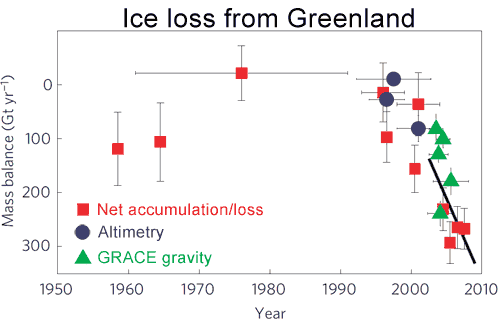
Figure 1: Rate of ice loss from Greenland. Vertical lines indicate uncertainty, horizontal lines indicate averaging time. Blue circles are from altimetry, red squares are from net accumulation/loss and green triangles are from GRACE. The black line is a straight-line (constant acceleration) fit through the mass balance data for the period 1996–2008 with a slope of 21 gigatonnes/yr2 (Jiang 2010).
Is there any evidence that this ice loss has stopped recently? The latest gravity data, released just over a month ago, shows continued accelerating ice loss from the Greenland ice sheet. This is because ice loss has spread from southern Greenland to the northwest, confirmed by gravity measurements and GPS data. Currently, Greenland is losing ice mass at a rate of around 286 billion tonnes per year.
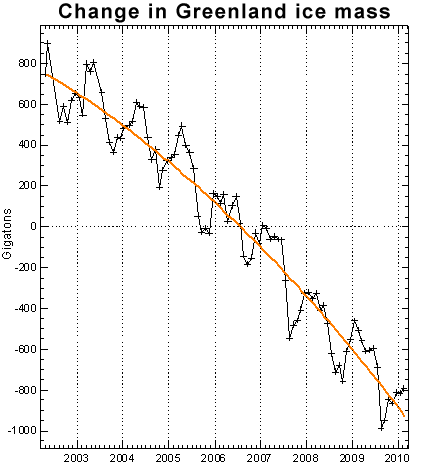
Figure 2: Greenland ice mass anomaly (black). Orange line is quadratic fit (John Wahr).
The full body of evidence gives us a variety of direct measurements, using independent techniques, all arriving at the same answer. When Naomi Oreskes refered to "multiple, independent lines of evidence converging on a single coherent account", she may as well have been talking about Greenland ice loss.
Steve Goddard is correct when he says there's a "continuous stream of gross misinformation" about Greenland ice loss but it's not coming from the peer-reviewed research which paints a remarkably consistent picture. Instead, the misinformation comes from those who ignore the full body of evidence and cherrypick bits and pieces to paint a misleading picture.


 0
0  0
0 This is the temperature profile used (it is 3°C below 2000 m):
 The curve above has a minimum around 1000 m. You can only decrease sea level by a simple redistribution of heat if it does not go too deep.
On the other hand we know (e.g. from 14C) almost all the water at intermediate levels is several thousand years old (the time since it has seen surface). It is also the case the deeper you go the less water is in a specific layer. On top of that specific heat of water decreases slightly with increasing pressure.
It is not easy to find a realistic heat redistribution pattern that does not increase sea level while sucking in more heat from above.
But global ocean is not a very good thermometer, that much is true.
The curve above has a minimum around 1000 m. You can only decrease sea level by a simple redistribution of heat if it does not go too deep.
On the other hand we know (e.g. from 14C) almost all the water at intermediate levels is several thousand years old (the time since it has seen surface). It is also the case the deeper you go the less water is in a specific layer. On top of that specific heat of water decreases slightly with increasing pressure.
It is not easy to find a realistic heat redistribution pattern that does not increase sea level while sucking in more heat from above.
But global ocean is not a very good thermometer, that much is true.
 Decadal heat content change in each 100m layer of Pacific from measurements from repeat hydrographic surveys.
On the idea that overturning rates and hypothesised lack of vertical mixing to deep layers means it take centuries to change bottom water temperatures, there is a significant amount of measured evidence that suggests otherwise. This is worth a post at some point. It is fair to say vertical mixing processes are not fully understood, but numerous plausible mechanisms and some corroborating evidence have been put forward, and simulations are only now getting to the point of replicating some of the observations. Another very recent contribution is Masuda 2010, which shows it is possible to simulate a fast (40 years lag) mechanism that links surface air heat flux off Antarctica with bottom warming in the North Pacific.
Decadal heat content change in each 100m layer of Pacific from measurements from repeat hydrographic surveys.
On the idea that overturning rates and hypothesised lack of vertical mixing to deep layers means it take centuries to change bottom water temperatures, there is a significant amount of measured evidence that suggests otherwise. This is worth a post at some point. It is fair to say vertical mixing processes are not fully understood, but numerous plausible mechanisms and some corroborating evidence have been put forward, and simulations are only now getting to the point of replicating some of the observations. Another very recent contribution is Masuda 2010, which shows it is possible to simulate a fast (40 years lag) mechanism that links surface air heat flux off Antarctica with bottom warming in the North Pacific.







Comments