



 Arguments







Climate time lag
Posted on 8 July 2009 by John Cook
The previous post on CO2/Temperature correlation sparked some interesting comments on climate time lag. Unfortunately, the discussion went pear shaped with some ideological anti-intellectualism and things got a little bitchy after that. Nevertheless, climate time lag is an important subject that deserves more attention. Several metaphors were invoked in an effort to explain the phenomenon including stove hot plates and warming baths. However, I find the best way to understand climate time lag is a direct look at the science.
Our climate receives its energy from the sun. The amount of energy the planet absorbs from the sun is calculated from this equation:
Incoming Energy Flux= πR2S(1-A)
R is the radius of the earth, S (the solar constant) is the energy flux from the sun and A is the Earth's albedo - around 30% of sunlight is reflected back to space. The earth also radiates energy into space. The amount of energy emitted is a function of its temperature:
Outgoing Energy Flux = 4πR2εσT4
σ is Boltzmann's constant, T is the absolute temperature in degrees Kelvin and ε is the average emissivity of the earth. Emissivity is a measure of how efficiently the earth radiates energy, between 0 and 1. A blackbody has an emissivity of 1. Greenhouse gases lower the earth's emissivity. When the climate is in equilibrium, energy in equals the energy out.
S(1-A) = 4εσT4
What happens if the sun warms (solar constant S increases) then maintains a sustained peak? This is what occured in the early 20th century when solar levels rose then plateaued at a hotter state in the 1950's. The radiative forcing from the warming sun is not particularly large - between 0.17 W/m2 (Wang 2005) to 0.23 W/m2 (Krivova 2007) since the Maunder Minimum. Nevertheless, let's assume for the sake of argument that there is some amplifying effect (perhaps the cosmic ray effect on clouds) so that the warming sun has a substantial effect on global temperature.
When the sun warms, initially more solar energy is coming in than is radiating back out. The earth accumulates heat and it's temperature rises. As the earth warms, the amount of energy radiating back out to space increases. Eventually, the energy out matches the incoming solar energy and the planet is in equilibrium again. The time lag is how long it takes climate to return to equilibrium.
How long does the climate take to return to equilibrium? The lag is a function of climate sensitivity. The more sensitive climate is, the longer the lag. Hansen 2005 estimates the climate lag time is between 25 to 50 years.
How would climate have responded to the solar levels maxing out in the 50's? For the next few decades after the 50's, the radiative imbalance would've gradually decreased until the climate reached radiative equilibrium around the late 80's (give or take a decade). So how has our planet's radiative imbalance evolved over the latter 20th century?
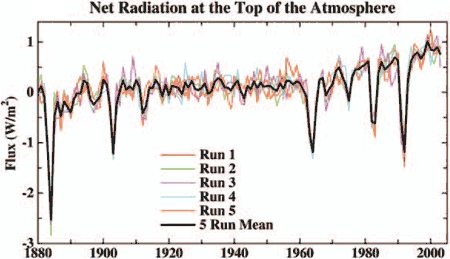
Figure 1: net radiation flux at the top of the atmosphere (Hansen 2005).
Hansen 2005 finds that the net radiative imbalance has steadily increased over the 20th century. There is no indication that the climate is heading towards equilibrium - quite the contrary. This is confirmed by satellite measurements of energy flux at the top of the atmosphere:
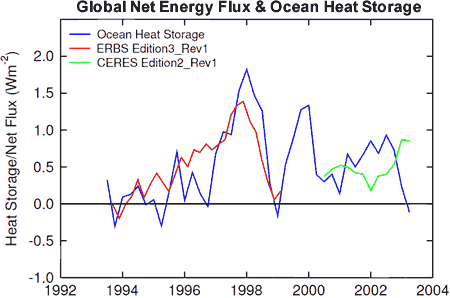
Figure 2: Global ocean heat storage (blue) against global net flux anomalies (Wong 2005).
The climate is not heading towards equilibrium. Rather, the radiative imbalance is increasing with the climate steadily receiving more energy than it is radiating back out into space. And this is where the true significance of climate time lag lies. Even if the radiative imbalance were to level off at its current rate of around 0.85W/m2, it would take several decades for the climate to return to radiative equilibrium. Based on this climate lag, Hansen 2005 calculates there is still 0.6°C warming still "in the pipeline".


 0
0  0
0 This is the water vapour content over atlantic ocean from 1950-1972. Even if you consider this data alone it doesn't mean anything, because between 1950-1970 the global temperature was flat, and SST over tropical atlantic decreased , so even if the data shows a statically significant trend it actually shows support for water vapour being determined by temperature and strengthening the case for water vapour feedback.
The water vapour feedback argument is based on temperature not CO2, so plotting CO2 against water vapour to "disprove" water vapour feedback is misleading at best.
In addition it is now 2012, so there is no excuse for not including modern data and global coverage.
This is the water vapour content over atlantic ocean from 1950-1972. Even if you consider this data alone it doesn't mean anything, because between 1950-1970 the global temperature was flat, and SST over tropical atlantic decreased , so even if the data shows a statically significant trend it actually shows support for water vapour being determined by temperature and strengthening the case for water vapour feedback.
The water vapour feedback argument is based on temperature not CO2, so plotting CO2 against water vapour to "disprove" water vapour feedback is misleading at best.
In addition it is now 2012, so there is no excuse for not including modern data and global coverage.

 In this simple model the lag time is just the time taken to get about 63% of the effect. The response stats immediately and proressively slows down due to the decreasing energy imbalance, as expected.
 But the earth isn't a circle, it's a sphere. That light isn't falling on a disk but on the surface of that sphere. Since the surface is curved, it has a larger surface area than the disk.
This means two things. First, that the same amount of light is falling on a larger area at the edges of there sphere:
But the earth isn't a circle, it's a sphere. That light isn't falling on a disk but on the surface of that sphere. Since the surface is curved, it has a larger surface area than the disk.
This means two things. First, that the same amount of light is falling on a larger area at the edges of there sphere:
 And second (because the sphere is rotating) that the light is falling on both the front and the back of the sphere.
In the end, the computation is very straightforward. The light being delivered covers the area of a circle (πr^2) while the light being received is spread out over the area of a sphere (4πr^2). So the amount of energy received per unit area on the earth is energy-delivered-per-unit-area times area-of-delivery divided by area-of-receipt, or:
energy * πr^2 / 4πr^2 = energy / 4
1361 * πr^2 / 4πr^2 = 1361 / 4 = 340.25 W/m^2
Interestingly, the only denier I've seen that has been foolish enough to dispute this is Postma, but even he comes up with the same answer... he just claims the logic of the geometry is wrong.
And second (because the sphere is rotating) that the light is falling on both the front and the back of the sphere.
In the end, the computation is very straightforward. The light being delivered covers the area of a circle (πr^2) while the light being received is spread out over the area of a sphere (4πr^2). So the amount of energy received per unit area on the earth is energy-delivered-per-unit-area times area-of-delivery divided by area-of-receipt, or:
energy * πr^2 / 4πr^2 = energy / 4
1361 * πr^2 / 4πr^2 = 1361 / 4 = 340.25 W/m^2
Interestingly, the only denier I've seen that has been foolish enough to dispute this is Postma, but even he comes up with the same answer... he just claims the logic of the geometry is wrong.


 [Source]
Temperature response to a 'step' forcing would be an exponential decay towards equilibrium - but with an ongoing change in forcings, temperature will follow along (somewhere behind the curve, so to speak). Linear temperature increase (observed) is very strong evidence for ongoing increases in climate forcings - and again, that eliminates insolation as a cause.
[Source]
Temperature response to a 'step' forcing would be an exponential decay towards equilibrium - but with an ongoing change in forcings, temperature will follow along (somewhere behind the curve, so to speak). Linear temperature increase (observed) is very strong evidence for ongoing increases in climate forcings - and again, that eliminates insolation as a cause.
 [Source]
(2) Note as well that CO2 and the sun are not the only influences on climate. Aerosols, land use, ENSO, and internal variation all have roles in the forcings, and in the climate response. Therefore, do not expect exact tracking of any particular forcing component.
(3) There are multiple response times, multiple lags in the climate (thus keeping this on topic here), in response to a forcing change. As a quick summary, the atmosphere responds quickly, while the oceans with a much larger thermal mass respond slowly. Tamino has discussed this at some length: multiple exponential decay factors here, and applying a two-box model to both modeled and observed temperatures here. A single lag model simply doesn't match the climate response to forcings, but a two-lag, two-box model matches quite well - and is supported by the physics. Air temperatures demonstrate quite fast swings WRT forcings - the oceans slower response shows larger changes over a longer period of time.
(4) The IPCC 2007 statement you quoted clearly states that while uncertainties remain, estimates of insolation have improved over time. The estimate of +0.12 [+0.06 to +0.3] W/m^2 since 1750 expresses and encompasses that uncertainty - but even the most extreme TSI within that range is far too small to produce recent climate changes. Check the numbers - uncertainties are expressed with ranges, and you cannot take a statement of uncertainty as license to assume values far outside those uncertainties.
(5) Important: You do not seem to have recognized the linear warming/linear forcing issue that Sphaerica and I discussed in comments from here to here (it goes unmentioned in your last response). The temperature pattern over the last 40-50 years is one of near linear increase, more than half a degree C. If the climate were responding to a halted TSI increase from mid-20th century (the observed insolation pattern) there would be a decreasing temperature trend towards equilibrium. The linear trend directly indicates a continually increasing forcing over that period. Claiming (as you are, again) that accumulated TSI may have hid out somewhere, and is now returning in what appears to be a linear pattern, is simply a leprechaun level argument. And hence dismissable.
Comment: You seem to be searching quite hard, over multiple threads, for a 'skeptic' argument that holds up. While these conversations are quite pleasant, and may lead to additional clear discussions of these topics, I have to say that with just a little work on your part you would be able to find, or read, or understand, the collected information regarding and debunking these 'skeptic' arguments.
Please - read the responses, read the opening posts, use the "Search" box here, or Google/Google Scholar. If there was a 'skeptic' argument that held up, that matched the data and the physics, that would become part of the mainstream theories - there isn't, and they aren't, for very good and well supported reasons.
[Source]
(2) Note as well that CO2 and the sun are not the only influences on climate. Aerosols, land use, ENSO, and internal variation all have roles in the forcings, and in the climate response. Therefore, do not expect exact tracking of any particular forcing component.
(3) There are multiple response times, multiple lags in the climate (thus keeping this on topic here), in response to a forcing change. As a quick summary, the atmosphere responds quickly, while the oceans with a much larger thermal mass respond slowly. Tamino has discussed this at some length: multiple exponential decay factors here, and applying a two-box model to both modeled and observed temperatures here. A single lag model simply doesn't match the climate response to forcings, but a two-lag, two-box model matches quite well - and is supported by the physics. Air temperatures demonstrate quite fast swings WRT forcings - the oceans slower response shows larger changes over a longer period of time.
(4) The IPCC 2007 statement you quoted clearly states that while uncertainties remain, estimates of insolation have improved over time. The estimate of +0.12 [+0.06 to +0.3] W/m^2 since 1750 expresses and encompasses that uncertainty - but even the most extreme TSI within that range is far too small to produce recent climate changes. Check the numbers - uncertainties are expressed with ranges, and you cannot take a statement of uncertainty as license to assume values far outside those uncertainties.
(5) Important: You do not seem to have recognized the linear warming/linear forcing issue that Sphaerica and I discussed in comments from here to here (it goes unmentioned in your last response). The temperature pattern over the last 40-50 years is one of near linear increase, more than half a degree C. If the climate were responding to a halted TSI increase from mid-20th century (the observed insolation pattern) there would be a decreasing temperature trend towards equilibrium. The linear trend directly indicates a continually increasing forcing over that period. Claiming (as you are, again) that accumulated TSI may have hid out somewhere, and is now returning in what appears to be a linear pattern, is simply a leprechaun level argument. And hence dismissable.
Comment: You seem to be searching quite hard, over multiple threads, for a 'skeptic' argument that holds up. While these conversations are quite pleasant, and may lead to additional clear discussions of these topics, I have to say that with just a little work on your part you would be able to find, or read, or understand, the collected information regarding and debunking these 'skeptic' arguments.
Please - read the responses, read the opening posts, use the "Search" box here, or Google/Google Scholar. If there was a 'skeptic' argument that held up, that matched the data and the physics, that would become part of the mainstream theories - there isn't, and they aren't, for very good and well supported reasons.







Comments