



 Arguments







Climate Trunk - Science
Posted on 18 August 2026 by BaerbelW
In April 2026 we published a guest blog post by John Lang in which he introduced his "Climate Trunk" graphics project and website. Since then, he has been adding one graphic per week and plans to keep going for about 2 years rounding out the big picture of human-caused climate change graphic by graphic. In this blog post we'll show-case the graphics related to climate science and will keep adding more as they get published.
What we know about the climate system, how we know it and where the uncertainties are.
#1 - It’s real
Global temperatures are rising fast. The long-term trend is unequivocal: Earth has heated by around 1.3°C since the late 19th century – with most of that increase coming recently.
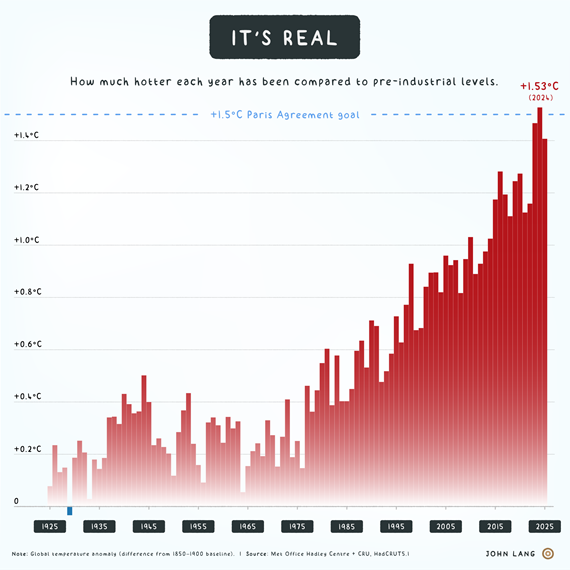
Earth is heating.
#2 - It’s Us
Human activity is driving today’s heating. Greenhouse gases create strong warming, partly offset by cooling from air pollution. Natural factors play a minimal role in the long-term trend.
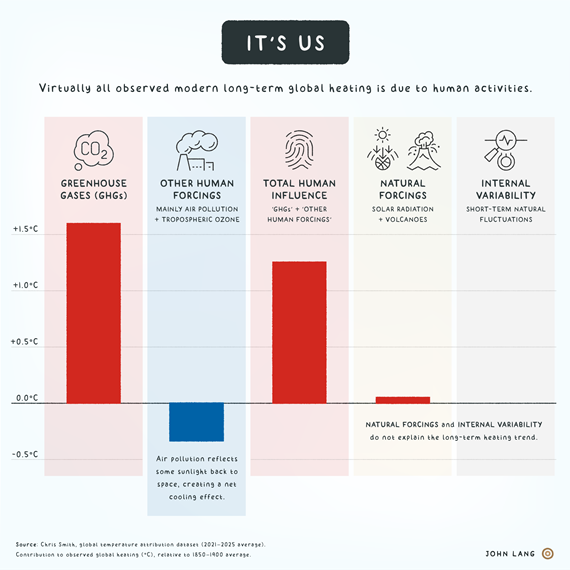
And it's 'unequivocal'.
#3 - It’s bad.
Climate change is bad news for societies built on stability. But the future is not pre-written. Within a single lifetime, the extent of heating – and the risks that come with it – depends on the choices societies make over the next decade or so.
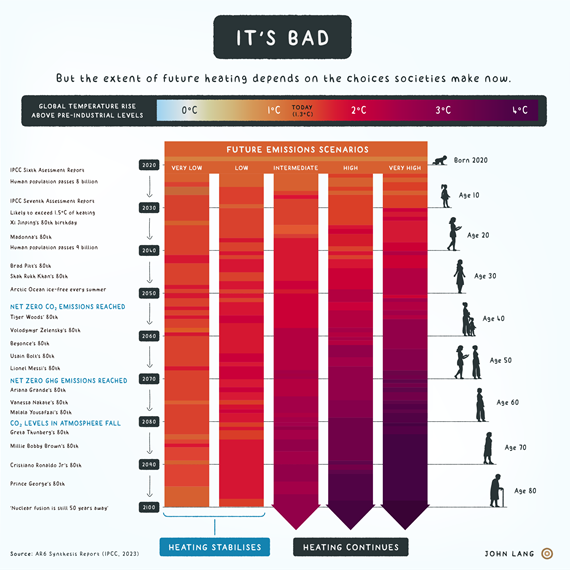
The future has not been written.
#4 - We can fix it: net zero
Net ZeroNet zero is not a political slogan, it’s the physics of how we stop heating. Turn down the emissions tap as far as possible, then remove what’s left – bringing inflows and outflows into balance so temperatures stabilise.
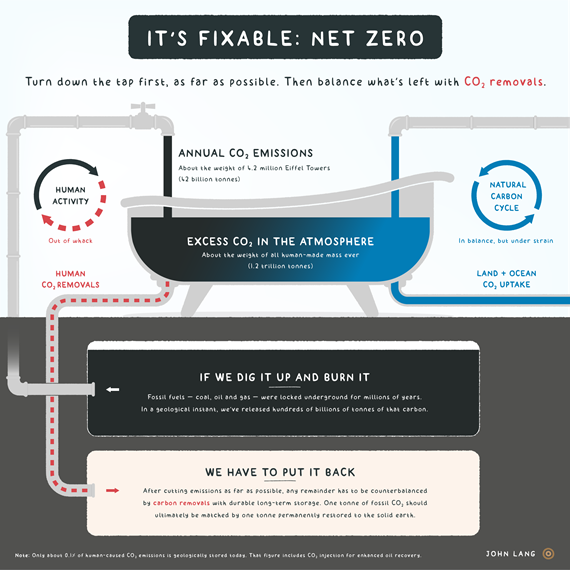
Net zero is the only way to stabilise rising temperatures.
#12 - Matter of Degrees Not Thresholds
Climate change is a slope we slide down, not a cliff we fall off. Every fraction of a degree matters because that means impacts worsen and risks compound. By avoiding additional heating, it also reduces the risk of triggering irreversible tipping points in the Earth system.
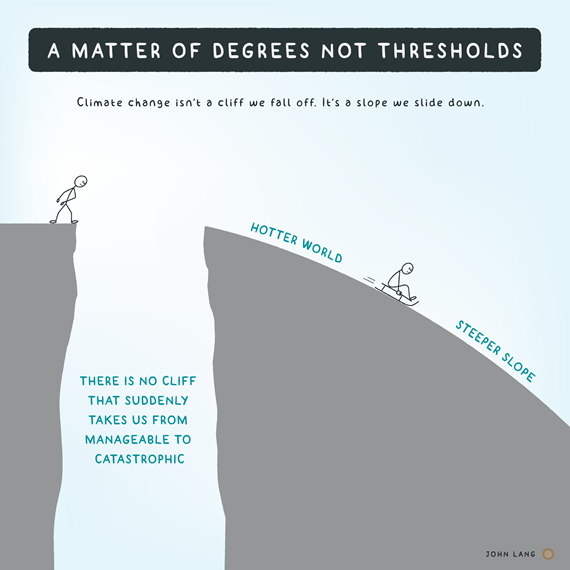
Climate change isn't a cliff we wall off. It's a slope we slide down.
#17 - Two Centuries, One Conclusion
Climate science did not emerge overnight. It is built on two centuries of observation, experiment and discovery by thousands of scientists, all pointing to the same conclusion: human activities are driving today's global heating.
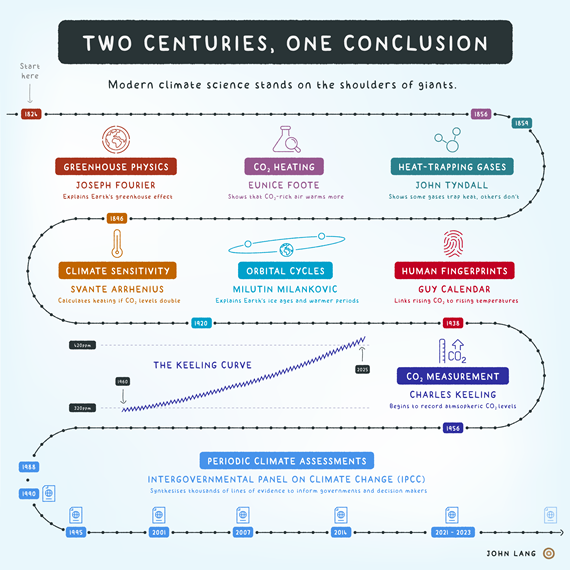
Modern climate science stands on the shoulders of giants.
#18 - A Reflection Problem
Climate change is first and foremost an emissions problem. It is also increasingly becoming a reflection problem. As Earth reflects less sunlight back to space, more energy stays in the climate system, increasing Earth's energy imbalance and accelerating global heating.
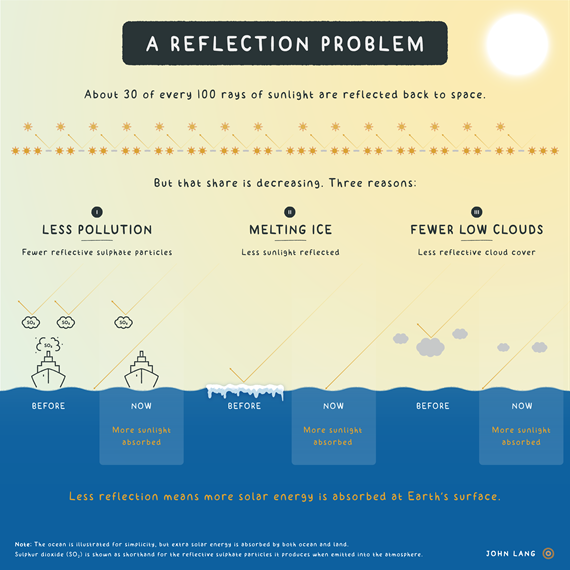
About 30 out of every 100 rays of sunlight are reflected back to space.
...to be continued!
Follow these links to dive into the other Climate Trunk rings: Impacts, Economics, Political Economy, Governance, Solutions, Energy, Daily Life.









Excellent start, looking forward to your continuing to produce this "trunk." In the meantime, a little feedback on your graphics so far:
It's Us: Is the third column the result of subtracting the second column from the first? I think it must be, but it's ambiguous, and could be played with to show this more clearly. Maybe stacking the first two columns on top of each other, with an arrow pointing over to the net warming column??
It's bad: The blue Net Zero milestones listed in your timetable are presumably inserted to show when a stabilized atmosphere milestone is reached, but you have two "heating stabilized" scenarios so it is not clear to me whether those Net Zero milestones are referring to the "low" or the "very low" scenarios.
It's Fixable: It would be helpful to me to expand the "putting it back" label to parenthetically include reducing emissions, energy conservation, tree, planting, agricultural improvements, and other organic sequestration methods as well as pulling it back out of the atmosphere. Reducing emissions should always be front and center, and using the biosphere to re-absorb the excess greenhouse gases should be explicitly mentioned lest we think we have to depend on pulling it out of the air with technologies not yet invented.
Hope this helps, and keep up the good work!
Hi Douglas (?)
I like your suggestion for It's Us — let me try to clearly show that.
On it's bad, I see what you mean. They're not, they are simply hypotheticals so not to invite fatalism. It's what could happen, not what is likely to happen.
And on it's fixable, yes, point taken. I try to make that point in the write up. The graphic itself is busy as is, so let me think this one through more.
Thank you.
John