



 Arguments








Weather vs Climate: Watch the waves, miss the turning of the tides
Posted on 22 August 2010 by Jim Meador
This post is the Basic version (written by keepingitreal) of the skeptic argument "It's freaking cold".
It's easy to confuse current weather events with long-term climate trends, and hard to understand the difference between weather and climate. It's a bit like being at the beach, trying to figure out if the tide is rising or falling just by watching individual waves roll in and out. The slow change of the tide is masked by the constant churning of the waves.
In a similar way, the normal ups and downs of weather make it hard to see slow changes in climate. To find climate trends you need to look at how weather is changing over a longer time span. Looking at high and low temperature data from recent decades shows that new record highs occur nearly twice as often as new record lows.
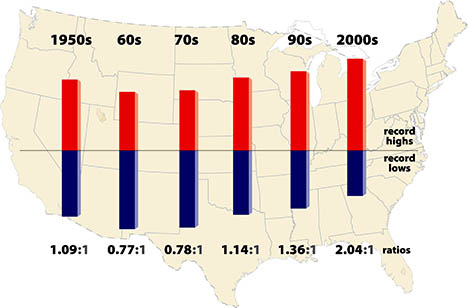
New records for cold weather will continue to be set, but global warming's gradual influence will make them increasingly rare.
Note: we're currently going through the process of writing plain English versions of all the rebuttals to skeptic arguments. It's a big task but many hands make light work. If you're interested in helping with this effort, please contact me.


 0
0  0
0 This was made from a recent GISSTemp release going back to 1880. The plateaus represent each time a new high or low (in the temperature anomaly) is set.
Hot summers (JJA average) continue getting hotter, but summertime lows don't get any lower; winter (DJF average) record lows don't get any lower than the -0.62 deg C anomaly from 1893.
This was made from a recent GISSTemp release going back to 1880. The plateaus represent each time a new high or low (in the temperature anomaly) is set.
Hot summers (JJA average) continue getting hotter, but summertime lows don't get any lower; winter (DJF average) record lows don't get any lower than the -0.62 deg C anomaly from 1893.







Comments