



 Arguments







Recent Comments
Prev 2429 2430 2431 2432 2433 2434 2435 2436 2437 2438 2439 2440 2441 2442 2443 2444 Next
Comments 121801 to 121850:
-
HumanityRules at 14:04 PM on 21 April 2010Where is global warming going?
34.scaddenp The ocean doesn't just heat it also expands so there is a way of double checking the bouy data by using satellite data to measure sea level rise. For the present period (2003-2008) almost all the sea level rise is accounted for by melting land ice. That means very little thermal expansion, which means the energy is unlikely to be in the ocean. The bouy results are in agreement with the GRACE satellite data you don't just need to believe the bouy data. Secondly OHC was in line with expectations upto the mid 2000's before they began to diverge. So you have to believe that the data was fine and then became corrupted in some way. The reality is that the quality and coverage of the bouy ( and other ocean data) have only continued to improve a a time when we are meant to believe they have got worse. It's not just a matter of believing one or the other. -
HumanityRules at 13:11 PM on 21 April 2010Tracking the energy from global warming
Trenberth wasn't kidding when he says figure 1 is heavily smoothed and simplified. The other thing that confuses me is that it is meant to in some way relate to this figure.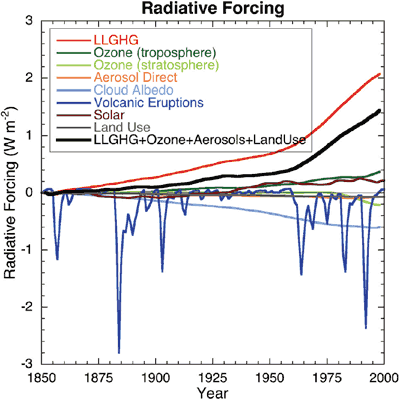 Now I realise this is in some way also a simplified graphic. But with no volcanic activity since 2000 to give those great spikes then a simple increasing nett radiative forcing and energy budget should be on the cards but it obviously isn't. There is obviously an extraordinary amount we don't know when it comes to the natural variation in radiative forcing and energy budget.
-
scaddenp at 12:08 PM on 21 April 2010Where is global warming going?
33 - this "missing heat" comes about because of the discrepancy between OHC (heat stored) and TOA measurements (difference between incoming energy and outgoing energy). Heat leaving is measured so unless there is error in measurement, you can discount that. What do you trust most? The satellite measurements of heat imbalance or the buoy network of ocean temperature measurements? There is clearly an issue to be sorted out here. Its not about models - its about the heat balance. -
actually thoughtful at 10:55 AM on 21 April 2010Where is global warming going?
Don't we have to give serious consideration to the idea that either 1) the heat is not there to be missing or 2) the heat is leaving the atmosphere? I would be satisfied to know that this "missing heat" comes from the 2000s "lack of warming" - this is tongue in cheek as everyone knows the world warmed - even during an el nino and the very low sunspot activity. So are we missing heat that IS there and it is just finding it? Or are we worried the models are wrong because they predict heat we can't find (so it could have never existed or left the envelope)? thanks. -
GFW at 09:44 AM on 21 April 2010Where is global warming going?
Taking dscheidt's idea and running with it. Let's suppose we're trying to imagine a biological sequestration of 0.5 W/m2 over the whole planet via phytoplankton. Let's ballpark that as 1W/m2 over the most productive 70% of the ocean (therefore ~50% of the planet). Skipping a bit of math ... and charitably assuming that dead phytoplankton is nearly as nutritious (i.e. energy-laden) as pure sugar ... that's around 40g of excess material every 24 hours, in every square meter. So a patch of ocean 1000km by 1000km would create 40 mega-tonnes excess every day, which would be about 1.5 giga-tonnes per year. Scaling up to 50% of the planet's surface, that would be 300 Gt/y. Bearing in mind that this is excess, on top of "normal" it doesn't fit with estimates of the *total* biological rain over the entire ocean. which is on the order of 1 Gt/y -
Donald Lewis at 09:36 AM on 21 April 2010Where is global warming going?
Here is my pass at the graph where area is proportional to magnitude. http://docs.google.com/present/view?id=d5sm6vp_50k3vzx2g3 -
Glenn Tamblyn at 09:04 AM on 21 April 2010Where is global warming going?
RSVP @25 The most recent figure I have seen are Murphy et al which go from 1950 to 3002 and give the total heat rise as around 1 *10^23 Joules. Thats around 3 Billion Hiroshima bombs. So thats what we are taking a percentage of. -
Riccardo at 08:35 AM on 21 April 2010Where is global warming going?
dscheidt, the NASA image shows that there's an inverse correlation between phytoplankton productivity and temperature. -
Berényi Péter at 07:36 AM on 21 April 2010Tracking the energy from global warming
#55 HumanityRules at 23:43 PM on 20 April, 2010 I also hunted down this presentation Thank you. It is useful. I have copied the 2000-2010 TOA radiation imbalance figure here. Also, I took NODC Global Ocean Heat Content for the same period, computed its derivative and made a figure. figure 1
 figure 2
If all went well, the lower graph in figure 1 would be proportional to that of figure 2. It is clearly not, they are not even similar.
Fluctuations in OHC as measured by floats are almost an order of magnitude larger than in net radiation imbalance at TOA as measured by satellites. Sometimes not even the sign comes out right.
figure 2
If all went well, the lower graph in figure 1 would be proportional to that of figure 2. It is clearly not, they are not even similar.
Fluctuations in OHC as measured by floats are almost an order of magnitude larger than in net radiation imbalance at TOA as measured by satellites. Sometimes not even the sign comes out right.
-
dscheidt at 06:53 AM on 21 April 2010Where is global warming going?
Riccardo @ 26, Thank you for the links. You are correct that phytoplankton productivity has not been increasing during the period for which there is data [1998-2008]. Over that period the observed sea surface temperature hasn't increased. Indeed, in the Behrenfeld paper that you cited shows that there is a strong corollation between sea surface tempurature and ocean productivity. In short, if I understand Behrenfeld correctly, globally phytoplankton is behaving as expected with respect to temperature. Since we know that phytoplankton growth is endothermic the elevated levels of phytoplankton shown by Behrenfeld (with respect to pre-1998 levels) must be absorbing more energy than pre-1998 levels. The question is whether the amount of the negative feedback is significant. Of course, if the feedback was linear then one would expect to see a consistant divergence between temperature and missing energy, which we are not seeing. I suspect that it is, as it always seems to be with AGW, a more complex process. I'm not at all sure that the phytoplankton feedback effect is significant. I suspect that it's not. But I wanted to pose the question. -
hu? at 06:44 AM on 21 April 2010Trenberth can't account for the lack of warming
Thank you for your response yocta, but your answer does not address my question. Where does Trenberth claim satellites indicate an energy imbalance? (not a sea level rise). There are two satellite data-sets discussed in the paper, CERES and GRACE. Which one does Trenberth refer to with this warming quote, in your opinion? -
Jacob Bock Axelsen at 06:25 AM on 21 April 2010Are we too stupid?
embb A post ago you said that no one sees even the remotest chance for a trade war. Now it is "the lesser evil" and even real wars a possibility? Aren`t you a bit inconsistent? I claimed a tax and trade restrictions is not like a trade war. A trade war is the lesser evil as opposed to real war. I never denied the possibility of war. No inconsistency. I agree the type of fraud in the article does not affect the emissions. Still, a post ago you claimed there is no link between organized crime and emission trading... I doubted it. My bad. "Any asset market comprised of buying and selling non-physical, hard-to-measure goods is a con man’s dream."(...) Any game is a con man's dream. Strategies such as tit-for-tat amend that by stimulating cooperation through reciprocity. "An environment group slammed “false” carbon credit trading related to mainland China’s dams which allegedly *** undermines the Kyoto Protocol***, leading to a renewal of a carbon trading platform’s ban on the country’s hydroelectric power projects, reported South China Morning Post. " Apparently compliance can be checked in China. Contrary to what you persistently claim. If the US did not sign then most would agree that he did not become "bound by some tie" - as the act of signing means becoming bound to the agreement. So, there is no way for the US to defect on an agreement that was not signed. If USA signs it, they will come. If USA doesn't sign it, climate change will come. Cooperation or Defection. Take your pick. (...)are you suggesting the WTO fine the country that defects? Prison is of course meaningless in this context, so is tit for tat. I proved that taxes are always rigged to not be a dilemma. If there is no dilemma tit-for-tat will definitely beat all-defection. So US gets more money BY levelling the carbon tax on american companies and China gets a lot less by letting its companies become more competitive? In this case the 'prison time' can be substituted for 'trade restrictions'. You will see it makes sense. During the whole discussion I kept coming back to the point that the difference to the PD is that here we are not talking about individuals inside a state but about states with no organization above them. You keep coming back to explain trivial stuff about individuals. Unless you answer to my objections this is pretty much pointless. States, individuals - no matter. Tit-for-tat beats all-defection. No organization. No judge. No God. Just maths. they cooperated in Copenhagen? I missed that. Or maybe this wonderful change happened since December? If China, US and the rest of the world had signed a comprehensive deal to combat climate change it would have been wonderful? Absolutely. I was referring to the situation where a treaty to tax carbon emission was already in place. What is the point of even talking about game theory if you end up believing that the actors will not defect without any real analysis? I have never postulated that. It is the point of the post to analyse how to avoid defection. You must have missed that. Now, enough of what I know. What are your solutions to mitigate climate change? You must have something considering your clear stance. -
Riccardo at 06:17 AM on 21 April 2010Where is global warming going?
As mspelto pointed out there's the big unknown of the Arctic and the Antarctic oceans, we don't know much about what's happening down there. But I would say we do not know much about global ocean circulation either. For example, we know that convective mixing in the Labrador Sea stopped for a while and then resumed. Does anybody know why? Also, scientists are still debating on the behaviour of the North Atlantic thermohaline circulation or the fate of Anarctic Deep Water. These are huge amount of heat (energy, to make suibhne happy ;)). Although the overall picture is clear, the details are missing. Trenberth has shown he does not belive the ocean heat content measurements much (see the email exchange with Pielke Sr.). With him, I'd not be surprised if that heat is in part "hidden" somewhere there. -
mspelto at 05:58 AM on 21 April 2010Where is global warming going?
Albatross you are certainly correct that Trenberth has considered the polar areas. What to do to close that data gap is actually the focus of some new projects in the Arctic Ocean , and what Trenberth is trying to motivate us to do, better capture the energy balance of our globe. In the Antarctic the hidden area is under the ice shelves. or was in the case of Wordie Ice Shelf. -
Riccardo at 05:54 AM on 21 April 2010Where is global warming going?
dscheidt, phytoplankton productivity is not increasing. (See also here). -
RSVP at 05:00 AM on 21 April 2010Where is global warming going?
A car without shocks gives a bad ride and on a subjective level can seem horrendous, but the amount of energy related to these extra vibrations is very small. Similarly, the big blue circle representes a percentage, whereas its the absolute value that matters. -
Marcel Bökstedt at 04:33 AM on 21 April 2010Tracking the energy from global warming
John> Thanks for comment! And above all, thanks for this great site! I believe that you are right in that we should only consider change in energy imbalance, not the imbalance it self. The sign (positive or negative) of the second time derivative of the energy. A second derivative is clearly a priory something which is hard to measure. This also means that in figure 1, the relative height of the blue and the the black curve is arbitrary. We could as well shift the (entire) black curve downwards by a fixed amount to give a better fit. I'm not sure that Trenberth states as clearly as you do that the satellite data show that there is an increasing energy imbalance, but maybe I just haven't found where he does so. HumanityRules> From reading your links, I get the impression that the satellite data have not really arrived yet. At present there is a huge year to year variability and also a huge uncertainty, and in addition to that there is a suggestion that there might be systematic errors (instrument drift). On the other hand these measurements will eventually arrive, and become very important once they do. It seems to me that the black line in figure 1 is pretty close to a smoothing AND upwards shift of the green line in Figure 2.26 from the "presentation" you mention. As usual, I could be wrong about all this. -
Albatross at 04:02 AM on 21 April 2010Where is global warming going?
mspelto @12, You beat me to it. I was pondering the same thought after reading John's articles. The period of divergence does seem to coincide with the time when the Arctic has experienced a significant loss of sea ice (2005, 2007, 2008 and 2009 were all very low). So perhaps some of the "missing" energy has been sequestered into those portions of the Arctic Ocean which have been largely ice free during the "warm" season since 2005? As mspelto pointed out, there are no Argo floats or other instrument platforms up there to measure the OHC. Not sure about the Antarctic though, sea ice cover has not changed much, although if the Southern Oceans did have a role in this puzzle it would not surprise me. Anyhow, I don't want to presume to know more than Drs. Trenberth and Fasullo; they have probably already considered mspelto's idea in addition to many other possibilities.... -
dscheidt at 03:19 AM on 21 April 2010Where is global warming going?
Let me know if this makes sense. Consider the following: 1) Excess heat is radiated predominately into the oceans. 2) Algae growth increases due to increased heat. 3) Algae growth is an endothermic process therefore the increased growth absorbs a portion of the excess heat[ref Barinov et al, "Respiration energetics of marine algae for total heat production and some features of photosynthesis", Thermochimica Acta, Vol. 309, Is. 1-2, 1998] 4) Increased algae growth "consumes" both energy and C02, sequestering both on the sea floor eventually (either directly or indirectly) Could this account, at least in part, for the missing energy? -
Riccardo at 03:02 AM on 21 April 2010Where is global warming going?
suibhne, it's not very constructive to think that Trenberth doesn't know physics, besides being absurd. You are probably missing what Joule demonstrated more than a century centurie ago and the first law of thermodynamics. It's taught at the high school level, no need for a higher degree. Think twice before beliving that you know more than reputable scientists. -
chris at 02:53 AM on 21 April 2010Where is global warming going?
suibhne at 02:16 AM on 21 April, 2010 I don't think so. Your point might be worth considering if everyone has a Physics background or has taken a first year university introductory thermodynamics class! Trenberth's concept is pretty straightforward and easily understandable by the layman. If there is a radiative imbalance we expect an accumulation of thermal energy in the system. Why not call it "heat", since everyone can understand that? Once we've grasped the simple idea, then we can develop it towards more rigorous directions (the expected accumulation of Joules in the ocean under a radiative imbalance of so many W/m^2, and so on). I suspect Trenberth knows full well what he's doing - he's trying to communicate simple concepts in an easily understandable manner. -
Andy Skuce at 02:51 AM on 21 April 2010Where is global warming going?
Oops, sorry about that premature submission. I find the graphic to be a little misleading. The circles seem to be scaled so that their diameters are proportional to the percentages, whereas the implication from a graphic of this type is that it's the areas that are proportional. The area of the "ocean" circle (from my rough measurements) is about 750 times the area of the "atmosphere" circle. The point that the oceans are massive sinks of heat compared to the air, land or ice is still entirely valid, it's just exaggerated in that figure.Response: You're completely correct - it should be areas, not diameters. Should've thought of that (smacks forehead). Am updating the graphic accordingly. -
hank at 02:47 AM on 21 April 2010Where is global warming going?
> suibhne Look it up; you're wrong about language physicists use: http://scholar.google.com/scholar?q=climate+heat+storage+missing First year physics? where are you reading this stuff? -
suibhne at 02:16 AM on 21 April 2010Where is global warming going?
Anyone with a Physics background will wince at phrases like "heat storage" and "missing heat". A lecturer may have just finished taking a first year university Physics through an introductory thermodynamics class. Where it would be explained that for instance it would be wrong to say that the higher temperature reservoir contained "a lot of heat". The correct description would instead use "internal energy". Heat it would be explained is reserved for the process by which energy is transferred from a body at a higher temperature to a body at a lower temperature. Its disappointing that leading NCAR scientist Kevin Trenbertht uses phrases like “missing” heat." and “The heat will come back to haunt us sooner or later,” Perhaps he doesn't know any better! -
Chris G at 01:51 AM on 21 April 2010Where is global warming going?
Re #15, Yes, the polar regions are still cold relative to everywhere else. I don't find that surprising. But, I'm wondering if you are totally disregarding GISS data. http://data.giss.nasa.gov/gistemp/graphs/ -
Berényi Péter at 01:38 AM on 21 April 2010Where is global warming going?
#12 mspelto at 00:46 AM on 21 April, 2010 The arctic in particular has had high air temperatures Come on. The "Arctic" has only one active GHCN station in Canada. It is Eureka, Nunavut (79.98 N, 85.93 W). This year the average March temperature there was -32.2 °C. It is higher indeed than the multi-year average of -37 °C, but still damn cold. And all the excess heat comes from a brief hot spell at the end of the month when temperatures reached an unbelievable high of -9 °C (between 7 AM and 4 PM, 29th March). -
Chris G at 01:36 AM on 21 April 2010Where is global warming going?
Re 12 MsPelto, While the distribution of buoys may not be very uniform, I don't think that can be eyeballed from that map. The map, like most flat maps, suffers the distortion of projecting a globe onto a flat surface. Nice article. I was trying to imagine the relative sizes of the various possible heat sinks, and it was very fuzzy to me, then click, there it is. -
embb at 01:22 AM on 21 April 2010Are we too stupid?
Jacob:For two agents the 'tax-payment-game' is trivial and looks something like this: i) Mutual defection and temptation is the initial saved tax payment, tax, plus the high probability of a fine, fine=tax, and N years in prison: pay-off = tax - fine - N*income << 0. Okay, let us make this concrete. We are talking about carbon tax in the Us and China say. temptation is to lie about the carbon enmission and to not tax the local companies for energy consumption, thus acquiring a competitive advantage on the world market. Fine - are you suggesting the WTO fine the country that defects? Prison is of coursemeabningless in this context, so is tit for tat. Naturally, on top of this comes the future cost of indirect reciprocity from your surroundings that disapprove of parasitic freeloaders. However, you benefit from the public goods financed by the tax. You mean the world public opinion? ii) Mutual cooperation and being cheated is 0 plus the public goods financed by the tax. Your average payoff when cooperating is larger than 0, and your average payoff when defecting is much less than 0. No dilemma. So US gets more money BY levelling the carbon tax on american companies and China gets a lot less by letting its companies become more competitive? I really dont see how this should work, can you explain? During the whole discussion I kept coming back to the point that the difference to the PD is that here we are not talking about individuals inside a state but about states with no organization above them. You keep coming back to explain trivial stuff about individuals. Unless you answer to my objections this is pretty much pointless. Jacob:China, inspite of being a communistic dictatorship, has already understood the pay-off from international trade and domestic entrepreneurship. Oooh, so they cooperarted in Kopenhagen? I missed that. Or maybe this wonderful change happened since December? What is the point of even talking about game theory if you end up believeing that the actors will not defect without any real analysis? If you disagree, then by all means, try to disprove it. -
Steve L at 01:16 AM on 21 April 2010Where is global warming going?
Re #11 -- do you think the analogy works very well? I don't think it works, but the differences could be instructive. First, a person's decision to go under the knife is very personal and the outcome is direct. Compare this to the discussion of how to fund health care! I think the latter is more similar to the discussion about global warming. Second, the 'medical industrial complex' spends a lot of money, effort, expertise on communication. Third, and closely related, anti-medical industry communication is rather limited. Who are the powerful players who lose money by people making decisions to get medical treatment? Maybe chiropractors would like you to try them before getting back surgery, but you don't see commercials by them telling you not to get back surgery. (That's probably illegal.) Fourth, and sort of looping around to the first thing, I bet the people who refuse to go under the knife ARE victims of communication problems. The demographics of those that believe something else will heal them are probably biased toward those without a good education, with too much access to strongly messaged but bad advice, etc. To sum up, I think your comparison to medical care shows that communication is key -- the medical industry spends heaps of money on it even though they aren't fighting much counter-communication, and those who fall through the cracks are probably the ones getting the worst ratio of communication/counter-communication. The communication of climate science should be even better than medical industry communication because it has more obstacles. Sorry for not having a single study to back any of this up, but I don't think I'm saying anything controversial. -
embb at 01:12 AM on 21 April 2010Are we too stupid?
Jacob: A trade war seems the lesser evil. A post ago you said that no one sees even the remotest chance for a trade war. Now it is "the lesser evil" and even real wars a possibility? Aren`t you a bit inconsistent? Jacob:As that article correctly states, this large tax fraud has no effect on emissions. I agree the type of fraud in the article does not affect the emissions. Still, a post ago you claimed there is no link between organized crime and emission trading... How about these: http://www.environmentalleader.com/2010/03/08/steps-to-stop-carbon-trading-and-emissions-offset-fraud/ "Any asset market comprised of buying and selling non-physical, hard-to-measure goods is a con man’s dream." http://www.ecoseed.org/en/general-green-news/green-topics/emission-trading/6856-Environmental-lobby-group-claims-carbon-credit-fraud-on-China-dams "An environment group slammed “false” carbon credit trading related to mainland China’s dams which allegedly *** undermines the Kyoto Protocol***, leading to a renewal of a carbon trading platform’s ban on the country’s hydroelectric power projects, reported South China Morning Post. " Jacob:Surely most would agree that not signing at all is defecting to act on mitigating climate change. No, you are wrong here. The definition of defection is, from wiki: More broadly, it involves abandoning a person, cause or doctrine to whom or to which one is bound by some tie, as of allegiance or duty. If the US did not sign then most would agree that he did not become "bound by some tie" - as the act of signing means becoming bound to the agreement. So, there is no way for the US to defect on an agreement that was not signed. -
mspelto at 00:46 AM on 21 April 2010Where is global warming going?
Take a look at the Argo float distribution. Floats You will note there is a dearth of them around the Antarctic and in the Arctic. We have none under ice shelves. The scale of the missing energy is too large to have most of it occur anywhere besides the ocean. The poorest data is in the high latitudes, thus, that is likely where the heat is. The arctic in particular has had high air temperatures. -
HumanityRules at 00:25 AM on 21 April 2010Where is global warming going?
Response to #6 Oh yeah! 7.Glenn Tamblyn Seems to me doctors and surgeons speak their own foreign language but it generally doesn't stop the ordinary folk from taking pills or going under the knife. The problem is bigger than just communication. -
Steve L at 00:21 AM on 21 April 2010Where is global warming going?
Following on #4, I think it would be neat to see the figure scaled by mass (but how heavy is the continent component that they're measuring?). Question: Antarctic ice sheet has an ozone hole and air current stuff that keeps warming at bay. Arctic sea ice is in contact with warming water, so it's easy to see why more global warming 'goes' there. How do we explain the relatively high proportion of heat going into other glaciers given their small total mass and often more tropical distribution? Is this perhaps just a result of ~edge effects (there is so much contact with other warming features [continents] that a lot of the heat is transferred)? -
chris at 00:21 AM on 21 April 2010Where is global warming going?
Berényi Péter at 18:17 PM on 20 April, 2010 Two problems: 1. Since the question of "where's the heat?" relates to a TOA radiative imbalance, the loss of heat to space is implicitly accounted for. 2. The Second Law is often misused in the manner you illustrate. Excess heat builds up in the oceans (warmer) as a result of a positive radiative imbalance originating in the cooler atmosphere. Remember that warming of the oceans requires that the balance of energy input minus energy output is shifted such that energy output is less than energy input. So oceans warm as a result of a decrease in ocean heat loss. If the atmosphere warms due to radiative imbalance (enhanced greenhouse warming), this will suppress loss of thermal energy from the oceans even if the atmosphere is always cooler than the oceans. No heat flow from the cold atmosphere to the warmer oceans is required. Obviously we know this has to be true both from simple thermodynamics and from observations that the oceans are warming significantly under the influence of enhanced greenhouse-induced radiative forcing. -
gallopingcamel at 23:52 PM on 20 April 2010Where is global warming going?
Berenyi Peter (#2), Isn't the "huge temperature anomaly" you mention taking place where there are only a few thermometers left in the GHCN gridded data? -
HumanityRules at 23:43 PM on 20 April 2010Tracking the energy from global warming
You can access were Trenberth gets TOA data for figure 1 at BAMS State of the Climate 2008. Go to page S33. Read to the end because it discusses some of the issues with the dataset. It seems the quality of the data has reduced over time in this series with the early data seeming to have better stability than later material. Trenberths smoothed black line must be based on Figure 2.26 but I don't immediately see the connection. I also hunted down this presentation by the same guys. Page 20 shows Figure 2.26 while page 21 shows an updated version. -
Glenn Tamblyn at 22:57 PM on 20 April 2010Where is global warming going?
And with that 2.3% sitting next to that great big 93.4%, the 2.3% can easily get pretty volatile. And Juliet Davenport. You are so right. Looking at AGW as energy change should be a no-brainer. But that assumes that people have a technical education so that looking at the world in terms of energy and quantification is second nature. My humble BEng(Mech) leads me to do that as a matter of course. But how many of our friends, family, neighbours, fellow countrymen look at the world that way. How many naturally seek to quantify a problem as their first step to understanding it? This is the terrible insidious danger of AGW. The appropriate way of looking at it, the best mode of thought on the subject, is simply a foreign language and mental framework for the majority of people. So people distrust their lack of understanding of it more than they fear the actual problem. A foreign idea gets doubted precisely for its foreignness, not for its correctness. -
HumanityRules at 20:33 PM on 20 April 2010Where is global warming going?
Nice graphic, although I'd like to see the others in orbit around the large 'sun-like' ocean :) So why are we concerned about a tiny 2.3%? A simple answer might be because that is were we've being doing most of our measurements for along time. Science has to be pragmatic.Response: "So why are we concerned about a tiny 2.3%?"
I thought the answer to that was obvious... we live in that 2.3% -
Juliet Davenport at 20:30 PM on 20 April 2010Where is global warming going?
I wonder about how to communicate this further than just the concept of "heat" - because in countries where it tends to be cold, "heat" has a positive connotation - and vice versa in warm countries. Could we explain what the warming affect actually means within each of the environments? The phrase Global Warming is more widely associated with temperature and perceived by how we feel it, but does not explain what "work" is done as a result of global warming, and what impact that has on systems. To make it straightforward what does heating the oceans actually mean? What does heating the atmosphere really mean, and are we talking about in terms of ice-sheets - is that "work" related to the amount of heat given to the ice-sheet but with no temperature change? Sorry for the stream of consciousness! -
Peter H at 18:46 PM on 20 April 2010Where is global warming going?
Seems to me this might provoke a 'so why are we concerned about a tiny 2.3%' comments. And isn't it not about the amount of energy but, given the atmosphere is so much less mass than the oceans, the relative effect of that 2.3% on a much smaller mass. So, I'd like to see a mass v change graphic for each component I think -
Ed Davies at 18:30 PM on 20 April 2010Where is global warming going?
"The ocean heat figure of 93.4% is almost certainly an underestimate as it only includes ocean heat down to 700 metres (Levitus 2005)." I think I'm with John Russell on this one. As I understand it, a lot of the "natural variation" in the climate, that part usually described by the shorthand "El Niño", is the result of changes in the rate of transfer of heat from the top levels of the oceans to deeper levels so when the globe is supposedly cooling what's really happening is the heating is happening deep in the ocean rather than on the surface. Therefore, what's of interest is the rate of change of total heat content of the ocean all the way down, not just the surface or even the top 700 metres. Are there now enough measuring buoys, etc, to plot that reliably? -
Berényi Péter at 18:17 PM on 20 April 2010Where is global warming going?
There is another heat reservoir around for Global Warming to go. It is actually the coldest of all (-270 °C). The huge March temperature anomaly around the North Pole for example, while temperatures are higher than average, is still pretty cold (way below freezing). This excess heat can not go to the oceans, because open sea surface is defined to be above freezing temperature and according to the Second Law heat is never transferred to a warmer reservoir from a colder one. It has simply nowhere else to go but space. -
John Russell at 17:58 PM on 20 April 2010Where is global warming going?
Is not averaging effect created by the colossal thermal mass of the oceans the reason why the evidence of rising ocean temperatures -- as opposed to the much more erratic atmospheric temperature readings -- is so much more useful when attempting to convince sceptics that there is a clearly visible overall warming trend? -
Berényi Péter at 17:44 PM on 20 April 2010Tracking the energy from global warming
#49 Moderator's comment to Marcel Bökstedt at 05:31 AM on 20 April, 2010 what we're finding is the satellites are measuring an increase in the energy imbalance Are we? I am avare of an online analysis up to 2005: It does show that the alleged huge 2003 step-like increase in OHC is probably an artefact due to changing instrumentation (mass deployment of ARGO floats).
However, I could not find s similar analysis for the last five years. I agree with you on satellite net TOA radiation imbalance measurement's precision being better than its accuracy, especially since CERES started.
Unfortunately the NASA Radiation Budget Data Products page is a mess. Can anyone find recent data preprocessed enough to be shown here?
It does show that the alleged huge 2003 step-like increase in OHC is probably an artefact due to changing instrumentation (mass deployment of ARGO floats).
However, I could not find s similar analysis for the last five years. I agree with you on satellite net TOA radiation imbalance measurement's precision being better than its accuracy, especially since CERES started.
Unfortunately the NASA Radiation Budget Data Products page is a mess. Can anyone find recent data preprocessed enough to be shown here?
-
Jeff Freymueller at 11:32 AM on 20 April 2010Tracking the energy from global warming
#32 frogstar, it looks like one of your questions was never answered. There are many examples of quantities where we can measure Q(t2) - Q(t1) much more accurately than either Q(t2) or Q(t1). All it takes is for there to be some poorly known factor that contributes to both of the absolute levels Q(t1) and Q(t2), but cancels out when you take the time difference. This is actually a very common situation in all areas of science. -
HumanityRules at 10:29 AM on 20 April 2010Tracking the energy from global warming
It's worth reading about the confidence the IPCC had in the ocean data back in 2007 when the present divergence wasn't obvious. Fig 5.1 is enlightening in that the confidence intervals narrow over time representing an improvement in the data. Trenberth's analysis would have it that those confidence limits have widened again even though we have greater data coverage. I guess figure 5.4 also emphasises why the ocean heat content is so important to this issue. I'd be interested in seeing an undated Figure 5.4 covering 2003 to 2008. (You could read from this page onwards) http://www.ipcc.ch/publications_and_data/ar4/wg1/en/ch5s5-2-2.htmlResponse: Here's Figure 5.1 that you refer to:
Note that this refers to ocean heat from 0 to 700 metres deep. The issue here is the ocean heat measurements at deeper levels - both down to 2000 metres for which there is ARGO data and deeper, for which the data is more sparse. Figure 5.4 is even more interesting (in fact, has inspired an idea for a nifty graphic and a blog post), so here it is:
-
HumanityRules at 09:49 AM on 20 April 2010Tracking the energy from global warming
43.dhogaza I’m not sure you quite represent the position of each of the scientists accurately in the Pielke/Trenberth/Willis discussion. Trenberth notes that estimates of energy content of the ocean in the literature based on Argo data has a quite wide spread. Willis points out that early results contained errors, since these errors where identified estimates are all now in agreement. Willis thinks coverage is now good and the likelihood that further large errors are unlikely, like a good scientist he doesn’t completely rule out further adjustments. Ultimately Willis seems to think the Argo data is robust while Trenberth thinks it still contains large error. The degree to which both scientists think the Argo data contains errors is very important here. Given Willis is the expert on Argo data it does appear Trenberth is having his own Dunning-Kruger moment. But further experience will undoubtedly resolve this. 49.Marcel Bökstedt I agree we haven’t focused enough on the TOA estimates, thanks John for the reply. Do you have the references for any of this work? -
michael sweet at 09:39 AM on 20 April 2010Flowers blooming earlier now than any time in last 250 years
Johnd A number of scientific papers have been cited that show that spring is advancing. These papers measure the response of farmed plants and natural plants and also the behaviour of animals. You can check the data and find out how much is based on natural plants and how much is based on farmed plants. I have read some of these studies (there are hundreds of published papers) and am satisfied that the issue is caused by increasing temperature. You need to cite data that suggests that is not the case. As far as changing the standard of what is measured, I am sure that the farmers in Australia measure and track soil moisture every year at many locations. Find a summary of that data. See how it compares to this data of plant responses. Just because you have not looked for it does not mean that the data does not exist. If spring comes earlier it may become too hot in summer for plants to grow, because there was not enough time for the soil to accumulate water in the winter. Of course if you live in Sibera you might welcome the warmth. The point for this thread is that the weather is measurably changing. This is caused by human intervention in the climate system. This is additional proof of AGW. -
Jacob Bock Axelsen at 06:28 AM on 20 April 2010Are we too stupid?
embb The title says: economists warn about CO2 trade wars. Maybe they missed something? Der Spiegel certainly misses on the truth about climate scientists, but perhaps they are right in this case. At the other extreme, Lovelock and even the Pentagon predicts climate change related wars. A trade war seems the lesser evil. My post is about peer-reviewed realistic mechanisms that can avoid both the tax and the wars. "organised crime creates a fraud of billions with the trade of certificates" As that article correctly states, this large tax fraud has no effect on emissions. An analogue would be to conclude anything on the usefulness of dollar bills in light of the fact that 90% carry traces of cocaine. "(...) the US in this case (...) did not sign so they could not defect by definition." Surely most would agree that not signing at all is defecting to act on mitigating climate change. Who would sign and implement major emission cuts after that? "The question is how you can implement a tit for tat in the case of emission taxing." You did write "if you emit co2 I will emit co2", but no matter. You still incinuate a game between two prospective taxpayers. The pay-off demands for a dilemma are obviously: temptation > mutual cooperation > mutual defection > being cheated. For two agents the 'tax-payment-game' is trivial and looks something like this: i) Mutual defection and temptation is the initial saved tax payment, tax, plus the high probability of a fine, fine=tax, and N years in prison: pay-off = tax - fine - N*income << 0. Naturally, on top of this comes the future cost of indirect reciprocity from your surroundings that disapprove of parasitic freeloaders. However, you benefit from the public goods financed by the tax. ii) Mutual cooperation and being cheated is 0 plus the public goods financed by the tax. Your average payoff when cooperating is larger than 0, and your average payoff when defecting is much less than 0. No dilemma. If you disagree, then by all means, try to disprove it. Of course, the mafia may change the pay-off matrix. However, that is a choice between money versus lowered life expectancy, reduced fertility, stress and violence. A choice that most are able to turn down. Back to reality: A production company in China is part of society, so the authorities can document if they used power which lead to CO2 emissions. The company immidiately recieves the pay-off from not paying the tax, but faces much stronger punishment when caught, because the authorities do not wish to loose exports. China, inspite of being a communistic dictatorship, has already understood the pay-off from international trade and domestic entrepreneurship. It gets better. James Hansen has proposed that the tax revenue is divided among the payers. The dividend actually creates incentive to further and further decrease your emissions. This is guaranteed to work because it has been working in California for the last 35 years. BTW, the latest and most extreme reform was put in place by the famous 'armchair activist' Arnold Schwarzenegger. -
Leo G at 05:48 AM on 20 April 2010Tracking the energy from global warming
Marcel @ 49 - Thought you might like this reply to Dr. Trenberth from Dr. Willis, on Pielke Snr.'s blog http://pielkeclimatesci.wordpress.com/2010/04/19/further-feedback-from-kevin-trenberth-and-feedback-from-josh-willis-on-the-ucar-press-release/ "....You should also note that Karina’s paper suffered from errors in the altimeter data that were still not corrected at the time of her paper. These errors tended to make the altimeter time series show too much global sea level rise, and after correcting them the trend in globally averaged sea level since 2004 or 2005 is significanly lower. Finally, I do not think that any of the techniques used by various groups should be supressing the global warming signal in the data over the period from 2005 to the present. As I mentioned above, the Argo data coverage during this period is such that any reasonable interpolation technique should do. Capturing the trend over 50 years, however, is another story. Cheers, Josh"
Prev 2429 2430 2431 2432 2433 2434 2435 2436 2437 2438 2439 2440 2441 2442 2443 2444 Next







