Arguments







Recent Comments
Prev 2631 2632 2633 2634 2635 2636 2637 2638 2639 2640 2641 2642 2643 2644 2645 2646 Next
Comments 131901 to 131950:
-
Quietman at 12:02 PM on 22 April 2008Antarctica is gaining ice
"Computer models have predicted that energetic particles hitting the top of the atmosphere in polar regions may change temperatures by stimulating the production of nitrous oxides (NOx)." "NOx destroys ozone in catalytic reaction cycles; and when you change ozone in the stratosphere, that... can then feed down to surface temperatures." From an article by BBC News "More doubt on cosmic climate link By Richard Black, Environment correspondent, BBC News website, Vienna" under the subhead Local changeResponse: I did see that article earlier today. The section on Antarctica is interesting although the phenomena they're describing seems to be regional and shows no long term trends - it's a localised, short term effect. However, what did get my attention was the section on cosmic rays as I've actually been preparing a post on that very topic - cloud cover during Forbush events. This new study covers the same material using different data so I contacted the author this morning hoping to get more info. More on this soon, I hope. -
Robert S at 10:42 AM on 22 April 2008There is no consensus
Frankbi, I believe the number 19 originally came from Andy Revkin's Dotearth blog. Andy Revkin later said that he had gotten emails from other scientists saying that there were several dozen more in attendence. Granted, its not 19,000, but its not 19 either. Beyond that, the 19,000 scientists are not all in climate related field, but apparently the Scientific American did some "crude extrapolating" and found roughly 200 climate researchers in the bunch. Again, not 19,000, but still a respectable number. The Oregon Petition isn't worth much anyhow. -
Quietman at 04:06 AM on 22 April 2008There is no consensus
frankbi I was referring to all the peer-reviewed papers, and the blogs that link to them. Legitimate or not, there is an awful lot of dissent. The conference you mention was more like a rally from what I have read about it. I really don't consider that dissent, although a few of it's speakers did post their papers on-line. I have read many papers on-line that are skeptical but not actually in opposition to the AGW hypothesis. Do you consider these to be dissenters? -
Quietman at 03:48 AM on 22 April 2008It's the sun
John Me too. -
Quietman at 05:18 AM on 21 April 2008The Mystery of the Vanishing Ocean Heat
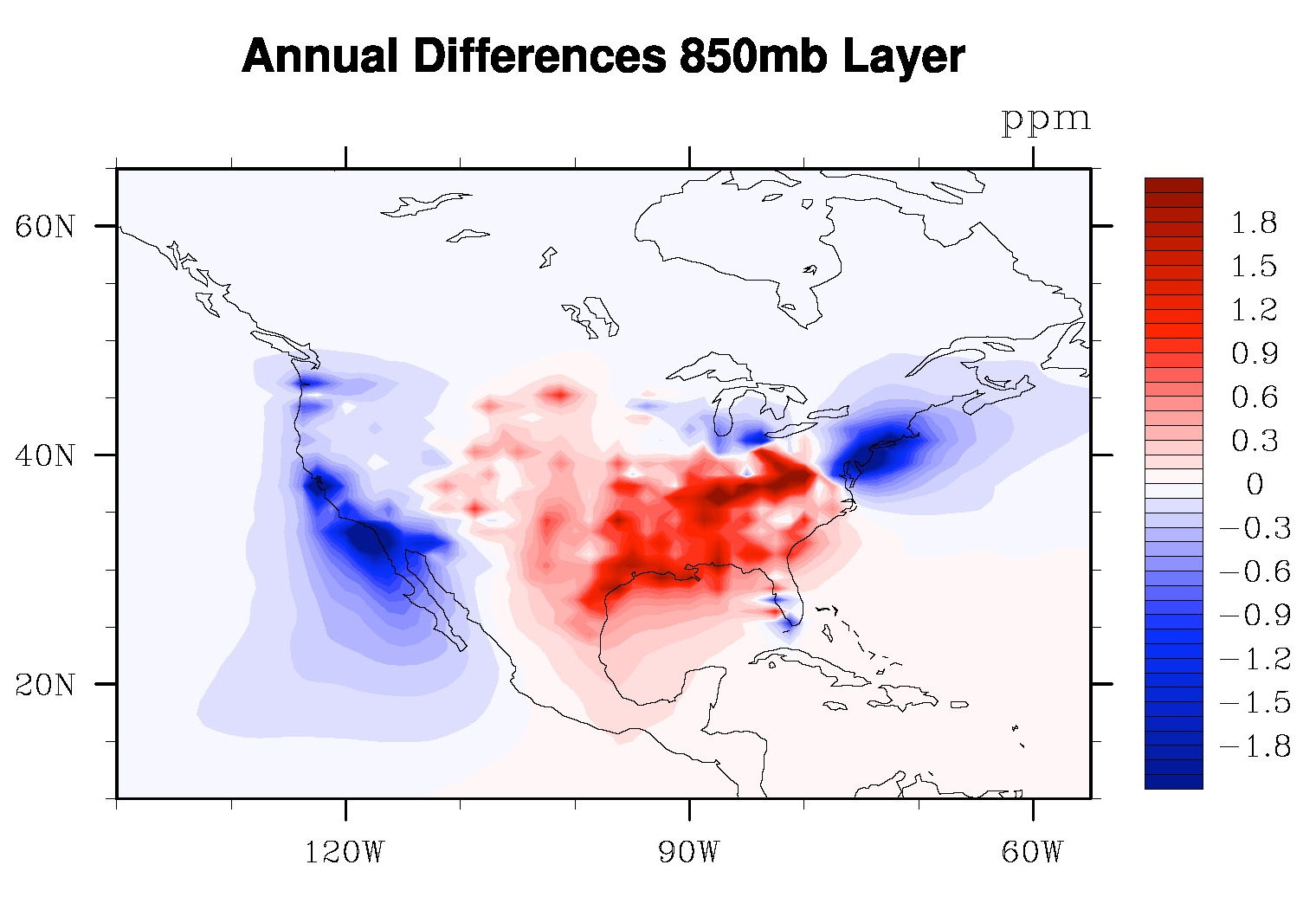
Here is the link directly to the CO2 Sources sample map -
Quietman at 05:15 AM on 21 April 2008The Mystery of the Vanishing Ocean Heat
In a recent article the new "Vulcan" system maps CO2 Sources (and sinks as well). Take a good look at the sample map in the article! -
ScaredAmoeba at 05:15 AM on 21 April 2008It's the sun
Quietman Definition of Argument 1'A connected series of statements intended to establish a position; a process of reasoning or disputation..,' NSOED 1993Response: I'm having a deja vu of a Monty Python sketch :-) -
Quietman at 03:34 AM on 21 April 2008It's the sun
ScaredAmoeba And I do not intend to make an argument, my intent is to learn more about climate change by questioning the points that I do not understand. The articles and papers that I have read all seem to be conflicting and I want to know why. The most logical statements I have seen all agree that we need to plan for a changing climate. Cleaner resources are a given, that is common sense. But putting the effort into controlling CO2 does not seem sensible given that we can have so little effect by following that route. -
Quietman at 03:22 AM on 21 April 2008Climate change on Mars
Philippe So what you are saying is that the same forces that cause the increased speed of the solar wind do not carry along with it the increased heat that is expelled in the microflare? -
Quietman at 02:56 AM on 21 April 2008It's the sun
ScaredAmoeba It would be silly to try to do something about the sun now would it not? Perhaps since we actually have no control over climate change we should put our effort into ways that we can live with it? -
Philippe Chantreau at 01:12 AM on 21 April 2008Climate change on Mars
Quietman: planetary magnetic fields shield planets from particles (solar winds), not from solar irradiance. -
frankbi at 00:45 AM on 21 April 2008There is no consensus
The so-called "large amount of dissent" is just a small group of people making a lot of noise again and again. Remember the claim that there were 19,000 scientists disputing global warming? During the New York denialist conference ("2008 International Conference on Climate Change"), it turned out there were only _19_ scientists. Looks like the number 19,000 is off by a factor of 1,000. As an added bogus, the logo for the denialist conference was a loudspeaker. -- bi, http://frankbi.wordpress.com/ -
ScaredAmoeba at 22:48 PM on 20 April 2008It's the sun
Quietman Flawed logic! IF what you say were true and it's a BIG IF, then it becomes even MORE important to reduce CO2 emissions to even LOWER levels than if CO2 was the primary cause of warming, because it's fairly impossible to do anything about the sun. I'm surprised that you weren't smart enough to spot that! Of course in the topsy-turvy world of AGW denial things that make sense don’t and things that don’t make sense, do. The next time you meet Alice in Wonderland, say hi! The tipping points remain waiting and at some stage they will be triggered. It matters not one jot to the clathrates or the permafrost where the heat is derived from. The ocean too is warming and that will mean outgassing. BTW Your link was corrupted and did not work. [hhttp protocol] I looked at the site you recommended and it's not science, it's not even peer reviewed but it's garbage and of no relevance. Not a single peer reviewed reference. But I noticed the Exxon funded Hoover Institute! Don't you just love the smell of that oil money! You will have to try harder, much harder. Try some real objective peer-reviewed science - you know the stuff that doesn't smell of oil or coal. Your argument gets even more unbelievable with every post. -
ScaredAmoeba at 22:16 PM on 20 April 2008Ice age predicted in the 70s
Quietman You are repeating the deceitful alarmist allegations made repeatedly by skeptics From Scientists add to heat over global warming by S. Fred Singer Washington Times, May 5, 1998 “But this exaggerated concern about global warming contrasts sharply with an earlier NAS/NRC report, "Understanding Climate Change: A Program for Action." There, in 1975, the NAS "experts" exhibited the same hysterical fears—-this time, however, asserting a "finite possibility that a serious worldwide cooling could befall the Earth within the next 100 years." The 1975 NAS panel claimed to have good reason for their fears: Global temperatures had been in steady decline since the 1940s. They considered the preceding period of warming, between 1860 and 1940, as "unusual," following as it did the "Little Ice Age," which had lasted from 1430 to 1850.” http://www.sepp.org/key%20issues/glwarm/sciaddheat.html You will note that the terms ‘exaggerated’, ‘hysterical fears’ and ‘fears’ are used. There are a number of other changes too that render the use of quotes highly questionable. 1975 US National Academy of Sciences/National Research Council Report UNDERSTANDING CLIMATE CHANGE: A program for action Strangely, From the foreword (by V E Suomi, Chair of the US Committee for GARP): "..,we do not have a good quantitative understanding of our climate machine and what determines its course. Without the fundamental understanding, it does not seem possible to predict climate..,". From the introduction "Climatic change has been a subject of intellectual interest for many years. However, there are now more compelling reasons for its study: the growing awareness that our economic and social stability is profoundly influenced by climate and that man's activities themselves may be capable of influencing the climate in possibly undesirable ways. The climates of the earth have always been changing, and they will doubtless continue to do so in the future. How large these future changes will be, and where and how rapidly they will occur, we do not know". Not much evidence of hysteria! It would seem that the allegations of exaggeration and hysteria were complete fabrications introduced by Singer. The measured and cautious language of the National Academy of Sciences has been entirely born out. -
ScaredAmoeba at 21:26 PM on 20 April 2008Ice age predicted in the 70s
PaulM, You bemoan people attempting to [quote]‘re-write recent history’. However, reporting the facts does not amount to ‘rewriting history’! The people actually responsible for the rewriting of history are not AGW fanatics, but people politically or ideologically aligned to industry and typically funded directly or indirectly by the fossil fuel funded denial industry. Peterson et al. 2008 have merely attempted to establish the facts and set the record straight. The fact that you may have identified two additional relevant papers and claimed there are ‘many more’, which may or may not support your pet theory, does not invalidate their research. It seems probable that any additional papers fitting the various search criteria will be distributed in much the same way as the papers already listed, unless there is a very good reason why they should not be included. -
Quietman at 17:04 PM on 20 April 2008Climate change on Mars
Victor Actually as I understand it, Mars should be less sensitive because it lacks the magnetic field that protects the earth. The sun distorts the magnetic field of the earth, altering what radiation can pass through but since mars lacks this field the sun has no martian field to distort so its effect is much the same all the time. I am sure Philippe will correct me if I got it wrong. :) -
Quietman at 08:25 AM on 20 April 2008Ice age predicted in the 70s
frankbi Read the media articles, they are almost always alarmist. Those that have comment sections often disappear after someone disproves the article. I have seen this on CBS, ABC and LiveScience quite a few times. Then there is the BBC. -
Quietman at 08:10 AM on 20 April 2008CO2 lags temperature
Dan Pangburn Very astute observation. Another look at those graphs will also show that temperatures fell dramatically when CO2 was at it's peak. -
Quietman at 08:07 AM on 20 April 2008CO2 lags temperature
ScaredAmoeba Re: "The economic argument that carbon taxes will damage the US economy is bogus." This is an unknown. It could go either way depending on exactly who is taxed and how much as well as who is hired and how many. If we are heavily taxed to pay for green products made in India we loose. If we are lightly taxed for production within the US by non-illegals we win. Can you assure us that the latter will be the case rather than the former? -
Quietman at 07:59 AM on 20 April 2008Al Gore got it wrong
Carrick Recent articles published within the past year have indicated that the ice sheets that are in fact melting in both Greenland and Antarctica is "at least in part due to vulcanism" (they discovered active volcanos under the ice sheets, first one, then another ...). -
Quietman at 07:50 AM on 20 April 2008It's the sun
ScaredAmoeba There is more than one solar hypothesis. Most of which are much more recent than the greenhouse hypothesis, of which there are also more than one. The simple fact is that the effect on temperature based solely on CO2 was only 50% of what the models predicted: Ohio State University Fact Sheet -
Quietman at 07:30 AM on 20 April 2008There is no consensus
All of you do realize of course that there is a very basic premise involved: If there was a consensus, there would be very little dissent. Given the extremely large amount of dissent, we must assume one of two things: 1) there is no consensus or 2) the consensus is not what the IPCC claims it to be. -
Quietman at 07:23 AM on 20 April 2008CO2 lags temperature
ScaredAmoeba 1. I said "what IF. (food for thought). There is a CO2 feedback effect and a contribution by AGW regardless. 2. Not one single graph that I have seen matched the rise in CO2 to the rise in temperature without some serious manipulation. Show me a graph of rising surface temperaturs that is based solely on rural weather stations and a chart of CO2 with a matching slope. You won't be able to. -
Robert S at 18:40 PM on 19 April 2008It's cosmic rays
Here are a few new studies in favor of the climate-GCR link: http://aps.arxiv.org/ftp/arxiv/papers/0803/0803.2765.pdf http://aps.arxiv.org/ftp/arxiv/papers/0803/0803.2766.pdf GCRs are certainly a fascinating aspect of climate. -
Robert S at 12:54 PM on 19 April 2008There is no consensus
Philippe wrote: "Even in periods of end interglacial times, when temps would be expected to slowly cooling down, as you mentioned?" Is it a "period of end interglacial time"? Well it depends on what you think causes the glacial periods--if the mechanism isn't there, then it isn't going to happen. If you believe the Milankovitch cycles are what initiates the glacial/interglacial, then we are still a ways from another glacial period. So it is not inconceivable that the planet would experience a warming at this time. Then he wrote: "Even on that kind of time scale, a blink of an eye really? OK, but can you substantiate with references?" If you want to take issue with the idea that the planet has had warming similar to the recent warming on both the time scale and in magnitude, be my guest. It would be a losing battle. As for references, all one has to do is a little searching--this interglacial, the last glacial, the last interglacial, etc. It won't be too hard to find warming of this magnitude in this time scale. -
Philippe Chantreau at 06:50 AM on 19 April 2008There is no consensus
"The recent warming is hardly unprecedented." Even in periods of end interglacial times, when temps would be expected to slowly cooling down, as you mentioned? Even on that kind of time scale, a blink of an eye really? OK, but can you substantiate with references? -
Robert S at 16:00 PM on 18 April 2008There is no consensus
My comparison using November and late frost was meant to imply that this interglacial has gone on several thousand years too long, with respect to previous interglacials. You say: "About climate, a warming like the one seen lately, while temps should be stable in our kind of time scale, is an element of instability." If the recent warming is an element of instability, then you have just contradicted your previous assertion that we have had 600kyr of very stable climate, because events similar to the recent warming have occurred a multitude of times in the last half a million years. The recent warming is hardly unprecedented. -
Philippe Chantreau at 15:34 PM on 18 April 2008There is no consensus
The weather comparison is not useless or irrelevant. Events like freezing in june or 4 months without rain are elements of instability, if they turn into a trend. Just like being in late november and still waiting for a frost to come, if it happens more and more regularly (as it has). About climate, a warming like the one seen lately, while temps should be stable in our kind of time scale, is an element of instability. A massive injection in the atmosphere of a gas ike CO2 (whose physical properties are known) is also an element of instability. -
Robert S at 15:11 PM on 18 April 2008Did global warming cause Hurricane Katrina?
The mere fact that he devotes a portion of his slideshow/movie to hurricanes would imply that he wants his audience to believe that GW and an increase in hurricane frequency/intensity go hand-in-hand. He gets no free pass for any aspect of that. -
Victor at 06:15 AM on 18 April 2008Does model uncertainty exagerate global warming projections?
This uncertainties yields also for negative feedbacks. Why are climatologist only talking about positive feedbacks? Every complex dynamic system, as climate is, has both positive and negative feedbacks. If the earth climate had only positive feedbacks live wasn't impossible.Response: A fair point - there are also negative feedbacks in the climate system. Eg - clouds have both positive feedback (trapping heat) and negative (reflecting sunlight). The question is what is the net feedback once you've added up all positive and negative feedbacks. This is looked at in Empirical evidence for positive feedback. -
Victor at 05:58 AM on 18 April 2008Water vapor is the most powerful greenhouse gas
The watervaporfeedbacktheory isn't 'waterproof' at all. Humidity is not only controlled by air temperature but also by the temperature of seasurface and tropopause. I've been working with boundarylayer models. They showed a decrease in evaporation when increasing greenhouseeffect by CO2 at fixed SST's, especially by stratocumulus-conditions. Since greenhouse warming is strongest in troposphere and over land. Atmosphere stabilize over oceans and reduce vertical mixing. On the other hand the stratosphere surpresses deep convection. CO2-cooling of the stratospere makes the tropopause more flexible which leads to higher cumulonimbusclouds. Thereby the tops getting colder and water/ice rains out more efficiently. They observe a trend in more intensive rainfall all over the globe which IPCC destributes to higher moisture contents. It's rather a result of higher and colder tropopause, since higher watervapour contents are not measured in tropospere in recent decades. NCEP/NCAR-realyses show decrease of relative humidity on different levels and the evidence raised above are just so tiny. The study of Soden 2001 doesn't say anything about watervapourfeedback by greenhousewarming. First the Pinatubo caused a short cooling by reflecting solar irridiance and not a slowly warming. The area examined is too small thus doesn't yield for the total globe and the period is too short. Local interannual variations should also cause that effect. -
Jürgen Hubert at 22:11 PM on 17 April 2008It hasn't warmed since 1998
I've analyzed the data used by Christopher Monckton in a recent essay where he claims a cooling trend, and the results may be surprising. Or possibly not, for the readers of this website... http://jhubert.livejournal.com/181274.html -
ScaredAmoeba at 17:15 PM on 17 April 2008It's the sun
mick What your first sentence actually means is rather unclear. Could you please explain what you meant? References please. As stated earlier, the solar hypothesis is wanting and satisfactory mechanisms remain unproven, especially since evidence for increasing solar output is unconvincing. More science is definitely required. The solar hypothesis is also vastly overhyped, especially by those with a fossil fuelled agenda or a political axe to grind. The lag of CO2 behind temperature only shows that CO2 is released by increasing temperatures. This does not disprove that CO2 is a GHG. CO2 is known to be infra red active, both as a feedback and as a forcing. The absorption spectra of CO2 and H2O are different and the absorption of CO2 can be detected by satellite. The warming from CO2 often leads to additional feedbacks from other sources e.g. water vapour. Annually adding ~ 28 Gt of CO2 from burning fossil fuels has artificially boosted atmospheric CO2 and started a warming phase. The fossil source of this carbon is demonstrated by the isotopic composition. The increasing temperatures will release further CO2 that will cause further warming. All this without requiring any change in solar output. -
Robert S at 09:02 AM on 17 April 2008There is no consensus
When you compare the last 600kyr to the previous 600myr, of course the climate looks "very stable," but that is not a meaningful comparison--it's useless. Not only is the time scale vastly different, but the mechanism for change is as well (also, time periods before the ice core record are far less certain). No great departure from extremes does not necessarily equate to "very stable climate." -
Robert S at 08:35 AM on 17 April 2008There is no consensus
Philippe said: "Change alone does not make unstability. Perhaps a comparison with weather would be useful. The weather changes continuously along the year, yet we deal with it just fine so long as nothing happens like 4 months without rain or freezing in june." You have invoked two comparisons which are irrelevant: Weather and climate more than 600kya. And your last sentence seems odd--based upon other interglacials, we have been in late november for the last 2000 years and the first frost still hasn't come. Then Philippe said: "The examples of hot house as in the mesozoic times are commonly used by advocates who argue that because it has been very hot before, it's OK to go that route again now. The fact that the world and the biosphere were vastly different in these times is what makes that argument irrelevant, not the climatological elements themselves. Those advocates often argue that warmer is better, yet mass exctinctions have happened during these periods, indicating that a hot house does not guarantee against them." I don't know who these "advocates" are but this does not seem to be in either of my responses. "The cause of the Permian extinction is unknown. I don't know any that has been established for the Ordovician. So the volcanic/collision explanation for mass extinction applies with any level of certainty to the Cretaceous only." The cause for an ancient extinction is never "known." It has been speculated that the Permian extinction was caused by a similar event to the one that caused the Cretaceous--volcanism and/or meteor impact. The Ordovician-Silurian extinction occurred at the transition to one of the largest Ice Ages in the last 600myr. So while he cause is not "known," the current running theory speculates that the cause is the somewhat rapid decrease in temperatures. -
Wondering Aloud at 07:16 AM on 17 April 2008Global cooling: the new kid on the block
I don't know what particular argument you are talking about, I suppose up top? Where I didn't like his graph or see where he got it from? I think that is mostly resolved. I am not sure how big the solar affect is but it looks to me like it might well be half of the total signal fairly easily. I don't think the current solar minimum should show up as a temperature drop for quite some time yet, and only a sustained minimum should have any effect. We had a couple of centuries of generally increased solar activity. I have severe doubts that this last March was second lowest snowcover on record. I think I'd question how that data was gathered if they actually publish that conclusion. GISS? no problem with that data set... except the warming signal is primarily coming from an "adjusted" version of the land record. Remove the obviously flawed stations with large warming bias and the arbitrary cooling of the past introduced as "adjustments" from that record; than we can talk about it seriously. But if you do that half of the total signal vanishes... That is why we have a problem here. Fortunately there are at least 3 better data sets. Using the GISS one is not needed. No one wants to admit that we should do that though because it isn't so dramatic. -
Philippe Chantreau at 05:33 AM on 17 April 2008There is no consensus
Change alone does not make unstability. Perhaps a comparison with weather would be useful. The weather changes continuously along the year, yet we deal with it just fine so long as nothing happens like 4 months without rain or freezing in june. The examples of hot house as in the mesozoic times are commonly used by advocates who argue that because it has been very hot before, it's OK to go that route again now. The fact that the world and the biosphere were vastly different in these times is what makes that argument irrelevant, not the climatological elements themselves. Those advocates often argue that warmer is better, yet mass exctinctions have happened during these periods, indicating that a hot house does not guarantee against them. The cause of the Permian extinction is unknown. I don't know any that has been established for the Ordovician. So the volcanic/collision explanation for mass extinction applies with any level of certainty to the Cretaceous only. -
mick at 03:10 AM on 17 April 2008It's the sun
Solar temperatures should lag temperature changes on earth. That is what actually shows the real influence of the sun on climate. This the exact opposite of historical readings of C02 when C02 lagged temperatures suggesting the opposite correlation. -
Robert S at 19:12 PM on 16 April 2008There is no consensus
Thanks for the response. You say: "Robert, these extremes are very well constrained compared to numerous changes that happened before that period. It is fair to say that the climate of the past 600k years has been quite stable compared to the climate of times before that, because those "extremes" remain within a certain range. Even the periodicity of the changes remains overall nicely consistent. So my comment is far from being ridiculous." and then you say: "I have ran many times into the argument that climate has changed to extremes in the past and they always call on paleoclimate examples from way before the ice core records, especially hot house periods of the mesozoic times, which are of little relevance to our situation." This seems slightly peculiar--you use that very comparison in your first paragraph. Regardless, the last 600,000 only appears stable when compared to the vastly different time scale of the previous 600myr (such a comparison is not useful). Essentially your argument boils down to the "the last 600k years have been stable in that they are consistent in their extremes and periodicity." The belief in constant change as "very stable climate" seems misplaced. Then you say: "Besides, it is interesting to note that the 2 largest mass extinctions of the geological record happened in hot times (P/T and Cretaceous)." They did occur in "hot times," but the mechanism behind these extinctions is considered to be volcanism and/or meteor impact-- blocking sunlight and preventing photosynthesis. On the other hand, the Ordovician-Silurian extinction (3rd largest) occurred during the transition to one of the largest Ice Ages in the past 600myr. Anyhow, this seems irrelevant to my response (39) above. Your last paragraph also seems irrelevant--I don't disagree that CO2 is higher now than any time in the last 600kyr. -Robert -
Philippe Chantreau at 11:33 AM on 16 April 2008There is no consensus
Robert, these extremes are very well constrained compared to numerous changes that happened before that period. It is fair to say that the climate of the past 600k years has been quite stable compared to the climate of times before that, because those "extremes" remain within a certain range. Even the periodicity of the changes remains overall nicely consistent. So my comment is far from being ridiculous. This page gives a quick glance at very long term variability: http://www.scotese.com/climate.htm I have ran many times into the argument that climate has changed to extremes in the past and they always call on paleoclimate examples from way before the ice core records, especially hot house periods of the mesozoic times, which are of little relevance to our situation. Besides, it is interesting to note that the 2 largest mass extinctions of the geological record happened in hot times (P/T and Cretaceous). It is also interesting to look at how CO2 has changed during these 600k years compared to what has happened in the (very) recent past. There is no precedent in the ice core record to such an injection of CO2. Nothing even remotely comparable to it. See this link, slide number 8. http://ec.europa.eu/research/environment/pdf/descriptions/raynaud_ipy_bxl07.pdf -
ScaredAmoeba at 06:12 AM on 16 April 2008It's the sun
Dan Pangburn You failed to prove that CO2 cannot be the driver of temperature via feedback, by choosing to totally ignore that other factors are involved. But later-on in your argument, you acknowledge that single effects alone are too simplistic. Are you suggesting that the climate is driven by a sole factor, or by more than one? You seem to suggest that both cases are true? Your contradictory logic proves that your argument is logically flawed and is without merit. Please ask any objective climatologist. Objective means NOT being in the pay of a vested interest (e.g. fossil fuel industry)! They will tell you that the climate is driven by numerous forcings and feedbacks. They will also tell you that a factor that causes cooling such as aerosols (volcanic or man-made) can result in cooling, despite increasing CO2 concentrations that would result in warming. -
ScaredAmoeba at 05:41 AM on 16 April 2008It's the sun
Quietman The Professor Giegengack’s accusation of exaggeration would have us believe that the IPCC and scientists have perpetrated a most serious fraud – if only it were true. The truth is that the Professor’s accusation of exaggeration is a straw man argument and completely dishonest. The Professor should know perfectly well that both the IPCC and the scientists, of which the IPCC is involved, are extremely careful to use ranges of future scenarios in which they have extremely high confidence. Therefore these projected scenarios tend to be very cautious and conservative. The IPCC, for instance has consistently published past projected future scenarios that have been proven by events not to be exaggerations. The fact that the Professor levels such a false accusation reveals more about him than the IPCC and the thousands of scientists involved that he wrongly accuses of exaggeration. There are a small number of scientists, who have chosen to accept money from the fossil fuel industry and who do not have a reputation for credibility worth preserving. So why is the Professor not telling the truth? I don’t know, but there are a small number of scientists who make very similar accusations at mainstream scientists and the IPCC. Most of the others have been funded by the fossil fuel industry. So perhaps, he too is being less than open and honest in terms of his conflicts of interest. Further evidence that Professor Giegengack was being disingenuous is another projection that supports the view that the IPCC’s estimates of future sea level rises of 28 to 43 cm by 2100 were over conservative, due to incompletely understood mechanisms of ice-melt. [Dr Jevrejeva's group’s projections have been submitted for publication in the scientific journal Proceedings of the National Academy of Sciences.] The new estimates suggest sea-level rise is likely to be in the range of 0.8 and 1.5 metres, which confirms another estimate of 0.5 and 1.4 metres by 2100 by Stefan Rahmstorf, but using a distinctly different methodology. IPCC exaggeration? – clearly not. However, the facts never got in the way of malicious allegations and lies. -
Quietman at 08:00 AM on 15 April 2008Al Gore and Dr Thompson's thermometer
John Do realize that you need a mirror to read the lower graph?Response: :-) That was Steve McIntyre's quick and dirty technique to compare the graph from Gore's movie to Thompson's paper. Thompson unfortunately displays the data in a vertical fashion which makes direct comparison awkward. McIntyre couldn't be bothered fixing up the axes labels and I'm even lazier, just hotlinking to McIntyre's graph. I could subtitle this post "An Inconvenient Axes Orientation" although not quite as catchy as "Inconvenient Truth". Here's the original graph from Thompson 2003:

-
Quietman at 07:48 AM on 15 April 2008Cartoon about global warming alarmism
frankbi You are right on, that "economist" is definately looney. We could use a few of those jobs here in PA. -
Robert S at 07:42 AM on 15 April 2008There is no consensus
Philippe (36) said: "That may be because there has not been a release of CO2 on the scale we experienced these last 150 years during the 600k years of very stable climate the planet has been through." Hold on, did anyone else notice that? 600k years of very stable climate? The last 600k years has been a torrent of climatic change. So if by "stable" you mean "always changing between extremes," then yes, you are correct. Beyond that, the Earth's climate has never really been stable. I just had to point out that ridiculous comment. -
frankbi at 21:44 PM on 14 April 2008Cartoon about global warming alarmism
Hah. I just wrote a blog post about how the Adam Smith Institute's `argument' against green jobs. Summary: creating jobs is bad. No, I didn't make that up. http://tinyurl.com/3ogc8y -
Robert S at 20:51 PM on 14 April 2008The Mystery of the Vanishing Ocean Heat
I really wish you would have waited, John. I can't stand the suspense. -
Robert S at 20:48 PM on 14 April 2008Models are unreliable
Frankbi said: "And besides, if models can be "fudged" to fit anything -- as our `skeptics' claim -- why are the _same_ `skeptics' saying that they can't get Hansen's model to fit the data? Can it be because our `skeptics' are simply full of junk?" I am surprised that John did not reply to this, but I assume he does not have the time to respond to every nonsensical claim that appears on his board. Frank, if you do not know that GCMs (and many other models) are "tweaked" to fit past data, then you have no place attacking others. It is common practice, and there is little that is nefarious about it, though it may appear as such. You probably know that there are many uncertainties and complexities in the climate system, and in attempting to model such a system, you must used what has already been observed to better your understanding and accuracy. If models were based purely upon theory for such a complex system, they would appear wildly inaccurate and worthy of no utilization. -Robert -
Quietman at 16:04 PM on 14 April 2008Solar cycles and global warming
Wait one minute. ALL of our heat other than vulcanism comes from the sun. Without sunlight CO2 could never have been an issue. Greenhouse gases only amplify, they can not cause heat. Therefore if the sun intensifies a little the greenhouse gases multiply the effect. By the same token, if the sun is not as hot or there is less TSI that lowers the number that can be multiplied by a greenhouse gas. So solar cycles affect the amount that can be multiplied by the gases. -
Quietman at 15:56 PM on 14 April 2008Al Gore got it wrong
This is an unfair statement. Of course he got it wrong. He's a politician.
Prev 2631 2632 2633 2634 2635 2636 2637 2638 2639 2640 2641 2642 2643 2644 2645 2646 Next