



 Arguments








Heat stress: setting an upper limit on what we can adapt to
Posted on 11 May 2010 by John Cook
It's widely agreed that warming over 6°C would have disastrous consequences for humankind. Increased drought and rising sea levels are the usual poster boys for climate impacts (and for good reason). However, the direct impact of heat stress on humans gives us a clear climate impact benchmark. Some argue that humans will simply adapt, as we already tolerate a wide range of climates today. But a new paper An adaptability limit to climate change due to heat stress (Sherwood 2010) shows this argument is false. Even modest global warming could expose large fractions of the population to unprecedented heat stress, and severe warming would lead to intolerable conditions over wide regions.
Human skin temperature is regulated at around 35°C. The human body needs to be warmer than it's environment in order to cool. Specifically, it needs to be warmer than the wet-bulb temperature Tw, measured by covering a standard thermometer bulb with a wetted cloth and fully ventilating it. Sherwood 2010 estimates that the survivability limit for peak six-hourly Tw is probably close to 35°C for humans - any longer results in hyperthermia.
Figure 1 depicts temperature over the last decade (1999 to 2008). The black line in Box A is a histogram of annual surface temperature. The blue line is annual maximum temperature. Of particular interest is the red line, showing a histogram of the wet-bulb temperature Tw. Note the vertical dashed line in Box A - this denotes the critical threshold of 35°C. The map also shows the wet-bulb temperature across the globe.
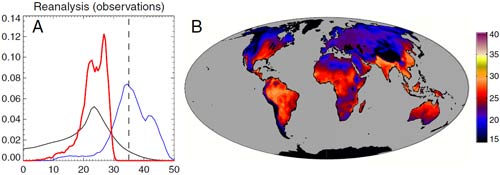
Figure 1: (A) Histograms of temperature (Black), Maximum Temperature (Blue), and Wet-bulb Temperature Tw (Red) during the last decade (1999–2008). (B) Map of Wet-bulb Temperature Tw.
While the distribution of temperature (black) is broad, wet-bulb temperature (red) has a much more narrow range. This means the peak heat stress is surprisingly similar across many regions on Earth. Even though the hottest temperatures occur in subtropical deserts, relative humidity there is so low that Tw is no higher than in the deep tropics. The result is that over the last decade, Tw has never exceeded 31°C.
The effect of global warming is an upward shift of the wet-bulb temperature distribution. Sherwood 2010 concludes that global warming of roughly 7°C would create small zones where metabolic heat dissipation would for the first time become impossible, calling into question their suitability for human habitation. A warming of 11 to 12°C would expand these zones to encompass most of today’s human population. If warmings of 10°C were to occur in next three centuries, the area of land likely rendered uninhabitable by heat stress would dwarf that affected by rising sea level.


 0
0  0
0 Southeastern Asia seems to be already close to the edge, and the few extra degrees of projected warming could make it exceed the tolerable limit. South America and sub-saharian Africa also seem vulnerable.
Let´s also keep in mind that this map here is the temperature anomaly for the period 2070-2100 (scenarios A2 and B2). Temperature does not stabilize there, though. Warming is expected to continue in the coming centuries.
Southeastern Asia seems to be already close to the edge, and the few extra degrees of projected warming could make it exceed the tolerable limit. South America and sub-saharian Africa also seem vulnerable.
Let´s also keep in mind that this map here is the temperature anomaly for the period 2070-2100 (scenarios A2 and B2). Temperature does not stabilize there, though. Warming is expected to continue in the coming centuries.
 Figure SPM.7. Examples of impacts associated with projected global average surface warming.
But it's entirely qualitative, unfortunately. I wonder if anyone ever tried to produce a similar graphic with quantitative metrics? That could get ugly fast, but it's an interesting information visualization challenge.
Figure SPM.7. Examples of impacts associated with projected global average surface warming.
But it's entirely qualitative, unfortunately. I wonder if anyone ever tried to produce a similar graphic with quantitative metrics? That could get ugly fast, but it's an interesting information visualization challenge.
 Do people not think there is a hint of alarmism about all this? Life isn't hell now so lets imagine a hell for future generations. It also ignores the possibility that humanity would do something about this.
15.mike roddy
Things might get sticky in Mumbai but it seems nobody told the indians they should be dropping dead of heat exhaustion. Life expectancy in India has almost doubled in the past 50 years.
Do people not think there is a hint of alarmism about all this? Life isn't hell now so lets imagine a hell for future generations. It also ignores the possibility that humanity would do something about this.
15.mike roddy
Things might get sticky in Mumbai but it seems nobody told the indians they should be dropping dead of heat exhaustion. Life expectancy in India has almost doubled in the past 50 years.







Comments