



 Arguments







Recent Comments
Prev 1892 1893 1894 1895 1896 1897 1898 1899 1900 1901 1902 1903 1904 1905 1906 1907 Next
Comments 94951 to 95000:
-
scaddenp at 13:42 PM on 3 March 2011Australia's departing Chief Scientist on climate change
I am not expert on Australian resources but would have thought CSP not PV would have considerable resource in Australia. I agree though nuclear seems a pretty obvious way forward for Australia. -
Riduna at 13:02 PM on 3 March 2011No Illusions podcast interview (and elocution lessons from an 11 year old)
Unless I’ve just listened to an expurgated edition, I found it an informative interview, fluent replies and all defensible. Well done John Cook.Response: I'll pass on your comments to my 11 year old daughter but I think you'll find she'll agree to disagree :-) -
Tom Curtis at 12:40 PM on 3 March 2011Crux of a Core, Part 1 - addressing J Storrs Hall
Charlie A, your whole case comes down to not understanding the difference between attribution and analysis. Rob Honeycutt never says that J Storrs Hall did not correctly attribute the GISP2 ice core to the GISP2 site. He clearly indicates, however, that in his analysis, Hall treats the GISP2 records as though it were a global record. That Hall does treat the GISP2 record as though it were a global record is obvious in his comparisons between the variability in the GISP2 ice core and the recent rise in global temperatures. That comparison is explicit in Hall's article in which he refers to the "hockey stick", and in which he says temperatures continue "... up in the 20th century at least another half a degree." To start with, global temperatures rose by 0.8 degrees from the 1850's to the 2000's (the actual interval between the end point and modern times), or by 0.9 from the 1900's to the 2000's (the interval Hall thought to exist). So even if a comparison between local and global temperatures were valid, Hall has understated the temperatures increase by 40%. That sort of misinformation seems not to vex you, but as it is part of a critical point at issue, it shows a complete disregard for accuracy in Hall's analysis. More to the point however, as Hall is using a local record, he should have stated the additional increase in local terms. In other words, the state increase should have been 1.44 degrees (1850's to 2000's decadal average) or 3.7 degrees (1855 to 2010). In either case, the rise in Greenland temperatures in the 20th century would have had only two parallels in the chart, both (I believe) caused by events relating to the melting of the continental Ice Sheets following the preceding glacial. Now, either Hall new the difference between local temperatures and global temperatures or he didn't. If he did, then he knowingly understated the 20th century temperature rise by a factor of between 3 and 6 on a crucial point in his analysis; and is consequently a liar. If he did not, then Honeycutt's claim that "Hall presents GISP2 as if it were a global record ...". By arguing that Honeycutt is wrong about that, you implicitly argue that Hall is deliberately dishonest. There is no way around that logic. Honeycutt, not one to stoop to ad hominem, has taken the charitable interpretation that Hall is confused on the difference between local and global tempertaures. You apparently are not so charitable. However, whether Hall is dishonest or incompetent is a side issue. Your restricted focus on that issue alone shows that you are trying to distract readers from Honeycutt's devastating critique of Hall's argument. -
muoncounter at 12:34 PM on 3 March 2011Climate Sensitivity: The Skeptic Endgame
"I do simply disagree", You're free to disagree, but that's one person's opinion (which is conspicuously unsubstantiated). You offer astrology's 'claim' to 'reproduce reality'? Hardly a meaningful comparison. Yes, models are predictive tools, so do you make one valid and useful point: See any of the threads here about models from as early as 1988 -- or even from 1981 -- and how well they have done. But this thread is not about models or modeling reliability; I referred you to that thread earlier. This thread is about climate sensitivity. -
Bern at 12:20 PM on 3 March 2011No Illusions podcast interview (and elocution lessons from an 11 year old)
Prompted by the podcast, I just looked up the Office of the Chief Scientist and what statements on climate science there were. I found this in the transcript of Professor Sackett's statements to the Senate Estimates committee hearing:"Scientists in every area of science are broadly telling us the same thing. And, when I say ‘scientists’, I would like to point out again—because I think it has been mentioned in these chambers before—that we are talking about all of science; we are talking about physics, we are talking about chemistry, we are talking about the science of the oceans. That is a very important message for people to hear. It is not a particular sort of scientist. It is not a scientist who works in government labs but not those who do not. It is not the scientists of one country only or a few countries only. It is scientists of all sorts in all countries, in all sorts of laboratories that are telling us the same thing. That is a message that I have great concern is not reaching the general populous at a level that engages them and enables them to ask the questions that they have in an environment where those discussions can take place without distractions of policy, without distractions of politics, if I may say. That is a great concern to me."
Well said, indeed! -
Bern at 12:14 PM on 3 March 2011No Illusions podcast interview (and elocution lessons from an 11 year old)
Have just listened to the podcast - not a bad discussion of the issues, thanks for that. I'd agree about the um's and ar's, in that it can be very difficult to avoid them. I would agree with your daughter's teacher, though - speak a little slower, consider your words a bit more, and it becomes much easier to avoid them. Slowing down your diction allows your brain to get ahead of what you're saying and have the next few words lined up - or so I've found, anyway, even if you have a few drawn out words or slight pauses in your sentence. (My boss is absolutely terrible at that, on phone conferences sometimes he'll say umm four or five times in a single sentence, and he speaks very quickly - which was not much fun when we were on a call to some guys in Brazil who have limited english!) -
Berényi Péter at 12:10 PM on 3 March 2011Climate Sensitivity: The Skeptic Endgame
“the global mean equilibrium warming for doubling CO2...is likely to lie in the range 2°C to 4.5°C, with a most likely value of about 3°C. Equilibrium climate sensitivity is very likely larger than 1.5°C.” Equilibrium climate sensitivity alone is not too informative. What is the relaxation time? -
Ken Lambert at 11:34 AM on 3 March 2011Australia's departing Chief Scientist on climate change
michael sweet #21, scaddenp #22 Both you comments betray a lack of appreciation of the realities of scaling up 'renewable' sources of base load power to replace 83% of Australia's - let alone the developed world's energy needs. PV Solar is still 4-5 times the cost of coal - without storage devices - and would need huge capital investment. Wind is simply too dilute and far from population centres and suffers from the same increased cost of storage devices and transmission costs. Geothermal is a serious 24/7 contender - but still too small, experimental and far from loads. Nuclear is the only ready to go technology which can deliver base load. Australia has 40% of the world's uranium reserves but again our politicians live out a hyprocrisy that it is OK to sell to China and NNPT signatories and let them dispose of the waste but we are too pure to use it ourselves. Prof Sackett would not be smart if she did not know all these things - yet she makes these unrealistic exit statements in the knowledge that she would never have to deliver a renewable future. -
Daniel Bailey at 11:27 AM on 3 March 2011A Swift Kick in the Ice
Sorry, michael, for my confusion. You are 100% right. Just me being a dumb*** & not reading the actual news release from here but relying upon a 2nd-party news service (here). Probably just a typo, like 2350 becoming 2035... I plead laziness originating from our public school systems and too many teachers from the "flower power" generation. ;) Thanks for being gentle, The Yooper -
Alexandre at 11:19 AM on 3 March 2011Climate Sensitivity: The Skeptic Endgame
Gilles, It's not the questions that annoy me (you don't ask many anyway). It's the row of unsubstantiated claims supported by the refusal to consider the available evidence that is more of a problem. There's nothing in those references that provide any evidence that most of the known reserves of fossil fuels (especially coal) will remain unexplored. Unfortunately. It's a great team of moderators, both in attitude and knowledge. I wish them all the patience to cope with this without wearing themselves out.Moderator Response: [DB] Thus far, sadly, I see the same modus operandi script being followed here as on RC. -
michael sweet at 10:59 AM on 3 March 2011A Swift Kick in the Ice
DB, I am not sure where you got your quote from. At the NSIDC website, they say the record was set in 2005, not 2007. They report the extent for the month of February to be record low, tied with 2005. (IJIS shows 2006 as the record low month. It is unusual for NSIDC and IJIS to differ). The current maximium is lower than the record low on IJIS, but NSIDC has not reported the maximium for the year yet. It is below, but very close to, the previous low maximum. A few cold days would put it over the previous record while a few warm days would set it under. At Cryosphere Today the Sea Ice Area (area is a little different from extent) is declining and the high would be a record low if there is not a major shift in the next few days. In any case, the ice is certainly not showing any signs of recovery this year. Your point is certainly correct: that's a really swift kick in the ice. -
dana1981 at 10:57 AM on 3 March 2011Climate Sensitivity: The Skeptic Endgame
Giles, I'm using "accurate" to mean measurements with relatively high confidence and small error bars. For example, we know the temperature change over the past century to high accuracy, due to the instrumental temperature record. -
NewYorkJ at 10:47 AM on 3 March 2011Crux of a Core, Part 1b
Combining multiple locations and proxies in the Arctic and including the recent temperature average... Arctic Warming Overtakes 2000 Years of Natural Cooling
At least for the last 2000 years and averaged over broader Arctic region, recent warming is very much unprecedented, and as we know, this conclusion can be extended to northern hemisphere average with fairly high confidence.
Arctic Warming Overtakes 2000 Years of Natural Cooling
At least for the last 2000 years and averaged over broader Arctic region, recent warming is very much unprecedented, and as we know, this conclusion can be extended to northern hemisphere average with fairly high confidence.
-
Gilles at 10:47 AM on 3 March 2011Climate Sensitivity: The Skeptic Endgame
"Models that tend to reproduce observations to date have a built-in check on how far their results can be 'from reality.' An ensemble of such models can then be used to describe 'likelihoods.'" I do simply disagree on this epistemological position. Astrology claims reproducing a fair part of reality, and you can do a statistics on astrological predictions. Ptolemaic models did reproduce a fair part of reality, and you could have imagined a statistics of how many epicycles are needed, and a "likelihood" of the number of epicycles of Mars. It would have been just bogus. Models are proved by accurate comparisons of predictions with data, not by statistical sets of approximate reproductions of reality. -
Gilles at 10:40 AM on 3 March 2011Climate Sensitivity: The Skeptic Endgame
Dana : "However, studies based on accurate measurements, such as responses to recent large volcanic eruptions (as discussed in the "climate sensitivity is low" rebuttal linked in the article)" maybe the problem arises from a different understanding of what is an "accurate measurement" ? I confess not being a native English speaker, could you elaborate what "accurate" means in your mind ? Dhogaza "Oil sands and natural gas fracking are putting large amounts of previously unavailable fossil fuel into the economy." Oh really ? what is your guess of how many toe these sources will produce in, say, 20 years ? " And "peak oil" says nothing about coal, which is available in copious quantities." Yes, peak oil says something : that the official estimates of resources are unreliable. -
bbickmore at 10:25 AM on 3 March 2011Roy Spencer’s Great Blunder, Part 2
WheelsOC @30, I think you're right that when Roy Spencer says "natural climate variablity" he really means "natural climate variability due to fluctuations in cloud cover". But that's not what he said, and some of the quotations above definitely imply that mainstream climatologists can't explain any climate change in the past before humans started burning lots of fossil fuels. So even if we try to give him a little leeway on his meaning, he still comes out looking disingenuous. -
Peter Offenhartz at 10:21 AM on 3 March 2011Roy Spencer’s Great Blunder, Part 2
@apsmith(19) Many thanks for the link to scienceofdoom.com. The article was clear and informative, and confirmed my own investigations(!). -
dana1981 at 10:17 AM on 3 March 2011Crux of a Core, Part 1b
Nice response Rob. I think it's pretty clear that Hall's original analysis and "rebuttal" were of extremely poor quality. It seems to be a rather convoluted misuse of GISP2 to argue that current warming isn't "unprecedented", therefore it's not anthropogenic. Even if the current warming isn't "unprecedented", that logic is like saying arsen is impossible because fires are known to start naturally. Only when investigators look carefully at all the evidence can they determine if a fire was started 'naturally' or by humans. Same thing with global warming. You have to look at the cause, not just the effect. -
dorlomin at 10:16 AM on 3 March 2011Crux of a Core, Part 1b
Greenland is an island partially surrounded by perennial sea ice and often exposed to the apparent vagrancies of sea and atmospheric currents. So it is quite possible to see changes in the Greenland record dramatically more variable than a global record. Without engaging with that subtantially I am at a loss as to what point Dr Hall was trying to raise. -
RickG at 09:42 AM on 3 March 2011Climate sensitivity is low
A curious digression on this topic - Dr. Roger Pielke Sr recently posted something on his blog, attempting to redefine the term Climate Sensitivity I wonder what's next, redefining the laws of physics to fit a specific outcome? -
KR at 09:30 AM on 3 March 2011Climate sensitivity is low
A curious digression on this topic - Dr. Roger Pielke Sr recently posted something on his blog, attempting to redefine the term Climate Sensitivity as: "Climate Sensitivity is the response of the statistics of weather (e.g. extreme events such as droughts, land falling hurricanes, etc), and other climate system components (e.g. alterations in the pH of the oceans, changes in the spatial distribution of malaria carrying mosquitos, etc) to a climate forcing (e.g. added CO2, land use change, solar output changes, etc). This more accurate definition of climate sensitivity is what should be discussed rather than the dubious use of a global annual average surface temperature anomaly for this purpose." Redefining a term used in all of climate science? I wonder why measuring the temperature response of the climate to a particular amount of radiative forcing wasn't working for him? This is a clear example of the Moving the Goalposts fallacy, often a sign that the original argument has been lost. -
damorbel at 09:27 AM on 3 March 20112nd law of thermodynamics contradicts greenhouse theory
Re #449 you wrote:- "Before that there was 'albedo', multi-layer insulation, 'sunlight can't make it out of the water', 'constant disequilibrium', 'elastic collision of photons', and the lovely bit of obfuscation, "All materials, even gases, have a refractive index >1, consequently no material substance can behave according to the definition of a black body"." This isn't a scientific argument of any sort, you do know that don't you? You cannot possibly imagine that material with a refractive index >1 can be a 'black body; it is in Kirchhoff's original definition; you have read Kirchhoff's work, haven't you? I think you may have trouble in discussing the matter you refer to as "elastic collision of photons". Photons do not collide there is no known collision process for photons, elastic or inelastic. Photons begin and end at electric charge, free or bound; that is the whole basis of electrophysics. I am beginning to wonder if you are aware of this. -
NewYorkJ at 07:57 AM on 3 March 2011Crux of a Core, Part 1b
Once someone uses the term "alarmist" and brings Al Gore into the discussion, they are pretty much exposing themselves. Hall apparently didn't read Alley's comment at DotEarth regarding point #1, since he doesn't address this: "First off, no single temperature record from anywhere can prove or disprove global warming, because the temperature is a local record, and one site is not the whole world. One of the lessons drawn from comparing Greenland to Antarctica and many other places is that some of the temperature changes (the ice-age cycling) are very widespread and shared among most records, but other of the temperature changes (sometimes called millennial, or abrupt, or Younger-Dryas-type) are antiphased between Greenland and the south, and still other temperature changes may be unrelated between different places (one anomalously cold year in Greenland does not tell you the temperature anomaly in Australia or Peru). After scientists have done the hard work of working out these relations, it is possible to use one ice-core record to represent broader regions IF you restrict consideration to the parts that are widely coherent, so it is O.K. to plot a smoothed version of an Antarctic temperature record against CO2 over long times and discuss the relation as if it is global, but a lot of background is required." Seems the details of this could be expanded on in another post. One interesting part of Hall's "rebuttal" is he changes the timescale by an order of magnitude from 10,000 years (his original post) to 100,000 years, so the goalposts shifted quite a bit. It's impossible to note any correlation from the graph over the last 10,000 years. Hall also claims Vostok shows the Younger Dryas event, but remove the artificial scaling done on his doctored graph, temperature change is magnified considerably. And did he shift the x axis as well?Moderator Response: [Daniel Bailey] "Seems the details of this could be expanded on in another post. " This is in the works. -
WheelsOC at 07:52 AM on 3 March 2011Roy Spencer’s Great Blunder, Part 2
nigelj @30: I think the key to understanding his meaning is to look at his recent "challenge to the climate research community".Studies that have suggested that an increase in the total output of the sun cannot be blamed, do not count…the sun is an external driver. I’m talking about natural, internal variability.
Indeed, his focus on "natural" variability excluding the sun keeps popping up in his writings, at least on the blog. More specifically I think he often means "natural variability" to refer to his causality-backwards idea that cloud cover drives mutli-decade climate trends. -
shoyemore at 07:37 AM on 3 March 2011Roy Spencer’s Great Blunder, Part 2
Arkadiusz Semczyszak #32, I have on occasions heard Professor Mike Lockwood being quoted as a supporter of the "solar theory" of climate change. This is a distortion of his position. While he believes that sun influences the jet stream and the Northern Hemisphere climate, he is in no doubt that the earth is warming due to CO2. You can read this paper: Solar change and climate: an update in the light of the current exceptional solar minimum Quote " In the case of climate change, there is no doubt that global mean temperatures have risen, so that the effect is known to be real. Furthermore, there is a viable explanation of that effect, given that the amplification of radiative forcing by trace GHG increases by a factor of about 2 is reproduced by global coupled ocean–atmosphere models. What is alarming is that in the face of this strong scientific evidence, some Internet sources with otherwise good reputations for accurate reporting can still give credence to ideas that are of no scientific merit. These are then readily relayed by other irresponsible parts of the media, and the public gain a fully incorrect impression of the status of the scientific debate. " -
WheelsOC at 07:25 AM on 3 March 2011Crux of a Core, Part 1b
Hall's original thread had comments on it to the same effect, pointing out the regional nature of the GISP2 data and the mistake in dating. One wonders why Anthony Watts doesn't comment on these basic mistakes made by his guest commentators, like an [Editor's Note: ...] sort of thing. This same vein of goof-up happened after Hall's original post when Don Easterbrook made similar mistakes (and sometimes to a more egregious extent), even when the comments for Hall's thread had pointed out the dating error. One might also wonder why Watts uses such non-experts as guest posters in the first place. It doesn't certainly doesn't seem to serve the aim of spreading accurate climate science information to the public. Quite the opposite: I've had to correct mistakes about GISP2 data in more than one place after a guest post on WUWT mangled it. And I'm not even a scientist. -
rickplan at 07:23 AM on 3 March 2011Crux of a Core, Part 1b
"There are reasons that we look to the top experts in various fields. They are the people who have a deep understanding of the areas of science on which they are commenting. I am quite confident that Dr Hall commands great respect in his own field. I would never presume to denigrate Dr Hall on matters of nanotechnology, AI or microprocessor design. But with all due respect, expertise in one field does not make one an expert in all fields of science. This is made abundantly clear in Dr Hall's original article, as well as his rebuttal." We see too much of this; e.g. Freeman Dyson and others. This paragraph sums it up very succinctly and accurately and should be posted in bold on the home page of this website for future reference and use. It should also be tattooed on the foreheads of any number of "skeptics" e.g. Inhofe, et al. Great post! -
DeanL at 07:22 AM on 3 March 2011Crux of a Core, Part 1b
A Commenter at WUWT suggested that there should be more "rebuttals" of Skeptical Science. I too would love to see them engage in such a scientific debate rather than do as the site owner does and cast insults at the site and it's content. SS does exactly what these people have asked for and scientifically and robustly deals with their so-called counter evidence to which they seemingly can respond only with taunts and ad hom. I invite anyone to compare the two sites, the content and the commentary objectively and decide for themselves which genuinely engages in real, scientific debate. -
muoncounter at 07:17 AM on 3 March 2011Climate Sensitivity: The Skeptic Endgame
"statistics of results": If you are questioning the reliability of the models themselves, see the thread Models are unreliable. Models that tend to reproduce observations to date have a built-in check on how far their results can be 'from reality.' An ensemble of such models can then be used to describe 'likelihoods.' Throwing the words 'complex systems' at it doesn't change the basic approach. So that argument goes nowhere fast. -
Dikran Marsupial at 07:14 AM on 3 March 2011Prudent Risk
RSVP@25 No, apparently several species are effectively biologically immortal, but that doesn't mean they cannot be killed by injury, predation or disease. However, this digression is way off topic, I suggest it ends here. -
les at 07:12 AM on 3 March 2011Climate Sensitivity: The Skeptic Endgame
46 Gilesbecause I think that real scientists should be much more cautious when they do this kind of "statistics of results"
Just out of interest, who are you suggesting is not a real scientists? Here and there we see many critiques of 'scientists' ranging from the accusation of not sticking with some very out of date, potted version of 1930's philosophy of scientific methodology; through the imaginings of people who haven't worked some data from an instrument to a numerical result since school; to out right slander. Of course the same techniques - I guess we're talking monticarlo simulation in this case - can be used by 'real' scientists and charlatans; well or poorly in either case... So, just who are you accusing of being what? And, while we're at it - will you hold your self up to higher standards on SkS... because most people who post here maintain really quite professional attitudes. -
RSVP at 06:46 AM on 3 March 2011Prudent Risk
#24 "we would not survive as a species if we lived forever, so your argument isn't even logically consistent. " If a species were able to live forever, I think it could also assume it is surviving quite well. -
Rob Honeycutt at 06:45 AM on 3 March 2011Crux of a Core, Part 1 - addressing J Storrs Hall
Charlie A @ 42... No. That is exactly what my article is about. Conflating a local record with a global record. I state in the very first paragraph, "Using a single ice core record as a proxy for global temperature is a little like reading the thermometer on your back porch and claiming you know the global average temperature." -
Rob Honeycutt at 06:42 AM on 3 March 2011Crux of a Core, Part 1 - addressing J Storrs Hall
Charlie A @ 40... I have to say you are quibbling over an extremely tiny point that has no bearing on the overall statements made in the article. I can go back and create a new screenshot of the chart. When I did the original screenshot I was merely trying to make the chart larger and clearer for the reader. No one is challenging the source of the data. It's the GISP2 data from Alley 2000. Hall says so, and I agree. You also have to realize there are hundreds of versions of this same chart floating around the internet. -
70rn at 06:33 AM on 3 March 2011Crux of a Core, Part 1 - addressing J Storrs Hall
The WUWT presentation tries to make the argument that 'global warming' is unprecedented by using a local curve. Whether they identify as such or not still calls into question the entire methodology. You can semantically scrutinize the above as much as you like, and it is possible to argue (fairly enough) that the author is false to presume that the originators tried to hide it's local nature. But inspite of all that it is very hard to prove much with one local proxy - and much of the discussion has produced graphs that demonstrate a far more convoluted local/global relationship (e.g fig 3, from the article). This both shows a far more robust array of evidence, and suggests strongly that the current warming trend isn't the usual holocene pattern. Perhaps more importantly it puts current global temperatures against a far broader spatial variety of data curves - which has a greater overall validity. Honeycutt's primary point seems to be that the overall trend is down - by 1 - 2 degrees over the last 10 K years - but that has largely been arrested in a single century or so. tbh I find much of the argument about what was said about wuwt to be strictly secondary, but addressing their methodologies less so. Another example is the forsight.org article here which appears to suffer from a distinct lack of present sight - as it seeks to use the curve to cast doubt upon gw theory with the ice core data, without including any data from the period that global warming is said to have occurred. Small gesures are made along the lines of 'it went up .5 of a degree more', which is not consistent with temeprature records from that area. These kinds of techniques are far more salient an issue than whether or not the above article is wrong to suggest a lack of transparency on the part of these third parties. To me the above article was more serving to give a wider context for the GISP2 curve. Sure the sniping is probably misplaced - but I don't think, judging from the concluding dot points - that it was really it's primary intent. -
NewYorkJ at 06:30 AM on 3 March 2011Climate Sensitivity: The Skeptic Endgame
Inconvenient Skeptic (#17), I think a core problem with your line of reasoning is that each argument presumes there must be one forcing of global temperature change, and if there lacks a correlation during a period for that particular forcing, then such a forcing must have little effect on climate. You've applied this logic to both atmospheric CO2 and solar variation. One must look at all causes, which includes volcanic and manmade aerosols. Anthropogenic Global Cooling Note also that some of the short-term spikes, such as the early 1940's or 1998, can be caused by ENSO variation, so we should look at longer term data. -
MattJ at 06:17 AM on 3 March 2011No Illusions podcast interview (and elocution lessons from an 11 year old)
You might get more hits on your website if you have her read the next podcast. -
Charlie A at 05:34 AM on 3 March 2011Crux of a Core, Part 1 - addressing J Storrs Hall
70rn, your comments about splicing a global instrumental record onto a single point ice core record are valid. That discussion is the result of a comment. That's not what this Skeptical Science article is about. Please go back up to the top of this page and read what Rob Honeycutt wrote. -
dhogaza at 05:28 AM on 3 March 2011Climate Sensitivity: The Skeptic Endgame
IPCC scenarios are basically grossly overestimating the size of fossil resources, especially oil and gas. And that "current path" is simply untenable, so extrapolations aren't justified.
Then it's really time to panic and go to renewables, I guess ... Of course, the grownups know this isn't true. Oil sands and natural gas fracking are putting large amounts of previously unavailable fossil fuel into the economy. And "peak oil" says nothing about coal, which is available in copious quantities. -
RickG at 05:26 AM on 3 March 2011Climate Sensitivity: The Skeptic Endgame
Giles, I wonder if you are confused with the "5 to 95% uncertainty" description in the graphs and what that means. -
dana1981 at 05:23 AM on 3 March 2011Climate Sensitivity: The Skeptic Endgame
As I've said Giles, if you want to argue that every single independent line of evidence is somehow biased high, you're free to do so. However, studies based on accurate measurements, such as responses to recent large volcanic eruptions (as discussed in the "climate sensitivity is low" rebuttal linked in the article), are also consistent with the lower bound and range being discussed here. So frankly I don't really think your criticisms are valid. -
70rn at 05:21 AM on 3 March 2011Crux of a Core, Part 1 - addressing J Storrs Hall
I think you are totally missing the point in regards to people concerns regarding the above wuwt curve. It seems apparent that the 'instrumental record' displayed isn't data from the local site, or even the Greenland ice sheet as a whole (which has warmed 2 to 3 degrees over the past century); but appears to be a rather abstracted version of the global record as a whole. Whilst you may argue, with a degree of legitimacy, that the global temperature been used for comparison before, this in no way detracts from the fact that it's use on a strictly local curve is highly spurious. Especially when other, much more relevant, data is available, and particularly especially when that data shows a far greater degree of parity with any temperature spikes over the past 10K years since the last glacial period (and before that as well, for obvious reasons). Using a global average to compare with a specific local site is never robust - in most cases all it demonstrates is misleading at best, flat out fallacious at worst. That you make plain that those demostrating this are clearly aware of the data's purely localized nature, only serves to cast doubt on the agenda of such a presentation. -
Gilles at 05:13 AM on 3 March 2011Climate Sensitivity: The Skeptic Endgame
dana, I'm making the point that the use of "likelihood", based on a set of widely inaccurate measurements, is inappropriate. So, yes, I'm disputing the fact that " climate sensitivity is very unlikely to be below 1.5°C for 2xCO2", because I think that real scientists should be much more cautious when they do this kind of "statistics of results". And I explain why : if you do a statistics of results of numerical simulations of many complex systems, the result can be very far from reality. -
dana1981 at 05:04 AM on 3 March 2011Climate Sensitivity: The Skeptic Endgame
Giles #44 - I think the problem is that I don't see the point you're trying to make. You don't seem to dispute that climate sensitivity is very unlikely to be below 1.5°C for 2xCO2, correct? If your argument is just that the possible range of climate sensitivity values is wide, that's fine (Annan and Hargreaves would disagree with you), but most of the uncertainty is on the high end. Perhaps you could clarify exactly what point you're trying to make here. -
Gilles at 04:58 AM on 3 March 2011Climate Sensitivity: The Skeptic Endgame
going back to the initial topics Dana : "You are of course free to disagree, but as shown in the article, the conclusion that climate sensitivity is unlikely below 2°C and very unlikely below 1.5°C is supported by virtually every study on the subject using both empirical observational data and climate models." I don't disagree with this assertion - after all, this is just a kind of demographic study of models and measurements. I'm just saying that the interval of models and measurement is pretty wide, much much wider than what is usually considered as an "accurate" measurement in physical science, and that a demography of inaccurate measurements is not a very solid thing in science to measure a "likelihood" of anything - I gave precise examples in other fields, that is you believe in computer simulations, it is "very unlikely" that the sun oscillates or supernovae explode. -
Gilles at 04:50 AM on 3 March 2011Climate Sensitivity: The Skeptic Endgame
"making absurd claims to hijack everyone's attention and divert the subject of the discussion is what defines a troll, isn't it?" It may be, but my experience is that it is also often defined by "somebody who asks some damned irritating questions that I can't answer". You asked me for some references, did you read them?Moderator Response: [DB] Please see the response to you at 41 above. -
Daniel Bailey at 04:42 AM on 3 March 2011A Swift Kick in the Ice
For the curious:"Data released March 1, 20011 by NOAA’s National Snow and Ice Data Center shows that the seasonal extant of Arctic sea ice at the end of February, 2011, stood at a record low, well below the prior record set in 2005 and almost 3 million square kilometers below the average for that winter date, when sea ice is usually within days of its greatest seasonal extant for the year."
Pretty much a new minimum maximum (say that 3 times fast):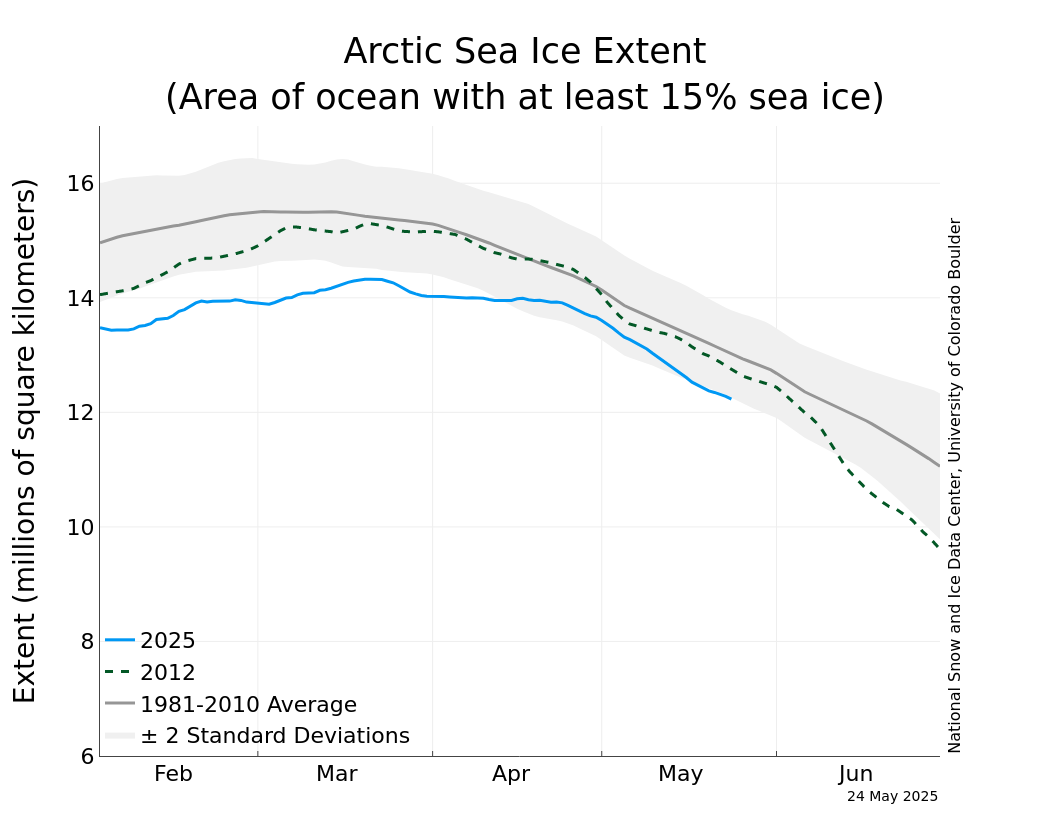
Gray line indicates 1979 to 2000 average extent I'd say that's a swift kick in the...ice. [ -Edit: fixed dates per guidance from michael sweet below; thanks michael! ] The Yooper -
Alexandre at 04:39 AM on 3 March 2011Climate Sensitivity: The Skeptic Endgame
Daniel #37 That crossed my mind too. BTW, making absurd claims to hijack everyone's attention and divert the subject of the discussion is what defines a troll, isn't it?Moderator Response: [DB] Everyone deserves the benefit of doubt. Until proven otherwise, Gilles should be considered a guest and seeker after knowledge here. :) -
Gilles at 04:39 AM on 3 March 2011Climate Sensitivity: The Skeptic Endgame
Daniel , thank you for noticing my contributions to RC - this is not a coincidence. Now you're free to answer my remarks, of course. Dana : you're confusing "scattering factor" with 95% confidence range. We are 95% confident that climate sensitivity lies above about 1.2°C. As KR #35 noted, almost all of the uncertainty you refer to is on the high end. So all you're arguing is that we can't rule out a scenario where the results of business-as-usual could be really, really bad. However, as I also previously discussed, Annan and Hargreaves put the sensitivity upper bound at 4.5°C with 95% confidence. If you believe their results, climate sensitivity is quite well-constrained." As I said, this kind of reasoning, applied to other problems, would conclude with a very high confidence level that solar cycles don't exist and supernovae don't explode. " Giles #32 - as Albatross noted (#34), unless you want to argue that we have far less coal reserves than we currently believe, the "we will run out of fossil fuels" argument is totally unrealistic. And Alexandre noted in #33, if that is the case, we'd darn well better start transitioning off of fossil fuels ASAP." So, if coal resources are reliable, so are oil resources, and you're also claiming that it is very unlikely that oil production would peak before all SRES scenarios predictions ? I think that's an interesting point that will be tested in the near future. How much are you ready to bet that oil production will exceed 100 Mbl/d , as all SRES scenarios predicted? I'm interested. But of course, I agree that we should try replacing fossil fuels ASAP - I'm just not really sure it is feasible. " I've addressed your point B previously by showing that the benefits of reducing carbon emissions outweigh the costs several times over. Technically I suppose you're right that it's an argument "skeptics" could make. Perhaps I should have specified "plausible" arguments." The real cost is not the cost of replacing fossil fuels by something else. It is in preventing the use of the spare fossil fuels for somebody else -especially the poorest people who need them the most. How far can you justify that fossil fuels should never be extracted even if poor people are starving juste on the above ground? that's not a virtual question, the development of China has pulled hundreds of million of people out of absolute poverty - but to my knowledge it has been achieved only through the use of fossil fuels.Moderator Response: [Daniel Bailey] Time to establish some ground rules, then. Let me first start by saying Welcome to Skeptical Science! There is an immense amount of reference material discussed here and it can be a bit difficult at first to find an answer to your questions. That's why we recommend that Newcomers, Start Here and then learn The Big Picture. I also recommend watching this video on why CO2 is the biggest climate control knob in Earth's history. Further general questions can usually be be answered by first using the Search function in the upper left of every Skeptical Science page to see if there is already a post on it. Or you can search by Taxonomy. If you still have questions, use the Search function located in the upper left of every page here at Skeptical Science and post your question on the most pertinent thread. Remember to frame your question in compliance with the Comments Policy and lastly, to use the Preview function below the comment box to ensure that any html tags you're using work properly. Keep the framing of your comments narrow and specific to the thread you post them on. Gish Gallops are frowned upon. Thanks! -
Charlie A at 04:38 AM on 3 March 2011Crux of a Core, Part 1 - addressing J Storrs Hall
 The above is from WUWT.
Note the "Central Greenland: caption in the upper right.
Compare with the Skeptical Science version, below:
The above is from WUWT.
Note the "Central Greenland: caption in the upper right.
Compare with the Skeptical Science version, below:
 Fig. 1: GISP2 as presented on Watts Up With That, conflating a local record with a global record.
Notice the removal of the "Central Greenland" caption.
==================
Let's move on into the article a couple of paragraphs:
Rob Honeycutt claims "Hall presents GISP2 as if it were a global record and makes no attempts to clarify that it is not nor does he even hint that he has any inclination that this is the case."
A simple scan of the article Honeycutt links to,Hockey Stick Observed In NOAA Ice Core Data shows the error of Mr. Honeycutt's statement.
The data is introduced as "It gives us about as close as we can come to a direct, experimental measurement of temperature at that one spot for the past 50,000 years."
Fig. 1: GISP2 as presented on Watts Up With That, conflating a local record with a global record.
Notice the removal of the "Central Greenland" caption.
==================
Let's move on into the article a couple of paragraphs:
Rob Honeycutt claims "Hall presents GISP2 as if it were a global record and makes no attempts to clarify that it is not nor does he even hint that he has any inclination that this is the case."
A simple scan of the article Honeycutt links to,Hockey Stick Observed In NOAA Ice Core Data shows the error of Mr. Honeycutt's statement.
The data is introduced as "It gives us about as close as we can come to a direct, experimental measurement of temperature at that one spot for the past 50,000 years."
Prev 1892 1893 1894 1895 1896 1897 1898 1899 1900 1901 1902 1903 1904 1905 1906 1907 Next






