



 Arguments







Recent Comments
Prev 1 2 3 4 5 6 7 8 9 10 11 12 13 14 15 16 Next
Comments 51 to 100:
-
Bob Loblaw at 06:05 AM on 22 July 2026Dangerous and historic wildfire smoke pollution event engulfs the U.S. and Canada
Alas, the "you need to manage your forests" deflection point was used in the US a few years ago, when California was suffering from severe fires. The usual suspects were in "climate change can't be a factor"" mode, and looking for any possible alternative explanation - ABC (Anything But Carbon dioxide). It's the standard playbook on climate change contrarianism - look for any other factor, and try to deflect attention towards that squirrel.
Trump has threatened (and now announced) tariffs as a result of the smoke.
The Canadian boreal forest covers an area of some 550 million hectares. We have about 41 million people. That averages out to about 13 hectares each. We'd have to get each person cleaning 13 hectares to cover the forest - and much of it is not accessible by roads. I can just imagine the bulk email:
In order to manage Canada's boreal forest, you have been assigned 13 hectares you need to clean up. It is located 800km from the end of the road in northern Ontario.
Please make sure you get it cleaned up by Thursday next week.
The boreal forest is dependent on fire for much of its ecology. Forest management does play a role in fire frequency and intensity, but claiming forest fires will stop with proper management is loony.
-
Bob Loblaw at 05:49 AM on 22 July 2026From the eMail Bag: the Beer-Lambert Law and CO2 Concentrations
a female Faust @ 34:
Three problems with your idea of using CO2 in water:
- You need to use a source of radiation that is at a wavelength where CO2 absorbs. That means a non-visible source of radiation (somewhere in the IR band). You will not be able to see the radiation with the human eye - you'd need an appropriate detector.
- Liquid water absorbs IR radiation pretty much completely. Adding CO2 will not absorb more, as all relevant IR radiation is already absorbed.
- As a near-perfect absorber of IR radiation, liquid water also is a near-perfect emitter of IR radiation. Any IR radiation detected coming from the liquid water will be IR radiation that was emitted by the water, not passing through it.
-
a female Faust at 02:19 AM on 22 July 2026From the eMail Bag: the Beer-Lambert Law and CO2 Concentrations
re your experiment: i am curious what you think would result from using CO2 itself, rather than dye, to adulterate the water (and if you think that information interesting, relevant, or useful). curious enough that i had to sign up to submit this comment...curious enough, in fact, that, especially should that curiosity be shared, i may just have to replicate the experiment with that alteration, that is, using water that is carbonated instead of coloured.
-
prove we are smart at 18:39 PM on 21 July 2026Dangerous and historic wildfire smoke pollution event engulfs the U.S. and Canada
Here is another example of the environment affecting the people in a very damaging way. Along with increasing horrific algae blooms, fresh water declines, weather patten anomalies, ad nauseam.
Many people understand the existential threat the co2 increase in the atmosphere is creating day by day, yet till it affects them meanfully, personally and constantly, this is what most people in the world really worry about, www.gallup.com/analytics/701519/worlds-most-important-problem-report.aspx?utm_source
We can come together every 4 yrs for sport or to save our ozone layer yet I'm told constantly not to scare people with the truth of an increasingly malevolent weather from our modern industrial practises and lifestyles.
-
Bob Loblaw at 05:31 AM on 19 July 2026Eastern U.S. broils after heat wave kills over 1,300 in Europe
Michael @ 10:
Thanks for the positive feedback and kind words. I (nearly) always write discussions like this assuming that there are at least a few lurkers that will read my comments and learn from them - something more than just the one person I'm discussing with directly.
I agree with you about the need for people posting comments to provide some analysis, rather than just posting a link to "data". There is almost no such thing as "raw data" - any measurement has some level of implicit or explicit processing involved. From the recent discussion, I'll take the example of "wind direction". What does "average wind direction" really mean?
- You can't just take a collection of wind direction readings and do a simple average. One minute of wind from 5° averaged with one minute of wind direction from 355° does not a south wind (180°) make.
- The usual process is to treat wind as a vector (speed plus direction) and sum the vectors to get the resultant vector. This gives more weight to the readings with greater wind speeds (among other factors).
- ...but the magnitude of the resultant vector will be less than the mean speed, if there is any variation in direction. Twelve hours of north winds at 40km/hr combined with 12 hours of south winds at 40km/hr does not a calm day make.
When Eric posted his strong claim ("never") about temperatures and exhaust heat from the terminals, my spidey sense immediately began to think we'd be dealing with another version of Anthony Watt's claims about station siting affecting temperature readings and rendering them useless.
- My background (people can read a bit about it on the SkS Team page) includes much work in microclimatology, so the immediate question to me was "where exactly is the weather station located?"
- ...but documentation on airport weather stations often provides the Airport Reference Point (as mentioned in comment 4), not the actual instrument location.
- ...and I knew to look for this because I have a background in instrumentation and standards for automated weather stations. Aviation stations are linked to aircraft needs (such as altimeter settings) and have their own standards.
- So Google Earth to the rescue - and because I knew what to look for, I could fairly easily find the actual weather station on the imagery.
For the record, here is the snippet from Google Earth that shows the automated weather station at Reagan airport:
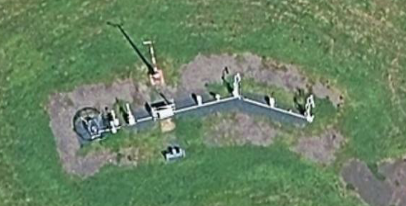
I immediately recognized the shadow of the anemometer (wind speed and direction, top middle) mast, and the wind shielding around the precipitation gauge (circular pattern on the left). [Again, my experience includes a lot of time working around automated weather stations, so I know what they look like.]
Later confirmation that I had found the correct location came when Eric posted information about BWI and Dulles airport weather stations. For the record, here are GE images for Dulles and BWI:
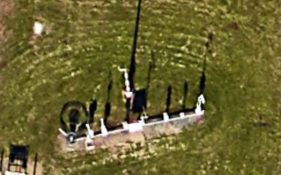
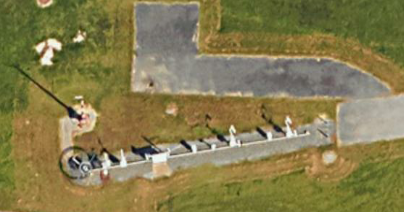
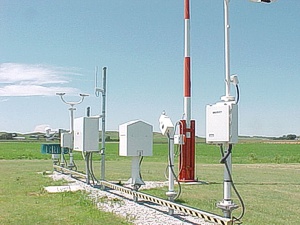
Note the close similarity in the views. Not exactly the same, but clearly following a similar standard layout. FYI, I was able to find a NOAA image of their standard ASOS (airport weather) system. Looks familiar...
As for working through and combining various sources of data related to the problem at hand (AC exhaust), my background also includes a period of time participating in the Canadian met service's data quality working group. I finished my time with the met service (in part) supervising the staff responsible for data QA/QC.Although automated systems do some checks (detecting spikes, step changes, unrealistic instrument readings, etc), most of these require an examination by human eyeballs. Figuring out "is that reasonable?" requires a blend of detective skills plus an understanding of micro- and meso-scale weather and climate. A sudden drop in temperature makes sense when you see a similar drop a few hours earlier or later in other nearby stations, and the shifting wind patterns and pressure changes tell you a cold front is moving through.
To Eric's credit, although he started with a strong assertion about exhaust plumes, he clearly listened to what I was saying and showed a willingness to change his mind. In the end, he agreed that AC exhaust plume hypothesis was not plausible. That shows a tendency towards genuine skepticism, not the dogged "you can't change my mind" that is often seen in climate discussions.
As you state, Michael, there is a level of skill involved. There is also a level of experience and training - "knowledge" as you describe it. Two old quotes come to mind:
From Alexander Pope, An essay on Criticism:
A little learning is a dangerous thing;
drink deep, or taste not the Pierian spring:
there shallow draughts intoxicate the brain,
and drinking largely sobers us again.And from the Canadian Aviation Safety Letter (from back in my pilot days):
Learn from the mistakes of others. You won't live long enough to make them all yourself.
-
michael sweet at 01:05 AM on 17 July 2026Eastern U.S. broils after heat wave kills over 1,300 in Europe
Bob Loblaw,
I found it very interesting to see how someone skilled in the art (you) can look at the details of where a weather station is located and what direction the wind blew from to show that claims of AC venting were incorrect. It is always enlightening to see what scientists can determine from all the data that is available.
This is another example of why citing raw data doesn't make sense. Analysis by scientists skilled in the art has so much more knowledge embedded in it.
-
Evan at 08:20 AM on 16 July 2026Fact brief - Do electric vehicles stop working in extreme heat?
Thanks Baerbel for the adjustment.
Like Doug, we've been successfully driving an EV for about 10 years, in both heat and cold. My favorite quip was during a very cold Minnesota winter day something commenting, "I didn't know EVs worked in the cold." I commented back that they start much more reliably than ICE cars in Minnesota, and they also heat up a lot faster!
-
ozthrox at 06:57 AM on 16 July 2026Home batteries could become the next must-have household appliance
There is already a massive battery uptake in Australia, with the resultant improvement to grid reliability and a marginal lowering of energy prices as peaks and troughs are flattened.
-
BaerbelW at 04:27 AM on 16 July 2026Fact brief - Do electric vehicles stop working in extreme heat?
Evan @1
Thanks for the pointer regarding the double negative, Evan! After checking with Sue Bin I updated the title to eliminate it while sticking with a question giving "No" as the answer. We'll also try to turn this into a rule of "avoid double negatives" for future fact briefs we create.
-
Doug Bostrom at 07:09 AM on 15 July 2026Fact brief - Do electric vehicles stop working in extreme heat?
After about 10 years of experience w/an EV as primary automobile my observation is that cabin temperature control imposes a fairly modest effect on operations, using 5-10% of available battery in warmish conditions of say ~32C. Usually the hit isn't even visible on the realtime kW power instrumentation and only shows up in cumulative kWh stats after some hours of use.
On one occasion during prolonged parking with the vehicle "on" and in 41C ambient outside temp the kW hit shown via instrumentation became quite visible as work was done to keep the propulsion battery healthy (Bolt separately reports comfort cooling vs battery cooling energy usage). -
Evan at 02:33 AM on 15 July 2026Fact brief - Do electric vehicles stop working in extreme heat?
Usseful fact brief, but if we are trying to help people clearly understand fact briefs, maybe it's preferable to avoid using double negatives. Instead of writing
"Are electric vehicles unable to function in extreme heat?, No"
write instead
"Are electric vehicles able to function in extreme heat?, Yes"
Nothing wrong with the article, but might be a bit clearer by avoiding double negatives.
-
nigelj at 07:54 AM on 13 July 2026Six charts show how clean power was world’s largest source of new energy in 2025
David-acct @3
Michael Sweet: In 2021 the Texas debacle was caused by the failure of gas and nuclear units.
David acct: The loss of electric generation from Gas and Nuclear plants was about 40% loss starting on 2/15/2021 and lasting until early 2/19/2021 (approximately 80 hours) where as the loss of electric generation from wind, solar was approximately 75% starting on 2/9/2021 and lasting until mid to late 2/19/2021 ( approximately 10 days).
Nigel: Davids reply implies the main cause of the power failure was renewables. But this is incorrect. According to official investigative reports the main cause was failure of the gas supply system due to freezing up of supply lines and equipment due in turn to bad design by the grid authority. This took a lot of generation off line just when it was needed.
The numbers David quotes for wind power output losses exceeding thermal and nuclear output is partly due to wind turbine equipment freezing up like with the gas system. But it also appears to include planned reductions in wind power due to the lack of wind. The system as a whole is designed to cope with this - provided the gas backup is working. So the real culprit was the failure with the gas supply. Nuclear power also had failures due to the freezing conditions.
Moderator Response:[BL] Link activated
-
Bob Loblaw at 05:17 AM on 13 July 2026Eastern U.S. broils after heat wave kills over 1,300 in Europe
Eric:
Another factor for short-term variations in local temperature is sunshine. The data source you linked to for DCA in your earlier comment does not include radiation measurements (it's not critical for aviation weather), but it does include cloud cover information. (I don't know if this is from human observers or an automatic system.) Most of the day on July 4 had clear skies. Cloud cover began to increase late afternoon, and some clouds remain after the brief rain/thunder spell around 6:30pm.
As for comparing temperatures regionally - still somewhat of a mug's game when it comes to absolute values. There is a reason why global temperature changes are evaluated using anomalies, not absolute values. There is an excellent 4-part series on this question starting here.
Regional precipitation patterns are even harder, as so many precipitation events (especially summer thunderstorms) are so localized. It's easy for significant events to slip between observing stations (or park over one and make it look like the whole region is getting dumped on). In Canada, a Canadian Precipitation Analysis product (CaPA) combines surface measurements, radar, and forecasting model results to provide precipitation maps and such. Documentation here, page with links to current maps here. I do not know if the US produces anything similar for public consumption.
As for the "exhaust plume" issue (to exhaust that discussion), there is much literature on the subject, from the perspective of pollution sources and how they spread locally or regionally. A basic model is the "Gaussian Plume". This link seems to give a decent overview. From a point source, the turbulent wind dynamics will spread a pollutant (or any property, such as temperature) both vertically and horizontally. As the spread increases, the concentration decreases. The further downwind, the harder it is to detect a weak source.
If the plume is hot (as you would expect for a source of heat, as you originally supposed) the plume will also tend to rise through the cooler air. At greater heights, turbulent mixing is increased as the mixing eddies increase in size.
What is seen at a point sink (e.g. a weather station) is the opposite: the further upwind you look, the wider the area the weather station sees. It will be getting air from a long line of (possibly differing) point sources.
Pollution spread science also looks at linear sources (think "highway vehicle exhaust in an urban area") and area sources (think "city surrounded by rural areas").
It is for these reasons that I rapidly discounted your AC heat plume hypothesis - before looking at data and hypothesizing alternate explanations for the temperature pattern you identified.
-
michael sweet at 03:31 AM on 13 July 2026Six charts show how clean power was world’s largest source of new energy in 2025
Frans,
Hundreds of papers like Jacobson et al 2022 (sorry no link, my computer is down) show that all Europe, and the entire World, can produce All Energy using renewable sources. Low wind periods can be accommodated with a combination of solar, hydro, storage and other technologies linked with a large grid. The amount of storage needed is measured in hours, not days. You have been misled by fossil fuel supporters.
In several of the graphs in the OP they show total energy, not capacity. As discussed in the OP, showing total energy severely handicaps renewables since thermal resources waste two thirds of their energy as waste heat while renewable electricity is much more efficient. None of the graphs show capacity, only generated energy is graphed.
Comparing the first graph of total energy supply it appears that nuclear supplies more energy than renewables. The next to last graph of electricity (graphing terrawatt hours) shows renewables produce much more usable electricity than nuclear. The additional energy in the first graph is released into the environment as waste heat.
Many people, including me, think it important to prevent killing a river by raising it's temperature. This is a serious concern. Thermal pollution kills environments.
-
michael sweet at 02:59 AM on 13 July 2026Six charts show how clean power was world’s largest source of new energy in 2025
David-acct,
We have previously discussed your citing raw data that doesn't support your claims instead of actual analysis of that data. You have refused to answer my questions about how the raw data from France proved that nuclear reactors were shut down on weekends when you falsely claimed reactors were not shut down.
It is not my job to analyse your data. You must provide the analysis.
Over 90% of the power lost in Texas was from thermal resources. You are simply parroting the fossil fuel industry's lies. If the Texas grid was linked to the rest of the country it would not have failed.
Anecdotes about periods of low wind do not show that peer reviewed papers (cited hundreds of times) are incorrect. If you want to claim Jacobson's paper was incorrect you must cite analysis of data. Since all his code was published it would be easy for fossil companies to replicate his work using the conditions you refer to. Since they have not shown Jacobson was incorrect it is most likely that they tried and found his system worked during the time periods you mention. I note hundreds of other papers, using different models, show a completely renewable system can supply All Energy to the world.
Find some analysis that supports your wild claims. Links to raw data with unsupported claims the data shows something is simply promoting lies.
Moderator: David-acct has previously linked raw data claiming it supports his claims when I have proven the data contradicts his claims. He refuses to answer my questions about his false claims. He should answer my questions or withdraw his false claims before he starts the same BS on another topic. He needs to cite analysis instead of making false claims about huge data sets. He is wasting our time.
I am sorry I didn't link our previous discussion on the nuclear thread, my computer is down.
Moderator Response:[BL] Indeed. David-acct has been warned before about providing links without giving much (or any) context or analysis.
Most recently, he was warned about this on this comment and this comment. Just because this was over a year ago does not mean he gets to start his bad habit all over again.
-
Eric (skeptic) at 12:36 PM on 11 July 2026Eastern U.S. broils after heat wave kills over 1,300 in Europe
Bob, my reason for bringing up only IAD and BWI along with DCA is I look at them daily for precipitation as part of early morning commentary at a local weather site. While the June 12th 100 degree event happened I had the CWOP and other station site up looking for other 100 degree readings. I came up with the plume explanation on that day based on wind switching to the west and nearby comparisons.
I saw the Andrews max at 103 for the first time before the post with that link. I was otherwise occupied on the 4th, and not able to look at the local stations. A general explanation for July 4th is synoptic scale warming from thunderstorms blowing themselves out to the west, heating both DCA and a number of MD stations with hotter and a bit drier air.
A more specific explanation for DCA is that the 9mph west wind at 5:40 droppd the dew point from 20C to 18C due to a drier air source and the potential of drier air mixing down. You noted those possibilities and the complexity and I agree. An AC exhaust plume is not a good explanation for that.
-
Philippe Chantreau at 11:44 AM on 11 July 2026Six charts show how clean power was world’s largest source of new energy in 2025
I'm not one to condemn nuclear systematically, but also not one to give a pass to ERCOT. In the Texas outage of 2021, one could legitimately make the argument that the (much) larger share of gas/combined-cycle suddenly reduced, and the expectation that it is supposed to be baseload, i.e. not subject to weather, were factors.
Taking a swipe at wind power like their politicians did was grandstanding nonsense. However, I noticed from the link provided by David acct that even coal dipped when the thing went down, so there is certainly an issue with the larger picture, including grid and exchanges with neighboring states. The integration of the European grid is a strength and France still has one of the lowest CO2/kw of electricity in Europe. However, they are facing problems, as the current very longand intense heat wave shows.
-
David-acct at 07:58 AM on 11 July 2026Six charts show how clean power was world’s largest source of new energy in 2025
Fran you make a good point on the German term Dunkelflaute. I happen to be big on a full and comprehensive understanding of the topic, due diligence and use of source data as much as possible. The EIA gov website provides considerable data, especially the real time grid monitor. Using Jacobsen's supplement tables (S7 through S14) , including installed capacity, then using actual demand and actual capacity factors obtained the EIA grid monitor, along with the backup battery power, it evident that the success of the "every 30 second " stress test for the 7/24/365 renewables may not be nearly as robust as advertised. It remains a legitimate concern.
-
Frans at 07:27 AM on 11 July 2026Six charts show how clean power was world’s largest source of new energy in 2025
Michael Sweet: My point was not to dismiss wind and solar at all and discount issues that other nergy sources may have. My point was to account for capacity factors when energy source is displayed in graphs in TWh or other appropriate units. All energy sources have their particular challenges. Hence the need for complementary/back-up sources for sufficient expected durations and the need to acknowledge these challenges.
Yes, we have had nuclear plants shut-down in France during high temperatures. One may ask whether this was due to a particular set of regulations on water discharge temperature that a more flexible system management may temporarily overrule.
Everyone is familiar with the German term Dunkelflaute, so multiple days of back-up are required for wind plus solar to avoid the repercussions. Spain was lucky that the blackout did not last longer than it did because Spain got help from the Nuclear plants in France and European integration of electricity transmission (and Spain may wish to reconsider whether they really wish to shutdown their very reliable Almaraz nuclear plant).
The whole point is that during the transition to clean energy sources (I prefer "clean" over "renewable" to avoid arguments about what is included in renewable) an "all of the above" approach is needed, including not just sources of energy but also improved grid management.
-
David-acct at 04:50 AM on 11 July 2026Six charts show how clean power was world’s largest source of new energy in 2025
Michael Sweet - " In 2021 the Texas debacle was caused by the failure of gas and nuclear units."
The loss of electric generation from Gas and Nuclear plants was about 40% loss starting on 2/15/2021 and lasting until early 2/19/2021 (approximately 80 hours) where as the loss of electric generation from wind, solar was approximately 75% starting on 2/9/2021 and lasting until mid to late 2/19/2021 ( approximately 10 days).
Percentage wise, the loss of electric generation from renewables was much greater than the loss from fossil fuels. Further the loss of electric generation from wind was across the north american continent for most of those 10 days. I have attached the link to the source data at EIA for your review
Thanks
Moderator Response:[BL] As Michael Sweet points out (correctly), it is not up to others to follow your link, do analysis of the data found there, and hope to discover what it is you expect them to see.
As for your argument that "percentage wise..." (supposedly supported by data at the link you fail to provide any analysis for), you are employing a fallacious argument often used by by people trying to mislead readers on the science of climate change: ignoring the denominator. I suggest that you read this blog post:
With regard to posting link-only comments with no analysis, consider this your final warning. Before you post again, please read the recently-updated Comments Policy. The rational for the recent changes was explained in this blog post. In particular, you need to read, understand, and follow the part about backing up your argument.
Please note that posting comments here at SkS is a privilege, not a right. This privilege can and will be rescinded if the posting individual continues to treat adherence to the Comments Policy as optional, rather than the mandatory condition of participating in this online forum.
-
Bob Loblaw at 02:13 AM on 11 July 2026Eastern U.S. broils after heat wave kills over 1,300 in Europe
Also Eric @ 5:
In your first comment, you mentioned "nearby stations", but ended up bringing in Dulles and Baltimore-Washington, neither of which I would consider "nearby" (being 40-50km away). Now you mention Andrews AFB, which is closer but still 15km away. Each of these also has quite different meso-scale surroundings compared to Reagan airport.
Trying to make comparisons of the sort you are doing for stations that far apart and subject to different local and meso-scale environments is much more complex than you seem to be making it.
-
Bob Loblaw at 02:04 AM on 11 July 2026Eastern U.S. broils after heat wave kills over 1,300 in Europe
Eric:
This is a subject where precision is important, so please try to be very specific in timing of events, etc. In this case, there is a noticeable difference between 5:40pm and 6pm.
...but first, are you backing off your claim of AC exhaust plumes? Or are you still considering it as a viable explanation?
Returning to the Reagan July 4 data, the 5:40pm time you call to attention is the one 5-minute period where winds are recorded from the west. There are several factors to consider when interpreting that value:
- The wind speeds 10 minutes on either side of that time vary from 5 to 9 mph, or 130-230 metres/minute. The nearest terminal building to the weather station is about 700 metres away, so it would take wind 3-5 minutes to reach the weather station from the terminal.
- From the documentation I can find for the ASOS weather measurement systems, it is not clear whether the 5-minute wind direction is a true 5-minute average, or for a shorter period reported at the end of the 5-minute period. (Some documentation references 2-minute averages.)
- Never-the-less, even if it was a full 5 minutes of west winds, that is barely enough time for a terminal exhaust plume to reach the weather station on a direct path.
- If we look at wind directions starting at 5:20pm and continuing to 6:10pm, we see S, S, SSW, WSW, W, SW, SSW, S, S.
- It is clear that winds are fairly light and somewhat variable in direction.
- The 102F peak temperature at 5:40pm actually continues from 5:35pm to 5:55pm. Most of this period did not have west winds.
- There are also two 102F readings at 5:05pm and 5:15pm, when winds are generally from the south.
- I would contend that one 5-minute period of west winds is a highly implausible explanation for a 20-minute period of slightly higher temperatures.
A couple of relevant points on the temperature data. The 5-minute readings are (from what I can find) actual 5-minute averages. The reported maximum temperatures are based on 1-minute averages, though, so the maximum can exceed the highest 5-minute average. Also, there is a sequence of conversions between Celcius and Fahrenheit as data are collected, processed, and displayed. So rounding can occur.
Before looking at dew point data, I'll cover a bit of basic micrometeorology. In comment 2, I mentioned that temperature measurements at 2m height are responding to what the surface is doing over a distance of 200m upwind. This is important in considering the effects of the surface a short distance upwind.
- At the edge of a surface change (paved runway to grass field) the surface temperature (and humidity) on the ground surface will change rapidly, but it takes time for that change to affect the air moving across that boundary.
- A rough rule of thumb says that there is a 1:100 ratio of distance away from the change and height above the surface that has fully responded to that change.
- So, 200m away the air temperature at 2m will no longer be affected by that very small scale step change at the runway edge. If we go 300m away, we won't see more change (at 2m).
The measured air temperature will still be dependent on larger-scale regional effects, though. The rates of adding heat and water vapour to the air from the local surface will have stabilized 200m downwind of the surface change, but ultimately the observed temperature and humidity at 2m will also depend on the ability of the atmosphere to move that heat and humidity up and away into the synoptic-scale air motions above that location.
So, to get back to the Reagan July 4 data, my interpretation is as follows:
- From noon through to 6pm, we see wind directions that shift from north to east, to south, to south-west. (By 8pm they are reaching north-west, but that is after the period of interest.)
- Reagan airport is bounded by the Potomac River to the east, south-east, and south.
- Distances from the weather station to the river range from 300-900m as you shift through those directions
- During periods of E and SE winds, I would expect the weather station to be under the influence of cooler, more moist winds.
- In the early post-noon period, we're probably looking at the normal diurnal variation (increases) in temperature and humidity.
- As the winds shift to the S and SW in the later afternoon, there is a longer path over land as air moves from the river to the weather station.
- Thus, the air overlying the weather station (above the 2m measurement height) will become warmer and drier.
- As a result, we see increases in the 2m temperature reading (instead of late afternoon cooling), and decreases in the dewpoint.
To me, I see nothing in this data that suggests any effects that can be attributed to AC exhaust plumes or any other artifacts that are not part of a normal environmental response in a moderately complex area (combination of grass fields, water bodies, and built-up areas).
-
Eric (skeptic) at 12:21 PM on 10 July 2026Eastern U.S. broils after heat wave kills over 1,300 in Europe
Thank you Bob for looking more closely at the data. The reading I remembered (incorrectly) as 6pm was actually at 5:40 Jul 4, 5:40 pm 102 65 30 106 W 9 The 9 or more mph west is the likely time when the 103 occurred although that five minute interval (and prior and subsequent) had 102 . The one minute data from Iowa Mesonet would likely reveal more but I'm having trouble accessing that.
The 103 likely coincided with the drop back to dew point of 65 where it had been earlier. In general lower dewpoints allow hotter temperatures. There is certainly a valid synoptic explanation for that: mixing, drier air, temporary heating. Such events can happen in small or large scales any time of day. Thus it need not be a plume to cause a 1F bump (the minimum possible delta).
While 103 was an outlier for northern Virginia: mesonet.agron.iastate.edu/sites/hist.phtml?station=DCA&network=VA_ASOS&mode=daily&year=2026&month=07&day=04 it was however not an outlier for MD. Andrews AFB to the SE was also 103 that day: mesonet.agron.iastate.edu/sites/hist.phtml?station=ADW&network=MD_ASOS
-
michael sweet at 08:21 AM on 10 July 2026Six charts show how clean power was world’s largest source of new energy in 2025
Frans,
No sources of energy are "always on". Currently five nuclear reactors in France have shut down due to high temperatures (when the electricity is needed most). Not to mention all the units out of service for maintenance. In 2021 the Texas debacle was caused by the failure of gas and nuclear units. The Spainish blackout was caused by the failure of thermal units, including nuclear plants, to provide grid stabilization they were paid to provide.
Batteries in combination with renewables can provide all power 24/7/365. It just takes time to build out a new system.
All generators need backup to provide all power. What do you think peaker plants are for? Baseload plants fail to provide all power every day. Did you account for the cost of peaker plants in your looking at thermal units? Really "apples to apples"??
The case for renewables was very strong 5 years ago. With the plummeting costs now even Trump cannot stop renewables replacing fossil fuels.
-
Bob Loblaw at 05:07 AM on 10 July 2026Eastern U.S. broils after heat wave kills over 1,300 in Europe
Eric @ 3:
Thanks for providing additional details. A good many points to consider.
First, the data source you link to is useful in providing coordinates for the actual weather stations. Often, sources referencing airport weather stations will provide the coordinates of the Airport Reference Point (ARP), which rarely matches the actual weather measurement coordinates. That web page does make it easy to find the weather instrumentation at BWI (Baltimore/Washington) and IAD (Dulles). Unfortunately, the coordinates it provides for DCA (Reagan/Washington National) appear to be about 150m north of the actual weather station, based on Google Earth's mapping.
I agree that the instrument location at BWI is pretty poor - near the button of runway 10, between the runway and the apron to the south. Dulles is definitely better, being at least 500m away from most large pavement surfaces.
...but I disagree strongly with your interpretation of the Reagan data for July 4 around 6pm. (As of today, the 7-day data from the page you link to only goes back to July 2.)
Here is my graph of the July 4 temperature data - both air temperature and dew point (humidity).

Temperatures were pretty stable at 100F from noon onward, and then there is a slight rise to 102F before 6pm, a drop to 97F immediately after 6pm, and then a temporary rise to 99F before dropping to 94F (and lower) after 6:30pm.
Note that dew point also fluctuates during this period. Having varied between 68F and 72F in the latter part of the afternoon, it shows a drop to 65F at 5:40pm, then rises to 74F by 6:10pm, then drops more or less steadily to the low 60s in the evening.
There is more variation in atmospheric moisture around your 6pm time range than there is in atmospheric heat.
Let's look at wind direction. Your source lists wind direction in 22.5 degree increments (S, SSW, SW, WSW, W, etc.) I have transformed that into standard degree coordinates in this graph. (The wild variations in values between 0 and 337.5, early in the day, are just small variations around north).

You claim that the temperature spike around 6pm is due to west winds bring exhaust air from the airport facilities. But the timing of the wind shift does not match this. There is one 5-minute value of west winds at 5:40pm, but from 5:45pm to 7:30pm, the winds are almost entirely from the S and SW. There is an increase in wind speed around 6pm, but the stronger winds do not happen until 6:30-ish and later, when a thunderstorm moves through.
Using the correct location of the DCA weather station, the land surface to the SW is predominantly grass, runways, and (to the WSW) aprons (pavement) a few buildings, and parking areas. Anything that looks like "newly expanded terminals" on Google Earth is to the west (or north of west) of the weather station. It is not upwind for S or SW winds.
And frankly, the amount of energy coming off the AC units you speak of is going to be dwarfed by energy coming of large areas of pavement. Any hot plume from AC is going to be mixed in with the normal air flow - spreading both vertically and horizontally in the turbulent air.
So, your "hot AC plume" is not from the correct direction, it does not explain the variations in humidity (dew point), and it is physically unlikely. What I see is normal variations in temperature, humidity, and wind speed/direction on a hot summer day as some thunderstorms move in.
I think you are over-interpreting the data, trying to seek justification for a viewpoint that the data do not support.
Moderator Response:[BL] When making later comments, I realized that the second graph in this comment suffered an incomplete copy-paste-revise process. The vertical axis units are wind direction in degrees, not temperature.
-
Frans at 03:31 AM on 10 July 2026Six charts show how clean power was world’s largest source of new energy in 2025
This is of course good new on wind and solar. To compare apples with apples, my question is whether the wind and solar energy contribution is "always on" contribution or whether the energy contribution needs to be discounted to account for variability of solar and wind over 24 hr periods or longer periods).
-
Eric (skeptic) at 20:15 PM on 9 July 2026Eastern U.S. broils after heat wave kills over 1,300 in Europe
Bob the comparison stations can be found here www.weather.gov/wrh/hazards?obs=true&wfo=lwx&hazard=true&hazard_type=all&hazard_opacity=80&tab=legend but some are poorly sited CWOP which can run too warm or too cool (e.g. in shade on a front porch). The five minute readings from DCA, IAD and BWI can be found here www.weather.gov/wrh/timeseries?site=KDCA&hours=72 Just replace the KDCA with KIAD and KBWI.
The problem at National (DCA) may be some parked jets but mainly exhaust from the AC units at the newly expanded terminals. The evidence is fairly obvious in the five minute readings when a fresh west wind (e.g. from convective outflow) will spike temperatures 2-3F with a west wind 10 or more mph after lighter winds most of the day. That happened June 12 and July 4th around 6pm after less hot temperatures earlier at "peak heat".
The problem at BWI is package delivery jet parking at the relatively new Amazon terminal S and SW of the sensor there. Please examine Google earth view for both BWI and IAD as you did for DCA. You will see local problems at DCA and BWI but not IAD. At IAD any possible heat production is north of the sensor.
-
Bob Loblaw at 00:43 AM on 9 July 2026Eastern U.S. broils after heat wave kills over 1,300 in Europe
Seriously, Eric? "...stream of exhaust heat"???
What the heck do you mean by "exhaust heat"?
Looking on Google Earth, I can see a weather station at Reagan Airport, located in the large grassy area to the east of the runways. The closest runway is about 250m to the west of the weather station, and the main terminal buildings are about 1km away.
At a standard height of 1.5-2.0m above the ground surface, the temperature at that location will be well-adjusted to the surface conditions approximately 200m upwind. There is no wind direction that crosses anything but grass field for 200m before reaching that weather station. The idea that there are plumes of hot air from "exhaust" washing over the temperature sensor seems highly unlikely, if not imaginative.
That weather station is probably only mildly affected by surfaces further away - be it the runway and terminal buildings to the west, or the body of water to the east. With a mix of built-up areas and water bodies in the few km around it, it is probably pretty representative of all the areas close to the major parts of central Washington and the rivers. You are going to have to be a lot more convincing to claim that the airport weather station is anomalously warm for central Washington.
You claim to have looked at "nearby stations". What ones, exactly, and exact locations, please.
-
Eric (skeptic) at 23:01 PM on 8 July 2026Eastern U.S. broils after heat wave kills over 1,300 in Europe
"As of midday Thursday, the official forecast for Washington’s Reagan National Airport was for highs of 102°F, 104°F, and 103°"
Highs were 102 102 and 103. But those were all about 2F too high when looking at nearby stations. I saw the same effect when DC hit 100 on June 12th. It was about 2-3F higher than it should have been. Definitely not comparable to past records.
As for the 1930 heat mentioned in the article, that was a dry heat from the NW and won't be matched until there is a similar pattern. But that might be a while. The lows in 1930 were in the 70s whereas the low last week at National airport was 84, a tie for the all time warmest low temperature set IIRC in 2011 and 2012.
Bottom line the very humid conditions we saw last week will never allow 102 or 103 unless there is a stream of exhaust heat from the terminals with a west wind at National airport like there was last week.
-
One Planet Only Forever at 07:11 AM on 6 July 20262026 SkS Weekly Climate Change & Global Warming News Roundup #27
Thank you for continuing to compile and share this record of News Items.
As an Engineer with an MBA I developed an awareness of the importance of limiting how harmful a pursuit of benefit can be, and a related awareness of how competition for power, wealth, and other perceptions of superiority can encourage and excuse harmful unsustainable pursuits of benefit.
The following misleading claim-making presented in Climate Change Mitigation and Adaptation News Item 'But we're just 1% of emissions': do smaller countries' climate efforts matter? is indeed a problem.
“When our share of global emissions is less than 1%,” Rishi Sunak argued when he was the UK prime minister in 2023, “how can it be right that British citizens are now being told to sacrifice even more than others?”
But that type of misleading trouble-making is happening on more issues than the required corrections of harmful developments that Climate Science has exposed and improved the understanding of. And addressing misleading claims requires the issue to be appropriately framed.
The framing needs to along the lines of:
Why should a person try to be less harmful and more helpful than their peers or people perceived to be superior to them?
Shouldn't people aspire to be like those who are perceived to be superior?
I would go further than the re-framing of the issue that is done in the following quote from the article:
Climate scientists point to the much larger historical emissions of these countries – the metric that matters most for global heating – as well as the fact that these countries have more money to cut pollution. Per person, European countries have contributed a disproportionate amount to emissions, and progress in cleaning their economies is only now bringing annual emissions close to the global average.
The following later quote is in the direction of better re-framing, by focusing more on the harms that can be done by members of the wealthier and more powerful portion of a population.
“These leaders wouldn’t like it if the top 1% of their wealthiest citizens didn’t pay their taxes, so the argument is fallacious and simply buck-passing,” said Prof Piers Forster, a climate scientist at the University of Leeds. “Future warming is driven by future emissions, so every tonne of carbon dioxide that a country or citizen can avoid emitting will improve temperature and heatwave outcomes for generations.”
The following quote at the end of the article is an even better re-framing of the issue.
Dr Ella Gilbert, a climate scientist and ECIU board member, said: … “The UK may account for just 1% of current global emissions, but we’re responsible for 100% of our own emissions, and we have the opportunity to show global leadership by bringing them down.”
A logical extension of ‘why do I/we have to be less harmful when the harm done by my/our pursuit of personal benefit or enjoyment is small or others are more harmful and less helpful is: Why should I/we (all people) try to be less harmful and more helpful to Others?
Logically, and ethically and morally, the most harmful and least helpful portion of any population relative to their capacity to be helpful and harmful needs to be required to change the most, even if that change reduces perceptions of their superiority relative to Others.
The highest status needs to be given to the people who are ‘The least harmful and most helpful to Others relative to their ability to be helpful, their wealth and power’. It can be very harmful to ‘simply’ correlate wealth or power to ‘status’.
To maintain a perception of superiority, a wealthier and more powerful person should be required to be less harmful and more helpful than their wealth and power peers, and be significantly less harmful and more helpful to Others than people with less power and wealth.
A key is to frame the discussion to be about the most harmful individuals. Very harmful individuals can be expected to try to hide their harmfulness as part of a larger collective.
Another important framing is to recognize that the very harmful people in a diversity of regional populations can be expected to try to act collectively for ‘their benefit’ to the detriment of all Others, even if the regions they hide in appear to be in conflict.
-
rainyx at 11:11 AM on 30 June 2026Studying hurricanes at sea to save lives on shore
Hello, sorry, I was just talking about the roles drones have played after hurricanes that I know of.
Moderator Response:[BL] The "drones" in the OP are not aerial drones, so the similarity is small. If you follow the link under "Saildrones", you'll find a story that describes them (and the work that they do) in more detail. The description from that linked story:
To safely collect data from the Southern Ocean, a company called Saildrone developed a 23-foot-long, wind driven and solar powered uncrewed surface vehicle (USV) that can be controlled remotely.
-
rainyx at 20:25 PM on 29 June 2026Studying hurricanes at sea to save lives on shore
I prefer to use drones for post-disaster environmental reconstruction, road, housing, and personnel damage statistics.
Moderator Response:[BL] How is this relevant to the original post?
-
Philippe Chantreau at 08:24 AM on 28 June 2026Greenhouse effect has been falsified
I do realize that. I just got curious about the term "quenching", which I had not seen before, so I looked up the only real reference (sort of) that was in post 221 and found all this interesting stuff, that constitutes more bricks in the full understanding of the radiative behavior of the atmosphere, up to mesosphere and thermosphere.
-
MA Rodger at 17:15 PM on 27 June 2026Greenhouse effect has been falsified
Philippe Chantreau @225,
The work you cite concerns the mesosphere/thermosphere which are a long way up and far enough not to significantly impact surface climate. The stratosphere which is close enough to have an effect thro' the tropopause is also still giving up the details of its inner workings. Published just last month Cohen et al (2026) 'Stratospheric cooling and amplification of radiative forcing with rising carbon dioxide' was paywalled until a couple of days ago. (The pre-print version was a bit too dramatic with some of its language.) A cooling stratosphere warms the troposphere below as well as outer space. Cohen et al describe the detail of the interactions between rising CO2 and the H2O and O3 up there.
-
Philippe Chantreau at 09:43 AM on 27 June 2026Greenhouse effect has been falsified
Better referencing is needed on the Siddles, WIlson, and Simpson works that NOGHE4ME mentioned in post 221. I am assuming that would be their 1994 paper. There has been considerable work since then. Looking into this further, one finds Castle et al. (2012) still reporting significant discrepancies between theoretical and experimental values, as well as between lab and field observations. Most of these are resolved in Kutepov et al. 2025, whose expressed purpose was to improve, guess what? GCMs, of course. As we well know the GHE is not in question in GCMs, and neither is it in Siddles, Wilson & Simpson (1994), Castle et al. (2012) or Kutepov et al. (2025). The suggestion that any of these works somehow can be used to invalidate the very concept of atmospheric GH effect is utter nonsense. A cursory look at Kutepov et al. (2025) seems to suggest that there is nothing that new since Iacono & Clough (1995), besides further and further refinement and greater precision.
-
ubrew12 at 14:57 PM on 26 June 2026The Merchants of Doubt are coming for Extreme Event Attribution science
If someone doubts your attribution, ask for his attribution. If he doesn't have one, you have your answer about his qualification to doubt your attribution. This is because we have passed the point where the attribution is nothing at all, and everybody knows it. That is: we see that 'global warming' is real, and we also know what 'global' refers to. So, the remaining argument is over the exact value of the attribution, not whether there even is one. Someone without a peer-reviewed attribution should come up with one before he looks at your estimate and comments on how it should be improved. That's because these are all just estimates. Complaining about an estimate, without having one yourself that you are prepared to defend, is like complaining about a model airplane for falling short of the real thing (as if the word 'model' didn't already do that).
First, Exxon buried the fact that it had ever paid internally for a climate model. Second, Exxon complained that climate models don't work. It gets much harder to complain about estimates if you stupidly made one yourself, thus exposing yourself to the same spotlight you are attempting to blind the Science with. The purpose of doubt is to End with "I'm just asking questions. What do you have against asking questions?" It is, God forbid, not to provide answers. But that lack of answers is how these Doubt merchants can be identified.
-
Bob Loblaw at 10:33 AM on 26 June 2026Greenhouse effect has been falsified
NOGHE4ME:
If you are puzzled by MA Rodger's question about where the 15um IR radiation comes from, you may wish to look at the Intermediate tab of his web page, where you'll find graphs of measured IR radiation - one showing measurements looking down at 20km altitude, and one looking up from the surface.
Note that the graphs are using wave numbers. 15um corresponds to a wave number of 667.
-
Bob Loblaw at 10:16 AM on 26 June 2026Greenhouse effect has been falsified
NOGHE4ME:
In addition to MA Rodger's comment, I'll say the following.
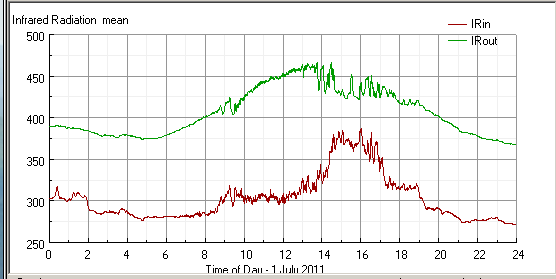
You claim "The claim that the Earth's Surface emitts 340w m**2 has been disproved experitmentally.[sic]" Well, here is some experimental (read "real" or "measured") data that shows the earth's surface emitting considerably more than 340 W/m^2 - varying from about 375W/m^2 at the coolest time of day, increasing to over 450W/m^2 at the hottest part of the day for that location and date.
- Since this measurement shows that the surface is quite capable of emitting 340W/m^2 (and more..), how does your physics explain that measurement?
- If by "surface", you mean upward-directed IR radiation in the atmosphere at some distance above the surface, then please clarify. But in that image, also note that the downward-directed ("IRin") flux from the atmosphere back to the surface ranges from about 275W/m^2 to over 375W/m^2. So the atmosphere is also quite capable of emitting 340W/m^2.
As MA Rodger points out, your argument about CO2 losing energy to surrounding molecules skips over the part where CO2 also gains energy by collision with other molecules. That's why CO2 will be at the same temperature as other molecules: the higher-energy ones pass energy to lower-energy ones, passing energy back and forth, until things average out. You can read the details over at Eli Rabett's blog.
The simple fact is that CO2 will always emit some IR at 15um as long as it is at a temperature above 0K. To argue otherwise ignores more than a century of physics.
Your "version 1.0" is simply wrong. Your version 2.0 is also far too simplistic. There is a version 3.0 out there that you need to learn, that explains the role of CO2 in atmospheric radiation, and how it is involved in the greenhouse effect.
-
MA Rodger at 09:17 AM on 26 June 2026Greenhouse effect has been falsified
NOGHE4ME @221,
So let us indeed be "ignoring #1 for a moment." If CO2 is not re-emiting IR at 15mu, where is all the IR at 15mu measured within the atmosphere coming from?
It is true that the vast majority of such IR when absorbed by CO2 in the atmosphere results in IR-excited-CO2. That excitation is almost always neutralised by collision and the energy transferred to thermal in the atmosphere.
What you overlook is the vast number of CO2 molecules excited by collision. And in the same manner as the IR-excited-CO2, most of that collision-excited-CO2 will in turn be neutralised by collision. But because there are so many collisions and thus so many more collision-excited-CO2 than IR-excited-CO2, the number of them that do not get neutralised by collision but instead relax to emit 15mu IR. Effectively the rate of emission is the same as the rate of IR-excitation of CO2.
And it has to be this way or the laws of thermodynamics won't work.
Concerning your assertion that "These two pieces of evidence are more than sufficient to falsify the hypothesis," can you clarify what "these two pieces of evidence" comprise? Your comment is far from clear in this matter.
-
NOGHE4ME at 05:14 AM on 26 June 2026Greenhouse effect has been falsified
Has the Greenhouse Effect Hypothesis been falsified? I think the answer depends on which version of the Hypothesis you are speaking of. I think we can agree that the Earth's Atmosphere is an isulator that keeps the plant warm and supports life. There are at least two versions. The two versions differ largely on what is the predominent energy transport mode in the "lower" atmosphere. 1) Version 1.0 suggests the 'predominent' energy transport mode in the lower atmospher is conduction and convection (latent heat) and no contribution from IR or CO2. 2) Version 2.0 is IR and C02 predominently driven from the bottom to the top of the atmosphere. Version 1.0 is grounded in basic physics and needs little explanation. Version 2.0 has a least two fatal flaws. #1, The claim that the Earth's Surface emitts 340w m**2 has been disproved experitmentally. I would direct you to Tom Shula's YT video. https://www.youtube.com/watch?v=NS55lXf4LZk. #2) The hypothesis calls for CO2 to asbsorb AND emit IR. Ignoring #1 for a moment, C02 in the atmosphere, while capable of absorbing IR at 15mu, it does NOT re-emit IR as called for. The reason is that the CO2 molecule in the excited state loses it's energy to surrounding non-IR gases (N2 and O2) thru a process called thermalization. The quenching rates for C02 are well documented e.g. Siddles, WIlson, and Simpson. These two pieces of evidence are more than sufficient to falsify the hypothesis.
-
anderl at 03:22 AM on 26 June 2026What Americans can learn from London’s war on cars
When I compare London’s transport policy with that of my home town, I can’t help but feel envious. Brussels essentially consists of 19 boroughs, all of which operate in much the same way as an Outer London borough – that is to say, local politicians respond to public demand (or create it, in order to fuel their populism). The outlying boroughs are extremely poorly served by public transport, whilst in the city centre’s business districts there are so many private car parks that parking management fails to act as a regulatory tool. As in London, this is compounded by the division of society into a progressive wing on the one hand, and a structurally conservative public on the other, which is increasingly tending towards right-wing populism.
-
michael sweet at 07:46 AM on 24 June 2026Plateauing CO2 emissions have slowed atmospheric growth
MA Rodger,
It is interesting to hear the different land uses that compare to the solar needed to power the country. My favorite is still the area of corn grown to make ethanol for gasoline is enough to power the entire US economy. If we put only half of the solar on land unusable for farming and parking lots we would greatly benefit.
Where I live in Florida about 650 sq mi has been strip mined for phosphate. Some of that is converted to lakes but the remainder could generate a lot of energy.
We agree that land for renewable energy can be found. Hopefully the US will work harder on electrification in the future since the Iran war demonstrates that fossil energy is undependable. Over 90% of all electrification in the USA was renewable last year, it is the cheapest energy.
-
MA Rodger at 01:40 AM on 24 June 2026Plateauing CO2 emissions have slowed atmospheric growth
michael sweet @8,
Further to the 'Texas annecdote' @7, the value of 10,000 sq miles as the area of solar PV in Texas to provide all the primary energy used by USA is indeed low. Perhaps 20,000 sq miles would be a better value.A simplistic calculation would run as follows:-
The daily solar irradiance in Texas averages up to 6.6kWh/m^2 = 6.6e3Wh/m^2 = (x 1.6e3^2) 1.7e10Wh/sq mile.
Thus with a 20% PV efficiency, annual output would be (1.7e10 x 0.2 x 365 =) 1.23e12 Wh/sq mile = 1.23e16Wh/10,000 sq mile.
The annual US primary energy use is 2.6e16Wh.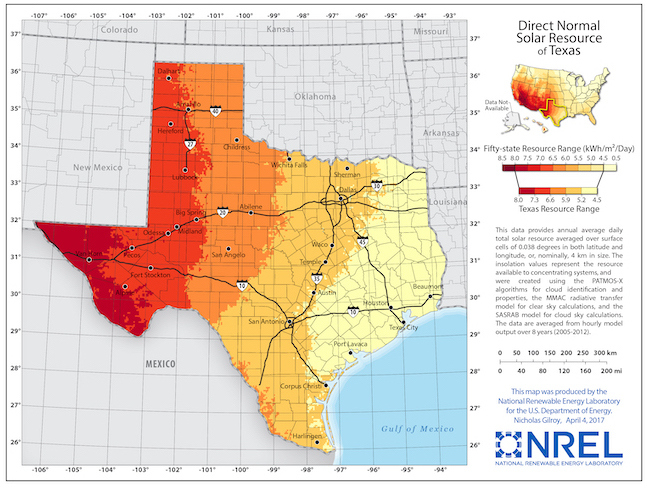
And this result is generally in agreement with this decade-old Fact Check of an Elon Musk statement which was shown correct. This was that 10,000sq km (or 4,000sq miles) of solar PV in Texas would produce the 425GW (= 3,725TWh) of electricity used annually in the US. The calculated output was 500GW (= 4,380TWh). That would equate to (4,380TWh x 2.59 =) 1.13e16Wh, The PV efficiency is put at 24% with the location the slightly-less-sunny NW Texas rather than W Texas.
The other half of the anecdote was the area of US that has been strip-mined for coal. The Ai function on Google offered up a reference that talks of a land area of 4 million hectaes (=10,000 sq miles) in the US that "open-pit mining of 124 billion tons of coal in the United States will destroy." [My Bold] Sadly this is derived from "data released by the National Research Council (NRC) of the United States" but the actual NRC document is not referenced. (The Google-offered reference concerns open-caste coal mining in Mongolia not the USA.)
However, this reference does give a measure of land 'destroyed' by open-caste coal mining. And data on good-old Wikki-thing shows perhaps 30 billions tons of open-caste-mined coal produced in the US since 1945. This suggests the land 'destroyed' by US open-caste coal mining is perhaps 2,500 sq mile.

Mind, there is another comparitor, The electricity that could be generated by that 10,000sq-mile-destroying mining, 124 billion tons would (generously) amount to [2e6Wh/ton x 1.24e11 ton =) 2.48e17Wh, enough to provide all US primary energy for 10 years. As well as the 10,000 sq mile of 'destroyed' land, this coal-use would double global CO2 emissions for that 10 years.
It's a shame the Solar PV required to provide the same annual energy output (and provide it for ever) would be twice the area. Perhaps in the future when the PV efficiencies are improved and if the calorific value of US coal continues to fall, those land areas will be more comparable. -
prove we are smart at 21:50 PM on 22 June 2026The Merchants of Doubt are coming for Extreme Event Attribution science
Best wishes from us all on your research into extreme event attribution science,maybe the courts can affect these money before morals elites.
Good luck to the remaining scientists and climate lawyers fighting their own administrations corporate and trillionaire/billionaire donors. It's not just Americans voting against their own interests, worldwide, we see time lost to start the deep emission cuts for climate stability. climateactiontracker.org/global/cat-thermometer/
These days,I think most in the world are "merchants of doubt" when it comes to believing the USA administration is about mitigating climate change or even if the USA is in fact a real democracy anymore..www.youtube.com/watch?v=GUHm6MfnPvw&t=534s
-
MA Rodger at 05:25 AM on 22 June 2026Plateauing CO2 emissions have slowed atmospheric growth
michael sweet @8,
Regarding the annecdote, I did mention that "I won't vouch for the numbers being right." Indeed, the numbers could all have been nonsense. In the past I recall attempting to find the area of open-cast coal mining in the US but never got anywhere. As for the 10,000 sq mile number I was actually told for this and thus the required area of solar PV to supply all primary energy for the US, that could well be wrong. 10,000 sq miles, 20,000, even 100,000 sq km (=40,000 sq miles) - all are possible but it was just an annecdote 20 years ago. Maybe I should do a bit of scaling of this requirement when I have a moment, something I likely have done previously but then forgotten the outcome.
The message I'd hope to give with the annecdote is that the area of unproductive land needed to power North America (in Texas), or Europe (in the Sahara), or China (in the Gobi) or India (in the Thar Desert) is entirely doable.
-
wilddouglascounty at 05:06 AM on 22 June 2026Cooking up the Climate Stripes, with Ed Hawkins
Thanks for sharing the story! It's such a great tool for helping anyone "get it." Some requests from someone who works with aging populations, folks with disabilities and other sensory processing differences:
-I think it would be a great exercise to make a "climate stick" that uses tactile cues to make the same point. The stick would start quite smooth on one end, and get progressively rougher as the climate warms. Perhaps the climate spiral would also translate into a stick by stretching it into an increasingly thick stick as the climate spiral gets wider and wider.
-For those with severe visual limitations, in addition to a climate stick, perhaps an auditory version by playing with the volume, amplitude and tonal qualities of the global climate representation? It would be interesting to give this task to some musicians to see how compelling and listenable they could make it, because it would be easy to make it increasingly grating, but a challenge to make it all listenable all the way to the present...
-other modalities: how about a room where you could sit in a chair and feel increasingly warm wind blown at you? Or increasingly bright lights? Or increasingly loud tone? Or heavier and heavier rate of raindrops? So many creative directions that this could go...
-
michael sweet at 03:25 AM on 21 June 2026Plateauing CO2 emissions have slowed atmospheric growth
MA Rodger:
I do not know the source of your story about Texas. The entire area of Texas is about 269,000 sq mi (according to Wikipedia). So 10,000 sq mi for all energy is not too much. A detailed post on Quora concluded that 10,000 sq mi would generate about the current electriicty use in the USA.
I have recently seen it posted on line that if we covered with solar only the square miles currently used to grow corn for alcohol used in gasoline we could generate all the energy (everything industry, transportation heating/AC etc) used in the USA. (AI claims there would be excess energy from this conversion but I do not trust AI any more than internet posters).
I have seen scientific posts that suggested we use desert land, roof tops and parking lots to generate the needed solar power and rewild the 35 million acres of corn-for-ethanol (about 55,000 sq mi). I doubt American farmers would like that but it is an interesting claim. Recent estimates of the needed energy to provide All Energy in the USA would be consistent with that plan if you got anywhere near all electricity from 10,000 sq mi.
I recently drove across Texas, New Mexico and Arizona and the amount of land that is not really usefull for agriculture is enormous. Not to mention brownfields from coal mining and oil extraction.
As you mention, the issue is political will and not the amount of land and other materials needed. Hopefully the overbuilt Chinese solar panel factories can be put to good use.
-
MA Rodger at 18:39 PM on 20 June 2026Plateauing CO2 emissions have slowed atmospheric growth
johnpead @6,
I can't accept that CO2 emissions are 'falling'. They are barely staying flat, and that due to reductions in emissions from Land-Use-Change.
To put some numbers on that from the GCP 'budget':-
Average Annual Global CO2 Emission increases... ... ... ... ... Fossil Fuel ... ... [LUC emissions]
1990-2000 .... +82Mt(C) ... ... [+4Mt(C)]
2001-2012 ... +215Mt(C) ... .. [+12Mt(C)]
2013-2024 .... +83Mt(C) ... ... [-48Mt(C)]But to address your question, the additional annual atmospheric CO2 burden is often called the "Airborne Fraction" which very roughly sits a 50% of annual emissions. But this fraction is not a single year thing. The draw-down of our emissions into ocean & biosphere is a multi-year thing. Thus that 50% comprises illustratively 3.00% of year one, 2.90% of year two, 2.75% of year three, etc, this draw-down completed over a millenium when about 75% (or less for high levels of emissions) in total will have been drawn out of the atmosphere. The final tiny-tiny component is absorbed when the last bit of deep ocean water eventually surfaces and absorbs its CO2. The remaining 25% requires geological processes or a helping human hand.
So if emissions level-off, the Keeling Curve will stop bending upwards, accelerating. Identifying that disappeared acceleration amongst the wobbles will take a decade or two. If there were a drop to 50% of our emissions, the Keeling Curve will plateau a while, and if emissions continue to fall below that 50%, the Keeling Curve will dip.
That doesn't sound very encouraging. That is not to say the problem is unnsoilvable. My own view of it is that solar PV is the solution along with its use for hydrogen/ammonia/methane production.
I recall an anecdote from a couple of decades ago. A clever environmentalist tells a dumb climate skeptic that the USA could get all its energy requirements (so all primary energy) from 10,000 sq miles of solar farms in Texas. The skeptic replies that 10,000 sq miles is a massive area - the task is far too great to be delivered. The environmentalist responds that 10,000 sq miles is massive but it is the area of forest/mountain strip-mined for coal in the USA, a far-harder task which didn't prove too great, and that all this mined coal is now burned and gone. With coal you have to keep mining. The solar PV will keep on delivering.
(I won't vouch for the numbers being right.)So there is a solution to hand (and likely other scaleable technologies as well) and if it (they) were embraced as strongly as then-there tech-bro AI projects (and money-wise it has a far far stronger basis for investment) we could deliver that solution.
What is depressing is the evident denial within the political sphere that we are still not doing anything like enough to reach net-zero (& the net-negative that must follow). The graphic below shows the scale of the problem.
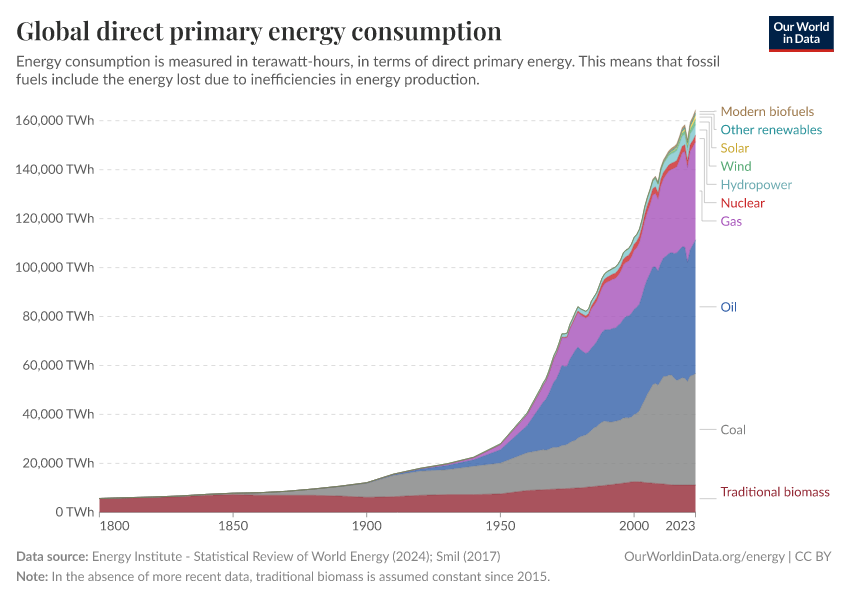
In terms of the warming, things are more encouraging. The delay in warming and the delay in draw-down sort-of cancel each other out. Modelling shows that, very roughly, net-zero also brings zero-warming. The draw-down of CO2 drops the climate forcing providing cooling. And that sort-of matches the delayed in-the-pipeline warming. (The detail of this 'matching' isn't entirely forthcoming. CH4 & N2O have shorter atmospheric residency and are substantial contributors to AGW [respectively 25% & 10% of CO2's forcing] and are surely significant in those 'matching' result.)
-
johnpead at 14:55 PM on 20 June 2026Plateauing CO2 emissions have slowed atmospheric growth
MA Rodger. Many thanks for such impressive responses to my two questions. I so enjoyed reading your thoughtful and respectful conversations about whether atmospheric carbon is not just increasing, but may be accelerating too. Especially appreciate your patience and humility in responding to me and others.
Supplementary question. If global carbon emmissions are presently not rising, but starting to fall, when and how will we see that reflected in the keeling curve and then subsequent effects on global warming. What are your hunches? Presumably, the present rate of increase of atmospheric carbon will first start declining (over say 10years)? Then effects on global warming will only commence much much later, after actual atmospheric carbon starts declining (over say 100-1000 years)?
-
nigelj at 07:56 AM on 20 June 2026Plateauing CO2 emissions have slowed atmospheric growth
johnpead @1
You ask - "How confident can we be about estimated annual emmissions?"
I was discussing this somewhere else, and include the following studies I found which indicate we can be reasonably sure about the accuracy of estimated emissions and emissions reported by individual countries:
1) Emanuele Solazzo, Robbie M. Andrew, and Greet Janssens-Maenhout. Annual estimates of global and national CO2 emissions from fossil fuels: tracking revisions to the United Nations energy statistics database input energy data. Environmental Data Science (Cambridge University Press). June 2022
2) Brendan Byrne, David F. Baker, Sourish Basu, et alia. National CO2 budgets (2015–2020) inferred from atmospheric CO2 observations in support of the global stocktake. Earth System Science Data (ESSD). March 2023
3) Christopher W. O’Dell, David Crisp, David F. Baker, et al. The Orbiting Carbon Observatory-3 (OCO-3) mission: Early science results from space-based observations of localized CO2 emissions. Remote Sensing of Environment. December 2022






