



 Arguments







Recent Comments
Prev 2200 2201 2202 2203 2204 2205 2206 2207 2208 2209 2210 2211 2212 2213 2214 2215 Next
Comments 110351 to 110400:
-
Arkadiusz Semczyszak at 19:18 PM on 23 September 2010Does Climate Change Really Matter?
“By your own definition you are incorrect.” No. At the hydrophobic surface sufficiently heated, drops generally do not combine - do not join because they do not ... The liquid forms a uniform layer. Violent phenomena virtually disappear. That's why (among other things + no Panamanian isthmus) in the Oligocene tree ferns (with extremely fragile stems) grew almost from the equator - practically to the North Pole - around - so defined area - and in addition, the same species. -
kdkd at 19:16 PM on 23 September 2010Global warming and the unstoppable 1500 year cycle
daniel #25 You're sailing pretty close to going against this site's comments policy with that post. It's perfectly possible to make your argument without recourse to the use of inappropriately emotive terms such as "crusade", "lame", "bother to do so" and so on, and in fact will help your argument to be taken more seriously. I strongly suggest that if you want your comments to remain on this site, then you adapt to condtions that will prevent your posts from being deleted. By the way, it's not "appeal to authority", it's "appeal to inappropriate authority". Good examples of inappropriate authority are Christopher Monkton, Tony Abbott and Al Gore. -
Arkadiusz Semczyszak at 18:47 PM on 23 September 2010Climate Change: The 40 Year Delay Between Cause and Effect
“Nothing you've posted here would lead anyone to not invest in mitigation and adaption.” The aim of the actions already adopted in Kyoto was that the cost of fighting the AGW, ONLY (and solely) suffered final consumers (therefore: "normal" people), so that the producers of energy - due to rising costs - not moved their production to countries where there is no this "struggle." „As usual, you're cherrypicking ...” This is not true. Indeed, my aim was not to summarizing the work of the authors - which I cited. Everyone knows that of teams the authors - cited the work (especially the second and third) is an “avowed” great proponents of the theory of AGW. If, however, and they have such fundamental questions ... (And that was my goal - to submit questions - I hope not omitted any of their doubts - because only then - if I ignored this question - it would be "cherrypicking"). For example, does the concentration of CO2 in the atmosphere will increase - for whatever reason - an additional 20 or 200 ppmv in the XXI century must be the great importance - what specific actions we take. Being a huge difference - in the context of chaos theory - "the wings of a butterfly" - indeed fundamental. These questions show that it really practically nothing (sufficiently accurately) do not know what will happen - for 40 years - from "our" CO2. Instead, there are serious reasons for that, not only in the Himalayan glaciers will melt by at least 300 years. In one word: "clock" - almost certainly - “not ticking "... Such a large number of papers of supporters of the theory of AGW, containing such a large question - written in recent times, is probably the result of appeal (2008 - The IPCC Must Maintain Its Rigor) Susan Solomon (real boss section "of science," the IPCC): “The climate system continues to change and science continues to improve, so policy must be kept current with our best understanding. Reformulating the science/policy interface should be considered and be open to change but must acknowledge lessons from the past. ...” “... if a rigorous scientific basis is to continue to inform the growing challenge of decision-making on climate change.” In 2010, Solomon does not know (but) nothing concrete (sufficiently accurately) about-at least - 1 / 3 warming - Guardian: “She said it was not clear if the water vapour decrease after 2000 reflects a natural shift, or if it was a consequence of a warming world. If the latter is true, then more warming could see greater decreases in water vapour, acting as a negative feedback to apply the brakes on future temperature rise.” “It shows that we shouldn't over-interpret the results from a few years one way or another.” Korhola: “Decision-makers should make sensible choices regarding the overall benefits in the environment of UNCERTAINTY.” Rather than pay for the synthetic tree CO2 removes, I will pay for research such as thermo-nuclear fusion, or efficient energy storage in solar and wind power (in the periods when they do not produce energy) - it is always useful (for example, here is an interesting use of the thermal inertia of the usual molten salt). -
jyyh at 18:30 PM on 23 September 2010Climate Change: The 40 Year Delay Between Cause and Effect
Question: Did the economic recession in the 1930s contribute much to the mid 20th century cooling, as there is this delay? -
CBDunkerson at 18:18 PM on 23 September 2010Global warming and the unstoppable 1500 year cycle
daniel #25: You should read up on the psychiatric concept of 'projection'. -
Riccardo at 17:54 PM on 23 September 2010Billions of Blow Dryers: Some Missing Heat Returns to Haunt Us
I happened to work for a few days on a oceanographic ship in the much warmer and calm mediterranean waters. We had a simple task, take an instrument left at the bottom (2000 m) back home. The operation plan was simple, distributed to all of us printed on paper it was about a single page. The weather was fine and the sea smooth, i thought it was going to be almost a couple of days out at sea on vacation. It turned out to be the hardest 36 hours of continuos work of my life. When the instrument was finally on board, we were so tired that no one could eat or take a shower. Still wearing our wet clothes we hung over the deck for a long while drinking coffee. I commented that everything went wrong but my collegues laughed at me and said "welcome to oceanography!" Thank you Doug for reminding me this experience. -
daniel at 17:49 PM on 23 September 2010Global warming and the unstoppable 1500 year cycle
I guess I must respond without the hoopla... I'll try "Dude", you give yourself a bad name. You believe unshakeably in anthropogenic global warming without much desire for, or competence in, critiquing the "science" behind the fad. Please also see the enormous link in comment 222 on the "There is no consensus" comments page 5. You will read a little about the not particularly thorough, easily skewed towards 'group think', peer review process and then reconsider your lame appeals to authority when trying to play down my claims. I am allowed to criticise scientific literature daniel, that is how scientific thought is truly refined, after publication. So many crusaders in the name of science just don't understand this (or don't want to). The link you provided is not specific to ice core dating. Why do you simply believe in O/E events without asking the hard questions daniel. It's just not good enough for you to lie there in your warm blanket of ignorance and say it's up to me to provide what wasn't provided by the "experts" in the first place. "In the meantime, you're blurring the line between skepticism and denial." Nice one liner here's one I thought of for you "Give up, you're an amateur" What kind of error margin would you put on the assignment of years in an ice core daniel? Do climate scientists bother to do so? Why don't you ask John to augment the article with some of that real scientific analysis. You should be thanking me for putting these comments in before he blunders the "intermediate" version up as well. All the best The Danster -
alan_marshall at 17:21 PM on 23 September 2010Climate Change: The 40 Year Delay Between Cause and Effect
Re:#8.sleepership You have seen the future we are currently headed for, and it is very frightening indeed. The following extract from your comment on my article is insightful: “Was the heat the planet experienced this summer from 1980 C02 or from recently? If from 1980- when CO2 was just passing 350ppm- then we are in deep deep trouble when today's levels overcome the 'inertia' around the year 2040” A deep political problem at the moment is that the majority of our politicians see the current warming of 0.8 C (if they concede there is any connection to CO2 at all) as being related to the current atmospheric concentration. The equilibrium temperature rise for 390 ppm is in fact at least 1.4 C, so we are only part way there. The stated goal of the Copenhagen Accord of keeping global warming below 2 C is looking increasingly difficult to achieve. The only ray of hope is that the oceans have not yet absorbed all of this heat. They will absorb it, and the surface temperature will rise as projected, if the current energy imbalance is not reduced. We need not only to move rapidly to a near-zero carbon economy – we need to remove the bulk of the CO2 emitted from 1750 up till now. That will require either carbon sequestration on an industrial scale, or geoengineering. -
adelady at 16:49 PM on 23 September 2010Billions of Blow Dryers: Some Missing Heat Returns to Haunt Us
Articles like this one, Matt, are like some books on our shelves. Even if we have read the whole thing, it's always instructive to return and reread with more understanding. It's terrific, Doug. And we should all echo your sentiments about the fanatical dedication of people prepared to take such risks for the benefit of science. Gratitude to all of them. -
citizenschallenge at 16:40 PM on 23 September 2010Billions of Blow Dryers: Some Missing Heat Returns to Haunt Us
MattJ #7 said: "I love the title! Unfortunately, the article is both long and dense, so I didn't finish it -- and am wondering how many in the target audience will finish it. " ~~~~~~~~~~~~~~~~~~~~~~~~~~~~~~~~~~~~~~~~~~~~~~~ That is why ScepticalScience folks are writing the basic version explanations as well. Also, don't forget - sometimes, one just needs the words to explain the situation. -
citizenschallenge at 16:36 PM on 23 September 2010Billions of Blow Dryers: Some Missing Heat Returns to Haunt Us
Yes, excellent, informative post. First class. I'm back to wondering about how the Pacific Decadal Oscillation might interact with deep sea thermohaline circulation... mixing dynamics? Any info? -
MattJ at 16:03 PM on 23 September 2010Billions of Blow Dryers: Some Missing Heat Returns to Haunt Us
I love the title! Unfortunately, the article is both long and dense, so I didn't finish it -- and am wondering how many in the target audience will finish it. -
scaddenp at 14:44 PM on 23 September 2010Billions of Blow Dryers: Some Missing Heat Returns to Haunt Us
The relevance of this paper is to total ocean heat content (OHC). Plenty of cycles to move heat around within the ocean without changing total OHC. (I'm not lost on calling it heat either). We barely have adequate measure of OHC now let alone anything remotely useful covering the last 100 year. If we did however, I would expect to periods of static and cooling because changes in solar and aerosols should have affected it. Climate is not single factor. -
nigelj at 14:32 PM on 23 September 2010Billions of Blow Dryers: Some Missing Heat Returns to Haunt Us
There are several cooling / flat periods over the last 100 years of ocean temperatures, so surely this is an ocean cycle or sunspot affect or la nina, and surely its been identified? -
Albatross at 14:22 PM on 23 September 2010Billions of Blow Dryers: Some Missing Heat Returns to Haunt Us
Excellent job Doug. Thanks for this. Have to "digest" the content before commenting on the science. -
dana1981 at 13:41 PM on 23 September 2010Billions of Blow Dryers: Some Missing Heat Returns to Haunt Us
Nice job, doug. Very interesting stuff. -
SoundOff at 13:09 PM on 23 September 2010Billions of Blow Dryers: Some Missing Heat Returns to Haunt Us
I wonder, with the ice packs breaking up in the north, if the now more open passages might be allowing new colder currents to flow south within the upper levels of the oceans. Think of cold fresh melt water spreading over the surface while the original warmer saline water is pushed down deeper. This might explain why we see less warming in the upper oceans than we expect. Just thinking out loud. -
jyyh at 12:24 PM on 23 September 2010Climate Change: The 40 Year Delay Between Cause and Effect
I'd like to point out that carbon fibers do not really decompose in a short time. To use these in construction and such would be preferable to many other materials. -
jyyh at 11:35 AM on 23 September 2010Billions of Blow Dryers: Some Missing Heat Returns to Haunt Us
Bering strait flow is probably too small to include in that wonderful image but I think it should be a two-headed arrow. -
scaddenp at 11:26 AM on 23 September 2010Climate Change: The 40 Year Delay Between Cause and Effect
Also, yes, the atmosphere emits radiation in approximately the spectrum of the Planck's Law for a blackbody radiator (modified by the gas absorption bands). -
scaddenp at 11:05 AM on 23 September 2010Climate Change: The 40 Year Delay Between Cause and Effect
John - massive confusion here. IR is not heat for starters. Heat is energy being transferred by conduction between bodies at different temperatures. IR is energy as electromagnetic radiation. A CO2 molecule DOES absorbs radiation only in certain frequencies. It is anything but "clear" that it does otherwise. However, the atmosphere is also warmed by conduction. A molecule excited by absorption "heats" other molecules by collision. The CO2 molecule will also gain energy by collision with other molecules. The temperature of the atmosphere reflects both processes. -
Phila at 10:45 AM on 23 September 2010Climate Change: The 40 Year Delay Between Cause and Effect
#25 nerndt Atmoshperic conditions are trivial. Good to know. Glad that's settled. It's really too bad so many climatologists are in the dark on this point. I guess they're just dumb, huh? -
johnd at 10:27 AM on 23 September 2010Climate Change: The 40 Year Delay Between Cause and Effect
scaddenp at 10:10 AM, it all comes back to trying to establish how as mentioned in the lead article CO2 "is “tuned” to the wavelengths of infrared (heat)" when it is clear that it absorbs and emits thermal energy at wavelengths beyond that "tuned" range found in the atmosphere. Can you elaborate on your answer as to clarify whether CO2 also absorbs and emits thermal energy at temperatures and pressures BEYOND those found in the atmosphere, and thus is not "tuned" to any specific range. -
scaddenp at 10:10 AM on 23 September 2010Climate Change: The 40 Year Delay Between Cause and Effect
John - answer to 1 and 2 would be "all temperatures and pressures found in the atmosphere. (pressures of 1bar or less). Again, the relevance of your questions to anything in climate is hard to guess. -
johnd at 09:41 AM on 23 September 2010Climate Change: The 40 Year Delay Between Cause and Effect
Riccardo at 09:18 AM, can you perhaps clarify these points for me, 1 - at what temperatures does CO2 exist as a gas? 2 - what is the range of temperatures that CO2 absorbs thermal energy and emits thermal energy? -
Riccardo at 09:18 AM on 23 September 2010Climate Change: The 40 Year Delay Between Cause and Effect
johnd, in #28 I copied part of your previous post and said it was not true. Maybe now you agree with me. In #34 you're switching argument: "As the diagram indicates, at 1 bar pressure the absorption band for thermal energy exceeds the range of 200K to 400K, that limitation being solely the range of the diagram." As MichaelM already said, there's no relation between a PT diagram and vibrational absorption/emission. That diagram just tells you that at 1 bar pressure CO2 is a gas between 200 and 400 K. Good to know, but then what? There's no thermal energy nor absorption lines shown there. -
scaddenp at 09:13 AM on 23 September 2010A detailed look at Hansen's 1988 projections
Badger, for the AR5, you are look for PCMDI participants -
snapple at 09:05 AM on 23 September 2010Climate scientists respond to Monckton's misinformation
The Guardian still doesn't have a working link to this article. Look, the politicians are getting a lot of money from fossil fuel interests. Cuccinelli's dad used to work in marketing for the American Gas Association and now has two companies that do advertising and marketing--including for "European" companies. Sometimes these "professional services" are just ways of laundering money from foreign entities to US politicians. I have some experience of such "Europeans." They are going to try to destroy the scientists by hiring politicians and lawyers. They are going to take over consumer affairs. That's what they do in the part of "Europe" they come from. They don't care what is true. They want to sell gas. -
MichaelM at 08:55 AM on 23 September 2010Climate Change: The 40 Year Delay Between Cause and Effect
Johnd: The chart at #23 is just a pressure-temperature phase diagram and has nothing to do with IR absorption bands. It indicates at what pressure/temp combination CO2 changes state eg at 10Bar/225K CO2 will be liquid and boil at 230K. The 200/400 limits of tempeature are just what the creator of the diagram chose. It looks like the colored-in version of this. -
Albatross at 08:54 AM on 23 September 2010A detailed look at Hansen's 1988 projections
Badger, You are welcome. Follow the second link in my post @88 ("more info here"). -
scaddenp at 08:44 AM on 23 September 2010Climate Change: The 40 Year Delay Between Cause and Effect
John, no significant change means no cause. Unlike GHG concentrations. As to whether laboratory measurements are born out in the natural world, then I can only point you at the classic Ramanathan and Coakley 1978 paper which tested just that, confirmed by numerous other studies since. -
johnd at 08:31 AM on 23 September 2010Climate Change: The 40 Year Delay Between Cause and Effect
Riccardo at 08:20 AM, that is exactly the point I am making. As the diagram indicates, at 1 bar pressure the absorption band for thermal energy exceeds the range of 200K to 400K, that limitation being solely the range of the diagram. For comparison think H2O and the changes of states that occur that affect the absorption and release of thermal energy, and how they relate to the natural environment. -
johnd at 08:22 AM on 23 September 2010Climate Change: The 40 Year Delay Between Cause and Effect
scaddenp at 08:04 AM, re "unnatural environment", obviously the laboratory Phil, the properties of CO2 as proven in the laboratory as referenced in the lead article, and illustrated in the diagram posted. Re your second comment, think cause and effect. -
Riccardo at 08:20 AM on 23 September 2010Climate Change: The 40 Year Delay Between Cause and Effect
johnd, I'm making the opposite point, molecular absorption of CO2 (or any other molecule, for that matter) is an intrinsic property of the molecule. Pressure and temperature of the gas only slightly widen and shift the absorption band. Try a google search for pressure and Doppler broadening. In accurate radiative transfer codes the broadening effects are taken into account because the "wings" of the wider emission at higher temperature and pressure near the ground is less absorbed in the upper atmosphere. But these are subtleties. -
kdkd at 08:15 AM on 23 September 2010A detailed look at Hansen's 1988 projections
BP #72 I'm sorry, but that's really not good enough. Comparing charts by eyeball like that is so ridden with pitfalls of subjectivity (conformation bias, perceptual bias and so on) the only way you can hope to offer a valid comparison is through statistical comparisons. And that's even before accounting for Albatross' comments at #78, which suggests that even if quantified your analysis would be invalid in any case. As I've said previously, if you want to be taken seriously, you've got to do much much better than this in terms of the way you go about assessing the evidence. -
scaddenp at 08:04 AM on 23 September 2010Climate Change: The 40 Year Delay Between Cause and Effect
john, I remain extremely confused by both your posts. "far greater range than found in natural environment". What unnatural environment are you talking about then? That temperature of surface varies with season is hardly surprising, nor is the globally, annually averaged heat capacity of surface materials varying in any significant way on the time scales we are interested in. I fail to see what you are driving at here. -
johnd at 07:33 AM on 23 September 2010Climate Change: The 40 Year Delay Between Cause and Effect
Riccardo at 06:44 AM, I think you are making the same point as I was. The properties of CO2 allow it to absorb and radiate thermal energy over a far greater range than what is found in the natural environment, and it is the environment itself that determines the width of the absorption frequency. -
John Hartz at 07:11 AM on 23 September 2010A detailed look at Hansen's 1988 projections
@ Albatross: Thanks for the link to the GISS webpage. Where can I find a laundry list of the current generation of climate models, i.e., the ones that the IPCC will use in the new assessment process now getting underway? -
johnd at 06:52 AM on 23 September 2010Climate Change: The 40 Year Delay Between Cause and Effect
CBDunkerson at 06:28 AM, is it not instead that the ocean, and land, heat accumulation that is causing the warmth in the atmosphere. Incoming solar radiation must first be intercepted and absorbed by matter on the surface BEFORE being converted to IR that then transfers into the atmosphere. How near surface temperatures just below the surface vary over the course of a year indicates that at times incoming solar energy is excess of what is being lost into the atmosphere and so is accumulated as thermal energy below the surface, whilst at other times incoming solar radiation is less than that being lost to the atmosphere from below the surface where the thermal energy stored begins to decline. -
Riccardo at 06:44 AM on 23 September 2010Climate Change: The 40 Year Delay Between Cause and Effect
john, "The absorption of IR, being thermal energy, heat, in the atmosphere falls within certain limits due, not to the properties of CO2 [...]" It's not so. First of all, IR is an electromagnetic wave as any other. It is emitted by warm bodies and this is why it is associated to heat. The absorption properties of a molecule depend on the characteristic frequencies of vibration of the molecule which in turn depend on the physical properties of the chemical bond. No relation with temperature here. The environemnt has an impact on the width of the absorption frequency (and very little on the central frequency) but not on it's ability to absorb or radiate EM waves (apart from extreme "pathological" cases which are not relevant to our atmosphere). In short, your claims are physical absurdities. -
rzwilling at 06:42 AM on 23 September 2010Hansen's 1988 prediction was wrong
Ok thanks for clarifying about Scenario C. It still might not hurt to explain in the "Basic" version that: 1) Michaels was misleading by focusing on Scenario A and ignoring Scenario B, and 2) Hansen had less data in 1988 and got the sensitivity wrong, but his overall theory (GHG and temp increases) has been borne out by observations in the last decades. Thanks again for the great post here! -
muoncounter at 06:40 AM on 23 September 2010Climate Change: The 40 Year Delay Between Cause and Effect
#22:"If you meant all CO2 emitted up THROUGH 1970" A cumulative plot using the CDIAC data shows that most of the emissions prior to 1950 or so don't make much of a contribution compared to everything since. See the cumulative graph in the figures here, for example. The caption says "Half of 270 Gtons [the cum to 2000] emitted since 1974". So if we are just now seeing the heating effects of the first half (its ~40 years post 1974) and have yet to see the heating effects of the second half --- ouch!!! For example, arctic ice melt started accelerating in the '80s; was that due to cum CO2 up to the 40's? That's why I'm still having trouble wrapping my head around a 40 year lag. -
CBDunkerson at 06:28 AM on 23 September 2010Climate Change: The 40 Year Delay Between Cause and Effect
nerndt #25: "Atmoshperic conditions are trivial." This is simply false. Basic physics tells us that without the atmosphere the planet would be about 33 C colder... and thus a solid ball of ice. The amount of heat retained in the atmosphere itself is SMALL (not "trivial") compared to the amount in the oceans, but the atmosphere is CAUSING a great deal of that oceanic heat accumulation. -
muoncounter at 06:27 AM on 23 September 2010A detailed look at Hansen's 1988 projections
#90: "scenario B and C had an ‘El Chichon’ " Yes, angusmac's refurbished graph shows the model runs with a one year dip; Pinatubo (and the LOTI curve) was more like 2-3 years (see Robock 2003). I'd assume there were more model runs and only these 3 made the paper. -
nerndt at 06:11 AM on 23 September 2010Climate Change: The 40 Year Delay Between Cause and Effect
repsonse to #18 Ned at 02:10 AM on 23 September, 2010 Ned - Of course global warming and cooling occurs, but CO2 has a minimal effect being a small percentage of greenhouse gas effect and that the atmosphere has a minimal effect on the overall energy of the earth (being more than 1/500 of the totla mass). Can anyone here see the big picture? The key point is that mankinds increase of CO2 to the atmosphere pales in comparison to the effects on the oceans and land by other conditions. Atmoshperic conditions are trivial.Moderator Response: See the post (and take the discussion there): CO2 effect is weak -
nerndt at 06:06 AM on 23 September 2010Climate Change: The 40 Year Delay Between Cause and Effect
As for your general idea that since the mass of the ocean is much greater than the mass of the atmosphere, we can safely ignore climate change ... well, that just makes no sense. The mass of the ocean was just as large at the end of the previous interglacial, but that didn't prevent the very radical climate change in which ice sheets spread southward for 80,000 years, eventually covering the place where I now sit with over 2 km of ice. Why would the mere existence of massive oceans prevent us from altering the climate in a similarly dramatic fashion in the opposite direction? That's just wishful thinking, frankly. Hi Ned. The point I was trying to make is that the largest contributor to any global warming is not the atmospher, but the water and land masses. The atmosphere only has 1/500 (or less) overall mass than the oceans and has minimal effect. The one time this may not be the case would be in a large catastrophic event (huge volcano or metror strike) which then changes the absorption of energy by the oceans and land masses and quickly causes climate change. -
johnd at 06:05 AM on 23 September 2010Climate Change: The 40 Year Delay Between Cause and Effect
On the point made in the lead article of this topic of CO2 properties as having been established in the laboratory, the behavior in the atmosphere should follow. The absorption of IR, being thermal energy, heat, in the atmosphere falls within certain limits due, not to the properties of CO2, but must be due that of the environment itself as CO2 can absorb heat to temperatures far in excess of normal conditions without any change of state occurring as this chart shows. The ability of it to radiate heat off, transfer heat to other adjacent matter will depend again on the state of the environment rather than any specific property of CO2 given it remains a gas at normal pressures at temperatures well in excess of anything within the normal environment.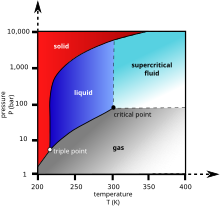
-
Anne van der Bom at 05:43 AM on 23 September 2010A detailed look at Hansen's 1988 projections
muoncounter #79 Actually, scenario B and C had an ‘El Chichon’ sized volcanic eruption in 1995. Pinatubo was much larger (about 4x I believe), so your point is still valid. The only way to deal with this is do multiple model runs, based on different scenarios. The inclusion of one or more volcanic eruptions then becomes part of those scenarios alongside the emissions. -
Paul D at 05:18 AM on 23 September 2010Does Climate Change Really Matter?
Kevin Judd: “Big storms and extreme weather require a lot of energy to drive them.” Arkadiusz Semczyszak response "Nothing could be further from the truth. Great storms require a considerable variation in energy over a small area." The Ville: Tell us something we don't know Arkadiusz. Since Kevin didn't actually define what a big storm was, I think you are making an assumption and then automatically correcting something without knowing what Kevin was referring to. If you weren't here to be deliberately negative, you would have asked for a clearer definition of what a big storm was and then made a comment on that. Arkadiusz Semczyszak: "...we understand that with the increase of the energy supply to such an system...number of extreme events as a result of warming MUST be reduced." The Ville: By your own definition you are incorrect. You earlier stated "Great storms require a considerable variation in energy over a small area.", not increased or decreased energy. Arkadiusz Semczyszak: "Polish scientists (Natural Disasters, 2008.) write: "In the years 1701-1850, ie during the period when the Earth was in the so-called Little Ice Age in the Caribbean basin hurricanes were almost three times higher than in the second half of last century." The Ville: Sorry, 'Polish scientists' were cherry picking or wildly wrong. See Ricardo García-Herreras work on Spanish records of hurricanes in that area and era. Given that the Polish were no where to be seen as far as Atlantic exploration is concerned, I think Spanish records are probably more accurate. Specifically between 1576 and 1601 there was a huge peak, they then dipped until 1760, then started peaking again. eg. during a large chunk of the 'LIA' there were both larger numbers and fewer. -
CBDunkerson at 05:03 AM on 23 September 2010Climate Change: The 40 Year Delay Between Cause and Effect
BmuS #17, dana1981's answer is probably the most useful you'll get. If you are really looking for the warming from CO2 emitted in JUST the year 1970 then we are talking about less than 2 ppm and the resulting warming would be exceedingly tiny. If you meant all CO2 emitted up THROUGH 1970 that's a much bigger factor, but difficult to quantify. Let's say CO2 had stabilized at the 1970 level. I think that was around 320 ppm. In that case, assuming a climate sensitivity of 3 for a doubling of CO2, I get; ln(320/280) * (3 / ln(560/280)) = 0.58 C Since we are 40 years past 1970 pretty much all of that warming should have now been cycled through into the atmosphere. Obviously, different climate sensitivity factors would yield different results, but the current 0.8 C warming is consistent with the 3 C 'fast feedback' sensitivity estimate.
Prev 2200 2201 2202 2203 2204 2205 2206 2207 2208 2209 2210 2211 2212 2213 2214 2215 Next






