



 Arguments







Recent Comments
Prev 2404 2405 2406 2407 2408 2409 2410 2411 2412 2413 2414 2415 2416 2417 2418 2419 Next
Comments 120551 to 120600:
-
Doug Bostrom at 07:35 AM on 13 May 2010Estimating climate sensitivity from 3 million years ago
Not the case we're speaking of, johnd. Flipping the analogy is pointless. -
johnd at 07:32 AM on 13 May 2010Estimating climate sensitivity from 3 million years ago
doug_bostrom at 03:13 AM, whilst many people try to use a blanket as a simple analogy, that is making it too simple. For a start you need to clarify whether the house is on fire or not, because if it is, and your blanket slips off........ The greenhouse effect is not really a mechanism providing our comfort as a blanket usually does, but one providing us with protection, as a blanket also can, so a more useful analogy than a blanket would be a firefighters protective gear. So what happens if the firefighters jacket slips off? -
Berényi Péter at 07:22 AM on 13 May 2010Estimating climate sensitivity from 3 million years ago
#47 Riccardo at 17:37 PM on 11 May, 2010 there's no formal definition of slow or fast feedbacks, they must be considered relative to the time scale analyzed That's not an answer. It always bothers me that all kinds of feedback loops are discussed all the time without assigning proper time constants to them. For example atmospheric water feedback (including both vapor and clouds) has to be pretty fast. Residence time of water in the troposphere is about 9 days. Even in the lower stratosphere it is a month at most. It means it should respond to any changes in SST (Sea Surface Temperature) on this timescale. That is, if the water cycle is supposed to amplify CO2 forcing threefold as claimed, we should be able to detect the effect even in short records (several years), we do not need many decades of data for this particular purpose. This is exactly what Roy Spencer is doing recently. His upcoming paper in the Journal of Geophysical Research will be an interesting read. Spencer, R. W., and W. D. Braswell (2010), On the Diagnosis of Radiative Feedback in the Presence of Unknown Radiative Forcing, J. Geophys. Res., doi:10.1029/2009JD013371, in press. (accepted 12 April 2010) He does not address water feedback directly, but claims to have found a strong short term (~1 month) negative feedback based on 7-9 years of NASA CERES radiation budget data. For detecting fast feedback loops that much data should be more than sufficient. On the other hand, it is hard to imagine that there could be a strong short term feedback in the climate system other than atmospheric water. At least no one has found one so far. Anyway, if short term (up to a month or so) feedback is negative, all feedbacks operating on longer time scales (years, decades, centuries, millennia) can only take this controlled signal as input. It means that any long term positive feedback loop that would bring temperature anomaly up to 4-5°C for CO2 doubling as claimed by Pagani should supply a gain close to 10 (Dr. Spencer has found a 0.5°C short term equilibrium value for CO2 doubling, as opposed to the 3°C IPCC "consensus" figure). With an f value of ~0.9 the climate system would be dangerously close to a runaway feedback (f > 1). In this case any number of slight structural changes over the ages could push it over the limit. As it has never happened in billions of years, there can be no such a strong positive feedback whatsoever on any timescale. Therefore we should look for some explanation of past excursions of climate other than carbon dioxide "forcing" amplified by multiple positive feedbacks of different origins operating on all timescales.Moderator Response: The right place to post this comment should be Climate sensitivity is low. Please always find the appropiate topic for your comments. -
johnd at 07:14 AM on 13 May 2010Estimating climate sensitivity from 3 million years ago
The need for postings to remain on topic is well understood for, each thread would quickly become chaotic, and people generally like to keep things neat and tidy not only in their minds, but in their forums as well. It has to be that way. The irony is that the matter being discussed, climate, is just the opposite, chaotic, and each individual factor somehow linked to interact with every other single factor. The subject is simply too vast and too complex for any single person to get their mind around, hence the need to break it down into handy bite sizes easily digestible, not only on forums such as this, but for the scientists as well. Ordered scenarios can be prodded and poked into a shape that than can be measured, and then modelled to yield results that reflect such an ordered system, but the focus is on the calculated outcome and the range of uncertainty essentially becomes off topic there also. -
WaxItYourself at 05:44 AM on 13 May 2010CO2 was higher in the late Ordovician
A 2005 study shows that the late Ordovician glaciation actually occurred 10 million years before. This ice age did not occur when CO2 was at it's peak. Rather it began at a time when the concentration was between 180 and 200 ppm. http://geology.gsapubs.org/content/33/2/109.short -
Dikran Marsupial at 03:23 AM on 13 May 2010Estimating climate sensitivity from 3 million years ago
e says: "Long term processes such as rock weathering eventually start to remove CO2 from the atmosphere." I think the 200 year adjustment time is based on transfer of CO2 from the surface waters to the deep ocean, rather than chemical weathering, which acts on even longer time scales. -
Dikran Marsupial at 03:19 AM on 13 May 2010Estimating climate sensitivity from 3 million years ago
johnd says: "If CO2 has been calculated as having a long residency time, what is the residency time of water vapour." CO2 has a short residence time (4-5 years) but a long adjustment time (50-200 years). CO2 needs modeling rather differently to other GHGs due to the large annual exchange flux. "Even though there is a high turnover of individual molecules, water vapour as a gas has residency time beyond measurement, a permanent presence that will exist whilst warmth from any source rises from the earth's surface. " Water vapour doesn't have a residence time beyond measurement, IIRC it is a couple of weeks. As I understand it warm air holds more water vapour than cold air, so if CO2 radiative forcing falls, and air temperature with it, then water vapour will precipitate out and there will be less radiative forcing from water vapour as well. It is a feedback in both directions. CO2 is a permanent presence in the atmosphere in exactly the same sense that water vapour is. -
Doug Bostrom at 03:13 AM on 13 May 2010Estimating climate sensitivity from 3 million years ago
RSVP, you've got to make a stronger effort here. If by adding C02 to the atmosphere we cause it to be a more effective insulator, if we then remove C02 from the atmosphere we can expect it be a less effective insulator. In terms of net effect, this is simply insulation we're talking about. Do you live where it's necessary to have blankets on your bed? What happens when your blanket slips off? It's that simple. Please try a little harder. -
Estimating climate sensitivity from 3 million years ago
RSVP, Long term processes such as rock weathering eventually start to remove CO2 from the atmosphere. As CO2 decreases the equilibrium temperature gets pushed down and the earth cools. -
Doug Bostrom at 03:05 AM on 13 May 2010Estimating climate sensitivity from 3 million years ago
Ring-a-ding! Teachable moment. What I said: Surface insolation for Earth taking into account angle of incidence, atmospheric attenuation, diurnal cycle etc. is roughly 250MW/km2. The surface of the Earth is about 510,000,000 km2. So, about 127,500TW of total insolation. What RSVP perceived and concluded: doug_bostrom "surface of the Earth is about 510,000,000 km2. So, about 127,500TW of total insolation" You are taking the total surface area. Only one side of the Earth gets Sun at any given time, so you will need to at least half that result for starters and reduce some more to account for albedo. If we take the time to read a little more carefully and integrate new information, more progress in understanding becomes possible. -
RSVP at 02:57 AM on 13 May 2010Estimating climate sensitivity from 3 million years ago
John Why isnt waste heat in the list of skeptical arguments?Moderator Response: Not enough time to have written pages for all the arguments. The Links contain more. (Click the "Links" button in the horizontal bar at the top of the page.) -
RSVP at 02:54 AM on 13 May 2010Estimating climate sensitivity from 3 million years ago
Ned And aside from the question of what is causing global warming, you remark that the effects of CO2 will linger for 200 years even if CO2 levels were to stabilize. Assuming that the Earth's temperature were to actually increase 4 degrees 200 years from now. And assuming GHG did return to "normal" (say 250 ppm). What exactly should cause the Earth's temperature to come back to "normal", assuming all else being equal? Shouldnt it remain higher if equilibrium is maintained? -
Ned at 02:41 AM on 13 May 2010Heat stress: setting an upper limit on what we can adapt to
Right, IPCC always gives figures for warming by the end of the century (or 2095, in this case from AR4) but the warming won't stop there. 2095 is actually not that far away. Go back the same amount of time and you're in 1925 ... approximately when my parents-in-law were born. The average girl born in Japan this year will still be alive in 2095, the end point for the IPCC AR4 projections. That's pretty amazing when you think about it. -
Alexandre at 02:17 AM on 13 May 2010Heat stress: setting an upper limit on what we can adapt to
Ned #28 I find it important to stress that those ranges in your bottom box is just the projection for the end of the century. The warming (particularly the slow albedo feedback) is projected to go beyond that. -
michael sweet at 02:11 AM on 13 May 2010Heat stress: setting an upper limit on what we can adapt to
James Wright, It was pointed out earlier in the thread that this was a worst case analysis. The temperature change required depends on what you consider bad. If you are only worried about large areas of Earth being completely uninhabitable it requires 7C. On the other hand, CB Dunkerson at #5 pointed out that several thousand people have died already in heat waves throughout Europe. If climate sensitivity is really 6C per doubling (long term) we have currently committed the Earth to substantial warming. How bad does it have to be to be considered bad? -
Ned at 01:40 AM on 13 May 2010Estimating climate sensitivity from 3 million years ago
johnd, now you're talking about feedbacks, all of which apply to both the radiative forcing from CO2 and the (much smaller) forcing from waste heat. There's the water vapor feedback, the ice albedo feedback, the tundra/forest albedo feedback, etc. All of which will be very small for a very small forcing (waste heat) and much larger for a much larger forcing (absorption of IR by GHGs).Moderator Response: Indeed, the off topic of waste heat has been discussed enough on this thread. Further comments on that topic probably will be deleted from this thread. But please do suggest links to other treatments of that topic. -
Estimating climate sensitivity from 3 million years ago
johnd, Talking about water vapour just confuses the question. You can compare the relative significance of waste heat vs. CO2 by measuring both of their effects on temperature without any feedbacks. Taking feedbacks into account just multiplies both sides of the equation by the same number. The rate vs. increase of a rate thing has been explained in pretty much every way possible. If it is still unclear, please try and re-read and see if one of the explanations sinks in. I don't think much more can be said on this thread. -
johnd at 01:14 AM on 13 May 2010Estimating climate sensitivity from 3 million years ago
If the heat sink for waste heat is water vapour, and water vapour concentration is relative to temperature, would not the increased water vapour due to that waste heat in effect accumulate the waste heat even if it is relatively small. -
Ned at 00:48 AM on 13 May 2010Heat stress: setting an upper limit on what we can adapt to
James Wight has a good point. Unfortunately, the table at global warming impacts doesn't really have a handy way of breaking down impacts as a function of temperature increase. That would be a long-term project -- it's basically what Mark Lynas does in his book Six Degrees. There's a handy version of this kind of chart in the IPCC AR4 SPM: Figure SPM.7. Examples of impacts associated with projected global average surface warming.
But it's entirely qualitative, unfortunately. I wonder if anyone ever tried to produce a similar graphic with quantitative metrics? That could get ugly fast, but it's an interesting information visualization challenge.
Figure SPM.7. Examples of impacts associated with projected global average surface warming.
But it's entirely qualitative, unfortunately. I wonder if anyone ever tried to produce a similar graphic with quantitative metrics? That could get ugly fast, but it's an interesting information visualization challenge.
-
Ned at 00:37 AM on 13 May 2010Estimating climate sensitivity from 3 million years ago
RSVP writes: "I understand the "theory"; however, there is no theory required to quantify waste heat. " There's no theory required to quantify the absorption of longwave radiation by CO2 either. You can measure it in the lab. Again, the complicated part is the feedbacks. You are verging onto "argument from incredulity". I really think you need to give this up. It's been explained over and over again (not just in this thread) that waste heat is quantitatively trivial compared to the radiative effects of greenhouse gases. At some point, continuing refusal to engage with the points that are made by so many other people crosses the boundary into trolling. -
Ned at 00:31 AM on 13 May 2010Earth's five mass extinction events
Mike Roddy writes: Thanks for this, fascinating stuff, especially Chris #45. I have a question for nobody in particular: Hansen says that burning all the coal and tar sands will lead to Venus. BAU projections call for 5-7C temps in 2100, which is deadly, but not Venus. Does this mean that feedbacks at 5-7C will subsequenstly overwhelm the planet, since the rise in CO2 has been so rapid? Good questions. First of all, note that this is Hansen's own opinion, and other scientists may not be convinced by this claim. That said, Hansen is talking about burning all the conventional oil, coal, heavy oil/tar sands (cf Canada, Venezuela) and I think oil shale as well. That's a long-term, multi-century process, not something that would happen by 2100. So even if temperatures rise 5-7 C by 2100, Hansen's not saying that in itself would trigger a runaway greenhouse effect (RGHE?) like on Venus. What he IS saying is that if we spend the next few centuries burning everything, with CO2 over 1000 ppm, various other feedbacks like clathrates etc. would kick in and lead to RGHE conditions. That's still a pretty extreme claim, and I would want to see a bunch of convincing model results before accepting that it's possible. All that said, there's a lot of room for "extreme misery" even if we don't actually trigger a Venus-style RGHE. Burning a large enough fraction of coal and/or tar sands would put us at 3XCO2 and probably lead to disastrous conditions for much of the world's population. -
Stephen Baines at 00:17 AM on 13 May 2010Estimating climate sensitivity from 3 million years ago
RSVP It doesn't matter that it is more tangible. Imagine a bar for a waste heat forcing of 0.027 W/m2 on the forcing graph Doug Bostrom shows above. You would have a hard time even distinguishing it from 0. It's just not enough heat to matter much. -
Ned at 00:16 AM on 13 May 2010Earth's five mass extinction events
The back-and-forth between batsvennson and chris in this thread might be a bit confusing for anyone who hasn't followed it closely. Back on the first page of comments, batsvennson wrote: [...] we may postulate a hypothesis that the current increasing of atmospheric CO2 concentration is a consequence of an current ongoing - for some reasons - (mass) extinction. This seems very peculiar to me. We know that we're adding CO2 to the atmosphere from combustion of fossil fuels, land use, and other factors. So the increase in CO2 in the atmosphere isn't a mystery. Batsvensson's hypothesis would necessitate some unknown mechanism removing anthropogenic CO2 from the atmosphere and some other unknown mechanism adding CO2 due to an ongoing mass extinction. (There is plenty of evidence that we are in the midst of a new mass extinction, caused by human impacts on the biosphere, but no evidence that this inherently is causing a large CO2 flux.) Occam's razor suggests that an explanation with zero unknown processes is preferable to one that requires two different unknown processes. So, Chris understandably points out (in this comment) that batsvensson's hypothesis is probably not a productive line of scientific inquiry: As for your "hypothesis"; why would we propose or consider a hypothesis for which there is not only zero evidence, but which is robustly contradicted by what we know of the real world? I don't see how it takes us anywhere scientifically speaking... batsvennson then asks Chris for more elaboration on these objections, and Chris obliges in this comment. There is some subsequent back-and-forth, ending with this very strange statement by batsvennson. Not all hypotheses are created equal. On the subject of the increasing CO2 concentration in the atmosphere, consider the following two hypotheses: H1: The increase is primarily due to combustion of fossil fuels. H2: The increase is primarily due to invisible leprechauns. I think most people would agree that the former is more productive than the latter, not just because it's more realistic but because it's testable. A hypothesis that is stated in vague, ill-defined terms, or that requires unknown and unexplained phenomena, is not really testable and thus is not particularly useful. Here's another case: H1: The increase is primarily due to combustion of fossil fuels. H3: The increase is due to the rapid deterioration of an undiscovered lens of frozen CO2 (dry ice) buried beneath the topsoil of a remote region of the Himalayan plateau. Now, unlike the leprechaun hypothesis, H3 is actually testable -- NSF or its European or Chinese equivalents could fund a field campaign to travel to Tibet and look for this interesting dry-ice feature. However, it's unlikely that a grant proposal focused on this hypothesis would be funded. Why? Because there's no prior evidence or reasoning to suggest that it's even remotely likely. A hypothesis with no justification for its own existence is better than an untestable hypothesis, but not much. Moving on, consider the next two hypotheses: H1: The increase is primarily due to combustion of fossil fuels. H4: The increase is primarily due to outgassing of CO2 from the oceans as they are warmed by a cyclical increase in solar irradiance. Now, H4 is clearly better than the leprechaun or dry-ice hypotheses -- it is testable, and it is at least based on plausible physics and some things we know about the relationship between temperature and the partial pressure of gases in seawater. But it still has problems -- in particular, it conflicts with other things we already know about the Earth system (solar irradiance has been decreasing, CO2 concentration in surface waters is increasing as CO2 moves from the atmosphere to the ocean rather than vice versa). In addition, H4 still requires some unknown explanation for why the CO2 that we know we're emitting from our cars and power plants is somehow not contributing to the atmospheric store of CO2. Now, batsvennson's hypothesis suffers from the problems of H3 and H4 above. She/he doesn't present any evidence to justify why we should even bother to consider "an ongoing mass extinction" as an explanation for the current rise in CO2, aside from one brief reference to a paper that suggests that some mass extinctions in the geologic past may have caused an increase in the CO2 flux from the biosphere to the atmosphere (but where's the evidence that's happening today?) More importantly, however, it is contradicted by the changing isotopic signature of atmospheric carbon. Finally, from a straightforward logical perspective it requires throwing out a much simpler explanation (we know we're producing CO2 from fossil fuels) in favor of a more complex one. As Carl Sagan said, extraordinary claims require extraordinary evidence. The claim that "something other than combustion of fossil fuels is responsible for the current rise in CO2" is most definitely an extraordinary claim. It's up to anyone proposing such a claim to provide extraordinarily convincing evidence. So far, batsvennson has provided no evidence at all. -
RSVP at 23:35 PM on 12 May 2010Estimating climate sensitivity from 3 million years ago
Ned "Likewise, when you add CO2 to the atmosphere, you're essentially creating lots of tiny machines that add X joules every year,.." Well put. I understand the "theory"; however, there is no theory required to quantify waste heat. -
James Wight at 23:14 PM on 12 May 2010Heat stress: setting an upper limit on what we can adapt to
I notice you’ve added this to the list of global warming impacts. I think it might be worth pointing out that some pretty extreme global warming (at least 7°C) is required for this to happen. -
Ned at 23:10 PM on 12 May 2010Estimating climate sensitivity from 3 million years ago
Oh, yes ... I forgot to add this: You write "The fact that [waste heat] is so easily calculated demonstrates how tangible it is." But it's much easier to calculate the heat added to the atmosphere from greenhouse gases than it is to figure out the total of all sources of waste heat! The complexity in predicting radiatively forced climate change is not in the initial heat transfer, it's in all the various feedbacks. -
Ned at 23:04 PM on 12 May 2010Estimating climate sensitivity from 3 million years ago
RSVP writes: Waste heat is perfectly tangible, unlike the indirect and complex effects of anthropogenic greenhouse gases. The fact that it is so easily calculated demonstrates how tangible it is. There's no difference -- heat is heat. Just in one case it starts out concentrated around chimneys, cars, etc. before dispersing, while in the other it's horizontally dispersed throughout the atmosphere right from the start. But the heat created by radiative transfer is every bit as real as the heat created by any other mechanism. If you insist on comparing CO2 to waste heat, you should think of the CO2 as equivalent to the machines that produce the waste heat, not the heat itself. If you add X joules of heat to the atmosphere, you increase the heat content of the atmosphere by X joules full stop. If you build a machine that adds X joules of heat to the atmosphere per year, then you've added X*L joules, where L is the lifespan of the machine in years. Likewise, when you add CO2 to the atmosphere, you're essentially creating lots of tiny machines that add X joules every year, and that will keep doing so for roughly a century or so. And every year we create more of these machines ... -
embb at 22:24 PM on 12 May 2010Are we too stupid?
Jacob:What gives you the idea that reducing CO2 emissions makes a country's industry uncompetitive? Aren't we talking about an emission tax? It will increase the production costs hence make the industry less competitive. Jacob:OPEC is an excellent example of how powerful a coalition using reciprocity can be. If you think so... I seem to remeber lots of defections during its existence. Also, Russia, one of the biggest producers, is not a member. Are you sure this is the right model? Jacob:Neither I nor the EPA ever postulated that. Whatever gave you that idea? Simple: CO2 is a pollutant. People prefer to live in less polluted areas. Thus people should be willing to pay for having less CO2 in their area. Some element of this chain is faulty, which one is it? Jacob: You just dismiss that "The Lancet and University College London's Institute for Global Health issued a major report concluding that climate change is the "biggest global health threat of the 21st century."? No, I did not. You were talking about "immediate" effects, they are ttalking about "threats". Surely you see the difference. Jacob:Do you think geo-engineering is more or less risky than switching to sustainable energy? You completely miss my point. You were advocating immediate actions regardless of the risks. I am asking YOU if this is your attitude towards geo-engineering as well? Remeber? "So you argue for the preservation of the status quo because the proposed reforms may be imperfect? That is why I conclude that you have an interest in not mitigating climate change." If you argue against geo-engineering then according to YOUR own logic you have an interest in not mitigating climate change. That is all. Jacob:There is no police force in the case of the fig tree/fig wasp, is there? You might want to rethink this a bit. Evolution is about the survival of the fittest - so defectors will just die. If this is your example of a non-violent scenario you are really wrong. :) -
Zero132132 at 22:23 PM on 12 May 2010Heat stress: setting an upper limit on what we can adapt to
I haven't had time to look into it yet, so I must ask, does this study include the effects of increased temperatures on the amount of water vapor in the air? It would seem that both an increase in water vapor would drive the wet-bulb temperature, unless I'm misremembering something from genchem. -
RSVP at 22:13 PM on 12 May 2010Estimating climate sensitivity from 3 million years ago
chris Waste heat is perfectly tangible, unlike the indirect and complex effects of anthropogenic greenhouse gases. The fact that it is so easily calculated demonstrates how tangible it is. Waste heat goes directly into oceans and rivers (and the air) everyday, 24 hours a day. Power plants are water cooled for the most part, and the atmosphere does not get a chance to see this heat until it is exchanged at sea. Waste heat is real and accumulating, and yet somehow considered an inconvenient piece of data that is best ignored. I am not denying effects of GHGs, but it would be a useful exercise to assume a zero contribution of anthropogenic GHG (for the exercise) just to estimate how this alone would affect temperatures (assuming it is accumulating in some percentage). And in comparing to the actual average global temperature increase, this would help determine how much is actually due to anthropogenic GHGs. KR You comment that the higher the temperature, the more IR. I agree, but this applies to all forms of forcing, and is basically a form of negative feedback which maintains temperature convergence (to the benefit of all). -
Ned at 22:00 PM on 12 May 2010Estimating climate sensitivity from 3 million years ago
I agree with Dikran Marsupial that one can't draw conclusions about climate sensitivity by looking just at CO2 and temperature over the first half of the 20th century, since there were countervailing trends in other forcings. Here's a handy figure from Meehl et al 2004: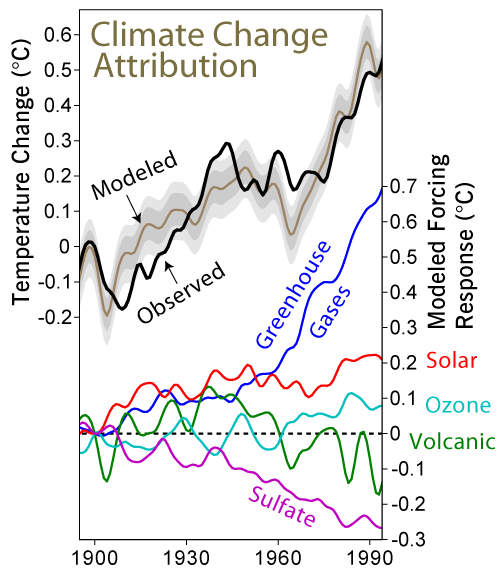
-
Ned at 21:51 PM on 12 May 2010Heat stress: setting an upper limit on what we can adapt to
Arkadiusz Semczyszak writes: Thesis GW = greater frequency heat - it is already outside the mainstream of science. Not at all -- quite the opposite, in fact. The largest increase in temperatures is in winter and at night, but there's also an obvious trend of increasing intensity of extreme summer heat waves. Just looking at some recent papers, we find: Ballester et al. (2009): "... the increasing intensity of the most damaging summer heat waves over Central Europe is mostly due to higher base summer temperatures ... 36% (B2) to 47% (A2) of future Central Europe July and August days at the end of the present century will be warmer than the 1961/1990 99th percentile." Beniston et al. (2007): "Heat waves – Regional surface warming causes the frequency, intensity and duration of heat waves to increase over Europe [...] The intensity of extreme temperatures increases more rapidly than the intensity of more moderate temperatures over the continental interior due to increases in temperature variability" Meehl and Tebaldi (2004) Clark et al. 2006: " [...] Although uncertainty associated with the magnitude of expected changes is large in places, it does not bring into question the sign or nature of the projected changes. Even with the most conservative simulations, hot extreme events are still expected to substantially increase in intensity, duration, and frequency. [...]" I'm not sure why you think that increasing frequency of heat waves is "outside the mainstream of science" when it's actually one of the most robust findings of both observational and modeling studies. -
CBDunkerson at 21:27 PM on 12 May 2010Estimating climate sensitivity from 3 million years ago
Dikran Marsupial #82, true. Looking only at CO2 oversimplifies the issue considerably. However, if you look at the chart doug provided in #71 you'll see that various other forcings (including solar) are comparatively minor and largely cancel each other out. If all the uncertainty bands came out with the highest possible result for each forcing that would just about equal the observed warming... but that isn't possible because parts of those uncertainty bands are from overlapping sources. For instance, we know that sulfate aerosols have a strong cooling effect, but we aren't sure how much of that is directly from the sulfates and how much is indirectly from compounds they form... so both forcings have large uncertainty bands, but they can't both be the highest (i.e. closest to zero) value. In short, the observed warming can't be explained even when we include all the known forcings... leaving unknown forcings or feedback effects to explain the difference. And we KNOW feedback effects are taking place because we can measure the change in albedo from ice retreat and the increase in water vapor from rising temperatures. -
Arkadiusz Semczyszak at 20:30 PM on 12 May 2010Heat stress: setting an upper limit on what we can adapt to
#14 And even well-known popularizer of knowledge Ron Redfern in his book "Origins" (2000), writes that in the tropics during the last glaciation may have been even more tropical than at present (significant reduction - compression THC) and the Northern Siberia, formed stable - static for thousands of years - Anti-cyclones. Strong warming is perhaps the disappearance of cyclones - almost pressure gradient = 0? In summer, temperatures in Siberia could be as high as above 45 deg C ... Sherwood'a work is very valuable and interesting but not very useful for prediction of ways to adapt to GW. Thesis GW = greater frequency heat - it is already outside the mainstream of science. -
chris at 19:58 PM on 12 May 2010Estimating climate sensitivity from 3 million years ago
RSVP at 18:58 PM on 12 May, 2010 RSVP, doug has already corrected for a spherical Earth, angle of incidence, albedo. The TOA average solar radiation is 1,366 W.m-2. If you divide by 4 to account for a spherical Earth, and multiply by 0.7 - 0.8 to account for the Earth's albedo, the surface solar radiation is around 250 W.m-2 averaged over the Earth's surface. Please stop these tedious attempts to pursue false arguments based on ignorance. You've been here long enough to have learned some basic backround information on these subjects. The idea that a straightforwad subject like the contribution of waste heat to the Earth's energy balance has to be gnawed over by a boring recapitulation of the whole theory and empirical knowledge of radiative forcing and energy balance, as if the subject has only just been awakened and needs to be sorted out fom scratch on this thread is tedious in the extreme. Several useful sources of info on this have been posted aready on this thread - please go and read them... -
RSVP at 18:58 PM on 12 May 2010Estimating climate sensitivity from 3 million years ago
doug_bostrom "surface of the Earth is about 510,000,000 km2. So, about 127,500TW of total insolation" You are taking the total surface area. Only one side of the Earth gets Sun at any given time, so you will need to at least half that result for starters and reduce some more to account for albedo. In any case, the absolute amount of insolation is supposedly a non-issue (neither here nor there) for those that base their analysis on the radiative forcing model (the tree graph that has branches going left and right). Its funny how the total solar insolation is never mentioned in that context, only when the question of waste heat is brought up. -
Riccardo at 17:31 PM on 12 May 2010Estimating climate sensitivity from 3 million years ago
johnd, 2xCO2 correspond to about 3.7 W/m2. Multiply that number by 0.0075 and you'll get the forcing in W/m2 (0.028 W/m2) which is obviously the same you'd get using the formula i gave you before. It's just a simple change of the unit of measure. But again, this is not the main problem with your reasoning. You're still missing that the forcing due to increased absorption need to be summed up over time, waste heat does not. -
Bern at 17:11 PM on 12 May 2010Heat stress: setting an upper limit on what we can adapt to
Further to my last post - I wasn't able to dig up the extremes, but Darwin has a reputation for pretty unbearable weather in summer. Going by BoM data, the mean 3pm wet bulb temperature in January is 26.4ºC. -
Dikran Marsupial at 17:03 PM on 12 May 2010Estimating climate sensitivity from 3 million years ago
CBDunkerson wrote: "Using the actual CO2 figures for today vs 100 years ago gives ln(387/300)=0.367371 C warming... as opposed to the ~0.7 C actually observed. Ergo, we have observed more warming than can be explained by the enhanced CO2 greenhouse effect. Thus demonstrating that total feedback effects over the past hundred years have been positive." Wouldn't that be the case only if anthropogenic CO2 were the only change in forcing? IIRC the IPCC report attributes most of the warming of the first half of the 20th century to changes in solar forcing. So the difference between the 0.7C and 0.36C could simply be due to changes in other forcing, rather than being the consequence of feedback. Don't get me wrong, I am confident in the ability of the climatologists, and the bulk of the evidence gives little support to low sensitivity, although I keep an open mind on it - and await Roy Spencers new paper. -
Bern at 16:55 PM on 12 May 2010Heat stress: setting an upper limit on what we can adapt to
@Joe Blog: yes, there are calculations, but the easier way is to look up a psychrometric chart. They can be a bit hard to read, though. Wikipedia has some here. You can tell from looking at the charts that the conditions to get to a wet bulb temperature of 35 are pretty extraordinary (something like 75% relative humidity at 40ºC). Remember that relative humidity also drops rapidly with increasing temperature unless you put a lot more water vapour into the air (0.02g H20 per gram of dry air = 100% RH at 25ºC, but only ~34% RH at 45ºC). There's some more info about apparent & wet bulb temperatures (including formulae) on this Bureau of Meteorology page. -
Joe Blog at 14:41 PM on 12 May 2010Heat stress: setting an upper limit on what we can adapt to
Ive also spent a bit o time in the jungles in the tropics... A decade or so ago, i spent six months kicking around East Timor... And three months of that at Suai, which is basically a big valley/swamp, and even though its further south than Dilli (the capital) Suai is generally approximately 10C warmer(generally fluctuates between lows of 35C and 45C. With extreme humidity(90%+) I dont know how this compares with the wet bulb taken into account? Ive seen a fair few people drop with heat stroke(hypothermia???) And some people dont handle it well at all.(might last 10mins o a two week patrol, but this is with 60 odd kgs on yer back.) But just too me, it seems 35 is a tad on the low side As far as survivability goes... Is there a calculation showing what temp C vrs humidity is equal to wet bulb temp? -
thefrogstar at 14:21 PM on 12 May 2010Heat stress: setting an upper limit on what we can adapt to
One of my biggest issues with living in one of those red zones is that the noise of the air conditioning affects my mental health. That and the cockroaches. On the plus side, I'm told that our electricity in South Carolina comes from nuclear power. Think I'll treat myself to another "guilt-free" cold one. Cheers! -
Doug Bostrom at 14:10 PM on 12 May 2010Hockey stick is broken
By a couple of common metrics such as overweening attention paid to what frankly appear as imaginary slights against the author on the part of a host of what he characterizes as conspirators, that "Casper and the Jesus paper" item appears to have been written by a crackpot. Yet the author has been published, patiently refuted and refuted again in a very professional manner by a number of researchers. I'd call that an excellent demonstration of scrupulous inclusiveness of outsiders on the part of the climate research community. -
Doug Bostrom at 13:48 PM on 12 May 2010Estimating climate sensitivity from 3 million years ago
Clouds have -what- to do with the comparison of human-liberated waste heat and C02 forcing? Changing topics, much? -
johnd at 12:03 PM on 12 May 2010Estimating climate sensitivity from 3 million years ago
Stephen Baines at 11:32 AM, perhaps you can explain the difference between 2xCO2/year and W/m2/year. My original read of the link revealed this clarification:- "It is a common convention in the literature to use 2xCO2 as the unit for forcing, rather than W/m2" I double checked and I did read that right. I assume that you also read it as it did not require a particulary close read to come across it. That leaves the possibility that the units cannot be exchanged in this application. Perhaps you can explain why that might be the case. -
Stephen Baines at 11:34 AM on 12 May 2010Estimating climate sensitivity from 3 million years ago
I meant the "increase of a rate"! This is too loopy. -
scaddenp at 11:33 AM on 12 May 2010Hockey stick is broken
John, I would check whether the Holland paper is peer-reviewed even by E&E "standards". poptech - interesting that you fixate on this. (especially in light of Mann 2009 and all the other reconstructions) What do you think it means? Got "demolitions" for all the other proxy papers as well or this is a crusade against Mann? -
Stephen Baines at 11:32 AM on 12 May 2010Estimating climate sensitivity from 3 million years ago
73 johnd I followed your link. You should read more closely. That 0.0075 value is measure of the rate of change of CO2 in the atmosphere relative to a doubling. It does not have W/m2/year units at all but units of 2xCO2/year. The same link suggests calculating the forcing per relative change in CO2 concentration as described in the post you cite as =5.35 ln(C1/C0) - exactly the same as a previous post. The calculation of this on a year by year increment basis makes no sense for comparison with waste heat production rate, as others have stated. One is an increase in the rate of a rate, and the other is just a rate. It's not like we can pretend that CO2 we put up in the past isn't there and isn't doing anything. Why do you discount all the evidence people here were providing rather that go back and checking to see if you read right? -
Ned at 11:31 AM on 12 May 2010Estimating climate sensitivity from 3 million years ago
HumanityRules, as scaddenp notes clouds aren't a forcing. However, there's a very, very well written discussion of forcings and feedbacks -- including clouds -- at Chris Colose's place. Check it out! The very short version of the answer is that uncertainty about clouds is responsible for much of the gap between low vs. high estimates of climate sensitivity (i.e., 2.5 vs 4.5 C). -
Tom Dayton at 11:18 AM on 12 May 2010Climate Change and the Integrity of Science: a letter to Science
Geo Guy, Stephen Baines told you to "Check elsewhere on this site for proof" that CO2 is well mixed. Here are some of those elsewheres: The post CO2 measurements are suspect, including the comments. In particular, click on the links in my comment of 18:10 PM. Also click the links in my comment 13:54 PM, and be sure to then read this comment by dhogaza and this one by cbrock that are in the thread Is the airborne fraction of anthropogenic CO2 emissions increasing?.

Prev 2404 2405 2406 2407 2408 2409 2410 2411 2412 2413 2414 2415 2416 2417 2418 2419 Next






