



 Arguments







Recent Comments
Prev 2448 2449 2450 2451 2452 2453 2454 2455 2456 2457 2458 2459 2460 2461 2462 2463 Next
Comments 122751 to 122800:
-
Jesús Rosino at 19:16 PM on 31 March 2010A database of peer-reviewed papers on climate change
Ari's AGW Observer has a useful index page listing all the paperlists: http://agwobserver.wordpress.com/index/ -
Mikko at 19:14 PM on 31 March 2010A database of peer-reviewed papers on climate change
http://www.populartechnology.net/2009/10/peer-reviewed-papers-supporting.html Hi experts. Pleas comment this link. I have feeling that it is another hoax of the denialits. -
RSVP at 18:32 PM on 31 March 2010The human fingerprint in global warming
In tracking global atmospheric composition, the implications of change goes beyond effects on Earth's temperature. In fact, climate may be the least significant issue. For instance, life (as we know it) cannot be sustained without oxygen. Mathematical projections on global ice melting, temperatures, sea level rise, etc., are commonplace on this site, yet general questions on bio-sustainability are typically avoided. And while these issue may hold a higher priority for limiting fossil fuel burning, the focus here attemps to limit itself to safeguarding the climate theory behind AGW (i.e., the relationship between CO2 levels and global warming). And with all the data and resources currently dedicated to this issue, it would seem proper to apply it to a higher purpose. Not only would there be more interest and motivation, there is a higher chance of actually acheiving goals relative to the reduction of GHG emissions. -
Jeff Freymueller at 16:32 PM on 31 March 2010Greenland's ice mass loss has spread to the northwest
#33 Geo Guy, yes, but 300 gigatons per year by sublimation due to changes in winds? Please. Not credible. You are going to have to do better than a blanket claim that all of the observations being made about Greenland have no scientific basis. On what basis do you make that sweeping claim? -
GFW at 16:26 PM on 31 March 2010Greenland's ice mass loss has spread to the northwest
And even beyond that, let's consider an imaginary ice sheet somewhere undergoing significant annual mass loss via sublimation. Um, where does the ice go? Into the air as water vapor. And then? It rains out ... and winds up in the ocean. Simple fact - any loss from any ice sheet winds up in the ocean. Yes, humans have created some extra lakes with dams, and a warming atmosphere will almost certainly retain more water vapor, but the former is a relatively small (though measured!) effect while the latter is obviously something that an AGW denier isn't going to want to talk about. -
Doug Bostrom at 16:07 PM on 31 March 2010Greenland's ice mass loss has spread to the northwest
By the way, here is the paper Geo Guy cites, and here is a full text article fully disclosing the context of the situation Geo Guy believes overturns ice mass loss in a completely different situation. -
Doug Bostrom at 16:00 PM on 31 March 2010Greenland's ice mass loss has spread to the northwest
Geo Guy, just to be clear are you in doubt about the GRACE results indicating loss of ice mass on Greenland, observed acceleration of ice loss at the margins of Greenland? Also, you probably did not notice that the paper you cite refers to closed drainages and has no particular relevance to Greenland or other locations where glaciers or ice sheets are connected to outflows. Sublimation or melting is the only available means of attaining mass balance for glaciers in closed drainages. The Greenland ice sheet and associated glaciers are of course not confined to closed drainages. -
Geo Guy at 14:43 PM on 31 March 2010Greenland's ice mass loss has spread to the northwest
In response to Ned 23 and Jeff 26 (and others who find it difficult to believe that sublimation does not play a role in the disappearance of glaciers), when air temperatures fail to move above melting (even in the summer) plus when you factor in the thermodynamics of the amount of heat needed to melt ice, and given the polar regions are sub zero for half the year, the melting of glaciers at the rates indicated in the loss of mass just are not possible from an increase in atmospheric temperatures. For anyone who has worked in the far north in the winter, the sublimation of snow cover is quite observable as is the reduction in ice on the lakes. Geologists Andrew Fountain, Karen Lweis and Peter Doran authored an article in Global Planetary hange (Vol 22 Issues 1-4) from which I took the following quote: "In polar regions, where melting is typically absent, sublimation is the only significant process by which glaciers lose mass and its rate largely depends on wind speed rather than temperature." The reduction in glaciers located in high elevations in Chile and Mount Kilimanjaro etc are attributed to sublimation and not melting. Observations being made about Greenland and interpretations as to the cause of the change in Mass blaance that are posted here simply have no scientific basis attached to them. -
muoncounter at 13:41 PM on 31 March 2010Greenland's ice mass loss has spread to the northwest
GeoGuy #20: "temperature plots from 1930 onwards from stations located on Greenland show consistent temperatures and no rising temperatures - especially the the heights needed to melt glacial ice." Perhaps we should listen to the local population: "A Greenlandic supermarket is stocking locally grown cauliflower, broccoli and cabbage this year for the first time. Eight sheep farmers are growing potatoes commercially. Five more are experimenting with vegetables. And Kenneth Hoeg, the region’s chief agriculture adviser, says he does not see why southern Greenland cannot eventually be full of vegetable farms and viable forests."" ... Cod, which prefer warmer waters, have started appearing off the coast again. Ewes are having fatter lambs, and more of them every season. The growing season, such as it is, now lasts roughly from mid-May through mid-September, about three weeks longer than a decade ago." -- http://www.nytimes.com/2007/10/28/world/europe/28greenland.html Again, evidence of warming that isn't dependent on temperature data. Wonder if there's any beachfront property available in Narsarsuaq.
-
yocta at 13:34 PM on 31 March 2010A database of peer-reviewed papers on climate change
John, you should convert this hobby into a PhD given the amount of literature reviewing you do!Response: If any universities are interested, I'm happy to discuss thesis ideas :-) -
Berényi Péter at 13:30 PM on 31 March 2010Is the science settled?
#92 Ned at 14:40 PM on 27 March, 2010 "To illustrate the point about positive feedbacks, here are graphs of two cases, one where f > 1 (resulting in a runaway increase) and one, like the real-world positive water vapor feedback, where 0 < f < 1, so that the temperature increase is bounded (2C in this case)" I see. Your model should go something like this: 1 Average SST (Sea Surface Temperature) s is a monotonic function H of average IR optical depth y of atmosphere: s = H(y) where H(y1) > H(y2) for all y1 > y2. 2 For a given optical depth y0 there is an equilibrium temperature s0 so that s0 = H(y0). 3 This equilibrium is stable against small transient perturbations. 3.1 If H is considered to be a functional acting on optical depth histories y0 + y(t) such that y(t) is bounded (y0 >> |y(t)|) and zero outside t1 > t > 0 for some t1, then H(y0 + y(t)) tends to s0 in the long run. 4 H is smooth around y0, that is if the integral of y(t) squared is sufficiently small, there is some linear transform H such that H(y0 + y(t)) = H(y0) + Hy 5 H is time shift invariant. That is if h(t) = H(y(t)), then h(t+t1) = H(y(t+t1)) for all t1. In this case the linear transform H defined above is a filter and is fully specified by its impulse response function or the Fourier transform of it, the transfer function. 6 Let H be a first order lowpass filter. It's easier to visualize its response to a step function y(t) which is y1 for t > 0 and zero otherwise. If this forced increase in optical depth (relative to the equilibrium value of y0) induces a long term increase of s1 in SST, the response function defined by H is h(t) = s1/y1(1-e-t/t0) where t0 is relaxation time. Now. Average water contents of the atmosphere is somewhere around 4000 ppmv, highly variable. It is more than ten times the current CO2 level. Also, H2O has much more absorption lines in thermal infrared, so even tiny changes in humidity imply changes in overall IR optical depth. Also, as the story goes, vapor pressure of H2O over open water surfaces increases with temperature, so overall optical depth is also expected to increase. As average annual precipitation on Earth is close to 1000 mm and atmospheric moisture is low (only 0.24% by weight), turnover time has to be short (approx. 9 days). Therefore atmospheric IR optical depth change should be an almost instantaneous response to a change in SST. We have already postulated a rise of s1 in SST in response to an increase in optical depth of y1. Now it is done the other way around. If SST is increased by s1, it causes an immediate increase of optical depth by f*y1 (with some coefficient f). This is the water vapor feedback. From now on attention is restricted to the supposed linear regime around the equilibrium state defined above, so only anomalies are dealt with. Let x be the IR optical depth anomaly due to GHGs other than H2O. We have two equations: s = Hy (1) y = f*y1/s1*s + x (2) From these we have s = (H-1-f*y1/s1)-1x = Gx (3) Let's switch to the frequency domain. The Fourier transform of H is H and w is angular frequency. In this case Hw = s1/y1/(1+j*t0*w) (4) If it is put back to (3) Gw = 1/(1-f)*s1/y1/(1+j*t1*w) (5) where t1 = t0/(1-f) is obtained. From this (by inverse Fourier transform) the response to a step function of magnitude x1 in GHG induced increase of IR optical depth is g(t) = 1/(1-f)*s1/x1*(1-e-t/t1) (6) Indeed, an amplification factor of 1/(1-f) is seen which is larger than one if 1 > f > 0. There is no runaway warming in this case. However, we also have this relaxation time thingy. Could anyone give an order-of-magnitude guess about how large it is supposed to be? Also, the assumptions going into the WV amplification theory are made explicit, so they can be scrutinized. -
shdwsnlite at 13:09 PM on 31 March 2010A database of peer-reviewed papers on climate change
Sure one more thing to do in your all your spare time. Thank you for all the work you do on this site. -
shdwsnlite at 13:05 PM on 31 March 2010Climategate CRU emails suggest conspiracy
nice to see what the supporters have been saying confirmed, but many will say the judgment was rigged. Inquiry backs scientists in global warming row -
Jonathan E Markham at 12:36 PM on 31 March 2010A database of peer-reviewed papers on climate change
But mere cataloging isn't particularly helpful. One can just go to ISI and search for 'climate change' if you want a catalog of peer reviewed papers. Much more useful is a catalog of important peer reviewed papers, for which there are many possible judging criteria, times citied (self-citation excluded) is a good one, reflecting how well the paper was received and its influence.Response: It's helpful in grouping them to particular skeptic arguments. So if someone says to you "Greenland isn't losing ice" and you want to look up peer-reviewed research on this exact question, you can go to our links to papers on Greenland ice mass loss. Re additional info on citations to establish the credibility of a paper, I may just add that info to the database at a later stage - why not?! -
Yngtor at 12:31 PM on 31 March 2010A database of peer-reviewed papers on climate change
Excellent! This is just the stuff we need out here to argue coherently. Thanks. -
From Peru at 11:04 AM on 31 March 2010Greenland's ice mass loss has spread to the northwest
When will arrive the MELTING ANOMALY MAP FOR 2009? GRACE show it will probably be a record-breaking one! -
Philippe Chantreau at 09:21 AM on 31 March 2010Is the science settled?
My hypothesis is not the only one to be speculative and there is some work to back it up. Trenberth' model showing decreasing cloud cover leading to more insolation and the majority of warming happening from insolation is an example. That was linked multiple times in earlier threads. -
Lou Grinzo at 09:16 AM on 31 March 2010Greenland's ice mass loss has spread to the northwest
Thanks for the pointer to that article, Albatross. The exact quote from New Scientist: ---------------------------- The model suggests that within 100 years, PIG's grounding line could have retreated over 200 kilometres. "Before the retreating grounding line comes to a rest at some unknown point on the inner slope, PIG will have lost 50 per cent of its ice, contributing 24 centimetres to global sea levels," says Richard Hindmarsh of the British Antarctic Survey, who did not participate in the study. ---------------------------- Source: http://www.newscientist.com/article/dn18383-major-antarctic-glacier-is-past-its-tipping-point.html I wish people would push Lovelock (and everyone else) harder to back up such pronouncements. -
Albatross at 08:18 AM on 31 March 2010Greenland's ice mass loss has spread to the northwest
Thanks John, sorry to make work for you. You must feel like you are a school teacher at times, making sure everyone is behaving and also having to help out :) NewScientist (13 January 2010) has an article on the potential impact on global SL if the PIG were to slide into the ocean-- they reckon that would increase global SL by about 24 cm. And yes, scientists think PIG exceeded its tipping point in 1996..... -
shawnhet at 08:17 AM on 31 March 2010Is the science settled?
Phillippe, I fail to see where I have engaged in wild speculation. I have merely raised the simple hypothesis that more WV in the air will lead to both more clouds and more precipitation. Warmer air will hold more WV cooler air everything else being equal and, thus, cooling it by the same amount will cause more precipitation for a warm climate than a cool one. How Much More Rain Will Global Warming Bring? Frank J. Wentz,* Lucrezia Ricciardulli, Kyle Hilburn, Carl Mears Climate models and satellite observations both indicate that the total amount of water in the atmosphere will increase at a rate of 7% per kelvin of surface warming. However, the climate models predict that global precipitation will increase at a much slower rate of 1 to 3% per kelvin. A recent analysis of satellite observations does not support this prediction of a muted response of precipitation to global warming. Rather, the observations suggest that precipitation and total atmospheric water have increased at about the same rate over the past two decades. While the energy from condensation doesn't disappear, it does disappear from the surface resulting in cooling of the surface. In the Kiehl and Trenberth model, the surface temperature is the solar heating of the surface + backradiation minus evapotranspiration(and the energy absorbed by the Earth). Your idea that cloud lifetimes will be lessened is of course possible, but does seem a little speculative to me. Cheers, :) -
NewYorkJ at 07:23 AM on 31 March 2010The human fingerprint in global warming
To add to the upper vs lower stratosphere distinction, here's a source on this, although much of the data is somewhat out-of-date. http://www.atmosphere.mpg.de/enid/20c.html -
tobyjoyce at 06:06 AM on 31 March 2010Greenland's ice mass loss has spread to the northwest
Geo Guy, John L. Daly died in 2004 & the charts you reference have not been updated since 2003, most of them end in 1999 or 2000. Daly's site has been maintained by a colleague, but even that is quite outdated: http://www.john-daly.com/ -
Philippe Chantreau at 05:57 AM on 31 March 2010A peer-reviewed response to McLean's El Nino paper
Ok, apology for that, I missed it. -
Philippe Chantreau at 05:51 AM on 31 March 2010Greenland's ice mass loss has spread to the northwest
Looking at Albatross' last link, I found this to be quite interesting: "Based on the differences he saw between his map and his new observations, he concluded that the surrounding ice had retreated at least 10 kilometers (6 miles) in the previous five years." An average of 2 km/year. Some should instruct these glaciers to stop being so alarmist, it's starting to look bad. -
Jeff Freymueller at 04:56 AM on 31 March 2010Greenland's ice mass loss has spread to the northwest
#20 GeoGuy, like Ned #24 I have to assume your suggestion of sublimation was not serious. Please re-read John's post. The mass loss is not all caused by melt and runoff -- much of it comes from glaciers dumping large amounts of ice into the ocean, where it then melts. We know this from direct observation, time-lapse photography, repeat satellite imaging, estimation of glacier velocities from radar interferometry and direct measurement, etc. The isostatic uplift doesn't have to be inferred from relative sea level, it has been measured directly. See Sella et al. (2007) in GRL, or free ftp access (according to Google) at the author's ftp site. As far as accounting for the effect of isostasy in sea level rise, you need to acquaint yourself with the work of Jerry Mitrovica and colleagues, who have done that (and more). -
Albatross at 04:29 AM on 31 March 2010Greenland's ice mass loss has spread to the northwest
This article might answer people's questions as to the mechanisms responsible for the acceleration of ice loss (i.e., acceleration of outlet glaciers) from Greenland: http://www.sciencedaily.com/releases/2009/12/091215173144.htm -
Albatross at 04:19 AM on 31 March 2010Greenland's ice mass loss has spread to the northwest
Ok, I give up, here is the link for the melt season anomaly in 2005: http://earthobservatory.nasa.gov/IOTD/view.php?id=8010 Melt season anomaly in 2006 http://earthobservatory.nasa.gov/IOTD/view.php?id=7563 And the melt anomaly in 2007: http://earthobservatory.nasa.gov/IOTD/view.php?id=8264 And in 2008: http://earthobservatory.nasa.gov/IOTD/view.php?id=37215 This is also quite striking, melting ice reveals new island off coast of Greenland: http://earthobservatory.nasa.gov/IOTD/view.php?id=7738 -
Ned at 04:19 AM on 31 March 2010Climategate CRU emails suggest conspiracy
It's particularly silly to complain about "loss of data from UEA" since there are now a whole bunch of replications of the same results using 100% publicly available data from GHCN. If you don't like the UEA temperature reconstruction, use the one from GISS or NCDC or any of the various open-source efforts that people have developed in the past few months. They all show the same thing. Link 1 Link 2 -
Ned at 04:12 AM on 31 March 2010Greenland's ice mass loss has spread to the northwest
Geo Guy, you've got that backwards. There are multiple independent lines of evidence showing that Greenland is losing mass both by melting and by discharge from accelerating marine-terminating outlet glaciers. These independent lines of evidence include: (1) gravity data from GRACE, which yields the total mass balance of the ice sheet; (2) laser and radar altimetry measurements of ice sheet elevations; (3) interferometric radar measurements of increases in the velocity of outlet glaciers; and (4) high-precision geodetic GPS measurements of bedrock and ice elevations. I'm going to ignore the suggestion that Greenland is losing 300 GT/year of mass (and accelerating) due to "sublimation," since I assume that wasn't serious. Re: temperature, John Daly is not a reliable source, his graphs don't show data for most of the past decade, and Jan Mayen is not in Greenland. -
Doug Bostrom at 04:11 AM on 31 March 2010Climategate CRU emails suggest conspiracy
kblood, you're claiming that failure of a small research unit to efficiently maintain backups of copies of data obtained from a primary source still able to supply the data in question invalidates all of the research findings presented here at Skeptical Science? Can you demonstrate how the loss of copies of a a few years' temperature data invalidates the work of thousands of persons working in a plethora of fields pursuing numerous lines of inquiry? No, obviously you can't. You make a ridiculous charge, harmful to your own credibility. Take a few moments to read what others write here, rejectionists and skeptics included. Get calibrated, please. -
Albatross at 04:09 AM on 31 March 2010Greenland's ice mass loss has spread to the northwest
This is of interest: http://earthobservatory.nasa.gov/Newsroom/view.php?id=43080 The ice below the melt line does melt in the boreal summer: http://earthobservatory.nasa.gov/NaturalHazards/view.php?id=20178 http://earthobservatory.nasa.gov/IOTD/view.php?id=7569 The area experience summer melt is also increasing: Response: Fixed your broken image and yes, a preview feature is coming.
 -
angliss at 04:05 AM on 31 March 2010Greenland's ice mass loss has spread to the northwest
There's also Pritchard et al 2009 that finds significant thinning of glaciers on Greenland. Thinner glaciers means less mass, although how much less mass is more difficult to quantify. Here's an image from the paper (click for a larger version)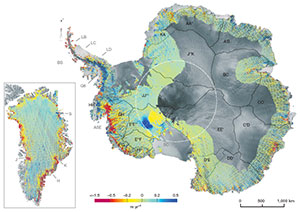 Notice how the thinning matches up with the GRACE and GPS data from Kahn paper. So that's three independent datasets (four, if you include prior radar altimetry data).
Thanks for pointing this one out, John. Now to get a copy of that paper for my own post at S&R.
Notice how the thinning matches up with the GRACE and GPS data from Kahn paper. So that's three independent datasets (four, if you include prior radar altimetry data).
Thanks for pointing this one out, John. Now to get a copy of that paper for my own post at S&R.
-
Albatross at 03:51 AM on 31 March 2010The human fingerprint in global warming
Sorry folks. The PW water link @ 68 is broken. It should be: http://www.pnas.org/content/104/39/15248.full The link for the NERSC summary is also broken: http://www.nersc.gov/news/annual_reports/annrep03/advances/5.1.fingerprints.html -
Geo Guy at 03:48 AM on 31 March 2010Greenland's ice mass loss has spread to the northwest
I think this post characterizes what Alarmists tend to say. The ice is disappearing hence increased CO2 is to blame. Nothing could be further from what is truly happening. For starters, ice can disappear by evaporation and sublimation resulting from wind blowing over its surface. Of course the predictions of massive sea level rises don't factor in this. John Daly, who has written a number of books arguing against the alarmist view, has posted temperature data that he obtained from GISS and CRU. He subdivided the data into regions, including the Arctic, and has data from a number of stations located in Greenland. http://www.john-daly.com/stations/stations.htm What is interesting is the temperature plots from 1930 onwards from stations located on Greenland show consistent temperatures and no rising temperatures - especially the the heights needed to melt glacial ice. Here are a few examples: http://www.john-daly.com/stations/dmkshavn.gif http://www.john-daly.com/stations/egdesmnd.gif http://www.john-daly.com/stations/ilulissa.gif http://www.john-daly.com/stations/janmayen.gif On another note regarding isostatic recovery, it should be noted that the norther part of North America is still rising. Canadian scientists have noted that while sea levels elsewhere in the world have risen marginally, they have found no signs of similar rising in the Canadian artic. They have concluded that this phenomenon is the result of isostatic recovery. What climate scientists need to take into account is the amount of water being displaced by this isostatic recovery - said water of course flowing into the other oceans and contributing to their rise. In other words, not all of the rise in ocean levels can be attributed to glacial melting. Finally you have to understand that when glaciers move, they are not melting but are growing. Glacial ice disappears from melting AND evaporation and sublimation. Since historical Greenland temperatures appear to be somewhat static since the 1930's, and keeping in mid that even if they are warmer than in the past, temperatures still remain sub-zero for most of the year, it is unlikely that any melting of Greenland ice is attributed to higher temperatures brought on by increased levels of atmospheric CO2. Scientists should look elsewhere for the cause if they are serious in trying to determine what is happening there. -
Albatross at 03:45 AM on 31 March 2010The human fingerprint in global warming
I'm a little surprised that there has not been much (if any) discussion yet on the seminal fingerprinting techniques used by Santer and others. Perhaps it is because their technique relies on a combination of observations, modelling and reanalyses (model runs constrained by observations). Regardless, Santer et al. have a few papers in which they make a very convincing case that the response of the biosphere has a marked human influence via higher concentrations of GHGs-- that is, the recent changes cannot be explained solely by internal climate variability or other natural drivers of climate. Here are some links: The human fingerprint on increase in precipitable water over the oceans The human fingerprint on changes in the height of the tropopause And another paper in Science There is also a summary here and here -
pohjois at 02:29 AM on 31 March 2010How you can support Skeptical Science
Congratulations for your fantastic effort. I rate your site as the best climate-related in known Internet. There are some problems with some arguments in Polish - the short explanation is fine, but then the link leads into some non-existent page. It would look much better if the dummy page with "Not translated yet" or something similar would be present instead. Thank you for this site.Response: Thanks for pointing this out, the error has been fixed. Those pages had been translated, it was just a glitch with the URL addressing. -
Chris G at 01:52 AM on 31 March 2010Greenland's ice mass loss has spread to the northwest
Also Lou (#17), what I've read on the PIG leans towards the collapse becoming more of a prolonged calving event rather than an abrupt, tsunami-inducing slip. That makes sense to me since the underlying topography slopes upward toward the sea, up to the outlet, which is the current grounding line. It would be similar in nature, though larger, than what is happening with the Columbia glacier. RealClimate post Articles: http://www.sciencemag.org/cgi/content/abstract/291/5505/862 http://tintin.colorado.edu/.../MeierPost_FastTidewaterGl_JGR_1987.pdf -
Tom Dayton at 01:44 AM on 31 March 2010The human fingerprint in global warming
Martin Hedberg, there is a relevant post on RealClimate, about a new paper describing how fast CO2 levels would drop if human emission suddenly went to zero: Climate Change Commitments. And I think you're right that more conversation on this topic should happen over at the thread Airborne fraction of CO2. Other folks will notice your comments and follow you there. -
Ned at 01:22 AM on 31 March 2010Greenland's ice mass loss has spread to the northwest
Nope, the PIG isn't that big, though PIG is huge for a glacier. The entire drainage area for PIG is about 10% of the West Antarctic Ice Sheet, so even if all of that ice went into the ocean it would be less than 1 m SLR. Either Lovelock was being misquoted or his imagination was running away with him. -
johnd at 01:04 AM on 31 March 2010The human fingerprint in global warming
re GFW at 15:56 PM on 30 March, with regards to your comment about gases in bulk, warm gases rising etc, all CO2 produced by burning fossil fuels leaves the combustion at an elevated temperature. I expect that it then both rises and begins dissipating heat energy until it acquires equilibrium with the surrounding air. At what point would the now cooled CO2 begin re-absorbing IR radiation, and if it was to re-radiate it downwards to the surface, where has the surface heat dissipated to that allows a temperature differential to develop between the warmer CO2 and the cooler surface. If the surface was able to cool sufficiently to create such differential by dissipating it's heat energy upwards, why then was the CO2 not also dissipating it's heat energy in the same direction and at the same rate as the surface? In fact should not gases such as CO2 reach equilibrium faster than the surface? -
Lou Grinzo at 00:00 AM on 31 March 2010Greenland's ice mass loss has spread to the northwest
One thing that caught my eye just a few minutes ago was this snippet from an interview with James Lovelock, talking about what it would take to make us take action on climate change: ------------------------------ There has been a lot of speculation that a very large glacier [Pine Island glacier] in Antarctica is unstable. If there's much more melting, it may break off and slip into the ocean. It would be enough to produce an immediate sea-level rise of two metres, something huge, and tsunamis. ------------------------------ Two meters? Is the PIG really that big? This is the first time I've seen someone provide a number for such an event. Even assuming a fairly large fudge factor, 2 meters of "immediate" SLR is an astounding number. Source for the above quote: http://www.guardian.co.uk/environment/blog/2010/mar/29/james-lovelock -
mspelto at 23:31 PM on 30 March 2010Greenland's ice mass loss has spread to the northwest
The spread of the mass loss to the northwest over this time period represents the shifting of the maximum ice melt anomalies from southern Greenland beginning in 2002-2007 Tedesco et al., 2008 . Whereas northern Greenland began a series of substantial melt anomalies in 2005, with 2008 being the record. Box et al. 2009 This has had implications for the Petermann Glacier in northern Greenland which has the longest floating glacier tongue in the Northern Hemisphere. Petermann Glacier Retreat -
Ned at 23:16 PM on 30 March 2010Greenland's ice mass loss has spread to the northwest
To clarify my comment above, over the past decade the rate of ice loss from Greenland accelerated by about 11% per year. This is highly unlikely to continue (there would be no ice left by ~2075 or so). If that acceleration dropped to 3% per year tomorrow and continued for the rest of the century, you'd end up with 0.3 to 0.4 m SLR from Greenland, 1.0 m SLR total. Greenland would still have 93% of its ice. The ablation rate in 2100 would be around 4000 GT/year, compared to 286 GT/year in 2009. That's still a big increase in ablation over the next 90 years, but much more reasonable than Berényi Péter's calculations above. -
Ned at 22:22 PM on 30 March 2010Greenland's ice mass loss has spread to the northwest
Argus writes: Also, (Wikipedia) mean annual temperatures on the ice sheet domes are -31°C (on the north-central part of the north dome), and -20°C (at the crest of the south dome). How is ice going to melt with those kind of temperatures? Ice melts below the equilibrium line, and ice is discharged into the sea by marine terminating glaciers. Ice in the center of the sheet then flows outward. -
Ned at 22:18 PM on 30 March 2010Greenland's ice mass loss has spread to the northwest
Berényi Péter , you need to read more carefully. John Cook wrote Various independent studies predict global sea level rise of around 1 to 2 metres by 2100, with Greenland being a significant contributor (Vermeer 2009, Pfeffer 2008). That does not mean that Greenland's contribution alone would be 1-2 m of SLR. Read the two papers that John linked. Pfeffer et al. 2008 derive total SLR of 0.8 to 2.0 m by 2100, with 0.2 to 0.5 m of that coming from Greenland and the remainder from Antarctica, other glaciers & ice caps, and thermal expansion. Vermeer and Rahmstorf 2009 give a range of 0.8 to 1.8 m by 2100, again including a mix of contributions from all the above sources. From the Velicogna paper that BP cites, ice mass lost from Greenland in 2007-2009 averaged 286 Gt/yr. The 21st century average would only have to be a factor of about 4-5 greater than this to yield +0.3 m SLR from Greenland and +1 m SLR total. Considering that the rate of loss of mass from Greenland doubled over the 2002-2009 period, this doesn't seem especially farfetched. -
Argus at 21:21 PM on 30 March 2010Greenland's ice mass loss has spread to the northwest
# Berényi Péter, Thank you for giving us the correct numbers, and a more realistic view on the Greenland ice, than the ones coming from makers of the usual panic reports! In Wikipedia (''Greenland ice sheet'') I just read that 'the warmest decades were the 1930s and 1940s'. Not now. Why was nobody alarmed 70 years ago? Also, (Wikipedia) mean annual temperatures on the ice sheet domes are -31°C (on the north-central part of the north dome), and -20°C (at the crest of the south dome). How is ice going to melt with those kind of temperatures? -
fydijkstra at 21:18 PM on 30 March 2010Greenland's ice mass loss has spread to the northwest
There is no reason to extrapolate the current Greenland ice loss for many decades into the future. The current ice loss has only little to do with general global warming. Persistent patterns of wind have caused an abnormal warming in the Arctic region. That pattern can change again, and probably will, as it has often done. That would reverse the current alarmist predictions. -
Ned at 20:38 PM on 30 March 2010The 5 characteristics of scientific denialism
Earlier in this thread (e.g., here) I mentioned that several people have managed to do independent replications of the global mean surface temperature analysis using GHCN stations (i.e., replicate the results of GISSTEMP, HADCRU, etc.) Zeke Hausfather has helpfully compiled links to five of these analyses and has done some comparisons. Here is the 1880-present global land temperature trend in all the studies except those from Tamino and Clear Climate Code (the CCC one is so close to GISSTEMP that the two are more or less indistinguishable): Zeke also computed linear trends over various time intervals. Over the last three decades GISSTEMP has the lowest trend, NCDC has the highest trend, and all the "independent blog studies" show trends in the middle of the range.
-
Riccardo at 20:31 PM on 30 March 2010Greenland's ice mass loss has spread to the northwest
Arjan, unfortunately no one still came out with a reliable ice sheet dynamics model. The IPCC AR4 did not include the ice sheet melting contribution to sea level rise because a reliable prediction was not possible. From then, scientists made a few step forward, but more than this it is the new data that rise concern. Although still not conclusive for accurate projections, the new data show acceleration of melting in Greenland, in West Antarctica and possibly even in East Antarctica. And we know from paleo reconstructions that rates of the order of meters per century are indeed possible. Although no one can say conclusively that the current acceleration trend will continue, all the signs point in this direction. As for The Netherlands, already in 2008 your Delta Commitee projected 0.65-1.3 meters by 2100. They included the caveat of the unknown response of Greenland and Antarctica ice sheets and concludes "that this level may be higher than has been assumed up till now.". But, according to the Delta Committee, the impact will vary in different part of the coast. The engineer point of view is not general and needs an expert and specific advice. -
Ned at 20:14 PM on 30 March 2010A peer-reviewed response to McLean's El Nino paper
Philippe Chantreau writes: Jonicol, you complain, unjustifiably, about people not using their real names, yet don't reveal yours? Actually, at the end of his first comment here he does sign it "John Nicol PhD (Physics)."
Prev 2448 2449 2450 2451 2452 2453 2454 2455 2456 2457 2458 2459 2460 2461 2462 2463 Next






