


 Arguments







Recent Comments
Prev 2576 2577 2578 2579 2580 2581 2582 2583 2584 2585 2586 2587 2588 2589 2590 2591 Next
Comments 129151 to 129200:
-
Quietman at 04:30 AM on 12 July 2009It's the sun
Gord Re: "Don't understand?...It's OK....everybody else will." Sorry. I don't understand. I don't what is "Baghdad Ali". -
Quietman at 04:17 AM on 12 July 2009The CO2/Temperature correlation over the 20th Century
"We did not about the increase" s/b We did not KNOW about the increase -
Quietman at 04:15 AM on 12 July 2009The CO2/Temperature correlation over the 20th Century
Thumb The Arctic is not about CO2. It's about tectonic plates. We did not about the increase in the Arctic ridge until the past couple of years, It was even not about the under volcanoes erupted until they put together the quakes with the eruptions BEFORE the recent eruptions in Alaska. They also show the subduction zone in NE Greenland but they recognize the thin crust and hot spot and Greenland active volcanoes the "might add to the glacier melt". See the volcano threat here. http://www.skepticalscience.com/volcanoes-and-global-warming.htm -
Dan Pangburn at 23:25 PM on 11 July 2009It hasn't warmed since 1998
Since the year 2000, atmospheric carbon dioxide has increased 18.4% of the increase from 1800 to 2000. According to the average of the five reporting agencies, the trend of average global temperatures since 1998 shows no increase and from 2002 through 2008 the trend shows a DECREASE of 1.8°C/century. This SEPARATION (there have been many others) corroborates the lack of connection between atmospheric carbon dioxide increase and average global temperature. I wonder how wide the separation will need to get before the IPCC and a lot of others are forced to realize that maybe they missed something. As the atmospheric carbon dioxide level continues to increase and the average global temperature doesn’t it is becoming more and more apparent that many Climate Scientists have made an egregious mistake and a whole lot of people have been misled. -
Mizimi at 21:56 PM on 11 July 2009Climate's changed before
Thanks QM; an interesting article. I shall have to go and revisit clathrate physical/chemical properties. From what I recall, they only form under extreme pressure/low temperature conditions ( which is why they are mostly found in very deep water). -
Mizimi at 21:34 PM on 11 July 2009Water vapor is the most powerful greenhouse gas
There is considerable evidence that man's activities are changing the distribution of WV with consequential effect on climate. Deforestation has decreased evaporation by around 3000cubic/k/a which is mostly balanced by increases from agricultural evaporation of # 2600c/k/a. To that must be added the estimated loss of 400 c/k/a from industry, commercial, municipal use and reservoirs. The system seems to be in balance. However, the flow pattern of WV has changed, with subsequent effects on climate....this is explored from an agricultural view in "Human modification of global water vapor flows from the land surface." published online at PNAS ( the address is just too long to post) and the authors conclude that until modellers include redistribution of WV, GCM's cannot be considered to adequately describe real world conditions. -
thingadonta at 20:13 PM on 11 July 2009Greenland was green in the past
Greenland was relatively warm between about 800-1300 AD due to the well-defined 1500 year solar cycle, as detailed by Singer and Avery in: "Unstoppable global warming every 1500 years". We are currently in another upswing in the solar cycle, which started about 1750, and which will probably rise about another 0.5-1 degree C over the next few hundred years. Current T to the 21st century is entirely in line with this solar cyle trend. C02 is irrelevant to this cycle,it has been traced 600 times over the last 1 million years in ice cores, and is a result of an overlap between the 87 and 210 year solar cycles. It is well documented, world wide, and climatologists have conveniently forgotten about it (see reference given above). Greenland was settled by vikings during the last solar warming period, which is also why they travelled so far in general during this time period-the northern world was warm. -
thingadonta at 19:01 PM on 11 July 2009Climate time lag
There is a 1500 (1470) year natural solar cycle, which is a superimposed 87 year and 210 year solar cycle overlap. It has been traced 600 times over the last 1 million years in ice cores, is very consistent, and we are currently about halfway through the latest solar warming trend, which started in about 1750; T will rise another 0.5-1 degree C over the next few hundred years, from the sun, as it has already risen about 0.8-1 degree C since 1750, also because of the sun. C02 is irrelevant to this trend. Current T is entirely in line with this well-defined 1500 year solar trend. Reference: "Unstoppable global warming every 1500 years" by F.Singer and D.Avery. They also trace numerous studies which confirm the trend, eg the medieval warm period, the little ice age etc etc. -
Philippe Chantreau at 15:59 PM on 11 July 2009Climate time lag
The Cazenave paper states that the sea level increase of the past 5 years is due to increase of the oceans' mass due to shrinking land ice, both from polar ice caps and mountain glaciers. It seems that perhaps that could prevent too much warming from comparatively modest forcings. There has to be a reason for all that ice to melt. It also seems to undermine your assertion about the "total energy in the system." We're missing big chunks of ice that have now become water. What is exactly the 1000 to 1500 years cycle that you refer to? -
Robbo the Yobbo at 10:51 AM on 11 July 2009Climate time lag
I wonder why the cloud nucleation should be instantaneuos and why there should be therefore an immediate link to the 11 year solar cycle. Ionised aerosols are much smaller than cloud condensation nuclei. It must take some time to coalesce into larger particles and then to accumulate water vapour. There is an obvious 20 to 30 year cooling and warming pattern in global temperatures - as well as longer (1000 to 1500 year) cooling and warming. Unless we can distinguish clearly between natural variation and anthropogenic global warming - the attribution problem is not solved. The heliospheric/cosmic ray/ cloud connection is the leading contender for a source of the variation on these timescales. The basis of the concept relies is in analysis of beryllium and carbon isotopes form ice cores. The correlation over more than a thousand years is best with a 10 year lag. But this is only a correlation. The essential question is, because it is fundamental to assumptions about TOA fluxes (and therefore the time lag and cimate sensitivity), is whether clouds are changing in reality and from observation - and what are the implications. Clouds decreased from 1984 (when the reconstructions commence) to 1998 - with an increased shortwave forcing at the surface of 3 to 4 W/ms. Cloud cover has subsequently increased decreasing the shortwave forcing by 2 W/m2. Ocean heat content has, at a minimum, not increased since 2008. That is clear in: Sea level budget over 2003–2008: A reevaluation from GRACE space gravimetry,satellite altimetry and Argo A. Cazenave a,⁎, K. Dominh a, S. Guinehut b, E. Berthier a, W. Llovel a, G. Ramillien a, M. Ablain b, G. Larnicol b Also in the recent work by Willis referred to elsewhere and the 2009 Energy and Environment Article by Loethe. At the same time the monthly values of global surface temperature continue to decline. People are hoping that surface temperature will reach a new record if an El Nino forms in the boreal summer. The strength of El Nino is statistically correlated with the state of the Pacific Decadal Oscillation. While the PDO is cool - it is hugely unlikely that a strong El Nino will form. NASA is predicting record temperatures when El Nino returns. It is not even close this year and we will return to La Nina next year. Energy can be transferred betwen the ocean and atmosphere - especially in ENSO events. However the total energy of the ocean and atmosphere (barring volcanos) cannot decline with the forcings given by the IPCC. It seems likely that there is less energy in the climate system today than in 2005. This is a serious problem for AGW theory. - although I am anticipating that Chris will argue that there is more energy. It is hiding perhaps under a rock. -
shawnhet at 06:56 AM on 11 July 2009Climate time lag
Philippe, you may not care for the tone of the Shaviv's reply, but it seems to me that the long-term correlation btw CRF and climate has very strong evidentiary support, whether or not it can be separated from noise for the short term. There are many papers that demonstrate such a correlation - see here for example. http://geology.gsapubs.org/content/37/1/71.abstract BTW, I would not be so quick to accept chris's assertion that there is no link btw CRF and clouds. In the discussion on Shaviv's page, he states the following: "The next criticism Sloan and Wolfendale raise is the fact that when the cloud cover is correlated with the cosmic ray flux over the 11-year solar cycle, it appears that the cloud cover leads the cosmic ray flux variations by about 3 months (see panel 2 of fig. 1 above). If cosmic ray flux affect the cloud cover, such a lead should not be observed." (Shaviv then goes on to discuss his reasoning why this objection doesn't apply). Cheers, :) -
Robbo the Yobbo at 06:17 AM on 11 July 2009Does ocean cooling disprove global warming?
Look - you can have a go at me but leave Freddy out of this. Svensmark-Friis-Christensen have obviously interpreted the data they present differently to you. But this was a paper that you originally introduced. Let's not worry about that - but concentrate on the peer reviewed work. To quote Jasper Kirkby – ‘The data for the period 1957–2001 show the solar cycle modulation and the effect of geomagnetic shielding, which leads to reduce fluxes and modulation amplitudes at lower geomagnetic latitudes (Fig. 7). Although the GCR reduction occurred mainly in the first half of the twentieth century (Fig. 6), the cosmic ray measurements shown in Fig. 7 suggest a continuing decreasing trend in the second half of the century, by a few per cent in the lower stratosphere and upper troposphere… On the other hand, there has been a substantial increase of solar magnetic activity since the Little Ice Age, and a corresponding reduction of the cosmic ray intensity. This suggests that the possibility of an indirect solar mechanism due to cosmic-ray forcing of the climate should be seriously considered.’ There is a cloud and cosmic ray correlation here – not sure how reliable it is. http://www.sciencebits.com/CosmicRaysClimate I don’t think it works like that – there is a lag between cosmic ray intensity and global cloud cover. The basis of the idea is in the record of cosmogenic isotopes preserved in ice cores. A well known correlation of isotopes of beryllium and carbon and global temperature reconstruction over more than a thousand years. Hence the link between heliospheric modulated cosmic rays and climate. The best correlation is with a 10 year lag. The most likely connection is through ionisation of aerosols and subsequent growth of cloud condensation nuclei. The core of the science is pretty solid and widely accepted as the dominant cause of climate change prior to 1975. We are only quibbling about a supposed divergence of trends post 1975. Neutron counts peaked in 1991. Usoskin calculated a cosmic ray modulation parameter which peaked strongly in 1991. Cloud cover peaked in 1998. Global surface temperature peaked in 1998. Ocean temperatures are falling or at least steady in the ARGO data. Usoskin et al - Heliospheric modulation of cosmic rays: Monthly reconstruction for 1951–2004 http://cosmicrays.oulu.fi/phi/2005JA011250.pdf I have referenced CERN, the Hadley Centre, the Max Planck Institute and the Sodankyla Geophysical Observatory. There is nothing dubious about the science. The only question is by how much cosmic rays influenced climate in the late 20th century. -
Philippe Chantreau at 04:45 AM on 11 July 2009Climate time lag
A question for Chris, since I could not read through that paper: does "an increase in ionization by a factor of 10" correspond to what happens in nature? -
Philippe Chantreau at 04:42 AM on 11 July 2009Climate time lag
The CRF-cloud relation is not at all so obvious as "skeptics" like to claim. Chris' point about the lack of cyclic variations in phase with solar cycle is a major hurdle in pursuing that hypothesis. Sawhnet, would you expect anything not in defense of his pet theory on Shaviv's personal blog? Any blog post including these words "many in the climate community try to do their best to disregard the evidence" is going to be met with great skepticism by me. I'm sure that, as a self proclaimed skeptic, you can understand. -
shawnhet at 01:58 AM on 11 July 2009Climate time lag
Chris, can you post the material pertaining to the "20-1500 times realistic true atmospheric levels" you mention above? The only link to the paper I have found is behind a pay wall. I find this interpretation odd, because it seems to contradict earlier work by the some of the same authors see here - http://adsabs.harvard.edu/abs/2006cosp...36.2889P where they claim that the levels of SO2 ozone and WV are atmospherically relevant. Further, just for people's information, here is a very good discussion on the state of play of the cosmic ray hypothesis IMO. http://www.sciencebits.com/SloanAndWolfendale "One last point. Although many in the climate community try to do their best to disregard the evidence, there is a large solar-climate link, whether on the 11-year solar cycle (e.g., global temperature variations of 0.1°C), or on longer time scales. Currently, the cosmic-ray climate link is the only known mechanism which can explain the large size of the link, not to mention that independent CRF variations were shown to have climatic effects as well. As James Whitcomb Riley supposedly once said: "If it walks like a duck and quacks like a duck, I would call it a duck"." Cheers, :) -
thingadonta at 23:15 PM on 10 July 2009The CO2/Temperature correlation over the 20th Century
re 61: pretty good post. I think clouds are the key, they will enhance solar increases signficantly. Also your point: "The idea that sulphur dioxide masked warming between the mid 1940’s and 1975 isn’t realistic as the GISS calculated net forcing is positive other than in episodic (and short lived) periods of volcanic perturbation" Another problem with the aerosol idea ~1950-1980 is that they contradict what actually happened in the USA/Europe where they were being emitted between 1950-1980-these were the same areas where surface T increased mostly in the 20th Century... -
thingadonta at 22:57 PM on 10 July 2009Climate time lag
Nice reply, I need to do more research here, I only note that clouds are weird, and also point out that any small global changes in cloud cover would have VERY strong forcings-you can observe this on any cloudy/foggy morning. Note also that the sun 'burning' off low clouds (like burning off fog), even if only a small amount- is hardly mentioned by most reseachers (think Europe in the middle ages compared to today-look at the Dutch 17th Century paintings!). Cloud 'forcings' would be large, and could be strong enough to explain T changes in the 20th century- IF they respond to small changes in solar activity etc, but I note that heat T lags are not mentioned by the Danish scientists etc. -
Robbo the Yobbo at 21:03 PM on 10 July 2009The CO2/Temperature correlation over the 20th Century
Usoskin correlated cosmogenic isotopes of beryllium and carbon with a global temperature reconstruction and found the best fit with a 10 year lag. The isotopes are formed when hit by cosmic radiation which is modulated by heliospheric magnetic intensity. The likely connection of cosmic rays to climate is in ionisation of aerosols in the atmosphere and subsequent growth of cloud condensation nuclei. Heliospheric magnetic intensity peaked late last century on at least a thousand year high – in fact, as Usoskin shows, a very similar hockey stick shape as temperature. With the appropriate bends for the medieval warm period and the little ice age. Usoskin’s data stopped in 1975 – but the comment was made that global temperature and heliospheric modulation of cosmic rays diverged after 1975 and this has been repeated ad nauseum. Usoskin makes a more measured contribution to this latter discussion here: Usoskin et al - Heliospheric modulation of cosmic rays: Monthly reconstruction for 1951–2004 http://cosmicrays.oulu.fi/phi/2005JA011250.pdf The cosmic ray modulation parameter is shown to peak around 1991 and this is entirely consistent with global temperature and cloud parameters. The idea that sulphur dioxide masked warming between the mid 1940’s and 1975 isn’t realistic as the GISS calculated net forcing is positive other than in episodic (and short lived) periods of volcanic perturbation. The cooling is especially evident in the Artic temperature record. The Pacific Decadal Oscillation is a clue to the underlying cause of mid century cooling. The cool period of the PDO extended from the 1946 to 1975 but could a tiny cool spot in the north eastern Pacific affect global temperature so dramatically? Hardly likely. The PDO is associated with changes in ENSO. Cool modes bring more intense and frequent La Niña and warm modes more frequent and intense El Niño. We can show this with statistical analysis of rainfall records – which was my starting point. However, I doubt that even that is much of a multi decadal cooling influence. Instead, I believe the 20 to 30 year PDO is an effect rather than a cause. The heliospheric link to clouds appears to be firmly based in science and the heliosphere varies on a 22 year solar magnetic polar reversal cycle. The polar magnetic reversal occurs in the 11 year solar cycle about 2 years after solar maximum. There is an 11 year period of higher magnetic intensity followed by 11 years of reduced magnetic intensity. This is obviously a thought in progress – I think I need another 20 years of data. Nonetheless, I am working on the assumption that there is actual shortwave heating and cooling of the world ocean on 20 to 30 years cycles. There is a balance between the resistance of a warm surface layer to the penetration of cold subsurface currents and this is particularly apparent in the sweet spot in the north eastern Pacific. A little cooling and cold water upwells strongly. A little warming and it is suppressed. The same heating and cooling happens in the central Pacific with a 2 to 7 year ENSO cycle superimposed. The shortwave heating and cooling shows up in International Satellite Cloud Climatology Project records. Declining cloud cover from the start of records in 1984 to 1998 and about 4W/m2 additional shortwave radiation at the surface. Increasing cloud cover from 1999 to 2008 and about 2 W/m2 less shortwave radiation. The PDO was originally defined in terms of fisheries productivity associated with sea surface temperature changes. Upwelling cold and nutrient rich water in a cool mode provides a huge boost to fisheries and the reverse happens in a warm mode. The biological indicators suggest that the current cool mode commenced after 1999. There’s at least three linked sceptical arguments and one that is totally original – heard here first. Surely, I get sceptic of the week? Cheers Robbo -
chris at 19:48 PM on 10 July 2009Climate time lag
re #15 thingadonta The "chilling stars" Danish scientists certainly don't consider that there is a lag between solar effects and the cloud/climate response. There are three very significant problems with your argument. For example, have a look at the web article on the website of the Danish scientists here: www.spacecenter.dk/publications/scientific-report.../Scient_No._3.pdf If you look at Figure 1 and 2 (especially 2b) you'll see that the Danish scientists attempt to define correlations between solar parameters (they use the cosmix ray flux-CRF, but since all the solar parameters cycle in phase with the solar cycle, this could be solar irradiance or whatever). Are there "lags" in the solar/temperature response demonstrated by these authors? No. They attempt to show that the CRF matches the temperature response effectively with zero lag. The second problem relates to the solar-cloud link. This is normally made in relation to the hypothesis that variations in the cosmic ray flux (CRF) modulated by the solar variation, results in changes in low level clouds. The idea is that the cosmic rays nucleate cloud formation, such that a high CRF (bottom of solar cycle) leads to lots of clouds (and vice versa). Again, the cloud nucleation effect is essentially instantaneous [***]. No lag in cloud levels expected, and there should be a minimal lag in the onset of the temperature response , especially in the atmosphere. The third problem relates to cloud formation. Although the CRF proponents seem to be attempting to insinuate that tiny secular changes of a few percent have altered cloud levels (and this earth temperature) in a significant manner throughout the latter part of the 20th century, they leave unspoken a rather fatal flaw in their analysis. While the secular long term CRF variation since the onset of detailed measures (1958) has been negligible (see Figure 2 of the Svensmark-Friis-Christensen web report I urled above), the variation of the CRF within the solar cycle is very large indeed...it can be up to 25%. Therefore if changes in the CRF dramatically influence low level clouds in a climatically-meaningful manner there should be large and obvious cyclic changes in the cloud levels as the solar cycle waxes and wanes.... ...except that there aren't: http://isccp.giss.nasa.gov/climanal1.html ............................................. [***] Svensmark has recently published his data on cloud nucleation by gamma rays in a model system containing atmospheric pollutants (SO2 and ozone). He had to use very high aerosol concentrations (20-1500 times realistic true atmospheric levels) in order to detect nucleation with his particle detector. Nevertheless, the nucleation occured rapidly (max nucleation within 10 minutes of onset of iradiation). There we don't expect a lag between CRF changes and changes in nucleation events leading to putative cloud formation in the atmosphere, even if cloud formation itself may take some time (minutes/hours) to arise from nucleation. MB Enghoff, JOP Pedersen, T Bondo†, MS Johnson, S Paling and H Svensmark (2008) Evidence for the Role of Ions in Aerosol Nucleation J. Phys. Chem. B 112, 10305–10309 abstract: Aerosol nucleation has been studied experimentally in purified, atmospheric air, containing trace amounts of water vapor, ozone, and sulfur dioxide. The results are compared with model calculations. It is found that an increase in ionization by a factor of 10 increases the production rate of stable clusters by a factor of 3, probably due to ion-induced nucleation. -
chris at 17:44 PM on 10 July 2009Does ocean cooling disprove global warming?
re #51 It's the data that Svensmark and Friis-Christensen present, Rob, and not their interpretation. One should address the data in a paper before considering the reliability of what the authors say. They show very clearly in their Figure 2B their consideration of the CRF since 1958. There is virtually zero secular trend over this period (a slight cooling contribution, if anything). Are you suggesting they don't believe their own data presented in the figures they prepare and present? If the stongest advocates of the CRF-cloud-climate connection show there has been zero CRF contribution to any cloud-climate secular variation (outwith the solar cycle), then one can hardly try to sneak a CRF-cloud-climate connection for the very large late 20th century and contemporary warming in by the back door! The CRF data in the Jasper Kirby article is more or less the same. I don't think there is anything controversial about that. Incidentally, the Svensmark-Friis-Christensen is another of those examples of dismal science from a small sub set of the proponents of the CRF-climate "link". They totally misinterpret the Lockwood-Frolich paper, which nowhere stated nor inferred that the "historical link between the sun and the climate came to an end about 20 years ago". Lockwood and Frolich (proper solar scientists) showed that all of the measurable solar parameters were in the wrong direction for warming since around the mid-late 1980's. The point is that the CRF simply hasn't undergone any trend during the period in which it has been monitored in detail, that could have made any significant contribution to the very marked warming of the last 30-odd years (a secular trend of only a few % according to Jasper Kirby in the web paper you brought to our attention). This is a severe problem for those who assert a strong CRF-cloud-radiative forcing connection, since during the solar cycle the CRF can vary by up to 25% (see Svnsmark-Friis-Christensen Figure 2). Clearly if virtually zero long term change in the CRF can influence the cloud coverage in a way that you seem to be inferring (and Jason Kirby makes a bit of an inference in that direction too, without coming right out and stating this - see page 7/8 of his article), the CRF-cloud link must be exquisitely sensitive. Why then if we inspect the albedo-cloud-moonshine data in the Palle and Goode articles we have been discussing, do we see no cyclical variation of cloud/albedo/moonshine through the solar cycle with its very large changes in CRF? Even your blind Freddy (poor chap!) would consider that a rather problematic flaw in the dodgy CRF-cloud-climate notion. -
thingadonta at 16:43 PM on 10 July 2009The CO2/Temperature correlation over the 20th Century
re50: "that no environmental concern must ever get in the way of, hell, must never even pause, neoconservative laissez faire unregulated capitalism for the very rich - and therefore no fact can ever demonstrate the failure of their ideology"... Yawn. I suppose radical socialist-intellectuals have a completely rosy record?? Did it ever occur to you that bureaucrats and intellectuals can have self-serving interests/bias? Who regulates the regulators?? (Note: Karl Marx scoffed at the idea that the new 'factory managers' could be tempted to distort/exploit the system for their own benefits. What naivety). The question is not left versus right, or market forces versus socialist ideology and/or regulation, but a breakdown in regulation/uncertainties in modelling/ideology in human thought (ie on both 'sides'). If you want historical examples of where intellectualism and modelling/ideology can go drastically wrong (on both 'sides'): - Richard Pipes of Harvard blames radical academics for providing the foundation, framework and justfication for radical Bolshevic communism in the late 19th century-early 20th century. -Weikart blames German Social Darwinists and intellectuals in the late 19th-early 20th century for providing the foundation, framework and justification for radical Nazism -Social Darwinists/Eugenics movement came from within radical academics and intellectuals, who also attempted to impose their 'science model' on the world in the early 20th century (with Nazism as an offshoot of this). -The financial crisis of 2000s, where the 'expert banks' and their modellers got it all wrong. -Human-induced global warming modellers, (>90% sure that there is >90% effect from human activity). The jury is still out on the last one, but their general manner and methods, in my opinion, are not all that dissimilar to the previous ones. AGW just could be a form of socialist-determinism-the bane of the 20th century-eg in biology and ethics (eugenics), radical socialism (communism), Nazism (biology and race), AGW (?socialist-determinist distortion and control of energy?) -
thingadonta at 16:20 PM on 10 July 2009Climate time lag
Another issue about time lags and solar changes: it isn't only solar irradiance that causes T on earth to warm, less low cloud cover is one example which would magnify a slight solar radiation increase. Your data seems to contradict that of Danish solar scientists (eg the book 'the Chilling Stars'), which state that total solar effects peaked in 1985, not the mid 20th centuy. In cold-temperate climates, a slight increase in solar irradiance most significantly reduces cloud cover, as the sun 'burns off' low clouds (just like early morning fog- but only when condensation points are already close to T already-ie in cold-temperate climes), however in tropical climes a slight increase in T/solar irradiance may increase overall cloud cover (the process is not linear). This effect would cause surface T in temperate climates (eg USA/Europe)to rise more than tropical climates, which is also what is observed. The troposphere mostly above ? the reduced low cloud cover shouldnt heat much?, which is also what is observed. Note also, that once low clouds pass their condensation point, they disappear very quickly (ie a tipping point), which would produce a sharp spike in T, and this is not a linear, smooth process-the same as on a cold morning fog, once it has gone. As for time lags, the cold-temperate oceans, with less cloud cover (following a slight rise in T), would heat slower than the land. Whether or not the clouds in tmerpate zones would take time (ie years-decades) to 'burn off' is another possible T lag. I also note that paintings in the 'litle ice age' are generally more cloudy than modern european climates. Danish solar scientists state that solar effects peaked in 1985, not the 1950s (including ?cosmic rays, ?clouds, ?solar magnetics), and with a heat time lag of ~10 years, would bring a peak in the mid-late 1990s, which is also what is observed. And what about solar magnetic field, and cosmic rays. Solar irradiance is not the only solar effect, and non-linear effects may account for recent warming trends. T has now flattened since ~2003, and the worlds governments are going to look pretty silly when T doesnt rise onver the next 10-20vyears, since solar activity has now waned, and c02 does hardly anything at all. -
JCLadybug at 13:38 PM on 10 July 2009The CO2/Temperature correlation over the 20th Century
Question. So I know from the Calvin cycle and from the relative pH of water that as temperatures warm up they CAUSE carbon dioxide levels to increase. Isn't it a circular argument to say that inverse. Wouldn't the temperatures just simply continue to increase if both statements are true? -
JCLadybug at 13:17 PM on 10 July 2009The CO2/Temperature correlation over the 20th Century
Question. So I know from the Calvin cycle and from the relative pH of water that as temperatures warm up they CAUSE carbon dioxide levels to increase. Isn't it a circular argument to say that inverse. Wouldn't the temperatures just simply continue to increase if both statements are true? -
Thumb at 12:59 PM on 10 July 2009The CO2/Temperature correlation over the 20th Century
"It's up to you to prove that it is warming" Have you been watching the Arctic or Greenland? What about glacier retreat in general, or the rising ocean levels? I thought the new argument was that the Earth was warming but it's not our fault. Now the argument is, in spite of the events I listed above, that the earth is cooling because it's not warming in a straight linear progression since it's peak in 1998? Or is it that it's warming but it's all a big multi-decades long lag effect from the sun? It's really tough to keep up sometimes. -
Robbo the Yobbo at 12:46 PM on 10 July 2009Does ocean cooling disprove global warming?
On nett climate effects from clouds - it is indeterminate - but simply to discount the SW effect by assuming no nett effects is less than scientific. There is a beautiful new site at: http://www.climate4you.com/ClimateAndClouds.htm It is worth checking the entire site. It provides nice pictures and graphs on all sorts of things - including low cloud and high clouds from the ISCCP. It shows tropical high level cloud increasing since 1999 and low level cloud decreasing. This should be a warming from IR trapping by clouds which offsets the increase in shortwave radiation at the surface. Nonetheless, it is obvious to blind Freddy that the planet is not warming all that quickly and that there are changes in the radiative budget caused by cloud changes that need to be accounted for. The position of the IPCC in regarding clouds as a climate feedback rather than a forcing is untenable. -
Robbo the Yobbo at 11:20 AM on 10 July 2009Does ocean cooling disprove global warming?
Posted in the wrong spot - Doh! Never mind, it is still relevant. Just on your Svensmark and Friis-Christensen comment - the paper is not peer reviewed (but you bring it up). I had a quick glance. You are intepreting the discussion in a radically different way from what they themselves say. 'In a recent paper (ref. [1]) Mike Lockwood and Claus Frohlich have argued that recent trends in solar climate forcing have been in the wrong direction to account for "the observed rapid rise in global mean temperatures". These authors accept that "there is considerable evidence for solar influence on Earth's pre-industrial climate and the Sun may well have been a factor in post-industrial climate change in the first half of the last century." But they argue that this historical link between the Sun and climate came to an end about 20 years ago. Here we rebut their argument comprehensively.' You may not agree but you have no right to make an assertion that is diametrically opposed to what is said in very clear terms and then attribute that to the authors. -
Robbo the Yobbo at 11:01 AM on 10 July 2009Climate time lag
Not trying to hide - Rob or Robert is fine - my laptop was offline and I used a work email in registering and forgot my login details. My mates call me Robbo. The cloud reconstruction is, and I will quote Goode et el 2009, that using 'satellite cloud data and Earth reflectance models, we also show that the decadal scale changes in Earth's reflectance measured by earthshine are reliable, and caused by changes in the properties of clouds rather then any spurious signal, such as changes in the Sun-Earth-Moon geometry.’ It is not just one paper or source however – see Hatzianastassiou et al ‘Global distribution of Earth’s surface shortwave radiation budget’, the Global Energy Balance Archive, the International Satellite Cloud Climatology Project and the Baseline Surface Radiation Network. We saw an increase in surface incident shortwave radiation of 3 to 4 W/m2 between 1984 and 1998 and a decrease of 2-3 W/m2 between 1999 and 2008. These fluxes are climatologically significant. As I say, clouds have been treated as a climate feedback rather than a climate forcing and this is proving to be a questionable assumption. I have provided references. There is a link to a 42 page summary from CERN’s Jasper Kirkby. It appeared in Surveys in Geophysics 28, 335-375 (Nov 2007) – but is available on the CERN server. There are several references linked to on ScienceBits: http://www.sciencebits.com/CosmicRaysClimate Check out Figure 3 on the site – but of course never relying on a single source. Google Ilya Usoskin who has a dozen relevant studies on his website. Usoskin specialises in correlating cosmogenic isotopes with global temperature reconstructions over 1150 to many thousands of years. There is also a Hadley Centre Technical Note No 62 prepared for the 4AR. Both the Schwartz and Spencer and Braswell papers I referred to as interesting discussions. The Spencer and Braswell paper is more relevant to changing shortwave forcing. But this is about time lag. The Mizimi post adds another element to uncertainty in the TOA fluxes – CERES calibration – on top of cloud changes and early 20th century TSI changes – as well as other changes in Earth albedo – snow and ice, black carbon, land clearing etc. I have trouble accepting PDO data prior to WW2, let alone calculated TOA fluxes to 1880. The uncertainties are far greater than the changes being modelled. If we add to this the more recent ocean cooling. At a very minimum – a lack of heating since 2004. Does that imply a new climate equilibrium has been reached? Hardly, climate is not and never has been in equilibrium which is the fundamental flaw in all of the climate equilibrium models. -
Robbo the Yobbo at 10:52 AM on 10 July 2009Does ocean cooling disprove global warming?
Not trying to hide - Rob or Robert is fine - my laptop was offline and I used a work email in registering and forgot my login details. My mates call me Robbo. The cloud reconstruction is, and I will quote Goode et el 2009, that using 'satellite cloud data and Earth reflectance models, we also show that the decadal scale changes in Earth's reflectance measured by earthshine are reliable, and caused by changes in the properties of clouds rather then any spurious signal, such as changes in the Sun-Earth-Moon geometry.’ It is not just one paper or source however – see Hatzianastassiou et al ‘Global distribution of Earth’s surface shortwave radiation budget’, the Global Energy Balance Archive, the International Satellite Cloud Climatology Project and the Baseline Surface Radiation Network. We saw an increase in surface incident shortwave radiation of 3 to 4 W/m2 between 1984 and 1998 and a decrease of 2-3 W/m2 between 1999 and 2008. These fluxes are climatologically significant. As I say, clouds have been treated as a climate feedback rather than a climate forcing and this is proving to be a questionable assumption. I have provided references. There is a link to a 42 page summary from CERN’s Jasper Kirkby. It appeared in Surveys in Geophysics 28, 335-375 (Nov 2007) – but is available on the CERN server. There are several references linked to on ScienceBits: http://www.sciencebits.com/CosmicRaysClimate Check out Figure 3 on the site – but of course never relying on a single source. Google Ilya Usoskin who has a dozen relevant studies on his website. Usoskin specialises in correlating cosmogenic isotopes with global temperature reconstructions over 1150 to many thousands of years. There is also a Hadley Centre Technical Note No 62 prepared for the 4AR. Both the Schwartz and Spencer and Braswell papers I referred to as interesting discussions. The Spencer and Braswell paper is more relevant to changing shortwave forcing. But this is about time lag. The Mizimi post adds another element to uncertainty in the TOA fluxes – CERES calibration – on top of cloud changes and early 20th century TSI changes – as well as other changes in Earth albedo – snow and ice, black carbon, land clearing etc. I have trouble accepting PDO data prior to WW2, let alone calculated TOA fluxes to 1880. The uncertainties are far greater than the changes being modelled. If we add to this the more recent ocean cooling. At a very minimum – a lack of heating since 2004. Does that imply a new climate equilibrium has been reached? Hardly, climate is not and never has been in equilibrium which is the fundamental flaw in all of the climate equilibrium models. -
David Horton at 09:08 AM on 10 July 2009Climate time lag
#8 Chris - thank you, that makes sense. The more general point I was exploring is that, as is clear on the previous thread, denialists are interpreting "time lag" as meaning some period when change in input (ie from the sun) has no effect at all on global warming until some long time afterwards, 20 - 50 years, when it suddenly warms up. This is to "explain" why global temperatures keep rising, inconveniently, when sun activity is low and falling. That is, the rise now is a delayed reaction to sun activity half a century ago. In fact, as I was trying to tease out with my questions, the "lag" that Hansen (and John Cook) are talking about is just a delay in the full effect of input changes being felt. A change in sun activity does give an instant response, but equilibrium, between the new input and output parameters, is not reached for some time. However a tracking of temperature would still show it rising and falling (if this were the case) with sunspot activity or cosmic rays or whatever deus ex machina mechanism is the denialist talking point of the day. It doesn't, it rises, and rises, and rises, with GHG concentration, and time is running out. It is I suppose another example of where climatologists need to be very careful of the terminology they use. But it is impossible to guard against the cherry picking of words and sentences and gotcha moments that is the antithesis of science. -
canbanjo at 08:15 AM on 10 July 2009Climate time lag
re the 'radiation at the top of the atmosphere' graph, why do all the runs correlate very closely during the 'dip' periods, compared to the more typical periods? -
chris at 07:07 AM on 10 July 2009Climate time lag
re #5 David, I think I can answer your point #1. First of all we need to define what we mean by lag. This is the period during which the climate response to a change in forcing comes to equilibrium with the forcing. So if we double atmospheric CO2 and the climate responds with a 3 oC rise in temperature, the lag refers to the time for the full 3 oC of warming to be realised. This "evolution" to a new equilibrium occurs on many different time scales. The atmosphere will respond quite quickly...the oceans very slowly. In reponse to a large volcanic eruption there is a rapid onset and very short duration (18-24 months) "pulse" of considerably reduced radiative forcing. The atmosphere will cool quite quickly and this will be quite noticable in land/ocean surface temperature measures. The oceans will statrt to cool. However they will not have "got very far" in cooling before the atmospheric aerosols are washed out of the upper atmosphere and the radiative forcing has returned to the pre-eruption level. So basically in a volcanic eruption the effects of the forcing doesn't penetrate very deeply into the "climate system". Only the superficial levels with rapid response times (the atmosphere) are significantly affected. Although it gets a bit colder in the year or two following a large volcanic eruption, this degree of cooling is small compared to the cooling that would occur if the negative forcing was maintained for a long enough period (hundreds of years) for the ocean heat content to come to equilibrium with the reduced forcing... -
chris at 06:55 AM on 10 July 2009Climate time lag
re #3 Robert ("Robbie" now?), we've already seen on the other thread that there's something rather dodgy about these data. I think we need to wait until the practitioners sort out their methodologies and analyses before we can take the cloud/albedo data seriously. It's a very difficult topic. Interplanetary Magnetic Field. I'd like you to refer us to a peer-reviewed paper that discusses a mechanism and a quantitative analysis of any IMF/CRF/cloud/climate relationship. It seems to me that with the seeming difficulties in relating the CRF-climate hypothesis to empirical observation, some dubious recourse to the IMF is now being made. Let's see some science please. The Schwartz paper. You've made the same mistake with Schwartz as with Goode and Palle. You haven't noticed that these authors have recvised their work in subsequent publications. Schwartz's original analysis was poor (an arbitrary and ridiculously small time constant deining the inertia in the ocean resonse to radiative forcing), and he published a correction in which he increased the time constant to 10 years (I think) and now comes up with with a climate sensitivity around 2 oC (of warming per doubling of atmospheric CO2): http://www.ecd.bnl.gov/steve/pubs/HeatCapCommentResponse.pdf His ocean inertial time constant is probably still to low (and in any case the ocean response very likely can't be modelled with a single time constant), and making it a bit longer would put his climate sensitivty smack back into the scientific "best estimate" of around 3 oC per doubling of [CO2]. -
chris at 06:39 AM on 10 July 2009Does ocean cooling disprove global warming?
Robert, the cosmic flux-climate advocates I was referring to are Svensmark and Friis-Christensen. They stuck a (rather scientifically illiterate) report on their website concerning the solar contribution – climate link www.spacecenter.dk/publications/scientific-report.../Scient_No._3.pdf whatever the failings of the science in their report, they are pretty clear that the cosmic ray flux has been pretty flat (a slight cooling contribution) since the late 1950's. That's clear from their Figure 2B where they've stripped out the warming trend and shown that the cosmic ray flux (though it could well be total solar irradiance) "matches" the denuded temperature evolution over this period (note that their cosmic ray flux data is upside down). It's obvious that the cosmic ray flux data in their figure indicates a net cooling contribution if anything during the period of large late 20th century and contemporary warming. A similar conclusion could be made from the data presented in your Jasper Kirby article. The long term secular trends in the CRF are tiny (total variations of a few percent). A pretty fatal problem with attempting to link rather dodgy cloud-albedo effects to the CRF, is that the CRF variation through the solar cycle is much larger than the tiny scular variation throughout the last 60 years. However inspection of all of the ISPCC-albedo data in the Palle/Goode papers we've been discussing shows no relationship between albedo/cloud metrics and the solar cycle. That pretty much rules out significant CRF-albedo-cloud linkages. Two other problems: 1. There are clearly major problems in obtaining reliable cloud-albedo metrics. The two data sets presented in your original Goode-Palle paper and the recent one I found are wildly different. I prefer to wait until the issue are clarified objectively before drawing major conclusions. However it's worth pointing out that the apparent large forcings that you are taking from these papers are not necessarily nett forcings anyway. You can correct me if I'm wrong, but these forcings seem to be calculated from the observed "moonshine" (or cloud) albedo measurement. However these effects, if cloud related, are not pure albedo effects in the manner arising from (for example) surface land or sea ice. Clouds in the sky enhance earth albedo, but they also warm the surface by preventing convective and radiative heat loss. The actual nett effects of variations in clouds are not necessarily very significant. 2. I agree with you that one needs to consider forcing (W/m^2) and heat accumlation (Joules) properly. If one assesses the accumulated upper ocean heat in the period 2003-2008 inclusive, using the data of Levitus et al (2009) [see graph in John Cook's top article to this thread), this value (around 5.8 x 10^22 J) is rather similar to that predicted from the net forcing resulting from enhanced greenhouse and all other contributions. So there isn't really anything that is yet inconsistent with our understanding of the greenhouse effect and the consequences of enhancing this. Of course there is some uncertiainty about accumulated heat in the oceans during the last few years. You suggest that the ARGO data is "the best". Perhaps, but it's not yet terribly reliable yet. A couple of years ago the ARGO data was indicating marked upper ocean cooling. That was found to be the result of an artefact from malfunction in a subset of the devices. More recently two separate analysis using the same corrected data have resulted in two different interpretations of upper ocean heat. So rather like the cloud/albedo/CRF data there are serious issues of reliability. I prefer to wait til these are sorted before making/believing fundamental interpretations. Incidentally, I agree that the Jasper Kirby web article is well written. However it treats the subject with a vastly "one-eyed" interpretation. If I have time I might make a few points on this. -
rcluvsc at 05:45 AM on 10 July 2009Is the climate warming or cooling?
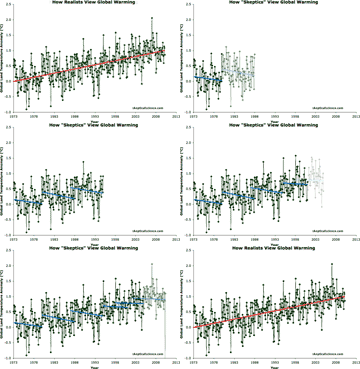
Instead of taking everything for face value, I downloaded the global land/ocean temp data from NCDC and plotted it out on excel. While it is obvious that global warming has occurred for many years, what happened around 1997 to 2009? The data plainly shows nearly any change with no significant warming or cooling with the exception of a couple of years the trend has been neutral. So if Carbon dioxide is supposedly causing the earth to warm, why has the temperature trends for the past 12 years not continued to increase? This shows the flaws and uncertainties in the science. What about ocean currents, the sun, PDO, AMO, etc? If you don't believe me, pull up the raw data and look at it closely. -
Mizimi at 05:01 AM on 10 July 2009Climate time lag
"The 5-yr global mean CERES net flux from the standard CERES product is 6.5 W m-2, much larger than the best estimate of 0.85 W m-2 based on observed ocean heat content data and model simulations. The major sources of uncertainty in the CERES estimate are from instrument calibration (4.2 W m-2) and the assumed value for total solar irradiance (1 W m-2). After adjustment, the global mean CERES SW TOA flux is 99.5 W m-2, corresponding to an albedo of 0.293, and the global mean LW TOA flux is 239.6 W m-2. These values differ markedly from previously published adjusted global means based on the ERB Experiment in which the global mean SW TOA flux is 107 W m-2 and the LW TOA flux is 234 W m-2." Toward Optimal Closure of the Earth's Top-of-Atmosphere Radiation Budget....Loeb et al. -
Quietman at 03:45 AM on 10 July 2009Climate's changed before
"When it comes to climate, the early Paleogene period (~65-34 mya), at the start of the Cenozoic Era, had one of the most Eden like climates of the Phanerozoic. As the Cenozoic progressed a cooling trend set in leading up to the formation of permanent ice caps and the Pleistocene Ice Age we are still experiencing. But before the world started to ice up our planet underwent one of the most dramatic bouts of global warming known to science—the Paleocene Eocene Thermal Maximum or PETM. Recently, global warming activists have tried to liken human CO2 emissions to the cause of the PETM, 55 million years ago. Is it true, that our actions may trigger a sudden sharp rise in global temperature? The mid-Cretaceous (~125-85 million years ago) and the early Paleogene are among the best known ancient “greenhouse” climate intervals—times when Earth's average temperature was significantly higher than they are today. During the Cenozoic (the last 65 million years) the global climate has cooled substantially, up to a main cooling step at the Eocene-Oligocene transition (~34 mya), which included the development of the first glaciation at a continental scale in Antarctica. Another main cooling step occurred in middle Miocene (14 mya) and was a significant step in the development of the Antarctic continental glaciation." FROM: Could Human CO2 Emissions Cause Another PETM? Read the rest, It's an interesting view. -
Quietman at 03:40 AM on 10 July 2009The CO2/Temperature correlation over the 20th Century
"I'm sure the majority (but not all) of my IPCC colleagues cringe when I say this, but I see neither the developing catastrophe nor the smoking gun proving that human activity is to blame for most of the warming we see. Rather, I see a reliance on climate models (useful but never "proof") and the coincidence that changes in carbon dioxide and global temperatures have loose similarity over time." FROM: My Nobel Moment - By JOHN R. CHRISTY I could list all the articles from scientists but John asks us not to make lists of links. I think this one is a good example of good scientists that are more than skeptic about the whole fiasco. -
Quietman at 03:32 AM on 10 July 2009The CO2/Temperature correlation over the 20th Century
Thumb It's up to you to prove that it is warming. So far we see broken satellites, broken weather sensors, excuses for why the machines do not show reality unless they fudge the data. Show the proof that it is warming? Even the IPCC said it's cooling. NASA said it's cooling. Where do you get your data from? -
David Horton at 14:54 PM on 9 July 2009Climate time lag
Good to see such a quick response John, well done (but I didn't think I was being bitchy, so there!). But my physics isn't good enough to understand completely what is being said here, or by Hansen in the paper being summarised. Let me try some questions. 1. If there is a 20-50 year lag, why is there such an instant response to volcanic eruptions, which are equivalent to reducing solar input? 2. I had understood that the variations in solar input were too small to do more than explain some of the noise in the graphs, and "The radiative forcing from the warming sun is not particularly large" seems to conform this, so why is this an issue in the greater scheme of GHG effects? 3. The plateau business is confusing. The graph you show of net radiation is essentially plateaued from 1900 to 1970. Hansen has a graph of surface temp which shows a rise to 1940 and then a plateau to 1970 - is this the lag effect of solar increase in the early 20th century? I haven't seen that as an explanation before. 4. Granted some meaningful changes in solar radiation, are you saying this: when solar input increases, radiation out also increases, but it takes a while to warm up the whole planet so radiation out increases more slowly and the planet warms up slightly faster than it might otherwise have done until equlibrium is reached. When solar input decreases, radiation out continues at a higher rate because of the planet temperature, and therefore the fall in temperature, until equilibrium is reached is faster than it might otherwise have been. 5. Leaving those details aside, the increase in the temperature of the Earth from 1970 onwards has taken place in spite of falling or steady solar input, and therefore can only be the result of lower radiation outwards which in turn is the result of rising CO2 levels. That is, the solar input question, while of academic interest, has no relevance to the fact of global warming in recent times. And will continue to be of no relevance unless an increase in solar input makes our problems even worse. -
Robbo the Yobbo at 12:45 PM on 9 July 2009Climate time lag
I have been introduced to an update of the ISCCP reconstruction. The increased shortwave forcing between 1984 and 1998 is 3.4 W/m2 in the newer study. -
Robbo the Yobbo at 12:37 PM on 9 July 2009Does ocean cooling disprove global warming?
Hi Chris - back again but on my laptop. Directly quoting from the Palle et al (2009) - 2 W/m2 change in shortwave forcing between 1999 and 2004 and constant (within the limits of error) thereafter based on Earthshine data. Compare this with the ISCCP-FD data. You are still not understanding the distinction between energy flux (W/m2) and energy (J). The latter accumulates as heat in the global system. When the energy flux declines on a sustained basis there is less energy accumulating in the system. Nothing peaked in 2000 - it just moved to a new state of energy flux. I must admit that I can't make head or tail of the difference between the 2006 and 2009 graphs. However, a 1% change in albedo is 3.4 W/m2 – the math is very easy. Figure 2 of the 2009 paper actually makes a lot more sense - a 1% decline in albedo from 1984 to 1998 - noting Mt Pinatobu in 1992. A total change in shortwave forcing of 3.4 W/m2. It is not 20 times less than the value of 6.8 given in the 2006 paper. I am not sure which solar system magnetic/cosmic ray/cloud proponents admit anything of the sort. See Svensmark and Marsh on the Nir Shiviv website – Figure 3. http://www.sciencebits.com/CosmicRaysClimate See this discussion. Neutron counts peaked in the late 1980’s – and I am not convinced that neutron counts are the ideal metric to see changes in magnetically modulated cosmic rays. The aa-index peaked in 2003 on an annual basis - but in the late 1980's on 11 year averages. http://hesperia.gsfc.nasa.gov/sspvse/oral/Ken_McCracken/wintergreen1.pdf The point about ENSO is that it involves an energy transfer between the ocean to the atmosphere. Inter-annual variation in the heat content of either doesn’t matter a damn. The moving averages of either are not terribly informative. All that matters is the total energy in both. The heat content of the atmosphere is quite a lot less than in 1998 – El Niño pumped a lot of heat into the atmosphere in 1998 and it is simply a function of a vast area of warm water across the Pacific. http://www.drroyspencer.com/latest-global-temperatures/ We get back to ocean cooling. The ARGO data – best available – doesn’t show any warming since commencing in 2004. Together with atmospheric cooling – the data seems to show less energy in the global system. The cloud and energy content data are consistent. -
Robbo the Yobbo at 08:19 AM on 9 July 2009Climate time lag
One of the problems is that A, contrary to the ruling assumption, is not even nearly constant resulting in an increase in surface incident shortwave radiation of 6 W/m2 between 1984 (the beginning of cloud reconstructions) and 1998 and a decline of 2 to 4 W/m2 from 1998 to 2008. The decline in cloud cover between 1984 and 1998 seems to be equally high and low cloud - so the increase in shortwave forcing is not offsett by longwave cloud effects. The only reasonable conclusion seems to be that cloud changes contributed significantly to late century warming - and certainly of the oceans. All I can say in relation to the IPCC is - how do you like those bananas? No - naughty - I shouldn't gloat - I could conceivably be wrong. Although it is all adding up - sea surface temperatures, ocean heat content, global surface temperature, sea levels and cloud cover. Let me go back to the Usoskin result provided earlier. The link is between cosmogenic isotopes and global temperature reconstructions over 1150 years with the best correlation on a 10 year lag. The likely conection is between the Interplanetary Magnetic Field (IMF)/cosmic radiation/clouds. This is summarised in Jasper Kirkby "Cosmic Rays and Climate'. The IMF is reflected in the aa-index of Earth geomagnetic activity which peaked in 2003 on an annual basis - although 11 year averages peaked in the late 1980's. In discounting the link to surface temperature rise post 1975, both you and Ilya Usoskin use the wrong metrics - solar irradiance in your case and the sunspot number for Ilya. The 10 year lag between the IMF, clouds and, consequently, global total heat content seems to be working out pretty well. See Spencer and Braswell - http://www.drroyspencer.com/Spencer-and-Braswell-08.pdf for the implications for TOA radiative balance for varying cloud cover. Changing cloud cover falsifies the Hanson paper referred to above. Swhartz - http://www.ecd.bnl.gov/stevepubs/HeatCapacity.pdf - provides a discussion of surface temperature response to climate perturbation based on ocean heat capacity. An interesting discussion that finds a relaxation period of 5 years and low climate sensitivity to CO2. -
shawnhet at 05:28 AM on 9 July 2009Climate time lag
I think it bears mentioning that an increase in sunlight will increase heating in the oceans as compared to an increase in the GH effect(which will primarily heat the atmosphere). Energy that is absorbed by the oceans will be emitted slower than energy absorbed by the atmosphere. It takes much longer to heat the ocean that it does the air(due to the mass difference). Given this alone, a straight increase in solar irradiance should have a longer lag time than an increase in the GH effect(even assuming the energy contribution is the same). Cheers, :) -
Lee Grable at 04:44 AM on 9 July 2009Climate time lag
Maybe you should take some lessons from the Real Climate website. They don't suffer fools over there. Cuts way down on the bitchiness. -
chris at 04:09 AM on 9 July 2009Does ocean cooling disprove global warming?
whoops, that should be: "One can hardly claim a contribution from variations in the cosmic ray flux when there has been no trend in this parameter (a slight cooling contribution if anything) during the period since the late 1950’s when the CRF has been measured in detail." -
chris at 23:59 PM on 8 July 2009Does ocean cooling disprove global warming?
The revised analysis of Palle et al (2009) is pretty straightforward, Robert, and I understand it quite well having read it carefully a couple of times. The original analysis on which you were basing your interpretations in post #41 has been rather fundamentally revised. The so-called "robust" estimate of 6 W/m2 variation based on an apparent decrease of albedo anomaly from around 9% in 1986 to around -2% in 1998 originally proposed by Goode and Palle in their 2007 paper, seems now to be [based on ISCCP FD data - see Figure 1a of Palle et al (2009)] an apparent decrease in albedo anomaly from around 0% in 1986 to around -0.5% in 1998. If the albedo anomaly change has been revised downwards by a factor of around 20-fold to 5% of the original estimate upon which you were basing your analysis in post #41 how can the original estimate by the same authors be "robust"?! Likewise if the original Goode and Palle estimate of an increase in albedo between 1998-2005 has been revised to a best estimate of zero change between 2000 through 2007, that should lend us to question the significance of these measured albedo contributions to climate parameters. Even if there is an apparent "cooling" forcing due to a small increase in albedo between 1998-2000, this is difficult to reconcile with the fact that all of the climate parameters associated with radiative imbalance from any source have been in the warming direction for many years since 2000. The ocean heat content has increased markedly since 2000 (at least up to 2004) as have sea levels (latest data still consistent with a trend near 3.2 mm/yr: http://sealevel.colorado.edu/current/sl_ib_ns_global.jpg); the air-sea surface temperatures for the decade 2000-present are significantly warmer than for the decade 1990-1999 and so on and this applies right through 2007. Why should these parameters have continued in a warming direction for many years after your apparently dominant cooling forcing has peaked in 2000? The IPCC certainly hasn’t “spent 20 years ignoring natural variation”. What leads to that odd conclusion? The IPCC analysis of the full surface temperature variation since the start of the 20th century has been made using the best (and evolving) measures of all contributions to variable radiative forcing whether natural or anthropogenic. One can hardly claim a contribution from variations in the cosmic ray flux when there has been no trend in this parameter (a slight cooling contribution if anything) during the period since the late 1980’s when the CRF has been measured in detail. Even the proponents of that theory recognize that variations in the CRF hasn’t contributed to marked late 20th century and contemporary warming. -
Robert Ellison at 14:56 PM on 8 July 2009Does ocean cooling disprove global warming?
Incidentally, have a look at the steric sea levels (I assume these are deltas) in Figure 4 above - none of these show much of a change. I can only reiterate that you need to look at total global heat content at any one time. That is the heat content of oceans and the atmosphere as well as other minor heat reservoirs. The bottom line is that the planet is not heating at all since at least 2004 - the revised ARGO data is certainly the best that we have. There is obviously something that has changed in the Earth energy budget. -
Robert Ellison at 14:45 PM on 8 July 2009Does ocean cooling disprove global warming?
Chris – I think you are misunderstanding the E. Pallé, P. R. Goode and P. Montañés-Rodríguez (2009) Interannual variations in Earth's reflectance 1999–2007 J. Geophys. Res. 114art #D00D03 Just between you and me - a copy is available at: http://bbso.njit.edu/Research/EarthShine/literature/Palle_etal_2008_JGR.pdf ‘Earth's global albedo, or reflectance, is a critical component of the global climate as this parameter, together with the solar constant, determines the amount of energy coming to Earth. Probably because of the lack of reliable data, traditionally the Earth's albedo has been considered to be roughly constant, or studied theoretically as a feedback mechanism in response to a change in climate. Recently, however, several studies have shown large decadal variability in Earth's reflectance.’ The ‘climatologically significant’ change in Earth Albedo since 1998 – reassessed downward from 4 to 2 W/m2 since 1998 in the Palle et al (2009) study - although the ISCCP-FD result is higher. The lower estimate is not a ‘small’ value. Compare it with the IPCC estimated net anthropogenic forcing of 1.5 W/m2 to 2005. The decrease in energy hitting the earth surface is not a one off event but represents an ongoing reduction in shortwave energy flux hitting the surface of the planet. The energy deficit is cumulative and this is the reason why you would expect a global decline in total heat content of the oceans and atmosphere and other minor components in the global energy reservoirs. The question is not whether one should expect a decadal decrease in global total heat content but how long it will last and what are the implications for anthropogenic global warming. The ‘robust’ estimate of decadal variation – 6 W/m2 between 1985 and 1998. The shortwave forcing of Earth’s climate between at least 1985 and 1998 must not continue to be ignored. This means that the IPCC estimate of the cloud albedo effect is wrong because; • the cloud albedo effect is not constant; and • it is simply wrong - the 2007 IPCC estimate of the cloud albedo effect is negative when it should be hugely positive between at least 1985 and 1998. The IPC has spent 20 years ignoring natural variation that is obvious to blind Freddy in the climate record. Now it is being said that there is natural variability of unknown causality that is masking global warming but which will soon return with a vengeance. Doh! The situation gets worse for the IPCC when you start to wonder what the drivers of decadal variation of global cloud cover are. Is it internally driven by decadal variation in sea surface temperature? This really just leads to seeking the underlying driver for the well known decadal variations in sea surface temperature and, indeed, in total ocean heat content. Inevitably, it seems to me, we are drawn to the solar system magnetic/cosmic ray/cloud theories of Svensmark and numerous other authors. Jasper Kirkby of CERN provides a terrific summary at: http://arxiv.org/abs/0804.1938 Solar system magnetism – as reflected in the annual series of the aa-index of Earth geomagnetic activity - was at 14.2 last year down from a peak of 37.1. It is expected to trend down for a couple of centuries. -
chris at 05:24 AM on 8 July 2009Does ocean cooling disprove global warming?
re #41 Robert, the Goode and Palle data you cited which shows an apparent continuing ("cooling") contribution from an apparent reduction in SISR reaching the surface (increasing albedo) from 1998 through 2005 has been reassessed by the same authors (abstract below [***]), and found to be inconsistent with new data and analysis. http://www.agu.org/pubs/crossref/2009/2008JD010734.shtml Goode and Palle now find a consistent interpretation with the CERES and ISCCP cloud analyses in which there has been no change in albedo from the period 2000 through 2007. In other words their previous large apparent negative forcing that you describe isn't actually correct. Although their new analysis suggests that there has been a small increased albedo in the period 1998-2000, there has been no detectable change since then. This reassessment is consistent with the data on ocean warming which shows large increases in upper ocean heat since 1998 (see John Cook's top post, for example), even if there is some question about the last few years. One shouldn't be fooled into thinking that the land-ocean surface warming under enhanced greenhouse forcing has "stopped" just because 1998 was a very anomalously warm year due to a large El Nino! It's likely that the very recent period of lower temperature anomalies are the result of the strong La Nina episode of 2008 and the fact that the sun is at the bottom of its solar cycle. Palle and Goode's reassessment of surface incident solar radiation indicates that that metric is unlikely to be very important outwith the small reduction in total solar irradiance at the solar minimum (and not forgetting the effects of aerosols on reduced surface insolation). Easterling and Wehner (2009) [*****] have recently highlighted (again) the fallacies in the assumption that the earth will not undergo significant periods of temperature statis or even cooling on a long term warming trajectory under the influence of an enhanced greenhouse radiative imbalance. Of course when this happens it should be possible to adress the significant causal elements in hindsight (solar metrics, volcanos, La Nina's etc.). In this case the change in albedo doesn't seem to be important at least according to Goode and Palle's reanalysis. Incidentally you said on another thread that sea levels haven't risen "in years". That's incorrect. http://www.agu.org/pubs/crossref/2009/2009GL037810.shtml [***]E. Pallé, P. R. Goode and P. Montañés-Rodríguez (2009) Interannual variations in Earth's reflectance 1999–2007 J. Geophys. Res. 114art #D00D03 abstract: The overall reflectance of sunlight from Earth is a fundamental parameter for climate studies. Recently, measurements of earthshine were used to find large decadal variability in Earth's reflectance of sunlight. However, the results did not seem consistent with contemporaneous independent albedo measurements from the low Earth orbit satellite, Clouds and the Earth's Radiant Energy System (CERES), which showed a weak, opposing trend. Now more data for both are available, all sets have been either reanalyzed (earthshine) or recalibrated (CERES), and they present consistent results. Albedo data are also available from the recently released International Satellite Cloud Climatology Project flux data (FD) product. Earthshine and FD analyses show contemporaneous and climatologically significant increases in the Earth's reflectance from the outset of our earthshine measurements beginning in late 1998 roughly until mid-2000. After that and to date, all three show a roughly constant terrestrial albedo, except for the FD data in the most recent years. Using satellite cloud data and Earth reflectance models, we also show that the decadal-scale changes in Earth's reflectance measured by earthshine are reliable and are caused by changes in the properties of clouds rather than any spurious signal, such as changes in the Sun-Earth-Moon geometry. [*****]D. R. Easterling and M. F. Wehner (2009) Is the climate warming or cooling? Geophys. Res. Lett., 36, L08706 abstract: Numerous websites, blogs and articles in the media have claimed that the climate is no longer warming, and is now cooling. Here we show that periods of no trend or even cooling of the globally averaged surface air temperature are found in the last 34 years of the observed record, and in climate model simulations of the 20th and 21st century forced with increasing greenhouse gases. We show that the climate over the 21st century can and likely will produce periods of a decade or two where the globally averaged surface air temperature shows no trend or even slight cooling in the presence of longer‐term warming.
Prev 2576 2577 2578 2579 2580 2581 2582 2583 2584 2585 2586 2587 2588 2589 2590 2591 Next