



 Arguments







An underwater hockey stick
Posted on 1 October 2010 by John Cook
A new paper adds another piece of the puzzle to our understanding of past climate change. This one is Twentieth century warming in deep waters of the Gulf of St. Lawrence: A unique feature of the last millennium (Thibodeau et al 2010). In this paper, the authors reconstruct North Atlantic water temperature over the last millennium using oxygen isotopes from ocean sediment cores on the Canadian east coast. What they found is the warming over the 20th Century has had no equivalent over the last thousand years.
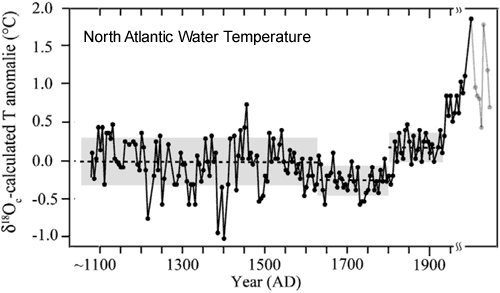
Figure 1: Temperature anomaly calculated from oxygen isotope composition. The grey lines to the right of the graph are shaded as that part of the core was disturbed by the coring process.
As the temperature record only represents one particular region, they also plot two reconstructions of Northern Hemisphere temperature which I've reproduced below (I use a colour version of the Moberg reconstruction with the instrumental record included).
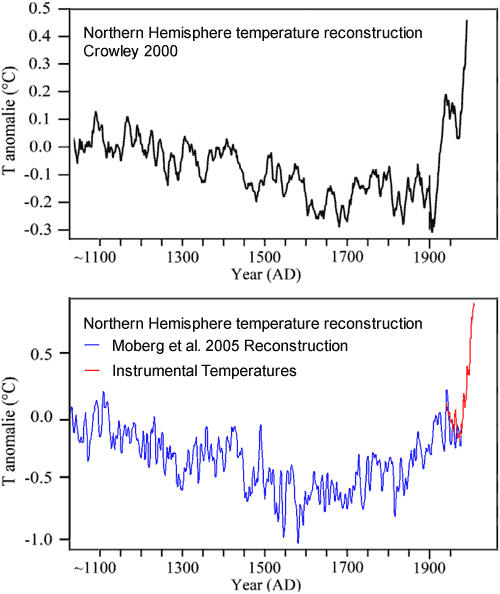
Figure 2: Two reconstructions of Northern Hemisphere temperature from 1100 to present (Crowley 2000, Moberg et al 2005).
The growing body of evidence is strengthening the view that current warming is unprecedented over the past 1000 years, as confirmed by a number of temperature reconstructions.









- Conduction
slow
not likely in liquids and gases
- Convection
rapid
can transport vast amounts of heat
very likely in gases and liquids
not particularly dependent on the nature of the materials
- Radiation
speed of light
very particular about the nature of the materials
occurs at interface of two bodies separated by relatively free space, does not occur inside solid or liquid matter to as great a degree as in gases or vacuum
- Phase Change
As an adjunct to convection can transport orders of magnitude more energy than storage by temperature change alone. Transport of heat to the upper troposphere by phase change of water comes to mind.
Since the water where these cores were taken were, as the paper points out, are relatively well insulated from surface effects (radiation, conduction from atmosphere) you have convection (which can be horizontal if by currents) and conduction from below. These water temperatures were also localized. We just don't have enough of these temperature measurement to make global statements. I believe we had some information about anomalies in the Southern Ocean Basin a few days ago. The same concerns apply there. What this paper opened up is the possibility that a ocean heat transport has melted the arctic ice from below. Remember, "science tends to be self correcting."