



 Arguments







A Swift Kick in the Ice
Posted on 19 February 2011 by Rob Honeycutt
Commenting in the trenches of the climate change blogosphere I find a large number of people who lack very basic understanding about Arctic Ice. While I'm not an expert in the field I have managed to learn a few things with regards to why Arctic ice is an important issue. There are a few misconceptions that require a "swift kick in the ice."
When learning about these issues myself I came upon a question that I could not immediately answer. We know that water vapor is a strong greenhouse gas. We know that warmer air holds more moisture than cold air, in fact, to the point where the Antarctic is one of the driest deserts on the planet. So, how does this jibe with the idea of polar amplification, the idea that the poles will warm faster than the rest of the planet on average? The climate models tell us that the poles will warm faster, and the model results are proving true now. Why would the poles warm faster if there is so little water vapor in the air?
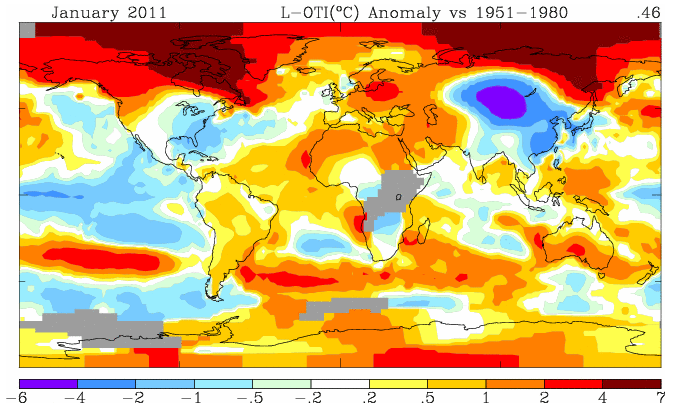
Fig 1 - Surface Temperature Map for Jan 2011 (Source: GISS)
The first answer comes by way of looking at a surface temperature map (Fig 1). What we find is that the north and south poles are not warming equally. In fact, the term "polar amplification" is better described by saying "Arctic amplification." If we look out to the end of the century there is anticipated to be amplification in the south as well but most of the warming will take place in the north.
But that still leaves us with, why? The Arctic gets cold too, therefore is drier than the equator. Why would the equator not warm faster?
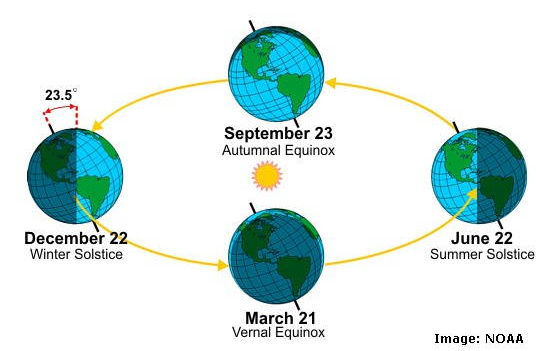
Fig 2 - Orbital tilt through the year
Pretty much everyone knows that these basic very important facts about the north pole:
- The ice at the pole is covering the Arctic ocean. It's sea ice.
- Both poles are mostly dark half the year and mostly light half the year.
These two very basic aspects of the Arctic make it special in terms of climate change form the reason why Arctic Amplification is happens and is so important.
Each year the ice of the Arctic thaws back to a minimum extent during the late summer, usually some time in September. Then it freezes back each winter. This is obviously because summer months are warmer and winter months are colder.
The Battle of Albedo
Now I'll beat you up with the concept of "albedo." Albedo is the effect where light colored surfaces reflect light and dark colored surfaces absorb light. Think of it as white pavement or black pavement. Black pavement is always going to scorch your bare feet more than white pavement in the noontime sun. Dark surfaces absorb more heat from the sun. Light surfaces reflect more light away and absorb less heat.
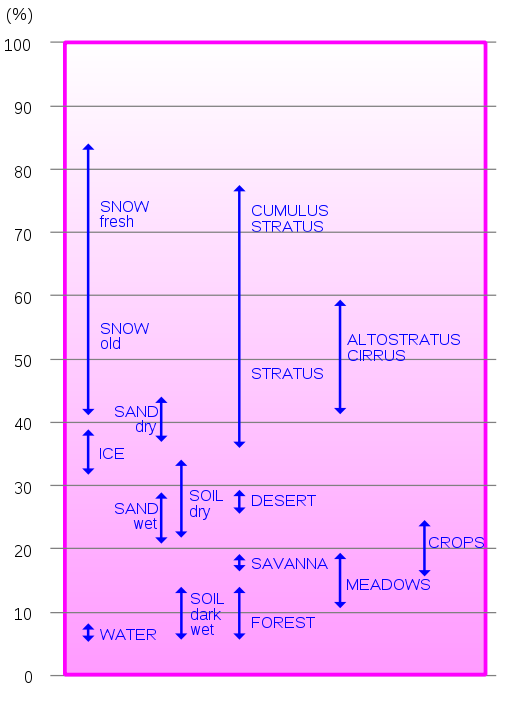
Fig 3 - Albedo effects (source: wikipedia)
As you can see from Figure 3, the albedo of fresh snow is dramatically different from water - it's much more reflective.
In the winter the Arctic sea is almost completely frozen over but this doesn't matter a lot because there is little sun shine for half the winter and even no sun shine at all for several months of the year. There is no albedo effect at all during this part of the year.
In the summer months, though, the story is the opposite. If the Arctic Sea is covered with ice in the summer - as it has been dating back perhaps thousands, to millions of years - the incoming sunlight is mostly reflected back to space without adding any heat to the Earth. But, as ice melts back, as is happening today, the summer sun is absorbed by the darker open sea exposed by the disappearing ice.
The open water absorbs more and more heat during the extended daylight of the summer months until winter comes again, when the Arctic Sea freezes. But because of warming the ice is also losing its capacity to freeze back to previous levels. This is what is meant by a feedback. Less ice makes warmer water, which makes thinner ice, which melts easier, which makes warmer water… and so on.
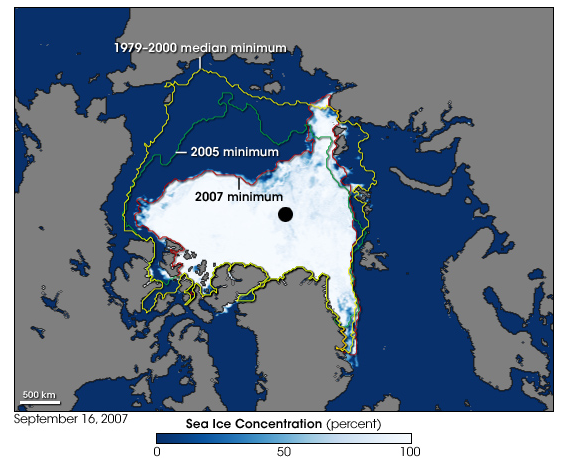
Fig 4 - 2007 Summer sea ice minimum (source: NSIDC)
This also points out why the sea ice in the Antarctic is less important and generates less warming. The Antarctic is a land mass 1.5 times the size of the United States. Each winter sea ice develops around the Antarctic continent but thaws back mostly to the coast each summer. There it can go no further. The continent is almost completely covered in snow year round so the south pole maintains its high reflectivity during the summer months.
Something to be wary of is people who point to very select years or short time periods to say the ice is not melting. You have to look at all the data to see the full picture. The full picture of the Arctic clearly shows a rapid decline of ice both in extent (area) and volume (total ice). Some people will also tell you that ice is growing in Antarctica. That's true and false. Winter sea ice extent is increasing slightly, but the land based ice, on the whole, is melting. And as we understand above, winter sea ice extent is not going to have any effect because there is little or no sun in the winter.
When you take a moment to step back from the dusty battle taking place on climate issues sometimes you gain a little perspective. I've actually learned quite a lot doing battle in the blogosphere trenches. On occasion I get a boot on the derriere that forces me to try to better understand the arguments on both sides of the issue and learn more about what scientists are trying to tell us.
It's not a pretty battle, and you have to bust ice to really get down to the truth.
- - - - - -
For the most up to date and accurate information about snow and ice issues you can visit the NSIDC, the National Snow and Ice Data Center.


 0
0  0
0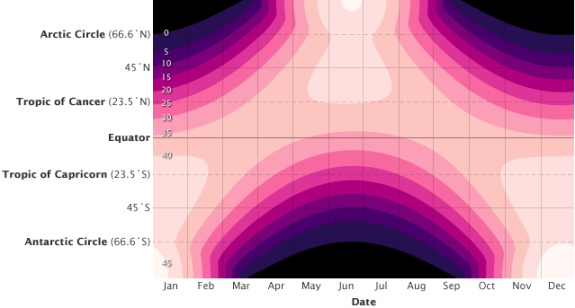 What is more, because of the structure of solar insolation, even the annual average is more or less constant above the arctic circle:
 So, what you are doing here is invoking speculations and errors of fact to refute empirical observations because in this instance you happen to prefer the model results. Your hoped for reduction of the effect will probably occur, but only once ice formation and snowfall are confined to those months and areas with no insolation, but by then the increased global warming due to the arctic sea ice albedo feedback will be an irreversible fact.
 Large reductions in ice volume correlate very well with elevated arctic spring time temperatures, so temperature is the determinant of arctic ice melt. Wind strength and speed, along with the extent of multiyear (thick) ice are additional factors determining ice extent.
Of course, no body has claimed that the greenhouse effect or the ice albedo feedback are the sole determinants of global temperatures, let alone regional temperatures, which can vary based on a large number of factors, the most important of which regionally is the direction of prevailing winds.
So you can put that strawman firmly back in the basket.
Large reductions in ice volume correlate very well with elevated arctic spring time temperatures, so temperature is the determinant of arctic ice melt. Wind strength and speed, along with the extent of multiyear (thick) ice are additional factors determining ice extent.
Of course, no body has claimed that the greenhouse effect or the ice albedo feedback are the sole determinants of global temperatures, let alone regional temperatures, which can vary based on a large number of factors, the most important of which regionally is the direction of prevailing winds.
So you can put that strawman firmly back in the basket.
 Well that certainly puts a whole new perspective on things!
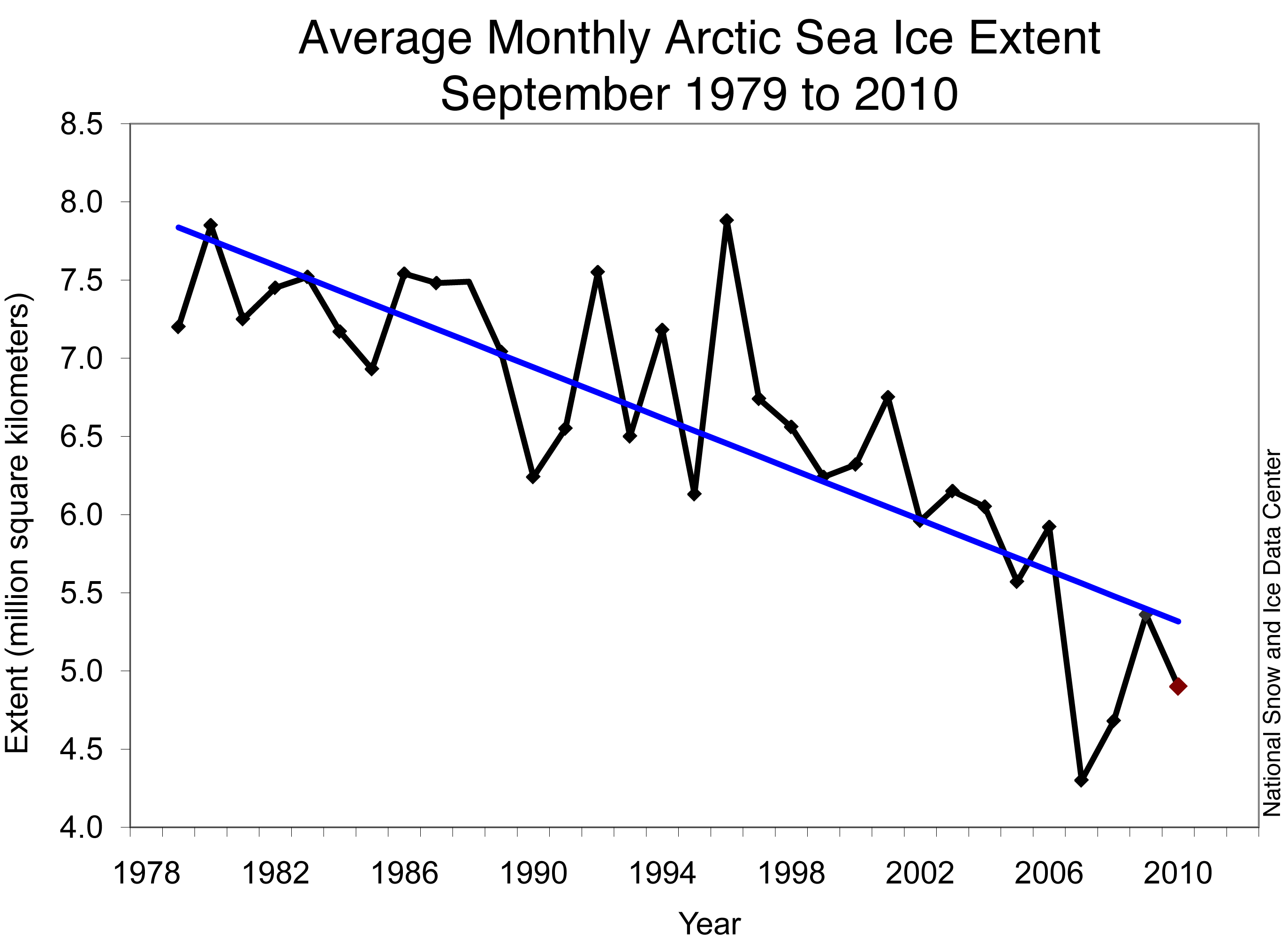 And the minimum in 2010 was the third lowest on record, not the fourth. And that the best fit to the data in the above graph is a quadratic not a linear model.

 -- both from Has Arctic sea ice returned to normal?
Pay attention to trends, not a year or two. But if you insist, here's how this year stacks up:
-- both from Has Arctic sea ice returned to normal?
Pay attention to trends, not a year or two. But if you insist, here's how this year stacks up:
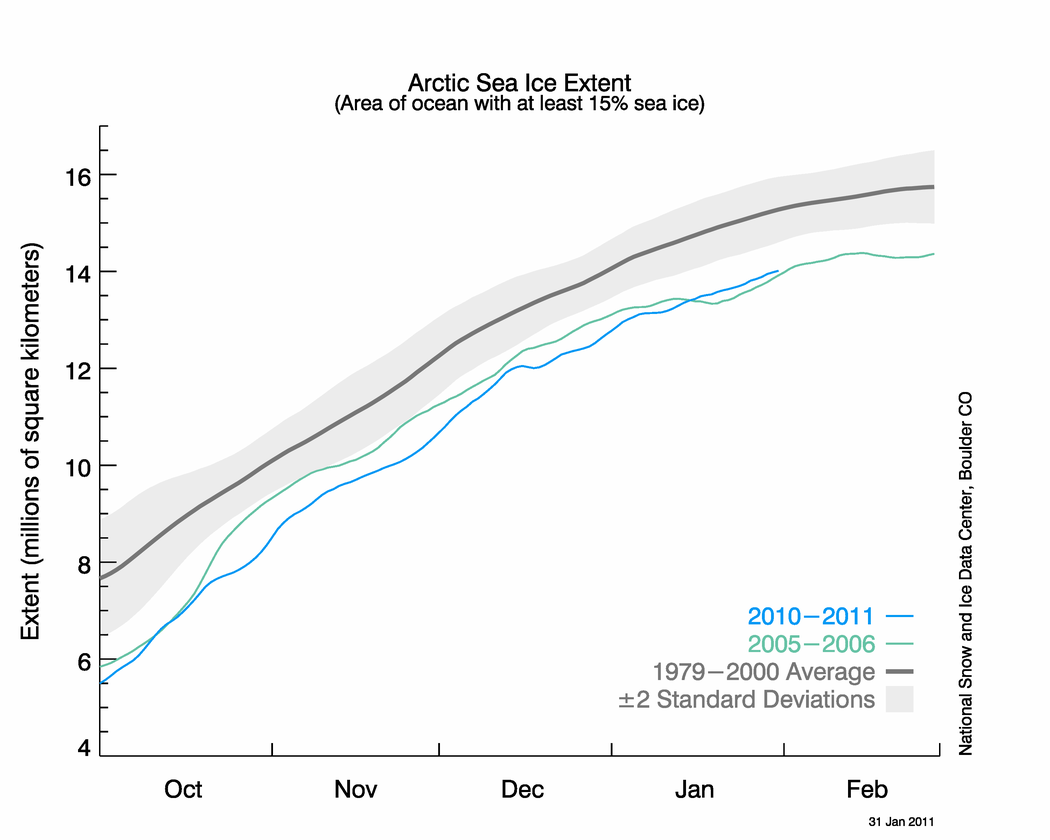 -- NSIDC sea ice news "Record low January extent"
You'll note that this year is more than 2 std devs below the average and playing tag with 2005-06 (the prior record low extent). The annual max occurs in March. There are websites where they bet on such things.
-- NSIDC sea ice news "Record low January extent"
You'll note that this year is more than 2 std devs below the average and playing tag with 2005-06 (the prior record low extent). The annual max occurs in March. There are websites where they bet on such things.
 The high temperature anomaly in the Arctic this winter was not due to the greenhouse effect directly on the Arctic Ocean. It was due to heat being transported to the Arctic by global weather patterns. If you run the animation you see the transport of heat from as far south as the Sahara to the Arctic through a cluster of vortices that swirl around the arctic like giant hurricanes pulling warm air from southern climes and pushing cold air back down. Cold air can pour out of the Arctic into the more temperate areas such as caused the large snow events in the US and England. When this happens you get something like this:
  It should be obvious that the warming of the Arctic is not due to the greenhouse effect taking place in the Arctic. There isn't any to speak all year round and especially in winter.
You might say, "What about summer? Isn't there greenhouse effect due to the open water?" Not much because the albedo of the open water is so low that there is little long wave radiation or any other kind going up out of the water after the sun's rays hit it. All that energy is deposited deep in the water, CO2 or no CO2. So regardless of CO2, an ice free Arctic Ocean is going to contribute a lot to global warming during summer months.
What was not addressed in the article is whether the polar regions are any less effective in radiating energy into space in the winter seasons regardless of the ice state.
It should be obvious that the warming of the Arctic is not due to the greenhouse effect taking place in the Arctic. There isn't any to speak all year round and especially in winter.
You might say, "What about summer? Isn't there greenhouse effect due to the open water?" Not much because the albedo of the open water is so low that there is little long wave radiation or any other kind going up out of the water after the sun's rays hit it. All that energy is deposited deep in the water, CO2 or no CO2. So regardless of CO2, an ice free Arctic Ocean is going to contribute a lot to global warming during summer months.
What was not addressed in the article is whether the polar regions are any less effective in radiating energy into space in the winter seasons regardless of the ice state.
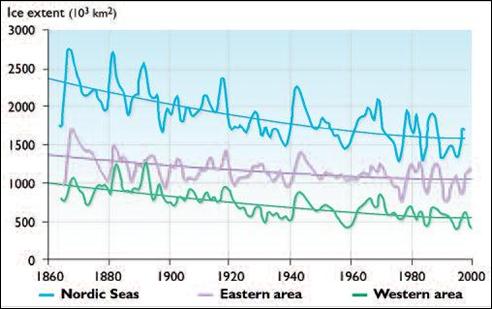
 (Sea Ice extent in Nordic Seas)
Before you get too excited about all those low values, you should notice that 2002 is the last point on the graph, and and the second lowest point is 2001. So clearly 2007 and 2010 have fallen of the chart by comparison. You will also note that 1922 is only about average for post 1950 ice extents, and well above the recent figures.
For comparison, here is equivalent data for other regions of the Arctic (for April). As you can see, the Nordic sea shows the greatest variability, so your case will not be improved by appealing to other regions.
(Sea Ice extent in Nordic Seas)
Before you get too excited about all those low values, you should notice that 2002 is the last point on the graph, and and the second lowest point is 2001. So clearly 2007 and 2010 have fallen of the chart by comparison. You will also note that 1922 is only about average for post 1950 ice extents, and well above the recent figures.
For comparison, here is equivalent data for other regions of the Arctic (for April). As you can see, the Nordic sea shows the greatest variability, so your case will not be improved by appealing to other regions.
 (See note below.)
Consequently the extent of the greenhouse effect is very important in determining arctic temperatures. An increase in the greenhouse effect will slow the escape of energy to space, thus raising temperatures.
(Note, the graph determines intervals on the x axis based on area, thus generating a non linear scale in terms of latitude. If a linear scale for latitude had been used, the near constant insolation at higher latitudes would be apparent. Scaled linearly, for example, the interval between the last two northern values would span from the current 60 degree north mark to the first "i" in "deficit".)
(See note below.)
Consequently the extent of the greenhouse effect is very important in determining arctic temperatures. An increase in the greenhouse effect will slow the escape of energy to space, thus raising temperatures.
(Note, the graph determines intervals on the x axis based on area, thus generating a non linear scale in terms of latitude. If a linear scale for latitude had been used, the near constant insolation at higher latitudes would be apparent. Scaled linearly, for example, the interval between the last two northern values would span from the current 60 degree north mark to the first "i" in "deficit".)








Comments