



 Arguments
Software
Resources
Comments
The Consensus Project
Translations
About
Support
Arguments
Software
Resources
Comments
The Consensus Project
Translations
About
Support







Latest Posts
- How many people does heat actually kill?
- Check out the brand-new hurricane ‘cone of uncertainty’ graphics arriving this season
- 2026 SkS Weekly Climate Change & Global Warming News Roundup #23
- SkS Housekeeping: Updating the Comments Policy
- Skeptical Science New Research for Week #23 2026
- Nobody knows the future of energy
- Fact brief - Do electric vehicles almost always have a lower carbon footprint than gasoline-powered cars?
- Solar, wind, and EVs have knocked out a doomsday climate scenario
- 2026 SkS Weekly Climate Change & Global Warming News Roundup #22
- Skeptical Science New Research for Week #22 2026
- The next era of Atlantic hurricanes could be far more destructive
- On the death of RCP8.5
- RCP8.5 Update
- 2026 SkS Weekly Climate Change & Global Warming News Roundup #21
- Skeptical Science New Research for Week #21 2026
- What’s a ‘super El Niño’? And other El Niño questions, answered
- Fact brief - Does electromagnetic radiation from wind turbines pose a threat to human health?
- Five things you need to know about El Niño’s likely comeback
- 2026 SkS Weekly Climate Change & Global Warming News Roundup #20
- Skeptical Science New Research for Week #20 2026
- Higher warming predictions for 2026 and 2027
- A look back at ‘An Inconvenient Truth,’ 20 years later
- Two videos about the Atlantic Meriodonal Overturning Circulation (AMOC)
- 2026 SkS Weekly Climate Change & Global Warming News Roundup #19
- EGU2026 - Five days of virtual learning
- Skeptical Science New Research for Week #19 2026
- Climate Adam - Climate Change is Destroying Lives... Now
- EGU2026 - Presentation about the Skeptical Science Experiment
- Fact brief - Were the 2022 whale deaths off the US East Coast caused by offshore wind development?
- 2026 SkS Weekly Climate Change & Global Warming News Roundup #18

Comment Search Results
Search for coral reefs
Comments matching the search coral reefs:
- Fossil fuel pollution’s effect on oceans comes with huge costs
prove we are smart at 13:26 PM on 26 February, 2026"The Trump EPA buries its head in the eroding sand". I will argue the Trump admin has its head up and looking around to take many more "donations" from any billionaires wanting to pay for an advantage.
Its not limited to only one party either, www.youtube.com/shorts/qzYTN4lfEn4
Coral reefs are ecosystems whose collapse signals that multiple planetary boundaries are being exceeded simultaneously. All are under worstening die-back, some disapearing faster, today, some corals survive in much warmer waters in the Red Sea than on the Great Barrier Reef. The concern is therefore not strictly the temperature but the pace at which the temperature is rising above what corals in specific regions have adapted to over longer time periods.
The current rate of environmental change, and dramatic increase in the frequency of bleaching events in 2016, 2017, 2020, 2022, 2024 and 2025 (before then mass bleaching occurred in 2002 and 1998), raise concerns that most reef-building coral will not be able to adapt fast enough.
Our Australian summary. www.youtube.com/watch?v=BJRBYPhKnXA&t=1s
Really, the only glimmer of hope I have for the USA is how the citizens of New York, rejected corporate politics and elected a self proclaimed democratic socialist. I can naively wish.
- Climate Adam: Can Coral Reefs survive Climate Change?
MadMackz at 11:08 AM on 30 August, 2024The only issue I have with this is that it doesnt really promote the things that people really should also know about coral reef namely the Great Barrier Reef. It is strange how although through the mass events that have killed off so much precious reef, that since 2022 we have observed Record Highs regarding size, growth and overall health of the GBR in all recordable history in its entirety. 3 years in a row! Which is great! Something else that many people dont know is that although record levels of the reef have been observed there has been a detrimental outbreak of starfish which are one of the largest offending predators of the reef, them along with Fish, marine worms, barnacles, crabs, snails and those pesky sea stars all prey on the soft inner tissues of coral polyps. But that still is not the largest Killer of these beautiful reefs. That...would be waves, from cyclones and storms.. Breaking off large pieces of coral at a time and literally shredding it as the waves flatten it to litteral sand. Its a good thing that those cyclones have been showing a decline in frequency and intensity for the last half a decade. One plus of the warm waters though is the spawn of new reef is increased, Once a year, on cues from the lunar cycle and the water temperature, entire colonies of coral reefs simultaneously release their tiny eggs and sperm, called gametes, into the ocean. The phenomenon brings to mind an underwater blizzard with billions of colorful flakes cascading in white, yellow, red, and orange.
In ways that scientists still do not fully understand, mature corals release their gametes all at the same time. This increases their chance at diversity and has shown the mixing of genes to increase their tolerance to the changing climate and temperatures. And finally while individual coral colonies suffer from a degree of bleaching in any given summer. This is a natural process and not of particular concern, what we do know is the reef has never been better than now and heres to another 3 years of Great Barrier Growth.
https://www.youtube.com/watch?v=QnQPSYC3IdI
https://www.youtube.com/watch?v=znOidiyUnq8
I want to note that there are sources out there claiming widespread bleaching events are killing off the reef . Namely ABC New3s Australia, I will note that Comments are all turned off, and I suggest seekingout the words of those that work with the reef everyday, Give them a call, go take a tour. Get out and Get the Facts for yourselves, If it matters , Its worth it, and you deserve it. - A data scientist’s case for ‘cautious optimism’ about climate change
michael sweet at 23:01 PM on 2 April, 2024William,
Once you build the wind and solar generators you don't have to buy fuel to run them every day so they are cheaper than fossil fuels. You continue to only measure the cost of the renewable side. Who cares if it costs L1.4 trl to build out renewables if the cost of fuel is L3 trl? The article I linked included storage for enough power so that there would be no shortages, you just didn't read it. Fossil or nuclear backup are not necessary.
I remember 10 years ago the IPCC report suggested that Global Warming would eventually cause sea level rise that endangered houses near the sea, wildfires and droughts that caused massive relocations of people. I wondered if I would see these damages in my lifetime. I expected to live about 25 years.
We see all these things happening now, only 10 years later. They are no longer future projections. Wildfires are destroying entire towns and massive amounts of forrest. Unprecedented droughts and floods are making it harder for farmers to turn a profit. Millions of climate refugees are already trying to access the Global North because they can no longer make a living due to climate change. The damages we currently see are much, much higher than scientists projected only 10 years ago. 40 years ago they thought the great ice sheets would take thousands of years to melt as much as they have already melted now. No-one thought that all the coral reefs worldwide would be dying off as we see today.
We do not need to wait 40 years to see these problems. You are blind to what is happening before your eyes.
- Ocean acidification isn't serious
anika.ag at 15:43 PM on 4 April, 2022Even just a slight change in the pH of the ocean can affect it a lot, this includes all the animals living in it as well. As time goes on the amount of CO2 that humans are emitting through industrial activities is increasing, this means the amount of CO2 that the oceans are absorbing is also increasing, if this continues at the rate that it is going, there are going to be extreme impacts on the oceans and ocean life. Coral reefs will suffer affecting all the animals that rely on them, and many humans who rely on the ocean will suffer as well.
- It's not bad
TVC15 at 10:06 AM on 16 July, 2021Hi Skeptical Science Team,
I am not trying to come across as a pessimist, in fact I am very jolly happy optimist. (it’s my nature).
However, looking around at all the attitudes that lack an understanding of how urgent our climate situation is, and the fact that not much has been done to ween the globe from fossil fuel burning, I can’t help but to think we are past the point of being able to curb the future disasters that are coming our way due to climate change. Those disasters are here and now already.
We are now living on a planet that is in the beginning stages of driving humans, as well as other animal species towards extinction. We’ve already caused extensive death and destruction. Over 50 percent of the world's coral reefs have died in the last 30 years and up to 90 percent may die within the next century. The rate of normal background extinction is hundreds, or even thousands of times higher than the natural baseline rate.
Also, since CO2 lingers around in the atmosphere for 1000’s of years and we are continuing to pump ~50 Billion tonnes of carbon dioxide equivalents a year into the atmosphere, how on earth are we going to prevent the creation of a runaway greenhouse effect?
Am I alone in thinking we’ve reached a point of no return? - 2020 SkS Weekly Climate Change & Global Warming News Roundup #35
gseattle at 13:16 PM on 2 September, 2020Found an earlier 200 species claim, seems to be the first ever:
1995, Adam Rogers of United Nations, [Book] Taking action: An environmental guide for you and your community
... "every 24 hours, an estimated 150 to 200 species of life become extinct" (in the preface)
... No citation or reference.
Didn't find a formula at ipbes, still trying to locate clear species estimate models. The creators of one model, Stephen Hubbell and Fangliang He … wrote in 2011: “extinction rates overestimate extinction”. That’s an understatement because the Rogers claim could have 1 in 5 extinct by now (over 1.8M) and IUCN says only 869 known extinct since 1500. Causes are always from the crush of humanity, hunting, pesticides etc, not climate.
That book by Rogers mentions 'climate' 42 times but doesn't cite climate change in connection with extinctions, it says:
The predominant causes for the loss of biodiversity and the degradation of biological resources include large-scale clearing and burning of forests, destruction of coral reefs, destructive fishing practices, overharvesting of plants and animals, the illegal trade in endangered species of wild fauna and flora, indiscriminate use of pesticides, draining and filling of wetlands, air pollution, and the conversion of wildlands to agricultural and urban uses.
Many of these causes are themselves symptoms of much deeper problems. In many cases, the root causes for the loss of biodiversity are found in basic economic, demographic and political trends. These root causes include consumption and consequent market demands for commodities such as tropical hardwoods, wildlife, fibre and agricultural products. Population growth is another key factor [gseattle: Bingo!!] . The growing human population, even without proportional economic growth, places increasing demands on natural resources and ecosystem processes that are already impoverished and stressed. Settlement policies, such as those in Brazil, promote the movement of the growing unemployed labor forces to frontier regions.
There are 150 new people on earth every MINUTE (even accounting for deaths) based on United Nations population estimate and 2050 projection. Tiny Bangladesh has more people than Russia. I'd suggest the best thing we can do to protect the climate is offer people $300 for voluntary sterilizations as a token thanks for caring about the planet. We're up against corporate boardrooms who lust for all those new consumers and care only about stock price going up.
The grossly exaggerated extinction claims are not a sensible way to promote climate awareness, it is off-putting for people who think rather than just enjoy bathing in fear, it is criticized even by some who created models, has zero connection to reality, is wildly incorrect (a Yale article asks why), yet thanks in part to Greta, wound up in a blender with climate and has legs, parrot legs. Alarmists would like to be seen as the ones who are scientific but to do so, since the claim evidently was created out of thin air instead of a scientific paper, it would be wise to jettison it in the campaign, seriously, this is sound advice. The false connection with climate came into existence out of sloppy thinking and a dose of intellectual dishonesty. This is not hyperbole, emotion or speculation, I've gone through at least 93 scientific papers on climate, for example, many of them on species, and those are only the ones I've saved, I did my homework. Greta didn't.
Those of you who visit this website, being thoughtful, now that you know these things, have an opportunity to nudge the climate campaign toward sanity. Greta is being mocked by around half of the top 100 videos about her, it doesn't have to be that way, but she must be corrected, informed of this and make herself willing to re-align with truth, she should apologize publicly, confess, concede that point, she's falsely scaring people with that bogus distraction away from real problems. I want her to grow up to be someone we can trust.
In summary, the 200 species extinct per day claim is 100% nonsense, an embarrassing mockery of real science.
Be nice, let your weapons be scientific facts.
- PETM climate warming 56 million years ago strongly tied to igneous activity
william5331 at 06:15 AM on 20 May, 2020If, during the PETM, the ocean acidified, a further feed back loop could have been the suppression of the growth of various marine organisms that sequester Carbon dioxide as Calcium carbonate. Such 'organisms' as coral reefs, oysters, Pteropods may all have been suppressed, removing a sink for the extra Carbon dioxide. In addition, methane, as a short time green house gas is about 140 times as powerful as Carbon dioxide so this may have had an effect as well.
https://mtkass.blogspot.com/2013/03/the-real-strength-of-methane.html
- Michael Moore's 'Planet of the Humans' documentary peddles dangerous climate denial
ubrew12 at 10:40 AM on 3 May, 20201st law of thermodynamics "You can't win". 2nd law "You can't even break even"
Ubrew's correlaries: 1st law "Every bit of energy you use comes from your environment" 2nd law: "Yeah, it hurts your environment"
Jeff Gibbs movie belabors something we all knew: we lean on our environment for everything we produce. Unhappily for Gibbs, there isn't a smidgen of non-fossil energy that claims otherwise.
I'm deeply moved by what fossil fuel burning is going to do to the coral reefs, the rainforests, and the polar bears. But I'm a climate activist for what it's about to do to us mere humans. For starters, its going to destroy many of our most cherished historical cities. Against this, should we really dismiss 'Plan B' because it has 'sinned' against our environment? Since I used a toilet today, go ahead and dismiss me as well, by that standard.
- Deep emissions cuts this decade could prevent ‘abrupt ecological collapse’
michael sweet at 22:28 PM on 10 April, 2020The results of this study suggest that fast action will help a lot compared to BAU. That is good news.
Last August I was able to log a few SCUBA dives on the North side of Cuba and at Cozumel. These are reputed to be among the best dive locations in the world. In both locations over 90% of the coral was dead. In Cozumel they closed the main wall to diving in hopes it would recover. The surrounding areas were very dead. There was also little fish life considering that Cozumel banned all fishing decades ago.
It was recently reported in the Smithsonian Magazine that the Great Barrier Reef is facing its most widespread bleaching event ever, the third in 5 years.
Perhaps coral reefs are the first to go and other locations will not be as bad. I noticed that North Cuba and Cozumel are in the few areas hit hard in the RCP 2.6 graph in the OP.
- 2019 in climate science: A continued warming trend and 'bleak' research
michael sweet at 04:27 AM on 14 January, 2020Ritchieb,
I understand your frustration. Imagine how Michael Mann and James Hansen feel after trying to deal with this issue for 30 years.
The Earths energy imbalance and ocean heat content have only been accurately measured for a few years, less than 2 decades. There are no proxies to extrapolate the data into the far past. There are still large error bars for these measurements. The deep ocean (over 2,000 meters) is poorly measured.
By contrast, there are accurate thermometer temperature measurements going back to 1880. Proxies have been found that accurately go back over 800,000 years and much further with poorer resolution. There is a reason deniers deny the Hockey Stick graph so much. Current estimates of the world temperature anomaly have error bars of hundredths of a degree. People do not understand what 2E18 joules means. I have a very strong scientific background and 2E18 joules does not have much meaning to me except it is a lot of energy.
As you point out, many people do not recognize that 2C will have big effects. I remember 10 years ago I wondered if I would live to see obvious sea level rise, more fires, increased storms, Antarctica melting and other effects (I expect to live to 2045). Here in just 2020 we see all of those effects already. Scientists seriously underestimated what effects 1C would have. Remember that only a 5C decrease in temperature means a mile of ice over New York! The last time carbon dioxide was over 400 ppm sea level was 20 meters higher!! (that will not happen overnight, do you care about your decendants in 300 years?).
It was recently pointed out here that 2C world average means 4C over land which is 7.2F over the entire USA!! I knew all the math but had not connected all the dots to see how much change F 2C really was. We are heading for most likely 3C by 2100 (more after that!) which is 11F every day all summer! Are your audiences really prepared for 11F? How could you visit Los Vegas half the year?
The deniers will deny whatever measurement scientists make. EEI and OHC would make no difference. I try to focus on the effects we all currently see. Point out that they will get worse over time. Here in Florida people moan about 10 inches of sea level rise. Can Miami Beach continue to exist when they already have 8 inches of water in the streets? Fires worldwide are obvious and people know about them. Storms like Harvey, Florence and Sandy are unprecedented and people worry. They have had three 500 year storms in the last 3 years in Houston.
If you are speaking to the public use the numbers you are most comfortable with. One talk I heard used pictures of people and had no data. The speaker found people did not relate to data no matter what it described but related to stories of people whose homes were flooded or Koalas killed in the thousands. One moving picture showed the speakers' friend who lost their home in the Paradise fire and is now a climate refugee in the USA. This October I went diving in North Cuba and Cozumel, both world class coral reefs. Over 90% of the coral was dead in both areas.
Use what you find relates best to people. If you find you are successful in reaching people come back here and tell us what works best for you.
- Millions of times later, 97 percent climate consensus still faces denial
Doug_C at 05:09 AM on 21 August, 2019MA Rodger @31
There's clearly an unscientific bias being applied by climate change deniers. Despite the vast amount of objective evidence going back centuries that the Earth is in fact much warmer than it should be if just basic thermodynics were at work and it is almost certainly the presense of persistent carbon dioxide that is mostly responsible for this warming effect, their entire position is based on denying this.
Deniers simply do not weight their position based on the varying confidence in the data. They are 100% certain that by vastly increasing carbon dioxide in the atmosphere there will be no major warming event. And in fact whenever possible they default to a global cooling scenario to frighten people into believing in the threat of rapidly advancing ice sheets from the next ice age.
As for the catastrophic impacts of global warming and climate change, when exactly do we declare it an emergency. The entire biosphere is now in a state of risk, we are now in the position where it isn't individual species that are at threat but the entire biological systems of the planet.
Most life on Earth is in the oceans and they are in rapid transition to often a much more hostile state to the life there. About 25% of marine life spends part or all its life on coral reefs. As we saw with the recent coral bleaching over a massive area in the Great Barrier reef system this transition to what is effect a dead state can happen very rapidly. It took two years for half of one of the most extensive and diverse ecosystems on Earth to die.
We are not going to see a rapidly recovery of any coral reef system on Earth, almost all are going to be lost in the coming years as an incredible amount of heat is added to the Earth - mostly the oceans - constantly. Skeptical Science has a meter to display just that. The loss of marine coral reef systems globally can be considered a significant extinction event on it own. That will include most of the 1 to 9 million species that depend on coral reefs.
But it is just one such factor. As I said we also have to look at the rapid and virtually uncontrolled removal of many marine species at clearly unsustainable rates. How will the oceans even function with such rapid and destructive changes. The source of most free molecular oxygen on Earth.
Terrestrially we are looking at about 40% of insect species in rapid decline and the overall biomass of insects decreasing at about 2.3% a year. The basis of much of the food chain and biological communities on land is in rapid decline.
About 40% of avian species are also in decline.
I don't believe in unsupported alarmism, I do think that if the evidence is as stark as it seems then we are looking at a rapidly approaching point where the overall integrity of ecosystems on a global scale will start to fail.
At which point there will simply be nothing we can do except watch a very rapid and almost certain cascade effect into a world that will not support much of the life now on Earth. And certainly not a species as large as ours with such high metabolic requirements.
The oxygen question alone is stark. Not only are the oceans in a decline to a very unstable situation, but we are rapidly removing the secondary centers of oxygen production the rain forests. Under the current government in Brazil deforestation has doubled in pace. The rain forests of the SE Pacific region are being logged and in many cases converted to palm oil and other plantations on a vast scale.
All these factors stress the entire biosphere and global climate change ties it all together into a formula for catastrophic failure that the data indicates has already begun.
- Millions of times later, 97 percent climate consensus still faces denial
Doug_C at 01:50 AM on 20 August, 2019MA Rodger @20
Quantum Mechanics are the most powerful tool we now have to understand physical interactions at the level relevant to this issue. Before we had QM there was very strong evidence that carbon dioxide is the most important persistent gas in the atmosphere for moderating the global climate. After the development of QM that became far stronger as we then had a detailed explaintion as to why that has allowed experimentation to a degree that simply wasn't possible before.
And the science on carbon dioxide concentration in the atmosphere and its intimate link to global climate got stronger as more data was produced.
My point about uncertainty is it is being misrepresented by the denialist campaign, not placed in its proper context. There will never be 100% certainty on global warming in scientific terms because there is always room left to expand and adapt scientific theory as new information is acquired.
The standards of scientific certainty are far higher than in any other discipline, in legal terms the confidence on the link between CO2 emissions and the serious impacts have been recognized at the highest level a long time ago.
Massachusetts v. Environmental Protection Agency
The use of uncertainty in the case of global warming denial has nothing to do with advancing our understanding of the physical aspect of this phenomena, it is almost entirely political and economic in nature. It is simply not valid scientific skepticism.
I use the term existential in regards to global warming in the threat to the existence of human technological culture and society on a global level and the threat to a significant portion of the existing biosphere that is already in the process of accelerated extinction as climate conditions change far faster than many species can adapt to or migrant along with.
How can you refer to a process that is already well acknowledged to be underway as looney fringe?
We are already seeing massive dieoffs in the oceans in some of the most important ecosystems, if fully half the Great Barrier Reef system dies off in two years with a projection of almost all coral reefs systems and their diverse biotas gone by mid century, is that not a signficant loss of biodiversity from that one source.
Plus the research showing many insects populations in rapid decline, it's at an estimated 2.5% per year now. Many avian species are in rapid decline as well.
We now have an estimate of 1 million species at risk of extinction, that would have a profound impact on the overall biosphere.
Keep in mind that global warming and climate change is not taking place in isolation, it is the major human impact on the physical and natural systems on the Earth. But is taking place in the context of rapid deforestation of much of the worlds rain and temperate forests. In conjunction with a removal of a huge amount of species from the ocean for food with an equally massive polluting of the ocean environments.
Plus everything else we are doing to replace and remove those natural systems that make complex life possible on Earth in the quantity and diversity it currently has.
The truly loony fringe are those who think we can keep doing this for any longer without causing a systemic biological collapse.
Climate change denial is probably the most irrational organized behavior of our species yet.
- Climate's changed before
TVC15 at 08:30 AM on 1 July, 2019Here we go! My favorite denier is back to attacking me.
Why don't you tell us about the severe weather up through the 1700s? Oh, that's right, you can't, because nobody recorded it.
I'm guessing you're totally oblivious to the fact that the Romans grew grapes in Britain and made wine. The Emperor Hadrian was drinking and enjoying that wine.
I responded with a NOAA link that stated.
Clues about the past climate are buried in sediments at the bottom of the oceans, locked away in coral reefs, frozen in glaciers and ice caps, and preserved in the rings of trees. Each of these natural recorders provides scientists with information about temperature, precipitation, and more. Many of these have some type of layers, bands, or rings that represent a fixed amount of time, often a year or growing season. The layers vary in thickness, color, chemical composition, and more, which allows scientists to extrapolate information about the climate at the time each layer formed.
- The Methane 'Time Bomb': How big a concern?
Doug_C at 06:29 AM on 31 January, 2019Evan @7
Unfortunatley we are now in a position of triage having to decide what we can save and what resources we have to do so.
The loss of coral reef systems alone is going to have a profound effect on how life in the oceans behave. One quarter of marine species are dependent on coral reefs for some or all of their lifecycle. The oceans are the main lungs of the planet and home to most life here.
The loss of glaciers is going to also have major impacts on us and the ecosystems around us in many places. I'm from British Columbia and have been familiar with glaciers all my life and the rivers and lakes they feed. It's really sobering to think of a BC... and many other places... with little or no glaciers.
As a kid in the early 1970s I remember a family trip through Glacier national park on the Canada-US border and the many glaciers that gave the park its name. Most are now gone in a pattern repeated globally.
The polar ice sheets have already lost their stability and are losing ice at an incredible rate, far faster than models that treat them as solid blocks melting from the outside predicted.
And it goes on an on, we have upset a fundamental balance that determines one of the most important factors on Earth, how warm it is on the planet's surface. And it is still treated as a relatively minor issue by far too many people, many of them in positions that need to take responsible action, not keep promoting the same activities that have brought us here.
I also have family who work in the oil industry in Alberta and I get how important it is to people there. But it is incredibly frustrating to try to explain to people how what they are doing right now to meet their immediate needs is going to make it very difficult to impossible for them and their kids to meet those needs in just a few decades. With major emergencies along the way like the record flooding in southern Alberta in 2013 and the massive wildfires that burned down Fort McMurray in 2016.
There are real actions and solutions to this growing catastrophe but they require a willingness to change. Sadly something that is still lakcing in many people, who are somehow able to ignore the fact that the Earth is already changing now for the worst.
Real change to a low carbon sustainable energy and economic model has so many benefits that it no longer makes any sense at all to talk about fossil fuels as anything else but a disaster on a scale that makes CFCs, DDT and many other human created ecological and social problems minor in comparison.
- Corals are resilient to bleaching
dvaytw at 16:08 PM on 12 December, 2018NYT has a hard-hitting report, linking to a new study from Hughes et al:
Global Warming’s Toll on Coral Reefs: As if They’re ‘Ravaged by War’ - SkS Analogy 16 - Arctic ice, sailboat keels, and wild weather
Doug_C at 04:36 AM on 5 December, 2018Evan @3
I agree fully, I was referring more to contrarians who use the claim that a few degrees increase in global temperature will have little impacts. When we already see significant changes in climate in many places and very troubling responses in biological communities such as the massive die offs of coral reefs in places like the Great Barrier Reef.
This temperature increase is averaged over the entire globe and as the meter constantly ticking here indicates, the addition of billions of tons of carbon dioxide to the atmosphere mostly from fossil fuels use also adds an incredible amount of heat to the Earth's surface. Over 2.685 billion Hiroshima bomb heat units since 1998 alone with 4 more being added every second.
We are reordering how heat and thus weather and climate is distributed around the Earth and this is already having catastrophic impacts.
The increase in global average temperature may be "slight" in relation to the overall temperature of the Earth, but there is nothing slight in the impacts. And at some point we will hit tipping points that will likely force rapid changes to an Earth that simply will not support many of the current species here now.
Ecosystem transition on a global scale as has happened in the past with rapid excursions in CO2 and then climate are now referred to as Extinction Level Events.
Do we really want to create one that we will all be caught in.
Alarming new study makes today’s climate change more comparable to Earth’s worst mass extinction
- But their Emails!
Doug_C at 15:08 PM on 1 December, 2018JP66 @8
Virtually every peer-reviewed article backs up the theory of athropogenic global warming mostly forced by massive fossil fuel use.
The 97% consensus on global warming
If you're straddling a fence then one half of your body is being crushed up against the wall of evidence.
The models being discussed in these taken out of context emails don't "prove" that anthropogenic global warming is happening, they are an attempt to model what we might expect to see in coming years given specific forcings. And even if the models could be discredited totally - which they haven't been - it doesn't change the basic science telling us why the globe is warming so rapidly and what is almost certainly the main forcing. Coarbon dioxide absorbing huge amounts of longwave EM ratiated by the Earth.
A forcing that has been understood for well over a century and more than a century ago climate sensitivity was calculated before we even understood the fundamental mechanism that causes the greenhouse effect. Namely photons being quantized to be absorbed by certain molecules but not others.
Svante Arrhenius - Climate Sensitivity
The idea is not to wait until there is nothing we can do about this growing global catastrophe, the signal rose above the noice over two decades ago. The idea is to let the overwhelming evidence on this existential issue determine policy. Something that still isn't happening not because the evidence is not far above a rational doubt, but because people skilled in hitting the scientific method where it's most vulnerable - in the constant application of skepticism - keep demanding 100% certainty before we change anything. There is zero genuine skepticism being applied by these people to their own positions.
That's not science, I'm not going to put in blunt words what it is but that is not science and there is nothing sacrosanct in playing silly bastards with an issue that is already killing large numbers of people every year and driving entire essential ecosystems like coral reefs to the edge of existance.
- California's response to record wildfires: shift to 100% clean energy
Doug_C at 08:08 AM on 5 September, 2018DrivingBy @12
"1. If we're due for an anthropegenic extinction event, it will be a few hundred years in the future."
What do you base that on, we are already starting to see some very significant loss of species from coral reef die-off alone.
Best Protected Great Barrier Reef Corals Are Now Dead
And if almost all coral reef systems are gone by 2050;
Coral Reefs Could Be Gone in 30 Years
With up to 25% of ocean species being reliant on coral reefs, that's an extinction level event right there when you consider the ripple effect it will have across the marine habitat. Plus what is going on with rapid removal of tropical rainforest and rapid transitions in many habitats globally as climate change literally rewrites local conditions so the things that used to live there no longer can.
This isn't a process that is going to take place at some point in the future, it is happening right now.
"2. Each time such an event has occured, life sprung forth again, eventually in more complex form."
Sure life comes back after extinction level events, but it can take a very long time to recover to previous levels of complexity. After the End Permian extinction it took up to 100 million years for diversity at the family level to recover.
And the life producing factors on Earth are winding down and the Sun is heating. On the scale of tens of millions of years the crisis with CO2 will be the lack of it as tectonic activity drecreases.
And as the Sun continues to heat the Earth will eventually leave the CHZ.
We may be the Earth's only shot at "intellegent" life, which isn't behaving in a very smart fashion at the moment.
- Great Barrier Reef is in good shape
Eclectic at 19:36 PM on 29 March, 2018Ping34 @ post #2 , you are correct. The Great Barrier Reef has suffered much damage from (mostly) the increasing water temperatures. And it will get worse, because global warming is continuing, and the politicians of the world are making only minor effort to counter the effects of CO2 emission.
The GBR is large — about the size of Italy — and not all of its beauty has been destroyed (so far). The local tourist industry does not like to mention the damage, or that the damage will almost certainly increase over the next decades. And Australians do not like to think about the situation. Also, other coral reefs in other places, are being damaged. But the GBR is the most important and beautiful of them. Ping34, if you wish to see the GBR, you should visit it as soon as you can. Do not wait for 10 or 20 years.
There is one hope. Scientists are studying ways of selective breeding of corals which are more resistant to high temperatures. It is uncertain how much success they will have; or how well they can re-populate such a large reef in just a few decades; or if they can re-create the numerous varieties of corals which give the reef its beauty and provide the habitat for the many beautiful varieties of fish.
- Is warming in the Arctic behind this year's crazy winter weather?
william5331 at 05:35 AM on 2 February, 2018It is reasonably likely that this is a transition phase. When the Polar Hadley cell finally reverses for longer and longer periods, we should see climate zones rapidly move northward and all of Northern America warm considerably. Right now, Polar air can make it's way south as the Polar Hadley cell weakens and is no longer confining Arctic air to the Arctic but this should change as the sea is more and more open water. At least there is one positive in all this. As heat is drawn northward, just possibly enough heat will be removed from southern waters to save our coral reefs. Not much of a comfort if the Northern Hemisphere grain belts are destroyed.
- Scott Pruitt insincerely asked what's Earth's ideal temperature. Scientists answer
rocketeer at 03:05 AM on 19 January, 2018Scott, since sea level and global temperature are closely linked, your question can be reconstructed as, "What it the ideal sea level?"
Well, the sea gulls don't care, the fish don't care, even the coral reefs will move effortlessly if the change is gradual. However one species has trillions of dollars invested in coastal infrastructure. What is the ideal location for a major port? Ten meters above sea level? Ten meters below sea level? Or right at sea level where it currently exists?
- 2017 SkS Weekly Climate Change & Global Warming News Roundup #28
Doug_C at 16:21 PM on 17 July, 2017Here's what a realy hot summer can look like where I live.
The town of 11,000 where I grew up has been evacuated and there are major fires all around it. That is just one small area of central BC which is covered in fires.
I stopped thinking that climate change was an academic issues years ago, watching this happen is like being in a disaster movie as a participant not a spectator. Talking on the phone with my elderly mother, she suddenly began weeping for all that is being lost.
It's insane that we're all basically sitting back and watching this happen... and keep in mind this is the opening stages in a process that will become increasingly catastrophic taking out entire ecosystems. Coral reefs are already well on their way to being mostly gone, likely by mid century.
How is it more people don't get that at some point this wave will wash right over them. In Florida it was an unspoken rule created by the governor that public employees not mention climate change because of the implications of a rising sea level for a state much of which is barely above sea level now.
Warmer summers is just the tip of this "iceberg"...
- Al Gore got it wrong
Tom Curtis at 15:38 PM on 19 June, 2017iocc @16, do you have a link. The most recent Al Jazeera article on coral I can find is from May 7th.
- Al Gore got it wrong
Eclectic at 14:55 PM on 19 June, 2017Iocc @16 , on the contrary , a large conference of coral reef experts (gathering in Hawaii) in mid-2016 expressed grave concern about the fate of coral reefs worldwide. And individual reef experts have been pointing to the impending destruction of coral reefs, for many years now.
All this was well before Mr Trump was anybody worth paying attention to.
The by-now unavoidable death of coral reefs is merely a part (but a spectacularly obvious part) of the corner that we have painted ourselves into, regarding the slow-building crisis of global warming.
- Al Gore got it wrong
iocc at 11:14 AM on 19 June, 2017Further to 'foram' it's interesting in the wake of President Trumps withdrawal from the Kyoto Agreement that a news bulleting about coral reefs dying worldwide has appeared on the Al Jazeera network in Australia this morning - complete with heart tugging segments of local fishermen.
- 2017 SkS Weekly Climate Change & Global Warming Digest #15
nigelj at 06:43 AM on 17 April, 2017Joe @5, you have a few reefs in Indonesia bleaching, due to a local fall in sea level. Most reefs globally, including the GBR, are bleaching due to global warming. You are not fully reading the articles you list, and you are missing the big picture. You did the same thing on the legal persons issue.
- 2017 SkS Weekly Climate Change & Global Warming Digest #15
John Hartz at 04:23 AM on 17 April, 2017Joe: The answer to your question can be found in:
Why dead coral reefs could mark the beginning of ‘dangerous’ climate change by Chelsea Harvey, Energy & Environment, Washington Post, Apr 12, 2016
- 2017 SkS Weekly Climate Change & Global Warming Digest #15
John Hartz at 03:47 AM on 17 April, 2017Joe: Here's the Abstract of the paper you have provided a link to:
Abstract. The 2015–2016 El-Niño and related ocean warming has generated significant coral bleaching and mortality worldwide. In Indonesia, the first signs of bleaching were reported in April 2016. However, this El Niño has impacted Indonesian coral reefs since 2015 through a different process than temperature-induced bleaching. In September 2015, altimetry data show that sea level was at its lowest in the past 12 years, affecting corals living in the bathymetric range exposed to unusual emersion. In March 2016, Bunaken Island (North Sulawesi) displayed up to 85 % mortality on reef flats dominated by Porites, Heliopora and Goniastrea corals with differential mortality rates by coral genus. Almost all reef flats showed evidence of mortality, representing 30 % of Bunaken reefs. For reef flat communities which were living at a depth close to the pre-El Niño mean low sea level, the fall induced substantial mortality likely by higher daily aerial exposure, at least during low tide periods. Altimetry data were used to map sea level fall throughout Indonesia, suggesting that similar mortality could be widespread for shallow reef flat communities, which accounts for a vast percent of the total extent of coral reefs in Indonesia. The altimetry historical records also suggest that such an event was not unique in the past two decades, therefore rapid sea level fall could be more important in the dynamics and resilience of Indonesian reef flat communities than previously thought. The clear link between mortality and sea level fall also calls for a refinement of the hierarchy of El Niño impacts and their consequences on coral reefs.
- 2017 SkS Weekly Climate Change & Global Warming Digest #15
joe - at 02:12 AM on 17 April, 2017
Ruins, Not Reefs: How Climate Change Is Fast-Forwarding Coral Science
Great Barrier Reef Bleached Staghorn Coral
A bleached coral near the Great Barrier Reef on March 16, 2017
The first article listed in the "stories of the week" discuss the coral bleaching. It should be noted that the GBR along with numerous reefs around indonesia are suffering coral bleaching due to a drop in sea level. Is it possible that other factors unrelated to AGW is causing the bleaching.
- 2017 SkS Weekly Climate Change & Global Warming Digest #11
nigelj at 06:45 AM on 21 March, 2017William @13, I have heard of the possibility of north atlantic currents slowing right down, but not so much pacific currents, and this is where many of the coral reefs are. Maybe the experts know more on this.
But regardless, ocean temperatures dont have to change much to pose a threat to coral. There may not be much we can do now.
I agree with your money in politics comments. It's like a log jamming up the river of progress on so many things, including climate change. But the alternative is tax payer funded election campaigns, and many people are resistant to this, and don't see how it's in their longer term interests.
- 2017 SkS Weekly Climate Change & Global Warming Digest #11
william5331 at 05:57 AM on 21 March, 2017When the ocean circulation shuts down there will be a strong accumulation of heat in equatorial waters as this heat is not taken pole-ward. It is highly unlikely that any reduction of emissions now will save the coral reefs. We can only hope they will recolonize from small remaining pockets when we get back down to, say, 250ppm. None of us alive today will see this. The one ring that controls them all is money in politics. Remove this barrier and results are not guaranteed but they are possible. Leave vested interest money in politics and we will continue sitting in the middle of the freeway with the Mac Diesel roaring down on us.
- Ocean acidification isn't serious
Tom Curtis at 12:42 PM on 22 December, 2016Further to my post @73, regardless of the theoretical basis, it is pointless for Andrew1776 to argue that increased CO2 levels would be good for corals, for too many real world examples exist proving the contrary. In particular, examples such as the CO2 seeps at Milne Bay:

Note that changes from pH factors typical of those expected in open ocean around 2050 (a) to those expected by the end of the century (b) with BAU do not reduce the coral cover, but massively reduce the diversity of coral species. In particular:
"The field surveys showed that at high compared with low pCO2 sites, hard coral cover was similar (33% versus 31%; Fig. 2a,...). However, the cover of massive Porites corals doubled, whereas the cover of structurally complex corals (with branching, foliose, and tabulate growth forms, that is, excluding massive, submassive and encrusting growth forms) was reduced three fold. The taxonomic richness of hard corals was reduced by 39%. The cover of fleshy non-calcareous macroalgae doubled and seagrass increased eight fold, whereas the cover of crustose coralline algae (important calcareous substrata for coral settlement) and of other red calcareous algae was reduced seven fold. Cover and richness of soft corals and sponge cover were also significantly reduced. The density and taxonomic richness of hard coral juveniles were reduced 2.8- and 2-fold, respectively, and of soft coral juveniles 18- and 12-fold, at the high pCO2 sites (Fig. 2b). Even juvenile densities of massive Porites declined >fourfold at high pCO2, despite the high representation of this taxon in the adult community."
Note that the reduction in juvenile Porites (> fourfold) shows them also to have been adversely effected by the increased pH, but that the lack of competition from other corals allow an overall increase in adult forms.
The sites with pH levels expected in the next century with ongoing BaU (c),
"... were covered by sand or rocks with individual coral colonies, macroalgae or dense seagrass (Fig. 1c, Supplementary Fig. S4). No reef development was found at a pH less than 7.70 (>1,000 ppm CO2), and hence the most intensely venting zones were excluded from the reef assessment."
More detail about the specific effects can be found here.
Similar observations have been made at other CO2 seeps in New Guinea, and the Mariana Islands, among others.
So, the fact that elevated pH due to increased CO2 concentration adversely effects corals and other calcifying sea life is not just a matter of theory, but of direct observation. Observation that Andrew1776 wants to simply ignore.
- Why Coal Is Not Our Future
Riduna at 12:14 PM on 18 December, 2016Digby - Quite Right! Compared with global subsidies for fossil fuel exploration and production ($88 bn/year), Australia pays out a modest $4bn/year, of which some $1.8bn/year goes to coal.
This sum does not include the cost of health care for those involved in production and use of coal, the value of water used in the process, or its effects on the environment. The latter includes global warming of the atmosphere and oceans and all that entails, including damage to coral reefs, the biosphere and food production.
- Corals are resilient to bleaching
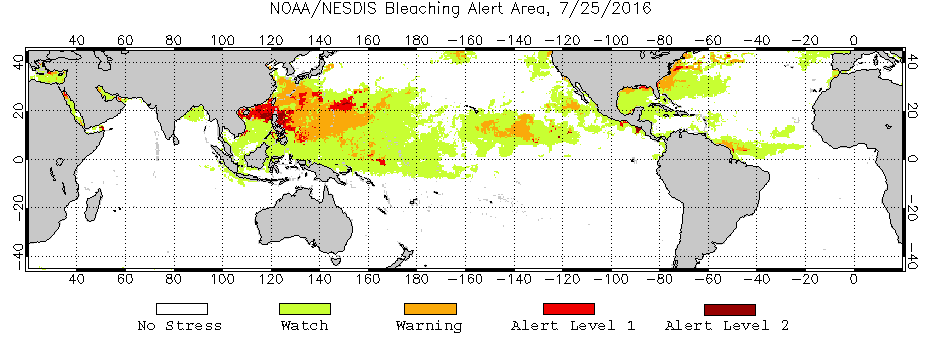
Rob Painting at 19:27 PM on 26 July, 2016As predicted, coral bleaching is now starting to manifest in the reefs of the western tropical Pacific:
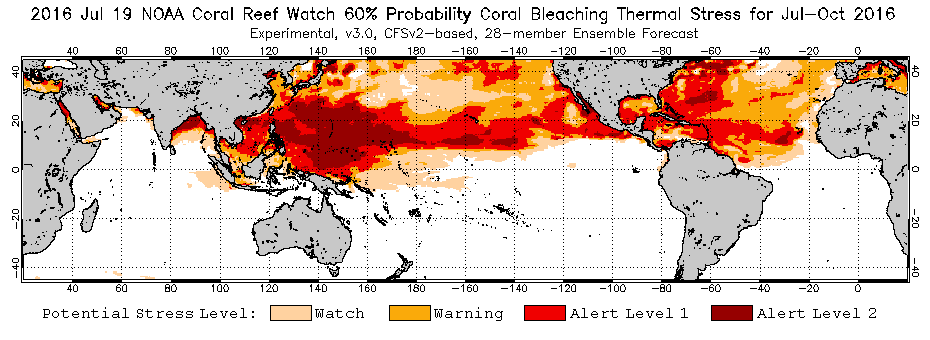
And the outlook for the next few months is grim:
- Corals are resilient to bleaching
Tom Curtis at 13:48 PM on 26 July, 2016Jim Steele @25:
1) "There has been virtually no warming on the GBR"
On the contrary, there clearly has been warming on the Great Barrier Reef:


The resort to a limited time span (1982-2014) when more extensive data is easilly available, or to July temperatures (when the bleaching occurred over the Feb-April interval) clearly represents cherry picking.
What is more, the area of most bleaching experienced record SST over that period:

(Source)
2) Hendy et al (2003) in addition to showing coral die of events in 1782-5 and 1817 also shows LIA GBR temperatures elevated to end 20th century values (figure 2, bottom panel). The LIA was a period of depressed global mean surface temperatures which need not have been represented by depressed temperatures everywhere and were not in the GBR. Including the missing evidence about LIA SST in the GBR shows the evidence that purportedly shows no temperature dependence in fact shows a relationship between die backs and elevated temperatures.
3) It is true that some reefs have recovered rapidly from die backs, but others have not, and some have recovered but only with a massive loss of biodiversity. One of the key factors in rapid recovery is the presence of nearby reefs with appropriate species to recolonize the site of the die back. In mass coral bleachings, the great extent of the bleaching makes that less likely. The greater the extent, therefore, the greater the long term loss in coral viability.
That leaves aside the obvious point that these mass bleachings are occuring at current temperaures. If the target for restraining global warming is met, we can expect an additional 1 C increase in global Mean Surface Temperatures relative to 2015. If not, it will be much more than that. The likely consequence is that we will experience mass coral bleachings not every decade or so, but every few years - meaning the bleachings will occure of reefs not yet recovered from the last bleaching. The consequence will be a long term loss of vitality for coral reefs - and that is considering only the effects of temperature based mass bleachings.
- Corals are resilient to bleaching
JIm Steele at 05:30 AM on 26 July, 2016The trouble with blaming global warming and bleaching for reef mortaliti
1. There has been virtually no warming on the GBR https://i2.wp.com/mclean.ch/climate/figures_2/GBR_SST_Anom_Jul2014.gif
2. Paleo studies such as Hendy 2003 foudn warmer temperatures durng te LIA
3. Coral bleaching from and El Nino ismuch like a devastating forest fire from a dry La NIna spell. There is a natural recovery and coral often recover from natural bleaching faster than a forest recovers from a nautarl fire.
Northwest Australia's Scott Reef, the upper 3 meters lost 80 to 90% of its living coral and the disappearance of half of the coral genera. Yet researchers observed, “within 12 years coral cover, recruitment, generic diversity, and community structure were again similar to the pre-bleaching years.” A similar long-term study in the Maldives observed a dramatic loss of coral during the 1998 El Nino but by 2013 the reefs also had returned to “pre-bleaching values”. Although a reef’s recovery sometime requires re-colonization by larvae from other reefs, a process known as re-sheeting or Phoenix effect can facilitate a reef’s speedy recovery. Often a small percentage of living “cryptic” polyps with a more resilient symbiotic partnership were embedded within a “dead” colony and survive extreme bleaching. They then multiply and rapidly “re-sheet” the colony’s skeletal remains.
- Climate scientists have warned us of coral bleaching for years. It's here
Tom Curtis at 21:55 PM on 22 June, 2016scaddenp @20:
"Was there a coral bleaching event in 1965? yes. Is it comparable to events today in severity and coverage?- you need the larger scale evidence. Valerie says no but you appear to not to like that statement, but project heaps from the other one. Drawing a long bow from one observation instead of decades of study is highly unconvincing to me."
As previously noted, Valerie Taylor only state the extent of her, and her husbands travels in 1965, not the extent of the bleaching. However, she does not state that the bleaching was limited. From the information she gives alone, it could have been one or two small patches of bleaching, or a bleaching event comparable to that in 1998 and 2016. Of course, we know on other grounds that the later is not the case. Further, she does not even state when the bleaching occurred, or its cause. The bleached areas they saw could have been remnants of a bleaching event in the previous two years. The bleaching could also have been caused by large inflows of fresh water (as happens on inshore reefs during floods). It may have even be a Crown of Thorns Starfish outbreak, whose initial impact of the reef is superficially similar.
Not only is her account vague, but it is also that of a non-expert. She is a very experienced diver, but so also is Ove Hoegh-Guldberg, who was collecting for an Oceanarium before he left high school, and has been diving for at least 39 years. What Ove Hoegh-Guldberg adds to that is a lifetime of intensive research which makes him an expert, something pjcarson would immediately acknowledg, if only Ove Hoegh-Guldberg agreed with him. Unfortunately he does not, so he has to talk up a non-expert who does not explicitly disagree rather than acknowledge genuine expertise.
- Climate scientists have warned us of coral bleaching for years. It's here
pjcarson2015 at 15:19 PM on 20 June, 20161. Rob P’s quote “We cannot yet be certain, but it is unlikely that mass coral bleaching has, until very recently, occurred for thousands of years.”
Aren’t Valerie Taylor’s observations large-scale? They were 50 years ago and bleaching was as extensive as today’s.
2. The corals also self-repaired later - despite CO2 levels being higher. If bleaching is caused by warming due to high CO2 levels, how is it that repair occurred at higher levels than the damage? In spite of this you conclude
“Of course this doesn't have to be, but humans, collectively, have shown no intention of curbing industrial carbon emissions and so the demise of coral reefs seems inevitable.
3. [You know where to find more on this topic.] As bleaching/repair occurs sporadically, one would suspect the cause to also be sporadic. Undersea volcanism fits the bill, both in location and in its irregularity, and it produces localised toxicity and heating; witness the Qld, etc floods in 2011 (when bleaching followed) and 2016 which match the preceding large Mag seismicity around Vanuatu. Expect more bleaching soon.
4. The Eemian was about 2C higher than now (Vostok data). As you note, such temperatures may well recur.
5. I’m still puzzled by the this article’s title when the Taylors - and you - note that bleaching has preceded the “warnings” by decades.
- Climate scientists have warned us of coral bleaching for years. It's here
Tom Curtis at 17:15 PM on 18 June, 2016pjcarson2015 @4:
"Incidentally, in my previous post I referred to chapters in my site, “Planet Earth Climate Topics” at ..."
Yes. As always you spammed an add for your site which contains, as usual, a great paucity of facts, a significant number of inventions, and a curious refusal to correct errors. On this topic it contains no information in addition to the text of your post @3 and therefore is not an independent source of evidence, or indeed a source of evidence at all.
As to your post @3, yes coral recovers from bleaching. Recovery, however, takes time. If there are repeated impacts during that time, recovery will be slow, or not occur at all. As can be seen below, events causing damage to reefs have accellerated in recent times, and for the Great Barrier Reef, that has lead to a long term decline in coral cover (second figure):

(Source)

(Source)
As you can see, that decline has been precipitous for the southern most (and most disturbed) portion of the reef.
What is worse, as can be seen from calcification studies, that decline comes at the tail of a reversal of a century long increase in reef health in the mid 20th century (figure d):
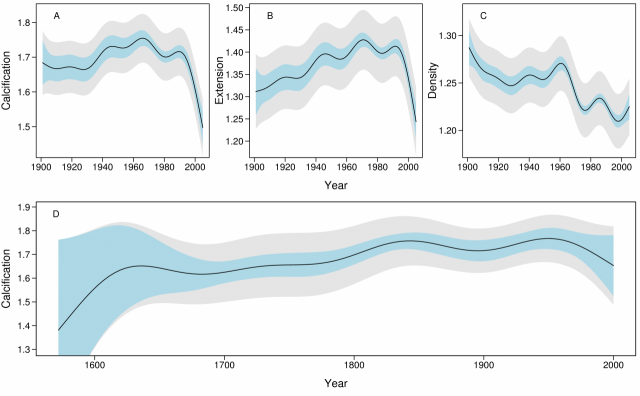
Granted that bleaching events currently account for only 10% of reef damage. However, the GMST during the last bleaching event was less than the 2 C limitation on global warming aimed at by international agreements. If global warming is restricted that limit (currently very unlikely on present policies), that means we will be getting multiple equivalent bleaching events every decade within fifty years. That is far to rapid a pace to recover from, so that bleaching events alone would be sufficient to destroy most of the Great Barrier Reef.
- Climate scientists have warned us of coral bleaching for years. It's here
pjcarson2015 at 10:39 AM on 17 June, 2016Currently there is anxiety about coral bleaching, affecting particularly the northern Great Barrier Reef. Valerie Taylor had a short informal interview in The Weekend Australian’s Magazine, May 14. You may recall she made many documentaries with her husband Ron about sharks. She’s now 80, and still dives. [Current researchers would/should have been aware of their well known documentaries.] She says of the GBR,
“In 1965 we went from one end of the reef to the other, over six months, and we found bleaching then. In the ‘70s we went back and you’d never know it happened. The coral had recovered; nature had taken care of it. I’ve seen reefs in PNG that were as white as snow and I’ve just come back from there and they’re terrific.”
She thus observes that bleaching is reversible. (Presumably spores from unaffected corals can flow in again to re-colonise affected areas once the cause has departed.)
Coral bleaching and repair occur independently of atmospheric CO2 levels.
As it is mainly the relatively untouched northern areas of the GBR affected, it is unlikely that run-off is the cause. The current bleaching decreases towards the south, flowing on the north-to-south counter-clockwise current from Vanuatu, and becoming depleted in the process. Upstream undersea volcanic activity around Vanuatu produces toxic H2S (Chapter 4a, Cyclone Pam), in time oxidising to sulphuric acid, which may also be a concern; Chapter 5 shows acidity produced by CO2 is not.
Other coral bleaching areas around the globe, eg Seychelles, Caribbean, Maldives, etc are downstream from undersea volcanic areas.
- Corals are resilient to bleaching
JIm Steele at 04:01 AM on 29 May, 2016Rob asserts, "tropics are reaching temperatures in summer that exceed the upper thermal tolerance threshold of coral that is no longer the case"
You are assuming that the upper thermal tolerance threshold has been reached but symbiont shuffling and shiftings has demonstrated that the upper threshold is moveable and new thresholds rapidly evolve. The fact that coral thrived during the Holocence Optimum when temperaturs in the Coral Sea were 2.1C warmer than today suggests you are very wrong about corals upper threshold. Coral must adjust their thermal boundaries to deal with cooler and warmer temperatures. The Great Barrier Reef Expedition of 1928-29 was concerned with bleaching and warming temperatures. Bleaching happens when ever there is an abrupt event that exceeds the prevailing climatology. If the extremes represent a trend the coral then evolve new symbiont partnerships best suited for that change.Most global bleaching events are temporary and will not be detected by cores sample. Furthermore as discussed in Hendy 2003 even massive mortality as observed in the 1998 El Nino bleachings are very difficult to detect without much much larger samples size within a location and from a wider range of locations.
You absurdly suggest a growing pace of coral death based on extrapolating from a short term snapshot and dismissal of the evidence of symbiont shifting. But most reefs that suffered high mortality have recovered within a decade and have been resilient to subsequent warm events. Bleaching is a minor cause of moratlity and coral have had to evolve resilience and quick recovery to deal with more destructive forces such as tropical storms.
- Corals are resilient to bleaching
JIm Steele at 01:59 AM on 28 May, 2016Rob, You put words in my mouth. I never made "the flawed assumption that the marine revolution that occurred during this time, as it pertains to coral reefs, came about because of some hitherto unrecognized invulnerability to warm water." I asked "Do you really want to argue coral suffered more from warmth than they have from the cold during the most recent ice ages??" and you went off on a strawman tangent.
The coral holobiont is constantly shifting the symbionts to maximize growth withing very narrow limits. Thus they are always stressed by an extreme El Nino event, whether happens in cooler water of the 1800s or warmer waters of the 21st century. Bleaching is part of their ongoing adpatation mechanism of expelling symbionts and acquiring new ones. This very well documented.
Obviously you and others disagree with those experts that push the adaptive bleaching hypothesis. That why it is a professional debate. That polyps die is by no means a refutation of that hypothesis and such an argument is a bit disingenuous. A colony consists of 100s to millions of polyp clones. Most of the clones die after a stressful event, such as an abrupt cooling or warming. It's like leaves falling from a tree but buds, or in this case cryptic polyps reamain viable and in what is known as the Phoenix effect those clones with a better adapted symbiotic partnership can rapidly re-sheet the skeletal remains. Recovery can take weeks or years, and the reefs with the greatest moratliy, 90% or more, have recovered within 15 years. In the process those living polyps have been demonstrated to acquire better adapted symbionts. And the species that experienced the most bleaching during on EL Nino are observed to rsist bleaching during subsequent extreme events.However because EL Nino warm event are abrupt and temporary, coral will again shuffle and shift symbionts to be better adapted to the cooler pre El Nino events. They may then re-acquire the old symbionts and once again be vulnerable to a EL NIno. The coral that suffer the most are exposed to extreme variability as warm EL Nino waters are replaced by cold upwelled La Nina waters. That' s why the cool eastern Pacific has only ~18 species, while the Western Warm pool has over 500 species and more massive reefs.
Fears surrounding bleaching and climate change are only valid if you believe that coral have reached their upper thermal limit and can only adapt via a slow evolutionary process. But there is amples and growing evidence that is not the case. Symbiont shifting and shuffling allows rapid adaptations, and there is no reason to believe that holobionts that thrived during the Holocene Optimum when tropical oceans were 2.1 C warmer than today, will not be able to thrive any similar warming over the next millennium
- Corals are resilient to bleaching
JIm Steele at 10:24 AM on 20 May, 2016Rob, Seriously. Reef forming coral expanded during the warm periods of the Mesozoic. Do you really want to argue coral suffered more from warmth than they have from the cold during the most recent ice ages?? Please provide the evidence? LInks?
And indeed there has been episodic declines in coral reefs, but the greatest mortality has been due to tropical storms, predators like Crown of Thorns, or disease like White band. Dynamite and cyanide fishing have also been destructive as well as nutrient runoff from agriculture and seage. INstead you want to focus on bleaching, the smallest cause of mortality which is also part of their amazing adaptation mechanisms?!? Why do you disagree with the experts who promote the Adaptive Bleaching Hypothesis?http://landscapesandcycles.net/coral-bleaching-debate.html
- Corals are resilient to bleaching
MA Rodger at 22:43 PM on 24 April, 2016Glenn Tamblyn @15.
I think the closing comments of the full article are a better interpretation of what the authors are saying:-
"Seawater carbon chemistry is a key determinant of coral calcification, and the potential for future anthropogenic-influenced declines in carbonate saturation state, and hence coral calcification, is cause for serious concern (2,4,7). However, we conclude that the rate of change in the thermal environment of coral reefs is currently the primary driver of change in coral calcification rates. Warming SSTs are resulting in (i) increased calcification rates reported here in the southeast Indian Ocean, where marginal reefs have taken advantage of warmer conditions, and (ii) recent declines reported elsewhere for more typical reef environments where thermal optima for calcification have been exceeded or resulted in setbacks in growth as a result of thermally induced bleaching. Whether the former is sustainable as oceans continue to warm is another question."
- Corals are resilient to bleaching
Glenn Tamblyn at 09:23 AM on 24 April, 2016From the abstract for the paper.
"We show there is no widespread pattern of consistent decline in calcification rates of massive Porites during the 20th century on reefs spanning an 11° latitudinal range in the southeast Indian Ocean off Western Australia. Increasing calcification rates on the high-latitude reefs contrast with the downward trajectory reported for corals on Australia's Great Barrier Reef and provide additional evidence that recent changes in coral calcification are responses to temperature rather than ocean acidification."
Huh! This is a classic Black is White piece from the Australian. There is a downward trajectory to calcification in the GBR, in warmer water, in contast to the cooler waters at higher latitude in the southern Indian Ocean. - Corals are resilient to bleaching
gtarestoration at 05:57 AM on 21 January, 2016Corals are bleaching across all the world’s oceans in only the third die-off of its scale in history, scientists have revealed.
El Nino and a Pacific warm water mass known as “The Blob” are combining with human-caused climate change to drive record high ocean temperatures.
These hostile conditions are expected to deplete more than 38% of the world’s reefs by the end of 2015, according to the US-based National Oceanic and Atmospheric Administration (NOAA).
Recent damage to corals in the Caribbean follows bleaching in the Pacific and Atlantic oceans earlier in the year, confirming the phenomenon as global in scope.
It has knock-on effects for species that rely on healthy corals for food, as well as for people who make a living from tourism or fishing.
“What really has us concerned is this has been going on for a year and is likely to last another year,” said NOAA coral specialist Mark Eakin.
The El Nino weather system, characterised by a period of warm water across much of the Pacific, is forecast to remain strong until early 2016.
- The Ghosts of Climate Past, Present and Future: Part 2
michael sweet at 09:50 AM on 25 December, 2015William,
While your link is interesting, a blog post by someone with a BS who is a High School Chemistry teacher (like me, except I have an MS) is not proof. Especially since it contains no peer reviewed references. This post at SkS by Rob Painting, which does reference the peer reviewed literature, states that there was a sea level high stand approximately 4,000 years ago that was approximately 3 meters higher than current sea level.
Atolls like Tarawa, capitol of the country Kiribati (which I have visited) are set on the limestone reef that was formed at the high stand, not on sand dunes as described in your link. These reefs are about 2 meters above current sea level since coral cannot grow up to the high water mark. Once the sea level rises over the hard rock base of the current islands they will be permanently submerged. This will happen even if the coral grows and keeps up with the rising sea level. There are many examples of atolls that are slowly sinking and stay just at sea level. For example Minerva Reef, which I have also visited, has a few sand bars and the main reef that are above sea level at low tide but is conpletely submerged at high water.
The description in your link that the locals can preserve their islands in the face of sea level rise by sufficient care is simply false. These Islanders are at the mercy of the USA and China. Who will take them in when their homes are destroyed by the baked in sea level rise of CO2 already in the atmosphere?
If Rob Painting cares to comment his word is expert on this subject.
- Corals are resilient to bleaching
Argus at 07:45 AM on 27 October, 2015"Oops! It may not be ‘ocean acidification’ killing coral after all – common chemical found in sunscreen is poisonous to coral reefs"
A greater threat to corals than warming and acidity may be suntan lotion that contains oxybenzone or any of three other ingredients. See:
Sunscreen contributing to decline of coral reefs, study shows
- Corals are resilient to bleaching
Thomas Traill at 22:00 PM on 22 June, 2015There seems to be some good news on the coral front.
- A 23-year experiment finds surprising global warming impacts already underway
ranyl at 21:34 PM on 10 February, 2015HI Wili,
See article at HTML.
There is no doubt that the oceans have been a major sink, however as temperature rises water can absorb less and less CO2,
http://www.rtcc.org/2012/01/24/warming-oceans-face-co2-tipping-point/
also as they acidify oceanic sinks can turn to sources.
http://www.climate.org/topics/climate-change/ocean-uptake-climate-change.html
Further the oceanic desserts are growing, and dead zones increasing and biodiversity is dropping all of which will not help the future prospects of CO2 absorption.
Further again, as the southern hemisphere warms and the winds move south they draw up more water from the depths and this water is CO2 rich and releases CO2 from the ocean's depths and warms the base of the below sea level based ice sheets.
Therefore not sure the oceans will provide CO2 salvation.
Not unless through our actions (or none actions (i.e. not putting toxic waste in the water)), an oceanic ecosystem and biodiversity boom can be utilized, still going to lose many coral reefs, not sure what happens to CO2 releases associated with coral die offs?
- Meeting two degree climate target means 80 per cent of world's coal is unburnable, study says
Rob Painting at 06:05 AM on 8 February, 2015Indus56 - Agreed. A 2 degree limit will not save the world's coral reefs for instance. Coral will still exist, but the grand structures they have built, and which harbour an estimated one million marine species, will not.
- Scientists connect the dots from identifying to preventing dangerous climate risks
mancan18 at 08:08 AM on 25 December, 2014Changing the view of the public is not only a job for the scientists, it is also a job for the media and for popular writers to create the right fictional (and non-fictional) literature that will be widely read. While SkS is predominately a forum for scientific discussion. Perhaps, while I don't pretend to be any great writer, I have a more scientific and mathematical bent, I have penned something, while it's not great liteature and it may be an inappropriate forum, it might get the ball rolling.
AGW and CC
Doggerel for the AnthropoceneMore extremes,
Less in betweens;
Records broken,
That are not a token;
Longer lasting,
Wider happening,
All a sign
Of what's to come.Warmer hot days,
Warmer cold days,
Warmer OK days,
Just changing to a warmer way.
More summer times,
Later autumn times,
Earlier spring times,
Shorter winter times,
Sometimes sharper,
Most times milder,
Years not quite,
What they've always been;
Where only some days,
Seem the same.More sunny days,
More droughts;
More cloudy days,
More rain;
More floods;
More storms,
More wind;
More homes destroyed,
More houses wrecked,
Oh well what the heck.Warmer land,
Warmer seas,
With
Glaciers smaller,
Poles retreating,
Overall,
Ice just disappearing;
High tides higher,
Low tides higher,
The coast we know,
Just eroding;
Coral reefs fewer,
Sea shells thinning,
All the while
Cities slowly sinking.Less land to farm,
To keep us fed,
More sandy deserts,
And a few more dead;
Fewer species,
Animals disappearing,
While others just seem to thrive,
Over a range,
A little more wide;
More pests,
To cause us harm,
More sickness and disease,
To threaten us all.While climates tropical
Become more topical
And milder climes
Are in decline
As poles shrink
You have to think
For polar bears
It's now quite clear,
It's simple,
Really,
They just won't be here.Early signs now,
Give a clue,
And climate scientists,
Seem to know;
That clearing forests,
Burning more oil, gas and coal,
Will only achieve that final goal;
Of seeing what happens,
From feeding the Anthropocene;
Sending CO2 to levels not seen,
Since sometime before the Pleistocene,
Increasing at rates that have never been;
So finally we will know,
What business as usual,
Truly means,
Unfortunately it'll be all too late,
We'll have sealed our fate,
Where, in a few centuries,
There will be a climate that took eons,
For the natural world to make.97% of scientists,
Do agree,
And have spoken through
Their journals, Academies and the IPCC;
3% think something different,
And have sown seeds of uncertainty,
While doubters lay doubt,
With skepticism and deniability,
With their talk of conspiracy
From their political ideology,
Or simply for reasons monetary;
With arguments, politic,
And few, scientific;
All to get in the way,
So action is stopped again and again;
For a little more money,
From a 19th century technology;But it's not so funny,
Because it keeps on happening,
And it will be our children,
Who will surely pay.Some will win,
Most will lose,
But for everyone,
It won't be the same;
One thing though,
As certain as day,
It will be the poorest
Who will have to pay;
While the air conditioned move to higher ground,
Where a more pleasant clime can be found,
To continue their lives day to day,
As if nothing ever happened.It's not a good idea,
To change the climate,
To one not seen,
Long before the thylacine,
It might be a little more green,
In some places,
While in others,
Nothing,
Only desert;
Where in the future
All we'll see,
Is a world where we didn't exist,
A world where we would never be.Should we worry,
And chance our luck,
Just ignore the science,
And hope for the best;
Well, our children will certainly know,
In a hundred years or so;
We will leave them a legacy,
For them to live by,
To wonder why,
People, so supposedly enlightened,
Like us,
Could just let it happen.Despite all the controversy,
Debate and prophecy,
There's one thing certain,There is no doubt,
With CO2 increasing,
There will be heating,
Unlike anything we've ever seen.So for Paris,
In two fifteen
Scientists have spoken;
Will the politics remain same,
Just still broken;
Or will we stop the rot,
So the world doesn't become,
A lot more hot?mancan18 Dec 2014
- Ocean acidification isn't serious
Tom Curtis at 08:18 AM on 8 November, 2014dvaytw @61, that is a simple question requires a moderately complicated answer.
The most fundamental point is that ocean acidity is controlled not only be pCO2 concentrations, but also by Calcium ion concentrations. A high dissolved CO2 concentration can be largely offset by a high Calcium ion concentration. Calcium is introduced to the ocean by the weathering of rocks, both by rain and plant activity. Both of those increase in a warm (high CO2) world so that a natural tendency to equilibrium exists. The result is that even in the eras of highest CO2 concentration over the past 500 million years, ocean pH has not fallen below 7.4 (Zeebe 2012, see figure 5). Past increases in CO2 concentration have been very slow in comparison to the modern anthropogenic increase, allowing ocean chemistry to adjust and restrict the resulting rise in ocean acidity. Because the modern increase is so fast, however, the calcium buffer is being exhausted, allowing a far higher ocean acidity relative to atmospheric CO2 concentration than has been the case in the past.
Second, it is not expected that increased ocean acidity will kill all corals. In particular, soft corals are not directly effected by ocean acidification, and can be expected to flourish (as will other related animals such as sea anenomes as jelly fish). Given high ocean acidity, hard bodied (ie, reef building) corals may revert to soft bodied forms and potentially survive in that way. The consequence of this, however, is that the reefs themselves will decay and be destroyed. The reefs form the basis of major ecosystems, and if they are destroyed most of the reef fishes will find themselves without habitat (including many of the newly soft bodied corals). The consequence will be that many of the reef species will go extinct, and those that survive will do so by adopting a non-reef mode of life - becoming much rarer than is currently the case. The human impact will be a reduction of the shelter provided to tropical shores by reefs, and a great reduction in tropical fisheries.
Third, as CBDunkerson points out, modern corals (scleractinia) have only existed for the last 220 million years, and missed the periods of very high CO2 levels in the past. Indeed, the leading explanation for the supplanting of previous reef building corals is that soft bodied ancestors of modern corals survived, where their hard bodied rivals did not, during the very high CO2 episode of the Permian extenction, and then evolved in to the thus vacated ecological niche. Since then, hard bodied forms of scleractia (and the reefs they produce) have disappeared several times in periods of high CO2 concentrations, ony to reappear several million years later. That several million year delay suggests to me that the scleractia have had to reevolve the reef building habit, ie, that the survivors were not the reef builders of the period but their soft bodied cousins. In any event, the last reappearance was 40 million years ago, when ocean acidity dropped to levels lower than can be expected from BAU over the next two the three hundred years (or one hundred if we are determined).
- 2014 SkS Weekly News Roundup #31B
Tom Curtis at 07:58 AM on 6 August, 2014Speaking of sticking to what is known, how about we start by quoting in context:
"A few studies provide limited evidence for adaptation in phytoplankton and mollusks. However, mass extinctions in Earth history occurred during much slower rates of change in ocean acidification, combined with other drivers, suggesting that evolutionary rates may be too slow for sensitive and long-lived species to adapt to the projected rates of future change (medium confidence)."
(Bolded sections elided by M Thompson)
Also from the summary on Ocean Acidification:
"Ocean acidification poses risks to ecosystems, especially polar ecosystems and coral reefs, associated with impacts on the physiology, behavior, and population dynamics of individual species (medium to high confidence). See Box TS.7. Highly calcified mollusks, echinoderms, and reef-building corals are more sensitive than crustaceans (high confidence) and fishes (low confidence), with potential consequences for fisheries and livelihoods (Figure TS.8B). Ocean acidification occurs in combination with other environmental changes, both globally (e.g., warming, decreasing oxygen levels) and locally (e.g., pollution, eutrophication) (high confidence). Simultaneous environmental drivers, such as warming and ocean acidification, can lead to interactive, complex, and amplified impacts for species."
(Bold in original)
So, to "stick with what is known" in M Thompson's version, you need to quote out of context, and ignore the IPCC's findings. That is not what I would call integrity.
- State Department cuts through the acid political environment on oceans and climate
Stephen Baines at 06:06 AM on 1 August, 2014jim,
De'ath et al did not consider acidification effects on reefs, and they explicitly state that they probably underestimate coral reef decline on the Great Barrier Reef as a result. Just because a study only focusses on some factors affecting coral reefs does not mean that it concludes others are not important.
Also, it's important to realize that while human nutrient pollution, resource harvesting and land use have been fairly advanced for some time, ocean acidification is in many ways only beginning. Negative effects on corals are likely, and sometimes observed, but many won't be fully manifest for some time, prehaps until pH in these regions approaches the saturation point for calcite/aragonite. Unlike those other problems, which we largely dealt with post-hoc, we are a touch ahead of the curve in assessing the impacts of ocean acidification, even if we're not necessarily coming up with solutions.
The fact that waters off the east coast of the US are acidifying faster than elsewhere means only that factors other than the increase in atmospheric CO2 also influence local patterns in pH, as I pointed out, and it is important to understand those other factors. However, it also means that fully one third of the increase in LIS and Chesapeake Bay ecosystems is directly attributable to increased CO2 in the atmosphere. This effect exacerbates the effect of the other factors on pH, and it will only increase in importance in the future. It makes it much more likely that critical thresholds will be crossed under extreme conditions. Future increases in CO2 may also render attempts at remediation of pH through pollution control unworkable.
In short, I'm not sure it makes sense from a risk avodance point of view to think about ocean acidification as a process that is important in one place and not another. Yes, organisms adapted to more constant conditions are likely to be more vulnerable, but so may be organisms in cold areas that are already acidic, or organisms at the northern ends of their ranges who may be near thresholds. Moreover, the combination of local variation with a longterm trend in pH could mean that critical thresholds could be crossed sooner in coastal systems under extreme conditions. Since we depend heavily on the living resources of coastal ecosystems, it would be unwise to deny that risk until we know more.
- State Department cuts through the acid political environment on oceans and climate
Stephen Baines at 03:48 AM on 1 August, 2014jim @16,
I'm not sure what your question is, but the basic story is that it depends on where you are.
Variations in pH in coastal regions reflect the balance of respiration in plankton and in deep sediments (which produces CO2), photosynthesis (which consumes CO2), upwelling of deep water (which has lots of CO2) and inputs of rivers (which often also have a fair amount of CO2 as well as other inorganic and organic acids). As a result, pH can vary a fair amount (easily 0.5 units) over time scales of days in coastal systems with variable upwelling, high algal growth, shallow water columns and large rivers. It's also true that organisms growing in such environments are often capable of handling, and even preferring, variations in pH that result, while open ocean species are typically less equipped to handle such variation.
However, its also true that progressive acidification combined with such variation makes it more likely for pH to drop to levels that may be outside the typical environmental conditions to which these organisms are adapted. The parallel with how gradual atmospheric warming combines with weather variability to produce a large increase in the probability of damaging extreme temperature events is obvious. We don't know in many cases what the critical pH thresholds are for many species, or how long pH must stay below them to have a significant impact.
Also, as indicated by the article to which John Hartz points, atmospheric CO2 in the past influences the pH of deep water brought to the surface now, and current CO2 will lead to lower pH in such water in the future in regions exposed to upwelling, so the the effects of upwelling and atmospheric CO2 on acidification are not really independent, just lagged in time.
The generalization about coral reefs is completely off the mark. There is a reason we don't see coral reefs off of heavily populated temperate coasts. Reef building corals require warm waters with relatively high pH that are not subject to upwelling of deep water. They also do not like the extra nutrients and sediments that are brought in by rivers or are introduced as a result of human activity. Because they prefer those factors be absent, and because they need relatively high pH to build calcium carbonate shells, corals in particular are likely to be directly affected by ocean acidification.
- State Department cuts through the acid political environment on oceans and climate
Tom Curtis at 09:54 AM on 31 July, 2014Russ R @7, as one of the original respondents to your first post, I trust the moderators will not see me as "piling on".
1 a) In fact it is very difficult to get good proxies with millenial resolution in the distant past, let alone decadal. However, your original question was focussed on episodes of sustained depressed ocean pH. During those sustained periods there were shell building organisms present (made possible by buffering by increased weathering). You have now switched your question, and you are no longer entitled to your assumption of onging existence of shell building organisms.
For example, there have been sustained periods in the past with a noted absence of reef building organisms in the ocean:

(Source)
Several of these events are associated with periods of rapid increase in CO2 levels in geological terms, on which more below.
The question will obviously arise, if the corals go extinct, how do they come back in 5 million years. The obvious answer is that while members of the same family, or order of corals survive, members of the same genus and species do not. In particular, what probably has occured is that either a related soft coral has evolved to occupy the vacated niche; or a surviving species or small number of species of hard corals have successfully made the transition to a soft coral niche, and then reevolved the reef forming habit once conditions were more suitable.
We can be sure that some measure of evolution was involved because of the 5 million year gaps. Had a small number of hard corals retained the hard coral habit in refugia (isolated areas were pH is sustained and higher levels by local geochemistry), restoration would have been almost instantaneious in geological terms (100,000 years or less).
So, on the plus side, rapid ocean acidification will likely only eliminate coral reefs for the next five million years. Is that really any different from eliminating them forever in human terms? And once the five million years are up, related corals may take up the reef forming habit. Or perhaps not. After all, to previous forms of corals (Rugosa and Tabulata) did not come back after the end Permian extinction, being replaced by an entirely different form of coral.
1 b) It is highly unlikely that many past excursions in CO2 concentration have been as rapid as the current excursion. Among the most rapid (geologically speaking) causes of increased are large igneous provinces such as the deccan traps, of which wikipedia says:
"The Deccan Traps are a large igneous province located on the Deccan Plateau of west-central India (between 17°–24°N, 73°–74°E) and one of the largest volcanic features on Earth. They consist of multiple layers of solidified flood basalt that together are more than 2,000 m (6,562 ft) thick and cover an area of 500,000 km2 (193,051 sq mi) and a volume of 512,000 km3 (123,000 cu mi)."
(My emphasis)
The CO2 content of flood basalts as a proportion of mass is well known. So also are the timings of eruptions in flood basalts (igneous rock being the easiest to date). That has allowed Self et al (2006) to estimate the rate CO2 emissions as a result of the formation of the Deccan traps:
"This calculation shows that approximately 1.4×10¹⁰ kg, or 14 Tg of CO2, could be released for every 1 km3 of basaltic lava erupted (assuming a density of 2750 kg m−3), thus the total release from an erupted lava volume of 1000 km3 would be "14×103 Tg CO2. Whilst this is a very large mass, it should be noted that it represents less than 1/200th of the CO2 present in the modern atmosphere ("3 million Tg, or 3×10¹⁵ kg), and
only about 3% of the current annual land–atmosphere CO2 flux. In effect, even an instantaneous release of this quantity of CO2 would increase the content of the current atmosphere (i.e. "365 ppmv) by only 1.7 ppmv. This compares with the current, largely anthropogenic, annual increase of 1 ppmv since 1958."Even assuming the entire Deccan traps were formed over the 33 million years of peak erruption, that amounts to an annual average emission rate equivalent to of 0.03 ppmv. Human emissions are currently 100 times that rate.
If even the formation of the Deccan traps cannot hope to match current human emission rates, and hence current rates of change in ocean pH, rates of change in ocean pH equivalent to the modern must be rare to non-existent in the past. It is possible that such rates have been matched by either large scale clathrate release (PETM) or large igneous provinces igniting larger reservoirs of fossil fuels (suggested for the end Permian extinction), but all such potential instances are associated with large scale extinction events, particularly among animal types known to be vulnerable to ocean acidification.
2 a) You cite pH values for water intake at Monterey bay. In enclosed waters such as bays, pH values are often far lower than in the open ocean, and are far more variable. A more appropriate comparison (because not all threatened species live in bays) is with monthly variations in open ocean pH:

There you see a peak intra-annual increase of just 0.07 pH over four months, and peak declines of slighty less magnitude. That is, the peak monthly change in open ocean pH is less than the change in open ocean pH already brought about by anthropogenic emissions of CO2.
2 b) scaddenp @13 correctly notes that changes in seasonal values do not have the same impact as changes in annual averages. Specifically, molluscs in Monterey bay, for example, may have an annual cycle in which they build up shell thickness during periods of high pH, can loose shell thickness during periods of low pH. A general lowering of pH may then restrict the build up in one season and increase the decline in shell thickness in the other - weakening shells overall and (if sustained) eventually eliminating them.
You can reasonably point out that that is a hypothetical mechanism, but what you cannot reasonably do is ignore the numerous examples of recorded shell loss, or depleted reef construction rates, and of inability of reefs to colonized otherwise suitable areas with low pH in the wild. The adverse impacts of low pH on a number of marine animals is not hypothetical. It is observed.
- State Department cuts through the acid political environment on oceans and climate
KR at 01:42 AM on 31 July, 2014Russ R. - Regarding past episodes of acidification, Hönisch et al 2012, The Geological Record of Ocean Acidification, is a recent and relevant paper. They examine among other data boron isotope composition for pH, calcium-to-trace element ratios for ambient CO2, and alkenone carbon isotope composition for aqueous CO2.
In table S1 of the paper (supplemental data) they compare these past episodes to the present, and find the only really comparable episode is the Paleocene–Eocene Thermal Maximum (PETM). The PETM notably had a mass extinction of shell-forming foraminifera. This recent work with direct proxies for pH and CO2 changes agrees with previous research on the PETM and its similarities to the present.
Regarding your "hard to believe" question (Argument from Incredulity?) on pH swings, seasonal variations are short term and can be managed by many organisms, while longer term average pH changes induce energy costs (energy of fixation in shells) and the lifespan availability of aragonite and calcite needed to build shells. And yes, there are nonlinear thresholds (Ries et al 2010) for many organisms.
Finally, the correct and proper chemical terminology for lowering pH is indeed "acidification" - semantic arguments in that regard don't affect changing H3O+ concentrations, and are irrelevant red herrings. If you start at the South Pole and travel a few hundred km in any direction, you are moving north (northification?) despite still being in the Southern Hemisphere, and the weather will be correspondingly different there.
- Ocean Acidification Is Fatal To Fish
DSL at 08:20 AM on 7 February, 2014And let's look at some of Goreau's other comments on that thread:
"What I take violent exception to is the claim that acidification is a major threat to tropical coral reefs NOW. It is not: corals will die of high temperaturesdecades to centuries before the dead reefs dissolve! Claiming this is a major problem is a deliberate straw man designed to avoid dealing with the immediate impacts of global warming. No wonder the US and Australian governments and their research agencies love acidification, and act like they invented it!"
"The fact is that if we solve the CO2 problem in time to save reefs from global warming, the acidification problem will automatically be taken care of. If we focus on acidification as the major threat to reefs, we guarantee their extinction."So, Vonnegut, are you suggesting that your quote is evidence that Goreau--a recognized expert--is saying that research on ocean acidification is garbage? Is that what your quote says to you? Or do you recognize that Goreau thinks that acidification is a problem, but it's a long-term problem that pales in comparison to the problem of rapidly warming oceans (via anthropogenic global warming)?
- Ocean Acidification Is Fatal To Fish
Vonnegut at 00:49 AM on 6 February, 2014@92 Tom "Vonnegut @91, Fortunately, a crashing economy and potentially a crashing global civilization will effectively our further emissions of CO2 long before that. So, almost certainly, will a limited supply of fossil fuels. Consequently, the question is not if we will stop emitting CO2, but when - and how much damage we will do to ourselves and the environment in the meantime."
My sentiments entirely , mother nature always wins in the long term.
Specifically, you have scoured the internet for one or two quotes from coral experts that indicate OA may not be totally disasterous (at least by itself). In the meantime you are ignoring far more quotes from coral scientists that indicate that OA plus SST increase by themselves may be enough to destroy the worlds major reefs. Some scientists put that possibility at 50/50 by 2050. As neither you (nor I) are experts, we have no basis to ignore any actual experts within the range of opinion. By formulating your opinions on only the more upbeat reports, you are biasing them so that they do not correspond with what the totallity of observations and analysis are showing.How do you know Im ignoring other views? Im just looking at the other side of the coin.I dont rest easy knowing the oceans are polluted more each day or knowing that 'global warming did it' is being used as a get out clause and diverting money and resources away from fixing the obvious.
You say Ive scoured the internet for a few quotes, Im surprised how many coral positive reports there are from more than 2 places on the planet. Coral wont be missing off the planet anytime soon because of warming, some will, some wont. I can and have backed that up with links I can do it again if needed.
- Ocean Acidification Is Fatal To Fish
Tom Curtis at 00:31 AM on 6 February, 2014Vonnegut @91, if we are "...never going to stop producing co2..." then we are going to kill ourselves of as a species. It is that simple. Fortunately, a crashing economy and potentially a crashing global civilization will effectively our further emissions of CO2 long before that. So, almost certainly, will a limited supply of fossil fuels. Consequently, the question is not if we will stop emitting CO2, but when - and how much damage we will do to ourselves and the environment in the meantime.
If you begin on the assumption that we will not stop emitting CO2, and look only for the evidence that might suggest that could be OK in the short term, you will get a very distorted view of the science. Instead of trying to understand, you will have been merely trying to find a security blanket for your pre-established belief. There have been a lot of signs that that is indeed what you are doing.
Specifically, you have scoured the internet for one or two quotes from coral experts that indicate OA may not be totally disasterous (at least by itself). In the meantime you are ignoring far more quotes from coral scientists that indicate that OA plus SST increase by themselves may be enough to destroy the worlds major reefs. Some scientists put that possibility at 50/50 by 2050. As neither you (nor I) are experts, we have no basis to ignore any actual experts within the range of opinion. By formulating your opinions on only the more upbeat reports, you are biasing them so that they do not correspond with what the totallity of observations and analysis are showing.
- Ocean Acidification Is Fatal To Fish
Tom Curtis at 22:35 PM on 5 February, 2014Vonnegut @82 and 84, unfortunately one of the "other" stressors is high Sea Surface Temperatures, which we are not limiting under current policies. Other stressors such as soil runoff, fertilizer runoff and polution will be very hard to limit in a world with a doubling population by the mid 21st century. Finally, some biological competitors are favoured by high temperature and lower pH; so will place corals under further stress. So, you have to understand that just as some scientists are saying OA may not kill of even the majority of species if we can limit other stressors, other biologists studying the impacts of these other factors, and saying the same thing, with OA included as another stressor. Thus a glimmer of hope is not a panacea.
Specifically to 82, a major shift in reef species means the at least local extinction of many species of coral. That will significantly reduce the ability of the reef to sustain biodiversity, resulting in the at least local extinction many species of fish, crustaceans, and other reef associate species. The total loss of local biodiversity has two further knock on effects. First it reduces the total biomass sustainable by the reef (reducing its potential as a source of food); and it reduces the potential to resist other shocks to the reef. The reef become less robust, and more precarious. The loss of coverage (ie, smaller reefs) reinforces that. Smaller reefs support fewer species, and are more vulnerable to complete destruction by additional hazard.
So, this good news story with a loss of coverage, but some survival if we can exclude other stressors (which we are not doing) starts to look like a Titanic story. 'Well, there will be significant loss of life, but at least some first class passengers will get into life boats" sort of thing. It is telling of the predicament facing reefs that such essentially bad news stories if taken by themselves are regarded as signs of hope.
Further, the widespread loss of species at least locally probably means the extensive loss of some species globally. Even without other stressors, this is starting to put us into survival in refugia only scenarios. That means globaly we are looking at the extinction of a very large number of coral and associated species; with hundreds of years to restore healthy reef communities, and tens of thousands of years to restore the variety of reef species, and hence the sustainable biomass of the reefs.
- Ocean Acidification Is Fatal To Fish
Vonnegut at 19:56 PM on 5 February, 2014""There are likely to be major shifts in reef species and some loss of coral cover, but if ocean acidification is the only factor there won't be total destruction," Paytan said."
www.nsf.gov/news/news_summ.jsp?cntn_id=128243
After studying reefs on the caribbean coastline of Mexico's Yucatan Peninsula
- Ocean Acidification Is Fatal To Fish
Vonnegut at 19:47 PM on 5 February, 2014"It doesn't mean that coral reefs around the globe are going to be fine under ocean acidification conditions. It does mean that there are some coral communities out there--and we've found one--that appear to have figured it out. But that doesn't mean that all coral reef ecosystems are going to figure it out."
So because someone said that I have to agree with it? is that how science works?
- Ocean Acidification Is Fatal To Fish
Dikran Marsupial at 19:41 PM on 5 February, 2014vonnegut. you first raised the example of Palau in your post here, where you gave this link:
http://nsf.gov/news/news_summ.jsp?org=NSF&cntn_id=130129&preview=false
Do you agree that the text at that link includes the following quote:
"It doesn't mean that coral reefs around the globe are going to be fine under ocean acidification conditions. It does mean that there are some coral communities out there--and we've found one--that appear to have figured it out. But that doesn't mean that all coral reef ecosystems are going to figure it out."
If so please explain why you are ignoring this explicit caveat. Note that you are currently misrepresenting what your source of information actually says, which is every bit as much of an academic wrong-doing as plagiarism.
I suggest we ignore voneggut until he/she gives an adequate explanation of why he/she is repeatedly ignoring this caveat, even though it has been pointed out more than once. - Ocean Acidification Is Fatal To Fish
Tom Curtis at 17:19 PM on 5 February, 2014Vonnegut @68, the corals of Palau are clearly adapted to unusually low pH. That adaption may mean they are more resistant to even very low relative pH levels, so that they can survive at a pH of 7.4 while other corals are dying of at 7.8. Alternatively, it may mean they have a narrower range of reduction in pH before they reach the limit of their adaptability. Which of these is true depends on:
1) How long they have been adapted to near their current levels of pH (selection under pressure reduces genetic variability, limiting the pace of future adaptions);
2) Whether or not there exists a hard biological limit in pH below which corals simply cannot adapt to no matter how long they have to do so; and
3) The extent to which they have experience lower pH than current in prior years (which may allow some level of pre-adaption).
Which of these is the case cannot be determined a priori, and indeed probably require very detailed and carefull studies to determine.
What can be known with high probability from the general situation is that coral health is not independant of pH levels, so that significantly decreased pH will decrease the health of a coral community (and a reduction of pH from 7.8 to 7.4 represents a 150% increase in Hydrogen ion activity). Further, it is known that elevated CO2 concentrations will decrease pH even within Palau's lagoons. Consequently OA is still a problem for Palau. It just may be less of a problem than for other coral communites, or possibly more depending on the factors described above.
On a side note, the discovery of the acidity resistance of the Palau corals is unquestionably good knews in one respect. While those corals may or may not be able to survive at Palau with future pH reductions, they will be able to survive if transplanted to other locations with, currently, higher pH. While this would not save all coral species, nor save the great barrier reefs it does mean coral phylum is less likely to go extinct. It probably wasn't going to in any event, but this provides a significant boost to the phylums chance of survival.
- Ocean Acidification Is Fatal To Fish
Vonnegut at 07:31 AM on 5 February, 2014I posted reports to support my view but was told it was just one reef , its by far one of the best outdoor labs on the planet. I cant prove all ocean creatures will adapt just the same as no one can prove they wont, time will tell.
www.pri.org/stories/2014-01-02/palau-scientists-hope-theyve-found-coral-reef-save-all-coral-reefs
www.whoi.edu/news-release/palau-corals
news.stanford.edu/news/2013/april/urchins-ocean-acidity-040813.html
- Ocean Acidification Is Fatal To Fish
michael sweet at 07:21 AM on 5 February, 2014Vonnegut,
Your statements contain so many incorrect "facts" that it is difficult to know where to start.
Most fish that are kept 5C below or above the normal temperatures where they are from will stop reproducing and their immune systems will shut down. They will die in a year or two. They can survive tempory drops or increases in temperature much greater than that, but not long term.
You are simply not looking if you have not noticed any changes in flora and fauna in your area. It is difficult to find something you do not look for. Simply compare the changes in the USDA hardiness zones to see dramatic differences in temperature in just the last decade. Stone fruits do not produce fruit in many locations where they were traditionally grown. In my back yard I have over a dozen trees (includingfour jackfruit trees) that would have been killed by cold 30 years ago. Many of my neighbors have the same. The bark beatles that are killing forrests all over the country are caused by AGW. Open your eyes. Some animals and plants will survive. A few will thrive (I'm betting on the cockroaches). Most will be killed. Your trite comments about coelecanths when there are severe coral bleaching events year after year demonstrates your position. You need to provide evidence that an ecosystem will survive, not a single animal. There are myriad examples of coral reefs that are currently dying from the effects of heat and pH. While the Palau example was surprising, the overwhelming trend is down for coral worldwide. Look at the drought in the American West. Tell me where you live and I will give you examples of plants and animals that are dying off because of AGW.
You need to stop making statements like "small drop in pH" when you obviously have little knowledge of how pH works. You rarely provide evidence to support your wild claims. You claim you could post studies of creatures that would thrive, but you do not provide such evidence. When you go to look for it you will find the overwhelming majority of evidence is that things are doing worse. Read the background information so that you can understand what others are trying to tell you. Your basic science knowledge is sorely lacking.
- OA not OK part 20: SUMMARY 2/2
Dikran Marsupial at 22:15 PM on 4 February, 2014vonnegut
(1) You claimedthat the diurnal range of pH from 8.6 to 7.6 at Lady Elliot Island reef flat (Great Barrier Reef, Australia) answered by challenge " If you want to argue that this is not a problem, it is incumbent on you to provide the evidence that changes in pH will not result in ecologial change.". That coral reef us unquestionably adapted to that range of DIURNAL pH, just as UK fauna and flora is well adapted to a 15 degree change in DIURNAL temperature. So the 15 degrees is not a big change in diurnal temperatures, for the U.K it isn't at all unusual. It would however be a big change in MEAN temperatures. You STILL have not established that OA that would result in large long-term changes in MEAN ocean pH would be tolerable for ocean flora and fauna that are adapted to the mean pH in their current environment, so the Lady Elliot island reef figures do not answer the challenge.
(2) You still have not addressed the point that CO2 may not be the rate limiting factor for growth of algae in coral reefs. If you want to find out what causes algal blooms, you could try looking it up on the WWW using google (e.g. Wikipedia - hint nitrogen is also needed to make proteins as well as carbon, hydrogen and oxygen and notrogen and phosphorus to make DNA).
(3) It is your responsibility to be able to provide support for your position, not mine.
- OA not OK part 20: SUMMARY 2/2
Dikran Marsupial at 21:47 PM on 4 February, 2014To give another example of vonnegut's quote mining, (s)he uses the web page here to support the claim "extremes of ph will have more effect on life than a change in mean". However the sub-title of the article is "Corals living in more acidic waters are healthy, but is the situation one-of-a-kind?" and later in the article it says:
Palau is the exception to other places scientists have studied.
Through analysis of the water chemistry in Palau, the scientists found that the acidification is primarily caused by the shell-building done by organisms living in the water, called calcification, which removes carbonate ions from seawater.
A second reason is the organisms' respiration, which adds carbon dioxide to the water when they breathe.
"These things are all happening at every reef," said Cohen. "What's critical is the residence time of the seawater."
"In Palau's Rock Islands, the water sits in the bays for a long time before being flushed out," said Shamberger. "This is a big area that's a maze with lots of channels and inlets for the water to wind around.
.In other words, the reef at Palau is resistant to OA because of its geology and if you took the corals to some other location where the acidity was due to other factors they may not survive.
"It doesn't mean that coral reefs around the globe are going to be fine under ocean acidification conditions. It does mean that there are some coral communities out there--and we've found one--that appear to have figured it out. But that doesn't mean that all coral reef ecosystems are going to figure it out."
Thus the article provides no real support for the contention made, whatsoever. Voneggut should be ashamed of him/herself for stooping to that sort of behaviour.
- OA not OK part 20: SUMMARY 2/2
Dikran Marsupial at 20:29 PM on 4 February, 2014BTW, the first line of the abstract of the paper voneggut mentions reads as follows: "Ocean acidification is projected to shift coral reefs from a state of net accretion to one of net dissolution this century", is this projection explicitly refuted anywhere in the paper? Not as far as I can see.
- Climate Change: Years of Living Dangerously
Rob Painting at 06:14 AM on 7 December, 2013Yube - it's an anecdotal observation. I am unaware of any public survey which delves into the level of understanding of its respondents sufficiently to gauge whether they truly understand the ramifications. When I talk to people (non-experts) I've yet to run across a single person whom has even heard of ocean acidification. And yet, on our current trajectory, an extinction event later this century appears likely as a result of ocean acidification and ocean warming.
Coral reefs are already headed toward functional extinction, and a looming change in the wind-driven ocean circulation (greater warming in the tropical oceans) will see massive coral reef mortality in the coming years. Too late to stop that sadly, but it is likely to further galvanise climate policy activism.
Boswarm - I have no idea what you mean about coming back to bite us. The scientific basis for climate policy action is overwhelming. SkS writes about the science relentlessly, and will continue to do so. But the more people that understand the moral implications of climate change and ocean acidification the better. If Jim Cameron's mini series, and the use of movie celebrities, helps to penetrate public indifference or apathy, even better still. Hopefully he avoids further scientific mistakes, such as those I pointed out in the trailer.
- Global Warming Paws Fails to Materialise: Earth Still Warming and Global Sea Level Rising Like Gangbusters
chriskoz at 17:34 PM on 20 November, 2013This video emphasizes the role of oceans in AGW, and rightly so, because we, land creatures tend to ignore it.
Once you learn a little bit about climate science (like myself) it turns out the more you learn the more you realise the importance of the state of the oceans as the main measure of AGW and the related catastrophe:
- oceans absorb 93% of heat from increased GHE
- oceans are rising as they expand & melting ice adds there
- arctic ocean dramatically alters in albedo as sea ice melts with extra positive effect (heat from ocean speeds it up more than air temperature)
- sooner or later, oceans will absorb most of Antropo CO2 pulse (within 100ky timescale)
- oceans are getting acidic, and it's far too dangerous for CaCO3 forming creatures than the climate change is for us (if kept at 2degrees)
- our selfish hope is that ocean will absorb most of CO2 peak quickly enough (some 100y) before GIS and WAIS start collapsing... great hope, but what does it mean for coral reefs, foraminifera, crustaceans, and others in the food chain?... ceartain death!
I think we should repeat those scientific facts over and over until ignorant/denying public understands the extents of the main problem here. That wasting time talking about "pause" in air temperatures does not make sense.
- Global Warming’s Missing Heat: Look Back In Anger (and considerable disbelief)…
Composer99 at 03:26 AM on 13 September, 2013hank_:
In the first place, the hard data is already widely available. No special effort need be made by anyone who wants to find it. NOAA/NCDC, here at Skeptical Science, Real Climate, IPCC reports, and so on and so forth. Frankly, going around making statements implying that scientists have yet to "bring forth the hard data" sounds far more like spin in that light. In fact, it strikes me as practically an accusation of malfeasance.
In the second place, "damage control from the AGW faithful"?? Please. Pointing out (correctly) that the oceans are taking up 90+% of additional heat content from global warming isn't "damage control". It's called being accurate. If you want damage control, there are many accounts by climate pseudoskeptics of how Arctic sea ice has been "in recovery" any time over the last decade (it hasn't), or how a not-quite-statistically-significant-yet-still-positive surface temperature trend since 1998 counts as "no warming" or even "cooling".
-----
josiecki:
The NOAA/NCDC link posted by BBD works just fine for me (perhaps a mod fixed it if it was actually broken?). In addition, there just so happens to be a link to the Levitus et al paper in the Skeptical Science post discussing it. (Fancy that.) On to specifics regarding your inquiries:
Surface Temps vs. Heat Content
With regards to the prior focus on surface temperature anomalies, it must be said that these are much easier to measure than ocean heat content, we have longer-term reliable networks of surface temperature measurements, and as far as I am aware finding/developing adequate proxies for historical/paleo measurement is also much easier for surface temperatures than for ocean heat content.
That being said, we are getting better at measuring present and past ocean heat content, and it is IMO irresponsible to leave it out of the discussion, since as discussed it does represent heat storage of nearly 2 orders of magnitude more energy from global warming than do surface temperatures.
The Hockey Stick
For it's part, the "hockey stick" is in reality just a small, minor piece of the global warming body of knowledge. Insofar as it is a cause célèbre, at least in the last ten years, it is because of extraordinary efforts by denialists to attack and discredit it (which they have manifestly failed to do). It is also instructive since it shows an important part of the picture: the rapidity of contemporary warming.
Why the Atmosphere & CO2?
You ask "why are we looking at the atmosphere?" Then you basically answer the question yourself with "Isn't the atmosphere where we experience climate [weather]? [correction mine]"
The changes in weather due to warming, and its attendant effects on agriculture and other socioeconomic activity, is a very good reason to look at the atmosphere.
As for CO2, well, the physics shows that the reason all this warming is occurring, in the oceans and atmosphere and cryosphere, is because of the extra CO2 in the atmosphere. (This is kind of a "Well, DUH!" thing.)
What's It All About, Anyway?
In your final post (as of this writing), you make what is IMO a very revealing comment:
If we didn't have warming, we would be like Mars or a floating chunk of ice. It is a question of whether we are in balance, out of balance or just fluctuating.
There are three major reasons why global warming is "kind of a big deal":
- Sea level rise. Sea level rise has consistently been at the high end of projections. Current expectations for sea level rise range from 50 cm to 2 m above preindustrial levels by the end of this century. The lower end projection entails an enormous cost to protect what coastal infrastructure we can and abandoning the rest. The higher end projection means the effective end of, say, entities such as the city of Miami, or the country of Bangladesh. Both represent severe economic and human crises.
- Ocean acidification. The "evil twin" of global warming, this is not caused by warming per se, but rather has the same source as warming: CO2 emissions from fossil fuels. Currently, ocean acidification is proceeding at a rate that is unprecedented in recent geological history, faster even than occasions known to be associated with, say, massive dieback of coral reefs.
- Other impacts, especially on agriculture, glacier melt, and (sub)-tropical regions. I won't go into too much detail here.
Suffice to say, the net consequence of these impacts severely impairs our ability as a species to continue to exist in the extraordinary state of physical affluence and numbers we currently possess. If we want to maintain something like what we have now, global warming must be dealt with.
As a final word, as I said to hank_, the data you are wondering about is out there, in great abundance. Start with the IPCC reports and work your way through the references. Browse posts here, or at Real Climate, and work through the references. The people who know their stuff and are regulars here are quite happy to help (although their reaction is strongly contingent on the perceived "adversarial" nature of the questions - many are the pseudoskeptics who have come and gone while "just asking questions").
- It's not us
robert_13 at 15:37 PM on 18 July, 2013@Julian Flood
Suppose we have a sink into which the faucet is pouring water.We have control of the faucet and can increase or decrease its rate of flow. We may not have the political will to do that, but that's a side issue. The point here is that we can. Now let's say that some natural forces are pouring vinegar, pee, alcohol, orange juice, and milk into the sink at the same time our water is pouring in from the faucet.
If the water level in the sink is rising at only 45% percent of the rate we would expect from the rate of our input from the faucet, why do you think our lack of knowledge of exactly how much of each of the other inputs and our resulting inability to calculate the sum of their effects is important for understanding whether our faucet is causing the water level to rise?
If the rate of increase in the level of water is 45% of the rate we would expect from our input from the faucet, we know with absolute certainty that that 55% of our water is going down the drain and all the other inputs with it as well. I don't understand what is so hard to understand about that? Why do you think there is any need for detailed knowledge about the rest of what's going down the drain?
Now, there is a very significant implication in this. If we know how much CO(2) we're putting out and how much is showing up in the atmosphere (~45% of our input), where is the rest of that CO(2) going? The only reasonable explanation is that the ocean is sequestering the vast majority of it. We do know that the CO(2) level in solution in the ocean has been increasing and ocean water is becoming more acidic. We are also seeing the effects of this on coral reefs and other marine life. As the globe becomes warmer, CO(2) becomes less solube in water, so the 45% figure is bound to go up and accelerate an already undesirabe situation.
So I don't see where your doubts are coming from unless you just don't want to see and are willing to pick at any single little corner you can find, one at a time and out of context with the bigger picture, simply to avoid seeing.
- There is no consensus
Daniel Bailey at 15:12 PM on 14 July, 2013Agreed. Yet another Galileo wanna-be, ignoring his own physical society's position on AGW, as well as every other scientific body the world over. To wit:
The IPCC’s conclusion that most of the warming since 1950 is very likely due to human emissions of greenhouse gases and has been endorsed by this great cloud of witnesses:
the National Academy of Sciences,
the National Aeronautics and Space Administration,
the National Center for Atmospheric Research,
the National Oceanic and Atmospheric Administration,
the American Geophysical Union,
the American Institute of Physics,
the American Physical Society,
the American Meteorological Society,
the American Statistical Association,
the American Association for the Advancement of Science,
the Federation of American Scientists,
the American Quaternary Association,
the American Society of Agronomy,
the Crop Science Society of America,
the Soil Science Society of America,
the American Astronomical Society,
the American Chemical Society,
the Geological Society of America,
the American Institute of Biological Sciences,
the American Society for Microbiology,
the Society of American Foresters,
the Australian Institute of Physics,
the Australian Meteorological and Oceanographic Society,
the Australian Bureau of Meteorology and the CSIRO,
the Geological Society of Australia,
the Federation of Australian Scientific and Technological Societies,
the Australian Coral Reef Society,
the Royal Meteorological Society,
the Geological Society of London,
the Canadian Foundation for Climate and Atmospheric Sciences,
the Canadian Meteorological and Oceanographic Society,
the Royal Society of New Zealand,
the Polish Academy of Sciences,
the European Science Foundation,
the European Geosciences Union,
the European Physical Society,
the European Federation of Geologists,
the Network of African Science Academies,
the International Union for Quaternary Research,
the International Union of Geodesy and Geophysics,
the Wildlife Society (International),
and the World Meteorological Organization.
There aren’t any national or international scientific societies disputing the conclusion that most of the warming since 1950 is very likely to be due to human emissions of greenhouse gases, though a few are non-committal.
The last organization to oppose this conclusion was the American Association of Petroleum Geologists (AAPG). They changed their position statement in 2007 to a non-committal position because they recognized that AAPG doesn’t have experience or credibility in the field of climate change and wisely said “… as a group we have no particular claim to knowledge of global atmospheric geophysics through either our education or our daily professional work.”
Archive of position statements
Those like old sage would have science re-prove the existance of the atom in every study, mayhap...or republish the above list daily, it would see.(-inflammatory self snipped-)
- There is no consensus
Daniel Bailey at 11:34 AM on 6 July, 2013I've cobbled the following list together from a variety of sources and persons. Apologies, but it's been too long to remember whom they were for proper attribution:
The IPCC’s conclusion that most of the warming since 1950 is very likely due to human emissions of greenhouse gases and has been endorsed by this great cloud of witnesses:the National Academy of Sciences,
http://www.nap.edu/openbook.php?record_id=10139&page=1the National Aeronautics and Space Administration,
http://climate.nasa.gov/causes/the National Center for Atmospheric Research,
http://eo.ucar.edu/basics/cc_1.htmlthe National Oceanic and Atmospheric Administration,
http://www.ncdc.noaa.gov/oa/climate/globalwarming.htmlthe American Geophysical Union,
http://www.agu.org/sci_pol/positions/climate_change2008.shtmlthe American Institute of Physics,
http://www.aip.org/fyi/2004/042.html
http://www.aip.org/gov/policy12.htmlthe American Physical Society,
http://www.aps.org/policy/statements/07_1.cfmthe American Meteorological Society,
http://www.ametsoc.org/POLICY/climatechangeresearch_2003.html
http://www.ametsoc.org/policy/2007climatechange.html
http://www.ametsoc.org/policy/2012climatechange.htmlthe American Statistical Association,
http://www.amstat.org/news/climatechange.cfmthe American Association for the Advancement of Science,
http://www.aaas.org/news/press_room/climate_change/the Federation of American Scientists,
http://www.fas.org/press/statements/_docs/08grand_challenges.htmlthe American Quaternary Association,
http://www.inqua.org/documents/QP%2016-2.pdf
http://www.agu.org/fora/eos/pdfs/2006EO360008.pdfthe American Society of Agronomy,
https://www.soils.org/files/science-policy/asa-cssa-sssa-climate-change-policy-statement.pdfthe Crop Science Society of America,
https://www.soils.org/files/science-policy/asa-cssa-sssa-climate-change-policy-statement.pdfthe Soil Science Society of America,
https://www.soils.org/files/science-policy/asa-cssa-sssa-climate-change-policy-statement.pdfthe American Astronomical Society,
http://aas.org/governance/resolutions.php%23climate#climatethe American Chemical Society,
http://portal.acs.org/portal/fileFetch/C/WPCP_011538/pdf/WPCP_011538.pdfthe Geological Society of America,
http://www.geosociety.org/positions/position10.htmthe American Institute of Biological Sciences,
http://www.nationalacademies.org/includes/G8+5energy-climate09.pdfthe American Society for Microbiology,
http://www.asm.org/images/docfilename/0000006005/globalwarming%5B1%5D.pdfthe Society of American Foresters,
http://www.safnet.org/fp/documents/climate_change_expires12-8-2013.pdf
http://www.safnet.org/publications/jof/jof_cctf.pdfthe Australian Institute of Physics,
http://www.aip.org.au/scipolicy/Science%20Policy.pdfthe Australian Meteorological and Oceanographic Society,
http://www.amos.org.au/documents/item/26the Australian Bureau of Meteorology and the CSIRO,
http://www.csiro.au/files/files/pvfo.pdfthe Geological Society of Australia,
the Federation of Australian Scientific and Technological Societies,
http://www.fasts.org/images/policy-discussion/statement-climate-change.pdfthe Australian Coral Reef Society,
http://www.australiancoralreefsociety.org/c/document_library/get_file?uuid=5d093a51-a77e-4ae0-bd9f-67e459d57ac1&groupId=10136the Royal Meteorological Society,
http://www.rmets.org/news/detail.php?ID=332the British Antarctic Survey,
http://www.antarctica.ac.uk/bas_research/science/climate/position-statement.phpthe Geological Society of London,
http://www.geolsoc.org.uk/gsl/views/policy_statements/page7426.htmlthe Society of Biology (UK),
http://www.societyofbiology.org/policy/policy-issues/climate-changethe Canadian Foundation for Climate and Atmospheric Sciences,
the Canadian Meteorological and Oceanographic Society,
http://www.cmos.ca/climatechangepole.htmlthe Royal Society of New Zealand,
http://www.royalsociety.org.nz/organisation/panels/climate/climate-change-statement/the Polish Academy of Sciences,
the European Science Foundation,
the European Geosciences Union,
http://www.egu.eu/statements/position-statement-of-the-divisions-of-atmospheric-and-climate-sciences-7-july-2005.html
http://www.egu.eu/statements/egu-position-statement-on-ocean-acidification.htmlthe European Physical Society,
http://nuclear.epsdivisions.org/Reports/eps-position-paper-energy-for-the-futurethe European Federation of Geologists,
the Network of African Science Academies,
http://www.interacademies.net/File.aspx?id=4825the International Union for Quaternary Research,
http://www.inqua.org/documents/iscc.pdfthe International Union of Geodesy and Geophysics,
http://www.iugg.org/resolutions/perugia07.pdfthe Wildlife Society (International),
http://joomla.wildlife.org/documents/positionstatements/35-Global%20Climate%20Change%20and%20Wildlife.pdfand the World Meteorological Organization.
http://www.wmo.ch/pages/mediacentre/statann/documents/SG21_2006_E.pdfThere aren’t any national or international scientific societies disputing the conclusion that most of the warming since 1950 is very likely to be due to human emissions of greenhouse gases, though a few are non-committal.
The last organization to oppose this conclusion was the American Association of Petroleum Geologists (AAPG). They changed their position statement in 2007 to a non-committal position because they recognized that AAPG doesn’t have experience or credibility in the field of climate change and wisely said “… as a group we have no particular claim to knowledge of global atmospheric geophysics through either our education or our daily professional work.”
http://en.wikipedia.org/wiki/Scientific_opinion_on_climate_change#Non-committal_statements
http://dpa.aapg.org/gac/statements/climatechange.pdf
http://64.207.34.58/StaticContent/3/TPGs/2010_TPGMarApr.pdfThere are people maintaining lists of these orgainzations, but I'll have to try and dig up the links. Been about 3 years since I lasted looked at them...
The now-defunct LogicalScience.com website maintained a seemingly-complete listing, but it has gone into the great Internet Twilight zone. However, the most recent archive of the site can be found:
- The Consensus Project data visualisation - a history
Tom Curtis at 21:17 PM on 22 June, 2013chriskoz @18, click the "Interactive History of Climate Science" on the left bar (just under and to the right of the button for the "Consensus Project".
The interactive history starts with Fourier's classic in 1824, and runs through to 2012. In total, it has 266 Skeptic, 2376 Neutral, and 2493 Pro AGW papers, making the percentages 5.2% Skeptic, 46.3% Neutral, and 48.5% Pro AGW. Excluding Neutrals, that is 9.6% Skeptic, and 90.4% Pro-AGW.
From 1991-2012 inclusive, there were 252 Skeptic, 2100 Neutral, and 2355 Pro-AGW. That is 5.4% Skeptic, 44.6% Neutral, and 50% Pro-AGW, or excluding Neutrals - 9.7% Skeptic, and 90.3% Pro-AGW
On categorization, the Interactive History of Climate says:
"Skeptical Science takes a different approach to Naomi Oreskes' Science paper who sorted her papers into "explicit endorsement of the consensus position", "rejection of the consensus position" and everything else (neutral). In this case, the backbone of our site is our list of climate myths. Whenever a climate link is added to our database, it is matched to any relevant climate myths. Therefore, each link is assigned "skeptic", "neutral" or "proAGW" whether it confirms or refutes the climate myth.
This means a skeptic paper doesn't necessarily "reject the consensus position" that humans are causing global warming. It may address a more narrow issue like ocean acidification or the carbon cycle. For example, say a paper is published examining the impacts of ocean acidification on coral reefs. If the paper finds evidence that ocean acidification is serious, the paper is categorised as pro-AGW and added to the list of papers addressing the "ocean acidification isn't serious" myth.
There are a large number of neutral papers. Neutral does not mean to say each paper was unable to resolve the climate myth. Sometimes, a paper is relevant to a number of climate myths and the results are mixed as to whether it endorses or rejects all the myths. In many cases, the paper doesn't directly set out to directly resolve the myth or the paper has a regional emphasis rather than global. Papers that met any of these criteria are often categorised as neutral."
So, it differs from the Consensus Project in that it classified based on evidentiary contribution, whereas the Consensus Project classified based on endorsement. Further, it categorized based on support of any of 174 climate myths listed at SkS, so that many of the "skeptic" papers in fact are perfectly consistent with AGW.
- A Miss by Myles: Why Professor Allen is wrong to think carbon capture and storage will solve the climate crisis
william5331 at 05:34 AM on 13 June, 2013Carbon capture is our only chance to reverse climate change but not by some ridiculous technological fix that will ruin our economy and necessetate the burning of more fossil fuel which should be saved for industrial feed stock. Carbon capture will work by restoring and protecting natural carbon sinks. These include the coral reefs which could grow upwards as the sea rises. Unfortunately we are warming the water and acidifying it while at the same time we over fish this fragile environment. Coral skeletons are 60.5% carbon dioxide. We could restore the grasslands a la Alan Savory on TED talks. They store masses of carbon. We could restore our forests, log them selectively and cleverly and turn the wood into long sequestered well built houses and fine furniture. The waste wood should be used to produce urea for our fields, charcoal to increase the fertility of tropical soils, liquid fuel to replace the use of mineral oil and so forth. And we could restore the beaver to all it's native habitats both in North America and Eurasia. Beaver dams not only repair the ecology of an area, clear and even out water flow, increase the amount of water available for power generation and irrigation but they also sequester masses of carbon. Sequestration of carbon is our only chance. Of course it is ridiculous to keep pumping out masses of Carbon into the atmosphere.
- 2013 SkS Weekly Digest #19
Rob Painting at 21:38 PM on 14 May, 2013Seahuck - Not a good piece by Gillis. Relatively easy adaptation to climate change is simply a fantasy. Last time I checked, ocean acidification is still happening, and coral reefs the world over are in dramatic decline. Once the reefs and productive fisheries collapse (which they are on course to), I don't expect adaptation will be an apt description of what follows.
- The evidence for climate change WITHOUT computer models or the IPCC
Tom Curtis at 10:10 AM on 13 May, 2013Oriolus Traillii @3, I think Potholer may have made a mistake in this case. He cites a solar luminosity of about 0.94 of the current value at the time of the purported near polar coral reefs. That places the event at around 700 million years before the present, or over 100 million years before the evolution of the first corals in the Cambrian. In the precambrian, the most probable reefs to be formed would have been stromatolite reefs, although there were other forms of precambrian reefs.
You should really contact Potholer for the source of that claim, and the basis for claiming the reef as evidence of warm water. I am sure he will be able to provide you with a suitable scientific referrence that will get the facts straight (and possibly prove me wrong).
- The evidence for climate change WITHOUT computer models or the IPCC
Thomas Traill at 03:04 AM on 13 May, 2013Dear Dana,
Great summary! One thing got me frowning, though. Do you know why there were coral reefs at the poles (at 8:05) although CO2 was 25 times higher than it is today? Did the ocean have a higher pH or were they a different type of coral or what was different when compared to todays coral reefs dissolving in highly diluted carbonic acid?
Regards
- Food Security - What Security?
Riduna at 11:39 AM on 8 April, 2013Glen Tamblyn @ 7 … The most obvious effects of ocean warming are on fish habitat (eg coral reefs) and fish physiology – forcing fish to move further north or south of the equator, which is why I gave it a mention. It also leads to accelerated melting of ice, reduced albedo, rising sea levels, loss of permafrost, carbon emissions and a whole host of nasties not considered here.
Ainsworth et al (2011) point to the effects on biodiversity of ocean warming in their regional study of the NW Pacific. Pratchett et al (2011) also have some interesting stuff on the effects of ocean warming on seaweed and fish habitat and heaps of references to other material.
- NASA Retirees Appeal to their Own Lack of Climate Authority
Glenn Tamblyn at 08:32 AM on 23 March, 2013Harold
Depends how 'specifc' you want your location to be. So here are two examples for some moderately specific locations.
The Arctic. Rising temperatures there have resulted in melting of the permafrost beginning. This is causing erosion, land subsidence, damage to roads, destruction of pipes and buried infrstructure. It is also causing venting of elevated amounts of Methane. Future projections of impacts can be based on known studies of permafrost distribution and temperature profiles overlaid by patterns of human infrastructure. The Russians have identified several entire cities at risk from these problems. Also potential risks to major Natural Gas supply pipelines.Next, 'dead zones; in the ocean. It is basic chemistry that warmer water cannot hold as much gas in solution. This matters particularly for oxygen. Colder waters are better oxygenated which is why the most productive parts of the oceans are mainly in the higher latitudes. The clear waters of the Tropics are so clear because there is much less microscopic life within them - biologically the tropical oceans are like deserts with coral reefs being like little oases. In the extreme, there are regions where there is virtually no life - oceanographers have colloquially labelled these regions 'dead zones'. These can be found for example in the Gulf of Mexico. With higher water temperatures, oxygenation will decline and such dead zones will expand. Generally, warmer oceans will be less biologically productive. Since the oceans are the primary source of protein for around a billion people, any decline in the biological productivity of the oceans must unavoidably lead to a reduction in available protein.
Declining oceanic productivity due to reduced oxygenation is something that biologists could predict with high confidence since the chemistry of Henry's Law is well understood, as are the relationships between biological productivity and oxygenation levels.
- A Glimpse at Our Possible Future Climate, Best to Worst Case Scenarios
Rob Painting at 19:37 PM on 16 February, 2013Composer99 - the current rate of CO2 rise is unparalleled in the last 300 million years. See Honisch (2012). I've almost finished a post on Foster & Rohling (2013), but based on their research, global warming and consequent sea level rise will persist for many centuries. With atmospheric CO2 levels between 300-400 ppm (parts per million) sea level in the last 40 million years typically reached around 24 metres (+7/-15) higher than today. With CO2 now over 390ppm long-term sea level rise from greenhouse gases already emitted is going to be substantial.
If the low climate sensitivity people are right, it implies extraordinary sensitivity of global land-based ice to small amounts of warming. I doubt they are right, but the basis for this is too lengthy to fit into a comment.
Even keeping under the 2°C limit effectively dooms the coral reefs. A collapse of that ecosystem is going to have profound effects on the hundreds of millions of people whom depend on the reefs for protein. This will have significant repercussions for all humanity, especially so when industrial fishing methods are simultaneously emptying the oceans of fish.
The future is going to very different to how many people imagine it will be. And not in a good way. - Australia's Great Barrier Reef: Last Chance to See?
jonb at 14:41 PM on 30 January, 2013
Note that although the Reef Plan (Reef water quality protection plan)was agreed to in 2003 any real on ground action did not start till 2008 with the A$200 million Reef Rescue program (see Brodie et al 2012 in Marine Pollution Bulletin). So although we are now seeing some small improvements in water quality this was too little - too late to prevent the new crown of thorns wave of outbreaks. However a new Reef Rescue program is funded and will commence in 2014. We can expect to see further improvements in water quality from this but whether this will be enough in the face of climate change issues to maintain coral cover on the GBR at some acceptable level is doubtful (see Brodie and Waterhouse 2012 in Estuarine Coastal and Shelf Science). Note also that the De'ath paper shows that coral cover on Cape York reefs is not declining over the period 1986 to 2011. This is the one area of the GBR which is not subject to intense agricultural pollution. - CO2 limits will harm the economy
CBDunkerson at 23:03 PM on 17 January, 2013
Mal Adapted wrote: "However, the socialized external costs of fossil fuel use we're currently paying don't include things like the death of coral reefs from ocean acidification, the imminent extinction of the polar bear and the costs of weather disasters 50 years from now. These costs will be incurred even if all carbon emission ceases today. It's doubtful that a carbon tax could internalize them."
And if we don't get carbon emissions under control then the costs of those future impacts will be even greater. Ergo, a carbon tax paid today to avoid those greater future impacts would indeed internalize some of the future cost.
"It's about the costs that have been external to total gross global product until recently, but are now being socialized: groundwater overuse in the Great Plains; overfishing of all seafood stocks; growth of urban areas forcing agriculture onto less productive soils; the list goes on and on."
The list goes on and on... and has nothing to do with global warming. You appear to be saying that solving every problem in the world would require vast political and economic changes... and therefor solving global warming would require vast political and economic changes. It is a non sequitur.
Global warming can be solved without "radically reordering our economic and political systems". Read the article above for confirmation. - CO2 limits will harm the economy
Mal Adapted at 08:29 AM on 17 January, 2013
It appears I've given the impression I'm opposed to a carbon tax. For the record, I think a carbon tax is the most efficient way to internalize some of the external costs of fossil fuels and encourage their replacement with renewables, and the sooner a substantial carbon tax is in place the better.
Some of our disagreement here is because we're focusing on different time scales. My argument is that (assuming the tax isn't rebated in the right way), average buying will decline while the carbon tax is in place, before the transition to renewable energy is complete. After that, once energy unit costs stabilize and once the socialized costs you enumerated are no longer being paid (and little or no carbon tax is being collected), it's reasonable to predict that average buying power will be about the same as today.
However, the socialized external costs of fossil fuel use we're currently paying don't include things like the death of coral reefs from ocean acidification, the imminent extinction of the polar bear and the costs of weather disasters 50 years from now. These costs will be incurred even if all carbon emission ceases today. It's doubtful that a carbon tax could internalize them.
The argument of Naomi Klein that I linked to, and that I think is ineluctable, is about more than systems of energy production. It's about the costs that have been external to total gross global product until recently, but are now being socialized: groundwater overuse in the Great Plains; overfishing of all seafood stocks; growth of urban areas forcing agriculture onto less productive soils; the list goes on and on. This is the liquidation of global natural capital I was referring to, and as long as any of it continues, global society will not be sustainable. I can't escape the conclusion that ending liquidation of all natural capital will require "radically reordering our economic and political systems", and neither can some of the more forward-looking deniers. They want to keep socializing the loss of natural capital while they continue converting it to private gain. That's the freedom they're afraid of losing, as well they should be. - Most coral reefs are at risk unless climate change is drastically limited
gemmabluff at 06:58 AM on 16 October, 2012
This is a very interesting blog. I have studied Biology and Environmental Sciences where we have analysed the impacts of climate change on ocean warming and acidification, and have found the same results. Coral reefs lack the ability to diversify and as such, are subject to the harsh consequences when their environment changes. What some people do not realise is that declining coral reefs have a huge impact on the environment in which they grow. This is because of the feedback mechanisms that occur between the corals and the animals and plants that live amongst it - and the symbiotic relationships present. The fact that coral growth is limited to an increase of BELOW 1.5 degrees Celsius is very frightening, considering the possibilities of severer warming. Furthermore, that the scenario conducted only shows two thirds to be able to adapt to extreme conditions. It is situations like these where the environment (in this case coral reefs) cannot adapt appropriately to changing climates, that mitigation to anthropogenic activities is vital to their survival. Because while natural climate variability does occur, anthropogenic impacts put species at risk of extinction where before they may have had a chance to adapt and survive. - Realistically What Might the Future Climate Look Like?
Byron Smith at 00:33 AM on 19 September, 2012
"widespread coral mortality is expected ~3°C above late 19th Century temperatures"
A new study suggests widespread coral mortality at ~1.5ºC above late 19thC temps and close to universal degradation of all tropical corals by 2ºC.
http://www.nature.com/nclimate/journal/vaop/ncurrent/full/nclimate1674.html
Discussed by one of the authors here:
https://theconversation.edu.au/climate-change-guardrail-too-hot-for-coral-reefs-9610 - Realistically What Might the Future Climate Look Like?
David Lewis at 04:47 AM on 1 September, 2012
The "4 degrees" conference held in Australia was devoted to exploring what happens as climate warms beyond the 2 degree target adopted in climate negotiations.
The conference was inspired by the Royal Society "4 degrees" conference held in the UK. Conference organizers mentioned that when they attended the UK conference 4 degrees of warming was regarded as something civilization could not allow to happen and hence was unlikely. By the time the follow up Australian conference was held the idea of 4 degrees or more was, incredibly, becoming far more credible.
The conference has a website where many presentations are available in audio. This page contains links to the audios.
John Schellnhuber's keynote speech Climate Change: The Critical Decade is particularly recommended.
Schellnhuber gave another speech:Strange Encounters behind the 2 degrees C Firewall which is also very good.
I've been studying both speeches and forget what is covered best in which. He was part of the group that came up with the original idea for the IPCC "burning embers" charts shown updated by Smith et.al. in the above post. one of his specialties is tipping points. In the "Strange Encounters..." speech he explains very well what the 2 degrees target meant. For one thing, although 2 degrees was declared in political negotiations to be "safe" according to Schellnhuber, it means the end for coral reefs worldwide.
"But who needs coral reefs anyway?" He sadly joked. He offers the best explanation I have heard for why using the analogy that there is a limit in billions of tonnes of carbon that can be added in total to the atmosphere when talking about the solution to climate, as opposed to talking about restricting emissions to "x"% by some date in a given country.
The prior Royal Society 4 degrees conference is well worth studying as well. This Wikipedia page contains links to the conference video presentation page as well as much other useful info. I'm travelling and don't have access to my home computer which has better links to all presentations of this conference but you can find everything with a tiny bit of work.
Once people realize that 2 degrees was never "safe", and that the 2 degree target could well be out of our hands now, some minds turn from despair to geoengineering. I monitor a geoengineering group that is an exchange of views between some of the top researchers, i.e. Keith, Caldeira, etc., and this is what I feel. they aren't profit seeking cowboys- they are deeply concerned about what happens if say the Republicans suddenly wake up to the facts and immediately want to apply some wacked out scheme touted by such as Lomborg. They want to be able to say something about what scientific investigation of various techniques has shown might happen as civilization finds itself unable to face its present and becomes ready to try anything.
Kevin Anderson's views are also worth study. Anderson is associated with the Tyndall Centre in the UK, which is sometimes billed as the UK's premier climate research institution. He feels climate scientists, and anyone who has been in any way minimizing how serious the problem we now face is need to be more explicit about what they know and feel in the future. an example of what he's critiquing: the Stern report he says contains fudged date and impossible assumptions as it concludes climate could be solved at reasonable cost, and he states categorically that most of his colleagues understand this but have been rather quiet. - Polar bear numbers are increasing
Bob Lacatena at 21:14 PM on 19 May, 2012
matzdj,
This issue is very simple. If warming continues unabated then eventually Arctic ice will melt for some or even large parts of the summer season. If this happens it is a destruction of the polar bear habitat for a very important part of their annual life cycle... it will shorten a hunting season that was already abbreviated by summer ice melt in 1970s conditions.
For a human being, it would be like having a killing drought in August on every farm, every year for the next several hundred years (at a minimum).
If you destroy an animal's habitat it will die or migrate. If it has nowhere to migrate, the only choice is to die... or to adapt and evolve, but I'm not sure that can happen when the habitat changes or disappears so quickly, and in any event, what would emerge would no longer be a polar bear.
All of the evidence, no matter how sparse, points to a decline in polar bear populations, which is in keeping with all of the other science and observations (physics says the globe should warm, measurements show the globe is warming, measurements show the ice is retreating earlier and further each summer, etc.).
But what really matters at this point is a measure in the change in habitat. One does not, after all, start to worry about drowning only when the water is already filling one's lungs. It helps to consider how deep the water is before diving in.
Consider this report from the U.S. department of the Interior, which provides these graphs adapted from Durner et al 2009 (Predicting 21st-century polar bear habitat distribution from global climate models).

Observed changes in the spatial distribution of optimal polar bear habitat from 1985 through 1995 to 1996 through 2006. The map shows the net change in the number of months per decadal period where optimal polar bear habitat was either lost (red) or gained (blue).

Projected changes (based on 10 IPCC AR-4 general circulation models [GCMs] run with the SRES-A1B forcing scenario) in the spatial distribution of optimal polar bear habitat from 2001 through 2010 to 2041 through 2050.
Consider these other recent studies:
Projected poleward shift of king penguins' (Aptenodytes patagonicus) foraging range at the Crozet Islands, southern Indian Ocean
Monitoring sea ice habitat fragmentation for polar bear conservation
Rebuttal of "Polar Bear Population Forecasts: A Public-Policy Forecasting Audit"
In the end this all falls back, as usual, on the typical denial cry of "but it hasn't happened yet." Like most things related to climate change, however, if you can unequivocally prove that it is happening, then it is already too late. The climate will have gone too far, and there's no chance to stop it.
This is the true danger of climate change. Climate change is slow. Historically, it takes thousands to tens of thousands of years. We're doing it in a geologic blink of an eye, but on human time scales it is still "glacially slow" (pun intended). But the CO2 we add to the atmosphere now commits us to a future that we cannot reverse. The CO2 we have added to the atmosphere has already committed us to a future that we cannot reverse.
It bears repeating (that pun was unintentional): Like most things related to climate change, however, if you can unequivocally prove that it is happening, then it is already too late.
This is true of polar bears. It will be true of many habitats and species that may be impacted by climate change, such as the Amazon, coral reefs, and many, many more.
As thinking beings, we have two abilities that exceed those of other animals (like polar bears). One is to think and to project and to plan, to take what we know about how the world works, put 2 + 2 together, and realize what is likely to happen. The second is to look at what data is available, even for things that have not yet happened, and to make reasonable projections.
This applies to every aspect of climate change. Loud cries of "but it hasn't happened yet" are made to prey upon those who are too stressed and tired about other, immediate problems in their lives to bother to think ahead.
Thank goodness some people don't take such a conservative, short-sighted and ultimately failed approach towards how we manage our civilization and our lives. - New research from last week 12/2012
william5331 at 06:17 AM on 28 March, 2012
The suggestion that marine species may not be able to migrate quickly enough to keep up with the warming of the ocean is a tad strange. Many marine species are themselves mobile and the sessile members of the marine flora and fauna have pelagic larvae. At every spawning, they are spread far and wide and those that settle in favorable areas grow and prosper. If you have dived on coral reefs around the world you will have seen that the assemblages of animals are virtually identical in all of these. Quite a different situation from the assemblages of animals (pre human) on different continents and islands. - Oceans Acidifying Faster Today Than in Past 300 Million Years
John Hartz at 04:44 AM on 21 March, 2012
Suggested reading:
“In Fight to Save Coral Reefs, Finding Strategies that Work” posted by Dusti Becker, Yale Environment 360, Mar 13, 2012
In four decades as a marine biologist, Nancy Knowlton has played a key role in documenting the biodiversity of coral reefs and the threats they increasingly face. In an interview with Yale Environment 360, she assesses the state of the world’s corals and highlights conservation projects that offer hope of saving these irreplaceable ecosystems.
To access this informative article, click here . - Myth of the Mini Ice Age
boba10960 at 19:42 PM on 5 January, 2012
Tom @11
Actually, Ridgwell does address the Holocene rise in CO2. His Figure 2a shows that the period of greatest regrowth of coral reefs was in the early Holocene. His Fig 2b shows that the modelled impact on atmospheric CO2 is consistent with the Holocene rise after 7000 BP. As stated in the first sentence of his conclusions:
"we find that the buildup of coral reefs and other forms of shallow water carbonate deposition, rather than changes occurring in the terrestrial biosphere is the more likely underlying cause of the observed rising trend in atmospheric CO2 during the late Holocene."
I'm not contending that humans had no role at all; only pointing out that a case can be made that regrowth of coral reefs and burial of other forms of calcium carbonate on continental shelves may have contributed significantly to the Holocene rise in CO2. - Myth of the Mini Ice Age
boba10960 at 08:05 AM on 5 January, 2012
Excellent video!
A short comment for Tom Curtis @8: Note that the hypothesis that human activities influenced the rise of atmospheric CO2 after 7500 BP is highly controversial. For a rebuttal see Broecker and Stocker 2006
An alternative hypothesis for the rise in CO2 after 7500 BP is the regrowth of coral reefs following the end of the last ice age
Ridgwell et al., 2003. Growth of corals and other organisms that generate calcium carbonate shifts the acid-base balance of seawater which, in turn, releases CO2 from dissolved inorganic carbon. - Science and Distortion - Stephen Schneider
Tom Curtis at 09:43 AM on 2 January, 2012
Paul Magnus @13, I believe there is some confusion about Stephen Schneider's comment about "end of the world" is a low probability outcome. A decade ago it was considered a real possibility by at least some commentators that global warming could result in a runaway greenhouse effect. Such an eventuality would result in the oceans boiling away and the Earth becoming a second Venus, and consequently the death of all life on Earth. Since at least 2002 it has been known that that sort of runaway greenhouse effect is impossible on Earth. (There remains a slight epistemic possibility that it could happen in the sense that the science that shows it is impossible could be wrong.) That is the end of the world scenario that Schneider considered one of the two lowest probability outcomes.
At 6:45 in the video, Schneider says,
"... here we talk about 50% risks and the planetary life support system..."
Clearly the high probability scenario Schneider is considering is very grim. It involves mass extinctions. Given other concurrent human pressures on the environment, it is likely to at least equal the end Eocene extinction and has a low but significant probability of exceeding the End Permian Extinction (at 250 million years before present on the chart below):

In the more extreme scenarios with significant probability the ocean will become anoxic (without oxygen), a possibility that is distinctly more probable than "it is good for you".
So, what we are talking about in the middle of the range is something in the range of great depression plus Spanish Flu simultaneously for a century or so to Great Depression plus black death plus mongol invasion for a century or so. That is on business as usual.
If we do nothing it will not be the end of the world. It will not result in the extinction of the human species (with high probability) but it will be grim, and may be the end of our civilization (which would winnow the human population down to between half and a billion people). That is your 33 to 66% range.
Having said that, I believe Paul Magnus is being overly pessimistic. Two degrees C represents a significant (around 50%) possibility of the loss of major reef systems around the world including the Great Barrier Reef, but not of the loss of coral reefs altogether. That level of impact will place a large strain on our civilization, but we will cope. We have coped with far larger strains (including, but not limited to the Black Death and WWII). - Ocean Acidification Is Fatal To Fish
Tom Curtis at 23:00 PM on 22 December, 2011
mace @23, what the article tells us is that high CO2 levels are in and of themselves something fish need to adapt to. It has previously been known that many fish species are threatened by the probably loss of coral reefs, and of many species of planckton which will be adversely effected by high CO2 levels. That lead to risks to fish populations due to starvation (among other causes). But we now know fish themselves face direct adversity from rising CO2 levels. - (Fahrenheit) 451 ppm
Tom Curtis at 12:24 PM on 16 December, 2011
skept.fr @100 continues to argue that there is no basis for the 2 degree C guard rail. The potential of nearly a third of the world's future population (and nearly half if the current population in absolute numbers) suffering from water shortage apparently does not move him.
What moves me to favour a 2 degree guard rail is the fact that current CO2 concentrations are enough to destroy the Arctic sea ice, and hence the associated ecosystems. That, according to Ove Hoegh-Guldberg,
"Given that these levels of carbon dioxide in the atmosphere are likely to be associated with at least a 2°C increase in sea temperature, it appears that coral reefs will largely disappear if atmospheric concentrations of carbon dioxide exceed 450 ppm."
(See also the 2007 review paper in Science.)
I am also concerned about the impacts of higher temperatures on the Amazon rainforest. Based on model studies, the rainforest is stressed but intact for small temperature rises, but if temperatures rise above 3 degrees C, it is as though the Amazon falls of a cliff:

(Source, two lines have been added showing 2 degree and 3 degree temperature rises for ease of reference.)
Note that some model runs show decline starting much earlier than the 2 degree increase. Indeed, some show the decline to have already started, a result consistent with recent droughts in the Amazon.
Exceeding 2 degrees C, therefore, has a high probability of causing the loss of three of the Earth's major biomes, and given that ocean acidification adversely effects planckton as well as reefs, and there will be major shifts in precipitation patterns, and significant rising temperatures, it is more likely than not that other biomes will become either extinct, or significantly stressed.
Skept.fr places great faith in cost benefit analyses, even though the IPCC (which he otherwise accepts as an authority) indicates they can only indicate order of magnitude effects. I place no confidence in them at all. They are modeled on the assumption of a world much like this one, but a world without significant coral reefs is not much like this one, and nor is a world with out the Amazon. IMO, the supposition that civilization can continue much as before at temperatures with temperature rises above 2 degrees C is simply an act of faith. It is on a par with belief that decline into a full glacial would not effect our ability to feed the current population.
This leaves aside entirely issues of climate extremes, known effects on global food production (which will decline above 2 degrees C) and sea level rise.
skept.fr apparently wants his ideas to be taken seriously. In that case it is high time he recognized that the 2 degree guard rail is not just "a basis of discussion", but a basis of discussion based on solid scientific evidence. - (Fahrenheit) 451 ppm
Tom Curtis at 02:22 AM on 16 December, 2011
skept.fr @95, I am not interested in re-arguing the whole case with you. My intervention was simply to point out your biases and prejudices behind whose ramparts you where criticizing SkS as being insufficiently skeptical (a refrain you keep on returning to regardless of evidence). One key bastion of your fortress of bias was the claim that the 2 degree C (450 ppmv) guard rail was not based on science but on political discussions and decisions. I have comprehensively demolished that pretense above.
You now retreat behind a further bastion, that we can ignore particular scientific discussions of the preferable target because it is not part of an IPCC summary, and hence not part of the consensus of climate science. However even this bastion is shadow rather than rock.
If you wish to maintain the IPCC has provided no guidance on this issue, you need to explain the purpose of the updated reasons for concern and the discussion of mitigation strategies in Working Group 2. While doing so you would do well to note their opinion that:
"...quantifying market-based damages associated with MOC changes is a difficult task, and current analyses should be interpreted as order-of-magnitude estimates, with none carrying high confidence. These preliminary analyses suggest that significant reductions in anthropogenic greenhouse gas emissions are economically efficient even if the damages associated with a MOC slowing or collapse are less than 1% of gross world product. However, model results are very dependent on assumptions about climate sensitivity, the damage functions for smooth and abrupt climate change and time discounting, and are thus designed primarily to demonstrate frameworks for analysis and order-of-magnitude outcomes rather than high-confidence quantitative projections."
Fairly obviously a cost/benefit analysis that only demonstrates "orders of magnitude outcomes" has no inherent superiority to guard rail analyses, or analyses of stabilization targets.
More crucial to this point,however, is the discussion in WG 3, in which they state:
"[S]ignificant benefits result from constraining temperature change to not more than 1.6°C–2.6°C above pre-industrial levels. These benefits would include lowering (with different levels of confidence) the risk of: widespread deglaciation of the Greenland Ice Sheet; avoiding large-scale transformation of ecosystems and degradation of coral reefs; preventing terrestrial vegetation becoming a carbon source; constraining species extinction to between 10–40%; preserving many unique habitats (see IPCC, 2007b, Chapter 4, Table 4.1 and Figure 4.5) including much of the Arctic; reducing increases in flooding, drought, and fire; reducing water quality declines, and preventing global net declines in food production. Other benefits of this constraint, not shown in the Table 3.11, include reducing the risks of extreme weather events, and of at least partial deglaciation of the West Antarctic Ice Sheet (WAIS), see also IPCC, 2007b, Section 19.3.7. By comparison, for ‘best guess’ climate sensitivity, attaining these benefits becomes unlikely if emission reductions are postponed beyond the next 15 years to a time period between the next 15–55 years. Such postponement also results in increasing risks of a breakdown of the Meridional Overturning Circulation (IPCC, 2007b, Table 19.1)."
The prospect of 10-40% of all species on Earth going extinct illustrates the severity of the risk imposed by AGW, a risk which increases with increasing temperatures.
Of course, what you won't find in the IPCC reports is an explicit statement as to the appropriate temperature for a guard rail. That is because the IPCC reports are advise to policy makers, not policy making themselves. However, the clear advise of AR4 WG3 is that in the range of 1.6 to 2.6 degrees C, impacts are severe but potentially not catastrophic, where as beyond that all bets are of. In other words, the IPCC may indicate that there will be massive ecosystem collapse at temperature increases greater than 4 degrees C, with a minimum species loss of 35% (making global warming potentially the second or third largest ever mass extinction, and significantly worse than the K-T extinction event that destroyed the dinosaurs), but it is still open to policy makers to decide that life in a greater than K-T extinction event is an acceptable option.
Of course, as citizens, they have no doubt that anybody who would take that option either is secure in the fact that they will not witness it, or are insane.
Returning to the primary, and very simple point. You have indicated very forcibly that the 2 degree guard rail is simply a manufactured number for political convenience. I have demonstrated that, on the contrary it is a figure based on science, and science reported by the IPCC. The final decision was made by policy makers, but it was an informed decision. The question is, then, will you withdraw your objection to the 2 degree C guard rail as a reasonable basis of discussion? Or will you instead show by your intransigence that when the science is against you, you just ignore it?
More than 100 comments found. Only the most recent 100 have been displayed.

More than 100 comments found. Only the most recent 100 have been displayed.








THE ESCALATOR

(free to republish)