



 Arguments
Software
Resources
Comments
The Consensus Project
Translations
About
Support
Arguments
Software
Resources
Comments
The Consensus Project
Translations
About
Support







Latest Posts
- Skeptical Science New Research for Week #24 2026
- June update: Help still needed to get translations prepared for our website relaunch!
- How many people does heat actually kill?
- Check out the brand-new hurricane ‘cone of uncertainty’ graphics arriving this season
- 2026 SkS Weekly Climate Change & Global Warming News Roundup #23
- SkS Housekeeping: Updating the Comments Policy
- Skeptical Science New Research for Week #23 2026
- Nobody knows the future of energy
- Fact brief - Do electric vehicles almost always have a lower carbon footprint than gasoline-powered cars?
- Solar, wind, and EVs have knocked out a doomsday climate scenario
- 2026 SkS Weekly Climate Change & Global Warming News Roundup #22
- Skeptical Science New Research for Week #22 2026
- The next era of Atlantic hurricanes could be far more destructive
- On the death of RCP8.5
- RCP8.5 Update
- 2026 SkS Weekly Climate Change & Global Warming News Roundup #21
- Skeptical Science New Research for Week #21 2026
- What’s a ‘super El Niño’? And other El Niño questions, answered
- Fact brief - Does electromagnetic radiation from wind turbines pose a threat to human health?
- Five things you need to know about El Niño’s likely comeback
- 2026 SkS Weekly Climate Change & Global Warming News Roundup #20
- Skeptical Science New Research for Week #20 2026
- Higher warming predictions for 2026 and 2027
- A look back at ‘An Inconvenient Truth,’ 20 years later
- Two videos about the Atlantic Meriodonal Overturning Circulation (AMOC)
- 2026 SkS Weekly Climate Change & Global Warming News Roundup #19
- EGU2026 - Five days of virtual learning
- Skeptical Science New Research for Week #19 2026
- Climate Adam - Climate Change is Destroying Lives... Now
- EGU2026 - Presentation about the Skeptical Science Experiment

Comment Search Results
Search for polar bears
Comments matching the search polar bears:
- How does global warming affect polar bears?
Geomancer at 15:35 PM on 12 January, 2026Eric the Red @5 we now have the benefit of hindsight and new data showing that it's sea ice loss. The U of T Scarborough study demonstrated the direct link between loss of sea ice and loss of caloric intake for the bears and lower survival rate for the cubs in the Western Hudson Bay.
- At a glance - How will global warming affect polar bears?
Geomancer at 01:49 AM on 11 January, 2026The U of T Scarborough study demonstrated the direct link between loss of sea ice and loss of caloric intake for the bears and lower survival rate for the subs. I'm surprised it didn't make a bigger splash.
https://alphasteward.com/climate-change/polar-bears-and-climate-change-current-research-and-population-trends/ - Fact brief - Are polar bears endangered?
Geomancer at 13:29 PM on 10 January, 2026The U of T Scarborough study demonstrated the direct link between loss of sea ice and loss of caloric intake for the bears and lower survival rate for the subs. I'm surprised it didn't make a bigger splash.
https://alphasteward.com/climate-change/polar-bears-and-climate-change-current-research-and-population-trends/ - 2025 SkS Weekly Climate Change & Global Warming News Roundup #14
wilddouglascounty at 09:23 AM on 7 April, 2025This is a request:
In light of the overwhelming amount of research and analytics being done regarding the many, many facets of the climate, your Weekly Climate Change News has in the past been very helpful for the reader to find vetted journal news to sort through the tsunami of coverage that is almost impossible to sort out. Kudos for your editorial staff to sort through this firehose of information in order to glean it down to semi-digestible quantities!
Maybe it has been there along and I have noticed it, and perhaps it is because of your system of categorization that you are now using, but I have been noticing an inflation of news articles that are inundating the research based articles published in vetted journals. While there is nothing inherently wrong with reporting the "news" in the Climate Change Impacts category, for instance, I can easily find these news articles elsewhere, whereas the journal articles are more difficult to retrieve. Given the huge volume of articles available, you could greatly turn down the "news" volume in order to make it easier to take in the research end of the category. For instance in this week's "Climate Change Impacts" section, the following represent the kind of analytic and research articles I'm interested in finding out about:
- -If sea levels are rising, why is the Maldives still above water?
- -Losing Forest Carbon Stocks Could Put Climate Goals Out Of Reach
- -Big Banks Quietly Prepare for Catastrophic Warming
- -Global warming of more than 3°C this century may wipe 40% off the world’s economy, new analysis reveals
- -Climate crisis on track to destroy capitalism, warns top insurer
- -Forecasters predict another active 2025 Atlantic hurricane season
- -On the Edge: The people and polar bears of a warming arctic
The rest of the articles in the Climate Change Impacts category are merely news headlines about unfolding weather events, and we all know that intensity and frequency of these are increasing due to increased capacities of weather systems in an atmosphere juiced by increasing carbon levels. But I'm looking more for research and analyses of those weather pattern changes, instead of reportage of the weather events themselves, which I can find elsewhere. Burying the 7 analyses/research papers amongst the 11 weather news reports makes it more, not less difficult to study Climate Change Impacts, at least for me. Perhaps this might make it easier for you as well!
- Climate - the Movie: a hot mess of (c)old myths!
jimsteele24224 at 07:54 AM on 4 April, 2024I would respond to Charlie_Brown and Eclectic, but the moderator will simply remove my comments that refute your comments. Clearly commneting here on SkS is a privelege only given to those who support the CO2 warming narrative. Allowing scientific debate is not something that is honored here as revealed by the "moderator" deleting my post on polar bears, and other trivia. WUWT is clearly offtopic, but is always allowed because it dishonestly trashes skeptics which is the mission of SkS.
- Climate - the Movie: a hot mess of (c)old myths!
jimsteele24224 at 03:20 AM on 4 April, 2024Hmmmm. You deleted my polar bear post because you deemed it off topic despite the fact I was responding to SkS' original post calling
"Polar bear numbers are increasing" is a myth and then stating
"Polar bears are in danger of extinction as well as many other species."
Clearly I was on topic and your subjectively deleting my post that refuets SkS' claim!
- Climate - the Movie: a hot mess of (c)old myths!
jimsteele24224 at 02:05 AM on 4 April, 2024I would also take issue with SkepticalScience claiming Polar bears are in danger of extinction as well as many other species.
Polar bears are believed to be affected by reduced sea ice because their main prey, the ringed seal, remains in the Arctic all year and they give birth to their pups on the ice where they are very vulnerable to the bears.
• There are 2 types of sea ice. Land-fast ice and pack-ice. Unlike fast-ice, pack ice is mobile. When winds cause pack ice to collide with the shore or other ice slabs, the pack ice thickens as ice slabs are pushed on top of each other. Thick pack ice doesn’t melt completely in the summer. However, shifting winds can blow thick pack ice out of the Arctic, as happened in the 1990s9.
• Ringed seals depend on fast-ice. Thin fast-ice naturally melts completely by July, and then re-forms starting in October.To breathe, ringed seals must create breathing holes by head-butting through any newly forming thin ice. Then gnawing and clawing at the ice as it thickens, keeps their breathing holes open throughout the winter. Multi-year pack ice is too thick for seals to create breathing holes.
• Ringed seals mostly give birth to their pups on land fast-ice in March and April. Pups remain on the ice while nursing and then molting in June. Land-fast ice is thickest during the seals reproduction cycle and remains until late June. Seals then abandon the ice to hunt in open water starting in July and only crawl out on ice unpredictably to bask in the sun for a few hours. Melting ice after July has no effect on how available the seal pups are to bears.
• Polar bears gain almost all of their body fat in the late spring and early summer from feeding on baby ringed seals. In contrast, all bears lose weight during the winter when there is the greatest amount of ice. Feasting on baby seals from March thru June determines if the bears will survive the winter. Unlike feasting on baby seals, any feeding on ice or land after June is purely opportunistic. Pregnant females enter hibernation just as ice begins to reform and emerge only as ringed seals are giving birth
• Ringed Seal are so abundant they are considered a Species of Least Concern, so Arctic climate change does not appear to have had a negative effect.
• More open water from July to September increases sunlight reaching phytoplankton, generating greater photosynthesis and a more productive Arctic Ocean.3 Increased photosynthesis improves the whole Arctic food chain, eventually increasing fish populations that ringed seals depend upon. More ringed seals provide more food for polar bears.
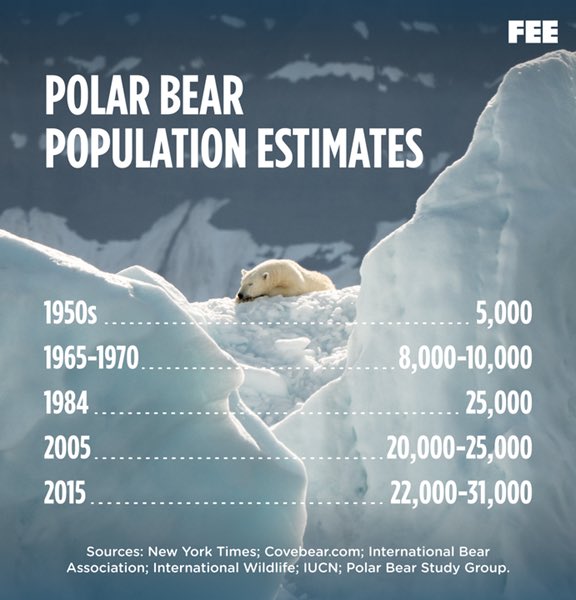
• Since hunting polar bears was restricted, polar bear populations have increased. - Climate - the Movie: a hot mess of (c)old myths!
William24205 at 10:23 AM on 27 March, 2024There is increasing evidence that hurricanes are getting stronger due to global warming.
37
bear
Polar bear numbers are increasing
The below does not debunk the above. The above is a fact the below is an opnion/speuclation.. You can't deny a fact by a prediction foir the future
Polar bears are in danger of extinction as well as many other species.
- Models are unreliable
Eclectic at 10:41 AM on 13 April, 2022MichaeISF @1305 , you sound a bit confused.
Climate models (for estimating future climate changes) base their predictions on the observed (and projected) rise in CO2 levels.
The CO2 level has continued to rise (observed fact). The world is warming (observed fact). Consequently, sea level is rising (observed fact) ~ so some increased flooding of coasts is occurring, and will get worse as a matter of course. (Unless you think the higher sea level is due to more polar bears staying in the water.)
Have you any evidence that "cancels" the facts?
- Warmer climate and Arctic sea ice in a veritable suicide pact
John Hartz at 09:45 AM on 31 October, 2020Recommended supplemental reading including three stunning graphs...
Why the record low Arctic sea ice this October is so alarming by Lili Pike, Energy & Environment, Vox, Oct 28, 2020
- Skeptical Science New Research for Week #40, 2020
Doug Bostrom at 10:36 AM on 11 October, 2020Thanks Nigel. Very interesting, particularly as it agrees with my intuitions. :-)
Climate communications for a popular audience are substantially worthless because they mostly reach only people who don't need persuading.
Meanwhile our preferred lexicon and methods are littered with landmines, starting with loud and frequently irrelevant semaphoring of political alignment and continuing with hopeless moon shot attempts at complete value reeducation.
There's a whole other language left largely fallow. Stable energy supply. Jobs that last forever, multigenerational livelihoods. Cars that are more fun to drive and with engines that never become an oily mess. All true, and all appealing to folks who don't share our concerns.
Some people don't care about polar bears. We'll likely never be able to make them care. On a 100 million year time scale, why should they? Bears come and bears go. The vast majority of us don't even think 50 or 100 years ahead.
But they do care about things that overlap with our own parochial concerns. And there are enough of 'em to really gum up the works of modernization, as we've seen.
- Michael Moore's 'Planet of the Humans' documentary peddles dangerous climate denial
ubrew12 at 10:40 AM on 3 May, 20201st law of thermodynamics "You can't win". 2nd law "You can't even break even"
Ubrew's correlaries: 1st law "Every bit of energy you use comes from your environment" 2nd law: "Yeah, it hurts your environment"
Jeff Gibbs movie belabors something we all knew: we lean on our environment for everything we produce. Unhappily for Gibbs, there isn't a smidgen of non-fossil energy that claims otherwise.
I'm deeply moved by what fossil fuel burning is going to do to the coral reefs, the rainforests, and the polar bears. But I'm a climate activist for what it's about to do to us mere humans. For starters, its going to destroy many of our most cherished historical cities. Against this, should we really dismiss 'Plan B' because it has 'sinned' against our environment? Since I used a toilet today, go ahead and dismiss me as well, by that standard.
- The high and low points for climate change in 2019
nigelj at 07:11 AM on 28 December, 2019takamura_senpai @13
You make some good comments. I agree with some and not others, which probably wont surprse you. Some random thoughts....
"Use a bicycle, have a good body and health, give positive example .... and laugh from fat car users......This work better, than boring appeal."
Yes I agree bicycles have many advantages. However our cities are designed around cars, so transitioning to the wide use of bicycles might be a slow process. Where I live we are building cycle lanes but its not easy as you can imagine, given the physical constraints.
Basically we are going to be stuck with quite a lot of cars for some time, even if people mainly use them for shopping etc, so electrifying cars or using hydrogen fuel cells is the most obvious way forwards.
"Much easier say: Africa, Asia are full of corruption. And do NOTHING."Africa = corruption, so they have to die" So many talks about population ... and here too. It look like racism."
Yes some people scapegoat Africa for various problems including climate change by pointing at its population growth and corruption. Its all unjustified, and tinged with racism, because corruption is not unique to Africa (and Asia), and their CO2 emissions are quite low and will probably remain that way even with a growing population, for some time anyway. But eventually Africa too will beome big consumers and emitters, if we continue with business as usual, and dont have a decent plan going forwards. So regardless of people unfairly scapegoating their population growth for problems, they do actually need to reduce their population growth.
However you reverse scapegoated Europe, by accusing them of being equally corrupt. Which is also factually wrong.
"Next.Politicians know about useless of agreements and meetings. But....How much noise about them we hear! and here."
Yes sadly. A lot of hot air and slow progress. However our civilisation is now so complex that making changes can take time.
"But solar panels, wind turbines, battery the same as 50 yers ago. People use batteries from old cars as a storage. What part of science? On research in solar energy and storage was spent less 0.01% than on entertainment. We try solve problem using a 50 year old technologies. => zero result."
This is 100% wrong in most places anyway. Battery technology is proceding at a spectacular pace with lithium ion batteries and many others under development here.
"I live in european country. There is geographical center of Europe lay in my country. And here green rates - corruption.....Ordinary people can't build solar plant without appropriate bribe. So robbers own all big solar plants. I think the same in most of World. And people become true haters of all this climat change, polar bears, nature and other rubbish, as they say."
You don't name the country or provide any links. You cannot assume all countries are like this. I live in New Zealand, and we dont have bribes and corruption like this. People are free to put solar panels on their roofs and connect into the grid and are paid for surpluses they generate, although not fairly, there are some problems like that. But yes sadly some countries have bribes almost as a way of life.
"Europe (and USA) politicians spent hundreds of billion dollars on the support of production NON elecric cars. It 100 more than spending on research on solar energy and storage. I see economic or corruption in their behavior/doings. Green rate in Germany 8.44 eurocents. People pay 20-30 or more. Just compare. Economic, not climat. You need dollars for buy oil, coal, natural gas."
I'm not aware of any governmnet subsidies in America for car manufacture, but they do subsidise fossil fuels, unfortunately. Not sure what you mean by green rates, please clarify if you have time.
"Asia is full of corruption" all World full of corraption :( As i said: "Because humans are egoists." I think approximately the same. Forms and ways different."
It depends on how you define corruption. The link I gave you defines it in certain conventional ways and its a fact that overall Europe has lower corruption than Asia or Africa. Of course all countries do have corruption to some extent.
Europe is not perfect, and they exploit other peoples to some extent, and drive very hard business bargains that are sometimes unethical. This is not corruption as such, but its arguably unethical. I guess the forms of corruption are a bit different from place to place, but we have to avoid false equivalence because some countries are definitely less corrupt than others, in an overall sense even by the widest possible definition of corruption. But its a bit academic, because regardless of the corruption level in another country, and how we define it, it never justifies corruption in our own country.
"Europe is leading in provision of wind energy and storage" China is leader in wind, solar energy and electromobiles. Produce 10? 20? 30? times more solar panels and electric cars."
Yes, although its mainly to reduce the pollution in cities and the chronic respiratory problems, more than to combat climate change. I guess the end result is still good and China deserve respect in regard to their efforts with renewable energy. Shame about some of the human rights issues.
- The high and low points for climate change in 2019
takamura_senpai at 16:45 PM on 27 December, 2019To Nigel:
You agree with others my statements..... This is excellent and enough
CO2 emission rised on 2.5% every year. Positive results of all this meetings and agreements = ZERO.
Because humans are egoists. Emissions rised, rise and will rise.
If we look at graph of the CO2 emission ... NOT straight line...Why? ... We see in 2009...because of Kioto protocol or other ? Climate or economic reason?
Global warming - incredible hard problem. But we want to solve it.
Do we really want solve problem? Do we? Realy? And how many % authors here use a car?
Cars need oil, roads, expensive bridges, other infrastracture. Our towns and cities designed for cars, not bicycles or other. On THIS was spent many trillions of dollars. Too much oil, gas, coal.
Use a bicycle, have a good body and health, give positive example .... and laugh from fat car users......This work better, than boring appeal.
We have to speak about man's potencia and influence of low active life ... cars .. traffic fumes...fastfood and so on.
I specialy use such words.... too harsh.
We must build cities with NO cars, with healthy habitants.
And laugh from habitants of Los Angelis New York Mexico Tokio Seul Beijing Moscow
Overhead roads for bicycles and roller skates - transport of the Future
8 directional overhead roads, not our dull 4 diractional(South-North West-East). And no traffic lights.
We can and must use metan in cars and others, not petrol. Cheaper and reduce CO2 emission .
If we burn a economic war between USA and China - it reduce CO2 several billion a year.
USA produce more CO2 than all Africa, and 80% poor people in Asia and Latin America. Only 1 country! Start from myself/youself.
Much easier say: Africa, Asia are full of corruption.
And do NOTHING.
"Africa = corruption, so they have to die" So many talks about population ... and here too. It look like racism.Next.Politicians know about useless of agreements and meetings. But....How much noise about them we hear! and here.
NOW, i see the only possibility/chance to avoid catastrophic global warming in solar and wind energy, and storage.
But solar panels, wind turbines, battery the same as 50 yers ago. People use batteries from old cars as a storage. What part of science?
On research in solar energy and storage was spent less 0.01% than on entertainment. We try solve problem using a 50 year old technologies. => zero result.
If EU and US would spend 1% of GDP from 2000 to 2020 on research in solar energy and storage, NOW our view on global warming would be optimistic... in general. possible.I live in european country. There is geographical center of Europe lay in my country. And here green rates - corruption, only corruption and nothing else. 60 cents -> scandal -> 50 cents -> scandal -> 40 and so on. And 0 in research. People hate all talks about global warming, nature and polar bears. This is the result! People hate and +2.5% rise CO2 emission a year.
Now green rate for solar 15 eurocents, corruption part aprox 7 eurocents, and pay one time in the beginning - too good for politicians.
Ordinary people can't build solar plant without appropriate bribe. So robbers own all big solar plants. I think the same in most of World. And people become true haters of all this climat change, polar bears, nature and other rubbish, as they say.Europe (and USA) politicians spent hundreds of billion dollars on the support of production NON elecric cars. It 100 more than spending on research on solar energy and storage. I see economic or corruption in their behavior/doings. Green rate in Germany 8.44 eurocents. People pay 20-30 or more. Just compare. Economic, not climat. You need dollars for buy oil, coal, natural gas.
German chancellor Shredder now in warm place in Moscow Gazprom.
"Asia is full of corruption" all World full of corraption :( As i said: "Because humans are egoists." I think approximately the same. Forms and ways different.
For example use central banks.
Europe buy politicians in East Europe, Africa, Asia, Oceania. Moscow buy europe politicians.....
We have to stop use coal and buy more gas from Moscow.....
I can give hundreds of examples. But politic is banned here in cite.
oh. climate change - is a politic problem
"Europe is leading in provision of wind energy and storage" China is leader in wind, solar energy and electromobiles. Produce 10? 20? 30? times more solar panels and electric cars."Asia is full of corruption" - South Korea?
"Asia is full of corruption, not every country but many." Exactly the same we can say about Europe, and every other part of the WorldMy name is Mihail (in english style). takamura_senpai - just post box to be unique
- Disappearing sea ice is changing the whole ecosystem of the Arctic Ocean
nigelj at 07:32 AM on 13 July, 2019The Orca that are moving into the arctic are apparently eating seals, so competing with the polar bears for the same food source. This video is of whales hunting seals on ice in Antarctica.
- Medieval Warm Period was warmer
RBFOLLETT at 14:41 PM on 12 June, 2019Wow, a hundred answers, but I think most of them missed the obvious. Everyone keeps focusing on the mythic global mean temperature that they say they can measure into the decimals (BS). They have been talking about sea level rise for the past 30 years almost within every sentence that contains the words global warming. So take a look at sea levels during the Medievil Warm Period then. Historical sea level charts show sea levels almost a foot higher than today and better yet actual History and living proof confirms historic Sea Ports miles inland from current sea shores. Actual physical empirical EVIDENCE that establishes sea levels much higher than today in the Medieval Warm Period, no science, no theory, no BS, just ABSOLUTE PROOF. The same goes for the the Mini Ice Age Cooling, sea level was down almost a foot from what it is today, again no BS, just Absolute Proof. Surely to God the Scientists are not now disputing the link between warming and sea level rise? What does it take to accept actual physical empirical evidence over scientific theory? Why go back tens of thousands of prehistoric years ago to predict what’s going to happen in the next hundred years, when you have historical evidence from the last 2000 years. Obvious cycles of warming and cooling are there in the sea level charts, a $10 tide gauge proves we have been warming for the last 250 years with another foot to go before we reach the levels of 450 years ago. Man (and the Polar Bears) have already survived a much warmer Earth, it’s a fact not a theory.
- How blogs convey and distort scientific information about polar bears and Arctic sea ice
Bob Loblaw at 01:09 AM on 18 March, 2018ImaginaryNumber @52 finally posts some specific claims that can be examined. I have downloaded Pagano et al (along with the supplementary material for the paper). I have not followed links to Crockford's blog posts - I will start from a position of assuming that ImaginaryNumber has provided an accurate summary of Crockford's arguments.
Let's look at the first claim:
"Crockford claims that in the spring of the year ringed seals have their birthing lairs on the ice, and that in good years they should be relatively easy for bears to raid. But Pagano's paper only mentioned eating adult or subadult ringed seals (for the healthy bears), or carcasses (for the unhealthy bears) — but no pups.[emphasis mine]
On the first page of Pagano et al, the paper says "...a solitary female bear on the spring sea ice would on average need to eat either one adult ringed seal, three subadult ringed seals, pr 19 newborn ringed seal pups every 10 to 12 days..." [emphasis mine]
On page 4, figure 4 shows feeding demands for polar bears. In fgure 4a, the first bar is labeled "Pups". In figure 4D, the second legend entry is labeled "Pup ringed seal".
In the supplemenatary material:
On page 3, we find " Nutritional demands were determined from the caloric value and digestibility of ringed seals in polar bears (55, 56) as ringed seals are the primary prey of female polar bears in the Beaufort Sea in the spring (57–59). Ringed seal pups were mean total (fat + protein) caloric values from pups < 1 month old, carcasses were mean caloric values of protein from subadult and adult ringed seals, and subadults and adult ringed seals were mean caloric values of fat. "
On page 6, in the caption for figure S1, we find " Figures show locations where bears were captured (green squares), recaptured (white squares), resting (red circles), walking (blue circles), exhibiting mixed behaviors (black circles), kill sites of seals (yellow asterisk), kill sites of seal pups (white crosses), scavenging sites of seal carcasses (green pluses), or scavenging sites of whale carcasses (yellow pluses)."
On page 7, in the caption for figure S2, we find " ...kills sites of seal pups (white crosses)..."
At this point, I think the claim that Pagano et al did not mention bears eating seal pups is, shall we diplomatically say, less than fully accurate. They considered them as an energy source, and they observed bears eating them.
Now, it may be that ImaginaryyNmber has not accurately summarized Crockford, or is reading into it something that is not there. I don't care which it is, and I don't care to pursue the rest of the so-called "criticisms". The first criticism is so egregiously wrong (to be less diplomatic) that I can only conclude one (or both) of two things:
- ImaginaryNumber is not a trustworthy source of critisicm of Pagano et al.
- Crockford is not a trustworthy source of critisicm of Pagano et al.
In either case, ImaginaryNumber is no longer worth listening to on this subject. No, this is not ad hominem. I am not saying "ImaginaryNumber is wrong because he can't be trusted", I am saying "ImaginaryNumber can't be trusted [on this subject] because he is wrong".
In comment 43, I linked to another SkS post. That post included a link to this paper on denialism. A quote from this paper is:
"The third characteristic is selectivity, drawing on isolated papers that challenge the dominant consensus or highlighting the flaws in the weakest papers among those that support it as a means of discrediting the entire field.
In ImaginaryNumber's case, he is drawing not on an isolated paper, but a blog criticism of one single paper.
- How blogs convey and distort scientific information about polar bears and Arctic sea ice
Eclectic at 18:29 PM on 15 March, 2018ImaginaryNumber @61 , it is fair enough for you to raise your point of criticism — but your criticism is misplaced.
SkepticalScience [SkS] website is primarily about the science of climate (and especially the modern AGW). It is not a website about politics — if you wish to discuss that aspect, then please go to another venue. True, the politics of what best to do about about our AGW climate problem . . . is an aspect which cannot entirely be avoided — but SkS exists for scientific education, rather than for "persuasion of the voting masses".
Yes, there have been occasional articles on the psychology of (rational) persuasion. But that aspect is largely pursued elsewhere. Indeed, I gather John Cook, one of the founders of the volunteer website SkS, has moved to George Mason University, Virginia, for that purpose.
People come to SkS to be educated through the articles (which also give links to the scientific research). Attached to the articles are comment columns, which attract certain subgroups of people :-
( A ) Those who wish to engage in genuine discussion of certain aspects e.g. in giving, gaining, or exchanging information
( B ) Those who disingenuously troll the topics
( C ) Those who truculently come to rant, sloganize or otherwise vent their denialism.
ImaginaryNumber, when you log on to post in the comment columns, you ought first to make a clear decision in your mind — whether you wish to participate per A , B , or C . And you should clearly express yourself in a manner in accordance with A or B or C . Do not try to straddle 2 or 3 of these categories. Nor be so careless or clumsy in execution, as to give the reasonable reader the impression of straddling.
If you are clearly in category A , then you will be treated politely.
On the matter of Dr Crockford, she is well-known for her unscientific attitude regarding polar bears and global warming. You encroach on categories B and C , by asserting that the other posters here are not familiar with her or have not read her comments nor understood her.
- How blogs convey and distort scientific information about polar bears and Arctic sea ice
michael sweet at 20:56 PM on 14 March, 2018Reading your summary of Pagano's paper I did not see any mention of the fact that polar bears are white because of evolution. There is also no mention that the polar bears and the ice they stand on are made of atoms. It appears to be incomplete.
Peer reviewed papers are written for experts to read. They leave out information that everyone who is expert knows. There is not enough space to rewrite the history of science in every paper. Crockford's suggestion that they have left out necessary information is only relevant to people who are not experts (like Crockford). Subadult seals include pups, experts know this and it does not need to be explained. Experts know about snow conditions and leads, Crockfords comments are irrelevant.
Pagano's paper shows that polar bears are expending more energy to survive. That suggests that that reproduction is threatened.
- How blogs convey and distort scientific information about polar bears and Arctic sea ice
Eclectic at 17:50 PM on 14 March, 2018ImaginaryNumber @52 , firstly: the polar bear occupies a limited niche in the arctic environment. It is a highly-specialized apex predator. It relies upon its build-up of fat reserves, to get it through the annual cycle of feeding & breeding — and it leads a hazardous existence because of the prolonged & irregular fasting periods between kills of prey. It cannot benefit from the broad environmental band which is available to its cousins, the various species of "brown" bears (which are omnivorous).
Essentially the polar bear is in a rather precarious position, and its survival (as a species) depends on a complex interaction of sea-ice conditions suitable to itself, and sea-ice conditions suitable to its prey, the seals.
Secondly , the study by Pagano et al 2018, does little more than indicate that the situation [of polar bear energy requirement] is even worse than previously thought. And it points out that the arctic warming is producing conditions requiring even greater travel/energy-requirement. Thus an even more precarious existence for the polar bear.
None of this provides any real support for Dr Crockford's contention that "all is well" for the polar bear & the polar bear future as a species. In essence, Crockford takes a short-term [not "big-picture"] view of the situation. Short-term and unsupported [= anti-scientific] . . . and quite reprehensible "Fake News" propaganda.
- How blogs convey and distort scientific information about polar bears and Arctic sea ice
ImaginaryNumber at 15:48 PM on 14 March, 2018Thank you all for your patience. I'm away from home, and have to fit in this extra-curricular activity whenever I can.
First of all, I haven't read a lot of what Crockford has written about polar bears. And I haven't read much of what her critics say about what she has said about polar bears. I'm hoping you won't mind just sticking, as much as possible, to the Pagano paper, and those Crockford papers that deal most directly with the Pagano paper. Thanks :)
Now back to the Pagano paper --
As I understood it, the study by Pagano, et al, was primarily designed to determine the how much energy polar bears expended during the yearly time period (late spring and early summer) when they typically put on the most fat. Nine female bears were caught and monitored for between 8 and 11 days, each year, in April of 2014, 2015, and 2016. During the study period, four bears gained 5% to 15% of their initial weight, four bears lost at least 10% of their initial weight, and one bear lost a very slight amount of weight. Pagano notes that--
"Bears that successfully killed and ate adult or subadult ringed seals either gained or maintained body mass, whereas bears that only scavenged or showed no evidence of eating lost mass."
From my reading of the Pagano paper, the major conclusion of the study was that polar bears expend about 1.6 times the amount of energy, during late spring/early summer, as had been previously estimated. Thus, to put on the fat needed to fast through the summer/autumn months, when they are land-bound and fasting, they need to be able to capture and eat more seals than other researchers had previously estimated. Clearly, not all of Pagano's polar bears were able to capture enough seals to meet their energy needs, at least during the observation period. This later point is important, because Pagano also noted that --
"previous researchers reported that 42% of adult female polar bears in the Beaufort Sea during the spring from 2000 to 2016 had not eaten for ≥ 7 days before capture."
— suggesting that historically polar bears are not always able to find food when they want it. Pagano then goes on to say that --
"This rate of fasting was 12% greater than measurements from 1983 to 1999, suggesting that spring ice conditions are affecting prey availability for polar bears even before the summer open water period."
Pagano concludes by saying that --
"These studies suggest that an increasing proportion of bears are unable to meet their energy demands. Our results indicate that further increases in activity and movement resulting from declining and increasingly fragmented sea ice are likely to increase the demand side of the energy balance ratio."
^^^^^^^^^^^^^^^^^^^^^^^^^^^^^^^^^^^^^
Now to Susan Crockford's critique.
Her primary concern with Pagano's paper was a lack of explaination for why the Beaufort polar bears were having trouble catching seals? Crockford claims that in the spring of the year ringed seals have their birthing lairs on the ice, and that in good years they should be relatively easy for bears to raid. But Pagano's paper only mentioned eating adult or subadult ringed seals (for the healthy bears), or carcasses (for the unhealthy bears) — but no pups.
Crockford provides a link to another paper she wrote in which she discusses the snow conditions under which ringed seal births are either successful or unsuccessful. She cites various research papers which show, for example, that when snow cover over the sea ice is deep, seal lairs are well-protected, bear predation is low, and bears became malnourished. Conversely, when snow cover is light, or when there is rain, seal lairs are easy to locate and break into, and bears are better fed. In that same paper Crockford also cites research which shows that when sea ice is very thick polar bears also have trouble finding enough to eat.
Now back to Crockford's more recent paper. She notes that Pagano makes no mention of ringed seal lairs or sea ice conditions in their paper. This seems to me to possibly be a critical omission.
Crockford then posts US Navy sea ice thickness maps for the Southern Beaufort Sea, for April 2014, 2015, and 2016. In all those years, but especially for 2014, there was a band of very thick (up to 5m) sea ice along the coast of Alaska. She suggests that this thick band of sea ice may have been critical to the study polar bears not finding sufficient nourishment.
Crockford also quotes from another paper (by Stirling) --
"Polar bears prey mainly upon ringed seals and, to a lesser degree, on bearded seals. Polar bears appear to be more abundant in polynya areas and along shoreleads, probably because the densities of seals are greater and they are more assessable. For example, between March and June in the Beaufort Sea from 1971 through 1975, 87% of the sightings of polar bears were made adjacent to floe edges or in unstable areas of 9/10 or 10/10 ice cover with intermittent patches of young ice.”
Stirling also says in the same paper:
"the influence of rapidly changing ice conditions on the availability of open water, and consequently on populations of seals and polar bears, has been observed in the western Arctic. Apparently in response to severe ice conditions in the Beaufort Sea during winter 1973-74, and to a lesser degree in winter 1974-75, numbers of ringed and bearded seals dropped by about 50% and productivity by about 90%. Concomitantly, numbers and productivity of polar bears declined markedly because of the reduction in the abundance of their prey species. … If the shoreleads of the western Arctic or Hudson Bay ceased opening during winter and spring, the effect on marine mammals would be devastating."
This suggests that polar bear foraging is best when there is a reasonable number of open leads, which is less likely when there is very thick sea ice. Again, is seems that Pagano was remiss in not including more information about sea ice conditions, and seal lair conditions.
^^^^^^^^^^^^^^^^^^^^^^^^^^^^^^^^^^^
My thoughts and questions:
Now that I've read Pagano's complete paper, and not just the abstract; and now that I've read two relevant papers by Crockford, it seems to me that Crockford is raising valid questions as to why some, but not all, of Pagano's polar bears were malnourished? Maximim sea ice extent occurs in mid-March, and maximum sea ice volume typically occurs in the later part of April. So lack of sea ice is certainly not the problem.
Did Pagano provide an answer in their paper that I (and Crockford) missed, or was their analysis of polar bear dietary habits and processes less than complete?
Likewise, has Crockford misunderstood seal breeding cycles, or misinterpreted the polar bear research that she cites?
As I understand it, if Pagano (and the news media which reported Pagano's findings) has just stuck with saying that their research showed that polar bears expend 1.6 times more energy than previously thought, Crockford might not have found anything to criticise. As it was, many concluded that because half the bears in Pagano's study were malnourished (at least during the 8-11 day study window, which apprently happens quite a lot — sort of a feast or famine situation for bears), that it must be true that all polar bear populations, at all times of the year, were also not finding enough to eat. While that concievably may be true, it appears to me that you can't infer that from Pagano's study, as Pagano didn't include a number of relevant factors in their study (e.g. sea ice thickness; snow thickness; number of open leads; relative abundance of seals, etc).
- How blogs convey and distort scientific information about polar bears and Arctic sea ice
Eclectic at 13:44 PM on 13 March, 2018Bob Loblaw @47 , you are far too cynical in your supposition about the "protesting too much". Me — when I am phoning the VD clinic about some new symptoms, I am always enquiring on behalf of a friend. Truly and always.
ImaginaryNumber, there is almost no overlap in the positions of the scientific blogs versus the denier blogs, in regard to polar bears. Why do you suppose that might be ?
And why is there almost no overlap between Dr Crockford's position and the position of the mainstream scientists ?
The polar bear scientific experts dismiss Dr Crockford & her ideas, not for the reason that she lacks formal credentials in that area, nor for her failing to be among the "inner group" of mainstream scientists. Nor do they dismiss her for her lack of appropriate publications in the appropriate peer-reviewed journals.
Nor do the scientists dismiss her for being a contrarian, nor for having red hair.
The scientists dismiss her ideas, because she is wrong.
It is that simple.
(The question of her receiving money/benefits for promoting "Fake News" propaganda, is a somewhat separate issue. And please note that a friend of mine considers her actions as morally repugnant even in the absence of any transactions from Heartland, Koch, GWPF, etc. )
- How blogs convey and distort scientific information about polar bears and Arctic sea ice
Bob Loblaw at 07:32 AM on 13 March, 2018JohnSeers has much better reading skills than ImaginaryNumber.
Note that the context of this discussion should also include the post we are commenting on. The paper, looking at the web as a source of information, tells us that the dominant reference in the blogs that go against the scientific position mostly rely on the opinions of one person. There seem to be two possibilities:
- All the other "experts" are wrong, and this one source of alternative facts is the only true expert.
- That one alternative source is unreliable.
The denier web sites try to pretend that #1 is the case, and argue that Crockfords' credentials on non-polar bear areas is sufficient to establish her expertise on polar bears. [It does not.]
ImaginaryNumber is using the old dodge that questioning that evidence of expertise is an ad hominem. Combined with the other links to posts that actually refute her arguments, we have a good case to argue that because she posts junk, and because her resume does not contain any relevant experience, she is not an expert. Neither her blog posts nor her academic creentials support the position that she is an expert.
Methinks ImaginaryNumber doth protest too much. I have no reason to belive that IMaginaryNumber is posting opinions he's seen elsewhere - I suspect that his friend-of-a-friend style of posting is just hiding an opinion he wants to argue himself.
- How blogs convey and distort scientific information about polar bears and Arctic sea ice
ImaginaryNumber at 14:09 PM on 12 March, 2018My thanks to all of you who have commented. I'm working my way through the links given, and will respond to those later. But first some general comments ---
Eclectic said: "ImaginaryNumber @39 , regarding polar bears, Dr Crockford is more [paid] propagandist than scientist."
I understand that, but it is irrelevant with the specific people I am discussing polar bears with. I, and they, are only interested in the scientific arguments, not with who paid whom.
Bob Loblaw said: "You use the phrase "...don't take kindly to ad hominem attacks..."
It is the fake skeptics that claim that Crockford is an expert on polar bears. It is they that present her background as evidence of that expertise. Tearing apart that "evidence" is not "ad hominem". Crockford does not present as a credible "expert".
Dismissing Crockford simply because she isn't a polar bear expert, and not specifically addressing her arguments, is an ad hominem attack. I suspect none of you (and certainly not me) are polar bear experts. But that doesn't stop us from expounding on the topic.
Again, I am working my way through the links you're provide to see if they answer the specific questions that I listed above in post 39. Thanks for your help.
- How blogs convey and distort scientific information about polar bears and Arctic sea ice
Bob Loblaw at 00:22 AM on 12 March, 2018ImaginaryNumber @ 39:
You use the phrase "...don't take kindly to ad hominem attacks..."
It is the fake skeptics that claim that Crockford is an expert on polar bears. It is they that present her background as evidence of that expertise. Tearing apart that "evidence" is not "ad hominem". Crockford does not present as a credible "expert".
The "fake expert" is a common tactic in the so-called debate on climate change:
https://skepticalscience.com/Resources-when-facing-firehose-of-falsehoods.html
You have been pointed to subtantive take-downs of her arguments. Read them.
- How blogs convey and distort scientific information about polar bears and Arctic sea ice
Eclectic at 19:15 PM on 11 March, 2018ImaginaryNumber @39 , regarding polar bears, Dr Crockford is more [paid] propagandist than scientist.
You will notice the [Desmog] comment that Crockford (despite some expertise in evolution) has never published an article on polar bears in a peer-reviewed journal. Nevertheless, she has received money/benefits (from blatantly anti-scientific organizations) and has written very one-sided propaganda reports that are at odds with the mainstream opinions of scientists who possess actual polar bear expertise. Her "reports" are strong on propaganda rhetoric, and are weak on overall science.
She does indeed bring (as she claims) "a unique 'big-picture' perspective to the issue of polar bear conservation." ~ More is the pity !
On the particular faults of her statements :-
ImaginaryNumber, you will especially notice how she conjures with very short-term periods (e.g. 8 years of polar sea-ice) and draws a long-bow assessment that "all is well: no problem to see here". In typical rhetorical propaganda style.
You would normally think that a zoologist with an interest in evolutionary development would instead be thinking & talking in terms of centuries and millennia (and multi-millennia of glacial/interglacial cycles). In other words, she completely fails to present the 'big-picture'.
She also plays fast-and-loose with polar bear numbers (and the equally important question of their condition/fatness). Polar bears' numbers are difficult to ascertain by ordinary aerial survey; and their actual condition is vastly more difficult to assess properly. Bears with year-on-year poor condition can very suddenly crash in numbers. At which point, the problem is much more obvious — even to propagandists.
Yet Dr Crockford is buoyantly optimistic about the overall situation, and she seems to turn a blind eye to the long-term decline of arctic sea-ice (the polar ice for which the very-white polar bear has evolved — and has also evolved to a highly-specialized meat/blubber diet rather than the omnivorous diet of the brown bear species).
As you see from its coloration and lifestyle, the polar bear is an ambush predator. It relies on ambushing seals which surface to breathe at small polynyas and ice-leads and smaller breathing-holes. (A bear may even dig through shallower ice to produce an "attractive" breathing-hole.)
Yet the relation between polar bears and the ice-environment is not as simple as other species/habitat ratios (e.g. orangutans and hectares of forest). Normally you would think that "specialized apex predator" versus "shrinking environment habitat" . . . equates to high risk of extinction. But with polar bears, we need to look at the interaction of bear/environment with seal/environment — it can indeed be complex, depending on the foraging/breeding abilities of the seals in low-ice conditions (low-ice conditions which at the same time severely handicap the polar bears).
In the overall picture, the polar bears will suffer severe decline (and likely extinction in the wild) as the planet approaches "prolonged zero" summer sea-ice over the next 100 years or so. Note: the polar bears survived through the [hotter-than-present-day] Eemian Interglacial 120,000 years ago — but arctic conditions at that time were able to maintain some coastal ice, owing to a a different set of marine currents.
But all that is unimportant to Dr Crockford : she seems intent on using the [short-term] polar bear situation as a propaganda proxy-argument to "dismiss" AGW.
- How blogs convey and distort scientific information about polar bears and Arctic sea ice
John Hartz at 10:05 AM on 11 March, 2018From the Climate Feedback Reviews section of the 2018 SkS Weekly Climate Change & Global Warming News Roundup #9:
Climate Feedback asked its network of scientists to review the opinion piece, Polar bears keep thriving even as global warming alarmists keep pretending they’re dying by Susan Crockford, Financial Post, Feb 27, 2018
Three scientists analyzed the article and estimate its overall scientific credibility to be 'very low'.
A majority of reviewers tagged the article as: Biased, Cherry-picking, Misleading.
Review Summary
This article in the opinion section of Financial Post, written by Susan Crockford, claims that rather than being threatened by declining Arctic sea ice, polar bears are “thriving”.
Three scientists who reviewed the article explained that this article fundamentally misrepresents research on the topic. The author exhibits poor reasoning in arguing that polar bear population loss projected for 2050 should have occurred already if that science was accurate. Researchers do not ignore the evidence Crockford claims they do, but instead incorporate all published research on polar bear populations. Despite the article’s statements to the contrary, research shows that polar bear populations will struggle as ice-free periods (during which they cannot hunt for food) grow longer.
Financial Post publishes misleading opinion that misrepresents science of polar bears’ plight, Climate Feedback, Mar 2, 2018
- How blogs convey and distort scientific information about polar bears and Arctic sea ice
John Hartz at 09:51 AM on 11 March, 2018ImaginaryNumber:
As has already pointed out to you, Crockford's psuedo-science poppycock has been thoroughly refuted by Dr Shaye Wolf* in:
Polar Bears at Ground Zero for Climate Change and Climate Science Deniers, Opinion by Shaye Wolf, DeSmog UK, Mar 5, 2018
Wolf draws from a number of peer-reviewed scieintific studies to rebute Crockford's propaganda.
*Shaye Wolf, PhD, is the climate science director at the Center for Biological Diversity. She graduated with a bachelor's in biology from Yale University and received a doctorate in ecology and evolutionary biology and a master's in ocean sciences from the University of California, Santa Cruz, where she examined the effects of ocean climate change on seabird populations.
- How blogs convey and distort scientific information about polar bears and Arctic sea ice
ImaginaryNumber at 09:25 AM on 11 March, 2018Daniel and Bob, thank you for your comments. I'm no friend of the Heartland Institute, nor generally of those they support. But the skeptics I'm discussing the polar bear issue with don't take kindly to ad hominem attacks. So I was hoping that you at Skeptical Science could help me understand any possible flaws in Susan Crockford's arguments, as they pertain to the paper I linked to.
http://science.sciencemag.org/content/359/6375/568
https://polarbearscience.com/2018/02/01/polar-bear-specialists-double-down-on-message-of-future-starving-bears/
,
Apparently Pagano found that polar bears were sometimes not capturing enough ringed seals to maintain weight. (I haven't read the Pagano study because it is behind a paywall) Crockford wondered why Pagano didn't mention that typically Southern Beaufort Sea polars bears would have an abundant supply of ringed seal pups to eat during the spring of the year, and thus not have to depend on capturing adults. (Crockford provides references for her claim, which I can't verify.)Crockford then provides maps showing sea ice thickness for the years under study. These maps seem to show that sea ice thickness just offshore of the Beaufort seas was up to 5 meters thick. I don't know if this ice thickness is typical or atypical for this area? She then suggests that the thick ice played a significant role in forcing the seals to go elsewhere to give birth to their pups, thus creating a local shortage of prey for the polar bears.
Crockford then goes on to quote other reseachers (Stirling) who found that when they studied polar bears in the 1970s, during years of severe ice the number of ringed and bearded seals fell, and as a result so did the number of polar bears.
So my questions to you good folk of Skeptical Science are:
Is Susan Crockford missing critical information that would otherwise explain why some, but not all, polar bears lost weight?
And, did Pagano overlook any important factors in their study, such as ice thickness?
- How blogs convey and distort scientific information about polar bears and Arctic sea ice
Bob Loblaw at 08:30 AM on 10 March, 2018What Daniel Bailey said.
FYI, Desmog UK has published another polar bear post, including discussion of Crockford and her credentials.
https://www.desmog.uk/2018/03/08/opinion-polar-bears-ground-zero-climate-change-and-climate-deniers
- How blogs convey and distort scientific information about polar bears and Arctic sea ice
ImaginaryNumber at 15:11 PM on 7 March, 2018I would appreciate your critique of these recent articles on Polar Bears by Pagano, vs a counter-article by Susan Crockford. To my non-scientific mind, it appears she has some valid points.
http://science.sciencemag.org/content/359/6375/568
https://polarbearscience.com/2018/02/01/polar-bear-specialists-double-down-on-message-of-future-starving-bears/
- 2018 SkS Weekly Climate Change & Global Warming Digest #7
nigelj at 16:50 PM on 19 February, 2018Such low sea ice in summer and winter presumably means low spring sea ice as well. Polar bears hunting becomes affected as follows.
I agree the general public probably relate best to sea ice minimums and maximums, but Im interested more in total volumes. Maybe I'm just weird.
- How to Change Your Mind About Climate Change
Alchemyst at 12:32 PM on 17 February, 2018michael you are offensive.
Read the Feyman quotes. My opinion is that he was the greatest scintist of his era
Also
scientists were unable to replicate the results of 47 out of 53 papers that were seminal to launching drug-discovery programs. “This is a systemic problem built on current incentives,” he said according to Nature.
https://www.the-scientist.com/?articles.view/articleNo/33719/title/Science-s-Reproducibility-Problem/
Sweet
In answer to your question regarding medics. I do not self diagnose but I always ask to see the test results and often ask for a second opinion. I only fly in planes that have co-pilots. It's what is known as double contingency. The systems allow it for a very good reason as a bad decision can easily be fatal. As for a second shot at filling a cavity, on that, I gernerally think that once is enough, the pain ain't worth the gain.
nigelj, you seem to give too much reverence and attribute too much power to the peer review system. It is better to have it than to have not. But it has limitations, in that it does not guarantee
that the work is reproducible, or correct, see above. The reviewers check it for grammer, style, reasoning but not specifically that the results are correct and reproducible. see https://www.springeropen.com/get-published/peer-review-process.1/ I have personal experience of stopping an already peer reviewed paper from an eminent scientist going to publication. The reasoning in the paper was correct. His results were not faked, but his conclusions had a mistake, which had only become apparent through supplemental work which we had performed at our own suggestion to strengthen his work. Upon hearing of our results he pulled the paper back. But it was only by luck through that eminent scientist talking with my collegue that these supplemental tests were performed.
2/ Peer reviewers are normally very busy and do not go to their labs and repeat the experiment, or in the case of climate reseach do not repeat the darting of polar bears or checking the thermometer readings. However there should be sufficient information available so that another researcher can reproduce the results. Please read the next ref in it you will find how long a reviewer spends on a paper. the longest time in this unscientific sample was one day whilst the researcher may well have encompassed an entire PhD project of 900 days. It can hardly do merit to the original work.
https://academia.stackexchange.com/questions/99238/how-do-people-peer-review-many-papers
3/ Having shown you the weakness of the publish and peer review process, it is still better than nothing at all. However it does have a strength. It sets out a paper with a conclusion that can be confirmed or denied by someone else skilled in the art. In reality most papers end up in the journal and get read by the apocraphal 2 and a half other researchers on a wet thursday afternoon. But sometimes someone will take the effort to properly check out the paper, which is more likeley if the guy has a genuine interest or maybe does not like the author. It is only then do we have any idea if the paper was reproducible or just bad sciencce. I hope now that you and this website will realise that Muller did the correct thing
please take the time to read these attachments and give me your opinion
https://chorasimilarity.wordpress.com/2015/04/09/reproducibility-vs-peer-review/
http://stealthsyndrome.com/?p=359
http://stealthsyndrome.com/?p=2125
ps from the accounts Bohr and Einstein were always disagreeing with each others papers and trying to find holes in them. Yet both men had a deep respect for each other (and both men went out to meet the young Feynman ) and that is how scientific knowledge progresses. What I am seeing in the climate change argument is a lot of disagreement without respect.
- 2018 SkS Weekly Climate Change & Global Warming Digest #3
nigelj at 06:03 AM on 22 January, 2018Thank's for printing Climate Feedbacks interesting review of 25 articles. I noticed that the most viral articles generally had something specific and simple like polar bears, diseases, beans, and icebergs. The least viral articles were dominated by anonymous people casting doubt on the science, and technical claims about lack of warming or changes in ocean circulation.
More people seem attracted to things easily understood and visualised like animals, rather than opinions of weather people, and technical issues.
The ten most viral articles also contained fewer denialist claims on the whole than the next ten articles.
The denialist articles are not persuasive.
- How blogs convey and distort scientific information about polar bears and Arctic sea ice
Zippi62 at 07:10 AM on 30 December, 20172 parts of the Arctic are above normal. Alaska and NE North Atlantic sea basin. Residual El Nino ocean warming is the most probable cause.
60%of the Polar Bears of the Arctic Region live in Canada and Canada has been very cold since November.
I sincerely doubt the polar bears are currently in any danger of losing Arctic Sea Ice any time soon. The current "record" of Sea Ice Extent only goes back to 1974. Sea Ice Extent was at its peak in 1979. Chapter 7, page 224 of the 1990 UN IPCC Report shows the graph.
https://www.ipcc.ch/ipccreports/far/wg_I/ipcc_far_wg_I_chapter_07.pdf
The 1930s and 1940s were also a rough time for polar bears, but there is barely any REAL record of Sea Ice Extent. Getting caught up in the Arctic Ice Melt misinformation trail isn't moving any understanding of the Arctic Region forward. Arctic Sea Ice Extent seems to be pretty safe for now.
- How blogs convey and distort scientific information about polar bears and Arctic sea ice
Philippe Chantreau at 06:39 AM on 30 December, 2017This is precious. TPohlman mocks the use of the word denier as "a pejorative within the Code on this site."
Zippi62: "Sea ice extent is currently well within normal variability."
NSIDC: "Arctic sea ice extent for November 2017 averaged 9.46 million square kilometers (3.65 million square miles), the third lowest in the 1979 to 2017 satellite record." Examination of the graph shows that it is well below both interquartile range and interdecile range for November. How far can we be from "well within normal variability"?
Zippi62:"It started to freeze early this year and has a lot of very cold air to force a deeper freeze (more multi year ice."
NSIDC: "November air temperatures at 925 hPa (about 3,000 feet above sea level) were above average over essentially all of the Arctic Ocean, with prominent warm spots (more than 6 degrees Celsius, or 11 degrees Fahrenheit above the 1981 to 2010 average) over the Chukchi Sea and north of Svalbard."
Perhaps TPohlman can propose a different word to include within the "Code" for this kind of contributors. As for myself, I'm a big advocate of concise and simple language so I think denier is appropriate.
And lastly, when this pattern manifests over and over and over again, patience for it runs even thinner than peanut butter...
As for Polar bear diet, no article I have found to date suggests that fish is an important part of their diet. It is not exactly easy for polar bears to catch fish. However, all isotope based studies I have found so far show they almost exclusively find their sustenance from the marine food web. The variations in organic contaminants according to the trophic level of their main food soure is especially interesting. They have only recently started to learn to extract food from land based sources and they are mostly opportunistic about it but also not very smart. One study showed no significant intake of readily available fruit, something that other bears would not pass. Perhaps hundreds of thousands of years of maritime meat eating can't be easily erased.
TPohlman seems to trust Stirling. Interestingly, Stirling has been the subject of extensive persional attacks from a certain part of the blogosphere, perhaps after refuting a very poor piece involving the infamous trio Soon-Baliunas-Legates.
Nonetheless, Stirling and Iverson certainly have more of a claim to polar bear expertise than Crockford. The study referenced below shows that ringed seals and harp seals are the main staples, the abstract does not mention fish. It has a interesting list of references.
- How blogs convey and distort scientific information about polar bears and Arctic sea ice
nigelj at 18:13 PM on 29 December, 2017"To the north, Arctic sea ice reached a record low wintertime maximum (this year) extent as, incredibly, temperature instruments in Alaska malfunctioned due to the surging warmth."
www.theguardian.com/environment/2017/dec/28/climate-change-2017-warmest-year-extreme-weather
But no, Susan Crockford says nothing going on here, and it can't possibly affect bisophere and polar bears. There just comes a point where people are clearly in denial, and simply loose all credibility.
- How blogs convey and distort scientific information about polar bears and Arctic sea ice
nigelj at 14:50 PM on 29 December, 2017Zippi@62, fair enough, polar bears do sometimes eat fish when they get lucky. I didnt say they never ate fish. But I doubt they would capture enough in the arctic region to be of much use. Remember it's the arctic bears we are all talking about.
I don't know why death of polar bears would be poorly understood. Old age, disease, hunting surely? There is some research suggesting it has been due to lack of seals related to climate change in one sub population.
Habitat loss and changes in food sources have been important causes in the extinction or decline of many species. I haven't seen any convincing reasons why polar bears are going to be immune to this, as the climate continues to warm and reduce sea ice extent.
- How blogs convey and distort scientific information about polar bears and Arctic sea ice
Zippi62 at 14:17 PM on 29 December, 2017Polar bears eat fish. - Bing Image Search
60% of polar bears live in Canada, which is NOT part of the Arctic Ice terrain. - " ... They are found in Canada (home to roughly 60% of the world's polar bears), the U.S. (Alaska), Greenland, Russia, and Norway (the Svalbard archipelago).
The polar bear Range States have identified 19 populations of polar bears living in four different sea ice regions across the Arctic. ... " - https://en.wikipedia.org/wiki/Polar_bearI'm surprised that you didn't read your own article thoroughly.
The death of polar bears in the wild is poorly understood. They live longer in captivity (according to WIKI.
- How blogs convey and distort scientific information about polar bears and Arctic sea ice
nigelj at 12:35 PM on 29 December, 2017Zippi62 @26
"Polar bears mostly feed on other ocean mammals and fish"
Actually they dont eat fish, or only rarely, as follows.
"Polar bears feed mainly on ringed and bearded seals. Depending upon their location, they also eat harp and hooded seals and scavenge on carcasses of beluga whales, walruses, narwhals, and bowhead whales. On occasion, polar bears kill beluga whales and young walruses."
seaworld.org/animal-info/animal-infobooks/polar-bears/diet-and-eating-habits
They also scavenge on land sometimes but with difficulty as follows.
en.wikipedia.org/wiki/Polar_bear#Hunting_and_diet
Polar bears aren't adapted to eating fish. Land based bears eat salmon in some places, but you can easily see why they are able to do this. Capturing fish from the sea is much more difficult for bears.
The problem for polar bears is shrinking sea ice threatens the habitats of polar bears, and also their prey, such as seals. Seals need sea ice to breed etc. So shrinking ice is basically affecting the whole food chain / pyramid.
- How blogs convey and distort scientific information about polar bears and Arctic sea ice
Zippi62 at 11:00 AM on 29 December, 2017Sea Ice Extent is currently well within normal variability. It started to freeze early this year and has a lot of very cold air temperature to force a deeper freeze (more multi-year ice).
HadSST3 data shows an overall GLOBAL ocean warming trend of 0.05C per decade over the past 167 years.
Polar bears mostly feed on other ocean mammals and fish. I would think that they would prefer the lack of sea ice in order to hunt something other than themselves (They are cannibalistic).
- How blogs convey and distort scientific information about polar bears and Arctic sea ice
nigelj at 07:16 AM on 29 December, 2017TPohlman @22 and 23, I have not referred to you as a "denier". Just wanted to clarify this. To me its just interesting discussion on polar bears, and thank's for the links you posted.
You say "More ice does not always imply ‘good for bears‘ any more than less ice always implies ‘bad for bears’, no matter how many times the mantra is repeated."
So are you seriously saying that no sea ice, or very small extent of sea ice, would have no effect on polar bear numbers? Come on it has to have an effect.
Look at the picture very long term. According to research by Noaa linked below, summer ice will decline drastically and spring ice during the feeding season you mentioned will also decline. Even winter ice will eventually be down to 10 - 15 %. I simply suggest this has to effect seals and polar bears.
www.theverge.com/2013/4/12/4217786/arctic-ice-free-summer-2050-noaa-study
According to NSIDC website:
"Combined with record low summertime extent, Arctic sea ice exhibited a new pattern of poor winter recovery. In the past, a low-ice year would be followed by a rebound to near-normal conditions, but 2002 was followed by two more low-ice years, both of which almost matched the 2002 record (see Arctic Sea Ice Decline Continues). Although wintertime recovery of Arctic sea ice improved somewhat after 2006, wintertime extents remained below the long-term average. In 2015, the wintertime extent set a new record low: 14.54 million square kilometers (5.612 million square miles). The next year reached a statistical tie: 14.52 million square kilometers (5.607 million square miles)."
nsidc.org/cryosphere/sotc/sea_ice.html
Sea ice is all going one way, down, down, down...
- How blogs convey and distort scientific information about polar bears and Arctic sea ice
michael sweet at 04:33 AM on 29 December, 2017Tpohlman @ 22,
From your reference

I see no evidence of increased sea ice around 1970 or before. This paper does not metion polar bears or the effect of sea ice on bear polulations.
From your quote "Each was followed by a decline in polar bear reproduction and condition," This is consistant with my claim "Adult polar bears have high survival even in bad conditions. Current sea ice conditions threaten cub survival. It will take years for the effects of sea ice decrease to be measured in polar bear counts." Bad conditions cause failure of reproduction but the adult bears survive in poor condition. Your quote does not say that polar bear numers decreased, only that reproduction failed. Because polar bears live so long it takes a long time for bad conditions to be reflected in polar bear numbers.
These yearly fluctuations have nothing to do with my claim that polar bear numers increased after the control of overhunting. The control of overhunting would result in long term (decadal) increase in the population while yearly variation in sea ice would only afffect yearly variation.
I do not think your data supports your claim that sea ice fluctuations affected long term increases in polar bear populations. The data do not address the claim that control of overhunting resulted in increase in polar bear populations.
From Wikipedia
"Due to warming air temperatures, ice-floe breakup in western Hudson Bay is currently occurring three weeks earlier than it did 30 years ago, reducing the duration of the polar bear feeding season.[163] The body condition of polar bears has declined during this period; the average weight of lone (and likely pregnant) female polar bears was approximately 290 kg (640 lb) in 1980 and 230 kg (510 lb) in 2004.[163] Between 1987 and 2004, the Western Hudson Bay population declined by 22%,[185] although the population is currently listed as "stable".[8]" (my emphasis)
A decline of 22% of one of the best studied populations of polar bears is considered "stable". The decrease in female weight portends a failure of reproduction. This is caused by a decadal decrease in sea ice, not a single bad year.
From Dr. Derocher, a polar bear researcher in Canada:
"After the signing of the International Agreement on Polar Bears in the 1970s, harvests were controlled and the numbers increased. There is no argument from anyone on this point. Some populations recovered very slowly (e.g., Barents Sea took almost 30 years) but some recovered faster. Some likely never were depressed by hunting that much, but the harvest levels remained too high and the populations subsequently declined. M'Clintock Channel is a good example. The population is currently down by over 60% of historic levels due only to overharvesting. Some populations recovered as harvests were controlled, but have since declined due to climate-related effects (e.g., Western Hudson Bay). In Western Hudson Bay, previously sustainable harvests cannot be maintained as the reproductive and survival rates have declined due to changes in the sea ice."
He states that all numbers from the 50's and 60's are guesses and cannot be trusted.
I withdraw my suggestion that you would not produce data. In the past those who challenge the scientific consensus have not replied to me with data.
- How blogs convey and distort scientific information about polar bears and Arctic sea ice
TPohlman at 02:43 AM on 29 December, 2017Michael,
just to make this easier, here’s the “money quote” from Stirling, et al 2008:
“The 1960s, 1970s, and 1980s each experienced a two- to three-year decline in seal productivity in the eastern Beaufort Sea and Amundsen Gulf, associated with heavy ice conditions, around mid-decade. Each was followed by a decline in polar bear reproduction and condition, after which both seal and bear populations recovered (Smith, 1987; Harwood et al., 2000; Stirling, 2002). The beginning of each of those three periods was associated with heavy ice conditions through the winter before the reproductive decline of the seals, followed by a late spring breakup.”
In summary, first seals, then bears, recovered from a decline caused by excessive sea ice and late spring breakup. More ice does not always imply ‘good for bears‘ any more than less ice always implies ‘bad for bears’, no matter how many times the mantra is repeated.
- How blogs convey and distort scientific information about polar bears and Arctic sea ice
TPohlman at 01:21 AM on 29 December, 2017Michael Sweet,
For a look at sea ice conditions (actual vs. modeled) in the late 20th century that clearly shows high conditions in the 70s and then the decline, I think you will find this paper useful, particularly see figures 2 and 7 in the PDF version.
http://journals.ametsoc.org/doi/abs/10.1175/JCLI-D-11-00201.1
It‘s more difficult to find references to the low points during the first half of that century, due to lack of data, but I will look for you.
As for the conjecture that recovery from excessive sea ice could have helped polar bear recovery along with the hunting ban, I will see what I can find. As I was clear, I “don’t know how valid that is”, but reasonable conjecture sometimes leads to fruitful lines of research, as I’m sure you know.
in that regard, I’m somewhat surprised at your in referenced assertion that ‘adult polar bears have high survival in bad conditions“. I suggest you look at what happened in periods of high Spring ice in 2004-2006, as well as in previous episodes in the 20th century and well documented in the literature. For more on that try these (Amstrup et al. 2006; Cherry et al. 2009; Pilfold et al. 2012; Stirling 2002; Stirling and Lunn 1997; Stirling et al. 1980; Stirling et al. 1993; Stirling et al. 2008).
Finally, you and another responder have referred to me as a ‘denier’, a perjorative that is apparently within the Code on this site. I’d be curious as to what you think I’m denying. Or is it that you just assume that any deviation from orthodoxy must imply a uniform ‘denialist‘ worldview? You have no idea what my views are on AGW, sea ice trends, greenhouse gasses, etc. because I haven’t expressed any. Therefore, be more cautious with such a powerful term: spread thinly like peanut butter over everything, it is meaningless, and frankly, somewhat tasteless.
- How blogs convey and distort scientific information about polar bears and Arctic sea ice
michael sweet at 22:05 PM on 28 December, 2017Tpohlman,
The Wikipedia article I linked upthread contains many peer reviewed citations that cover your questions. In any case, it is common knowledge that hunting reduced polar bear numbers.
Adult polar bears have high survival even in bad conditions. Current sea ice conditions threaten cub survival. It will take years for the effects of sea ice decrease to be measured in polar bear counts.
I noticed that you do not provide any references for your wild claim that the 1970's had high sea ice amounts. Unfortunately, Cryosphere Today is not online, but this page has several ice graphs that do not show any increase in sea ice that could have had the result you claim. Satalite data show little decrease in sea ice beore 1996.
It is typical for deniers to insist that scientists produce peer reviewed references while they spew false, unsupported claims without a shred of evidence. My claims are those supported by experts. Your claims are unsupported. Please provide citations to support your wild claim that sea ice conditions affected polar bears in the 70's.
- How blogs convey and distort scientific information about polar bears and Arctic sea ice
nigelj at 15:42 PM on 28 December, 2017TPohlman @16 and 17.
No it was not my count. It was information stated on the website I linked to.
The table of data also didn't say "7 populations were stable or increasing" it said 6 are stable and 1 is increasing.
"Dr. Crockford has disputed this theory,"
To repeat yet again, the data is too pooor to draw much conclusion either way.
"Her thesis (shared by some others) is that excessive sea ice in the spring feeding window is far more dangerous to polar bear survival than reduced ice in the summer fasting period, as evidenced by 2007.
What others apart from armchair bloggers? What recognised polar bear experts agree with it?
To me all this is somewhat beside the point. Arctic ice is projected to decline further. At some point this will include all ice spring and summer posing a challenge for the bears.
You go on to say "I note with some interest the comments by nigelj and Michael Sweet about the growth of the polar bear population since the 70’s (in the face of declining sea ice) being due to the cessation of hunting. While that is entirely reasonable in concept, it would be good to see some papers on the topic cited, since it seems to an underpinning of the argument."
Well I suggest you do a google search, if thats not too much trouble. To me its obvious less hunting would be a factor in increase in polar bear numbers. Some things are just obvious.
"i mention this because of an alternative (more likely joint) hypothesis. That theory was that polar bear recovery was due in part to the fact that the 70s were a period of extremely high sea ice and cold conditions which made for poor seal harvesting conditions in winter and spring. Warming and the retreat of sea ice in the 80s and 90s would have removed those constraints. I don’t know how valid that is, but it is certainly consistent with sea ice trends since satellite records were kept."
It's possible the cold period followed by warmer conditions caused a temporary bounce back in numbers, but this is a short term thing that could explain the pattern over a decade. You cannot conclude this process would continue for decades, and also forever unabated. There is going to be a point where warming and lack of sea ice starts to cause problems. Warming reduces areas of sea ice and this can affect breeding of seals. I posted some research above relating to this problem in more recent decades.
- How blogs convey and distort scientific information about polar bears and Arctic sea ice
nigelj at 13:23 PM on 28 December, 2017TPohlman
"Her (Susan Crockfords) thesis is that sea ice conditions expected in those papers by 2050 has already occurred, but expected population declines have not."
She doesn't have enough information to reach that conclusion. The following are the estimates of population trends in the sub populations according to the polar bear experts here:
3 Are Declining
6 Are Stable
1is Increasing
9 Are Data DeficientSo overall numbers do appear to actually be declining slightly, but despite this with so many data deficient areas, I don't think we can be sure of overall trends in numbers with any degree of real certainty, so its not possible right now to draw conclusions, or say any predictions have been proven wrong.
You also need to understand there has been a reduction in hunting polar bears due to changes in the law, and this could have had more effect than realised on numbers further confusing the picture.
I'm no expert in polar bears or biology, but it only takes a minute to find the critical information underpinning this issue. You should be able to do this yourself, and apply some healthy scepticism to Crockfords views.
It should literally be self evident a decline in ice affects their basic habitat, so at some stage will pose problems. Habitat loss has been a prime factor in the decline of many species. Polar bears are not as resourceful and adaptable as humans, and the trouble is we tend to see things through our own eyes.
I'm always open to alternative opinions, but Crockford is unconvincing.
- How blogs convey and distort scientific information about polar bears and Arctic sea ice
nigelj at 15:19 PM on 27 December, 2017Alchemyst @9, you ask for "arguments" about why Susan Crockford is wrong. Ok, one of the main things she claims is polar bears will simply adapt to less sea ice. The following two articles explain why this is unlikely, with reference to comments and research by polar bear experts.
www.desmog.ca/2017/11/30/polar-bears-chosen-bizarre-symbol-deny-climate-change-scientists-say
They cover only the main points, but straight away it's possible to see how weak Susan Crockfords views are. If you want the detail use google to find relevant research papers.
As stated by MS above, numbers have increased due to hunting, not climate issues. If Crockford was open and transparent she would have acknowledged this.
However according to the experts, numbers are only increasing in some places, and where they have decreased it appears to be lack of seals due to lack of sea ice as discussed below:
To me this is a good indication of what is most probable long term as sea ice declines.
Clearly the increase in numbers in some sub populations from some moratorium on hunting is essentially a "one off" event that has hidden the effects of climate change, so far.
This polar bear issue is difficult currently in terms of exact numbers, because of measuring difficulties, and many factors influencing their populations, and I think its of more use to ask what is most probable looking ahead. On this issue Susan Crockfords conclusions are implausible.
- How blogs convey and distort scientific information about polar bears and Arctic sea ice
michael sweet at 13:14 PM on 27 December, 2017Michael Schroeder,
The IUCN/SCC Polar Bear Specialist Group is a group of polar bear experts.
Susan Crockford has never studied polar bears in the wild. She has published on dog genetics and some polar archaeology.
Regarding polar bears over the last 50 years, around 1970 the USA, Canada and several European countries passed laws restricting the hunting of polar bears. Before that they were overhunted and the numbers were low. Unsurprisingly, when overhunting stopped the population of polar bears increased. This is urelated to global warming. Not everything is related to AGW.
Crockford and Wrightstone pick 50 years to get the full increase in population from the stoppage of hunting. Somehow they have left off the eplaination of the increase.
Experts are concerned about the future of polar bears.
- How blogs convey and distort scientific information about polar bears and Arctic sea ice
Michael Schroeder at 07:40 AM on 27 December, 2017Interesting discussion of Susan J. Crockford's work on polar bears. I wonder if you could offer your professional assessment of her "Polar Bear Science" website, in particular her claim that polar bear populations have been stable or increasing since the 1970s. I ask because I'm reviewing the climate change denialist Gregory Wrightstone's book, "Inconvenient Facts," and on pp. 98-99 he identifies what he calls "Inconvenient Fact 52 ("The population of polar bears is growing") and "Inconvenient Fact 53 ("There are more polar bears now than we've had for 50 years."). The chart in the book showing increasing polar bear populations cites SJ Crockford (2015), "Polar Bear Population Estimates, 1970-2017). wp.me/p2CaNn-gP2" (the URL takes you to her Polar Bear Science website).
A related question: is the "IUCN/SCC Polar Bear Specialist Group" website reliable and authoritative, in your view? It certainly seems to be. Or, a better question: What are the most reliable sources on polar bears & anthropogenic climate change, in your view? Thanks in advance for any help you might offer.
- How blogs convey and distort scientific information about polar bears and Arctic sea ice
Philippe Chantreau at 05:40 AM on 25 December, 2017Alchemyst, you're getting this backward. S.C.'s "pedigree" was misrepresented in the first place by pseudo-skeptics, who then used the misrepresentation as the basis of an argument from authority. Although that argument is a logical fallacy in its own right, it was also useful to examine the claim on the pedigree itself, which, as it turns out, is not all that impressive. Nonetheless, arguments from authority are still wrong. If Niels Bohr had started ranting nonsense, he would have been called on it, regardless of his previous achievements. Said achievements did not contitute a 100% guarantee on anything coming afterwards.
S.C. does not have a large body of orginal research work on polar bears. That does not invalidate by itself any claim she would make, but certainly withdraws from her being presented as an authority. I don't see anyone here "attacking" her pedigree. That's kind of impossible to do anyway. That's like attacking the sky. Her pedigree, the sum of her publications and contributions, is really a matter of public record; it is what it is. What contributors have done was to attack the idea that said pedigree granted her status as such an authoritative figure that what she said should be regarded with more respect than what any/all others say, and constitute the end all/be all on the subject. It was shown that there was no factual basis for it, and it is a logical fallacy.
- How blogs convey and distort scientific information about polar bears and Arctic sea ice
Eclectic at 14:38 PM on 24 December, 2017Alchemyst @2 , please note that there is no meaningful comparison between the ordinariness of Susan Crockford and the outstandingness of Neils Bohr. It is a logical non-sequitur to suggest that Bohr's brilliance somehow adds lustre to Crockford. Nor is she a Galileo !!
Please look at the faulty/unscientific nature of her assertions — assertions which are also strongly outlier to the views held by the generality of polar bear experts.
Although the white polar bears are specialized in diet and are of fairly recent evolutionary divergence from the "colored" bears, yet they managed to survive through the recent (Eemian) interglacial period — a period which was distinctly warmer than the present Holocene interglacial. How so? It seems that the Arctic region during the Eemian had disproportionately cooler temperatures, owing to "a reduced intensity of Atlantic Ocean heat transfer to the Arctic" [ Bauch et al., 2012 ]
The big picture presently is that: (A) despite wishful thinking, we have a very incomplete idea of polar bear numbers & population dynamics,
... and (B) the polar bears [as mega-fauna carnivores with a highly-specialized diet/lifestyle ] are facing almost 100% loss of their habitat during the next century or two. Crockford as well as anyone, should know that habitat loss is the biggest threat to endangered species. Yet she still makes soothing noises to the denialists.
- How blogs convey and distort scientific information about polar bears and Arctic sea ice
nigelj at 08:35 AM on 24 December, 2017Alchemyst @2
"Could we have an article regarding the polar bear counts etc"
As you can see from this study some populations of polar bears are currently declining, and a couple are increasing, and for many we don't have good data. The decline of polar bears is associated with climate change, particularly due to declining food resources like declining seal populations.
Projections are that all populations of polar bears will eventually decline.
"The deniers seem to point out that during other times the bears survived through warmer times with less snow"
The bears survived through warm temperatures after the end of the last ice age. We are heading to much higher temperatures, and less sea ice than this, by 2100.
Susan Crockford hasn't published any science on polar bears related to climate change, and very little research on any aspect of polar bears. Perhaps you should bear that in mind when you read research and opinion. Who has more basic credibility, the expert or non expert?
Of course people like Crockford might be onto something, but given she is a non expert I suggest look at every single thing she says carefully and double check it against what the research and what others are saying. Check her source dara carefully, to see if its reliable and properly relevent and not cherry picked. Her various claims do not stand up to even the most superficial scrutiny IMO.
- How blogs convey and distort scientific information about polar bears and Arctic sea ice
Alchemyst at 07:26 AM on 24 December, 2017I am interested in whether polar bears are declining. This is an opinion poll and not scientific fact. Could we have an article regarding the polar bear counts etc and the relative merits of the various arguments? At the moment I seem to be inclined to think that polar bears will always need ice, but how much do they actually need? The deniers seem to point out that during other times the bears survived through warmer times with less snow. Could we have a comparisom of the data?
The dig at Susan C again was not merited. Someone coming in fresh to a subject does not invalidate their work. I seem to recall reading in his biography thatNiels Bohr moved from Cambridge as his ideas were not well recieved by Thomson and moved to Manchester, that was at the time regarded as an upstart university and became part of a group that made history.
Criticise her work and results but not her pedegree.
- How blogs convey and distort scientific information about polar bears and Arctic sea ice
nigelj at 06:25 AM on 23 December, 2017The climate denialism pie charts are very one sided or extreme, because if they admit any uncertainty in their own views, the whole denialist edifice collapses. The deniaist edifice can only survive if it takes an extreme position of conceding nothing, because it cannot withstand open discussion and application of logic.
The denialists also fail to look below the surface in terms of data. For example, the denialists claim numbers of polar bears are growing. However this is only in some areas, and is due to less hunting, etc. In areas where numbers of polar bears are falling, research has highlighted specific causative factors lined to climate change, so this is a better indication of what future trends are likely to look like for the arctic as a whole. So the denialists fail to look at the complete picture.
Anyway the denialists claim polar bears and seals will "adapt". They might adapt to some level of shrinking sea ice, but it will certainly reach a tipping point where it becomes much more difficult to adapt.
Someone said on some denialaist blog polar bears will just eat other foods like birds eggs. I doubt a few eggs will provide much nutrition, and other predators will be very well adapted to targeting those birds eggs. Yet the denialists seem immune to such obvious things.
- Polar bear numbers are increasing
michael sweet at 20:25 PM on 20 December, 2017Bruce,
According to this Desmog blog, Susan Crockford refused to respond to emails that asked aboout the money she gets from the Heartland Institute. Desmog provides links to internal Heartland documents that say they pay Crockford. Most of her claims are that she is a biological expert without mention of polar bears ie: " a paper in a peer-reviewed book chapter on ringed seals, the primary prey of polar bears (Crockford and Frederick 2011), and a peer-reviewed journal article on the paleohistory of Bering Sea ice,".
Susan Crockford has never studied polar bears, her "detailed academic critique" (mentioned first by you so it must be important to you) is a blog post written for the Heartlad Institute.
She is an adjunct professor which means she is part time in a position at the bottom rung of education. Hardly the position of an expert. I am an adjunct professor at a college so I know what that is.
Under no standard is she an expert in all biology as she claims.
I await your apology since I have provided documentation that Susan Crockford receives money from the Heartland Institute. Her denials are apparently false.
- Polar bear numbers are increasing
Eclectic at 19:21 PM on 20 December, 2017Bruce @72 ..... with all due respect, Dr Crockford's expertise in evolution/speciation & hybridization of polar bears has near zero relevance to the modern situation where there is an extinction threat to the species.
Polar bears are evolved for a specialized diet, and they do not have the fall-back position of an omnivorous diet (such as possessed by their ursine relatives). The polar bears' hunting habitat is heading rapidly toward 100% loss over the next one-to-two centuries, thanks to Arctic warming (per AGW).
Polar bear numbers (and importantly their condition) can be very difficult to determine accurately. It is a bold, very bold, scientist who undertakes to publicly express a complacent attitude about the survival of a specialized mega-fauna carnivore which is undergoing almost complete loss of habitat. Especially bold, for a scientist who is not a specialist "at the coal face".
It appears Dr Crockford holds an outlier opinion, and is also making a mountain out of a molehill when it comes to relevant expertise.
As to whether she is receiving financial benefits (from propaganda organizations such as Heartland, GWPF or other slush funds) in the form of a retainer or fee-for-service or stipend [see for instance the case of Emeritus Professor Lindzen or maybe Dr Judith Curry] or receiving non-cash benefits for speaking engagements etcetera ..... a cynic like you Bruce would of course wish see an absolutely categorical denial from her, that "none of the above" benefits apply to the present financial year nor any years of the past decade. Alas, it is all too easy for propaganda organizations to arrange for covert benefits of various types.
All too often in this world, Bruce, situations are more "gray" than you would wish.
- Polar bear numbers are increasing
bruce14421 at 17:32 PM on 20 December, 2017Michael Sweet says about Dr Crockford "No sign of expertise in polar bears"
From Dr Crockfors's letter to the AIBS.
"I am a professional zoologist with a Ph.D. and over forty years of experience and dozens of peer-reviewed papers on various topics, and also fails to mention that I have recently published a detailed academic critique on the issue of polar bear conservation status."
"...my Ph.D. dissertation on speciation included polar bears"
"In addition to my dissertation that features polar bears, I have an article on evolution in a peer-reviewed journal in which polar bears are prominently featured (Crockford 2003), and two official comments, with references, on polar bear hybridization (which is how official responses to published papers are handled in these two journals). I also have a paper in a peer-reviewed book chapter on ringed seals, the primary prey of polar bears (Crockford and Frederick 2011), and a peer-reviewed journal article on the paleohistory of Bering Sea ice, the habitat of Chukchi Sea polar bears (Crockford and Frederick 2007)."
According to http://wwf.panda.org/what_we_do/where_we_work/arctic/wildlife/polar_bear/population/
polar bear numbers are 22-31,000.
From the literature I've read no-one seriously disputes they are currently in decline but computer models say they are threatened by future climate change.
Michael Sweet said
"She is paid a monthly retainer from the Heartland Institute."
But she says...
I am not “linked with” nor do I “receive support” from The Heartland Institute or any other corporate-funded think tank.
either Michael Sweet or Dr Crockford is lying.
- There once was a polar bear – science vs the blogosphere
Bob Loblaw at 07:57 AM on 4 December, 2017I perused through Matthew L's list of Crockford's publications. I followed the link to the two Comments posted with respect to journal papers.
- The first comment (on the Science paper) discussed observations of cross-breeding between brown bears and polar bears, and says nothing about climate change or future directions of polar bear habitat reductions. I can't tell from the web page whether the comment is strictly an on-line comment or whether itt appeared in print. (The paper is from 2012.)
- The second link (to the Current Biology paper) is also a paper about historical brown bear and polar bear hybridization, but I see no comments listed at all. Using that web page's search tool produced no material written by Susan Crockford. The paper is from 2011.
It is interesting to note that in the first comment, Susan Crockford lists her affiliation as "Department of Anthropology ... University of Victoria". The department's faculty listing states that she is an Adjunct Assistant Professor. Being an adjunct carries a lot less weight than being a university employee.
https://web.uvic.ca/calendar2014/FACS/FoSoS/DoAn/index.html
Desmog.ca also has a story on this paper, which includes an interview with one of the authors of the paper - Ian Stirling. I've met him ,and he is a real polar bear expert. His opinion of Susan Crockford, expressed in the story, is not flattering.
Mathew L's depiction of Crockford as a relevant expert is a classic example of the denialist use of Fake Experts:
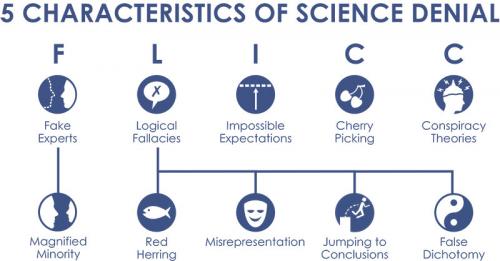
- There once was a polar bear – science vs the blogosphere
nigelj at 07:27 AM on 3 December, 2017Yes polar bears are accustomed to a certain way of life. It's not as if polar bears and seals can build boats. Polar bears eat seals and also carcasses of beluga whales. But seal numbers are declining, and arctic belguga whale numbers are under threat from hunting:
en.wikipedia.org/wiki/Beluga_whale#Population
Polar bears are not evolved to eat smaller fish easily. Its hard for me to see how they can adapt in time to all these changing circumstances. Things will reach a tipping point where numbers dwindle at an accelerating rate, and even finding a mate will become more difficult.
The resilent or adaptable species tend to be insects, bacteria and smaller mammals. And humans to an extent. But our vulnerability is the complexity of our economy and society now.
- There once was a polar bear – science vs the blogosphere
One Planet Only Forever at 05:11 AM on 3 December, 2017In addition to the threat to polar bear populations from reduced Arctic sea ice extents, there is already the challenge to polar bear populations due to the later formation of sea ice. I have seen numerous reports of polar bears trying to survive on the shorelines because of later formation of sea ice. unlike humans who can get a science based forecast and plan accordingly, polar bears base what they do on what they are accustomed to.
Unfortunately many humans fail to 'learn from science' and will not change their behavior responsibly if the required change is contrary to what they have developed a desire for ... become addicted to.
- There once was a polar bear – science vs the blogosphere
Jeff H at 19:39 PM on 2 December, 2017The things we wanted to emphasize in our paper are important concepts like tipping points, critical threshold, time lags and what Tilman and May referred to as the ‘extinction debt’ in their 1994 Nature article. Polar bears depend on habitat that literally melts as temperatures rise. If, as projected, ice extent in the Arctic continues to decline, then at some point bear populations WILL collapse. We have seen similar occurrences in tropical biota; species remained in fairly sizeable numbers until forest cover was reduced below a critical threshold and then numbers plummeted, often so rapidly that extinction was inevitable.
We therefore emphasize that focusing on today tells us little about future projections in a warming world. Paul Ehrlich’s building analogy is appropriate here. A man jumps off the top of a 100 story building, plummets 50 floors and while doing so shouts “everything is OK!”. Well, it clearly isn’t OK. Climate change skeptics and deniers routinely fail or refuse to project. Their mantra is, “everything is OK today, so don’t worry about tomorrow”. This isn’t science. I was taught as a professional ecologist to place the demographics of species and species populations in a dynamic, changing world. The world is not static. Humans are altering vast swathes of the biosphere, including surface temperatures, at rates well beyond the capacity of many species to adapt. Therein lies the rub.
- There once was a polar bear – science vs the blogosphere
FMeditor at 11:04 AM on 2 December, 2017Eclectic,
(1) "The climate science denialism seems to be a minor personal side-issue for him."
I don't respond to unsupported smears, but in this case will point out that I am a strong — even dogmatic — supporter of the IPCC and major climate agencies (esp NOAA). Their work is the foundation of my posts. That you consider that "denialism" is ... strange, and sad.
(2) "the topics tend toward the partisan-political,"
The tagline of the FM website says it is about "geopolics." So, yes, there is a lot about politics. Much of our content attacks extremists on both Left and Right. That's the case for posts about the policy debate about climate change — where both extremes have turned against the IPCC.
(3) "thereby implying to the casual/superficial reader, that Crockford was an expert in the field and whose opinion was worthy of respect)."
Your description of that section of the post is misleading. As is the standard practice on the FM website, we provide readers with full information so that they can make the own evaluation. I gave a summary of her professional background — education, a link to her publication (including her paper about polar bears), etc.
Calling that "disinformation" is daft.
Here background in zoology is relevant to this subject. Time will tell if her analysis is correct. As Popper said (paraphrasing), successful predictions are the gold standard in science.
- There once was a polar bear – science vs the blogosphere
John Hartz at 10:58 AM on 2 December, 2017Suggested supplemental reading:
How do you Spot a Climate Science Denial Blog? Check the Polar Bears
by Kyla Mandel, DeSmog UK, Dec 1, 2017 - There once was a polar bear – science vs the blogosphere
Matthew L at 10:57 AM on 2 December, 2017Jeff H. Please name the "deniers" you are referring to. The three names I put forward stress repeatedly that they fully buy into greenhouse gas global warming. However they do not agree with the established view that it is as rapid or likely to be as catastrophic as most articles on sites such as this. They put forward reasonable arguments and are far from extreme. So far the worst predictions of imminent catastrophe have failed to materialise. The longer the ice in the Arctic fails to melt away, the polar bears thrive, coral atols fail to sink and agricultural yields continue to grow the more convincing their arguments become and the less convincing are the predictions of disaster by the end of the century. I am still worried that the worst might happen and still read the science but am a lot less worried than I was 20 years ago when so many predictions of doom were made that have failed to come to pass. I notice you failed to respond to my comment on the tendancy towards self justification, and cognitive dissonance in the scientific community when predictions fail. Ever read the book "Mistakes were made (but not by me)"? I think you should. When you cry "wolf!" and predict catastrophe you had befter be very certain it will happen or you are not to lose all credibility. Professor Peter Wadhams was once a despected scientist...
- There once was a polar bear – science vs the blogosphere
Eclectic at 10:44 AM on 2 December, 2017Quite right, FMeditor @ 13 et seq . . . CBDunkerson should more properly have used the term "disinformation" (rather than "misinformation").
I suppose MatthewL could tell us whether his source was Dr Crockford's blogsite or Mr Kummer's blogsite — but really the exact source of the disinformation is of little relevance to the basic question.
On Kummer's blogsite, as far as I have seen, the topics tend toward the partisan-political, by himself and subsidiary authors. The climate science denialism seems to be a minor personal side-issue for him. Nevertheless, Kummer doesn't hesitate to have his climate article (on polar bears & Crockford) bristling with non-sequiturs & other disinformation (e.g. the link to Crockford's publication list . . . thereby implying to the casual/superficial reader, that Crockford was an expert in the field and whose opinion was worthy of respect).
It appears that Crockford's expertise on the evolution of the polar bears . . . is about as relevant to today, as the evolution of the rhinoceros is to the current problems of the rhinoceros. Worse, Crockford's own apologism (against climate science) on her own blogsite shows the cherry-picking [Hudson Bay bears] and logical non-sequiturs, irresponsible risk-management & short-term thinking so typically unobjective and in short: unscientific.
Note particularly her denial of the progressive loss of arctic ice.
- There once was a polar bear – science vs the blogosphere
nigelj at 05:57 AM on 2 December, 2017Just my view on polar bears, fwiw. Briefly I think polar bears are in trouble from declining sea ice. Polar bears use the floating sea ice, and sea ice is also important to seal populations, on which polar bears depend.
There is mixed evidence of whether polar bear numbers are declining overall right now because of so many influences, measuring accuracy, climate issues and hunting. But there is good evidence of declining populations of some seals here.
This is not rocket science. Species have some level of adaptability. Polar bears are probably still finding enough seals to get by. But in 20 years impacts will be much greater in terms of declining sea ice and seal numbers, and will stretch adaptability of polar bears. If seal populations declining now as seems apparent in at least some cases as above, directly from declining sea ice, they can only decine further. This is likely to impact on polar bears given its their food supply, and it's over a relatively short time frame of decades to a century. This is short in adaptation and evolutionary terms.
The issue is one where its too early to get a clear picture on polar bears partly because of changes in hunting, and its the projections that count most. Any 'reasonable' consideration paints a grim future for polar bears later this century.
- There once was a polar bear – science vs the blogosphere
nigelj at 05:12 AM on 2 December, 2017FMeditor @13
"(2) Matthew's comment is factualy correct — not "misinformation." From this information Bart and Michael draw different *conclusions* about the relevance of her training and experience."
Nobody said her publishing record is missinformation, you are making a straw man argument. Its her views and findings that are questioned.
And yes they do draw different conclusions, but only one conclusion makes sense, namely M Sweets. Susan Crockfords research is broadly speaking in zoology, with nothing published in the peer reviewed literature on polar bears apart from some very brief comment piece, and almost nothing published related to climate change. Thefore its nonsensical for anyone to consider her an expert or authority on polar bears, and relation to climate change.
If you want to be an expert and taken seriously, you have to prove it to your peers, and the only convincing way is to publish research of substance specifically on polar bears, or do a Phd thesis on polar bears, otherwise claims of expertise are empty assertions, like some arm chair retired physics teacher claiming to be a leading expert on black holes on the basis of some blog post he wrote. No, an expert is someonelike S Hawking, who has offered some substantial proof he is an expert. Its no different for Susan Crockford.
- There once was a polar bear – science vs the blogosphere
FMeditor at 04:46 AM on 2 December, 2017CBDunkerson
"Matthew L is likely getting his misinformation from this Larry Kummer piece."
(1) No, he didn't. He got that information from the "About" page on Susan Crockford's website, Polar Bear Science.
https://polarbearscience.com/about-2/
(2) Matthew's comment is factualy correct — not "misinformation." From this information Bart and Michael draw different *conclusions* about the relevance of her training and experience.
- There once was a polar bear – science vs the blogosphere
Jeff H at 03:55 AM on 2 December, 2017As lead author of the Bioscience paper I will make three responses to Matthew L’s erroneous posts. First, our paper is about scientific ethics, not about Susan Crockford, and we set out to prove that blogs which deny AGW largely ignore the primary scientific literature. We proved that here using PCA. Polar bears are used as biotic proxies for AGW by climate change deniers, hence why we focused on these iconic mammals. In truth, the empirical literature is filled with studies showing the harmful effects of warming on soil, aboveground terrestrial and aquatic communities. This wealth of data is ignored by denier blogs because it would be impossible for them to counter this veritable tsunami of data. Moreover, since blogs are operated usually by people lacking formal training in the relevant fields, a deliberate attempt is made to focus on only a tiny subset of areas or fields.
Second, Susan Crockford has only 17 papers in her career on the ISI Web of Science (none since 2014); her work has been cited less than 200 times and her h-factor is 7. Moreover, she has conducted no primary research on polar bear biology or ecology. On this basis I would question whether she is an ‘outstanding and eminent scientist in the field of Arctic fauna’. To argue that she knows more about the survival of Arctic fauna than anyone else is absurd. Three of my co-authors, Steven Amstrup, Ian Stirling and Eric Post, by contrast, have a combined total of over 500 publications, 15,000 citations and vastly more expertise on Arctic ecology than Crockford.
Third, there are not two sides in discussions about AGW. There is one side whose conclusions are supported by the vast majority of the empirical data and another side whose arguments are not. Of course there are uncertainties over future projections of AGW, and deniers exploit these as much as possible to sow doubt. But there are many certainties as well, and scientists need to do a better job getting these across to the general public. Oreskes and Conway named their book, ‘Merchants of Doubt’ for a reason. Deniers will never win scientific debates, but that is not their aim. Their aim is to convince the public that the science is not settled. In tis way nothing will be done to mitigate greenhouse gas emissions.
- There once was a polar bear – science vs the blogosphere
Matthew L at 02:18 AM on 2 December, 2017She has done meta-analysis on research data on polar bear numbers which is compelling, if not peer reviewed. As a medic I am well aware of the problems with peer review and the lack of replicated results, so I do not dismiss any paper just because it is not peer reviewed.
There is nothing to suggest that global numbers of polar bears have declined in the last 40 years and plenty to suggest that they have grown. It may be difficult to disentangle growth due to a reduction in hunting with decline due to a reduction in habitat. However, to date, the former effect has evidently been stronger than the latter, despite a steady decline in Arctic sea ice. You are disingenous in your statement that polar bears are listed as endangered. This was done to protect them from dangerous men with dangerous guns, not gradual sea ice decline.
From what I can gather, most of the time when an unbiased assesment is done on Arctic fauna the results tend to be less alarming than the initial press would suggest. For instance the recent Fish and Wildlife Service assesment of walrus populations as not endangered following "analysis of the best available scientific information".
https://www.fws.gov/alaska/fisheries/mmm/walrus/esa.htm
I do not know of Crockford's attitude on climate change, but as she is a highly qualified and published scientist who has worked extensively in the Arctic I very much doubt it is "anti-science" - any more than Judith Curry, Pielke Junior and Roy Spencer are "anti-science" or "deniers" (absolutely hate the use of that word). They are all highly qualified scientists in relevant fields of study who understand global warming and greenhouse gases but have come to a different view of the scientific evidence than taken on this blog - largely through empircal study and analysis rather than reliance on the wildly variable reuslts from General Circulation Models.
I am broadly on your side, fascinated by the science, but absolutely despair of the politics on both sides. The rampant and totally ludicrous millenial cult level alarmism (Manhatten under water by 2010, no Arctic ice by 2012, 5 million climate refugees by 2015 etc) in the press followed by ridiculous self justification and cognitive dissonance when the world does not end ("its worse than we thought!") just demolishes credibility . As for the "sky dragon slayers", I absolutely despair...
Blogs really are not the problem. The problem is that the uncertainties in the science are so huge (ECS between 1.5C and 4C per CO2 doubling according to IPCC) that it is quite possible to take a reasonable view at both ends of the spectrum. It would be better for sites such as this to climb down from the moral high ground and start looking at the effect that crying "wolf!" so often has on scientific credibility when the wolf does not appear.
- There once was a polar bear – science vs the blogosphere
Stephen Leahy at 02:10 AM on 2 December, 2017My take on the paper/Crockford for Vice:
80 Percent of Climate Denier Blogs Reference This One Canadian Zoologist
A University of Victoria adjunct prof has become climate deniers’ go-to source on polar bears.https://motherboard.vice.com/en_us/article/kzgq3y/climate-denier-blogs-spread-online-polar-bears-science
- There once was a polar bear – science vs the blogosphere
Eclectic at 00:26 AM on 2 December, 2017MatthewL @4 , as M. Sweet mentions — possibly you have not noticed it, but of those 29 scientific papers you mention, hardly any of them seem to be dealing with modern-day polar bear numbers (or, far more importantly, with the state of health of polar bear populations).
Polar bear numbers are notoriously difficult to assess accurately. Surveys suggest that numbers are growing in one region and static/declining in other regions. Part of the inaccuracy stems from the mobility of bears, and from the lack of volunteers "to bell the cat" with transponder collars. (The reason for the volunteer lack is unknown.)
What can be said for most populations (of any animals) in the wild, is that the biggest threat to them is loss of habitat. And considerable habitat loss is occurring for the polar bears. It would be a bold scientist indeed who would assert that the future looks tolerably good for polar bears particularly. And particularly worse for polar bears too, is that they are highly adapted to a rather specialised diet & annual cycle of feeding — and are far less omnivorous than their ursine relatives. So it's not looking good.
Worse again, some surveys report (as best as can be judged from a safe distance!) that there has been a decline in polar bear body weight. Even without a drop in absolute numbers as yet, this could indicate the approach of a sudden "crash" — which won't be verified until after it has happened.
Then we come to the reasons for Dr Crockford to be such an outlier in her opinions. The reek of Heartland Institute is strong.
Not to mention her anti-science attitude about climate change itself. (Never a good look, in the assessing of someone's objectivity in matters scientific.)
- There once was a polar bear – science vs the blogosphere
michael sweet at 23:09 PM on 1 December, 2017matthewl,
Thank you for the list. Looking it over I see that Susan Crockford has not written any peer reviewed articles on polar bears or their biology. She made two comments on others work on polar bear genetics. The majority of her work appears to be on domestic dogs. There is some material on archaeology and fossil animals.
What makes you think she is an expert on living Arctic mammals?
- There once was a polar bear – science vs the blogosphere
Matthew L at 20:31 PM on 1 December, 2017This paper smears an outstanding and eminent scientist in the field of Arctic Fauna. Susan Crockford probably knows more about the survival of all forms of Arctic mamalian species than anybody else. I am sure the following list of her papers won't make it through your moderation however I will give it a try:
**Crockford, S. J. 2012. Annotated map of ancient polar bear remains of the world.
*Crockford, S.J. 2012. Archaeozoology of Adak Island: 6000 years of subsistence history in the central Aleutians. Pg. 109-145 in D. West, V. Hatfield, E. Wilmerding, L. Gualtieri and C. Lefevre (eds), The People Before: The Geology, Paleoecology and Archaeology of Adak Island, Alaska. British Archaeological Reports International Series, Oxford, pg 109-145. ISBN 978-4073-0905-7
*Nishida, S., West, D., Crockford, S. and Koike, H. 2012. Ancient DNA analysis for the sea otter (Enhydra lutris) from archaeological sites on Adak, Aleutian Islands. Pg. 147-165 in D. West, V. Hatfield, E. Wilmerding, C. Lefèvre, L. Gualtieri (eds.), The People Before: The Geology, Paleoecology and Archaeology of Adak Island, Alaska. Oxford, British Archaeological Reports, International Series 2322, ISBN 978-4073-0905-7.
*Wilson, B.J., Crockford, S.J., Johnson, J.W., Malhi, R.S. and B.M. Kemp. 2011. Genetic and archaeological evidence for a former breeding population of Aleutian Cackling Goose (Branta hutchinsii leucopareia) on Adak Island, central Aleutians, Alaska. Canadian Journal of Zoology 89: 732-743. http://www.nrcresearchpress.com/journal/cjz
**Crockford, S.J. and G. Frederick 2011. Neoglacial sea ice and life history flexibility in ringed and fur seals. pg.65-91 in T. Braje and R. Torrey, eds. Human Impacts on Seals, Sea Lions, and Sea Otters: Integrating Archaeology and Ecology in the Northeast Pacific. U. California Press, LA.
*Baichtal, J.F. and Crockford, S.J. 2011. Possibility of kelp during the LGM in SE Alaska and implications for marine mammals. Poster 5-12, 19th Conference on the Biology of Marine Mammals, Tampa, FL. Nov. 28-Dec.2.
**Crockford, S.J. 2008. Be careful what you ask for: archaeozoological evidence of mid-Holocene climate change in the Bering Sea and implications for the origins of Arctic Thule. Pp. 113-131 in G. Clark, F. Leach and S. O’Connor (eds.), Islands of Inquiry: Colonisation, Seafaring and the Archaeology of Maritime Landscapes. Terra Australis 29 ANU E Press, Canberra. http://epress.anu.edu.au/ta29_citation.html
**Crockford, S. and Frederick, G. 2007. Sea ice expansion in the Bering Sea during the Neoglacial: evidence from archaeozoology. The Holocene 17(6):699-706.
*Crockford, S.J., Frederick, G. & Wigen, R. 2002. The Cape Flattery fur seal: An extinct species of Callorhinus in the eastern north Pacific? Canadian Journal of Archaeology 26(3):152-174. http://www.canadianarchaeology.com/publications.lasso
Martinsson-Wallin, H. & Crockford, S.J. 2001. Early human settlement of Rapa Nui (Easter Island). Asian Perspectives 40(2):244-278. (Includes an analysis of fish remains & a comprehensive list of modern Rapa Nui fishes). http://muse.jhu.edu/journals/asi/
Crockford, S.J. 1997. Archaeological evidence of large northern bluefin tuna, Thunnus thynnus, in coastal waters of British Columbia and northern Washington. Fishery Bulletin 95:11-24. http://fishbull.noaa.gov/
Domestication, speciation and evolution papers
Crockford, S.J. and Kusmin, Y.V. 2012. Comments on Germonpré et al., Journal of Archaeological Science 36, 2009 “Fossil dogs and wolves from Palaeolithic sites in Belgium, the Ukraine and Russia: osteometry, ancient DNA and stable isotopes”, and Germonpré, Lázkičková-Galetová, and Sablin, Journal of Archaeological Science 39, 2012 “Palaeolithic dog skulls at the Gravettian Předmostí site, the Czech Republic.” Journal of Archaeological Science 39:2797-2801. http://www.sciencedirect.com/science/article/pii/S0305440312001537**Crockford, S.J. 2012. Directionality in polar bear hybridization. Comment (May 1) to Hailer et al. 2012. “Nuclear genomic sequences reveal that polar bears are an old and distinct bear lineage.” Science 336:344-347. Follow link and click on “# comments” under the title http://comments.sciencemag.org/content/10.1126/science.1216424
**Crockford, S.J. 2012. Directionality in polar bear hybridization. Comment, with references (May 1) to Edwards et al. 2011. “Ancient hybridization and an Irish origin for the modern polar bear matriline.” Current Biology 21:1251-1258. to view comments, go through the host website, http://www.Cell.com and find the paper at the Current Biology website. http://www.cell.com/current-biology/abstract/S0960-9822%2811%2900645-2#Comments
Ovodov, N.D., Crockford, S.J., Kuzmin, Y.V., Higham, T.F.G., Hodgins, G.W.L. and van der Plicht, J.. 2011. A 33,000 year old incipient dog from the Altai Mountains of Siberia: Evidence of the earliest domestication disrupted by the Last Glacial Maximum. PLoS One 10.1371/journal.pone.0022821. http://www.plosone.org/article/info%3Adoi%2F10.1371%2Fjournal.pone.0022821
Crockford, S.J. 2009. Evolutionary roots of iodine and thyroid hormones in cell-cell signaling. Integrative and Comparative Biology 49:155-166.
**Crockford, S.J. 2006. Rhythms of Life: Thyroid Hormone and the Origin of Species. Trafford, Victoria [for a general audience, polar bear evolution discussed];
**Crockford, S.J. 2004. Animal Domestication and Vertebrate Speciation: A Paradigm for the Origin of Species. Ph.D. dissertation, University of Victoria (Canada), Interdisciplinary Studies. [filed at the National Library under Zoology; polar bear evolution discussed] Pdf available, just ask.
**Crockford, S.J. 2003. Thyroid rhythm phenotypes and hominid evolution: a new paradigm implicates pulsatile hormone secretion in speciation and adaptation changes. International Journal of Comparative Biochemistry and Physiology, Part A Vol. 35 (#1, May issue):105-129. http://www.elsevier.com/ [an invited submission; polar bear evolution discussed]
**Crockford, S.J. 2002. Thyroid hormone in Neandertal evolution: A natural or pathological role? Geographical Review 92(1):73-88. http://www.jstor.org/journals/00167428.html [an invited commentary]
**Crockford, S.J. 2002. Animal domestication and heterochronic speciation: the role of thyroid hormone. pg. 122-153. In: N. Minugh-Purvis & K. McNamara (eds.) Human Evolution Through Developmental Change. Johns Hopkins University Press, Baltimore. http://www.press.jhu.edu/press/books/index.htm [polar bear evolution discussed].
Crockford, S.J. 2000. Dog evolution: a role for thyroid hormone in domestication changes. pg. 11-20. In: S. Crockford (ed.), Dogs Through Time: An Archaeological Perspective. Archaeopress S889, Oxford. http://www.archaeopress.com/defaultBar.asp
Crockford, S. J. 2000. A commentary on dog evolution: regional variation, breed development and hybridization with wolves. pg. 295-312. In: S. Crockford (ed.), Dogs Through Time: An Archaeological Perspective. Archaeopress S889, Oxford. http://www.archaeopress.com/defaultBar.asp
Northwest Coast dog studies
Crockford, S.J., Moss, M.L., and Baichtal, J.F. 2012. Pre-contact dogs from the Prince of Wales archipelago, Alaska. Alaska Journal of Anthropology 9(1):49-64.Crockford, S.J., 2005. Breeds of native dogs in North America before the arrival of European dogs. Proceedings of the World Small Animal Veterinary Congress, Mexico City. [invited lecture] available online at: http://www.vin.com/proceedings/Proceedings.plx?CID=WSAVA2005&PID=11071&O=Generic
Koop, B.F., Burbidge, M., Byun, A., Rink, U, & Crockford, S.J. 2000. Ancient DNA evidence of a separate origin for North American indigenous dogs. pg. 271-285. In: S. Crockford (ed.), Dogs Through Time: An Archaeological Perspective. British Archaeological Reports (B.A.R.), Archaeopress S889, Oxford. http://www.archaeopress.com/defaultBar.asp (collaborative research with Univ. of Victoria (Ben Koop, Biology) & National Science & Engineering Research Council, Canada (NSERC) [first published analysis of ancient dog DNA]
Crockford, S.J. 1997. Osteometry of Makah and Coast Salish Dogs. Archaeology Press, Publication 22, Simon Fraser University, Burnaby, B.C. http://www.sfu.ca/archaeology/dept/arcpress/index.htm
[A comprehensive analysis of cranial & postcranial remains of adult dogs from 20 coastal archaeological sites]Crockford, S.J. & Pye, C.J. 1997. Forensic reconstruction of prehistoric dogs from the Northwest Coast. Canadian Journal of Archaeology 21(2):149-153 [the story of the wool dog/village dog sketches done by RCMP forensic artist CJ Pye] http://www.canadianarchaeology.com/publications.lasso
Seal and sea lion diet studies
Tollit, D.J., Schulze, A., Trites, A.W., Olesiuk, P., Crockford, S.J., Gelatt, T., Ream, R. & Miller, K. 2009. Development and application of DNA techniques for validating and improving pinniped diet estimates based on conventional scat analysis. Ecological Applications 19(4):889-905. [This study compares my bone ID of prey species to DNA analysis] http://www.esajournals.org/doi/abs/10.1890/07-1701.1Olesiuk, P.F., Bigg, M.A., Ellis, G.M., Crockford, S.J. & Wigen, R.J. 1990. An assessment of the feeding habits of harbour seals (Phoca vitulina) in the Strait of Georgia, British Columbia, based on scat analysis. Canadian Technical Reports on Fisheries & Aquatic Science. 1730.
http://pubs.nrc-cnrc.gc.ca/cgi-bin/rp/rp2_tocs_e?cjfas_cjfasS1-98_55 - There once was a polar bear – science vs the blogosphere
nigelj at 06:28 AM on 1 December, 2017Good article. I want to give my personal point of view on this, because I think its likely shared to some extent. The climate issue went public most strongly in the 1990s, and initially it seemed to me there was obvious evidence we were warming the climate. However I became distracted for about a year, after listening to various quite convincing sceptical points on climate change. This included material on the arctic and polar bears, and other things like theories about cosmic rays causing the warming (of course they arent). It seemed convincing, yet highly suspicious as well.
Only when I was off work sick with time on my hands, and dug deeper was it clear these sceptical points were either nonsense, or very misleading. The trouble is this takes time as "the devil is in the detail".
I see various people genuinely believing the most inane denialist rubbish, partly because they dont have the time to always cooly evaluate the fine detail or read complex rebuttals. Although its very important to make these rebuttals, and this website was one reason I saw the problems in denialist claims.
Perhaps what we ideally need is more politicians and leaders of business speaking out quite bluntly that climate denialists are talking misleading rubbish. This is an accurate assessment, so I dont see why they don't. Perhaps they are afraid of offending people, but its not freedom of speech to be making misleading sceptical claims, and quote material out of conext etc. This is an abuse of free speech.
- New study uncovers the 'keystone domino' strategy of climate denial
nigelj at 05:47 AM on 30 November, 2017Yes people do indeed latch onto a few selective issues to try to discredit entire theories. Of course intelligent open minded people know this is false logic, but not everyone does, or they are so blinded by their politics they just dont care.
It's a tough one, as things like polar bear examples make the issue real and relatable compared to some graph of climate trends, but at the same time are somewhat easy to pick holes in, especially as trends are currently only declining overall and not everywhere. Hopefully people see the big picture, not one study that shows an increase in some limited area.
I find it useful understand the polar bear issue by doing a simple thought experiment to imagine the arctic totally ice free, or nearly ice free, which is a very possible scenario in our lifetimes. This means no ice for polar bears and changes to seal populations etc.
Where do the polar bears go? Its almost certainly much too fast for them to biologically evolve and adapt to alternative environments. This sort of evolution takes centuries to millenia. Polar bears do not have the inventive nature of humans to use tools and innovate their way out of changing environments, and even humans can only do this up to a certain point. Its going to be game over for polar bears.
We have seen numerous species go extinct through not only hunting but environmental pressures. Some studies on species already affected badly by climate change and other environemntal problems here and here
- 2017 SkS Weekly Climate Change & Global Warming News Roundup #35
ubrew12 at 08:12 AM on 5 September, 2017Also I point out that when somebody builds in a bayou and is thus required Federal flood insurance, they are asking me, and other Americans, to subsidize their flood risk. That's absolutely not OK, and if I were a self-professed 'libertarian' that would go double. My point is climate change is now impacting us in the pocketbook. We're being asked to subsidize risk for people who should know better (as Hurricane Irma approaches Florida this is heavy on my mind).
This is no longer about saving the Polar bears. The climate deniers are hitting us where we live.
- Polar bear numbers are increasing
michael sweet at 21:40 PM on 4 September, 2017The author of your citation is Susan Crockford. She is an adjunct professor at the University of VIctoria. Her expertise is in the breeding and history of dogs. She is paid a monthly retainer from the Heartland Institute.
No sign of expertise in polar bears, although she lives closer to their habitat than I do.
The article was submitted on March 2 for comments but no-one has seen fit to comment. The impact factor of the journal is 2.2 which is very low. If you have $400 you can get a pre-print on PeerJ.
She purports to examine the status of polar bears when sea ice minimums are 3-5 mkm2. Current projections are less than 1 mkm2 in a few decades. Populations of long lived animals like polar bears change slowly in response to environmental changes.
- Russian email hackers keep playing us for fools
Paul D at 01:07 AM on 24 December, 2016Come on guys and girls.
You need to stop over analysing what 'Russia' is doing or even individuals in Russia.It is simple propaganda. The same goes for climate skeptics (in any country) etc.
There is NO interest in science. It is purely a war of intelligence and propaganda.
The idea is to confuse and destabilise the enemy. Hence you still get climate change skeptics deliberately regurgitating old lies and myths about ice, polar bears, volcanoes etc. There is no interest in science, it's purely to confuse, thereby maintaining the policy status quo or to reverse it to some previous state.
Hacking emails, denial of service attacks etc. It's all about causing disruption.Remember, this is all during peace time. Basically if war broke out, nowhere online would be safe!
We made our bed... - Conservatives elected Trump; now they own climate change
Bruce Frykman at 07:13 AM on 12 November, 2016If global warming were real which state or city would you move to?
I understand, for instance. that "global" does not involve a lot of places namely the lower 48 and Hawaii)
How are the polar bears doing...they must be dead by now...the pity...the shame. Such cute cudly things who should have never signed that contract with Coke.
- 2015 SkS Weekly Digest #8
CBDunkerson at 03:47 AM on 26 February, 2015Inside Climate News has the best writeup on the Soon debacle that I have seen thus far.
Quoting Soon: "For polar bears... you do want to watch out for ice. Too much ice is really bad for polar bears."
- Models are unreliable
Sangfroid at 14:17 PM on 21 February, 2015When I had taken on the task of learning to trade stocks and currency a few years ago, I was amazed at the number of 'models' that were 'back tested' to be accurate. They tended to be somewhat accurate - until they failed.
Most scientists do not understand randomness and the role it plays in all aspects of our lives. We exist totally due to randomness. Weather - despite how much we think we understand the interactions of everything that affects weather - is totally random. We will never be able to predict, with certainty, the future of weather.
Many, if not all, of the so called solutions to curb CO2 emmisions, or to curb sunlight, or to convert to alternate energy sources, - although they may be necessary - do not address the effects on many people in the middle income brackets and below. Some do not address the potential negative effect on our health.
I would like to see the data that scientists use to predict the negative effects on our environment, animals and humans. Polar bears are often used as an example. Polar bears can survive without the ice covered artic as they do in parts of eastern Canada.
Also, it would be very eye opening to see the source of the actual data, how it is interpreted, and what assumptions are included in their climate models. If we demand openness in government we should also demand it on something as importand as this.
- How we discovered the 97% scientific consensus on man-made global warming
Tom Curtis at 13:23 PM on 4 February, 2015Stranger @20, searching The Consensus Project database, I find just two papers with Willi Soon as a coauthor. The first, on polar bears, was rated neutral because it does not include any discussion in the abstract germain to the attribution of recent global warming. The abstract of the second reads as follows:
"The authors investigate how the global monsoon (GM) precipitation responds to the external and anthropogenic forcing in the last millennium by analyzing a pair of control and forced millennium simulations with the ECHAM and the global Hamburg Ocean Primitive Equation (ECHO-G) coupled ocean–atmosphere model. The forced run, which includes the solar, volcanic, and greenhouse gas forcing, captures the major modes of precipitation climatology comparably well when contrasted with those captured by the NCEP reanalysis. The strength of the modeled GM precipitation in the forced run exhibits a significant quasi-bicentennial oscillation. Over the past 1000 yr, the simulated GM precipitation was weak during the Little Ice Age (1450–1850) with the three weakest periods occurring around 1460, 1685, and 1800, which fell in, respectively, the Spörer Minimum, Maunder Minimum, and Dalton Minimum periods of solar activity. Conversely, strong GM was simulated during the model Medieval Warm Period (ca. 1030–1240). Before the industrial period, the natural variations in the total amount of effective solar radiative forcing reinforce the thermal contrasts both between the ocean and continent and between the Northern and Southern Hemispheres resulting in the millennium-scale variation and the quasi-bicentennial oscillation in the GM index. The prominent upward trend in the GM precipitation occurring in the last century and the notable strengthening of the global monsoon in the last 30 yr (1961–90) appear unprecedented and are due possibly in part to the increase of atmospheric carbon dioxide concentration, though the authors’ simulations of the effects from recent warming may be overestimated without considering the negative feedbacks from aerosols. The simulated change of GM in the last 30 yr has a spatial pattern that differs from that during the Medieval Warm Period, suggesting that global warming that arises from the increases of greenhouse gases and the input solar forcing may have different effects on the characteristics of GM precipitation. It is further noted that GM strength has good relational coherence with the temperature difference between the Northern and Southern Hemispheres, and that on centennial time scales the GM strength responds more directly"
The first thing you will notice is that it says nothing to dismiss the attribution of at least 50% of recent global warming to anthropogenic factors. On the contrary, it several times mentions CO2 forcing (an anthropogenic factor) as a relevant forcing, and as a cause of recent warming. Specifically, it is stated:
"The simulated change of GM in the last 30 yr has a spatial pattern that differs from that during the Medieval Warm Period, suggesting that global warming that arises from the increases of greenhouse gases and the input solar forcing may have different effects on the characteristics of GM precipitation"
Given reasonable background information about the relative strengths of anthropogenic and solar forcing, that represents an implicit endorsement that >50% of recent warming was anthropogenic. However, we don't need to dig that far in. The paper uses climate models which are known, given historical forcings, to show humans as responsible >50% of recent warming. Absent an explicit disclaimer indicating that the authors are not using standard historical forcings, that again respresents an implicit endorsement. The paper was in fact rated as Explicitly endorsing but not quantifying, ie, a 2, and that is arguably a mistake. (I would rate it as 3, implicitly endorsing.) It is, however, a mistake that makes zero difference to the headline result of Cook et al.
Now it is possible that Soon and his coauthors did clearly indicate the use of radically a-historical forcings in the depths of the paper. The raters did not get to see the depths of the paper, however. They rated on the abstract and therefore a rating justified by the abstract, though contradicted within the paper merely shows that abstracts often poorly communicate the contents of papers, not that the raters made a mistake. Further, raters clearly rated abstracts, not authors. If Willi Soon is really saying that he (rather than an abstract of one of his papers) was rated as endorsing the consensus, then he either completely misunderstands the study he is criticizing (nothing new there) or completely misrepresents it.
Turning to Craig Idso, he also has to papers rated, one of which was rated as neutral. The second, which was rated as implicitly endorsing the consensus, had the following abstract:
"Since the early 1960s, the declining phase of the atmosphere’s seasonal CO2 cycle has advanced by approximately 7 days in northern temperate latitudes, possibly as a result of increasing temperatures that may be advancing the time of occurrence of what may be called ‘climatological spring.’ However, just as several different phenomena are thought to have been responsible for the concomitant increase in the amplitude of the atmosphere’s seasonal CO2 oscillation, so too may other factors have played a role in bringing about the increasingly earlier spring drawdown of CO2 that has resulted in the advancement of the declining phase of the air’s CO2 cycle. One of these factors may be the ongoing rise in the CO2 content of the air itself; for the aerial fertilization effect of this phenomenon may be significantly enhancing the growth of each new season’s initial flush of vegetation, which would tend to stimulate the early drawdown of atmospheric CO2 and thereby advance the time of occurrence of what could be called ‘biological spring.’ Working with sour orange (Citrus aurantium L.) trees that have been growing out-of-doors in open-top chambers for over 10 years in air of either 400 or 700 ppm CO2, this hypothesis was investigated by periodically measuring the lengths, dry weights and leaf chlorophyll concentrations of new branches that emerged from the trees at the start of the 1998 growing season. The data demonstrate that the hypothesis is viable, and that it might possibly account for 2 of the 7 days by which the spring drawdown of the air’s CO2 concentration has advanced over the past few decades."
Cutting to the chase, the authors are suggesting an alternative explanation to the fact that spring is coming earlier than it did in the past. The standard explanation is that it is warmer earlier. Craig Idso's alternative explanation in terms of the CO2 fertilization effect is found to be a viable hypothesis, that "... might possibly account for 2 of the 7 days by which the spring drawdown of the air’s CO2 concentration has advanced over the past few decades." The might, possibly indicates not only uncertainty, but the upper range of the potential effect. That is, it might account for 28.6% of the botanical effect of an early spring (and zero of the effect on animals). That leaves around 70% still attributable to the traditional explanation, ie, the increased warmth.
To my mind, that is not enough to rate the paper as implicitly endorsing the consensus; though only because the consensus is implicitly defined as relating to attribution on which the abstract says nothing. Therefore this is a case of an abstract that was rated (3), but should have been rated, IMO, (4).
Note again that the ratings are not rating authors, and not rating papers. However, Cook et al did include a rating of papers by the authors. Comparison between it and the abstract ratings showed that by far the most common "error" was rating papers that endorsed the consensus as not endorsing the consensus. Again, if Craig Idso understood Cook et al, he would know that to be the case. He would know that pointing out one or two potential errors without pointing to the overall error statistics as shown be comparison of the abstract and author self ratings is a blatant cherry pick. Indeed, that is probably why he claims the error, but does not draw attention to the results of the author self ratings.
- Scientists connect the dots from identifying to preventing dangerous climate risks
mancan18 at 08:08 AM on 25 December, 2014Changing the view of the public is not only a job for the scientists, it is also a job for the media and for popular writers to create the right fictional (and non-fictional) literature that will be widely read. While SkS is predominately a forum for scientific discussion. Perhaps, while I don't pretend to be any great writer, I have a more scientific and mathematical bent, I have penned something, while it's not great liteature and it may be an inappropriate forum, it might get the ball rolling.
AGW and CC
Doggerel for the AnthropoceneMore extremes,
Less in betweens;
Records broken,
That are not a token;
Longer lasting,
Wider happening,
All a sign
Of what's to come.Warmer hot days,
Warmer cold days,
Warmer OK days,
Just changing to a warmer way.
More summer times,
Later autumn times,
Earlier spring times,
Shorter winter times,
Sometimes sharper,
Most times milder,
Years not quite,
What they've always been;
Where only some days,
Seem the same.More sunny days,
More droughts;
More cloudy days,
More rain;
More floods;
More storms,
More wind;
More homes destroyed,
More houses wrecked,
Oh well what the heck.Warmer land,
Warmer seas,
With
Glaciers smaller,
Poles retreating,
Overall,
Ice just disappearing;
High tides higher,
Low tides higher,
The coast we know,
Just eroding;
Coral reefs fewer,
Sea shells thinning,
All the while
Cities slowly sinking.Less land to farm,
To keep us fed,
More sandy deserts,
And a few more dead;
Fewer species,
Animals disappearing,
While others just seem to thrive,
Over a range,
A little more wide;
More pests,
To cause us harm,
More sickness and disease,
To threaten us all.While climates tropical
Become more topical
And milder climes
Are in decline
As poles shrink
You have to think
For polar bears
It's now quite clear,
It's simple,
Really,
They just won't be here.Early signs now,
Give a clue,
And climate scientists,
Seem to know;
That clearing forests,
Burning more oil, gas and coal,
Will only achieve that final goal;
Of seeing what happens,
From feeding the Anthropocene;
Sending CO2 to levels not seen,
Since sometime before the Pleistocene,
Increasing at rates that have never been;
So finally we will know,
What business as usual,
Truly means,
Unfortunately it'll be all too late,
We'll have sealed our fate,
Where, in a few centuries,
There will be a climate that took eons,
For the natural world to make.97% of scientists,
Do agree,
And have spoken through
Their journals, Academies and the IPCC;
3% think something different,
And have sown seeds of uncertainty,
While doubters lay doubt,
With skepticism and deniability,
With their talk of conspiracy
From their political ideology,
Or simply for reasons monetary;
With arguments, politic,
And few, scientific;
All to get in the way,
So action is stopped again and again;
For a little more money,
From a 19th century technology;But it's not so funny,
Because it keeps on happening,
And it will be our children,
Who will surely pay.Some will win,
Most will lose,
But for everyone,
It won't be the same;
One thing though,
As certain as day,
It will be the poorest
Who will have to pay;
While the air conditioned move to higher ground,
Where a more pleasant clime can be found,
To continue their lives day to day,
As if nothing ever happened.It's not a good idea,
To change the climate,
To one not seen,
Long before the thylacine,
It might be a little more green,
In some places,
While in others,
Nothing,
Only desert;
Where in the future
All we'll see,
Is a world where we didn't exist,
A world where we would never be.Should we worry,
And chance our luck,
Just ignore the science,
And hope for the best;
Well, our children will certainly know,
In a hundred years or so;
We will leave them a legacy,
For them to live by,
To wonder why,
People, so supposedly enlightened,
Like us,
Could just let it happen.Despite all the controversy,
Debate and prophecy,
There's one thing certain,There is no doubt,
With CO2 increasing,
There will be heating,
Unlike anything we've ever seen.So for Paris,
In two fifteen
Scientists have spoken;
Will the politics remain same,
Just still broken;
Or will we stop the rot,
So the world doesn't become,
A lot more hot?mancan18 Dec 2014
- Antarctica is gaining ice
Daniel Bailey at 06:44 AM on 21 December, 2014I have placed some updated information on Polar Bears here.
- Polar bear numbers are increasing
Daniel Bailey at 06:42 AM on 21 December, 2014Polar Bear populations are declining.
In 2005, the IUCN Polar Bear Specialist Group (PBSG) classified the Polar Bear as a vulnerable species. In 2009, they reported that of the 19 subpopulations of Polar Bears:
8 are declining
3 are stable
1 is increasing
7 are without sufficient dataThis compares with, in 2005:
5 declining
5 five stable
2 increasing
7 data deficient[Source]
· A decline in survival of female polar bears of all age classes, from 1194 to 806, between 1987 and 2011 in western Hudson Bay was due to earlier sea ice break-up in the spring and later freeze-up in the autumn.
· In 2010, polar bear numbers in the southern Beaufort Sea appeared to stabilize at 900 bears following a period of low survival during 2004-2006 that led to a 25-50% decline in abundance. However, survival of sub-adult bears declined during the entire period.
· Polar bear condition and reproductive rates have also declined in the southern Beaufort Sea, unlike in the adjacent Chukchi Sea, immediately to the west, where they have remained stable for 20 years. There are also now twice as many ice-free days in the southern Beaufort Sea as there are in the Chukchi Sea.
· Genetic studies indicate that polar bears have been through long and dramatic periods of population decline during the last one million years, and that during periods with little sea ice there have been multiple episodes of interbreeding between polar bears and brown bears.
[Source]
"The primary habitat for polar bears and their prey, sea ice, is declining rapidly in extent in all seasons, and particularly in summer, with concurrent and even more dramatic reductions in total volume (Laxon et al. 2013). Since the satellite record began in 1979, minimum sea ice extent has declined 13.3% per decade (see the essay on Sea Ice). Given the close association between polar bears, their primary prey and sea ice, climate warming remains the most significant threat to the long-term survival of this species (Stirling and Derocher 1993, Amstrup et al. 2008, 2010)."
[Source]
The evidence is clear: Polar Bear populations are declining.
- Antarctica is gaining ice
Composer99 at 03:56 AM on 21 December, 2014alan2112drums:
I believe you can simply share the link (which you did at the bottom of your post - unless that's for a related post) and either paste/quote relevant highlights or paraphrase what you think are the key points, rather than copy/pasting the entire article - especially since the Daily Mail still has copyright on its own content.
Please note that this original post & thread are meant to discuss the behaviour of Antarctic ice, and as such remarks about either the Arctic sea ice or polar bear populations - which appear to be the main poitns of contention raised by the Daily Mail article - are off-topic.
Threads for further follow-up (including responses):
- Arctic sea ice
- Polar bear populations
- There may be other appropriate threads following a search.
- From Pole to Pole - a climate-themed tour through a zoo
chriskoz at 20:07 PM on 25 October, 2014I'm amazed by the wealth of interesting information about climate change impacts on selected fauna species not only herein but also in the links.
I haven't seen such interesting and easy digestion of this subject anywhere yet, and that's the outstanding aspect of it. Thanks
Baerbel.I havn't known for example that walrus is a species as much affected by the diminishing ice cover as flagship polar bears. Maybe media need to pay more attention to species such as walrus. Polar bears became such cliche, that many people deny their problem. But more evidence involving different species would convince more people that we have loss of biodiversity problem.
I've learned about some species that were exotic to me, like Egyptian geese. Interesting to compare these geese with an American species that I know very well: Canadian geese. Here's an account from a hunter on the east coast. It apears Canadian geese also benefits from climate change, while people who depend on their migrations (like hunters/farmers) are distressed by the changes.
- Global warming: a battle for evangelical Christian hearts and minds
paul11176 at 03:18 AM on 4 October, 2014@DSL,
Since Im not a scientist heres a couple of links about the polar ice caps melting.
http://wattsupwiththat.com/2013/12/16/nature-proves-al-gore-wrong-again/http://stevengoddard.wordpress.com/ice-free-arctic-forecasts/
DSL, some models have been proven faulty. Some models are tweaked by omitting some of the numbers. For example, I could show you a warming or cooling trend by cherry picking the years the planet warms or cools and Im not even a scientist.
no global warming for 18 years 1 month
The Great Pause is the longest continuous period without any warming in the global instrumental temperature record since the satellites first watched in 1979. It has endured for a little over half the satellite temperature record. Yet the Pause coincides with a continuing, rapid increase in atmospheric CO2 concentration.
http://wattsupwiththat.com/2014/10/02/its-official-no-global-warming-for-18-years-1-month/
Blogs like this one would establish credibility to openly disavow politicians like Al Gore. Politics using scare tactics to openly advance agendas that have everything to do with money and nothing to do with saving the planet have effectively ruined any and all good faith in the sciences. Many people like me simply do not believe the climate change agenda.
It really irritates me to see blogs like this wanting to win the hearts and minds of Christians by telling them their religion is make believe.
When your minds are already made up about Christians how can you present yourself in good faith?
As for believing the "greenhouse effect" theory I cant really say I do or don't. What I know for sure is that the polar bears are doing just fine, the polar ice caps are doing just fine and last years winter was one of the coldest on record.
I think you guys need to rethink your approach to climate change. Theres been to many glitches along the way and blogs, such as Skeptical Science, never seem to root out the riff raff, such as Al Gore, among the rank and file. It is jaw dropping that he showed his face at the climate change march.
So, spare me the Psalm references and stick to science.
- What I learned from debating science with trolls
Tom Curtis at 11:40 AM on 2 September, 2014On a side note, "ideal temperature" differs by organism, by mass (larger prefers cooler), by metabolism (ectothermic prefers warmer up to about 40 C, endothermic prefers colder), and by specific adaption (polar bears prefer cold, thermophiles prefer hot). Because different organisms will respond differently to changes in temperature, rate of change in temperature becomes a relevant factor. For example, trees, ceterus paribus, do better with warmer than typical north american summer temperatures, but beetles do even better still so that the net effect of warming is devestating to trees - at least in the short term. Consequently rates of change in temperature greater than 0.01 C per century sustained over multiple decades would be net harmfull to ecosystems regardless of whether or not they are net beneficial or harmfull after several thousand years of adaption.
Given all of the above, the question "What is the ideal global temperature" is too simplistic even assuming it is intended seriously rather than as a rhetorical ploy.
- Animals and plants can adapt
Tom Curtis at 10:01 AM on 24 May, 2014MA Rodger @41, the current (day 142) sea ice extent according to Charctic is 12.592 million km^2. That is 92.69% (or 93% after rounding) of the 1979 figure of 13.585 million km^2, but only 90.714% of 13.881 million km^2 on day 142 of 1985, ie, he actual record year for day 142 values. 1979 was the record year for maximum ice extent, but not for maximum May extent.
Jetfuel is very careful to not tell us that the current sea ice extent is only 97.794% of the equivalent 2007 sea ice extent (12.876 million km^2), and 97.794% of the equivalent 2012 extent (12.876 million km^2). That there is currently less ice than in the former, and current record September minimum ice years, and that the former record minimim extent ice had more ice in day 142 than did the current record shows how pointless are the statistics jetfuel is quoting.
As jetfuel well knows if he has perused charctic, in May sea ice extent variability is at a minimum. At this time of year, there is the least difference between all years so that current values of sea ice extent provide almost no predictive value in predicing eventual September minimums. It also means that at this time of year there is a maximum ice melt for years with the maximum March extent relative to other years - and it means nothing in terms of determining how low the summer sea ice extent will be.
This repeat and greatly extended series of such posts by jetfuel were he takes data out of context and milks "skeptical" conclusions from them regardless of their actual import (or lack of import). He does it so consistently, and persistently in the face of correction that he is (IMO) not entitled to the presumption of honest mistakes, and I am astonished that his record of misinformation, sloganeering and repetition has not yet resulted in his loosing the privilege of posting at SkS.
Returning to the topic, polar bears are adapted to hunting on ice packs. That makes them poor hunters on land, so that summer months are lean month with many polar bears near starvation by the end of summer. The most immediate threat from global warming to polar bears is from the extended duration before they can return to the ice after summer due to the more extensive summer sea ice melts. The slightly reduced sea ice extents in March are of almost no consequence for polar bears, and also have no bearing on the critical summer sea ice extent values.
- Medieval Warm Period was warmer
michael sweet at 11:04 AM on 16 September, 2013Spoonieduck,you are an extraordinaryly selective reader. When I read Dugmore et al 2011, I saw that Greenalnd never raised crops, only pastoral animals. Today they raise cabbages and a number of other crops in Greenalnd. It must be warmer in Greenalnd now since they were unable to raise crops in 1200 that they can raise now. Dugmore states:
"the Greenlandic economy seems from the outset to have been geared to obtaining and exporting rare and prestigious commodities such as walrus tusk and hide, narwhal teeth, and live polar bears."
It would have taken years or decades to build barns for herds and to breed sufficient animals to support a society. The original settlers were primarily engaged in hunting and exporting high value objects. You ignore this completely. Dugmore goes on to say:
Climate variability always provided challenges to NorseGreenland’s TEK, and the notion of a uniform medieval warmperiod has long been replaced by the realization that even theearliest periods of settlement saw considerable variability requiringeffective coping strategies. The Norse Greenlanders survived manyhard years before the 13th century and not only persevered but prospered.Dugmore states blankly that your argument that your notion of a midieval climate optimum is false. The paper you referenced does not support your wild speculations. - Muller Misinformation #3: Al Gore and polar bears
goonobear at 07:21 AM on 13 May, 2013Am I incorrect, or is your quote from the film inaccurate? You say in the film Gore says:
"That’s not good for creatures like polar bears, who depend on the ice. They’re now, actually, looking for other ecological niches. It is sad what’s going on in the Arctic ecosystem."
In actuality, at approx 45:30, he states:"That’s not good for creatures like polar bears who depend on the ice. A new scientific study shows that for the first time they’re finding polar bears that have actually drowned, swimming long distances up to 60 miles to find the ice. They didn't find that before. What does it mean to us to look at vast expanse of open water at the top of our world that used to be covered by ice? We ought to care a lot because it has planetary effects."
While the overall truth of your point about Gore and Cicerone may hold, this inaccurate quotation should be corrected. Where did you find that particular line?Thanks.
- The Fool's Gold of Current Climate
CBDunkerson at 23:15 PM on 5 April, 2013The article Andy Skuce linked to also includes a bit about the fact that we know from fossil remains that polar bears used to live in the Baltic sea off Sweden and Finland... but now they don't. Still plenty of ringed seals there, but no polar bears. Why? Because there is no longer sea ice in that region for polar bears to hunt from. The presence of their prey doesn't mean a thing if they can't catch it.
- The Fool's Gold of Current Climate
climatelurker at 22:54 PM on 5 April, 2013As someone else suggested, it seems likely that polar bears will continue only as a hybrid species crossbred with other bears if they lose their habitat. I'm not sure how a polar bear could 're-emerge' as a distinct species during ice ages, though. Once the DNA has been mixed, it can't exactly be un-mixed.
However, there are a lot more animals in the crosshairs of climate change than polar bears and penguins. How is climate change going to alter disease trajectories in different species, for example the white nose fungus that's decimating bat populations (is it possible even if not yet evident that it's linked to climate change?), or if climate change has a hand in the bee colony collapse (aside from the neonicotinoid pesticide link). What will climate change do with bird or swine flu? E-Bola? Rabies? Strep Throat? Are fish and cetacean populations experiencing mass die-offs as a result of climate change already? What if previous mass extinctions from climate change had disease explosions as their vectors? Is that possible to study in the fossil records?
To try to tie this back to the blog topic, it seems like these underlying things may already be happening, hardly what I would call benign or beneficial (not even bringing the physical effects of rising water and weather pattern changes into the discussion).
- The Fool's Gold of Current Climate
Andy Skuce at 16:09 PM on 5 April, 2013There's a useful article here:
8 Tips From Scientists On Covering Polar Bears
It deals, among other things, with the myth that Polar Bears will just adapt to an ice-free Arctic, since ice is part of the ecosystem, like soil is in a forest and we would not expect trees to just adapt to a soil-free forest.
The climate conditions that Polar Bears will face by the end of this century with unmitigated warming will be unprecedented in the entire existence of the species over the last ~600,000 years since they split from brown bears. I hope I am wrong, but there seems every reason to doubt that they will be able to adapt to this very rapid change over just a few generations.
- The Fool's Gold of Current Climate
Michael Whittemore at 15:30 PM on 5 April, 2013@mandas (22)
The point Terranova makes about "population size of prey species" also does not explain the availability of prey. Regards to polar bears there may be lots of seals but little ice for the bears to be able to access them. I also think an early breakup of the ice could cause the deaths of bears trapped out in the ocean.
Of cause the polar bears could just change their source of prey (-snip-)
- The Fool's Gold of Current Climate
mandas at 15:06 PM on 5 April, 2013Terranova
I am also a wildlife scientist, and I have to say that I am flabbergasted by your statements at post #9. You can't seriously be trying to tell us that the only factor which affects polar bear populations is the population size of their prey species. Perhaps I misread you, and the moderators cut off some of your explanation.
But then, your statements that:... I don't doubt they will survive the next 100,000 years now that overharvesting of both species has been controlled.... is the sort of statement that only someone would make if they were completely unfamilar with wildlife, and who was putting forward an ideological statement rather than a scientific one. So on that basis alone I have to wonder what you are trying to suggest - and if you really have the qualifications necessary to suggest it.
You do know that one of the most important factors influencing the population size of any species is habitat, right? So what do you think will happen to polar bears if their habitat is degraded?
More than 100 comments found. Only the most recent 100 have been displayed.
More than 100 comments found. Only the most recent 100 have been displayed.






THE ESCALATOR

(free to republish)