



 Arguments









The tricks employed by the flawed OISM Petition Project to cast doubt on the scientific consensus on climate change
What the science says...
| Select a level... |
 Basic
Basic
|
 Intermediate
| |||
|
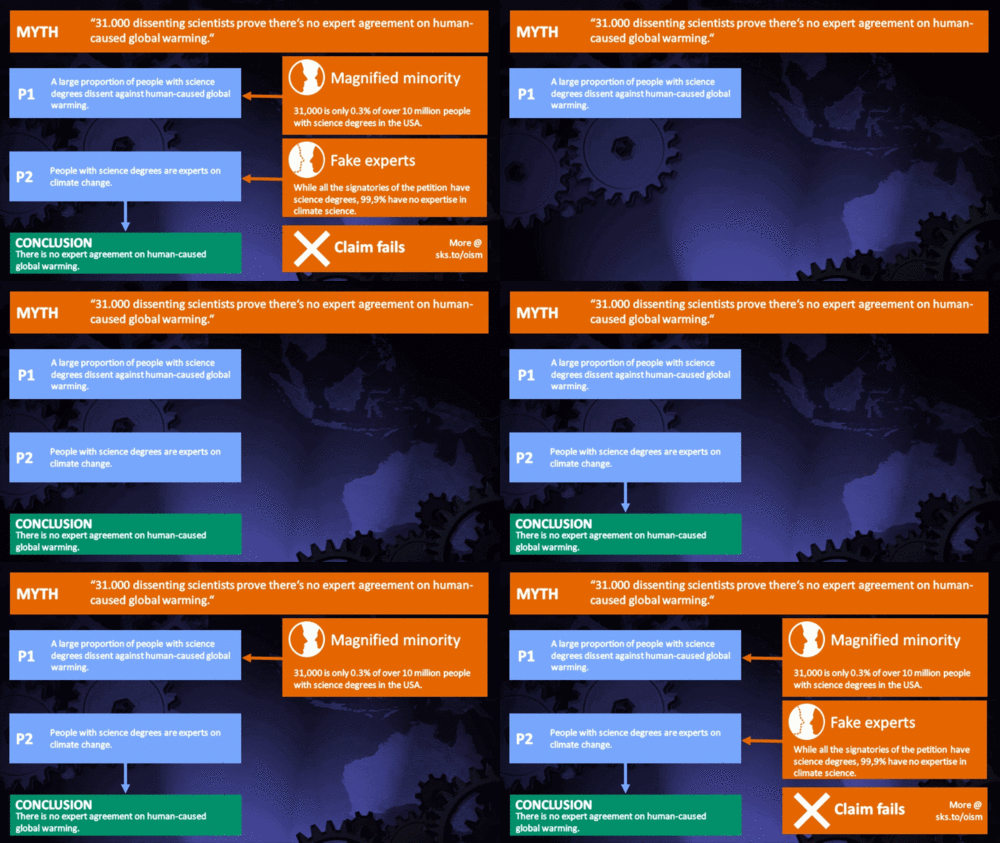
The 30,000 scientists and science graduates listed on the OISM petition represent a tiny fraction (0.3%) of all science graduates. More importantly, the OISM list only contains 39 scientists who specialise in climate science. |
|||||
Climate Myth...
Over 31,000 scientists signed the OISM Petition Project
The Petition Project features over 31,000 scientists signing the petition stating "there is no convincing scientific evidence that human release of carbon dioxide will, in the forseeable future, cause catastrophic heating of the Earth's atmosphere". (OISM)
In early 2008, the Oregon Institute of Science and Medicine (OISM) published their Petition Project, a list of names from people who all claimed to be scientists and who rejected the science behind the theory of anthropogenic (human-caused) global warming (AGW). This was an attempt to by the OISM to claim that there were far more scientists opposing AGW theory than there are supporting it. This so-called petition took on special importance coming after the release of the Intergovernmental Panel on Climate Change’s Fourth Assessment Report, and specifically the Working Group 1 (WG1) report on the science and attribution of climate change to human civilization.
The WG1 report was authored and reviewed by approximately 2000 scientists with varying expertise in climate and related fields, and so having a list of over 30,000 scientists that rejected the WG1’s conclusions was a powerful meme that AGW skeptics and deniers could use to cast doubt on the IPCC’s conclusions and, indirectly, on the entire theory of climate disruption. And in fact, this meme has become widespread in both legacy and new media today.
It is also false.
According to the Petition Project “qualifications” page, “Signatories are approved for inclusion in the Petition Project list if they have obtained formal educational degrees at the level of Bachelor of Science or higher in appropriate scientific fields.” The fields that are considered “appropriate” by the OISM are as follows:
- Atmosphere, Earth, and Environment fields: atmospheric science, climatology, meteorology, astronomy, astrophysics, earth science, geochemistry, geology, geophysics, geoscience, hydrology, environmental engineering, environmental science, forestry, oceanography
- Computers and Math: computer science, mathematics, statistics
- Physics and Aerospace: physics, nuclear engineering, mechanical engineering, aerospace engineering
- Chemistry: chemistry, chemical engineering
- Biochemistry, Biology, and Agriculture: biochemistry, biophysics, biology, ecology, entomology, zoology, animal science, agricultural science, agricultural engineering, plant science, food science
- Medicine: medical science, medicine
- General Engineering and General Science: engineering, electrical engineering, metallurgy, general science
 The OISM’s qualifications for being a “scientist” are expansive, and as such there are a number of questions that have to be answered before we can take this list seriously. What expertise does a nuclear engineer or a medical doctor or a food scientist or mechanical engineer have that makes them qualified to have an informed opinion on the cause(s) of recent climate disruption? How many of these names are working climate scientists instead of science or math teachers or stay-at-home-mom’s with engineering degrees? How many of these people has actually published a peer-reviewed paper on climate? How many people took a look at the card that served as a “signature” (click on the image to see a larger version) and realized that they could lie about having a science degree and their deception would never be discovered?
At this point it’s literally impossible to know because the names and degrees on the list cannot be verified by anyone outside the OISM. We can only take the OISM’s word that they’re all real names, that all the degrees are correct, and so on. This does not stand up to the most basic tests of scientific credibility.
Unfortunately, the OISM’s list has had its credibility fabricated for it by individuals and groups as diverse as Steve Milloy of Fox News (see this link for a S&R investigation into the background and tactics of Steve Milloy), L. Brent Bozell of conservative “news” site Newsbusters and founder of the conservative Media Research Center, Benita M. Dodd of the Georgia Public Policy Foundation, the libertarian/conservative site American Thinker (a site that has regularly failed to fact-check their AGW posts), conservative commentator Deroy Murdock (who works on Project 21 with the wife of one of Steve Milloy’s long-time associates), RightSideNews, Dakota Voice, Dennis T. Avery of the Hudson Institute, Michelle Malkin, and the Competitive Enterprise Institute, to name just a few of the better known. As a result, the OISM’s petition has been elevated to a level of credibility that is arguably undeserved.
While it’s not possible to test the validity of OISM list directly, it is possible to test the conclusions that have been drawn from the OISM list. Specifically, we can test what percentage the 30,000 “scientists” listed on the OISM petition represent when compared to the total number of scientists in the U.S. And we can then compare that to the percentage represented by the 2000 IPCC AR4 WG1-associated scientists as compared to the estimate number of U.S. climate-related scientists.
According to the OISM website, anyone with a Bachelor’s, Master’s, or Doctorate of Philosophy in a field related to physical sciences is qualified as a scientist. In addition, the OISM sent the petition cards pictured above only to individuals within the U.S. Based on this information, we can us the OISM’s own guidelines to determine how many scientists there are in the U.S. and what percentage of those scientists are represented by the OISM petition.
The U.S. Department of Education tracks the number of graduates from institutions of higher education every year, and has done so since either the 1950-51 or 1970-71 school years, depending on what specifically the Dept. of Ed. was interested in. This data was last updated in the Digest of Education Statistics: 2008. We’re specifically interested in the number of degrees that have been awarded in the various scientific disciplines as defined by the OISM in the list above. This information is available in the following tables within the 2008 Digest: 296, 298, 302, 304, 310, 311, and 312. Table 1 below show how many graduates there were in the various categories defined by the Dept. of Ed. since the 1970-71 school year (click on the image for a larger version). The numbers have been corrected to account for the fact that PhD’s will usually have MS degrees as well, and that both are preceded by BS degrees.

As you can see, Table 1 shows that there were over 10.6 million science graduates as defined by the OISM since the 1970-71 school year. This is a conservative estimate as illustrated by the 242,000 graduates in biological and biomedical sciences from 1950-51 through 1969-70 alone, never mind the 166,000 engineering graduates, and so on. Many of these individuals are still alive today and would be considered scientists according to the OISM definition thereof.
The OISM website lists how many signatures they have for scientists in each of their categories. Given the number of graduates and the number of signatures claimed by the OISM, we can calculate the percentage of OISM-defined scientists who signed as referenced to the total. These results are shown in Table 2 below.

In other words, the OISM signatories represent a small fraction (~0.3%) of all science graduates, even when we use the OISM’s own definition of a scientist.
However, as mentioned above, it’s entirely reasonable to ask whether a veterinarian or forestry manager or electrical engineer should qualify as a scientist. If we remove all the engineers, medical professionals, computer scientists, and mathematicians, then the 31,478 “scientists” turn into 13,245 actual scientists, as opposed to scientists according to the OISM’s expansive definition. Of course, not all of them are working in science, but since some medical professionals and statisticians do work in science, it’s still a reasonable quick estimate.
However, it’s not reasonable to expect that all of those actual scientists are working in climate sciences. Certainly the 39 climatologists, but after that, it gets much murkier. Most geologists don’t work as climate scientists, although some certainly do. Most meteorologists do weather forecasting, but understanding the weather is radically different than understanding climate. So we can’t be sure beyond the 39 climatologists, although we can reasonably assume that the number is far less than the 13,245 actual scientists claimed by the OISM.
13,245 scientists is only 0.1% of the scientists graduated in the U.S. since the 1970-71 school year.
We can, however, compare the number of atmospheric scientists, climagologists, ocean scientists, and meteorologists who signed this petition to the number of members of the various professional organizations. For example, the American Geophysical Union (AGU) has over 55,000 members, of which over 7,200 claim that atmospheric sciences is their primary field. The OISM claims 152 atmospheric scientists. Compared to the atmospheric scientist membership in the AGU, the OISM signatories are only 2.1%, and this estimate is high given the fact that the AGU does not claim all atmospheric scientists as members.
The AGU hydrology group has over 6,000 members who call hydrology their primary field. The OISM list has 22 names that claim to be hydrologists, or 0.4%.
The AGU ocean sciences group claims approximately 6,800 members. The OISM has 83 names, or 1.2%. And again, given that AGU membership is not required to be a practicing ocean scientists, this number is inflated.
The American Meteorological Society claims over 14,000 members and the OISM claims 341 meteorologists as petition signatories. That’s only 2.4%.
It’s clear that the OISM names don’t represent a significant number of scientists when compared to either the total number of science graduates in the U.S. or to the number of practicing scientists who work in likely relevant fields. But that’s not all.
Over recent years, various organizations have set out to estimate just how widespread the supposed “scientific consensus” on AGW actually is. Two recent efforts were conducted by the Statistical Assessment Service (STATS) at George Mason University and by the Pew Research Center for the People and the Press. The STATS survey found that 84% of climate scientists surveyed “personally believe human-induced warming is occurring” and that “[o]nly 5% believe that that human activity does not contribute to greenhouse warming.” The STATS survey involved a random sampling of “489 self-identified members of either the American Meteorological Society or the American Geophysical Union” and it has a theoretical sampling error of +/- 4%.
The Pew survey was taken in early 2009 and asked over 2000 members of the American Association for the Advancement of Science (AAAS) their opinion on various scientific issues, including climate disruption. 84% of AAAS respondents felt that “warming is due to human activity” compared to only 10% who felt that “warming is due to natural causes.” The AAAS has over 10 million members, and the results of the survey are statistically valid for the entire population with a theoretical sampling error of +/- 2.5%.
84% of 10 million scientist members of the AAAS is 8.4 million scientists who agree that climate disruption is human-caused. 84% of the climate scientists (conservatively just the members of the atmospheric science group of the AGU) is, conservatively, 6,000 scientists who have direct and expert knowledge of climate disruption. The 13,245 scientists and 152 possible climate scientists who signed the OISM petition represent a small minority of the totals.
The IPCC AR4 WG1 report was written and reviewed by approximately 2000 scientists. If we assume that the 20,000 AGU members who claim to be atmospheric scientists, ocean scientists, or hydrologists represent the pool of potential experts in climate science in the U.S., then approximately 10% of all climate scientists were directly involved in creating the over 1000 page report.
That compares to less than 1% of all OISM “scientists” who mailed a pre-printed postcard.
A more recent survey of earth scientists asked the question "Do you think human activity is a significant contributing factor in changing mean global temperatures?". 97.5% of climatologists who were actively publishing papers on climate change responded yes (Doran & Zimmerman 2009). What is most interesting about this study was that as the level of active research and specialization in climate science increases, so does agreement that humans are significantly changing global temperatures.
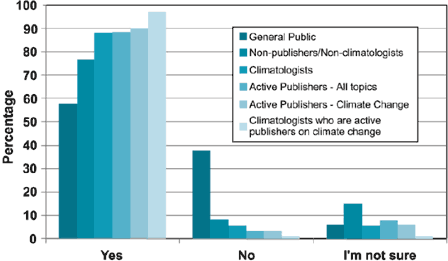
Figure 1: Response to the survey question "Do you think human activity is a significant contributing factor in changing mean global temperatures?" (Doran & Zimmerman 2009) General public data come from a 2008 Gallup poll.
Ultimately, The OISM petition will continue to rear it’s ugly head until its fabricated credibility has been thoroughly demolished. Social conservatives and libertarians, each of which has their own ideological reasons to push the OISM petition, have been effective at keeping the “30,000 scientists reject warming chicken-littleism of IPCC” meme circulating throughout conservative media outlets, even as climate disruption-focused media have worked at limiting the damage from the OISM petition. But given the fact that the science supporting a dominantly anthropogenic cause for climate disruption is overwhelming, it’s only a matter of time before the OISM petition wilts in the heat.
Acknowledgements to Brian Angliss at Scholars and Rogues who guest wrote this post.
Last updated on 4 November 2016 by MichaelK. View Archives








I did peruse some Michigan names on this "petition". A couple of the 'good doctors' don't exist. I tracked down one of the veternarians. I would suggest some of you try that...maybe we could find a few more 'weasels.'
Gee, I never knew it was so easy to write off 30,000 people's opinions as being meaningless. You'd think it would at least cool the sanctimonious rhetoric about 97%.
Maybe someone needs a reality check?:
http://www.thegwpf.org/content/uploads/2013/09/Montford-Consensus.pdf
likeithot... No one writes off the opinions of 30,000 people. It just happens to be an extremely low figure once you put it into context.
The 30k figure is a subset of some 30 million people who fit the definition of the petition. Once you add the denominator you find that 30k is a very tiny number.
Once you refine the standards and focus on actual expertise in the subjest of climate change, then you find that 97% agree that humans are changing the climate primarilty through the emissions of CO2.
The article I cited explains clearly how the standars were "refined" with a clearly pre-meditaded (+unscientific) political adgenda.
likeithot @23.
Do you not feel that the OISM Petition Project has "a clearly pre-meditaded (+unscientific) political adgenda"?
I note elsewhere on this website you protest that your questioning went unanswered. With that sensitivity in mind, I would answer your question @21 by pointing out that the "someone" is surely the GWPF who certainly require a reality check. To publish that propagandist and scurrilous nonsense from Andrew Montford is, for an organisation registered as a UK educational charity, bringing the UK Charity Commission and the numerous legitimate charities it supports into disrepute.
Just a psychologist so I'm sure I don't count here, but I do know something about people and the herd instinct which I think is working here to a large extent. There is also, I am not a theologist, some evidence of the sin of greed. So many billions of dollars changing hands over a theory, really just a theory which looks more like a religion since you can't oppose it without retribution. Wise men should be skeptical.
I am quite relaxed about the climate getting warmer, I like summer better than winter, don't you? The people with coastline properties are probably those terrible "rich" people anyway whom we have all been told are sucking on our vital juices for their own benefit. Terrible people.
[Dikran Marsupial] Welcome to SkS (psychologists are most welcome). Please take time to read the comments policy, SkS is intended to be a site for productive discussion of climate science and closely related topics, but it is not a forum for the sort of trolling that is all too common on climate blogs. Further comments of this nature will be deleted. If you disagree with the mainstream position on climate science, then I would encourage you to pick a specific argument (see the list of climate myths on the bar to the left) and explain your objection clearly. I'm sure you will find plenty of people here willing to discuss the science with you in a rational and friendly manner, provided that you behave in a similarly mature manner.