



 Arguments









Is the CO2 effect saturated?
What the science says...
| Select a level... |
 Basic
Basic
|
 Intermediate
|
 Advanced
| ||||
|
The notion that the CO2 effect is 'saturated' is based on a misunderstanding of how the greenhouse effect works. |
|||||||
Climate Myth...
CO2 effect is saturated
"Each unit of CO2 you put into the atmosphere has less and less of a warming impact. Once the atmosphere reaches a saturation point, additional input of CO2 will not really have any major impact. It's like putting insulation in your attic. They give a recommended amount and after that you can stack the insulation up to the roof and it's going to have no impact." (Marc Morano, as quoted by Steve Eliot)
At-a-Glance
This myth relies on the use (or in fact misuse) of a particular word – 'saturated'. When someone comes in from a prolonged downpour, they may well exclaim that they are saturated. They cannot imagine being any wetter. That's casual usage, though.
In science, 'saturated' is a strictly-defined term. For example, in a saturated salt solution, no more salt will dissolve, period. But what's that got to do with heat transfer in Earth's atmosphere? Let's take a look.
Heat-trapping by CO2 in the atmosphere happens because it has the ability to absorb and pass on infra-red radiation – it is a 'greenhouse gas'. Infra-red is just one part of the electromagnetic spectrum, divided by physicists into a series of bands. From the low-frequency end of the spectrum upwards, the bands are as follows: radio waves, microwaves, infrared, visible light, ultraviolet, X-rays, and gamma rays. Gamma rays thus have a very high-frequency. They are the highest-energy form of radiation.
As our understanding of the electromagnetic spectrum developed, it was realised that the radiation consists of particles called 'photons', travelling in waves. The term was coined in 1926 by the celebrated physicist Gilbert Lewis (1875-1946). A photon's energy is related to its wavelength. The shorter the wavelength, the higher the energy, so that the very high-energy gamma-rays have the shortest wavelength of the lot.
Sunshine consists mostly of ultraviolet, visible light and infra-red photons. Objects warmed by the sun then re-emit energy photons at infra-red wavelengths. Like other greenhouse gases, CO2 has the ability to absorb infra-red photons. But CO2 is unlike a mop, which has to be wrung out regularly in order for it to continue working. CO2 molecules do not get filled up with infra-red photons. Not only do they emit their own infra-red photons, but also they are constantly colliding with neighbouring molecules in the air. The constant collisions are important. Every time they happen, energy is shared out between the colliding molecules.
Through those emissions and collisions, CO2 molecules constantly warm their surroundings. This goes on all the time and at all levels in the atmosphere. You cannot say, “CO2 is saturated because the surface-emitted IR is rapidly absorbed”, because you need to take into account the whole atmosphere and its constant, ongoing energy-exchange processes. That means taking into account all absorption, all re-emission, all collisions, all heating and cooling and all eventual loss to space, at all levels.
If the amount of radiation lost to space is equal to the amount coming in from the Sun, Earth is said to be in energy balance. But if the strength of the greenhouse effect is increased, the amount of energy escaping falls behind the amount that is incoming. Earth is then said to be in an energy imbalance and the climate heats up. Double the CO2 concentration and you get a few degrees of warming: double it again and you get a few more and on and on it goes. There is no room for complacency here. By the time just one doubling has occurred, the planet would already be unrecognisable. The insulation analogy in the myth is misleading because it over-simplifies what happens in the atmosphere.
Please use this form to provide feedback about this new "At a glance" section. Read a more technical version below or dig deeper via the tabs above!
Further details
This myth relies on the use of a word – saturated. When we think of saturated in everyday use, the term 'soggy' comes to mind. This is a good example of a word that has one meaning in common parlance but another very specific one when thinking about atmospheric physics. Other such words come to mind too. Absorb and emit are two good examples relevant to this topic and we’ll discuss how they relate to atmospheric processes below.
First things first. The effect of CO2 in the atmosphere is due to its influence on the transport of 'electromagnetic radiation' (EMR). EMR is energy that is moving as x-rays, ultraviolet (UV) light, visible light, infrared (IR) radiation and so on (fig. 1). Radiation is unusual in the sense that it contains energy but it is also always moving, at the speed of light, so it is also a form of transport. Radiation is also unusual in that it has properties of particles but also travels with the properties of waves, so we talk about its wavelength.
The particles making up radiation are known as photons. Each photon contains a specific amount of energy, and that is related to its wavelength. High energy photons have short wavelengths, and low energy photons have longer wavelengths. In climate, we are interested in two main radiation categories - firstly the visible light plus UV and minor IR that together make up sunshine, and secondly the IR from the earth-atmosphere system.
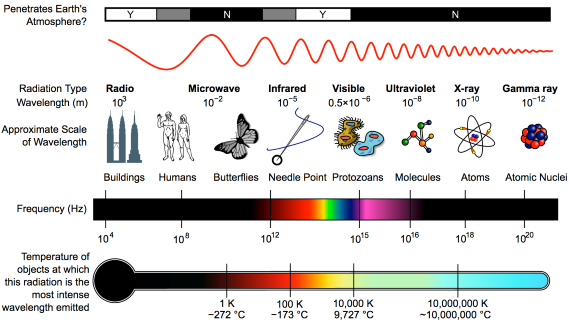
Fig. 1: diagram showing the full electromagnetic spectrum and its properties of the different bands. Image: CC BY-SA 3.0 from Wikimedia.
CO2 has the ability to absorb IR photons – it is a 'greenhouse gas'.So what does “absorb” mean, when talking about radiation? We are all familiar with using a sponge to mop up a water spill. The sponge will only absorb so much and will not absorb any more unless it's wrung out. In everyday language it may be described, without measurements, as 'saturated'. In this household example, 'absorb' basically means 'soak up' and 'saturated' simply means 'full to capacity'. Scientific terms are, in contrast, strictly defined.
Now let's look at the atmosphere. The greenhouse effect works like this: energy arrives from the sun in the form of visible light and ultraviolet radiation. A proportion reaches and warms Earth's surface. Earth then emits the energy in the form of photons of IR radiation.
Greenhouse gases in the atmosphere, such as CO2 molecules, absorb some of this IR radiation, then re-emit it in all directions - including back to Earth's surface. The CO2 molecule does not fill up with IR photons, running out of space for any more. Instead, the CO2 molecule absorbs the energy from the IR photon and the photon ceases to be. The CO2 molecule now contains more energy, but that is transient since the molecule emits its own IR photons. Not only that: it's constantly colliding with other molecules such as N2 and O2 in the surrounding air. In those collisions, that excess energy is shared with them. This energy-sharing causes the nearby air to heat up (fig. 2).
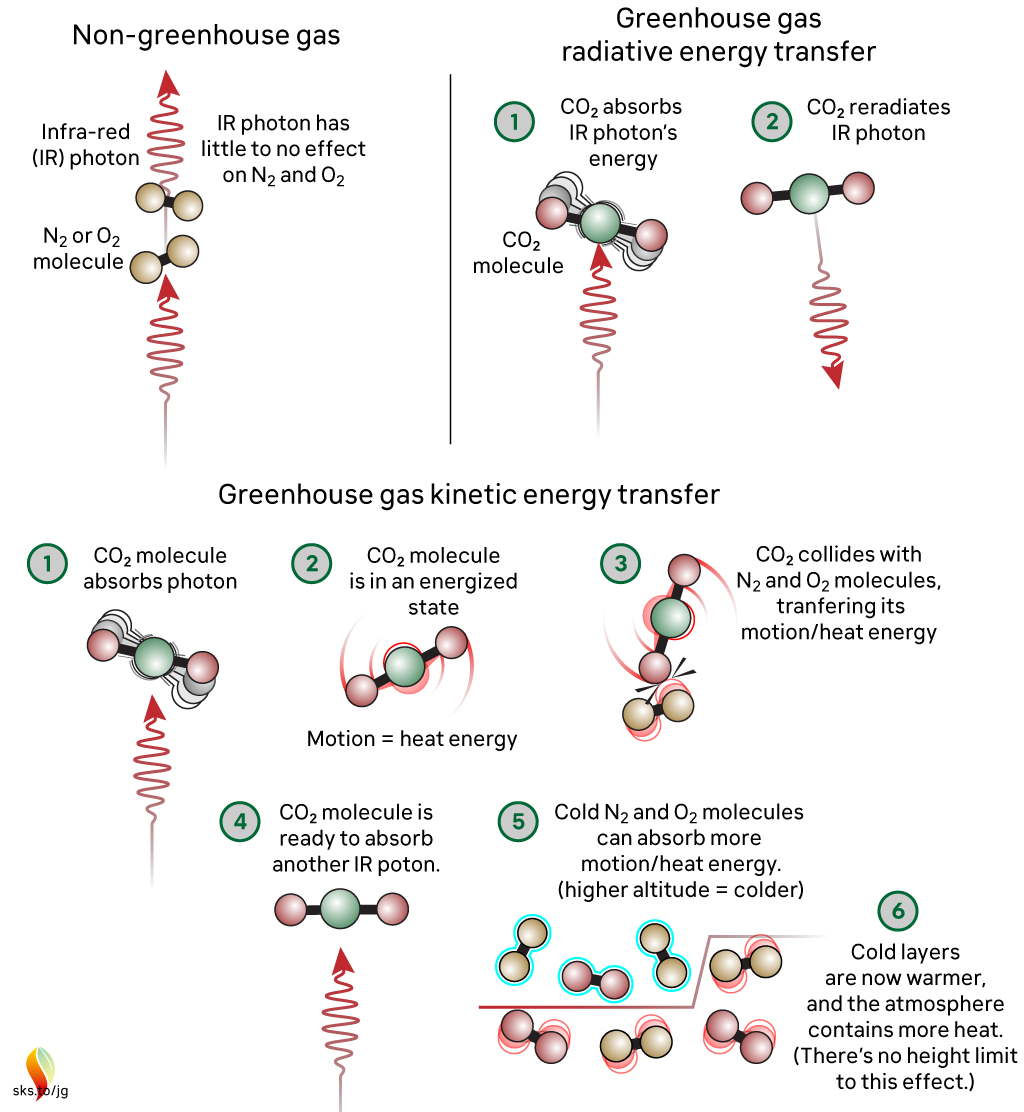
Fig. 2: The greenhouse effect in action, showing the interactions between molecules. The interactions happen at all levels of the atmosphere and are constantly ongoing. Graphic: jg.
The capacity for CO2 to absorb photons is almost limitless. The CO2 molecule can also receive energy from collisions with other molecules, and it can lose energy by emitting IR radiation. When a photon is emitted, we’re not bringing a photon out of storage - we are bringing energy out of storage and turning it into a photon, travelling away at the speed of light. So CO2 is constantly absorbing IR radiation, constantly emitting IR radiation and constantly sharing energy with the surrounding air molecules. To understand the role of CO2, we need to consider all these forms of energy storage and transport.
So, where does 'saturation' get used in climate change contrarianism? The most common way they try to frame things is to claim that IR emitted from the surface, in the wavelengths where CO2 absorbs, is all absorbed fairly close to the surface. Therefore, the story continues, adding more CO2 can’t make any more difference. This is inaccurate through omission, because either innocently or deliberately, it ignores the rest of the picture, where energy is constantly being exchanged with other molecules by collisions and CO2 is constantly emitting IR radiation. This means that there is always IR radiation being emitted upwards by CO2 at all levels in the atmosphere. It might not have originated from the surface, but IR radiation is still present in the wavelengths that CO2 absorbs and emits. When emitted in the upper atmosphere, it can and will be lost to space.
When you include all the energy transfers related to the CO2 absorption of IR radiation – the transfer to other molecules, the emission, and both the upward and downward energy fluxes at all altitudes - then we find that adding CO2 to our current atmosphere acts to inhibit the transfer of radiative energy throughout that atmosphere and, ultimately, into space. This will lead to additional warming until the amount of energy being lost to space matches what is being received. This is precisely what is happening.
The myth reproduced at the top – incorrectly stating an analogy with roof insulation in that each unit has less of an effect - is misleading. Doubling CO2 from 280 ppm to 560 ppm will cause a few degrees of warming. Doubling again (560 to 1130 ppm) will cause a similar amount of additional warming, and so on. Many doublings later there may be a point where adding more CO2 has little effect, but recent work has cast serious doubt on that (He et al. 2023). But we are a long, long way from reaching that point and in any case we do not want to go anywhere near it! One doubling will be serious enough.
Finally, directly observing the specific, global radiative forcing caused by well-mixed greenhouse gases has - to date - proven elusive. This is because of irregular, uncalibrated or limited areal measurements. But very recently, results have been published regarding the deep reinterrogation of years of data (2003-2021) from the Atmospheric Infrared Sounder (AIRS) instrument on NASA's Aqua Satellite (Raghuraman et al. 2023). The work may well have finally cracked the long-standing issue of how to make finely detailed, consistent wavelength-specific measurements of outgoing long-wave radiation from Earth into space. As such, it has opened the way to direct monitoring of the radiative impact (i.e. forcing + feedback) of greenhouse gas concentration changes, thereby complimenting the Keeling Curve - the longstanding dataset of measured CO2 concentrations, down at the planet's surface.
Note: Several people in addition to John Mason were involved with updating this basic level rebuttal, namely Bob Loblaw, Ken Rice and John Garrett (jg).
Last updated on 31 December 2023 by John Mason. View Archives







My apologies, Moderator.
For some mysterious reason (nefarious Romanians?) there was an unaccountably huge delay in my initial post showing up.
Please delete this and one of the "proper" posts above.
Duplicate deleted. Will leave this one intact, so people can see the following advice:
Fascinating , RedCloud/CallItAsItIs/et alia @877 :-
You certainly have concepts of concepts of a plan of explanation.
"Therefore, at altitudes above the extinction point [ = 10 meters high ] , the radiation reaching the detectors is only escaped IR that didn't cause one iota of atmosheric warming, and never will." [Unquote]
And so . . . "Escaped IR" cannot warm the atmosphere because it "escapes" from the sub-10 meter layer . . . and is not absorbed by local CO2 because it is above the 10-meter extinction altitude, where extinction means the IR does not exist. Makes perfect sense!
And then at Top of Atmosphere and at the stratosphere also, everything changes, and the high-altitude CO2 molecules regain the radiant abilities they did not have at lower altitudes in the troposphere. Also makes perfect sense!
Perhaps to explain this, we must hypothesize that each CO2 molecule (and H2O molecule) must possess a sub-atomic altimeter to inform the molecule whether (or not) it is permitted to radiate an IR photon. Yes, this also makes perfect sense! #At last, the Curtain is drawn back, and the scales fall from the eyes of physicists ~ who can now perceive a deeper layer of the Sub-Quantum Reality of Space-Time.
.... All thanks to the New Galileo.
[Moderator, please feel free to delete my garbled nonsense.]
User RedCloud has joined the long list of banned sock puppets that have been polluting this thread with garbage for years.
Please stop responding to him, and give the moderators the time to deal with it.
MathWhizAsItIs @878 :-
Greetings again. Thanks for your link. Apart from your mathematics, there seem to be at least two faulty assumptions, indicating that your ideas are unphysical.
[page 3] "It must be noted that these photons are leaving the atmosphere without causing any warming." [UNQUOTE]. A bizarre concept indeed, when taken in full atmospheric context.
[page 4]. "First, we note that 10 meters seems to be ... the extinction altitude" [UNQUOTE]. Another bizarre unphysical concept.
Whiz , there may well be other serious faults in your presentation. Me, I stopped counting at two.
~ To slightly misquote Einstein's famous comment :-
"Two would be enough."
.
Sorry Moderators, but his nonsense is "up" here for many hours ~ and it is rather fun to reply to such science-denier absurdities.
User MathWhiz has been banned. We don't do moderation 24/7, so it takes time.
After years of showing his inability to understand and properly use radiative transfer theory, there is no point in reading his current hallucinations. He has long since worn out his welcome here.
He is welcome to try to publish his results in a legitimate peer-reviewed journal. He is not welcome to keep spewing his garbage here.
In the At-a-Glance section of this page, it is stated that
You cannot say, “CO2 is saturated because the surface-emitted IR is rapidly absorbed”, because you need to take into account the whole atmosphere and its constant, ongoing energy-exchange processes.
In taking into account the whole atmosphere, however, we must remember that except for the earth surface and the TOA, it is an isolated system. As such, energy can only enter or leave the atmosphere through one of these surfaces, and thermal energy enters primarily from the earth surface. This energy arises from the radiant spectrum of the earth in thermal equilibrium with the sun, and is mostly in the infrared range. In 1824, Jean Baptiste Fourier made an estimate of the earth's surface temperature using known astrodynamic quantities and assuming a planetary object (ie.blackbody) model of the earth. This model had previously been shown to work well for the moon and planets without atmospheres. His calculated temperatures, however, were substantially lower than those obtained from the surface-level thermometers. From this, he concluded that the atmosphere was somehow acting as an insulating blanket retaining some additional heat that would otherwise be radiated into space. Later on, in the 20th century, this would be called the greenhouse effect.
This greenhouse effect arises from the presence of certain (at least triatomic) trace gases with absorption bands occurring in the infrared (IR) spectral range. These gases then absorb upwelling IR radiation from the surface of the earth (within their respective absorption bands), thereby placing a portion of their molecules into higher energy states. Eventually, these energized molecules collide with other molecules (including O2 and N2), causing them to release this extra energy and return to their original states. In the process, this released energy then takes the form of increased combined kinetic energy of the two colliding molecules. This, we recognize as heat or thermal energy which causes a temperature increase.
In regard to the CO2 greenhouse effect, the primary absorption band is a strongly absorbing but relatively narrow band with a wavelength around 15 microns. There are also two other minor absorption bands, but they only affect the total absorption by a few percent and are generally neglected in CO2 greenhouse studies. As acknowledged by all experts in spectroscopy, the CO2 absorption of this band is strong enough to give it an extinction length of about 10 meters. This means that nearly all (99%+) of the 15 micron radiation eminating from the surface of the earth is absorbed below 10 meters. Most but not all of this energy is converted into thermal energy as described above. For our purposes, however, we will assume that all absorbed 15 micron radiation becomes thermal energy since this would result in the largest possible temperature increase.
At this point, it must be indicated that 15 micron photons absorbed above the 10 meter altitude would not result in any more warming since these photons could not have originated from the influx of new photons (and new energy) at the surface. A 15 micron photon above the 10 meter extinction altitude could only have been emitted by an already energized CO2 molecule well inside the atmosphere. Absorption of this photon by another CO2 molecule would only result in a zero net-sum-gain in electromagnetic energy and no net changes in the atmosphere.
Statements that CO2 is always emitting and absorbing IR radiation at all levels of the atmosphere at all times are correct, but energy must be conserved in the process. In the case of atmospheric warming, the energy driving that warming can enter only from the surface. Therefore, photons transporting this new energy must originate from the surface and not from mid-air CO2 molecules. They can act only as energy relays, not energy sources.
foxydoxy @879,
It is correct that an IR photon of 15 micron will not get far in the lower atmosphere. 10 metres? On average? I thought it was less.
And it is correct that the vast majority of those absorptions will result in the energy being transferred to the air as heat following collision. Collisions happen very quickly (milliseconds) while the relaxation time for an excited CO2 molecule takes longer (tenths of a second), on average.
(One point to add is that the CO2 does have less strong absorption bands very close-by 15 microns and thus the almost-15-micron IR which can be absorbed bt CO2 will have a far longer path-length. It is only the central part of the 15 micron wave band that is absorbed so quickly.)
Your description leaves out the mass of CO2 molecules that become excited without absorbing IR but by the frequent collisions with other molecules. Due to the massive number of collisions, at any one time, there are far far more excited CO2 molecules due to collision than are due to IR absorption. And the physics says that this excited population will emit IR commencerate with its temperature. If the air is the same temperature as the surface, the returning IR will match the surface IR. Also, the surface only has a top (this side of the planet). The air has a top and bottom so it will also emit IR up as well as down, and at the same intensity.
Crutially, thus is all about temperature. The IR flying round the atmosphere will reduce in intensity as the air cools with height (due to the falling pressure). So when the IR reaches the TOA, there is less of it shooting out into space, less of it cooling the planet.
Thus the greenhouse effect.
MA Rodger @ 880
Thanks for your diagram of absorption coefficient vs. wavelength. It is of higher resolution than the plots I remember seeing, and those weaker sidebands do have somewhat higher extinction altitudes. In my comment @879, I focused primarily on IR absorption and conversion to thermal energy via collisions which are the fundamental mechanisms by which greenhouse warming occurs. There were several other important points I wanted to get to, but felt my comment was getting too long as it was.
You are correct about CO2 molecules becoming energized through collisions as well as IR absorption, but energy must be conserved in the process. This means that the colliding molecules must lose some kinetic energy in order to provide the CO2 molecule with the energy it needs for the transition. On the macroscopic scale, this would imply cooling.
Also, many critics of the CO2 band saturation theory correctly point out that if all of the thermal energy from the 15 micron band were packed into a 10 meter thick layer at the surface, then we would have one scalding surface! What mitigates this effect, however, is convection. As the surface warms, steep temperature and pressure gradiants form just above the surface which cause updrafts. These updrafts then carry the excessive thermal energy upward which results in a more uniform distribution of such energy over all altitudes. Note that this convection process does not affect the total amount of thermal energy in the atmosphere. It merely redistributes what energy is already there.
foxydoxy @ 881:
You are incorrect when you state "On the macroscopic scale, this would imply cooling." It only implies cooling if there are no other sources of energy of equal magnitude coming into that layer.
Although you speak of the transfers of energy via convection, and speak of it redistributing energy, you neglect that this transfer of energy can counteract the loss of energy as radiation is emitted. The one molecule that loses energy via collision will re-gain energy from collision with higher-energy molecules, and the bulk properties will regain energy via these other energy transfers. Convection will bring in higher-energy molecules.
Have you every heard of "radiation fog"? This occurs at night, close to the surface, when temperature inversions (cooler closer to the ground) suppress convection to the point that there is very little vertical mixing of the air. As a result, you do see the "macroscopic scale cooling" that you refer to. In this case, its the surface IR radiation being lost that removes energy (sends it upward), and that cooling surface cools the air by contact, but it is a case of radiative cooling. The air can't mix, so it can't bring energy to the surface to keep it warm.
But under normal atmospheric mixing, the vertical energy transfer via convection has no difficulty in counteracting the energy loss by emission of IR radiation. You don't see radiation fog on windy nights - lots of vertical mixing. You need very calm conditions (and typically clear skies, which reduces any incoming IR radiation at the surface).
Climate models do conserve energy. They do account for loss by IR radiation, but they also account for gains from absorbed radiation, transfers by convection, etc. If convection or radiation absorption can't keep up with IR losses, the models will cool that layer - but there won't be some infinite cooling trend just because there is IR radiation loss. Layers will warm when convection and radiation absorption exceed IR losses. It is not a one-way street.
A key thing to remember is that convection involves both upward and downward movement of air. In equal quantities. It can carry energy upwards or downwards. If a puff of air moving up is warmer than the air above it, this will mean that the replacement air from above will be cooler, and it's this "warm up, cool down" that results in a net upward transfer of energy. In a temperature inversion (warm air over cold), convection will be moving thermal energy downwards. In either case, that layer in the middle that is emitting IR radiation will be getting thermal energy brought in - either from above or below, depending on the temperature profile.
I guess when I said "cooling" in 881, I meant only the loss of combined kinetic energy a CO2 molecule and another molecule colliding with it (usually N2 or O2) where the collision causes the transition of the CO2 molecule to the higher energy state from which it can emit a 15 micron photon. I did not mean cooling of the entire atmosphere.
Since we are talking about collisions, however, there is one point of confusion that I believe may be troubling many individuals. That is, when they hear or read the word collisions, they immediately think elastic collisions where there is no loss of total kinetic energy among the colliding particles. This, of course, would be a clear violation of energy conservation if the collision involved an energy transition of one of the colliding particles.