



 Arguments







Recent Comments
1 2 3 4 5 6 7 8 9 10 11 12 13 14 15 16 Next
Comments 1 to 50:
-
wilddouglascounty at 10:49 AM on 17 December 2025Emergence vs Detection & Attribution
@10 Bob, we completely agree until the very last sentence. The exact analogy that I'm driving at is that we're NOT saying "He was on steroids." The analogy, if carried to its simplified analog to "steroids" is "fossil fuels" or "carbon emissions" or "greenhouse gases" and the like, not "climate change." There is a real psychological underpinning behind the need to simplify a complex topic: just make sure you simplify it in a way that points out what needs to change if you want the changing climate to stabilize!
As you have pointed out, the complexity of the climate includes all of the other factors as a system, including solar irradiation, volcanic activity, long term orbital dynamics, and on and on, which we know goes "whoosh" over the average person's head, which the fossil fuel companies have taken advantage of, by the way. But the systemic changes we're seeing in the climate is from the change in carbon emissions that are overwhelming the system's ability to absorb it, causing a change in the composition of the atmosphere and ocean that supports increasingly frequent severe weather events. So we need to really hone in on that single fact: rising greenhouse gas percentages in the atmosphere and oceans is changing the climate, not "climate change." It is easier for everyone to understand the source of the changes occurring in a very complicated system in the same way as "he was on steroids" cuts to the chase. And #11, Nigelj, I'm completely fine with the term "anthropogenic climate change" and for everyone, I don't honestly expect us to just immediately stop using "climate change" as an important phrase in our vocabulary and discussions about the topic. What I do sincerely hope is that this phrase be modified to include the human driven nature of the changes in the climate, so in addition to "anthropogenic climate change" I'm hoping folks will always use such phrases as "human activity induced climate change," "fossil fuel driven climate change," "greenhouse gas induced climate change," "carbon emission driven climate change," etc. if you need to use the phrase at all. These phrases include true causality, while "climate change" by itself does not pinpoint the causal problem as finely as it needs to be made if we have any chance of changing our future.
-
nigelj at 05:38 AM on 17 December 2025Emergence vs Detection & Attribution
Regarding whether its accurate use of terminology to say that anthropogenic climate change is changing the weather, by making certain events more frequent or extreme. Climate change involves a warming global climate and changes in average global precipitation and circulation patterns, its that extra warmth and precipitation that effects weather events, therefore it is correct terminology to say climate change is changing the weather.
-
Bob Loblaw at 04:52 AM on 17 December 2025Emergence vs Detection & Attribution
Wild:
The most common (and probably the most familiar) example of a descriptive approach to climate is the Koppen Climate Classification system. It uses seasonal observations of temperature and precipitation to classify a regions using qualitative terms. This system aligns with our common concepts of tropical, arid, temperate, polar, continental, coastal climates, etc.
Attribution studies need some sort of model that allows an estimate of the likelihood of events (e.g. severe weather) under two different regimes (with greenhouse gases, and without). The Koppen system is a model - but largely a descriptive model. It uses numerical results, but those are descriptive statistical models.
Attribution requires a much more quantitative model - a physical model. The model simulates climate under one set of controlling conditions, and then it is run under a different set (greenhouse gases, in this case). It can be a bit hard to see the physics behind that, though, as physical model outputs are often interpreted using a descriptive model. The statistics with and without greenhouse gases help determine the probability of an event of a particular intensity, with or without climate change. But keep in mind that those descriptive statistics of the physical model output are just as complex as doing descriptive statistics of actual weather observations.
In the case of the "juiced athlete", the attribution to performance-enhancing drugs (PEDs) is difficult, for very similar reasons. You can't claim "this home run was caused by PEDs" for the same reason you can't claim "this severe weather event was caused by climate change". Arguing that a particular drug is a PED needs to be based on detailed physiological studies, as you suggest.
...but that level of detail isn't going to get a message across to the general public very well - it will go "whoosh" over their heads. "He was on steroids" is the short form. Just as "the climate has changed" is the short form for all the things that have happened due to our release of greenhouse gases and other human activities that have altered the climate.
-
wilddouglascounty at 01:42 AM on 17 December 2025Emergence vs Detection & Attribution
Thank you, @8 Bob, for sharing your perspective on this issue and the climate as a causal factor. I guess I'm not sure whether its descriptive or physical when you are doing attribution of a hurricane's intensity as being caused by climate change as it seems that it has elements of both.
That aside, what I'm saying, once again to use the analogy of the juiced athlete, is that if there is a change in the constellation of factors that make them a professional athlete including years of strength and endurance training, strategic coaching, genetic predisposition, etc., along with the performance enhancing drugs, as contributing to the increased frequency of home runs, does it make sense to to talk about the athlete in general terms that includes the entire cluster of factors (physical), or the performance statistics (descriptive); OR rather does it make sense to focus on the relevant causal factor of the practice of using performance enhancing drugs as causing the changes in the athlete's performance? For clarification's sake, the changing performance of athletes in general could not really be addressed until the key causal factor, performance enhancing drugs, was identified, after which people "got it" and took actions that penalized their use.
In a similar way, yes, physical climatology has causality in a general, collective way that clusters the real causal factors "under the hood". Since there is an identifiable subset of those "under the hood" factors called "greenhouse gases," "human activity emissions," "carbon emissions from human activities, primarily fossil fuel use" or what have you, it's time to start focusing on those "performance enhancing chemicals" we're emitting as the cause of the observed changes, so that people "get it." Otherwise vested interests will just continue to spread misinformation about the other factors, such as the sunspot cycle, cosmic rays, the end of the ice age and other things they can point to also under that hood. They are not incorrect in pointing to other factors that contribute to the climate; it's just that the science is clearly pointing to the changes in the climate as being linked to the changes in the atmospheric and oceanic chemistry caused by carbon emissions.
-
Bob Loblaw at 11:21 AM on 16 December 2025Emergence vs Detection & Attribution
Wilddouglascountry @ 2, 4, 6.
I would tend to disagree with your characterization of the term "climate change". You appear to be exclusively thinking of climate in terms of what is called "descriptive climatology". In that context, "climate" is just a description of what is going on.
"Descriptive climatology" gave way to "physical climatology" at least as far back as the 1950s, when the science began looking at "climate" as the physical processes that link together to produce the observations that made up "descriptive climatology".
[Note: the textbook I used when taking my undergraduate climate course was "'Sellers, W.D. 1965: Physical climatology. Chicago: University of Chicago Press, 272 pp.]
As such "climate change" is a causal factor: through the physical processes of climate, changes in one part of the system (greenhouse gases and radiative transfer) lead to changes in other parts of the system (severe weather).
I don't think your change in nomenclature is justified.
-
Eclectic at 10:16 AM on 16 December 2025Emergence vs Detection & Attribution
Wilddouglascounty @6 :
I suspect that the adults in the village are more concerned with the actual threat to the sheep, rather than whether the threat is categorized as a wolf or coyote or wild dog. Semantics and chicken-or-egg arguments would be very low on their list of concerns, I'm sure.
If we argue on over-fine points, then the essential message gets lost.
Best to use the K.I.S.S. principle.
-
wilddouglascounty at 09:03 AM on 16 December 2025Emergence vs Detection & Attribution
Bottom line: attribution studies should point to the real cause of increased frequency and severity of weather events: human activity, fossil fuel emissions and greenhouse gases, NOT climate change. Climate change does not cause anything: it's the result of the changes caused by the changed chemistries.
-
Eclectic at 08:42 AM on 16 December 2025Emergence vs Detection & Attribution
Wilddouglascounty @4 :
Agreed ~ but the metaphor is flexible. Some of the villagers think the shepherd-boy [or Thunberg-girl ] is lying . . . and some of them wouldn't know a wolf if it bit them . . . especially if the village Chief said all wolves are hoaxes.
You just have to do your best, remembering human psychology.
-
wilddouglascounty at 08:23 AM on 16 December 2025Emergence vs Detection & Attribution
Eclectic @3: The shepherd boy was lying when he called "wolf" so often that folks started ignoring him, so that when the wolf really arrived, they ignored him. The wolf is clear and present right now, metaphorically speaking, and what I'm suggesting is that the way it is being used, "climate change" is being used like a sheepskin on that wolf, and our task is to point out the wolf underneath that sheepskin.
-
Eclectic at 08:12 AM on 16 December 2025Emergence vs Detection & Attribution
Wilddouglascounty @2 : Calling a spade a spade should be done often ~ but not too often. To change metaphors : the shepherd-boy's warning call is best made when the wolf has clearly emerged from the forest. [Yes, arguable.]
Prove we are smart @1 : If you are talking of US citizens showing more apathy, then perhaps you are being a little harsh, considering present-day distractions. After all, there is a lot more stuff hitting the fan in recent times ~ and the fan has been turned up to Turbo-speed [ sometimes known as Tariff-speed, or Taco-speed]. The air may be somewhat clearer of flying objects, after 2028.
-
wilddouglascounty at 06:59 AM on 16 December 2025Emergence vs Detection & Attribution
I think one of the main reasons we seem to be stalling out on the climate change topic is that we've been burying the lead. Climate change is NOT a causal factor for increasingly frequent severe weather, IT'S THE OTHER WAY AROUND. Climate is a summary abstraction of individual weather events, so the way the climate changes is by increasing the frequency of extreme weather events. Saying climate change is causing more severe weather is like saying Sammy Sosa's improved batting average is causing him to hit more homeruns--ignoring the REAL cause, which is performance enhancing drugs, right?
In exactly the same way, fossil fuel emissions and other greenhouse emitting human activities have changed the atmospheric and oceanic chemistry, enabling more frequent, severe weather events, in exactly the same way Sammy Sosa's performance enhancing drugs enabled him to hit more frequent homeruns. People can understand that a juiced atmosphere is the problem here, in the same way we understand the effect of juiced athletes.
Even the attribution studies don't point back to the real causes: they point back to the "increased probability" that "climate change" has made it 300 times more likely that a hurricane grew that fast and so on, when in reality the attribution studies need to be saying that the increased carbon in the atmosphere and oceans, caused by human activities, has made it 300 times more likely that a hurricane grew that fast and so on.
We need to stop hiding behind the phrase "climate change" and start putting our human greenhouse gas emissions as causing all of this. The science is settled on this, right? Then why not start putting that front and center every time we talk about these increasingly frequent severe weather events: human activities with fossil fuel emissions being at the top of the list, is CAUSING the floods, hurricanes, droughts, heat waves and other extreme weather events to get worse. To say "climate change" is causing these things is reifying the phrase and giving it causality when none exists!
We don't have time to pass this issue onto younger folk. It's time to call a spade a spade.
-
prove we are smart at 00:47 AM on 16 December 2025Emergence vs Detection & Attribution
As much as I enjoy reading Zekes or Andrew's call out of bad actors like the US DoE www.theclimatebrink.com/p/is-this-the-most-embarrassing-error I really feel an increased sense of apathy from people towards changing our behaviours to reduce co2 emissions.
You know when the US had that really terrible weather disaster year in 2020 www.climate.gov/disasters2020 .Heres a poll taken then and now, the importance of the climate has really taken a back seat www.statista.com/chart/32304/key-issues-in-the-us-according-to-respondents/
Australia too in 2020 had a catastophic fire season en.wikipedia.org/wiki/2019%E2%80%9320_Australian_bushfire_season and the important issues poll produced this www.ipsos.com/en-au/issuesmonitor As in the US poll, interest in the enviroment is currently still declining.
Are we just desensitised to it all now, misinformed or staying wilfully ignorant? Is this the last gasp of the good ole days before the shit really doesn't miss the fan anymore? We are destroying our life support and maybe we can get some control back like this www.youtube.com/watch?v=dQMZR64G_eM or stay in our consumer role like this www.youtube.com/watch?v=8dFa829W1Rk I feel like I know too much now and just say the positive stuff to any younger folk.
-
MA Rodger at 00:40 AM on 16 December 2025Is Nuclear Energy the Answer?
PollutionMonster @456,
I'd assume the paper mentioned @455 is Jacobson et al (2022) 'Low-cost solutions to global warming, air pollution, and energy insecurity for 145 countries'.
-
PollutionMonster at 12:58 PM on 15 December 2025Is Nuclear Energy the Answer?
Thanks for the quick response. I will let the author know since he is still posting as if his 2019 assertions are correct. I couldn't find the Jacobson 2022, got too many off topic search results. I did read the Abbott 2012.
Sorry about posting a link with so many flaws.
-
michael sweet at 00:01 AM on 15 December 2025Is Nuclear Energy the Answer?
Pollution Monster,
Your blog is dated 2019. It is now out of date. Like many blogs, it contains many mistatements of facts, cherry picked numbers and deliberate lies. I recommend you read Jacobson et al 2022 which addresses all the issues with renewable energy raised in the blog and shows renewable energy is much cheaper than any other technology. Jacobson uses only existing technology to generate all world energy.
Abbott 2012, linked in the OP, lists about 13 reasons why nuclear will never be capable of generating a significant amount of power. Nuclear supporters have never addressed these issues. To me, the most important issue is there is not enough uranium to generate more than about 5% of all power
Since 2019 renewable energy and especially battery storage have dramatically decreased in cost. This solves the main issues the linked blog has with renewables.
Nuclear power is too expensive, takes too long to build and there is not enough uranium.
-
PollutionMonster at 18:47 PM on 14 December 2025Is Nuclear Energy the Answer?
I have been reading this blog and it seems decent quality. I think that nuclear energy can used side by side renewable energy sources like wind and solar. That until we get the massive grid storage needed for all renewables that we can replace brown coal with nuclear at least in the short run.
I am not pro nor anti-nuclear, I just want to understand the topic better.
-
MA Rodger at 02:32 AM on 13 December 2025Climate skeptics have new favorite graph; it shows the opposite of what they claim
michael sweet @31,
A few thoughts about this +8°C ESS finding (actually it's AESS, taking the increasing solar energy into account).
(1) Hansen has indeed proposed a lower value, famously the graphic below from Hansen & Sato (2012) which even pre-dates the term ESS.
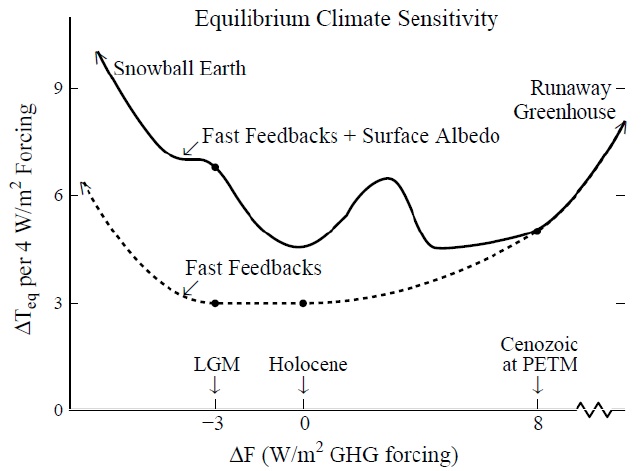
(2) Judd et al (2025) does say its constant ESS=+8°C finding is at odds with other work, but doesn't properly set all this out. For instance, they don't [ro[er;y review CenCO2PIP (2024) who find ESS "generally within the range of 5° to 8°C—patterns consistent with most prior work." I think all would agree that we haven't found a difinitive value for ESS although it will be higher than ECS.
(3) The Earth System equilibrium is very slow to arrive so the opportunity to keep AGW below +1.5°C in the long terms is surely far less of an issue than the shorter-term century-scale AGW.
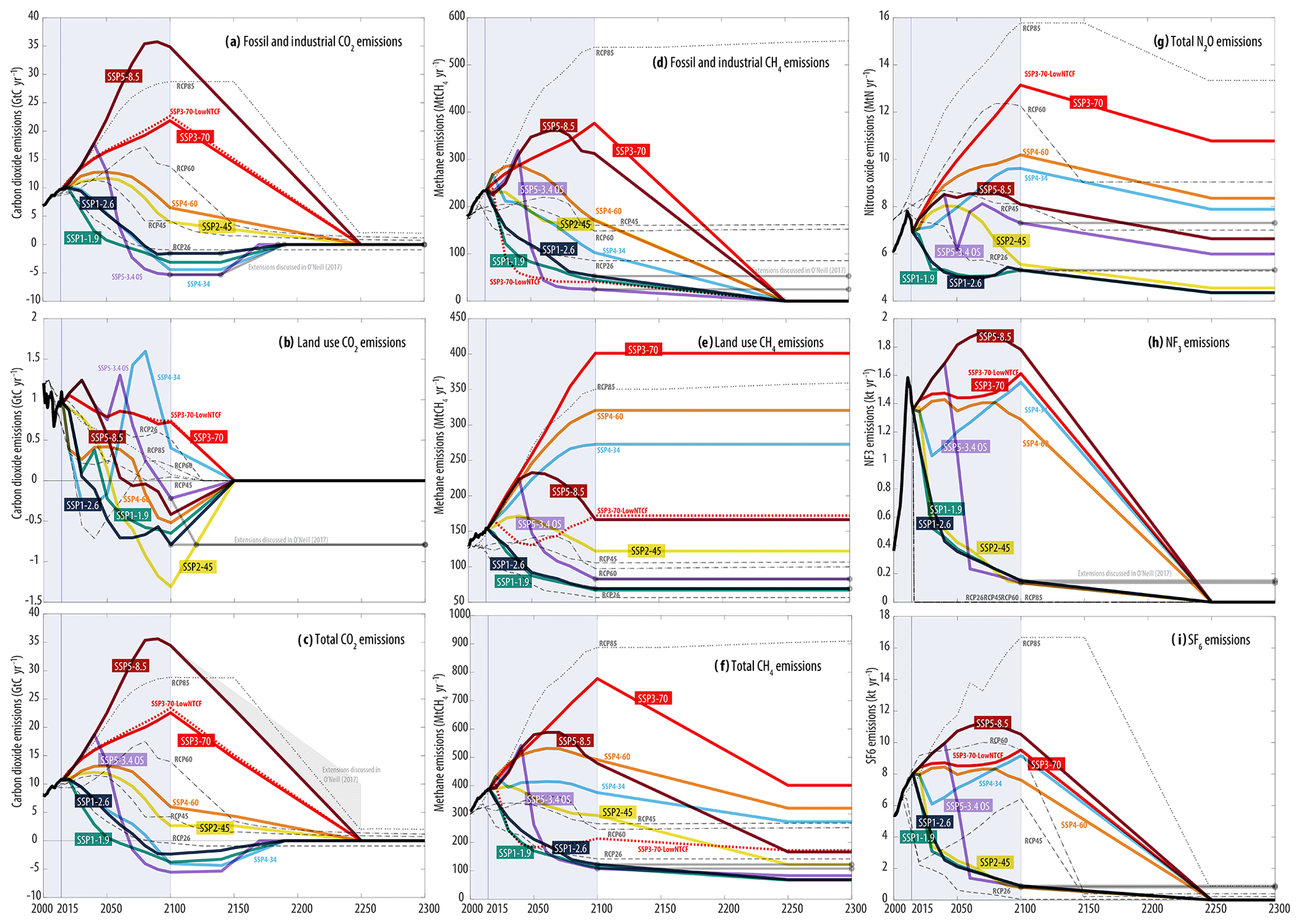
That is, if CO2 will be three-quarters sucked from the atmosphere over a millenium, the CO2 forcing from modern CO2 emissions (with Af = ~50%) will be halved during the next 1,000 years, the sort of timescale that ESS arrives in. So if ESS ≤ 2 x ECS, it is the shorter timescales we need to worry about regarding temperature. SLR would likely be a good reason for giving natural CO2 draw-down a healthy hepling hand. And the technology to effortlessly do that will not be that long in coming.(4) But on that point of a future 'effortless' techno-fix for excess CO2, I am always surprised that the post-2100 parts of the IPCC scenatios are not better known. The graphic below is Fig 2 from Meinshausen et al (2020) 'The shared socio-economic pathway (SSP) greenhouse gas concentrations and their extensions to AD2500'. The thumbnail bottom left-hand graph shows net CO2 emissions for scenario-various and if you scale SSP1-1.9 (a scenario which we should be trying to follow), the negative net emissions post-2050 equal all the FF & LUC emissions 2007-2050. That is something I find scary.
-
angusmac at 10:45 AM on 11 December 2025Ice age predicted in the 70s
BL@173 referring to your comment that Benton (1970) is referring to the warming and cooling of particulate pollution. I have reread Benton (1970) and I agree with your interpretation. Therefore, I confirm that my point 3 in angusmac@173 is incorrect and should be deleted.
Moderator Response:[BL] It has taken 17 days for you to accept this egregious error in your interpretation of Benton (1970).
As your entire viewpoint of Benton (1970) was based on continuing that error into the rest of the paper, this only demonstrates that you are unable to understand climate science papers to a degree that would make us believe that any assessments of other papers are worth our time.
After your error was pointed out, you posted three more times on Benton (1970), trying to convince us (convince yourself?) that your assessment was appropriate. The extremely slow pace with which you reflect on criticism is extremely discouraging.
Benton (1970) is only six paragraphs long, and less than 600 words. The space taken here in discussing it exceeds the length of the paper. (If anyone else is still following this thread, and is curious, here is a link to the Benton (1970) paper. The link has not actually appeared in this comments stream - you had to download angusmac's spreadsheet to find it.)
There is no point in polluting this comments section with more of your erroneous interpretations of the climate science literature. It takes far too much work to bash our heads against your stubbornness in having your errors pointed out.
I suggest that you go back to your assessment, and look at all the papers where you disagree with PCF-08 and revisit your thinking on why you came to a different conclusion. Then you may be able to look again at any other papers you have assessed with a better frame of reference.
I also previously suggested that you should read Spence Weart's "The Discovery of Global Warming", which looks back at the long history of people studying and trying to explain climate. You have an awful lot to learn.
We are not going to allow this comments section to continue as a circus where we try to change your mind one paper at a time. As previously stated, we're only willing to listen when you get your analysis published in the peer-reviewed literature.
-
michael sweet at 13:15 PM on 8 December 2025Climate skeptics have new favorite graph; it shows the opposite of what they claim
MA Rodger,
I read Judd et al. I have not previously seen an Earth Syatem Sensitivity of 8C. Hanson has long estimated ESS of 6C. If ESS is 8C we are leaving a super duper mess for our children. And the changes from 1.4 C are much higher than scientists thought they would be.
-
scaddenp at 06:12 AM on 8 December 2025A Skeptical Science member's path to an experiment on carbon sequestration
Not entirely related to the experiment, but EOS has article on climate-smart agriculture here. It notes limited evidence and low adoption. The paper is largely a call for large-scale systematic evidence collection.
-
scaddenp at 05:39 AM on 8 December 2025Increasing CO2 has little to no effect
For direct measurement of greenhouse effect, try here:
https://newscenter.lbl.gov/2015/02/25/co2-greenhouse-effect-increase/and here for the Nature paper.
-
TonyW at 08:37 AM on 7 December 2025Increasing CO2 has little to no effect
There is also direct measurement of the effect. https://www.researchgate.net/publication/26638729_First_direct_observation_of_the_atmospheric_CO2_year-to-year_increase_from_space_Atmos_Chem_Phys_74249-4256
Moderator Response:[BL] Note that the linked paper is really dealing with measurement of CO2, not the warming due to CO2. Consequently, it is sort of off-topic here. Nonetheless, the paper is an important one with respect to CO2 measurement.
Also note that the direct link to the journal paper (not ResearchGate) is https://acp.copernicus.org/articles/7/4249/2007/. There is a link there to obtain the full paper (free access), but also note that they mention a corrigendum (also available as a download).
-
angusmac at 11:38 AM on 4 December 2025Ice age predicted in the 70s
BL@179
I have provided an independent review. If you disagree then that is your opinion.
Moderator Response:[BL] The initial challenge, in my comment on post 173, was "...to give you the opportunity to demonstrate that you really understand the papers that you have been reading and assessing". I also stated "Please tell me, in your own words..."
The problem with your "independent" review is that it is not your independent review. You did not write it independently - you got an AI to write it for you. You clearly are not capable of doing it yourself - i.e., independently.
Reading and regurgitating someone else's work without understanding it does not demonstrate that you understand the climate science literature you claim to understand. In fact, it provides more evidence that you simply do not have the competence (in climate science) to be able to assess what papers do or do not say.
You came in here challenging SkS to change this rebuttal about the 1970s cooling myth, on the basis of your "analysis". SkS will not change the rebuttal on the basis of the opinion of an uninformed, unqualified, incompetent, unfit, unskilled, inept, worthless, and amateurish dilettante. [Full disclosure: I wrote that sentence with the help of a thesaurus.]
As this discussion is circling back on itself (item 3 in the Comments Policy), any further comments from you on this thread will be deleted. [One exception: you can come back and let us know when you get your "analysis" published in the peer-reviewed literature.)
-
pattimer at 20:43 PM on 3 December 2025Why the chemtrail conspiracy theory lingers and grows – and why Tucker Carlson is talking about it
There are many reasons why people believe that contrails are chemtrails.
There is the political motivation by climate change deniers to encourage this conspiracy and so we cannot address this serious problem without looking at politics.
However why are people persuaded by this political deception and why is it growing at the present time? This is the question that we are addressing.
*People are seeing more contrails in the sky that they used to.
* People often want an easy solution to climate change that doesn't affect their way of life. If scientists explain that contrails affect the climate or that flying has a large carbon footprint then it's easier to deflect any obligations by believing the conspiracy.
* People have learned that there are real political conspiracies that the author accepts. There is a worldwide growing awareness or believe of a lifetime of false information that has been presented from media even in countries that consider themselves democratic. (Whether or not this awareness or believe is correct is "off topic" although important to be considered elsewhere). This is evident in the mass movements we see around the world regarding wars that use weapons from the West in particularly America and her allies. Therefore to those with a less scientific understanding, people are making the false
step from their realisation that they have been deceived by politicians and the media to believing that everything including the science is false.
I have personally watched the frightning denial and conspiracies for many decades but the latter point I make here is a new trend and one that I believe should be taken seriously.
Perhaps the Author would find some agreement with this.
-
angusmac at 13:35 PM on 3 December 2025Ice age predicted in the 70s
BL@173, 177 and 178
Before responding to your challenge, I note that the points you raise would not normally be part of the guidelines that a publication would provide for an independent reviewer. Instead, they appear to be points derived by someone who has studied the paper at university and wishes to arrive at preconceived conclusions regarding my ability to carry out an independent review.
I now reply as follows.
Why did he do the work?
- He developed a one-dimensional climate model based on a steady-state energy balance approach to analyse temperature and ice distribution by latitude.
- The study was motivated by the need to understand how variations in solar radiation and atmospheric properties influence global surface temperature and ice coverage, with particular focus on the roles of solar input, surface albedo, and meridional heat transport.
- His work represents an early application of energy balance modelling to demonstrate how changes in climate variables can drive significant shifts in Earth’s temperature and ice extent
What aspects of climate science does he attempt to address?
The paper addresses some aspects of climate science, including:- The planetary energy budget, focusing on the balance between absorbed solar radiation and outgoing longwave radiation by latitude.
- The role of ice–albedo feedback and the existence of multiple stable climate states, demonstrating how changes in high-latitude ice extent can lead to either warmer climates or near-complete ice coverage.
What part of his paper represents "original work"?
He appears to have made several original contributions, including:- Developing a zonally averaged, one-dimensional energy balance model structured by latitude, which calculates mean annual sea-level surface temperature for each latitude band. The model incorporates key parameters such as solar radiation, surface albedo, infrared emission, and meridional heat transport.
- Conducting systematic numerical experiments by varying parameters such as the solar constant, albedo, and transport coefficients. This enabled the exploration of climate sensitivity and the identification of distinct equilibrium states, including both warmer climates and scenarios approaching global glaciation.
What part of his paper provides useful guidance to future work in climate science?
Part 2 “The Model” and Part 3 “Applications” provide particularly useful guidance for future climate science research for two main reasons:- Conceptual: These sections demonstrate that even highly simplified energy-balance models can produce multiple stable climate states. This insight has motivated more detailed investigations into climate feedback mechanisms, such as ice–albedo feedback, and their role in glacial–interglacial transitions.
- Methodological: The modelling framework introduced is straightforward and transparent and has been adopted in subsequent research. It enabled systematic evaluation of climate sensitivity, heat capacity, and meridional heat transport.
Interestingly, Sellers (1973) is classified as neutral, and Sellers (1974) is classified as warming by both PCF-08 and me.
Moderator Response:[BL] Congratulations. You have actually provided a reasonable summary of Sellers (1969) that covers the specific questions I have asked.
You claim that my questions "appear to be points derived by someone who has studied the paper at university and wishes to arrive at preconceived conclusions regarding my ability to carry out an independent review."
Yes, I have preconceived opinions on your ability to carry out an independent review, based on your posting here. And yes, I have an academic background, which includes a skill in identifying when the assignment handed in by a student does not match the quality or style of previous work by the student. Such a mismatch is often an indication that the work handed in is not really the work of the student. In academia, such actions fall under the categories "plagiarism" (handing in work that s not your own), or (more simply) "cheating".
Give that you have previously used perplexity.ai in your responses here, I decided to ask perplexity.ai to provide me with a summary of Sellers (1969). The text I sent to perplexity.ai was:
Please provide a summary of the Sellers (1969) paper at [link to PDF] and answer the following: Why did he do the work? What aspects of climate science does he attempt to address? What part of his paper represents "original work"? What part of his paper provides useful guidance to future work in climate science?
Guess what? Although the wording is not identical to yours, perplexity.ai has given me a summary that closely matches the points you make here, in much the same order, with a lot of similarity in wording. At the end of its summary, it also provided a list of related searches:
- Summarize Sellers 1969 main findings and conclusions
- Explain the methodology Sellers used in the 1969 model
- Which assumptions in Sellers 1969 are now considered outdated
- How did Sellers 1969 influence later climate model development
- What subsequent studies tested or expanded Sellers 1969 results
So, others have been asking before me. One of those people may have been you.
Now, when I initially made the challenge about Sellers (1969) I stated "please try to look at is as a chance to convince me and others that you know your stuff."
- By "stuff", I meant understanding of climate science, not the ability to use an AI tool..
- I strongly suspect, but cannot prove, that you have used an AI bot to produce your summary.
- You may have edited it into your own words, but that does not mean that they are your own ideas.
I therefore conclude that what you have posted is not an independent review.
Sadly, this is also pretty much what I expected from you.
Your credibility has pretty much reached zero here.
-
osbornll at 09:18 AM on 3 December 2025Why the chemtrail conspiracy theory lingers and grows – and why Tucker Carlson is talking about it
I have noticed a trend in conspiracy theories (chemtrails as well as climate denying, anti-vax, etc.) is that they push the solution to who must change to someone else. I am over 60, an applied physicst who has studied Wellness Coaching, and I cannot remember at time where science was telling us so much bad news and that we must change our ways! It is a common reaction, even amoung highly educated people, to blame others or deny the science instead of changing. I.e. Climate change is caused by a cabal of evil people using chemtrails and therefore I do not have to change. Does anyone know of papers addressing the issue from this angle? Thanks.
-
One Planet Only Forever at 08:56 AM on 3 December 2025Why the chemtrail conspiracy theory lingers and grows – and why Tucker Carlson is talking about it
pattimer @1, @4 and @5
Indeed, people who want to develop perceptions of superiority relative to others often have to resort to conspiracy beliefs to attempt to deal with reality (evidence and better understanding of what is harmful to Others that contradicts what they want to believe).
I am not a moderator. But I did see your original post before the moderator’s snipping.
It may have been better to generalize the comment rather than repeating a specific political interest that is unrelated to climate science or climate change impacts. That specific interest is only one example of the diversity of unacceptable results (misunderstandings and related harmful unjustified actions) developed in socioeconomic political competition for perceptions of superiority ‘any way that can be gotten away with - with related demands for more freedom to believe and do whatever a person or group wants’.
Moderator Response:[BL] Pattimer's duplicate (almost) second post has been deleted, so you're now #5.
...but please hesitate to second-guess the moderators.
-
pattimer at 07:55 AM on 3 December 2025Why the chemtrail conspiracy theory lingers and grows – and why Tucker Carlson is talking about it
It's disappointing that my comments were regarded as being off topic whereas I believe the comments were precisely a major reason why conspiracy theories such as chemtrails are presently rising around the world. Furthermore to believe that conspiracies whether rational or irrational can be isolated from politics will prevent an explanation being addressed.
I would appreciate that my comments were treated seriously by other moderators.
Moderator Response:[BL] First, you've posted basically the same comment twice. I don't know why - I assume it's a glitch in the matrix, but don't keep reloading/refreshing the page after you submit your comment. I have deleted the second copy.
Second: if you read the comments policy, moderation complaints are always off topic and will be deleted. It's in the very first point.
Third: the small portions that were deleted had the potential of leading to flame wars about non-climate issues. I don't think they were necessary to make your point.
-
nigelj at 07:07 AM on 3 December 2025Why the chemtrail conspiracy theory lingers and grows – and why Tucker Carlson is talking about it
Moderator, I will refrain from posting AI results. However I think the AI was perhaps describing the content of the articles, rather than making up titles. The AI did include links to the papers for a detailed look. However it is still certainly confusing.
Moderator Response:[BL] Your copy of the Gemini results didn't have actual links in it. That would have helped.
-
Bob Loblaw at 05:51 AM on 3 December 2025CO2 increase is natural, not human-caused
Thanks for that graphic, MA.
In the Climate Change Cluedo post I linked to earlier today, a comment from nearly 10 years ago included another graphic for the carbon cycle.
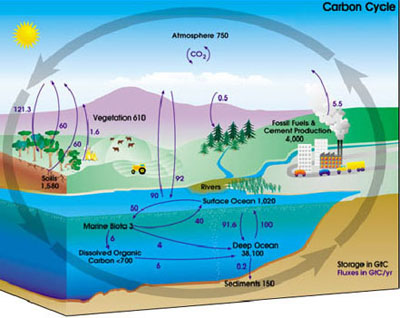
[The name of that commenter was also MA Rodger... what a coincidence...]
-
nigelj at 05:15 AM on 3 December 2025Why the chemtrail conspiracy theory lingers and grows – and why Tucker Carlson is talking about it
Regarding chemtrail conspiracy theories. Its been suggested some people have a conspiratorial leaning personality. I asked Google Gemini the following question: "Some people strongly believe in conspiracy theories. It's been suggested some people have a conspiratorial personality. What does the science say? Quote a couple of studies if possible." Geminis response was interesting and convincing:
Science suggests that while no single "conspiratorial personality" type exists in simple terms, a cluster of specific personality traits and psychological motives makes some individuals more susceptible to believing in conspiracy theories. These traits often relate to suspicion, a need for uniqueness, and a lack of analytical thinking.
Key Personality Traits and Predictors
Research has identified several personality characteristics and psychological factors linked to a propensity for conspiratorial thinking:
Antagonism and Paranoia: A sense of antagonism toward others, high levels of suspiciousness, and paranoia are strong predictors. People with these traits tend to view the world as a dangerous and threatening place.
Schizotypy and Odd Beliefs: Traits associated with schizotypal personality (a predisposition toward certain psychological disorders), such as eccentricity, magical thinking, and unusual beliefs, are linked to higher belief in conspiracies.
Narcissism and Fragile Self-Esteem: A high degree of narcissism (an inflated sense of self and entitlement) and low, unstable self-esteem can predict belief in conspiracy theories. Such beliefs may help people defend a fragile sense of self-worth by making them feel unique or superior for possessing "secret" knowledge.
Lack of Analytical Thinking: Individuals who rely more on intuition ("gut feelings") rather than analytical, critical thinking are more likely to endorse conspiracy theories. Lower levels of education and scientific knowledge are also correlated with this tendency.
Need for Uniqueness and Control: People are more drawn to conspiracy theories when they feel a lack of control over their environment or a desire to feel special and unique.
Conversely, the general "Big Five" personality traits (extraversion, agreeableness, openness, conscientiousness, and neuroticism) have a much weaker, less consistent relationship with conspiratorial thinking in meta-analyses.
Noteworthy StudiesTwo key areas of research illustrate these findings:
The Role of Personality Dimensions and Motivations (Bowes et al., 2020/2023): A meta-analytic review published in Psychological Bulletin (2023) by Shauna Bowes and colleagues synthesized findings from numerous studies to provide a clearer portrait of the "conspiratorial mind". The researchers found that while general Big Five traits had weak associations, more specific pathological personality traits, such as high grandiosity, low agreeableness/humility, and antagonism, were strong predictors. They concluded that conspiratorial thinking is complex and linked to various motives (epistemic, existential, and social), suggesting no single, simple "conspiratorial personality" type but rather a convergence of specific vulnerabilities.
Conspiracy Mentality as a General Predisposition (Bruder et al., 2013): A study in Frontiers in Psychology (2019) is part of a body of work that found a general measure called "Conspiracy Mentality" (a general predisposition to interpret events as the result of conspiracies) to be the best predictor of belief in specific conspiracy theories. This "mentality" captures a general mind-set of distrust and a tendency to see intentional, malevolent forces at work, and it was a more reliable predictor than broader personality traits like the Big Five. The study highlighted that people who believe in one conspiracy theory are more likely to believe in others, even mutually contradictory ones.
Moderator Response:[BL] Having recently given someone else a hard time about using AI to generate comments, I'm not sure we want to encourage it here. Although not explicitly stated in the current Comments Policy, that may change.
As an example, I did a Google Scholar search for the two studies Gemini pointed you to. I did find something close, but:
Martin Bruder, Peter Haffke, Nick Neave, Nina Nouripanah and Roland Imhoff (2013) Measuring individual differences in generic beliefs in conspiracy theories across cultures: Conspiracy Mentality
Questionnaire, Frontiers in Psychology.Note that Gemini seems to have come up with different titles for the papers. Or it has simply decided that the titles didn't matter and it would be better to come up with its own. That sort of behaviour makes me worry a bit.
-
MA Rodger at 03:54 AM on 3 December 2025CO2 increase is natural, not human-caused
I think sychodefender may benefit from seeing a diagram of the carbon cycle.

He also mentions atmospheric methane levels which have almost trebled since pre-industrial times and contributed roughly a third to the man-made global warming. The initial pre-industrial value would not result in modern warming.
-
Bob Loblaw at 01:47 AM on 3 December 2025CO2 increase is natural, not human-caused
sychodefender @ 39:
I am afraid that you start off with an incomplete statistic (% of total CO2 emissions that are man made), which leads you into incorrect conclusions about the role of CO2 emissions in the rise of CO2.
Atmospheric changes in CO2 are the result of net CO2 fluxes - both additions (emissions) and removals. Without human emissions, the natural system was in balance and atmospheric CO2 levels did not change much year to year. (There is a clear annual cycle, though.)
If your 5% argument was correct, then if human emissions stopped we'd continue to see CO2 rise at 95% of the current rate. If this were true, why was CO2 not rising at 95% of the current rate before humans started emitting CO2? Because nature was absorbing that CO2 - that's why. Humans are 100% responsible for the imbalance.
You can read a better explanation of this mass balance issue on this post that discusses other typcial (bad) arguments about CO2 rise. You can also find another discussion of the various clues that lead to the conclusion that anthropogenic CO2 is the cause of the increase in this post titled Climate Change Cluedo: Anthropogenic CO2.
Let's make a simple analogy:
- You start with $1,000 in the bank.
- Your regular income is $5,000 per month.
- Your regular expenses are $5,000 per month.
- After 5 years, you still have only $1,000 in the bank.
- You win the lottery, and the prize is doled out at the rate of $250/month for 5 years.
- You still get $5,000/month in income, and still spend $5,000/month.
- After another five years, you now have $16,000 in the bank - an extra $15,000.
By your math, the lottery winnings are only 5% of your income, so only 5% ($750) of the extra money in the bank is from the lottery winnings. But clearly your regular income and expenses have not changed, and never led to any increase in your bank account (net zero). The extra $15,000 is 100% due to the extra lottery winnings, not 5%.
Let's say you decide to spend half your lottery winnings. You still have $5,000/month income and $250/month lottery winnings going into the bank, but now your spending is $5,125/month. After five years, you will have $8,500 in the bank - added savings compared to your pre-lottery days. (This is a closer analogy to atmospheric CO2, where half the human emissions are absorbed by natural processes.) That extra $7,500 is still 100% due to the lottery winnings.
The rest of your post follows from an incorrect initial assumption. It is wrong.
-
sychodefender at 22:35 PM on 2 December 2025CO2 increase is natural, not human-caused
Only 5% of global annual co2 emissions are man made. Thus 5% of the yearly rise in atmospheric co2 (2.4 ppm) is from human activities.
(2.4 ppm X 5% = 0.12 ppm pa)
Scientists argue about the existence and quantity of various positive feedbacks from the tiny amount of warming that 0.12 ppm produces, but generally they estimate that feedbacks add 300% to forcing.
(0.12 ppm X 300% = 0.36 ppm pa)
So the maximum reduction that we can achieve with net zero is 0.36 ppm pa and this is extremely unlikely to happen this century.
Some other process is occurring to make up the remaining 2.04 ppm pa that is being added to the atmosphere, does this suggest that feedback from the small temperature rise is much more powerful than previously thought?
Or is our belief that this coincidental co2 rise is the driver of significant warming erroneous?
Methane is calculated to be responsible for 30% of warming, 60% of global methane emissions are anthropological, hence theoretically by completely eliminating our methane emissions we could prevent 18% of its influence on temperature increase.
This would necessitate dramatic changes which in all honesty are massively unlikely, perhaps a 10% reduction might be possible this century.
It seems that the ability of these anthropological gases (and their associated feedbacks) to have any significant warming effect is very small indeed.
If we are certain that the measurements revealing an untypical rapid temperature rise are accurate we must search elsewhere for an explanation and hopefully a method of control that is potent, plausible and genuinely achievable on a global basis and timescale.Moderator Response:[BL] Duplicate of this post has been deleted.
-
pattimer at 21:32 PM on 2 December 2025Why the chemtrail conspiracy theory lingers and grows – and why Tucker Carlson is talking about it
This is a good article.
However it was predictable that this ludicrous and other ludicrous conspiracies would grow now. I personally predicted this and watched them grow in line with the predictions, not just online but with talking and meeting people. As good as the article is, however, it doesn't cover why these deep state conspiracies are growing now at this point on time.
CL Matheson knows that conspiracies do exist. It would be equally ludicrous to claim otherwise.
While world conspiracies among scientists would be virtually impossible it would be unreasonable to believe that governments do not conspire particularly with their friends and allies.
People will generally accept that people in the countries that are considered to be politically in opposition to their own country have been conditioned through a false narrative. However analogous to the cosmological principle this works both ways.
However when more and more people have come to realise this last point those without adequate scientific understanding will make the irrational leap to think that scientists around the world are also conspiring.
The growing awareness of the history of the Apartheid, illegal Settlers, ethnic cleansing and now the Genocide that we see today in Palestine has made people aware that people in countries that consider themselves democratic have been given a false narrative for their entire lives.
[snip]
This awakening is undoubtedly for the best but it carries this short problem of growing mistrust in conspiracies such as chemtrails.
The cause of this growth in conspiracies can be blamed on the false narrative that has come from politicians and the media that has encouraged or at best turnned a blind eye to the Apartheid in Palestine and it's consequences for more than over a hundred
years.
[snip]
Moderator Response:[BL] Your two snipped paragraphs start to cross the line into politics that are potentially inflammatory and highly unrelated to the original post. Please re-read the Comments Policy.
-
angusmac at 09:51 AM on 30 November 2025Ice age predicted in the 70s
BL@177.
Oh dear. Now you are playing the semantics game
[Snip]
with “conclusions” versus “concluding remarks” in your statement that:

If it were just a summary, then I reiterate that your alleged summary states that, “Some years from now man will control his climate...”, either by warming from “the increase of carbon dioxide” or by cooling from “particulate pollution”.
However, I disagree that “concluding statements” are just “final words”, and I reply below.
Conclusions tend to be more formal than concluding remarks, but in practice, they tend to be very similar.
Conclusions usually include (but are not limited to) the following:
- Providing definitive, evidence-based judgment directly answering the questions raised in the paper.
- Interpretations are drawn from the paper's data, and recommendations are usually provided.
- Perhaps including a call for further research and/or a call for action.
Whereas, concluding remarks usually include (but are not limited to) the following:
- Summarizing the paper, providing final thoughts, perhaps discussing broader context and/or future implications.
- Incorporating reflections, acknowledging limitations, and possibly providing recommendations.
- Perhaps including a call for further research and/or a call for action.
Furthermore, you have worked in academia and will be aware that the use of either conclusions or concluding remarks tends to be journal specific. In practice, the terms are often used interchangeably, and the specific requirements for their use can depend on the journal, discipline, and/or publication guidelines.
It is evident from the above that “concluding remarks” are not just “final words”, but no doubt you are already aware of this having worked in academia. However, in your reply, you chose to play the semantics game by pretending that they are just “final words”.
[End snip]
P.S. You seem to be very keen on my response to your challenge at BL@173, and I have already confirmed that I will respond in due course. However, I do have a daytime job and, firstly, I would rather respond to your other allegations.
Moderator Response:[BL]. I warned you. The discussion of Benton (1970) is over, unless you are willing to respond to your egregious error in comment 173, where you implied that Benton was talking about CO2 and particulate matter in the third quote you provided as your assessment of the paper. Once again, the three points you made were:
- Benton (1970) does states that, “The present rate of increase [of CO?] of 0.7 ppm per year would therefore (if extrapolated to 2000 A.D.) result in a warming of about 0.6°C.”
- However, he also states that, “A second cause of climatic change is particulate loading of the atmosphere. Some meteorologists have attributed the cooling of the earth since 1940 primarily to such pollution of the atmosphere by man.”
- He also notes that, “The first process tends to depress the temperature of the earth's surface; the latter tends to increase it.
As I have pointed out more than once, the full context of that last quote from Benton is:
However, the net effect of particulate matter on climate is difficult to analyze. Such pollutants, depending upon their size distribution and the elevation at which they occur, both intercept incoming solar radiation and trap outgoing radiation from the earth. The first process tends to depress the temperature of the earth's surface; the latter tends to increase it.
You carry this error into your argument in comment 177, where you seem to be under the erroneous impression that Benton only talks about particulate matter causing cooling. Benton clearly knows that climate science of the 1970s understood that particulate matter sometimes has a cooling effect, and sometimes has a warming effect. (This is still our understanding, although our understanding now has much more detailed knowledge.)
Until you understand your error and correct your thinking, it is pointless to continue to discuss Benton.
Your summary of the importance of Sellers (1969) can wait. But given that you have claimed that you have read and understood all the papers on your list, the longer it takes for you to provide your summary, the more it looks like you really don't know what to say about it.
Addendum: Your summary of Sellers needs to be short. A few hundred words; a few short paragraphs. If you really understand the paper, you should be able to concisely describe its importance without a lot of excess verbiage..
-
MA Rodger at 05:03 AM on 29 November 2025Climate skeptics have new favorite graph; it shows the opposite of what they claim
RegalNose@26,
In the context of Judd et al (2024)'s graph below (Fig4a in the OP above),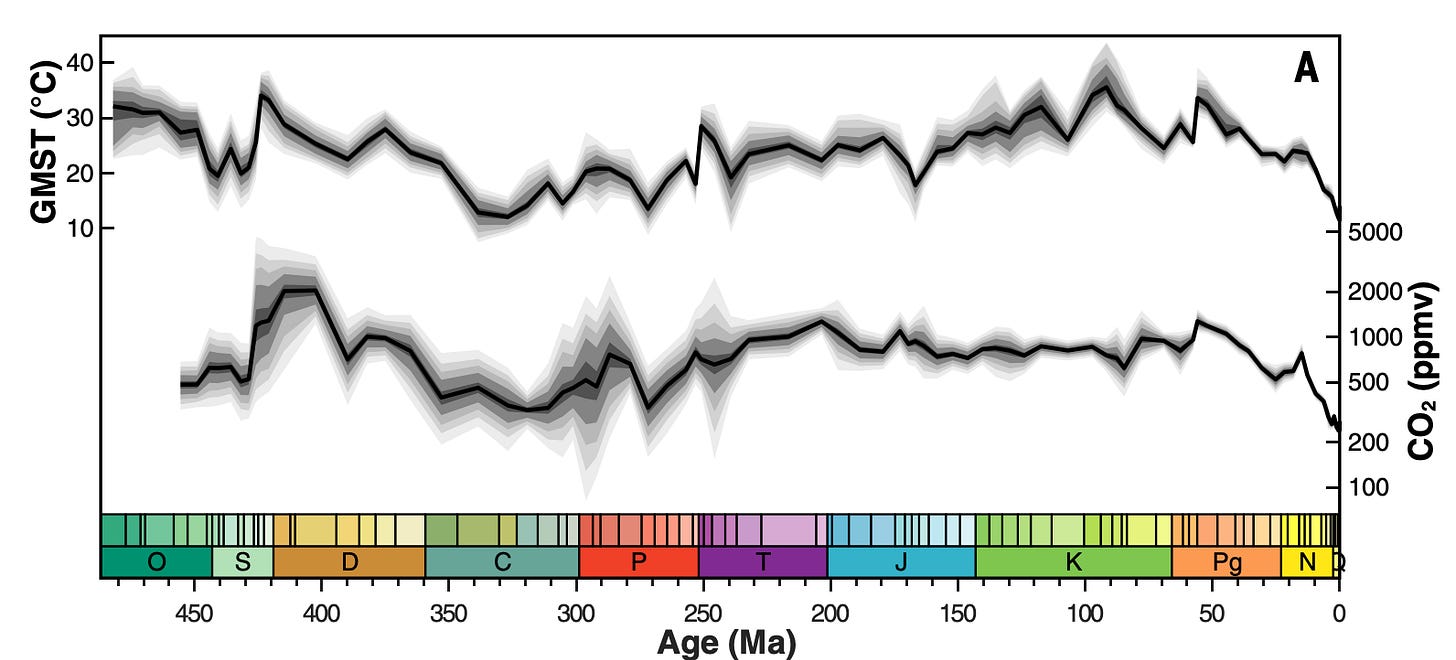
you ask - Isn't the NASA graph (below)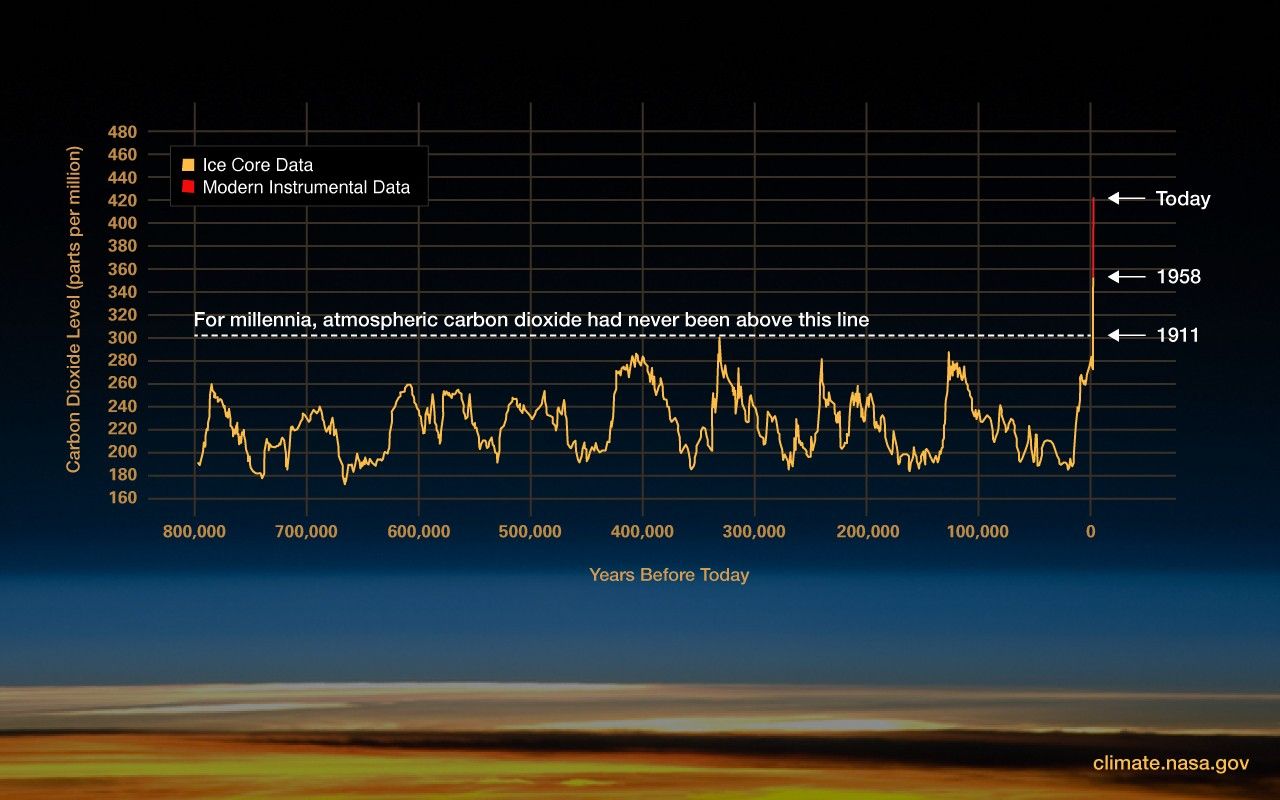
just pure scaremongring?
You ask "What am I missing? Why the panic and crisis mode?"
The OP above does not really answer your question of why CO2 should put us humans into a panic mode.
❶ The OP is firstly addressing the misuse of the Judd et al findings, being converted into total nonsense. It is, of course, difficult to nail down 'total nonsense'. ❷ Secondly, the OP chats about the threat of our CO2 to natural life on Earth rathert than the treat to humanity. ❸ That is not to say we humans should not be panicking.❶ That first point, the OP presents an exemplar piece of 'total nonsense' which says "There's always this rise and fall." The context here implies it is the global temperatures they are saying "always ... rise and fall."
They continue:-"This idea that the whole thing is based on carbon emissions from human beings is total bullshit. It's not true. Right. We might be having an effect, but we're having a small effect, a very small effect.”
This quote is 'total nonsense' as the findings of Judd et al, the evidence they are presumably presenting, says the exact opposite. Judd et al say it is CO2 on which the "whole thing is based". From their abstract:-
"There is a strong correlation between atmospheric carbon dioxide (CO2) concentrations and GMST, identifying CO2 as the dominant control on variations in Phanerozoic global climate and suggesting an apparent Earth system sensitivity of ~8°C." [My bold]
And the present-day big actor driving the 'whole thing', the startling rise in CO2 NASA graph above, that is the 'human beings'. This 'whole thing' is not "very small".
Additionally, Judd et al finding "an apparent Earth system sensitivity of ~8°C" suggests the effect is far from "very small" in terms of global temperature.❷ The threat to nature from to the CO2-rise being so rapid is a major part of the above OP. Perhaps to add a little colour, 56 million years ago the Paleocene–Eocene Thermal Maximum (PETM) was caused by CO2 rising from ~800ppm to ~2,000ppm. The climatic forcing would be the same if we today allow CO2 to rise to 690ppm (and no other GHG increases - accounting for other GHGs, the equivalent would be perhaps 520ppm).
The PETM was not a massive event in historical climate or ecology but it did have pretty big impacts. Consider horses - they shrank to the size of large dogs to cope with the heat. The PETM is often held up as the nearest example of what we are stoking with our man-made climate change. But there is one stark difference. The PETM warming took something like 25,000 years. Our warming is happening 100-times quicker. The sixth mass extinction event which humanity is already threatening with other activities will be a certainty if our warming gets anywhere close to rivalling the PETM's +6ºC.❸ But we humans are an adaptable species. However the problems are this.
(1) We a very numerous species that relies on a lot of real-estate. Loss of big portions of that real-estate (or even just the projected loss of it) will have big big geo-political consequences. If we could all pull together and address the problems, that may not be so disastrous. But we won't. And I'd imagine climate-change-mitigation measures will not be such a high priority when the world economy collapses and wars of national survival break out.
(2) The climatology cannot tell us how long we can keep melting Greenland to prevent 20ft of sea level rise becoming inevitable, or when the AMOC will disappear plumging Europe into the deep freeze, or when the cloud feedbacks over the Pacific will add another +3ºC to the warming, etc. The +2ºC limit to the warming was dropped in favour of +1.5ºC because tipping-points such as these could potentially be triggered below +2ºC.I hope that goes some way to explaining "the panic and crisis mode."
-
Philippe Chantreau at 04:06 AM on 28 November 2025Climate skeptics have new favorite graph; it shows the opposite of what they claim
The planet was lush and green very shortly after the end of the last ice age, when CO2 was less than 300ppm. In every region where the avilability of water made their existence possible, forests grew. They covered an immense area of the globe before humans started cutting them down and slashing/burning. Megafauna existed also and was in fact richer than now, even during the ice age: Mammoths, whooly rhinos, dire wolves, cave lions, megacerops, smilodon, cave bears, etc, etc.
Humans are an enormously powerful factor constraining the existence, abundance and diversity of life. Humans precipitated the disappearance of the megafauna of the late quaternary. Currently, life is subjected to all the "normal" natural stressors and all the human made ones as well. Without humans, it is very likely that after a few tens of thousands of years, life would be green and lush, rife with megafauna, under the future climatic conditions afforded by 500ppm of CO2. There is absolutely no chance of that happening with 8 to 10 billions of humans inhabiting the planet. None whatsoever.
-
Eclectic at 03:57 AM on 28 November 2025Climate skeptics have new favorite graph; it shows the opposite of what they claim
RegalNose @26 [and to add to Bob Loblaw's comment] :
What are you missing?
Many things, it seems (including biological evolution).
And you are missing the meaning of "crisis" ~ a delightful word which covers a broad spectrum of possibilities, and is often played with by politicians & scammers.
The scammers want you to feel panic, so that you take immediate (but unwise) action of some sort. And some politicians use that approach too ~ for their own benefit.
Other politicians go the opposite way, and say there is no immediate crisis . . . and tell you to relax and take no action at all. Even if your common sense tells you it would be a good idea to start tackling a problem which has obviously been developing.
Analogy : You have been checking your car engine oil level daily, and you keep finding that you need to top up the oil by a quart every week. Is this a crisis ~ obviously not an immediate crisis . . . and yet a wise man would quickly consult a car mechanic and decide what action to take to tackle the engine problem. Not put things off until the middle of next year.
RegalNose : What is your idea of "crisis" ?
-
Bob Loblaw at 03:21 AM on 28 November 2025Climate skeptics have new favorite graph; it shows the opposite of what they claim
RegalNose @ 26:
The OP mentions the concern about rapid changes. Do not dismiss that concern lightly.
...but with regard to the long-term record, and the Mesozoic period in particular:
- What evidence exists that human civilization in its current form was doing well in those warmer Mesozoic climates? Will our agricultural systems work for us?
- Temperatures similar to the Mesozoic would result in major reductions in land-based ice (especially Greenland and Antarctica). That will lead to sea level rise.
In the next 75 years or so, a metre of sea level rise is a reasonable expectation. That will lead to a lot of new coastal flooding (already beginning), at significant cost (either to prevent, mitigate, or move away from).
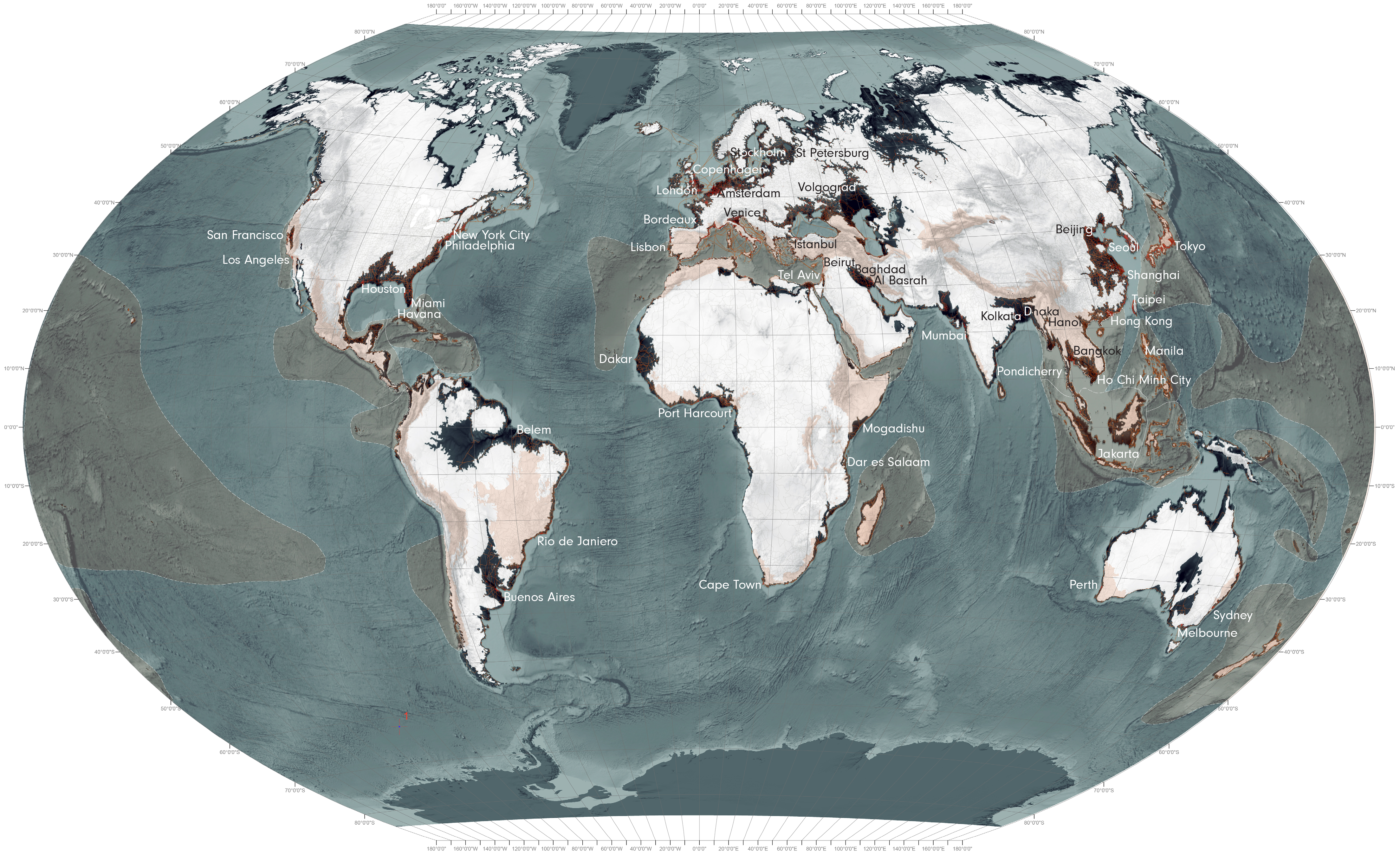
In the longer term (centuries), a complete loss of land ice in a Cenozoic-like climate would lead to an 80m rise in sea levels. Here is a map (from this web site, where you can see a larger image) of how much flooding is likely. Are there any portions of that flooded coastal zone that you would like to see preserved?
-
RegalNose at 22:46 PM on 27 November 2025Climate skeptics have new favorite graph; it shows the opposite of what they claim
Hi all,
I am absolute green when it comes to topic of Climate research (which is obviously not my field) and trying to make sense of some information presented to general public. I am writing here as I'd like your help with navigating this as it seems to me a bit contradictive with presented "news of the day".
If you navigate to the https://science.nasa.gov/climate-change/, there are two data points that are interesting to me:
1. current CO2 ppm = 430
2. increase of GMST of 1.5 degree C since pre-industry era.
What puzzles me, why is this so important to call for crisis mode?
When I look at the Judd's graph no. 2 I am reading that the planet was operating during The Mesozoic Era, which we know was lush, green and supported living of megafauna, on levels of CO2 between 500-2000ppm and with temperature s significantly higher comparing to current time. I am reading the graph as a path from local minimum and not as a path to glabal maximum, when it comes to GMST. I do understand the problem of how rapid is the incremental temperature increase, but don't see the issue of the increase itself.
In the context of Judd's graph, isn't the graphe used at https://science.nasa.gov/climate-change/evidence/ just pure scaremongring?
If you take 800,000 years, the CO2 ppm looks like massive spike, in the graph. But when you take the context of millions of years as Judd does, this increase is well.. insignificant.
What am I missing? Why the panic and crisis mode?
Thanks!
-
angusmac at 11:51 AM on 27 November 2025Ice age predicted in the 70s
BL@176 you seem to be determined to misrepresent what I actually said.
Yes, having written many scientific papers, I am aware of the structure of scientific papers, and I did state that they are broadly divided into two parts. I also agree with the typical contents of a scientific paper presented by you, and that (using your elements) these would usually include some or all of the following:
Part 1: Introduction/Methodology/Analysis/Interpretation and Discussion.
Part 2: ConclusionsConsequently, I agree with your comment that:

However, I was focusing on Benton (1970) as an example, which is very clearly divided into two main parts, namely:
Part 1: Present several hypotheses for the cause(s) of climate change and then discuss them.
Part 2: Present the conclusions.Furthermore, your comment below does not come as surprise to me:

I have systematically reviewed the existing methodologies contained in numerous scientific publications and have proposed enhancements where appropriate. Advancements in science and engineering often result from critically evaluating prevailing methods and introducing new approaches or techniques, which usually lead to alternative and more reliable conclusions.
I agree with your comment that the authors of PCF-08 knew how to find “Easter eggs”:

The reason I agree with your “Easter eggs” finding is because someone more sceptical than you might think that the authors of PCF-08 were data mining for information to support a preconceived warming position.
I also agree with your comment that Benton (1970) hardly merits the description of a paper:

However, I included it in my database because it was used by PCF-08.
I disagree with your comment regarding the clear prediction of warming in:

Benton (1970) only mentions 0.6°C warming in the discussion part of the paper by referring to “numerical studies have indicated” a warming of 0.6°C, namely:

I contend that if it were a clear prediction by Benton (1970) and not just an indication, then this warming would have been included in his conclusions as a clear prediction and not just an indication in the discussion part of the paper. Furthermore, if it were a prediction, I would have expected his conclusions to include an unequivocal statement similar to, “It is concluded that the present rate of increase in carbon dioxide would result an increase in temperature of approximately 0.6°C by the year 2000”.
However, the conclusions in Benton (1970) did not include an unequivocal prediction of warming.
Finally, I disagree that I am creating a false equivalence in:

On the contrary, Benton (1970) presented two main conclusions, namely: “Some years from now man will control his climate”, either by warming from “the increase of carbon dioxide” or by cooling from “particulate pollution”. It is evident from his conclusions that the Benton (1970) considers the possibility either warming or cooling to be equivalent and not a false equivalence.
However, I suspect that you will try to find some argument to postulate that “Some years from now” does not match your definition of a timeframe for a climate trend for some decades into the future.
It would appear to be you that is guilty of creating a false equivalence by taking a paragraph from the discussion part of a paper and elevating it to a conclusion of a clear prediction.
Moderator Response:[BL] As far as I am concerned, this comment closes the discussion of Benton (1970). You are now just repeating previous assertions. It is clear that you want to ignore the portions of Benton that disagree with your own "preconceived ... position" on climate science. Benton is so short that it does not even have section headings.
Back in comment 173 you gave reasons for your neutral classification of Benton (1970):
- Benton (1970) does states that, “The present rate of increase [of CO?] of 0.7 ppm per year would therefore (if extrapolated to 2000 A.D.) result in a warming of about 0.6°C.”
- However, he also states that, “A second cause of climatic change is particulate loading of the atmosphere. Some meteorologists have attributed the cooling of the earth since 1940 primarily to such pollution of the atmosphere by man.”
- He also notes that, “The first process tends to depress the temperature of the earth's surface; the latter tends to increase it.
I pointed out that your third quote does not apply to your first two. The full quote is:
However, the net effect of particulate matter on climate is difficult to analyze. Such pollutants, depending upon their size distribution and the elevation at which they occur, both intercept incoming solar radiation and trap outgoing radiation from the earth. The first process tends to depress the temperature of the earth's surface; the latter tends to increase it.
All you have done since then is try to deflect from this egregious error in interpreting Benton (1970) by trying to dismiss the contents of the middle section of Benton (where the proper context is explained) and pretend that somehow his very general "conclusions" somehow override the main body of the short paper.
I can only conclude that your actions fall into one or more of the following:
- You are unwilling to admit that your interpretation of your third quote was wrong.
- You realize that your inaccurate and misleading use of a selective quote was noticed, and you are trying to deflect attention away from that argument.
- You are desperately searching for some sort of additional quote from Benton that you can twist to support your argument.
Hint: when Benton starts his last paragraph with "Several concluding statements may be advanced", this basically means that these will be his final words. These are not "conclusions drawn from a detailed analysis". It's more of a summary than "conclusions".
You give away your bias by stating [your emphasis] "the conclusions in Benton (1970) did not include an unequivocal prediction of warming." Your demand that a paper provide unequivocal statements represents yet another example of the techniques of science denial: Impossible Expectations:
e
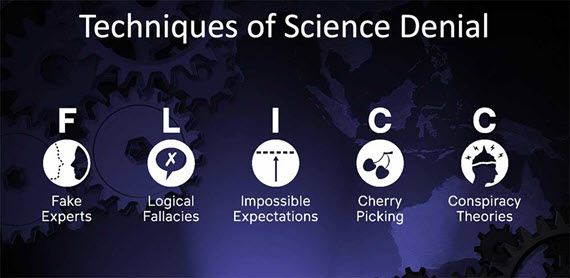
Your argument basically amounts to "Benton (1970) wasn't 100% sure about warming, so I get to treat his 90% statement of warming due to CO2 as if it is the same thing as his 0% confidence of aerosols having a possible warming or cooling effect".
You also give away your bias and need for selective quoting in the following paragraph:
On the contrary, Benton (1970) presented two main conclusions, namely: “Some years from now man will control his climate”, either by warming from “the increase of carbon dioxide” or by cooling from “particulate pollution”. It is evident from his conclusions that the Benton (1970) considers the possibility either warming or cooling to be equivalent and not a false equivalence.
The parts you place in quotes actually do appear in Benton's final paragraph, but where you say "warming from" and "cooling from", those words do not appear in Benton's final paragraph. Since you have hung your hat on "ignore the discussion part of the paper, only look at the conclusions", you are being disingenuous in manipulating the quotes from Benton as you have. Benton cannot be placing equal emphasis on two possibilities (warming and cooling) in a paragraph that does not even mention temperature trends directly. You need to look into the "discussion" part of the paper (which you want to ignore) to find the context. And the context regarding aerosols is not cooling: Benton clearly explains how aerosols can cause cooling in some circumstances, and warming in others. But you only know that if you pay attention to the discussion part of the paper. By claiming that Benton considers aerosols to be a cooling factor, you are perpetuating your error in your point #3 quoted above.
Let's be clear: In the entire paper, Benton only once puts numbers on the likely effects of various factors on climate over the decades following the 1970s: when he talks about CO2-induced warming. All your dodging and weaving does not change this.
So, no further discussion of Benton (1970) unless you are willing to admit to your error in your point #3 from comment 173. That error continues to permeate through your entire line of reasoning.
We await your response to the challenge I gave you in comment 173, regarding a summary of Sellers (1969). To wit:
- Please tell me, in your own words (not just selectively quoting from the paper), what you think the general theme of Sellers (1969) is.
- Why did he do the work?
- What aspects of climate science does he attempt to address?
- What part of his paper represents "original work"?
- What part of his paper provides useful guidance to future work in climate science?
Alternatively, you can get your analysis published in a peer-review journal, and then we'll see what you have to say.
-
angusmac at 09:09 AM on 25 November 2025Ice age predicted in the 70s
BL@173 you have made so many comments; therefore, I shall respond in smaller bite-sized chunks
Reply 1 to BL@173, you do not seem to understand my reviews of the papers contained in my database. Therefore, let me explain by using Benton (1970) as an example.
Benton (1970) is typical of many scientific papers in that they are broadly divided into two main parts, namely:
Part 1: Present several hypotheses for the cause(s) of climate change and then discuss them.
Part 2: Present the conclusions.I contend that the main part of a peer review classification of a paper is the conclusions – not the preceding discussion of the hypotheses. I think that this is where you (and the other commentators) on SkS have gone wrong because you focus on the hypotheses/discussion part of the paper, whereas the main part of the paper that matters is the conclusions.
I now present the conclusions from Benton (1970) below for ease of access for other readers (with my highlights):

It is evident from the above that, “Some years from now” Benson (1970) is primarily concerned about two things, namely “…the increase of carbon dioxide and particulate pollution”.
If you wish to argue against the Benson (1970) conclusions then please go ahead, but I suggest that any reasonable person reading these conclusions would agree that they are neutral on the causes of climate change, namely, either carbon dioxide warming or particulate cooling.
Moderator Response:[BL] I see that you want to ignore the simple fact that your three quoted sentences in comment 173 are not connected in the way you want them to be.
I am really getting to understand why you are so wrong on the interpretations of the papers we have looked at, though. There is a lot more that goes into a scientific paper than discussing "hypotheses". If all you are looking at in detail is what you think are the "conclusions", then you are missing most of the picture.
A typical scientific paper is expected to cover the following:
- Introduce the background behind the question at hand. Explain why the question is of interest to the scientific community you want to address. This typically involves some sort of references to the existing literature
- Explain the data being used, and the methodology used to collect it.
- Explain the analysis methods.
- Discuss and interpret the results.
- Then provide conclusions.
Proper review of the quality of a paper involves examining all of the above to see if anything has been missed and if the conclusions follow logically from the presented evidence and analysis.
And this will probably come as a surprise to you: to a scientist, the most interesting part of a paper may be in the data and methodology portions of a paper. Often, these present interesting new ideas that can be helpful in understanding different problems that were not the original intent of the authors (and thus, not discussed in their conclusions). The authors of PCF-08 knew how to find those sorts of things in a scientific paper - even if the main purpose of the paper was not what PCF-08 wanted to look at. PCF-08 knew how to find the Easter eggs.
At slightly over one page in length, Benton (1970) barely qualifies as a scientific paper. It is really just a short summary of the state of climate science in a particular subject area. (Philippe Chantreau already explained this in comment 147.)
It does, however, make a few short statements that relate to the question posed by PCF-08: predictions of trends in the decades following the 1970s. The only clear prediction it makes is the one with respect to the effect of CO2 - namely a temperature rise of 0.6C by the year 2000. Discussion of all other factors affecting climate are limited to general terms, with no specific prediction or time frame.
Once again, you are creating a false equivalence between a clear statement of prediction (increasing T due to CO2) and vague generalities regarding other factors.
-
angusmac at 15:57 PM on 24 November 2025Ice age predicted in the 70s
BL@168 you have made so many comments that it would take a very large post to respond. Therefore, I shall respond to them with separate smaller replies.
Reply 1 to BL@168 you state that, “Your opinion that climate science should be subjected to a red team/blue team examination makes about as much sense as me saying that the Tacoma Narrows Bridge collapsed in 1940, and as a result we need to take a red team/blue team examination of the entire discipline of structural engineering."
This is a misinterpretation of what I state at angusmac@168 which was:

It is evident from the above that my comment refers to only major engineering projects, and consequently, it would only apply to major climate science projects. Therefore, your inference that my opinion was that every climate science paper should be subject to a read team/blue team approach is wrong and is based on your selective reading of my text.
Furthermore, the Tacoma Narrows collapse did instigate major changes in structural engineering.
Since then, all long-span suspension bridges and other flexible structures were required to be designed to resist aerodynamic loading. These changes eventually evolved into the red team/blue team approach for major structures, and I have already given an example of one such flexible structure, namely, the Burj Khalifa.
Moderator Response:[BL] And you completely miss the point. The Tacoma Narrows bridge collapse did not result in an evaluation of the complete discipline of "structural engineering". It resulted in (by your own admission) changes in designing suspension bridges and flexible structures - one small part of "structural engineering".
As I pointed out in the moderator's comment to 168, "climate science" is a broad categorization covering many, many difference sub-disciplines. Your statement in 168 called "saving the planet" a major project in climate science. This is creating a strawman: there is no such "major project" in the discipline of climate science.
-
angusmac at 15:28 PM on 24 November 2025Ice age predicted in the 70s
BL@173
I shall reply to your comments and your Sellers challenge in due course but, firstly, I respond to your repeated allegations that I lack the skill to carry out a peer review.
I contend that our allegations are wrong because I have carried out many tens of peer reviews of papers proposed for the journals of well-respected professional engineering institutions. I could count the actual number of these reviews, if I thought that you would care.
Furthermore, these professional institutions think that I am a good peer reviewer and, therefore, I continue in this role. I suggest that these institutions should rank higher than the opinions of the SkS commentators on this thread.
Consequently, I suggest that my peer-review skills are at least as good (if not better) than those of the SkS commentators.
Moderator Response:[BL] Let's think a bit about what "peer review" actually means. Wikipedia has an article on it, which begins with
Peer review is the evaluation of work by one or more people with similar competencies as the producers of the work
In order to provide proper peer review, one needs to have competency in the topic.
I do not have the proper competency to provide peer review of a paper on some aspect of structural engineering. My training is in physical geography, specializing in climatology. I have extensive experience in the measurement of climatologically-important radiation, and meteorological instrumentation. (You can read more about my background on the SkS Team page.) I have published papers in the discipline, acted as reviewer on publications, and participated in international conferences, working groups, and instrument comparisons related to climatology.
You are exhibiting extreme hubris in thinking that your experience in structural engineering makes you an expert in climate science. Although you may be capable of reviewing papers in structural engineering, what we have seen here is strong evidence that you lack the knowledge and skill in climate science to be able to understand and review papers in climate science.
-
Randy Allred at 09:27 AM on 24 November 2025On the Gates climate memo
In Gates' memo, he writes:
"I wish there were enough money to fund every good climate change idea. Unfortunately, there isn’t..."
This facile assertion tells us that Bill Gates—rather astonishingly—doesn't understand how money and federal finance works. Money is not a scarce commodity, as Gates claims here. The US government is not financially constrained, it creates as much money as it chooses. Rather, it is real resources that are limited.
Money was invented by governments to marshall real resources into the public sphere for some desired public outcome. Private banks also issue money, but their motives are entirely different than those of government. We cannot depend on private finance to properly address climate issues.
Gates talks about companies, companies, companies, while giving short shrift to government action—which is the key to solving the climate crisis.
Perpetuating myths about money is not merely unhelpful, it's a huge drag on effective climate policy.
-
angusmac at 12:32 PM on 23 November 2025Ice age predicted in the 70s
Phillipe Chantreau@147
I note that Benton (1970) is included in PCF-08 as warming and NTZ as cooling. Yes, I do agree with your comment that,
However, please note that I have classified it as neutral for the following reasons:
- Benton (1970) does states that, “The present rate of increase [of CO₂] of 0.7 ppm per year would therefore (if extrapolated to 2000 A.D.) result in a warming of about 0.6°C.”
- However, he also states that, “A second cause of climatic change is particulate loading of the atmosphere. Some meteorologists have attributed the cooling of the earth since 1940 primarily to such pollution of the atmosphere by man.”
- He also notes that, “The first process tends to depress the temperature of the earth's surface; the latter tends to increase it.”
Benton (1970) concludes that [emphasis added], “At present, the natural causes of climatic change are probably more important than the effects of man-made gaseous [CO₂] and particulate pollution. However, the balance is changing as industrialization, urbanization, and transportation continue to grow at an accelerating rate. Some years from now, man will control his climate, inadvertently or advertently. Before that day arrives, it is essential that scientists understand thoroughly the dynamics of climate.”
Note that his conclusions give equal emphasis to warming, i.e., man-made “gaseous pollution” [CO₂] and cooling, i.e., “particulate pollution”. He does not single out CO₂ as the only problem. Furthermore, he also points out that we do not fully understand the dynamics of climate.
I hope that the above is a reasonable explanation of the reasons that I have arrived at the neutral classification and not cooling as you incorrectly stated.
Moderator Response:[BL] I agree with Philippe Chantreau's evaluation of Benton (1970) over yours. Once again, you do two things wrong:
- You mistake a discussion of the trend from 1940 to 1970 with a prediction over the period following the 1970s. The period 1940-1970 ends in 1970.
- You create a false balance between a strong statement regarding the expected warming due to CO2 (0.6C warming by the year 2000) with a highly uncertain statement regarding the possible future effect of aerosols.
Do you approach structural engineering with this same method of analysis? If your engineering design was subject to external review, how would you respond if the external review came back and said "we see an issue with the design that we are pretty sure will lead to weakening by fatigue and likely cause failure within 30 years, but there is an aspect of the design that we don't understand that might prevent that". Would you decide "that was a neutral review, so there is nothing to worry about"? I hope not.
And again, you selectively quote items from that report that tell me you have not properly understood what Benton (1970) has said. You have quoted:
The first process tends to depress the temperature of the earth's surface; the latter tends to increase it.
The two processes that Benton is talking about in that sentence are not CO2 and aerosols. He is talking about two different aerosol effects
- Intercepting solar radiation, which would lead to a cooling effect.
- Trapping outgoing radiation from the earth, which would lead to a warming effect.
This is clearly explained in Benton, in the sentences that immediately precedes the quote you provide as item 3. The full quote (emphasis added):
However, the net effect of particulate matter on climate is difficult to analyze. Such pollutants, depending upon their size distribution and the elevation at which they occur, both intercept incoming solar radiation and trap outgoing radiation from the earth. The first process tends to depress the temperature of the earth's surface; the latter tends to increase it.
If you are intentionally trying to mislead us by pretending that your third point compares your first and second point, then stop it. You are not fooling anyone. If you have made an honest mistake and erroneously thought that Benton was still comparing CO2 and aerosols, then you need to improve your reading skills.
CO2 is not particulate matter. Benton has changed the subject away from CO2 in that paragraph. Benton is not making an equivalency between warming due to CO2 and cooling due to aerosols - he is considering the possible (not yet well understood, as of 1970) opposing effects of different types of aerosols.
I am going to issue a challenge to you, to give you the opportunity to demonstrate that you really understand the papers that you have been reading and assessing. (You are, of course, free to ignore the challenge, but please try to look at is as a chance to convince me and others that you know your stuff.)
- I'd like to go back to Sellers (1969), which we have discussed previously. But this time, let's not think about predictions of warming/cooling in the post-1970 period (for now). Let's just look at climate science in a more general fashion.
- Sellers published his paper because he thought it contained new information with respect to climate science. People read it in the hope of learning new things.
- Please tell me, in your own words (not just selectively quoting from the paper), what you think the general theme of Sellers (1969) is.
- Why did he do the work?
- What aspects of climate science does he attempt to address?
- What part of his paper represents "original work"?
- What part of his paper provides useful guidance to future work in climate science?
Please provide a response telling me if you accept this challenge and when you might respond it detail (if you can't respond in detail immediately).
-
angusmac at 15:43 PM on 18 November 2025Ice age predicted in the 70s
Eclectic@169
At last, a humorous comment, regarding the grey team/purple team. No, I am not turning grey, because I am an independent hourly-paid contractor.
The only people who may be turning grey are the blue team(s) because they are major multi-national consultants working on a project that may be downsized.
-
angusmac at 15:29 PM on 18 November 2025Ice age predicted in the 70s
BL@165
I have read, and I do understand, the papers presented in PCF-08. I have also read, and I do understand, those papers presented in my database.
I also reiterate (although you keep denying it) that my methodology was identical to PCF-08. However, I will amend my paper to highlight that my database is limited to papers that include climate change trends that are “relevant to, time scales from decades to a century” so that anyone who reads my paper, and the database, will be able realise that I have used the same methodology as PCF-08.
Regarding your purported rebuttal of my database at:
https://skepticalscience.com/70s-cooling-myth-tricks-part-I.html
https://skepticalscience.com/70s-cooling-myth-tricks-part-II.html
My database, and the review therein, is different from the NTZ papers that you quote. Nevertheless, I shall conduct an independent assessment of the above 2018 SkS “Zombie Myth” posts and revert to you on how those posts compare with my database vis-a-vie completeness, content, and accuracy. Perhaps my assessment may turn out to be a red team review of your “Zombie Myth” posts.
Regarding your comment that PCF-08, “is now 17 years old – almost old enough to drink in most jurisdictions” is trite. Science, and scientific issues, are never too old to be revisited, and corrected if necessary.
Moderator Response:[BL] Despite your repeated assertions that your analysis is sound, the evidence you have presented here strong indicates that you cannot tell when a paper is talking about long term trends (millions of years) rather than decades to a century. You cannot tell the difference between a paper saying something is "highly unlikely" and saying that something else is quite probable. You cannot tell the difference between a paper that looks at the observed cooling trend from 1940 to 1970, and a paper that makes a prediction for the period following the 1970s. You cannot tell the difference between a paper that looks at historical local cooling and a paper that makes a prediction for future global trends.
I see two possible explanations, which are not mutually exclusive. Both are supported by the evidence you have provided in your comments here.
- You do not have the skill to understand the nuances and details of the papers you are reading.
- You do not understand how to interpret and apply the criteria specified in PCF-08.
The SkS debunkings of NTZ are not debunkings of your database, as they were written at a time when your datebase was not known to SkS. What the SkS debunking shows is that the NTZ analysis has serious weaknesses and errors, and provides examples of papers where NTZ gets things wrong. What has been pointed out is that your database - to the limited extent it has been examined here - suffers the same broad issues.
The second part of that SkS debunking lists several specific papers and discusses why the NTZ classification is poor. Feel free to go to that post and look at those papers (which may or may not be on your list) and see whether you agree with the SkS evaluation or the NTZ one.
You have also not addressed any of the criticisms that Philippe Chantreau provided to indicate errors in your evaluation of papers he looked at.
What has been shown here is that a sampling of your database shows serious errors in your categorization, based on the PCF-08 criteria you claim to have used. In my mind, this sample (combined with your comments here) gives enough evidence to make a preliminary determination that looking further is unlikely to produce a different conclusion.
Old items and papers can be corrected if necessary, but repeating the same bad reanalysis that has been made before and shown to be bad before is not a constructive use of time. The zombie myth about predicting an imminent ice age in the 1970s was already old and tired and wrong when PCF-08 debunked the myth in 2008. Your efforts (from what we have seen) continue to make the same mistakes that created the myth and were promoted by NTZ.
-
Paul Pukite at 15:08 PM on 18 November 2025Five ways Joe Rogan misleads listeners about climate change
"but Lindzen seems to have botched this"
I can make the argument that Richard Lindzen set the discipline of atmospheric sciences down the wrong path for generations due to his failure to get the attribution correct on foundational climate behaviors. He claimed he was expert on atmospheric tides, having written a book called "Atmospheric Tides" in 1970. Yet, he missed pointing out that the enduring behavior of the equatorial stratosphere known as QBO was due to an obvious forcing attribution of interacting lunar and annual tides. In his research publications, Lindzen clearly stated that tidal forces had no effect on the QBO and other behaviors because he found that the math didn't agree. Unfortunately, his claim appeared so authoritarian to readers that no one ever followed up on his assertions and just assumed forcing was via some other resonant process.
Alas, this same missing tidal attribution has also been found to control mean sea-level variations over many decades in coastal sites, via similar careful cross-validation of models (starting in the Baltic, which has the most extensive record of MSL). This should not be surprising to find that tidal forces control what naively appears to be long-term tidal levels, yet the common explanation is non-tidal and unpredictable. This missed attribution is arguably also an artifact of Lindzen's original gaffe. Worse yet, the same tidal attribution can also be applied to the important climate behavior of the North Atlantic Oscillation (NAO), which is best described as an erratic cycling of atmospheric pressure. Further, the same model can be tuned slightly to match the cycles of the Atlantic Multidecadal Oscillation (AMO). And to cap it off, the same common-mode tidal forcing can be used to cross-validate predictive models of ENSO in the Pacific.
The power of these tidal models are reinforced by advancements in the solution of non-linear fluid dynamics. Admittedly, I wouldn't have as strong a thesis because most people would ascribe it all to over-fitting of curves, similar to what can happen with neural-net models. Yet the rigor of extensive cross-validation on real FD models shows none of the artifacts of arbitrary over-fitting.
Given all that, and Lindzen's poor track record in anthropogenic attributions to climate change, I consider it past due to reappraise all of natural climate variation with these tidal factors in mind.
BTW, I essentially have one peer-reviewed publication on this topic, which was comprehensively covered in a 2019 Wiley/AGU volume (also presented at several AGU and EGU conferences prior to publication).






