Climate Change Cluedo: Anthropogenic CO2
Posted on 25 July 2012 by Tom Curtis
Anthropogenic CO2?
The human-caused origin (anthropogenic) of the measured increase in atmospheric concentrations of CO2 is a cornerstone of predictions of future temperature rises. As such, it has come under frequent attack by people who challenge the science of global warming. One thing noteworthy about those attacks is that the full range of evidence supporting the anthropogenic nature of the CO2 increase seems to slip from sight. So what is the full range of supporting evidence? There are ten main lines of evidence to be considered:
- The start of the growth in CO2 concentration coincides with the start of the industrial revolution, hence anthropogenic;
- Increase in CO2 concentration over the long term almost exactly correlates with cumulative anthropogenic emissions, hence anthropogenic;
- Annual CO2 concentration growth is less than Annual CO2 emissions, hence anthropogenic;
- Declining C14 ratio indicates the source is very old, hence fossil fuel or volcanic (ie, not oceanic outgassing or a recent biological source);
- Declining C13 ratio indicates a biological source, hence not volcanic;
- Declining O2 concentration indicate combustion, hence not volcanic;
- Partial pressure of CO2 in the ocean is increasing, hence not oceanic outgassing;
- Measured CO2 emissions from all (surface and beneath the sea) volcanoes are one-hundredth of anthropogenic CO2 emissions; hence not volcanic;
- Known changes in biomass too small by a factor of 10, hence not deforestation; and
- Known changes of CO2 concentration with temperature are too small by a factor of 10, hence not ocean outgassing.
Annual emissions of CO2 by human use of fossil fuels rose from 3 million tonnes of Carbon (11 million tonnes of CO2) in 1751 to 54 million tonnes of Carbon (198 million tonnes of CO2) in 1850. After that fossil fuel use rose sharply so that by 2008, annual emissions (including from cement manufacture) had risen to 8749 million tonnes of Carbon (32 billion tonnes of CO2). The rise in the atmospheric concentration of CO2 also began around 1750 and has followed the emissions up. This extraordinary coincidence strongly suggests that anthropogenic emissions are the cause of the rise in CO2 concentration.
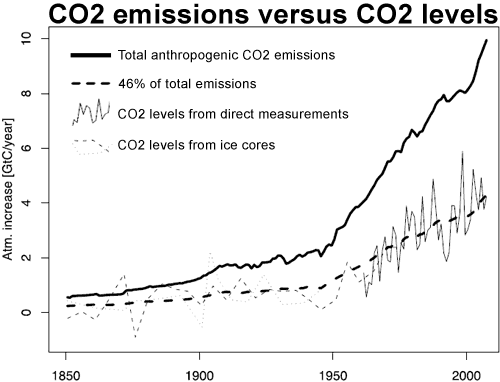
The increase in CO2 concentration over the long term (1850-2005) almost exactly correlates (corr.: 0.997; R^2: 0.993) with cumulative anthropogenic emissions from all sources including Land Use Change (LUC). The close correlation has continued in recent times, with a correlation of 0.9995 when compared to the Mauna Loa record (r^2: 0.999). So exact a correlation would be extraordinary if anthropogenic emissions were not the cause of the increase in CO2 concentration.
Over the course of the twentieth century, the increase in CO2 in the atmosphere measured in tonnes has been less than anthropogenic emissions in every year, and has averaged only 44% of anthropogenic emissions over the period from 1850-2005. Indeed, growth in atmospheric emissions probably has not exceeded anthropogenic emissions since the early 1880s, approximately the time anthropogenic emissions reached the equivalent of 0.45 ppmv of atmospheric concentration. It is interesting to note that the airbourne fraction, ie, the atmospheric increase divided by total emissions, has increased slightly in recent times. This means that natural carbon reservoirs have acted as a net sink over the course of the 20th century, and strongly indicates that the source of the increase in CO2 concentration is anthropogenic.
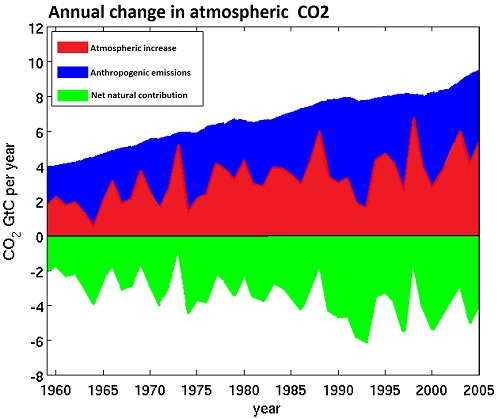
(Adapted from Cawley, 2011; data from CDIAC)
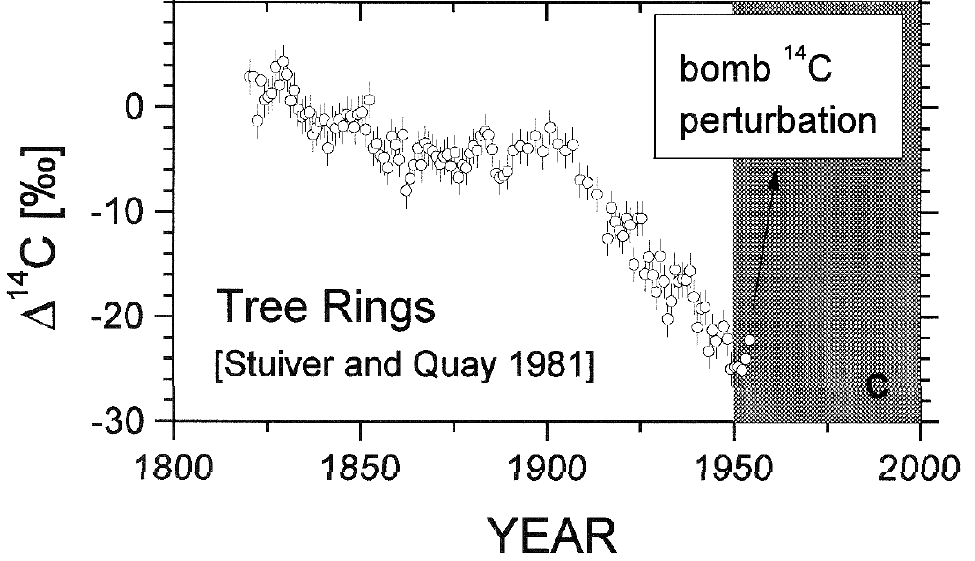
Carbon 14 is formed in the atmosphere by collisions between cosmic rays and Nitrogen. It has a very short half life (5,730 years), but atmospheric C14 is continuously replenished, maintaining a near constant concentration. Buried C14 is not replenished, however. As a result, whether from volcanoes or fossil fuels, CO2 from long-buried sources has effectively no C14. The addition of large quantities of CO2 from a long-buried source to the atmosphere will result in a significant decline in C14 concentration in the atmosphere, which is what we see. More recent, high precision measurements show the decline in C14 continued after the end of atmospheric nuclear testing.This is strong evidence that the source of the increased concentration of CO2 is fossil carbon, either from volcanoes or from fossil fuels.
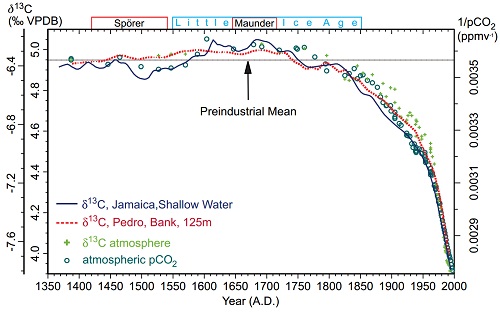
Carbon has two stable varieties (isotopes), C12 an C13. Because C13 has an extra neutron, it is heavier. In photosynthesis, most plants find it easier to take up the lighter C12, and do so at a higher rate than they take up C13, with the result that carbon compounds formed from the products of photosynthesis, including plants, animals and fossil fuels have a lower C13 to C12 ratio than does the atmosphere. Introducing a large quantity of CO2 derived from photosynthesis would cause the C13/C12 ratio to decline. In contrast, CO2 introduced from volcanoes or from outgassing from the ocean would not significantly affect the C13/C12 ratio. In fact the global C13/C12 ratio has declined, which is very strong evidence the source of the CO2 increase has was C12 enriched, ie, derived from photosynthesis. Therefore it is very strong evidence that it comes from the biosphere or fossil fuels, rather than from volcanoes or oceanic outgassing.
6) Declining oxygen concentration
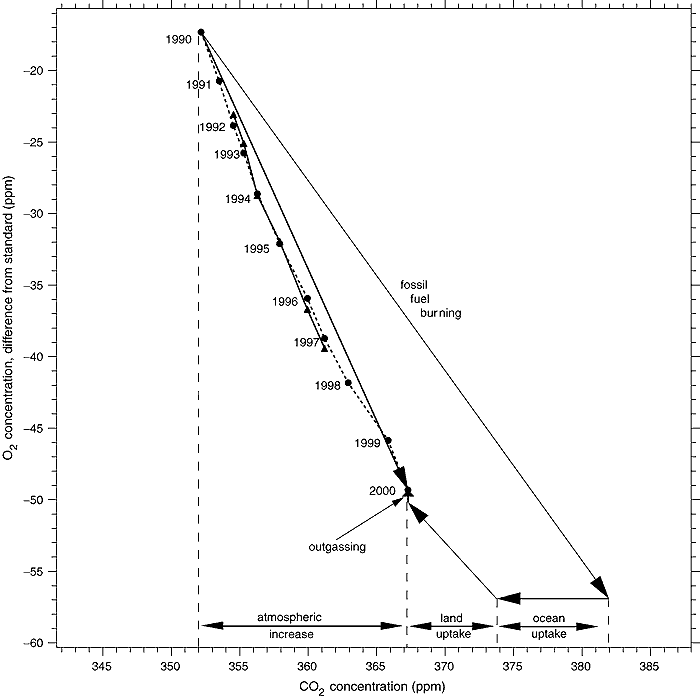
Because the change in solubility of O2 in water with change in temperature significantly differs from that of CO2, the change in O2 concentration is not affected by other possible CO2 sinks. That means the decline in CO2 concentration means any large unknown natural sources of CO2 must not come from a source of combustion but must come from a low C14 source generated by photosynthesis. These facts together almost completely preclude the existence of such putative natural sources. Because of the importance of the O2 decline, it is worthwhile looking at the chart below from the IPCC TAR which shows it:
(Source)
The observed decline in O2 is straightforward. The diagonal arrow from the start point marked "fossil fuel burning" represents the expected change in CO2 and O2 concentrations from known fossil fuel consumption. The arrow marked "ocean uptake" represents the uptake of CO2 by the ocean, which does not affect the O2 level. The arrow marked "land uptake" is the uptake of CO2 and release of O2 by photosynthesis, which also decreases the CO2 concentration and increases the O2 concentration. Finally, the small arrow marked "outgassing" represents outgassing of O2 from the ocean, which does not affect CO2 concentration. That outgassing is partly the result of a warming ocean, and partly a result of the very slight decrease in the partial pressure of oxygen in the atmosphere. These factors are reasonably, but not exactly known. It is important to note that because the fall in O2 concentration is significantly less than that predicted from known combustion of fossil fuels, the uptake of CO2 by photosynthesis must exceed the combustion or decay of modern organic material from either anthropogenic (Land Use Changes) or natural sources.
7) Increasing CO2 concentrations in the ocean
Simultaneously with the rise in the concentration of CO2 in the atmosphere, the concentration of CO2 (and its equilibrium products) in the ocean has been increasing. The rise in CO2 in the ocean is referred to as an increase in the "partial pressure" of CO2, and results in a simultaneous decline in the partial pressure of Hydrogen (pH), ie, an increase in the ocean's acidity. If the amount of CO2 in the ocean was falling, the partial pressure of CO2 would be falling, and the pH rising. This is very strong evidence that oceanic outgassing is not the cause of the rise in atmospheric CO2.
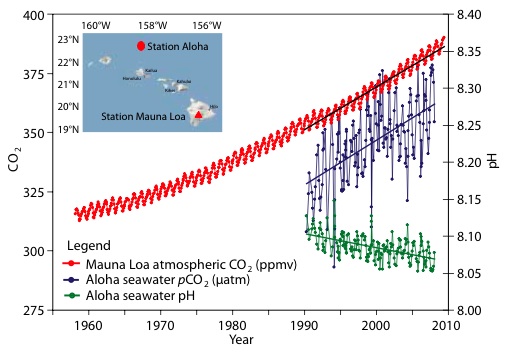
(Source )
8) Measured volcanic emissions
Scientists have used a variety of methods to determine the CO2 emissions from volcanoes. A common method is to use a tracer gas, ie, a gas emitted from volcanoes but which does not stay in the atmosphere for long. Determining the emissions rates of the tracer gas from volcanoes, together with the concentration of those gases in the atmosphere allows the overall level of volcanic activity to be measured. Once that is measured, measurements determining average rates of CO2 emissions for a given amount of activity can be used to determine the global CO2 emissions from volcanoes. Other techniques are used to measure CO2 emissions from volcanoes, mid-ocean ridges and subduction zones under the sea. The emissions, from all volcanoes, both on land and under sea, are about one hundredth of anthropogenic emissions. While there may be some error in the estimates, it is unlikely that the error would be large enough for volcanoes to be emitting a sizable fraction of anthropogenic emissions. That strongly suggests volcanic emissions are not the source of the increased CO2 concentration.
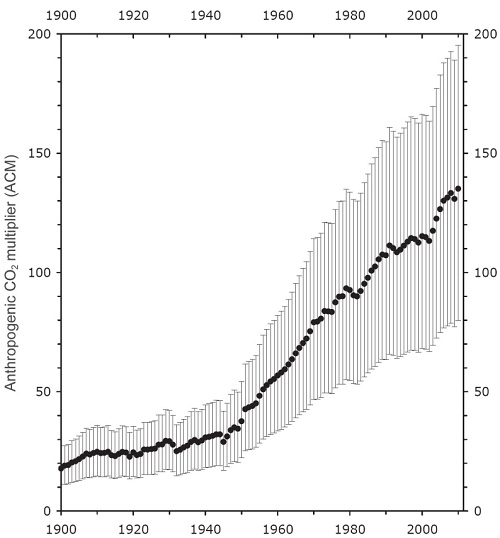
(Ratio of anthropogenic to volcanic CO2 emissions; source)
Anthropogenic Emissions from Land Use change and deforestation represent 10% of all human emissions (0.9 PgC of 10 PgC). Over the last century, human-caused deforestation and other land use changes have been by far the largest cause of change in land cover, and hence natural changes cannot be significantly larger than that.(Source) Indeed, as discussed regarding the declining oxygen concentration, that decline together with the land uptake shows that the biosphere is a net sink for CO2.
10) Past changes in CO2 concentration
During past "ice ages" (glacials) CO2 concentrations have correlated with temperature, with approximately a 22 ppmv increase in CO2 for every 1 degree increase in temperature. In more recent historical times, there was an increase in CO2 concentration during the Medieval Warm Period (MWP) relative to the Little Ice Age (LIA) of about 10 ppmv for approximately a 1 degree C change in temperature. Given that global temperatures have increased by 0.7 C since 1850, we would expect an increase in CO2 concentration of between 7 and 15 ppmv based on historical precedents. That CO2 concentrations have increased by approximately 110 ppmv over that period is very strong evidence that the source of the increase was not outgassing from the ocean.
(Source)
Playing Climate Change Cluedo
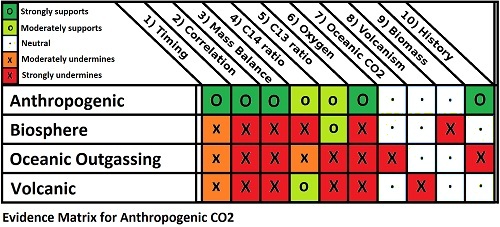
As a child I enjoyed playing Cluedo (Clue in the US market). I soon learned you discovered more from the questions people did not respond to than from those that they did, and developed a matrix from which to plot responses and non-responses. Filling in the matrix soon honed in on the correct answer, who killed whom, with what and where. Science is sometimes like that. The lines of evidence are the questions we put, and if we plot out our matrix, it quickly becomes clear that it is the humans who have caused the rise in CO2 levels, by burning fossil fuels in the twentieth century. Every other hypothesis makes a host of predictions that do not pass the test of the evidence.
Correction: The figures in section (2) have been corrected as of 12:45 PM, 29/07/2012. The nature and reason for the correction explained in my comment of 12:40 PM of that date.
The figure for the airborne fraction in section 3 was corrected at 8:54 AM, 18 th Feb, 2013.
Arguments


I love all the other "hockey stick" graphs :)
Thanks, I guess this list of evidence is pretty extensive, and might be worth a quicklink. Does anybody come up more examples of the evidence of the source of the extra carbon in the atmosphere/ocean? For my part, after 5) had been solved 1999abouts I've seen nothing to doubt the Anthropogenic part of the GW, though I accept the deforestation is a part (and it's mostly anthropogenic too.)
This is a question I run into surprisingly often. Thanks for putting the answers all in one place.
There is physically no way that the rise isn't being caused by humans. Anyone who sees the mass balance emasurements and then accepts claims that it's a natural rise really needs their skepticism checking.
The mass balance shows that for the rise to be natural, one or both of these things must be happening:
1) maths is wrong and bigger numbers are actually smaller than smaller numbers or 2) chemistry is wrong and molecules of carbon dioxide magically disappear in the atmosphere.
That's the sort of hypothesis that's needed for a natural rise in CO2 to be logically consistent. The fact that so many 'skeptics' argue it's natural is absolutely incredible to me!
Well, I'm pretty much of the same opinion, since I know no one who has extracted the steel and chrome and oil needed to plastics from the ground, and who has built, f.e. a car from these, literally from scratch. Some people might argue learning is natural for humans, and that the products made with the skills acquired from learning are thus also natural, but I'm more old fashioned with my definitions and append these things to culture, since the support structure to build something from scratch (i.e. from the elements that have not been modified by other humans), is likely to involve some sort of culture. To take an example, f.e. I couldn't build even a wooden bow naturally, for I do not have the skills to weave a strong string from the wool that I could get from lambs by some stone tools I can make (I've not done any refining of metals though I know the principle (that I couldn't have found out by myself (the lake/swamp ore process)).
But all of the above depends on the various uses of 'natural' that are not connected to the scientific evidence presented here, but are likely more of a subject of philosophy and semantics...
Moderators please delete this if this is too out of line and OT.
C + O2 -> CO2
O2 & CO2 are matched molecule for molecule, so deltas in O2 & CO2 should be the same. Am I missing something here?
CH4 + 2 x O2 => CO2 + 2 x H2O
Other hydrocarbons are very similar. Estimates of total O2 consumption depend on estimates of total fuel use divided among the three main form of fuels - coal, oil, and methane.
Agree with Dikran Marsupial "definitive" describes your piece perfectly.
I'd like to see a follow-up definitive posting using the same methodology to nail down atmospheric CO2 as the cause of current warming.
Then it would make sense to break "fossil fuel arrow" into 2 arrows:
1) "C components of fossil fuels burning", which would form an isosceles triangle 30ppm x 30ppm
2) "H components of fossil fuels burning", which would be vertical arrow as it does not produce CO2
It would be clearer for me and would also indicate the difference between CO2 emmissions from burning pure coal vs. carobhydrates.
Regardeless my comment herein, I join my predecessors in praising the value of this article: this is the best summary of arguments why humans are controling CO2. The AGW linking piece (CO2 rise=>warming) was best explained by Richard Alley in AGU 2009.
You commented briefly about this weeks ago, and I'm glad you put all the effort and work to release this post with more depth. I'll definetely save it as a reference.
Really great to see a short succinct summary with the points expanded on.
This is great fodder to fight away the armies of the night.
On another note
(-Snip-)
Do you have a citation for your Oxygen Depletion understanding... one complete with actual numbers? Nothing is ever "just this one cause," and the conversion of CH4 + O2 to CO2 and H2O is an ongoing natural process that gets H2O into the upper atmosphere. The question becomes one of simple math... how much O2 does the increase in the amount of CH4 (presumably from anthropogenic sources) consume, and how does this compare with the total oxygen depletion.
Without those numbers, and a citation, your statement is pure speculation.
But I strongly doubt that the numbers balance, or that fossil fuel combustion fails to dwarf the upper atmosphere methane contribution.
Observations of ozone show a thinning of the Earth's protective stratospheric ozone layer by about 3 to 8% overall since the 1970s. In the upper stratosphere, ozone depletion has been from 15 to 20%. Again, the model is better able to reproduce these values when increased water vapor is included. This is especially true in the upper stratosphere, where ozone is most sensitive to water. The model indicates that increased water vapor accounts for about 40% of the ozone loss in the upper stratosphere, and about 20% of the overall loss to date.
There are two driving forces behind the change in stratospheric moisture. Increasing emissions of methane are transformed into water in the stratosphere by chemical reactions. This can account for about a third of the observed increase in moisture there. http://www.giss.nasa.gov/research/briefs/shindell_05/
methane's reaction with hydroxyl radicals formed from singlet oxygen atoms and with water vapor. http://en.wikipedia.org/wiki/Methane
Why did you change topics to ozone? We were discussing O2 depletion in the entire atmosphere, and I presume (because we are on the topic of this post) as an indicator of an anthropogenic cause of CO2 increase.
Any casual reader of your comment is going to interpret it in that fashion, and your comment suggests oxygen depletion is not an indicator of an anthropogenic source of CO2 increase. As such, you need to support the claim.
Your shift to ozone depletion has no bearing whatsoever on the matter, and dodges the point.
Your explanation of the chemistry is similarly irrelevant. I well understand the reaction, and anyone who doesn't can google it quickly enough.
But you still haven't provided the necessary foundation for your argument, which is observational and computational evidence not merely that the reaction occurs (as it does naturally and continuously), but also that the mass balance involved, as compared to fossil fuel combustion, is high enough to diminish the argument in the original post.
You've failed to do so. I'll give you a second chance, or dismiss your statement as unsubstantiated noise.
Because the process of ozone depletion causes oxygen depletion. http://en.wikipedia.org/wiki/Ozone-oxygen_cycle http://en.wikipedia.org/wiki/Ozone_depletion
This statement is incorrect. Ozone depletion produces oxygen, as the wikipedia articles referenced describe.
This article describes the chemical reaction better:
methane reacting with something called the singlet D oxygen atom, denoted O(1D). This is a free oxygen atom that is in a particular sort of excited state. The reaction is
CH4 + O(1D) --> CH3 + OH
The result is a hydroxyl radical and a leftover methyl radical (CH3), which quickly reacts via
CH3 + O2 + M --> CH3O2 + M
CH3O2 + NO --> CH3O + NO2
CH3O + O2 --> HCHO + HO2
Eventually, reactions of HCHO (formaldehyde) with the hydroxyl radical result in the production of another water vapor molecule in the region between 35 and 45-km
HCHO + OH --> CHO + H2O
http://www.ccpo.odu.edu/~lizsmith/SEES/ozone/class/Chap_5/5_4.htm
You also need to read section 4.2.3 of the document you linked to.
"In this case, the reactive hydrogen exists in the form of two liberated OH (hydroxyl radical) molecules which become the catalyst in a pair of reactions with odd oxygen (OX) that result in a net loss of OX, by which we mean a net loss of both ozone molecules and free oxygen atoms."
Soooo? "..net loss"
1) ozone is O3
2) "free oxygen atoms" = O
Is there anything we've forgotten? Perhaps O2, commonly referred to as "oxygen"?
Does the statement "O3 + O ==> 2O2" show up somewhere?
(Your quote underlined; my bolding)
So, in context it is clear that the net reaction to which your refer is the loss of O3 and O and the creation of O2, hardly an explanation for the depletion of O2 from the atmosphere. That section, however, does not refer to section 4.2.2 from which you draw the methane related reactions, so I am unsure why you refer to it, or why Phil drew attention to it.
The question then arises, how significant is the release of methane to the depletion in atmospheric O2?
Total methane emissions have raised the methane concentration in the atmosphere by approximately 250 parts per billion since 1978. Given that the atmosphere contains approx 1.8 * 10^20 moles, and the molar mass of methane is 16 grams per mole, that represents emissions of 720 million tonnes of methane. Over approximately the same period, humans have used for energy, or flared over 350,000 million tonnes of methane. Thus emissions of methane represent just 0.2% of human consumption of methane.
The figures used are conservative, and do not include the fact that much of the methane emission comes from fugutive emissions (gas leaks) from human energy use which are incorporated in the total human consumption. So, while Chris has identified a genuine additional source of O2 depletion, it is too small relative to human use of gas for energy to be noticeable within error; let alone compared to the total use of fossil fuels, of which gas is a very minor component.
Though what i meant basically was what Tom points out to me in 26. I checked wiki again and found this
"Uncontrolled build-up of methane in Earth's atmosphere is naturally checked—although human influence can upset this natural regulation—by methane's reaction with hydroxyl radicals formed from singlet oxygen atoms and with water vapor."
With ozone depletion causes oxygen depletion is the result from the methane -> water vapor - reaction, and then the water vapor in the cold stratosphere destroys ozone. So maybe the ozone destruction doesn't destroy oxygen but it happens before that.
However the above quote is from this page http://en.wikipedia.org/wiki/Atmospheric_methane
which shows also (Section "Emissions accounting of methane" 1999 numbers?)about a 60 : 40 ratio for anthropogenic contribution to methane sources. (notice rice paddies are listed under natural sources)
Emissions + Sinks
Imbalance (trend)+20 ~2.78 Tg/(nmol/mol) +7.19 (nmol/mol)/a
And further down (Section "Rice agriculture")
"crop alone is responsible for approximately 50-100 million metric tons of methane emission each year"
So i think the emission of methane are higher than 0.2%. However i do not meant to say this is the only source, just another - and possibly above 0.2%.
Of those emissions, those from wetlands (225 Tg/a), termites (20 Tg/a), ruminants (115 Tg/a), waste treatment (25 Tg/a) and biomass burning (40 Tg/a) are all generated from carbon originally removed from the atmosphere by photosynthesis in recent times. As such, the full cycle involves no net change in O2 levels. A further 110 Tg/a comes from fugitive emissions from the fossil fuel industry, and hence are already accounted for as part of total human emissions from fossil fuels. That leaves just 65 of 600 Tg/a that can make an additional contribution to the reduction of O2 levels in the atmosphere. That represents an additional 0.74% O2 reduction from methane emissions. Thus calculated, I can concede the amount is greater than 0.2% - but I certainly cannot see how it could be considered significant.
I should note, however, that only clathrates represent emissions of methane which do not derive their carbon from either recent photosynthesis (hence having no net effect) or from fossil fuels (hence already accounted for). Clathrates represent 0.11% of the effect of fossil fuels based on the wikipedia figures.
(Off topic snipped)
What about methanogenesis from landfills, which depletes oxygen? And what is statistical significant, what are we looking for exactly to explain the O2 depletion?
Just how do methanogenic bacteria deplete oxygen? They are strict anaerobes i.e. they grow in the complete absence of oxygen. Most landfills go to great extremes to compact the garbage so that there is very little air space left. Aerobic micro-organisms exhaust this very low amount of oxygen so that the anaerobes can take over. Thus landfills are not responsible for oxygen depletion.
Why are you trying to connect all those fringe processes as culprits for oxygen depletion when the gorilla in the room is the burning of fossil fuels?
CH4 + 2 x O2 => CO2 + 2 x H2O
Therefore, typically, each methane molecule released by landfill (or any other source) will deplete the atmosphere of two oxygen molecules.
What Chris Machens @31 is neglecting is that carbon in landfill comes essentially from only two sources - fossil fuels either as some form of oil or fuel, or converted into plastics; and biomass in the form of kitchen and garden scraps, or wood, cotton, or wool.
Taking the carbon sourced from biomass first, because that carbon was taken from the atmosphere by photosynthesis, in a process that releases oxygen. In fact, photosynthesis in plants follows the formula:
6 x CO2 + 6 x H2O => C6H12O6 + 6 x O2
showing a deficit of 1 O2 molecule for each carbon atom fixed compared to the equation for the oxidation of methane. However, the process of converting sugar to methane will release an additional net 3 O2 molecules, and gaining the additional two hydrogen atoms, presumably from water, will release yet more oxygen. The net effect on atmospheric O2 levels is neutral.
Carbon from fossil fuels is slightly different. In calculating CO2 emissions from fossil fuels, scientists do allow for those fuels turned into stable products such as plastics, which do not decay easily and hence do not release their carbon to the atmosphere. According to Margate et al (1984) They represent about 6.7% of all liquid fossil fuels, and 3.2% of gases. However, relatively volatile products are already included in the accounting, and hence are not a source of additional O2 loss. And the non-volatile products such as plastics do not typically decay, and hence are not the source of methane from land fill.
Hence, while some small amount of the methane generated in land fill may not be accounted for in determining the expected O2 loss from fossil fuels, the effect is likely to be very small. It is certainly likely to be smaller than the approximately 10% error margin in estimates of fossil fuel production (Margate et al) and hence of O2 depletion.
Why We Need To Pay More Attention To The Role Of Landfills In Global Warming
In fact, landfills were responsible for almost five times more GHG emissions than understood. (from a 2009 report)
http://thinkprogress.org/climate/2012/07/26/516575/why-we-need-to-pay-more-attention-to-the-role-of-landfills-in-global-warming/
I think Chris Machens is confused between free Oxygen radicals and an Oxygen molecule.
As Bob points out above, The decomposition of O3 results in the creation of O2 molecule and an O* (free radical). These free radicals are extremely unstable and immediately engage in various other reactive pathways, illustrated in the Chapman Chemistry document. Some of these pathways result in further creation of O2 molecules and some of which "trap" oxygen in Nitrous Oxide.
So there are three problems with the statement "Ozone depletion also depletes Oxygen molecules",
1. It assumes one of these pathways is favoured over the other, for which no evidence is presented
2. It assumes that the "trapping" of oxygen in Nitrous Oxide is permanent; i.e. the oxygen is not recovered at some later stage. We know NO2 levels in the atmosphere are pretty constant, I would suspect that ocean chemistry (via acidic rain) would be important in this regard
3. Since we know that Ozone creation depletes O2 then the assertion that Ozone destruction does too should raise the question "How come we're still breathing?" :-)
"We were talking about C13/C12 ratio. It's the same for burning FF as it is for decaying plant matter, as they are both from organic/photosynthesis sources."
He says that the C13/C12 ratio can not be attributed solely to FF burning.
Now, I know what my response would be but I wanted to see what others have to say.
More specifically, however, just as the combustion, decay, or respiration of (or by) biomass) will add more C12 than C13 to the atmosphere relative to the existing proportion, so photosynthesis will take out more C12 than C13 by exactly the same amount per tonne of biomass generated. Given that the total amount of biomass in the world is stable, the biosphere can have no net effect on C13/C12 ratios except due to a small deletion of C12 relative to C14 due to biomass lost from circulation by fossilization.
Consequently, if the person you are debating wants seriously to argue that the biosphere is the source of the changes in CO2 concentration, they are compelled (if they are consistent) to argue that the biosphere is rapidly shrinking. How rapidly is shown by the fact that the biosphere contains approximately 1,000 billion tonnes of Carbon. (I apologize for referencing wikipedia on this point. Unfortunately searching google scholar simply returned page after page studies into biomass as fuel or as carbon sequestration.) One part per million by volume (PPMV) of CO2 in the atmosphere has a mass of 2.13 tonnes of carbon. That means an increase in CO2 concentration from 280 to 390 ppmv represents 234.3 billion tonnes of Carbon, or over 20% of the world's total biomass.
That may seem like to large a decrease to be contemplated, but as it happens, humans have caused the destruction of biomass to the extent of cumulative emissions around 165 billion tonnes of Carbon (17% of the world's total biomass) since 1850 (Houghton 2008, extended to 2011 by persistence). The margin of error is certainly large enough that the 20% could come from human activities alone.
Of course, the 20% estimate is letting your debate opponent of lightly. It is known that increases in atmospheric CO2 only represent 57% of total human emissions. Consequently, allowing for the extent of emissions not retained by the atmosphere your opponent would need to claim that over 400 billion tonnes of biomass had been lost. What is worse, in order to account for known human emissions and the known increase in the CO2 content of the atmosphere, to claim the increase is primarily from changes in the biosphere, he would need to claim an even larger fraction of emitted CO2 was not retained in the atmosphere. Just to assume 50/50 responsibility, they would need to claim the airborn fraction was just 28% of all emissions, requiring more than 500 billion tonnes emissions from biomass (on top of the human caused emissions). I think we would have noticed.
Of course, such a large net combustion of biomass is also going to require a larger net source of oxygen to account for the limited drop on O2 concentrations. I would say that I cannot wait to see what possible sources would be suggested, but I know better. Pseudo-critics of any scientific theory to not feel it incumbent on themselves to flesh out a coherent alternative proposal. They think it is sufficient to say that biomass has the same C13/C12 ratio as fossil fuels (approx true) and think that that is a devastating criticism even though no coherently worked out counter proposal that implies natural changes in biomass is remotely plausible given the sum of the evidence.
As originally published, section (2) reads in part:
Immediately after posting, this will be amended to read as follows:
(Emphasis added in both quotes to highlight the amended values.)
The figures initially published show the correlation between CO2 concentration and annual emissions, not cumulative emissions as stated. The corrected figures are for cumulative emissions.
It's quite astonishing the binding sites of enzymes in plants can be so selective they may differentiate between atoms of different nuclear charge distribution (the amount of neutrons and their locations). I'd presume the distribution of charge in the nucleus gets mediated to the exact configuration of molecular orbitals and this is sensed by the appropriate coordinated bonds within the photosynthetic machinery. If one wants to go by with the simple model of atoms based on positive-negative charge, one might think that the distribution of the nuclear charge in 13C gets polarised more to the one side of the nucleus so the electrons on that side would be on thighter orbits than usual.
In the case of CO2, the explanation of 12preference in plants in #42, would mean that the central C in O=C=O rotates horizontally along the long axis of the molecule while the slight excess of negative charge would be located perpendicular to it, making the O=13C=O look a bit fatter than O=12C=O. I'm pretty sure there are better explanations about this within physical chemistry, but I'm not that advanced in that discipline.
"1st, I see that Mr.Curtis confirmed my point that lower C13/C12 ratio is NOT unique to burning FFs.("just as the combustion, DECAY, or RESPIRATION of (or by) biomass will add more C12 than C13 to the atmosphere" So he tacitly agrees that the CAGW "unique FF fingerprint" meme is false.
He argues that the biosphere cannot be the source of the increased CO2 in the atmos b/c "PHOTOSYSTHESIS WILL TAKE OUT MORE C12 THAN C13 (his bold) by exactly the same amount per tonne of biomass generated""
"While that is true, Curtis's argument fails in his next statement:"Given that the total amount of biomass in the world is stable...". That is a false assumption, similar to the false CAGW assumption that climate is stable except for human interference.
Curtis erroneously concludes that 'pseudo-critics' have no coherently worked out counter proposal that could attribute C13/C12 ratio changes to natural changes. This is manifestly false, as I have pointed out to you previously."
"I imagine your confirmation bias &/or cognitive dissonance reflex reactions probably wiped them from your memory, but I'll repeat them since it appears yubedude & others are following our exchanges. bit ly/OyWzLj & bit ly/PuDQl
Perfectly plausible physical mechanisms to show that natural sources can be significant contributors to the increases in atmos CO2."
We'll see.