



 Arguments







Recent Comments
Prev 1115 1116 1117 1118 1119 1120 1121 1122 1123 1124 1125 1126 1127 1128 1129 1130 Next
Comments 56101 to 56150:
-
scaddenp at 07:02 AM on 30 August 2012Matt Ridley - Wired for Lukewarm Catastrophe
While others have pointed to some of the non-linearity in feedback system, it is worth also noting a couple of things. 1/ At moment, natural systems mop up more than half our emissions but there is doubt that the sinks can continue to do this 2/ Rising temperatures eventually cause natural increases in CH4 and CO2 from sea, tundra, swamps but this is a slow feedback. Fortunately, we can model these rather than just extrapolate temperature trends. The results arent pretty but that is no reason to ignore them. -
Bob Lacatena at 06:32 AM on 30 August 2012Matt Ridley - Wired for Lukewarm Catastrophe
23, Joel, And what if the system isn't so simple? What if the Arctic ice melt happens abruptly (as if that could ever happen), and the subsequent changes to the Arctic profile (absorbing radiation instead of reflecting it) ramps temperatures up in a sudden bump? And then that bump releases methane cathrates and melts permafrost in large quantities, causing another bump? What if the actual system moves in fits and spurts, bumping temperatures abruptly on timescales that a few decades cannot detect? In short, what if the science that suggests 2.4-4 C warming, based on a variety of disparate methods, is correct, and your simple projection based on a short period of observation is completely wrong? What if aerosols, a quiet sun, and a string a La Nina's are coincidentally and randomly holding warming to just 0.14 degrees per decade, but every down has an up, and there will be decades where the sun is hot, El Nino dominates, and China and other countries get their sulfide emissions under control? What if, as we already know, dimming aerosols provide a negative compensation for the radiative effects of CO2, and once those stop counteracting the GHG effect, a greater, fuller effect of CO2 is felt, well beyond 0.14˚/decade? What if the nice, simple, linear warming we've seen in just the first few decades since aerosols were reduced in the seventies is really just a blip in the process, and that when you add in real feedbacks, like the Arctic, things get more messy? And what if, as this year's extreme weather shows, the actual negative effects of even a small change in climate are far more deleterious than you or others expect, and that even "just" a 1.2 to 1.4 (or 2 or 2.5 or 3) degree increase has very, very frightening consequences? I think the problem with lukewarmers is that they are the worst of the deniers. They want to have it both ways, to accept the science but to be "reasonable" and dismiss any part of it which requires actual action. As John F. Kennedy said, “The hottest places in hell are reserved for those who in times of great moral crises maintain their neutrality.” -
SteveFunk at 06:31 AM on 30 August 2012Arctic sea ice breaks lowest extent on record
 For what it's worth, this is the area east of Scoresbysund, Greenland, lat 70, on Aug 23.
Moderator Response: [Sph] Image tag and actual URL repaired.
For what it's worth, this is the area east of Scoresbysund, Greenland, lat 70, on Aug 23.
Moderator Response: [Sph] Image tag and actual URL repaired. -
JohnMashey at 06:27 AM on 30 August 2012Matt Ridley - Wired for Lukewarm Catastrophe
As a reminder, there is nothing magic about 2100AD. Some people seem to want to act like "if we can only keep temperature rise to X by 2100, all is well." When the Earth gets to 2100, I'd guess there will still be much warming in the pipeline from the usual lags. -
dana1981 at 06:16 AM on 30 August 2012Matt Ridley - Wired for Lukewarm Catastrophe
Joel, CO2 emissions and concentrations are already accelerating, and have been for decades. You note the rate of increase is now 2 ppm/yr, in the 1980s it was 1.5 ppm/yr, in the 1960s it was 1 ppm/yr.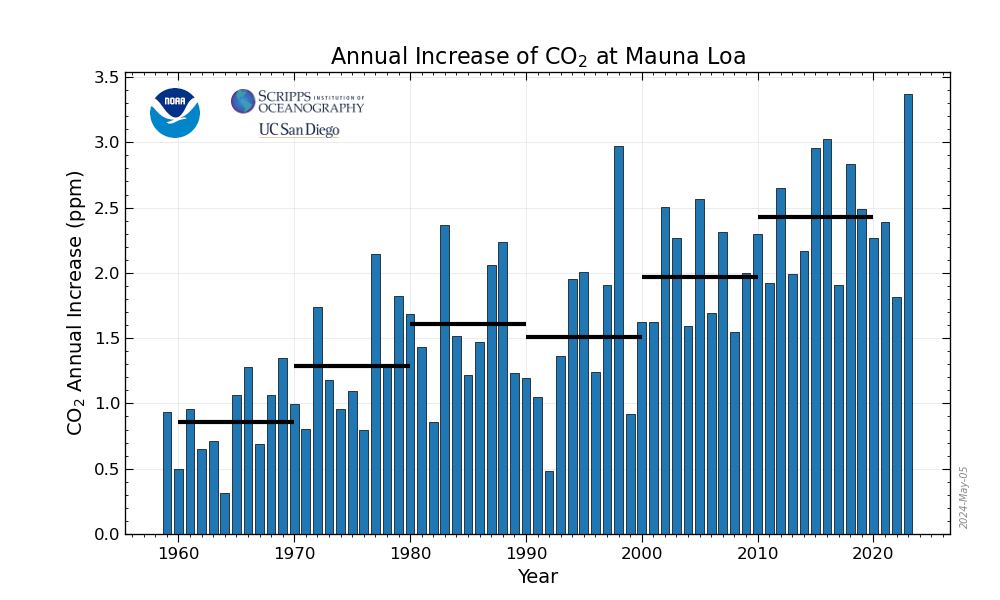 Unless we do something about it, emissions are expected to continue accelerating (see my link @22). The only way 'lukewarmers' are right is if we take major steps to reduce our emissions.
-
Joel Upchurch at 06:01 AM on 30 August 2012Matt Ridley - Wired for Lukewarm Catastrophe
dana @21 - Even to support a linear increase in temperature we need to postulate a exponential increase in CO2. If CO2 continues to increase at 2ppm per year, then we the temperature would increase at a rate much less than 0.14 degrees per decade I get for a linear increase. To get a 3 degree increase, then we have to assume that CO2 would actually double between now and 2100. That works out to 4.4 PPM average for the rest of the century, which means that the rate of increase would have to quadruple by the end of the century. The current rate of increase (2000-2012) is about 45% by the end of the century. -
Byron Smith at 05:30 AM on 30 August 2012Will the Wet Get Wetter and the Dry Drier?
It's tricky to get a decent handle on overall effect by eyeballing a global graphic showing annual changes in 5 year trends, but I was played it multiple times looking at a number of regions. Others can try the same and see if they had similar perceptions. Europe & North Africa: worst of everywhere. Mega-droughts. This was the most alarming feature of the whole presentation. Europe still produces very significant amounts of global food production and North Africa is experiencing some of the fastest population growth anywhere on the planet. China: mixed, but experienced bands of both wetter and drier than 20thC average. That will hurt when they have already had some pretty brutal floods and droughts that are going to be exceeded. India: Not quite as bad as Europe, but some major browning in regions of very high population density where access to water and groundwater depletion are already *huge* issues. US: Although the SW saw some dark brown, this was not as extreme as I had expected, since I thought the drying of SW US was one of the major climate concerns. Perhaps I've simply gained that impression by looking at too many US-centric analyses. Mexico is pretty dire. Sub-Saharan & southern Africa: Ouch. Pretty severe drying here. Though my memory is that sub-Saharan African rainfall is one of the bits of climate models where there is least agreement. What did others see? -
dana1981 at 05:19 AM on 30 August 2012Why Arctic sea ice shouldn't leave anyone cold
MA Rodger - thanks, I had intended to include something about the St Roch in the post but forgot. I'm glad you reminded me. -
dana1981 at 05:16 AM on 30 August 2012Matt Ridley - Wired for Lukewarm Catastrophe
Joel @21 - it appears that you are assuming the warming over the next century will continue at a linear rate, which is not realistic, and doesn't tell us anything about climate sensitivity. As we showed here, actual measurements are consistent with a climate sensitivity of around 3°C for 2xCO2. -
Joel Upchurch at 05:10 AM on 30 August 2012Matt Ridley - Wired for Lukewarm Catastrophe
I think the reason that lukewarmers arguments are strong is because it is consistent with the actual measurements. I went though all major temperature indexes and they indicate a warming rate that will increase the temperature by 1.2 to 1.4 degrees centigrade by the year 2100. Here is my graph. Graph of GISS, HADCRU, RSS and UAH indexes -
PopesClimateTheory at 05:06 AM on 30 August 2012Arctic sea ice breaks lowest extent on record
It is the land ice that makes the difference! -
PopesClimateTheory at 04:55 AM on 30 August 2012Arctic sea ice breaks lowest extent on record
(-Snip-)Moderator Response: [DB] Please note (1) that the topic of this thread is Arctic sea ice breaks lowest extent on record, not PopespersonalClimateTheory and (2) this site's Comments Policy. -
MA Rodger at 04:24 AM on 30 August 2012Why Arctic sea ice shouldn't leave anyone cold
dana1981 @73 In light of the Christy 1938-43 comments, JMurphy has a very interesting Henry Larsen quote about 1940-42. Larsen had sailed the western Arctic since 1928, including over-wintering up there, so he must rate pretty highly as an expert witness. http://www.skepticalscience.com/StRoch.html -
dana1981 at 04:06 AM on 30 August 2012Why Arctic sea ice shouldn't leave anyone cold
Just briefly regarding our rebuttal posts, one of the primary objectives of SkS is to debunk climate myths by seeing what the peer-reviewed scientific literature has to say about them. That's obviously not the only thing we do, for example we also write posts about new peer-reviewed papers, or as in this post the current state of the climate in general, etc. But it is a big part of SkS (see our myths rebuttals database which is the backbone of the site). So I think it's a little weird to criticize SkS for doing what it has always done, rebutting climate myths. -
Jeffrey Davis at 04:03 AM on 30 August 2012Will the Wet Get Wetter and the Dry Drier?
I'm reminded of the way Richard Feynmann dissected the Challenger disaster. Specifically, the way NASA calculated the risk of a disaster. The increase in droughts and floods increases the risk that one day most of the world's agriculture will be wiped out simultaneously by either one or the other. Russia/Australia and Pakistan managed that trick just 2 years ago. In time, the disasters will line up, and that will be that. -
dana1981 at 04:02 AM on 30 August 2012Why Arctic sea ice shouldn't leave anyone cold
We're working on a very detailed analysis of Christy's claims in the Leake article. Look for a blog post on the subject next week. -
John Hartz at 01:35 AM on 30 August 2012Why Arctic sea ice shouldn't leave anyone cold
@Tom Curtis #68: You may want to edit and repost your second point. As written, the second sentence of point #2 just doesn't make sense. Also, I believe you are referring to Dr. John Christy, not "Christie." -
Bernard J. at 01:16 AM on 30 August 2012Why Arctic sea ice shouldn't leave anyone cold
Another symptom of the increasing tribalism is the high number of rebuttal posts on SKS.
Or it could be a reflection of the enormous quantity of disinformation spreading through the Interweb and through the mainstream media, which desperately needs to be countered if humans are to reach in anything resembling an eleventh-hour (or more accurately, a thirteen point nineth hour) quorum with which to address the urgency of the problem of human-caused climate change. Of course, this might simply be my tribalistic opinion...Moderator Response: [DB] With that, the discursion into off-topic-land is now over. Thanks for taking the tour. -
Composer99 at 01:03 AM on 30 August 2012Will the Wet Get Wetter and the Dry Drier?
Categorizing the increased precipitation, where it occurs, as 'rich get richer' might be inadvertently misleading. Whether that is an apt description would depend on whether the precipitation arrives in forms amenable to food production or not. Obviously, that objection does not apply to 'wet get wetter' (since the two are, on this topic, synonymous, as far as I can see). -
SRJ at 01:00 AM on 30 August 2012Why Arctic sea ice shouldn't leave anyone cold
Tom Curtis I am aware of the context the map were presented in, but at the same time I find it important to point out the limitations of these maps. But what the map actually shows is that there were much more ice in easten greenland in 1938 than 2012 (look at the area west of Iceland). (-snip-)Moderator Response: [DB] Please refrain from using terms like "tribes" or "tribalistic". Focus on evidence and facts, not on ideological terms. Off-topic snipped. -
Why Arctic sea ice shouldn't leave anyone cold
SRJ - Given the observations indicating ice extent well above anything seen in the last decade, assertions that there were large extents of open water (4M k^2) would require a Jules Verne style Hatteras Island. Verne often had his fictional volcanic islands explode and disappear - claiming giant ice-free areas would require something like that. Not to mention the 1909 Peary expedition, the 1926 flyover of the North Pole by the airship Norge, etc - no giant ice-free areas were seen. In other words, low ice coverage in the early 20th century is strictly fictional. The observed ice extent (shoreline evidence, ship observations, etc) requires that more northern areas have ice - there is no support whatsoever for a "donut" shaped icecap. -
Tom Curtis at 00:41 AM on 30 August 2012Why Arctic sea ice shouldn't leave anyone cold
SRJ @67: 1) The existence of large areas of ocean with less than 15% sea ice inside the boundaries of sea ice extent is unlikely, to say the least. The supposition that data from the 1930s insufficiently constrains sea ice extent is therefore dubious at best. 2) More directly to the point at hand, the map presented was a rebuttal to claims by John Christie that there was evidence which suggested sea ice extent in the 1930s may have been comparable to that in 2012. All your quibble gains in his defense is to indicate that, while the evidence resoundingly rebuts his claim (and hence is misrepresented by him), it does not conclusive disprove the possibility of the 4 million square kilometer region of open water at the Pole in 1938 that would be required for his claim to have merit. (Edited for grammar following comment by John Hartz) -
SRJ at 00:18 AM on 30 August 2012Why Arctic sea ice shouldn't leave anyone cold
Daniel Bailey @ 62 22:31 PM on 28 August, 2012 These maps were discussed at length at WUWT earlier this year. One commenter noted that the white areas are not observed ice - it is unobserved area assumed to be ice covered. I quote from the legend on the map: "No colour indicates: Ice supposed but no information at hand" So some caution should be applied when comparing these maps with satellitte images -
vrooomie at 22:50 PM on 29 August 20122012 SkS Weekly Digest #34
One might think that getting whacked in the knackers would indeed raise that group's awareness but clearly, the impact in their crumbs has not yet been painful enough. Sad to say, when it finally does get painful enough, to the denialati, the rest of us will be *bleedin* profusely....:=( -
Rob Painting at 20:19 PM on 29 August 2012Will the Wet Get Wetter and the Dry Drier?
Chriskoz - I'm not familiar with research suggesting a permanent future La Nina state. A permanent El Nino was implied during the Pliocene (around 5-2.5 million years ago) but more recent work indicates otherwise, i.e ENSO existed throughout that time too. The increased precipitation variability (mainly ENSO as you point out) in the simulations is due to increased specific humidity (greater moisture holding capacity) in a warmer atmosphere. This drives greater moisture convergence & divergence - see: 1.Evaluating the rich-get-richer mechanism in tropical precipitation change under global warming - Chou (2009) 2. Does global warming cause intensified interannual hydroclimate variability? - Seager (2011) So a warming climate means greater extremes in precipitation even if La Nina & El Nino don't change much. And if you look at the abstract from Durack (2012)in the post above you'll note that actual trends are double those projected by the climate models. -
bill4344 at 19:56 PM on 29 August 2012Will the Wet Get Wetter and the Dry Drier?
Yeah, Rob - it means certain parties can always dust off Dorothea Mackeller... -
Rob Painting at 19:39 PM on 29 August 2012Arctic sea ice breaks lowest extent on record
Kevin - I was referring to the land-based ice, not sea ice. Slightly off-topic I know. -
chriskoz at 19:27 PM on 29 August 2012Will the Wet Get Wetter and the Dry Drier?
The simulations, I guess, include MEI (ENSO index), so it runs under "hopeful" assumption thet ENSO variability is to stay, as opposed to the suggestions that permanent LaNina could potentially develop. However, in the other side (and the other coast), by mid-2050, Perth WA seems to be entering the permanently "red" territory, and even edging "dark brown". -
Kevin C at 18:34 PM on 29 August 2012Arctic sea ice breaks lowest extent on record
Rob: Are you sure? My initial unconsidered reaction is that the loss of sea ice will have the essentially same effect on the earth's moment of inertia as it will on sea levels - i.e. to a first approximation zero. The water released by melting will be needed to fill up the hole left by the ice, so there will be no redistribution. When it comes to Greenland of course you have a point (at least over centennial timescales). (I may be completely wrong though - I've not thought it through properly.) -
Rob Painting at 18:32 PM on 29 August 2012Will the Wet Get Wetter and the Dry Drier?
Well spotted Bill. But note that, in the simulation, there are successive years where greater-than-normal rainfall occurs over Australia. Sound familiar? -
curiousd at 18:31 PM on 29 August 2012BEST Results Consistent with Human-Caused Global Warming
From the standpoint of education, I think the BEST result is great because of the following: BEST: 250 years time span with observed 1.5 degrees C temp increase.Then experimental 40% increase in CO2 since indust revolution,gives C2/C1 = 2^(t1/3) ~ 1.4 gives t1 ~ 1.5 degrees C indeed AND SINCE 1980: Since 1980 from Keeling curve, to present now different C2/C1 ~ 1.2 then C2/C1 = 1.2 = 2^(t2/3) gives t2 ~ 0.75 degrees C a little higher than observed for that time frame but not bad SO two different ranges of time and temperature change pretty consistent with same climate sensitivity of 3 degrees C and you can show a physics trained but "climate physics challenged" audience that climate sensitivity of 3 is a robust experimental result that does not depend on a simulation to be proven. Without Muller and BEST going back 250 years this argument is much less strong. -
bill4344 at 17:25 PM on 29 August 2012Will the Wet Get Wetter and the Dry Drier?
I trust all the Australians kept an eye on the wide, even-browner land? Wet-wetter and dry-drier ain't likely to bring much joy to the southern continent in particular! You know; where we all, um, live?... -
Riduna at 16:17 PM on 29 August 2012Global Warming - A Health Warning
Old Mole @ 85 claims that there is no record of premature deaths as a result of exposure to O3 in the South Coast Air Quality Management District. Sam Atwood, a spokesman is reported (New Scientist 25 August, 2012) as saying that in 2010, some 5,000 premature deaths occurred as a result of exposure to much reduced levels of O3. It is reasonable to assume that premature deaths were much higher in the past when O3 concentration was higher. -
curiousd at 12:08 PM on 29 August 2012Newcomers, Start Here
Hi, CuriousD back. Not sure where to post this but as a pretty much still Newbie this is probaly an o.k. place. Just realized: 1. Looked at the Berkeley Earth Surface Temperature (BEST) web site and they get 1.5 degrees C increase over 250 years. Then since 40% increase since industrial revolution in CO2 one has C2/C1 = 1.4 = 2^(t1/3) assuming 3 degreeC C.S. Solving, indeed t1 = 1.5 degrees. 2. And from 1980 (Keeling Curve) to present, CO2 increased so that C2/C1 ~ 400/340 = 1.2= 2^(t2/3) Solving, t2 = 0.75 degrees. Neato Mosquito , hey?Moderator Response: [DB] The Search function is your friend; using it you would find that a more appropriate thread for BEST discussions would be BEST Results Consistent with Human-Caused Global Warming. -
Doug Bostrom at 12:06 PM on 29 August 2012Matt Ridley - Wired for Lukewarm Catastrophe
In general "lukewarmers" seem to be expecting a myriad of graphs to exhibit strange and unlikely bends, that we'll see a chorus line of knees cocked in a comforting and attractive pose, an artful arrangement of "up" and "down" reversals just where we'd like them most. How likely is that? -
dana1981 at 11:56 AM on 29 August 2012Matt Ridley - Wired for Lukewarm Catastrophe
tmac57 @18 - I agree they're not called out on their economic alarmism often enough, but it's something we at SkS call them out on quite frequently! -
tmac57 at 11:14 AM on 29 August 2012Matt Ridley - Wired for Lukewarm Catastrophe
The 'lukes' and 'deniers' also have their own brand of alarmism that they rarely get called out on,concerning what they describe as "catastrophic" effects on the world wide economy and massive deaths to third world citizens if we turn our backs on petroleum fuels and pursue alternative energy. -
Michael Hauber at 11:13 AM on 29 August 2012Matt Ridley - Wired for Lukewarm Catastrophe
I remember the alarmism of the CFC issue. I remember the alarming impression that even the proposed gradual phase out would see us scared to go out in the sun by about now. This was from a casual reading of local newspapers at the time and without any real detailed investigation of what was being said by reliable sources of scientific information. I also remember other alarming claims that action to combat CFCs would destroy our economy because CFS were in so many things that we take for granted on a day to day basis which would all become more expensive with further positive feedbacks resulting in economic catastrophe. Even our fast food was going to be more expensive as McDonalds used to use a CFC based styrofoam container, and the CFC based alternative would be more expensive. Until they decided to wrap the burgers in paper instead of a plastic box.... -
tmac57 at 11:09 AM on 29 August 2012Matt Ridley - Wired for Lukewarm Catastrophe
In reality the "lukewarmers" are disproportionately over-represented, particularly in the mainstream media.
This is an important point. I would like to see a graph comparing congressional testimony in the U.S. congress by AGW deniers, vs consensus climate scientists,and comparing that to their representative numbers i.e. 3% vs 97%. My guess is that the deniers are very much over represented in their place at the table. -
JohnMashey at 10:06 AM on 29 August 2012Matt Ridley - Wired for Lukewarm Catastrophe
Some people, if they are remembered for anything, it will be: persistently, determinedly and loudly wrong about an important topic for which they had little expertise for a meaningful opinion. -
JohnMashey at 10:02 AM on 29 August 2012Matt Ridley - Wired for Lukewarm Catastrophe
re: 12 Yes: the Canadian Shield in particular is rocks, with minimal topsoil, because the glaciers moved it down into the US, as far as ~Kansas. Try this for images. This is not farm country. -
Daved Green at 09:35 AM on 29 August 2012Arctic sea ice breaks lowest extent on record
ok just that the GIS seems such a massive shift /loss of weight . I guess "wobble " is not very scientific , i guess there is a word for it Google here i come . thank guys . -
dana1981 at 09:05 AM on 29 August 2012Matt Ridley - Wired for Lukewarm Catastrophe
witsend @12 - we'll have a post on what the future climate might look like, on Thursday I believe. But we're not at a catastrophic point yet, and the idea is to avoid major disruptions to human society and economies. Immediately ending fossil fuel use would do just that. I think we have to be realistic about what we can do, and suggesting an immediate ceasing of all fossil fuel use is not at all realistic. -
Johnb at 07:56 AM on 29 August 2012Arctic sea ice breaks lowest extent on record
I've always used the website maintained by the Physics Dept, of the University of Bremen for a number of years now.. If you look at the graphs for the Arctic Sea ice extent over time you can see that the 2012 line has simply fallen off a cliff to be colloquial. I initially assumed it would show signs of reverting towards the mean, this simply hasn't happened. No doubt come the Equinox it will reverse direction but at the moment it is way out on its own. try this Link http://www.iup.uni-bremen.de:8084/ssmis/index.html -
witsend at 07:17 AM on 29 August 2012Matt Ridley - Wired for Lukewarm Catastrophe
Ridley's loathsome distortions made me so crazy I couldn't do anything when I read it other than click out and hope to forget by any means possible. However I think some of this rebuttal is less than complete. For instance this sentence which I suppose was meant facetiously, but could be construed as a real possibility: "Northern Canada and Siberia may become suitable for agricultural productivity - do we want to move all of our crops to those regions?" Regardless of warming, the soil and topography do not lend themselves to agriculture. As to this: "...nobody suggests that we should immediately cease burning all fossil fuels." Personally, I do - or at least, strict rationing. We've run out of time to wait for "carbon pricing" in the magic economic market or new "green" technologies to make a dent in the warming disaster already in the pipeline. We are in a global emergency and nothing less than drastic curtailment of consumption - serious sacrifice and a drastic reduction in the developed world standard of living will do. If we want to survive, that is. The mass extinctions have already begun...isn't that what the science says? -
DSL at 06:48 AM on 29 August 2012How much has nuclear testing contributed to global warming?
Well, vroomie, I don't think that argument's going to get any traction. I mean, evidence is where the rubber hits the road. It's been a good year for GW, and we're rapidly turning the planet into a fire stone. This tread is kind of petering out, isn't it? -
william5331 at 06:41 AM on 29 August 2012Arctic sea ice breaks lowest extent on record
If you look at http://nsidc.org/arcticseaicenews/ there is a curious anomaly, especially when you realize that we have passed the previous record for low ice extent and the the melt is proceeding like an elevator with it's cable cut. Look along the coast and note how much freezing is occurring. Go down on the right of the site and select August for previous years. Much less ice in previous years along the coast. This fits with the hypothesis that we are seeing the beginning of the reversal of the Polar Hadley cell. Air is being pulled off the rapidly cooling land around the Arctic ocean and is freezing coastal water. We probably have a 4 cell system at present. As the Arctic becomes more open, the rising air in the fall from the warmer ocean may be powerful enough to reverse the whole polar cell. We will then have a two cell system. Think what this will do to the wheat growing areas of the northern hemisphere. http://mtkass.blogspot.co.nz/2008/07/arctic-melting-no-problem.html -
Rob Painting at 06:07 AM on 29 August 2012Arctic sea ice breaks lowest extent on record
Daved - the loss of ice from the polar regions will have an affect on Earth's rotation - slowing it down. Not that anyone would be able to notice because the effect is so minuscule. Think of an ice skater spinning and then pulling their arms in toward their body - it causes them to spin much faster, and conversely when they straighten out their arms their rate of rotation slows. The same deal applies to the Earth, melting polar ice (near the Earth's axis of rotation) and its redistribution into the ocean (away from the axis of rotation) slows Earth's rotation. As for wobble - it depends where most of the melt occurs, but if the West Antarctic disintegrates (as it has done in previous interglacials), then the Earth wobble will cause a greater-than-global-average sea level rise off the east coast of the USA. -
vrooomie at 05:34 AM on 29 August 2012Arctic sea ice breaks lowest extent on record
Daved, short answer?....no. Though the mass of ice is large, it's not nearly large enough to affect the 'wobble' of the earth, nor its tilt. I don't ahve the numbers right here in front of me, but if you're interested, I can scare them up for you. To answer a bit more accurately, yes, there would be an infinitesimal change in the tilt and wobble, but literally *nothing* that would throw the Earth out of kilter. -
dana1981 at 05:17 AM on 29 August 2012Matt Ridley - Wired for Lukewarm Catastrophe
BWT @10 - yes, irrespective of caricatures of us, SkS is all about getting the science right :-) The picture still isn't pretty after the update. Basically we're looking at super extreme drought becoming the norm as opposed to super duper extreme drought.
Prev 1115 1116 1117 1118 1119 1120 1121 1122 1123 1124 1125 1126 1127 1128 1129 1130 Next






