



 Arguments







Recent Comments
Prev 1524 1525 1526 1527 1528 1529 1530 1531 1532 1533 1534 1535 1536 1537 1538 1539 Next
Comments 76551 to 76600:
-
chriskoz at 21:50 PM on 11 September 2011Just Deserts: Winning the 2011 Eureka Prize
My post is a proof how well deserved this prize is: I've been neutral towards the climate change debate and really I was taking the "balanced" view fostered by tabloid press. That was until about a month ago when I fisrt looked at SkS. This website really "opened my eyes" at how logical and clear/unrefuttable are the findings of climate science about AGW. The debate should not be called "balanced" when most "skeptics" are simply denialist. Congrats John and the rest of the team! -
Keith Hunter at 21:03 PM on 11 September 2011Just Deserts: Winning the 2011 Eureka Prize
Well done John! -
cynicus at 21:03 PM on 11 September 2011Lessons from Past Climate Predictions: IPCC TAR
Regarding Figure two: - I assume the two different datasets have been adjusted according to their baselines? I.e. the offset between the measured and projected temperature data is not a result of trying to get the best match on the right hand side of the graph? - Is it known why the hindcast is performing so poorly before 1930 (to my eyeballs)? -
cynicus at 20:43 PM on 11 September 2011Just Deserts: Winning the 2011 Eureka Prize
Congratulations John and the team of SkS! Well deserved indeed. -
Bud Ward at 20:21 PM on 11 September 2011Just Deserts: Winning the 2011 Eureka Prize
Great news and hats far off! Keep up the good work. -
Glenn Tamblyn at 17:52 PM on 11 September 2011OA not OK: Booklet available
Guys. Great series!! You alluded to a future series looking at future ocean chemistry changes. When can we expect to see that? No pressure of course, don't feel that I am breathing down your necks or anything. PANT, PANT, DROOL, DROOL! ... -
Glenn Tamblyn at 16:58 PM on 11 September 2011Haydn Washington talks Climate Change Denial on Steaming Toad
Luv it JC. And more of the world needs to be introduced to the 'focused' skill of H.G. Aahhg. If only his old partner RR Slavin had been there as well. To those from outside OZ, that is Rampaging Roy Slavin. Roy & HG has always been a name to conjure with. -
Tom Curtis at 15:35 PM on 11 September 2011Models are unreliable
Camburn @397, the performance of the models against the early 20th century has been known for a long time: As can be seen, the trend of the observed temperature changes in the early twentieth century is very close to the modeled temperature changes. Exceptions can be seen in 1909-10 and 1915-17 when the observed temperatures are significantly below the modeled temperatures, but both of those periods coincide with < ahref="http://www.bom.gov.au/climate/current/soihtm1.shtml">strong La Nina years (exceptionally so in 1917). A further exception can be found in the period 1938-1945 in which the observed temperatures lie well above the modeled line. This is partially explained by a strong El Nino in 1940-41.
The unexplained increase represents approximately 10% of the increase in temperature between the 1910's and the 1940's. It may well be explained by a dip in anthropogenic sulfates at the time, or indeed by a sudden influx of black carbon aerosols. Regardless, trying to interpret an approx 10% at one point as "Climate models don't show the warming in the early 20th Century" (my emphasis) is bizzare. Your statement was both unequivocal and wrong. Your follow up that "models do a poor job replicating the temp pattern" seems to come down to this - Climate models do a poor job at retrodicting the exact year of ENSO fluctuations (as opposed to their frequency), and the onset of wars and depressions.
Well, your probably right on that, but I don't think a failure to predict WWII (or the exact amount of black carbon released by the blitz) constitutes a serious problem for climate modelers.
As can be seen, the trend of the observed temperature changes in the early twentieth century is very close to the modeled temperature changes. Exceptions can be seen in 1909-10 and 1915-17 when the observed temperatures are significantly below the modeled temperatures, but both of those periods coincide with < ahref="http://www.bom.gov.au/climate/current/soihtm1.shtml">strong La Nina years (exceptionally so in 1917). A further exception can be found in the period 1938-1945 in which the observed temperatures lie well above the modeled line. This is partially explained by a strong El Nino in 1940-41.
The unexplained increase represents approximately 10% of the increase in temperature between the 1910's and the 1940's. It may well be explained by a dip in anthropogenic sulfates at the time, or indeed by a sudden influx of black carbon aerosols. Regardless, trying to interpret an approx 10% at one point as "Climate models don't show the warming in the early 20th Century" (my emphasis) is bizzare. Your statement was both unequivocal and wrong. Your follow up that "models do a poor job replicating the temp pattern" seems to come down to this - Climate models do a poor job at retrodicting the exact year of ENSO fluctuations (as opposed to their frequency), and the onset of wars and depressions.
Well, your probably right on that, but I don't think a failure to predict WWII (or the exact amount of black carbon released by the blitz) constitutes a serious problem for climate modelers.
-
muoncounter at 13:40 PM on 11 September 2011Models are unreliable
Camburn#398: "The statement of the abstract that the models do not do a good job of hindcast is a fact. " Of what use is a selectively chosen, isolated fact, without context or mechanism? This paper calls for higher positive feedback; Camburn is on record siding with Spencer on the side of low feedback and therefore low sensitivity. I would think you'd be running away from this paper as fast as possible - if you agree with it, you are contradicting your support of Spencer and tacitly siding with Dessler. Surely that's not your intent? -
Bob Lacatena at 13:13 PM on 11 September 2011Models are unreliable
397, Camburn, Lame response. You've been caught red-handed misrepresenting a paper abstract to try to imply doubt about climate science. Then you compound the error by acting as if your misrepresentation is still a reasonable interpretation. This is typical denialism, laid bare for anyone with half a brain to look at and recognize. Thank you for the demonstration. -
keithpickering at 12:47 PM on 11 September 2011Just Deserts: Winning the 2011 Eureka Prize
WOW! congratulations all! And having contributed an article during 2011, I now have a very inflated addition to my resume ... ;-) -
Camburn at 12:29 PM on 11 September 2011Models are unreliable
Tom: As far as feedback, that is in question. The statement of the abstract that the models do not do a good job of hindcast is a fact. -
Camburn at 12:27 PM on 11 September 2011Models are unreliable
Tom: The hindsight of the models do a poor job replicating the temp pattern in the early 20th century. That is obvious from the abstract. As to my question, is the paper worth paying the rental fee for? Someone may be able to access this and give an opinion. Abstracts are a hint, but the meat of an issue is in the paper itself. -
Tom Curtis at 11:53 AM on 11 September 2011Models are unreliable
Camburn @395, I cannot comment on the paper, but I can comment on your misrepresentation of the abstract. The relevant sentence, just one item out of many discussed is:"Few models reproduce the strong observed warming trend from 1918 to 1940. The simulated trend is too low, particularly in the tropics, even allowing for internal variability, suggesting there is too little positive forcing or too much negative forcing in the models at this time."
There is a very large difference between the claim that "Climate models don't show the warming in the early 20th Century" and the actual claim in the abstract that the warming shown by most models is not as great as that observed. There is also a difference between your blanket "Climate models" (indicating all Climate models) and the abstracts concession that a few models do in fact show the correct trend. It is difficult to not believe that your misrepresentation of the contents of the abstract is deliberate. Further, your choice of just one sentence to highlight out of the abstract also shows bias. Why not, for example, discuss this sentence:"Over the whole of the 20th century, the feedback strength is likely to be underestimated by the multimodel mean."
The answer, I am sure, is that you do not want people thinking about the possibility that climate sensitivity is more than that which the models indicate. -
Camburn at 11:31 AM on 11 September 2011Models are unreliable
This is an interesting abstract. Does anyone here have a journal handy to read it and know if it is worth the subscription rental? Climate models don't show the warming in the early 20th century -
dhogaza at 09:47 AM on 11 September 2011Just Deserts: Winning the 2011 Eureka Prize
Nice! Good job! Can't help but notice that Certain Names aren't adding to the congrats. They certainly jump on the other threads fast enough. -
Tenney Naumer at 07:20 AM on 11 September 2011Just Deserts: Winning the 2011 Eureka Prize
You are all so fabulous, and it is great that your contributions have been recognized in this way. -
RobertLeven at 06:40 AM on 11 September 2011Just Deserts: Winning the 2011 Eureka Prize
Congratulations to John and all others working for this fantastic resource. -
stonefly at 06:34 AM on 11 September 2011Climate's changed before
Thanks, Tom, Very informative. It brings up new questions for me, but I'll save 'em while I do more reading. -
Miriam O'Brien (Sou) at 06:11 AM on 11 September 2011Just Deserts: Winning the 2011 Eureka Prize
Congrats John and also to all your contributors and mods. Totally deserved. -
WheelsOC at 05:52 AM on 11 September 2011Just Deserts: Winning the 2011 Eureka Prize
An award richly deserved. SkS is the TalkOrigins of climate debates, an invaluable resource and teaching tool. -
John Hartz at 02:08 AM on 11 September 2011Republican Presidential Candidates vs. Climate Science
The following is from the most historically in-depth, recently published article on Galileo that I have come across. "For scientists it shows that if you are in agreement with most of your colleagues, you will most likely be forgotten while history remembers some crank. For advocates of non-consensus positions (e.g., AGW skeptics, Intelligent Design theorists) it teaches that claiming your theory is correct is no substitute for backing it up with experiments and data (even if you are right). For aggressively self-confident people the lesson is that sometimes being persistent and believing in yourself will just get you into trouble. For Catholics it provides an example of why you shouldn’t insult the Pope (at least when there is an Inquisition going on)." Source: "The Myth of Galileo: A Story With a (Mostly) Valuable Lesson for Today by Joe Carter," First Things, Sep 8, 2011 To access the article, click here. -
Lloyd Flack at 01:59 AM on 11 September 2011Just Deserts: Winning the 2011 Eureka Prize
Congratulations John and team. You thoroughly deserve it for creating the best denialist squishing facility around. Keep up the good work. -
Svatli at 00:52 AM on 11 September 2011Just Deserts: Winning the 2011 Eureka Prize
Congratulation to John Cook and the SkS team! -
John Hartz at 00:44 AM on 11 September 2011Dessler Demolishes Three Crucial 'Skeptic' Myths
Dana & Marcus: Thanks for the feedback re the term, "error bars." -
Lou Grinzo at 00:44 AM on 11 September 2011Just Deserts: Winning the 2011 Eureka Prize
A big cheer for John and the whole SkS team! And I would add to that my sincere thanks for everything they've done to promote education about climate change and its ramifications. This site is a fantastic resource for anyone interested in the subject. -
John Russell at 00:36 AM on 11 September 2011Just Deserts: Winning the 2011 Eureka Prize
Well done! A small reward for a lot of hard work. -
John Hartz at 00:34 AM on 11 September 2011Just Deserts: Winning the 2011 Eureka Prize
Encore! Encore! -
Jeff T at 00:17 AM on 11 September 2011Just Deserts: Winning the 2011 Eureka Prize
Congratulations on receiving a much deserved award! -
Marco at 00:05 AM on 11 September 2011Just Deserts: Winning the 2011 Eureka Prize
Congratulations to John and all other contributors! -
Papy at 23:33 PM on 10 September 2011Just Deserts: Winning the 2011 Eureka Prize
This is what happens when you create and share a website of public interest. Congrats to John and his team ! -
G McGuigan at 22:43 PM on 10 September 2011CO2 is just a trace gas
here is another comparison of trace gases. Hydrogen Sulfide - H2S. it occurs naturally typically in swamps and sewers as well as emmitted from volcanoes. 0.00047 ppm is the recognition threshold, the concentration at which 50% of humans can detect the characteristic odor of hydrogen sulfide,[14] normally described as resembling "a rotten egg". Less than 10 ppm has an exposure limit of 8 hours per day. 10–20 ppm is the borderline concentration for eye irritation. 50–100 ppm leads to eye damage. At 100–150 ppm the olfactory nerve is paralyzed after a few inhalations, and the sense of smell disappears, often together with awareness of danger.[15][16] 320–530 ppm leads to pulmonary edema with the possibility of death. 530–1000 ppm causes strong stimulation of the central nervous system and rapid breathing, leading to loss of breathing. 800 ppm is the lethal concentration for 50% of humans for 5 minutes exposure (LC50). Concentrations over 1000 ppm cause immediate collapse with loss of breathing, even after inhalation of a single breath. http://en.wikipedia.org/wiki/Hydrogen_sulfide -
mr.duget at 21:13 PM on 10 September 2011Just Deserts: Winning the 2011 Eureka Prize
Congrats. Well deserved. -
G McGuigan at 20:28 PM on 10 September 2011Just Deserts: Winning the 2011 Eureka Prize
A heart warming endorsement for the hard work you and your team do. I have been referring confused friends and family to you excellent website for over a year now. Cheers to you. -
Bern at 20:16 PM on 10 September 2011Lessons from Past Climate Predictions: IPCC TAR
Is it possible to put a marker on the graphs for this and the other 'lessons from predictions' articles, that shows exactly what part of the graph was predicted? In this case, the TAR was in 2001, I presume it included data up until 2000, so forecast is from that date, with the prior being hindcasting. Might be helpful for folks to see exactly how much prediction there is - the rest indicates how well their model fits the measured data, but isn't an actual prediction, per se. -
michael sweet at 19:55 PM on 10 September 2011Just Deserts: Winning the 2011 Eureka Prize
Congratulations, well deserved. -
Phil M at 19:46 PM on 10 September 2011Just Deserts: Winning the 2011 Eureka Prize
Congrats guys, well deserved. Kind of makes the WUWT best science blog voted by people who don't know what they are talking about look a bit silly now. -
Philippe Chantreau at 19:19 PM on 10 September 2011Just Deserts: Winning the 2011 Eureka Prize
Congrats to John and all moderators. This is a well deserved accomplishement and a meaningful award, not the internet poll type. -
caroza at 19:00 PM on 10 September 2011Just Deserts: Winning the 2011 Eureka Prize
Well done - richly deserved! -
Chemware at 18:33 PM on 10 September 2011Just Deserts: Winning the 2011 Eureka Prize
Good on ya John ! And the whole SKS Team ! You are very worthy recipients of this well deserved honour ! -
Mark Harrigan at 18:09 PM on 10 September 2011Just Deserts: Winning the 2011 Eureka Prize
A superb contribution to the understanding of this important science deservedly recognised by this highest of accolades. You are entitled to boast a bit! -
Kevin C at 17:10 PM on 10 September 2011Just Deserts: Winning the 2011 Eureka Prize
Well done all! -
Marcus at 16:11 PM on 10 September 2011Dessler Demolishes Three Crucial 'Skeptic' Myths
Dana. I can't speak for climate modeling, but 'error bars' in my line of work are just a way of graphically representing deviation around the mean-to ensure that any results are statistically significant. The larger the deviation, the more likely it is that the mean is due to chance alone. That's why we often employ so many field replicates in our analyses-to reduce the total deviation by having a sufficiently large sample size! -
Nick Stokes at 15:25 PM on 10 September 2011Just Deserts: Winning the 2011 Eureka Prize
Congratulations, Team - well deserved. -
Marcus at 15:05 PM on 10 September 2011Just Deserts: Winning the 2011 Eureka Prize
Well done John, your service to cause of dispelling the lies about Global Warming have been absolutely amazing. Keep up the fantastic work. -
rda3 at 13:56 PM on 10 September 2011Just Deserts: Winning the 2011 Eureka Prize
Bravo from across the ocean. -
Tom Curtis at 13:39 PM on 10 September 2011Climate's changed before
stonefly @214, below is a proxy of temperature over the last 5 million years. As you can see, significant low temperature episodes (glaciations) only occur the last 3.5 million years, and the large glaciations which we are familiar with from popular culture are a feature only of the last on million years.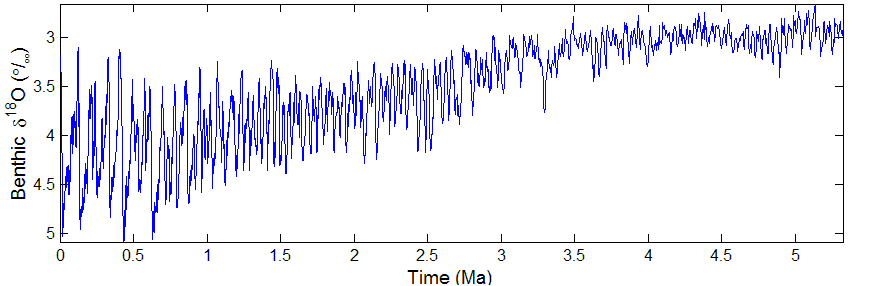 Here is a temperature reconstruction of the last 65 million years to put that into perspective. Note that the oxygen isotope "thermometer" is differently calibrated depending on the level of ice, so the first section is not strictly comparable to the last section of the graph.
 Over the last 600 million years,, every period of glaciation has coincided with CO2 concentrations less than 1000 ppmv. Note that this graph has an effective resolution of 10 million years. The entire period of the recent glaciation (double the length of the first graph) would appear as just one point on that graph.
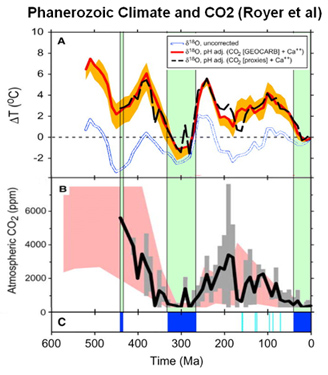 Obviously a lot can happen in 10 million years, and more detailed measurements have indeed shown in the episodes of glaciation during high CO2 levels as shown above, the duration of the glacition was short (< 10 million years) and that during the glaciation, CO2 levels where low (< 1,000 ppmv).
-
CO2 is just a trace gas
Tom Curtis - 40 W/m^2 escapes directly through the atmospheric window. However, ~160 W/m^2 leaves the ground through various means (IR, evaporation, thermals, minus 333 W/m^2 back-radiation). And ~80% of that energy leaves the surface via IR. But yes, convection is a major contributor to that heated atmosphere being able to radiate to space. A good thing, too - an average temperature 10 degrees C under boiling would be, um, uncomfortable... -
Just Deserts: Winning the 2011 Eureka Prize
Aye, congrats John -- and a hearty ditto to KR @ 3. -
Just Deserts: Winning the 2011 Eureka Prize
And also congrats to the team supporting John here. A true labor of love (since, after all, you're not getting paid for it), and very well done - contributors, moderators, and the regulars who spend time posting.
Prev 1524 1525 1526 1527 1528 1529 1530 1531 1532 1533 1534 1535 1536 1537 1538 1539 Next






