



 Arguments







Recent Comments
Prev 1602 1603 1604 1605 1606 1607 1608 1609 1610 1611 1612 1613 1614 1615 1616 1617 Next
Comments 80451 to 80500:
-
Eric the Red at 00:14 AM on 22 July 2011Climate's changed before
Tom, To what consensus are you referring? If you mean that temperature have risen globally or that atmospheric CO2 has increased, then yes. But, if you are referring to how much CO2 has contributed to the observed warming, and how much warming we can expect in the future, then I am afraid we have a long way to go to reach a consensus. Predictions have been all over the board, however as any fortune teller or stock broker will say, "make enough predictions, and some will come true."Moderator Response: [Dikran Marsupial] Actually the world climatologists are in pretty good agreement about the contribution of the CO2 to the observed warming etc. You may disagree with this, however it is for you to provide evidence to back up your opinion. Secondly the projections have not been "all over the board"; the uncertainties of the projections are high; that is not the same thing. Now this part of the thread seems to be heading to a point where no progress is likely to be made, and posts become indistiguishable from trolling. So unless you want to provide an evidence based argument with references to sources backing up your position, I suggest we all move onto a more substantive issue. -
Eric the Red at 00:08 AM on 22 July 2011It's Pacific Decadal Oscillation
As mentioned, whether PDO drives ENSO variations or is just an index of ENSO changes deos not matter to its temperature influence. Yes, it would be nice to understand what causes these fluctuation, but as long as we can measure the response, we can attribute the effects on the temperature record. The PDO was positive from 1977 - 1998, and could have contributed to the obserbed warming during that period. For the next decade, it oscillated around 0 until around 2008, when it turned negative. Compare the following graph to temperature graphs. http://en.wikipedia.org/wiki/File:PDO.svg The fact that Tamino can correlate temperatures to ENSO (or PDO) should indicate that it is a factor. How great a factor is still under investigation. -
Stephen Baines at 23:55 PM on 21 July 2011It's Pacific Decadal Oscillation
The poodlebites...A recent paper on global SO2 emissions 1850-2005. The US and european emissions have declined since the early 80s due to cap and trade, but China and other developing areas have been increasing exponentially, making up the difference. SO2 emissions have varied between 110 and 130 Gg/year since about 1960. -
skywatcher at 23:51 PM on 21 July 2011It's Pacific Decadal Oscillation
#88: Surely if, given that the most likely causal relationship is that ENSO drives PDO and not vice versa, we are likely to see more 'negative' PDO state if we have more frequent La Ninas? So your last sentence is in effect backwards. As ENSO is already factored into climate attribution (most recently and most neatly by Tamino), there is no great mystery, at least in relation to PDO. I prefer PDV, with V for variation, as there is no demonstrated cyclic pattern; additionally the 'cool' part of the variation has large positive heat anomalies in the central North and south Pacific. -
thepoodlebites at 22:30 PM on 21 July 2011It's Pacific Decadal Oscillation
#87 Tom Curtis Do you have a cite for variations in anthropogenic SO4? The EPA shows that U.S. trends in SO2 have been decreasing since 1981. And SO4 concentrations are linearly correlated to SO2. Here's a good website for PDO. The PDO has been more negative than positive since 1998 and could account for some of the pause in surface temperature increase in the last decade. Since global temps are tracking scenario C the best, the pause can not be related to CO2 emissions, CO2 emissions have not stopped since 2000. If the negative PDO trend continues, we should see a shift from more El Ninos (80's, 90's) to more La Ninas (00's, 10's?). -
Jeff T at 21:24 PM on 21 July 2011OA not OK part 8: 170 to 1
I appreciate all the effort Doug Mackie has made to produce this series, but I find this posting confusing. Eq. 12 by itself doesn't really imply that adding CO2 decreases CO3--, since the total concentration of carbon would be larger. Consider the opposite: removing all CO2. The result would not be more CO3--, since there wouldn't be any carbon left. Figure 3 is misleading because it seems to imply some agent other than CO2 is changing the pH. -
CBDunkerson at 21:01 PM on 21 July 2011Sea level rise is exaggerated
Scientists conduct proper research Deceivers misrepresent that research 'Sceptics' rejoice that global warming is false Actual sceptics point out that they've been hoodwinked 'Sceptics' complain about the scientists. Not the people who tricked them Par for the course. It always makes me think that at some level 'skeptics' must KNOW their position is nonsense. Otherwise they'd feel some sense of outrage at being lied to. The only conceivable reason that 'skeptics' haven't run off frauds like Goddard, Monckton, and so forth after their numerous blatant falsities have been revealed is that they WANT to be deceived. Why else keep going back to people you know are lying to you? -
CBDunkerson at 20:47 PM on 21 July 2011Visions of the Arctic
Speaking of polar bear mothers and cubs, there is a new study coming out which attempts to quantify how MUCH ice loss has increased cub mortality. The researchers used tracking collars to identify bears who had engaged in long swims and then compared survival of their cubs vs that of bears which hadn't been forced to swim long distances. It has long been obvious (deniers notwithstanding) that retreating ice edges would increase cub mortality, but this is the first study to show that empirically. -
michael sweet at 19:17 PM on 21 July 2011Visions of the Arctic
A Pirate: The original post does not mention mothers and cubs in hibernation so it cannot be wrong as you described. It discusses bears at a whale carcass in the summer. You are trying to change the subject to cover your catastrophic error. Mothers and cubs are discussed in the articles linked in the comments above. You clearly did not read the background and have little understanding of polar bear ecology. Please limit your strong comments to subjects where you have read the background material. -
Tom Curtis at 16:57 PM on 21 July 20112010 - 2011: Earth's most extreme weather since 1816?
Norman @361, this is ridiculous. You take monthly figures from three different cities which means your observations are not controlled for geographical or seasonal variables. You then draw conclusions about the relation of three other variables as though the uncontrolled variables are completely inconsequential. If you are serious about this sort of analysis, you should gain daily data from a large number of stations, preferably with global coverage. You should then sort each stations data into separate categories based on the state of the ENSO index (or equivalent). You should then do a second sort based on month of the year. You should then test the correlation to temperature, humidity and rainfall for each of these subgroups to test the hypothesis. If the subgroups have too few samples for statistical significance, you should determine an anomaly for each subgroup, scale anomalies for a common standard deviation and then combine the scaled anomaly data to perform the test. Albatross may have suggestions on other variables you should control for (NAO?, AMO?, PDO?, IOD?, direction of wind for each station?) or how to improve the method. -
Philip Shehan at 15:58 PM on 21 July 2011Examples of Monckton contradicting his scientific sources
His Lordship's accolytes are out in force on Mr Bolt's website again today. This page and many other links have been provided in an attempt to enlighten these people as to this fraudster's record regarding his own cv and his misrepresentation of the science. As usual a number of these skeptics think it sufficient to say that the link comes from Skeptical Science (and other sites that tell them what they do not want to hear, so it must be rubbish. Skeptical science regularly gets this response on Mr Bolt's blog. I frequently point out that Skeptical Science acts as a ready reference collating service and summary for scintific arguments citing peer reviewed literature, authoritative bodies and comments from scientists and the critics should attempt to point out where these sources are wrong, rather than shoot the messenger (Skeptical Scince) they so hate. Neeedless to say, no such attempt is EVER made. -
Paul Magnus at 15:18 PM on 21 July 2011China, From the Inside Out
China is probably one of the most affected countries by climate change..... Algae Bloom Spreads Across Qingdao, China Beach (PHOTOS) http://tinyurl.com/Climateportal200 -
Norman at 14:07 PM on 21 July 20112010 - 2011: Earth's most extreme weather since 1816?
Eric the Red From an earlier post by Tom Curtis at 258 "As Norman correctly points out, humidity alone is not enough for a thunderstorm; but heat and humidity are both definite factors in the strength of thunderstorms. If you increase both, ceterus paribus you will increase the frequency and intensity of thunderstorms. As it happens, increased warming is also expected to increase Convective Available Potential Energy, another key factor (see maps in my 246." There is a lot of assumption that increasing heat and humidity will lead to more rain or more severe storms. Or this on from Albatross at 269 "So the short of it is that increasing the low-level moisture is likely to increase the chances for more intense/severe thunderstorms, and perhaps larger hail too. Work by Botzen et al. (2010) predicts that:" I did a little study of 3 cities in the United States. Kansas City, Miami and Birmingham to test what effect heat and humidity have on preciptiation. I used these resources for this study. Monthly temperature and precipitation data. Humidity levels of cities in study, using afternoon humidity when temp is highest. This nice little calculator. I made it easy and just used one atmosphere in all cases. Pressure does alter the calculation a bit but not enough to overcome some major observations. Convert relative humidity into specific humidity and enthalpy. Kansas City: S.H. specific humidity. Month High temp S.H.(g/m^3) enthalpy (j/gram) rain (mm) April 19 C 0.00790 39.3 83.1 May 24 0.0115 53.7 115.6 June 30 0.0164 72.8 120.1 July 32 0.0184 80.22 91.7 August 32 0.0187 80.97 91.9 Miami: S.H. specific humidity. Month High temp S.H.(g/m^3) enthalpy (j/gram) rain (mm) April 29 0.013 64.01 85.3 May 31 0.016 73.41 140.2 June 32 0.0193 82.57 216.9 July 33 0.0197 84.94 147.1 August 33 0.0204 86.64 219.2 September 32 0.0196 83.37 212.9 It seems Miami is the only city of the three that roughly follows the moisture/temperature equation in relation to moisture. But in July the preciptiation drops even though it has a higher energy and moiture content than June. Look at Birmingham Alabama. The month with very little moisture in the air and low energy has the most rainfall. Maybe cold air aloft has a lot more to do with precipitation than moisture and heat content of ground level air. Small study but it does show that heat content and moisture do not correlate well with preciptiation levels, but the combination of cold air aloft and moisture and heat below seem to be a good combination. My hypothesis would be that cold winters and springs with a warm gulf are the cause of severe weather and floods in the US. Miami may get much more rain than Kansas City, but the storms generally are not as intense and less likely to cause flooding. -
Tom Curtis at 14:00 PM on 21 July 2011Sea level rise is exaggerated
Camburn @167, the proper thing to do when you have flawed data is to report both the data and the flaws. So called "skeptics" have been very critical when climate scientists have supposedly done otherwise, as, for example, with "hide the decline". Of course, they did not do otherwise in that case; and it would be wrong for AVISO to not publish their envisat data, so long as they also publish their reasons for thinking it may be flawed. The problem here is not with AVISO but with people such as Steve Goddard, who purport to have a scientific education, and hence should be aware of the pitfalls and qualifications that exist in the data, but who publish a cherry picked selection of the data to a popular audience without any mention of the problems that may be involved. That is, IMO, dishonest. It deliberately cultivates misunderstanding in order to persuade people to a view point that is almost certainly false. -
Bob Lacatena at 13:49 PM on 21 July 2011Sea level rise is exaggerated
167, Camburn, First, if they did hold back the data until they were certain it was well calibrated, there would be a great hue and cry that they were hiding something, so they can't win. Secondly, scientists, the ones who actually use this stuff, know very well all of the details involved, what to trust, when to be skeptical, and so on. That you are naive about it is meaningless. Thirdly, the information that you failed to find is all available on the Internet. You only had to take the time to look yourself, instead of excepting it to be spoon fed, and then complaining that you felt cheated. This last point is, time and again, the problem at the heart of so called "skeptics." For all of their skeptical attitude, they stop the very moment they find something that supports their desired belief, and anything after that is just plain annoying, or part of a vast conspiracy, or incompetence, or whatever the denial flavor of the month is. So your rather arrogant sounding "aha" attitude is nothing but bluster and implied recriminations. The only thing wrong here is your apparent feeling (shared by too many "skeptics") that science exists to satisfy and/or entertain you personally. It does not. -
Camburn at 13:06 PM on 21 July 2011Sea level rise is exaggerated
To all: I have no problem that Envisat has errors. IF you note, on my original post, I pointed out that the rise in Envisat exceeded the rise of the other metrics. Anyways, I had asked repeatedly if the data was good data. I had a hard time believing that a major organization would present data publically with known errors, (at least to me now). Envisat should not be avaialbe to the public until these issues are addressed and corrected in my opinion. One would expect AVISO to be a credible source....it now appears that I have to view everything with a skeptic eye. Thank you all for pointing this out. -
Rob Honeycutt at 13:01 PM on 21 July 2011China, From the Inside Out
Dcrickett... I had to laugh out loud at the "Chinese manners" comment, just because I know exactly what he was likely talking about. It's a little shocking if you're not used to it. Particularly restaurant manners. I always say you can tell how fancy a restaurant is by how much stuff the patrons toss on the floor. From their side they always say that Americans (while very nice people) treat their friends worse than they (the Chinese) treat their enemies. I have to say, I totally, totally love exactly those types of exchange of culture. Being married to a Chinese person is a very enriching experience indeed. Never a dull moment. -
Dcrickett at 12:49 PM on 21 July 2011China, From the Inside Out
Rob Honeycutt: Thank you for being a gentleman with trolls and surly churls. Being a True Believer and Champion of Truth, Justice and the American (or whichever) Way does not excuse rudeness. My son married a fantastic woman who happens to be Chinese, a native of a (very) small city in Hebei Province. The two of them, with their two daughters, live in Silicon Valley. They still keep a promise of visiting her family back there every two years. (Some visits are for business, but most are for family.) But after some struggles with La Migra, her parents now come for extended stays. And there is a nephew of my daughter-in-law who is in grad school in Boston… The travels of the extended family are beneficial all around, and for more than the usual. Cross-cultural enrichment is for real, beneficial for more than just the family(ies) involved. And the most passionate environmentalist in the family, my ten-year-old granddaughter, has defended the travels most eloquently, but her defense is too lengthy for a comment. However, I beg to disagree with you over your advising people in general to visit China (or anywhere else) for the sake of the broadening experience. A (former) friend visited China as a tourist some years back, and all he came back with was supercilious snobbish snide remarks about how bad Chinese manners are, how disagreeable the people are. (He did like traditional opera, though.) At a dinner party my wife and I hosted, he carried on at length, knowing full well of the origins of our daughter-in-law. He explained that he was merely telling the truth as he saw it, seeing no need for pretending that things are other than what they are. Such people should stay home; the atmosphere is not all that they foul. Separately, I very strongly suspect that there could well be means of transoceanic travel that are spectacularly less carbon intensive, but would have other drawbacks — like travel time. The Carbon Tax would/could be a great incentive as well as leveler. If a low-carbon low-speed trip to China were to have a tiny fraction of the carbon footprint of a high-carbon high-speed trip, let the business traveler whose time is so precious, or the wealthy flighty socialite, pay for the speed. Letting the rich and the foolish pay taxes for the poor and the prudent would eliminate a lot of any possible justification for so much of the twaddly blathering on a lot of blogs. -
Tom Curtis at 12:05 PM on 21 July 2011Sea level rise is exaggerated
Camburn, when the data for Jason and Envisat are compared over the same latitudes and over areas deeper than 1000 meters, Envisat still shows a negative trend relative to Jason for Mean Sea Level, along with much larger semi-annual fluctuations in sea level (see the first graph for "Cross comparison of performances".) At the same time, Envisat is known to have major instrument problems (from the same link):"USO anomaly: In February 2006, the RA-2 Ultra Stable Oscillator (USO) clock frequency underwent, for an unknown reason, a strong change of behavior. The anomaly consists in a bias, superposed with an oscillating signal with an orbital period. Auxiliary files are distributed since mid 2006 allowing the users to correct the range from this anomaly. The anomaly periods are detailed beside Loss of the S-Band: On the 17 January 2008, a drop of the RA2 S-band transmission power occurred. There is thus no more dual frequency altimeter both in Side A and Side B"
Further, Jason is known to agree with buoy data, while Envisat disagrees. This is true not only for sea level, but also for wave height:"Collocation criteria of 50 km and 30 min yield 3452 and 2157 collocations for Jason-1 and Envisat, respectively. Jason-1 is found to be in no need of correction, performing well throughout the range of wave heights, although it is notably noisier than Envisat. An overall RMS difference between Jason-1 and buoy data of 0.227 m is found. Envisat has a tendency to overestimate low Hs and underestimate high Hs. A linear correction reduces the RMS difference by 7%, from 0.219 to 0.203 m."
The logical conclusion is that the difference between Envisat and Jason is due to instrumental error in Envisat. -
Killian at 10:58 AM on 21 July 2011China, From the Inside Out
Rob, absolutely no antagonism. I failed at PC-speak, is all. I fully embrace all open source, all the time. We can't dance around these issues. As long as it is considered impolite to speak directly and urgently, we're not going to fix this. Systems analysis, risk analysis and reports such as the Hirsch Report illustrate we are responding far too slowly to this emergency. "I don't, though, have as pessimistic view as you apparently have." I did not say I was pessimistic, I stated some criteria for success. "I think there are lots of solutions out there that can help humanity avert a complete collapse of civilization." I agree. I suspect we will disagree on some of them. ;) E.g., most people start with efficiency, which cannot possibly get us close to solutions (diminishing returns, resource limits), but can only be a smallish plank. Innovation also cannot solve this problem I allude to, specifically, Tainter's observations on solving problems of complexity, i.e., they can't be solved with greater complexity. People tend to fail to note innovation in the past occurred within contexts of plentiful resources. Complexity and non-linear systems theory lead us to conclude rationing of resources will have unintended and unanticipated consequences. I do believe and understand the solutions to be embarrassingly simple. Unfortunately, humans are not. Getting back to your first comment, the conversation has got to become clear, direct, and unflinching. We didn't deal with WWII by dancing around the issues. This is far bigger than that. My 2c. -
Doug Mackie at 10:43 AM on 21 July 2011OA not OK part 8: 170 to 1
Thank you Bern. We knew if we chucked down 15,000 words in one go people would not read any of it. We are taking in the comments as we go and will incorporate answers into the booklet that comes out at the end. -
Bern at 10:33 AM on 21 July 2011OA not OK part 8: 170 to 1
Thanks again for the series. It's been 20 years since I studied any chemistry (and only got up to introductory undergraduate level as part of my engineering degree) so it's a good refresher for the things I knew, and educational about the things I didn't. While I find the wait for the next 'episode' somewhat frustrating, I think the pace of the articles is good - laying the foundations firmly along the way. -
Rob Painting at 09:27 AM on 21 July 2011Sea level rise is exaggerated
Camburn - Envisat has a drift problem as pointed out by Albatross @ 159, & Sphaerica @ 163, whereas ARGO, JASON, TOPEX (now defunct) and tide gauges all show rising sea level trends. Von Schuckmann and Le Traon in fact use the AVISO satellite altimetry data to validate their 'box-averaging' method. So any contradiction is purely imagined on your part. Is sea level rising long-term? Yes. But look at the satellite, tide gauge and ARGO data - there is considerable year-to-year variability. What do you think that means? -
Doug Mackie at 08:49 AM on 21 July 2011OA not OK part 1
Paul W@28: We will discuss this in post 16 (long time to wait I know) but briefly: Calcification is better described as a function of carbonate concentration (or saturation state, omega) than a function of pH. In surface water for constant alkalinity typical of surface seawater (more on this in a later post) a pH of 8 implies about 190 umol carbonate per kg of seawater. At pH 8.14, there is about 150 umol carbonate /kg. So you are correct - seemingly small changes pH can have noticeable differences in carbonate concentrations. But, calcification can still happen at these levels – see later posts -
Bob Lacatena at 08:25 AM on 21 July 2011There's no empirical evidence
171, cloa513,Its just pushing the all the blame on to industry when individuals consume the electricity and resources.
Yeah, and in the seventies it was pushing all of the blame on the tobacco companies when it was the people doing the smoking. It wasn't the tobacco companies' fault that so many smokers believed their arguments that the science was wrong, and smoking didn't cause cancer. It wasn't until the government enforced packaging and advertising regulations that people wised up. But then, that's their own fault for being so easily fooled, isn't it? There's no reason in the world why we shouldn't expect history to play out differently this time, right? -
Rob Honeycutt at 07:45 AM on 21 July 2011There's no empirical evidence
Every time I've heard this "empirical evidence" bit the goal posts immediately begin to shift. When I start putting forth the evidence the person's definition of "empirical" and "evidence" start moving all over the place. If you promise to stand still we can show you more evidence than you'll ever be able to process on your own. -
Rob Honeycutt at 07:15 AM on 21 July 2011China, From the Inside Out
Killian... Other than a slightly antagonistic tone I don't have much in the way of disagreement with you. Stabilizing population growth is probably one of the most important aspects of climate change. The whole world can clearly not live like Americans do today. No argument there. I don't, though, have as pessimistic view as you apparently have. I think there are lots of solutions out there that can help humanity avert a complete collapse of civilization. My greatest concerns are fossil fuel energy interests who want to forestall any developments that would help us move forward. I think we can raise the standard of living of most of the world's population. Not using current energy resources. Using solar and wind, yes. Probably. As for raw goods resources, we need to be looking at how to recycle most all that we use. Make things last longer. Make them fully "up-cyclable" as opposed to "down-cyclable." There are many complex aspects to the problem. But there are also many many smart people all looking for innovative solutions. -
dana1981 at 07:06 AM on 21 July 2011Lessons from Past Climate Predictions: William Kellogg
Thanks GFW. We actually have intended to do a post on the various measures of climate sensitivity. I'll check on the status of that, now that you mention it. -
GFW at 06:50 AM on 21 July 2011Lessons from Past Climate Predictions: William Kellogg
BTW, overall this is well written, and an excellent illustration of the way researchers advance a field - just as Dikran pointed out. I posted two very small (hopefully constructive) criticisms, but I'm certainly not criticizing in general. -
GFW at 06:46 AM on 21 July 2011Lessons from Past Climate Predictions: William Kellogg
Dana, actually I agree with Tony that at a minimum, the first use of "equilibrium" in such an article should be footnoted that it's Charney, not Earth System, and here on SkS, that footnote could point to a full article on the difference. Paleoclimatologists have to think in terms of Earth System sensitivity, so there are a few articles around where that sensitivity is mentioned or implied. Someone new to the field (e.g. a member of the public, new to SkS) could get confused depending on which articles they'd read. -
jeff_from_ky at 06:43 AM on 21 July 2011Climate Solutions by Rob Painting
Thanks, CB. After going to that site, I followed some links and did some more searching and have found some papers with some estimates of tons of carbon captured per acre per year. I'll do some additional research and some calculations and post my results. Jeff Nelson Paducah, KY -
GFW at 06:40 AM on 21 July 2011Lessons from Past Climate Predictions: William Kellogg
Under lessons learned, the 5th bullet point is a direct consequence of the 2nd. Perhaps it should be made a sub-item under the 2nd bullet point. I.e., by assuming no lag, one gets both that the instantaneous sensitivity = the equilibrium sensitivity instead of being only 2/3 of it, and a linear temp increase from an exponential CO2 increase. -
Killian at 06:35 AM on 21 July 2011China, From the Inside Out
A few quick hits. - I see no discussion, and little evidence of understanding, sustainability in these discussions. This is common because most people are not fully into systems thinking, and, frankly, it is virtually impossible to actually audit the energy/resource footprint of anything. I like to make this point simply: Oil. if all people lived like Americans we'd literally run out of all recoverable oil, including fantasy oil that is likely unrecoverable, in about 18 years. These kinds of simple extractions highlight what prof. Al Bartlett calls the greatest failing of mankind: to not understand the exponential function. So, let's say the eventual 9 - 12 billion people all ride bicycles. We need 6 billion or so bicycles. And 12 billion bicycle tires. At what replacement rate, if they are the primary mode of transport? Where do we get all that rubber? And at the expense of what? What about food? if we keep growing food like the Big Ag companies do, we will be out of phosphorus by the end of the century. Good luck with that! Without going too far into this, my point is simple: there is no solution for 9 - 12 billion people that leaves us with a world that is largely like the one we live in today. Feel free to keep arguing about how many plane miles we should be flying, but unless and until you start doing true whole system analysis, you haven't got a clue and cannot solve these problems. And that's without addressing hundreds, thousands of additional interactions. This is a very complex system that is overloading the ecological services of the planet by at least 50%. Your future will not look like this one. Get over it. You are failing forward until you do. [snipped] -
Camburn at 06:34 AM on 21 July 2011Sea level rise is exaggerated
I don't read Mr. Goodards blog, and I, up till a few weeks ago, have very seldom read Wattsup blog. As far as denialist, you will have to do better than that. -
Bob Lacatena at 06:20 AM on 21 July 2011Sea level rise is exaggerated
Don't blame poor Camburn. He's just echoing the siren calls of the great minds ofdenialismskepticism, like that Arctic ice prognosticator of prognosticators Steven Goddard. Goddard has a post about how the evil scientists that launched and run all of these nefarious, one-world-government-oriented satellites have hidden the decline in sea level rise by using a hard-to-notice color (yellow) for the Envisat data on their graphs. Evil, yellow-wielding scientists! Curse them and their foul color choices! He fixed that on his blog (by changing the one he likes, Envisat, to blue, while one he doesn't like, Jason-1, to the yellow that was originally assigned to Envisat... I don't know why he didn't do away with yellow completely and use black, maroon, dark green, dark gray, or any other clearly visible color -- pot, meet kettle kind of thing):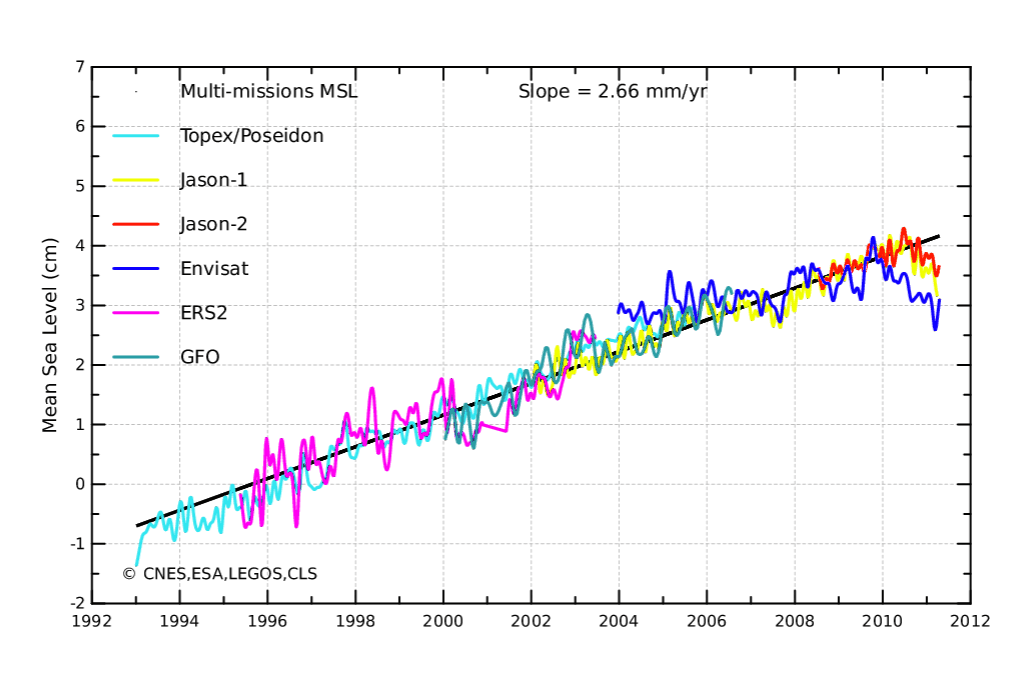 Of course, the fact that none of them seem to notice how closely all of the other data sets agree, while Envisat is a clear outlier that is off throughout its existence, doesn't appear to enter their observations or logic at any point. It couldn't possibly be that the Envisat data as currently badly calibrated, could it?
I can see the post a year from now, when they sort it out and the cry becomes that they "homogenized" the data to look the way they want it to. You can't win with some people (some = those with a serious confirmation bias wired into their nervous systems).
Of course, the fact that none of them seem to notice how closely all of the other data sets agree, while Envisat is a clear outlier that is off throughout its existence, doesn't appear to enter their observations or logic at any point. It couldn't possibly be that the Envisat data as currently badly calibrated, could it?
I can see the post a year from now, when they sort it out and the cry becomes that they "homogenized" the data to look the way they want it to. You can't win with some people (some = those with a serious confirmation bias wired into their nervous systems).
-
CBDunkerson at 04:36 AM on 21 July 2011Climate Solutions by Rob Painting
Hi Jeff. The amount of carbon sequestered in a tree can vary wildly by species, age, location, et cetera. The U.S. Forest Service has a Tree Carbon Calculator which might be useful for getting an estimate. The tool was designed to work with Microsoft Excel, but you may be able to get by with OpenOffice or some other compatible spreadsheet. -
KR at 03:57 AM on 21 July 2011Sea level rise is exaggerated
Camburn - It should be clear to you by now that Envisat data is still being calibrated, and is not currently a reliable data set. As opposed to the Jason/TOPEX data, which have much smaller drifts when calibrated against tide gauge data. Hence the Envisat dataset is not (yet) a basis for disputing sea level rise. I believe that over the next few years the various instrumental issues with Envisat will be identified and corrected for, much as satellite surface temperature records have been. As was noted earlier by another poster, though, I suspect you presented the Envisat data as something that agreed with your preconceptions. You did not take sufficient care to ensure that this was quality data, and certainly did not take into consideration the statistical significance of it given the short timeline. You need to pay more attention to the possibility of confirmation bias. -
Albatross at 03:37 AM on 21 July 2011Sea level rise is exaggerated
Camburn @158, "it appears that the error bars are so large for all satillite data at this point that it is unrealiable." Argumentum ad absurdum. Also, intriguing that you deduce that when their first line states: "This demonstrates in two independent ways the reliability of the global MSL evolution deduced from the Topex and Jason-1 altimetry missions." Your claim might apply to the Envisat data, but not the other satellite data. Note the excellent agreement between those data and the global tide gauge data shown in the post @151.Moderator Response:[DB] I appreciate the passion and conviction, but you are no doubt aware that all efforts to convince your primary target will bear no fruit.
-
Albatross at 02:46 AM on 21 July 2011Sea level rise is exaggerated
Data from von Suckmann and Le Traon (2011), experts in this field, clearly contradict your claims Camburn: "Our revised estimation of GOIs [Global Ocean Indicators] 25 indicates a clear increase of global ocean heat content and steric height. Uncertainty estimations due to the data handling reveal that this increase is significant during the years 2005–2010 (this does not mean, of course, that these are long term trends). Global ocean heat content changes during this period account for 0.55±0.1W m−2 and global steric rise amounts to 0.69±0.14 mmyr−1." The steric rise has decreased recently, but it is certainly not "virtually flat" (whatever that is supposed to mean-- anything you want I guess). -
Albatross at 02:39 AM on 21 July 2011Sea level rise is exaggerated
Camburn, I doubt very much had those Envisat data been showing a faster rate of increase in the GMSL than the other products that you would have been so quick and eager to post them here. "So, either there is someone wrong with the Evistat data" Indeed there does appear to be an issue with those data. Please follow and read the link provided above. The drift issue (see below) applies to the data after 2004. As clearly shown in my previous post, the Envisat sea-level data have issues at this time and should not be considered reliable. [Source]
-
Camburn at 02:34 AM on 21 July 2011Sea level rise is exaggerated
Albatross: Thank you for the link. After reading it, it appears that the error bars are so large for all satillite data at this point that it is unrealiable. "This demonstrates in two independent ways the reliability of the global MSL evolution deduced from the Topex and Jason-1 altimetry missions. Nevertheless, this budget should be refined further in order to estimate the impact of error sources which have not yet been taken into account such as the contribution of the ocean covered by ice and eventually the impact of very long ocean tide periods (18.6 years)." Certainly changes my view on the valilidity of salillite measurements of GMSL. -
Camburn at 02:24 AM on 21 July 2011Sea level rise is exaggerated
Albatross: Yep.....confirmation of bias, to question if the posted results are correct. That is really some bias. Thanks for the info on Envisat. They indiate that the results after cycle 22 should be viable...right? Are they? -
Camburn at 02:20 AM on 21 July 2011Sea level rise is exaggerated
Albatross: The Von Schuckman paper is one of the reasons I am questioning the results of the Evistat satillite. As I said, there is no physical reason for sea level to have been virtually flat for the past 6-7 years. I don't know how to post pictures. I have tried, but can't seem to get that to work yet. So, either there is someone wrong with the Evistat data, which I have not read about, or there is something that we don't understand. -
dana1981 at 02:17 AM on 21 July 2011Lessons from Past Climate Predictions: William Kellogg
Thanks Dikran and Tony. I believe in most cases we're talking about Charney equilibrium sensitivity, Tony. If I'm not mistaken, few climate scientists outside of Hansen spend much time looking at Earth System Sensitivity. -
Albatross at 02:13 AM on 21 July 2011Sea level rise is exaggerated
Whilst chasing down Camburn's unsubstantiated claims, I came across this comment on the Aviso website: "On the other hand the drift obtained with the Envisat MSL is more significant, approximately 0.45 mm/year. This is currently being investigated and could possibly be explained by stability problems for the correction of the wet troposphere and instrument corrections." They also say elsewhere on the page that: "During the first year (cycles 9 to 22) Envisat MSL global trend is not consistent to other flying satellites. This unexplained behavior is under investigation. Results plotted here are obtained after cycle 22 (beginning of 2004)." So while the Envisat coverage is better, north of 66 N and S, it appears that the data have unresolved issues. It would thus be unwise to place emphasis on these Envisat sea-level data until the drift issues have been identified and corrected. Now this is interesting, a so-called 'skeptic' identified those Envisat data and believed the results at face value, likely because those data told him what he wanted to believe. That is not skepticism, it is confirmation bias folks. And this is all ignoring the foolhardiness of looking at such short periods of time that are not statistically significant. -
jeff_from_ky at 02:02 AM on 21 July 2011Climate Solutions by Rob Painting
Been lurking for several years, first post. My wife and I have been trying to live a sustainable life since the early 70s. In 1987, we moved to 10 acres in western Kentucky and built our passive solar home. Winter heat is provided with a combination of passive solar and wood heat. We do use summer AC, but we installed the highest SEER unit we could and keep thermostat set at 78 F (humidity here is a much bigger problem than the heat itself). Keep our driving to a minimum (less than 6000 miles last year), and hope to buy an EV in the next couple of years. Clothes drying uses a solar powered dryer (100' of cotton rope). Replaced all lights with CFLs. When an appliance dies we replace with the most energy efficient model we can. Other than gasoline for the car, all of our purchased energy is electric. Our average usage, year round, is 17KwH per day. I'm working on a few other projects to cut that even more. I do have one question for the group. When we moved to our 10 acres, the land was used for agriculture (corn and hay). We have spent the last 20+ years restoring the land to native, deciduous forest. Simply for my own curiousity, does anyone know how I might estimate approximately how much carbon we have captured over the years with our (small) reforestation project and how much additional carbon we capture each year? I like to think that our forest is reducing our carbon footprint, but I'd like to estimate by how much. Thanks, Jeff Nelson Paducah, KY -
pbjamm at 01:53 AM on 21 July 2011Examples of Monckton contradicting his scientific sources
I listened to as much of the debate as I could stomach. His Lordship's primary arguments were that consensus is not science, we should return to doing real science (whatever that means), and that it is all a Marxist conspiracy. Also a few Nazi references thrown in for spice. All very emotional without any science content. Pretty standard really. -
Rob Honeycutt at 01:34 AM on 21 July 2011China, From the Inside Out
Paul D... But it makes no sense to quit their jobs because ALL the jobs in that field require the same thing. This is specifically an industry level change that needs to happen. I know my industry quite well having worked in it for 20+ years now. There is no way you can get the product you want and need without going to the actual factories and working through the details. Sending samples back and forth would put you way off schedule. My industry is the outdoor products industry. Bags and clothing. Probably one of the most environmentally conscious industries around. Believe me, everyone is talking exactly about all this stuff and trying to do what they can without putting their companies at a competitive disadvantage. I do see companies trying to reduce air travel by asking their designers to stay longer in China on a trip and fly there less often. But eliminating those trips is a long way away. If any of my friends asked my advice on that issue I'd tell them not to quit their jobs. I'd tell them, if they drive, buy the first electric car they can afford. I'd tell them to put solar panels on their homes when they can afford it. I'd tell them to try to eat locally grown foods whenever they can. Most of them are already committed bicyclists so the EV may even be overkill. -
Tony Noerpel at 01:27 AM on 21 July 2011Lessons from Past Climate Predictions: William Kellogg
Dana Agreed, nice post and nice series. I suggest though that we should distinguish between Charney Equilibrium Climate sensitivity which includes only relatively fast feedbacks and Earth System Sensitivity which includes slow feedbacks. Maybe Kellogg's only mistake was the timing. :+) -
Albatross at 00:47 AM on 21 July 2011Sea level rise is exaggerated
Re, "....and when one adds the current data the GMSL is unchanged since 2004.' Please quantify this statement and compare it with analysis of data from other observation platforms. Thanks.
Prev 1602 1603 1604 1605 1606 1607 1608 1609 1610 1611 1612 1613 1614 1615 1616 1617 Next






