Arguments







Recent Comments
Prev 1740 1741 1742 1743 1744 1745 1746 1747 1748 1749 1750 1751 1752 1753 1754 1755 Next
Comments 87351 to 87400:
-
Arkadiusz Semczyszak at 20:25 PM on 10 May 2011Lindzen Illusion #5: Internal Variability
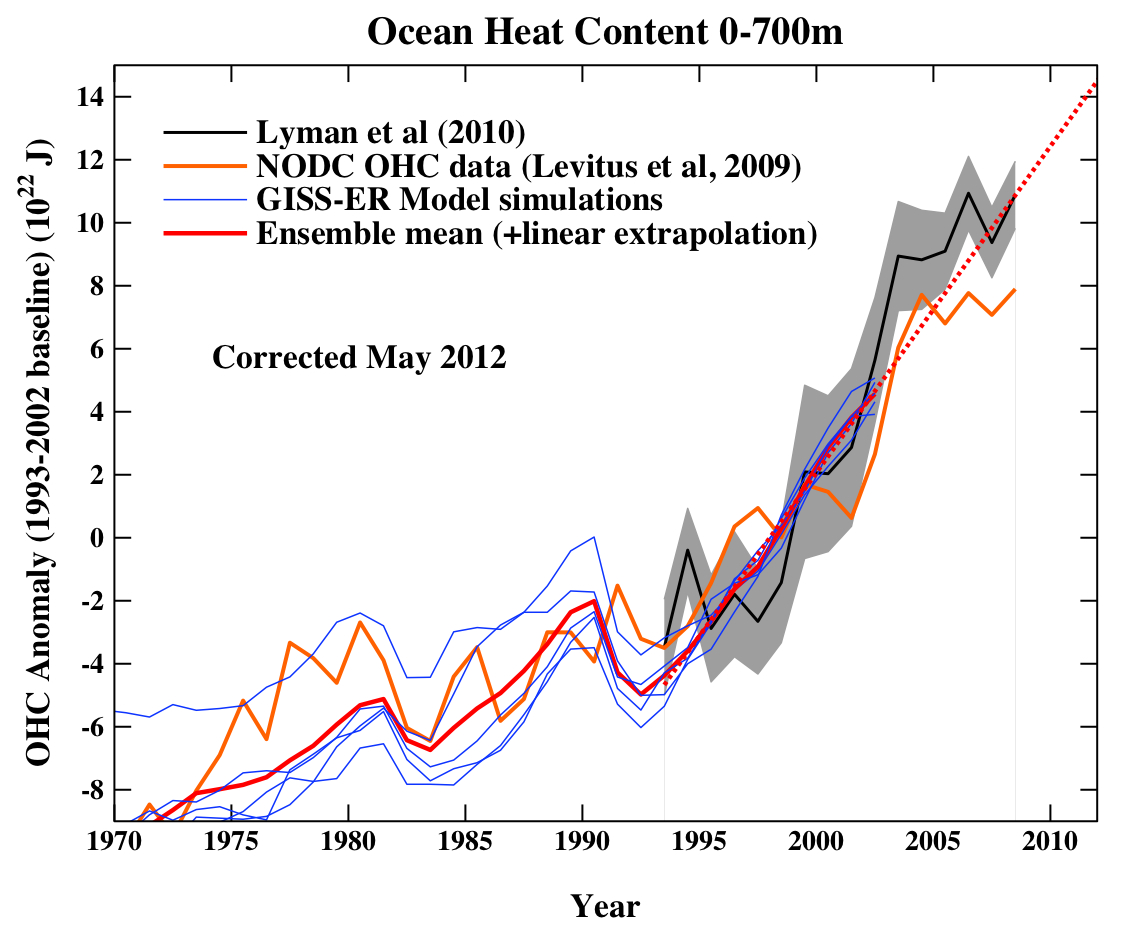
@KR. (and evidence of what writes johnny) “The energy accumulation in atmosphere, surface, and primarily ocean over the last 150 years or so is large and sustained ...” Ocean after 2003 - has stopped - at a fast rate - to collect energy. Change 1993-2003 is “a swept” - circa 90% growth this year 1993-2003 - the period of phase change (cold - hot) in the AMO + course ENSO (most of the energy is absorbed by the ocean in the tropics ). Hansen, Sato and Kharecha, ( Earth's Energy Imbalance and Implications, 2011.) explained it this way: “Aerosol climate forcing today is inferred to be ‒1.6 ± 0.3 W/m2, implying substantial aerosol indirect climate forcing via cloud changes. Continued failure to quantify the specific origins of this large forcing is untenable, as knowledge of changing aerosol effects is needed to understand future climate change. A recent decrease in ocean heat uptake was caused by a delayed rebound effect from Mount Pinatubo aerosols and a deep prolonged solar minimum.” Suddenly the sun and volcanoes are important? However, this is probably just the heat stable phase of the AMO and ENSO - internal variability ... Once again I remind the conclusions of the paper:Climate change and solar variability: What's new under the Sun?, Bard and Frank, 2006.: “Overall, the role of solar activity in climate changes — such as the Quaternary glaciations or the present global warming — remains unproven and most probably represents a second-order effect.” Cyclic variation and solar forcing of Holocene climate in the Alaskan subarctic, Hu et al., 2003.: “Our results imply that SMALL variations in solar irradiance induced pronounced cyclic changes in northern high-latitude environments. They also provide evidence that centennial-scale shifts in the Holocene climate were similar between the subpolar regions of the North Atlantic and North Pacific, possibly because of Sun-ocean-climate linkages.” Response of Norwegian Sea temperature to solar forcing since 1000 A.D., Sejrup,2010.: “The observed ocean temperature response is larger than expected based on simple thermodynamic considerations, indicating that there is dynamical response of the high‐latitude ocean to the Sun. [...]” “dynamical ...” - modulation of “internal variability”? I agree that external factors were most important in the last 500 years. Influence of human and natural forcing on European seasonal temperatures, Hegerl et al., 2011.: “In particular, we find that external forcing contributes significantly ( p <5 % ) to the reconstructed long-term variability of winter and spring temperatures and that it is responsible for a best guess of 75 % of the observed winter warming since the late seventeenth century. Summer temperatures show detectable ( p <5 % ) interdecadal variations in response to external forcing before 1900 only.” Here I disagree with this sentence: ” This warming is largely attributable to greenhouse-gas forcing.” In this paper is the conclusion that the volcanoes warm up - like a fingerprint - as A. GHGs - make the winters are warmer: “Finally, throughout the record we detect highly significant summer cooling and significant winter warming following volcanic eruptions. [!!!]” External forcing as a metronome for Atlantic multidecadal variability, Otterå et al., 2010.: “We find that volcanoes play a particularly important part in the phasing of the multidecadal variability through their direct influence on tropical sea-surface temperatures, on the leading mode of northern-hemisphere atmosphere circulation and on the Atlantic thermohaline circulation.” And the Sun (with a lag - "a second-order effect") affects the volcanic activity About possible influence of solar activity upon seismic and volcanic activities: long-term forecast, Khain & Khalilov, 2008. - see Pic. 5 and Pic. 6 (influence “a second-order effect”) - strict correlation. Volcanoes affect the ozone. And ozone has been discussed on this website a few days ago: "The ozone hole is not even mentioned in the summary for policymakers issued with the last IPCC report," noted Lorenzo M. Polvani, Professor of Applied Mathematics and of Earth and Environmental Sciences, Senior Research Scientist at the Lamont-Doherty Earth Observatory, and co-author of the paper. "We show in this study that it has large and far-reaching impacts. The ozone hole is a big player in the climate system!" "It's really amazing that the ozone hole, located so high up in the atmosphere over Antarctica, can have an impact all the way to the tropics and affect rainfall there - it's just like a domino effect," said Sarah Kang, Postdoctoral Research Scientist in Columbia Engineering's Department of Applied Physics and Applied Mathematics and lead author of the paper.” Testing solar forcing of pervasive Holocene climate cycles, Turney et al., 2005. : “The cycles, however, ARE NOT COHERENT WITH CHANGES IN SOLAR ACTIVITY (both being on the same absolute timescale), indicating that Holocene North Atlantic climate variability at the millennial and centennial scale IS NOT DRIVEN BY A LINEAR RESPONSE to changes in solar activity.” Gray et al., 2010. once again: “In discussion of solar forcing and global change, it is important to note that the climate system has a chaotic element, so the climate response to solar (and OTHER FORCINGS) can be attributed partly to forced variability and partly to INTERNAL VARIABILITY.” In addition: Solar forcing of the terrestrial atmosphere, Dudok de Wit & Watermann, 2009.: “... the main mechanisms by which the Sun affects the Earth are not the most immediate ones in terms of energetic criteria.” “- feedback mechanisms are not sufficiently well understood and positive feedback may be much stronger than expected ...” “According to the IPCC, over the last century, this impact has most likely been small as compared to anthropogenic effects. There are several important working fronts as far as the Sun–Earth connection is concerned. Most GCM whose development started in the lower atmosphere still largely ignore the upper part of the atmosphere on which solar variability has the largest impact.” Internal variability. According to Lindzen - internal variability is decisive - mainly through regional influence - globally decisive. The role of any external force (not just GHG) emissions - is - according to him - a very small minority, initiating change. I do not agree with him (The Sun is very important -"second-order effect"), but I think he does have "strong arguments" - in support of his claim. There is no place for his dishonesty. Dana1981 - once again, your analysis is absolutely too poor in the reference ... -
Arkadiusz Semczyszak at 20:16 PM on 10 May 2011Lindzen Illusion #5: Internal Variability
@Dana1981 - Even if you're right, "mercilessly" simplifies. A significant component of unforced multidecadal variability in the recent acceleration of global warming. DelSole, Tippett and Shukla, 2010. There is a sentence: “While the IMP can contribute significantly to trends for periods of 30 yr or shorter, it cannot account for the 0.8°C warming that has been observed in the twentieth-century spatially averaged SST.” ... but nevertheless (also): “The warming and cooling of the IMP matches that of the Atlantic multidecadal oscillation and is of sufficient amplitude to explain the acceleration in warming during 1977–2008 as compared to 1946–77 ...” In the past, even as big a change as the passage MCA - LIA may be caused by - “by INTERNAL VARIABILITY” Medieval Climate Anomaly to Little Ice Age transition as simulated by current climate models, González-Rouco et al., 2011.: “Therefore, under both high and low TSI change scenarios, it is possible that the MCA–LIA reconstructed anomalies would have been largely influenced by INTERNAL VARIABILITY. [...]” INTERNAL VARIABILITY is not only a redistribution of energy absorbed by the ocean, it is also a change in ocean circulation or strengthening - weakening - AMOC, ENSO, local circulation. It has an effect on the accumulation of energy by the ocean - change of place accumulation - the increase (and by changing the quantity of GHGs - water vapor, methane, CO2 - and the clouds - the spatial resolution). Today we see that part of the ocean, energy is lost - the obvious influence of ocean circulation. ... And for those circulations influences INTERNAL VARIABILITY. Solar Influences on Climate, Gray et al., 2010. : “... anthropogenic forcings are needed to explain the observations after about 1975. It should be noted that this is true globally as well as in many, but not all, regions, indicating that internal variability is larger in some regions than in others and also is larger than in the global means.” ... Top Of the Atmosphere (TOA): Estimations of climate sensitivity based on top-of-atmosphere radiation imbalance, Lin et al., 2009. . : “Currently, there is a lack of high accuracy measurements of TOA radiation imbalance.” “The range of feedback coefficient is determined by climate system memory. The longer the memory, the stronger the positive feedback. The estimated time constant of the climate is large (70-120 years) mainly owing to the deep ocean heat transport, implying that the system may be not in an equilibrium state under the external forcing during the industrial era.” “Furthermore, the climate feedbacks should include not only short-term (including instantaneous) responses but also longer time scale (or historical) responses because the climate generally has certain memories, which are omitted in these energy balance models.” “The range of feedback coefficient is determined by climate system memory. The longer the memory, the stronger the positive feedback. The estimated time constant of the climate is large (70 ~120 years) mainly owing to the deep ocean heat transport, implying that the system may be not in an equilibrium state under the external forcing during the industrial era.” @ adelady 1. The sun's been a bit cooler the last few years. And so what? The sun has always acted with considerable delay (probably many, many times I will have to resemble). Sub-Milankovitch solar forcing of past climates: Mid and late Holocene perspectives, Helama et al., 2010.: “Thus, the warmer and cooler paleotemperatures during the Medieval Climate Anomaly and Little Ice Age were better explained by solar variations on a millennial rather than bimillennial scale. The observed variations may have occurred in association with internal climate amplification [...] (likely, thermohaline circulation and El Niño–Southern Oscillation activity). THE NEAR-CENTENNIAL DELAY in climate in responding to sunspots indicates that the Sun's influence on climate arising from the current episode of high sunspot numbers may not yet have manifested itself fully in climate trends.” “... 70 ~120 years ...”, “... NEAR-CENTENNIAL DELAY ...” - After that time the climate will respond to the fact that: “The sun's been a bit cooler the last few years ...”, NO EARLIER !!! -
y-not at 18:46 PM on 10 May 2011Upcoming 'Climate Change Denial' book launches in Sydney and Canberra
The Vatican is suddenly calling for action on Climate Change, maybe Tony Abbott will hear that call. -
renemor at 18:41 PM on 10 May 2011Upcoming 'Climate Change Denial' book launches in Sydney and Canberra
Well, I already obtained it in Belgium, and read it eagerly ! I will keep recommending your book , which is encouraging in showing that denial may be managed by reason and faith in life. Thank you for this wide-encompassing treatment of the subject. It also encourages me in going to several of your references frequently cited in book. -
Tom Curtis at 18:01 PM on 10 May 2011Lindzen Illusion #6: Importance of Greenhouse Gases
Camburn @8, the model used by Schmidt et al is a Global Circulation Model configurable to twenty or twenty three atmospheric layers. Describing it as showing "what may happen in the atmosphere given slab role" is a gross distortion, and one for which you had no basis in claiming it. Just because a sound bite makes you comfortable in dismissing the science is no reason for you to utter it; and should you do so, our opinion of you will be revised down accordingly. -
Citizen99 at 14:43 PM on 10 May 2011Lindzen Illusion #6: Importance of Greenhouse Gases
It is pointless to discuss what percentage of the greenhouse effect is caused by CO2 relative to water vapor, because the simple fact is that the amount of water vapor is a function ONLY of the temperature, and of course the temperature is sensitive to the amount of water vapor. It is a recursive relationship. There is no "natural" source of water vapor that can be suggested as an alternative source of the last century's warming, because there is an ample inventory of liquid water, just waiting for some OTHER forcing to send it up into the atmosphere. That would be CO2 and CH4 from fossil fuel combustion. This argument of Lindzen's is a red herring, which as a physicist he knows very well. Only non-condensible IR-absorbing gases such as CO2 and CH4 can force the temperature upward, resulting in a higher vapor pressure of water and thus more water vapor, which amplifies the effect. -
scaddenp at 14:04 PM on 10 May 2011Lindzen Illusion #3 and Christy Crock #5: Opposing Climate Solutions
"Which studies are these? From the top of the Tibetan Plateau? The experience in Victoria is as low as 12.5% availability. " Whereas a trial one in our Capital is available 95% and overall I think our wind capacity is 41% (90-95% availability). And no, I don't think we are the Tibetan Plateau. Reference -
dana1981 at 13:47 PM on 10 May 2011Lindzen Illusion #6: Importance of Greenhouse Gases
Agnostic - no, we haven't invited Lindzen to respond. Camburn - we're not talking about climate sensitivity here. Try Lindzen Illusion #4. -
Ken Lambert at 13:38 PM on 10 May 2011Lindzen Illusion #3 and Christy Crock #5: Opposing Climate Solutions
"Seriously Ken, if you're not even going to *try* & be honest, then there is absolutely no point in even having a discussion with you." Accusations of dishonesty are explicitly against the comments policy. Are you exempt from this policy Marcus? Who is against Geothermal?, Tide of Wave generators? Many of these things work - just too expensively to be a viable economic alternative. Tell us their cost and we will tell you if they are starters of not. Elsewhere I have identified Geothermal as a 24/7 alternative base load source. Coupled with things like solar cooling and a pentane cycle - Geothermal is a contender. Trial plants are underway. Problems of scaling up, capacity and distance from loads have to be addressed to get decent cost projections. "Even in your example, that still represents an almost 300% mark-up. So either someone is gouging, or the costs of long-distance transmission & distribution are significantly higher than people such as yourself want to admit." Please tell us what price you will **buy** your 'renewables'. "Second of all, you keep citing low availability for wind power, when every official study shows a capacity factor of around 30% to 40%." Which studies are these? From the top of the Tibetan Plateau? The experience in Victoria is as low as 12.5% availability. -
Albatross at 13:30 PM on 10 May 2011Tracking the energy from global warming
KR and scaddenp, No worries. Yes, Hansen et al. (2011) is quite the paper, fantastic overview of the science. The von Shuckmann and La Traon paper is also impressive-- decimates Douglass and Knox's extremely poor effort.Response:[DB] BTW, Tamino has a real nice post on 5-year trends; tangential to this discussion.
-
scaddenp at 11:22 AM on 10 May 2011Tracking the energy from global warming
The Schuckmann and La Traon paper referenced is also pretty pertinent though note that it is also in press. -
Marcus at 11:06 AM on 10 May 2011Lindzen Illusion #3 and Christy Crock #5: Opposing Climate Solutions
Seriously Ken, if you're not even going to *try* & be honest, then there is absolutely no point in even having a discussion with you. First up, the ability to store energy-technology which is already available & relatively cheap-will actually improve the number of kw-h of electricity that renewable power can generate over its lifetime. Yes it will increase the capital cost, but the life-cycle cost will either be the same or possibly even lower. Second of all, you keep citing low availability for wind power, when every official study shows a capacity factor of around 30% to 40%. With storage, that capacity factor can be almost doubled. I've also pointed out that back-up does *not* have to come from coal or natural gas. Bio-gas is generated as a by-product of our everyday lives & could be easily burned to produce electricity in those rare instances when either solar or wind are not available. Also, why do you continue to ignore energy sources like tidal streams & geo-thermal, which are in no way hostage to the vagaries of weather systems, or to fluctuating fuel prices? Lastly, whether you choose to accept it or not, retail electricity costs in my area are close to 30c/kw-h. Maybe as a business user you get a discount, but you're really comparing apples & oranges. Either way, it still represents a massive mark up, given that generation costs are only 6c/kw-h. Even in your example, that still represents an almost 300% mark-up. So either someone is gouging, or the costs of long-distance transmission & distribution are significantly higher than people such as yourself want to admit. So my ultimate point is that, no matter how much you choose to ignore it, we can substitute a large proportion of our current coal-fired electricity use with renewable energy, especially if coupled with energy efficiency measures. -
Camburn at 10:59 AM on 10 May 2011Lindzen Illusion #6: Importance of Greenhouse Gases
Schmidt etal: [34] We conclude that, given the uncertainties, that water vapor is responsible for just over half, clouds around a quarter and CO2 about a fifth of the present‐day total greenhouse effect. Given that the attribution is closer to 20% than 2%, it might make more intuitive sense that changes in CO2 could be important for climate change. Nonetheless, climate sensitivity can only be properly assessed from examining changes in climate, not from the mean climatology alone [Annan and Hargreaves, 2006]. What this paper shows is what may happen in the atmosphere given the slab role. What it does not show is what the actual contributions of h20 vapor, clouds etc will have. This is a stab at sensitivity using a poor model to boot. -
Michael Hauber at 10:48 AM on 10 May 2011Why 450 ppm is not a safe target
I do not agree with picking a number such as 450ppm and declaring <450 is safe and >450 is dangerous. I do agree with Hansen that 350 is much more like a reasonable 'safe' number, but rather than consider that we are already in 'dangerous' territory, and risk some people concluding 'OMG we are ruined', I would prefer a more gradual approach, and consider that above 350 is 'risky' rather than 'dangerous'. By this I expect that for levels of warming up to about 2 degrees things will probably turn out quite ok. There will be some problems, but also some benefits, and nothing that we can't solve. But it is still not safe as we don't know for sure what can happen and there is always the chance something will go unexpectedly wrong and blow up bi time in our face (abrupt climate change, severe weather, methane clathrates etc) Like cigarettes. A few cigarettes probably won't kill you. But its just not safe and you want to reduce the number of cigarettes as much as possible as soon as possible. And trying to find a dangerous level foor Co2 is like stating that smoking more than 10k in a lifetime is dangerous, and getting all depressed because you've already smoked 12k so why bother quitting.... (and of course not like cigarrets because Co2 has benefits and is absolutely required for life in small amounts) -
scaddenp at 10:45 AM on 10 May 2011Tracking the energy from global warming
Blimey, that paper is pretty extraordinary. There is a great deal in it to digest. I look forward to the publication. -
Riduna at 10:04 AM on 10 May 2011Lindzen Illusion #6: Importance of Greenhouse Gases
Another very clear and concise explanation of why Lindzen is again wrong, though he does seem to have abandoned his beliefs of 25 years ago. The series of “Lindzen illusions” shows that he is wrong on a wide variety of issues and is rightly being held to account by SkS. Has SkS invited the attention of Dr Linzen to the series of “Illusion” articles it is publishing and, more importantly, has it invited him to respond? -
cwatts at 09:49 AM on 10 May 2011New SkS graphic: the Respiration Carbon Cycle
This isn't a bad graphic, but it might well be misinterpreted by some members of the farming community. There are a number of myths that seem to be quite peculiar to agriculture—or at least Australian agriculture, with which I'm most familiar. These include that methane levels have stabilized while livestock numbers have continued to rise and hence there is no connexion between the two. Or, that because methane is short-lived it isn't a problem (this one actually renders methane a priority for mitigation efforts). Another is founded on a fundamental misunderstanding of chemistry and physics: 'My cow is made of carbon and simply recycles the carbon dioxide it breathes out.' That this 'argument' completely misses key facts about enteric fermentation and methane is beside the point; it's out there, in the community, and being spouted by the leaders of peak farming lobby groups. The graphic might reinforce these myths, particularly the last one. -
dana1981 at 09:29 AM on 10 May 2011Lindzen Illusion #6: Importance of Greenhouse Gases
Bern and arch - Lindzen might still argue water vapor is "the most important" because of its role as a feedback. After all, he thinks climate sensitivity to increasing CO2 is low, and the reason he thinks it's low is because of his beliefs about the cloud feedback. -
dana1981 at 09:26 AM on 10 May 2011Lindzen Illusion #6: Importance of Greenhouse Gases
Lazy #3 - no, as the article notes, this is something Lindzen believed at least into the early 90s, but not anymore. -
Bern at 09:26 AM on 10 May 2011Lindzen Illusion #6: Importance of Greenhouse Gases
arch stanton: yep, it makes for an easy reply. When a skeptic asserts "Water is the most important greenhouse gas", the simple reply is thus: "Not even the scientist who said that still thinks it's true." -
KR at 09:12 AM on 10 May 2011Tracking the energy from global warming
Albatross - Thank you for the link and the information. It's great to see actual data and detailed analysis, rather than the subset analysis sometimes presented here as a skeptical argument. BP? Ken Lambert? I suggest you read the link Albatross provided to Hansen et al, in press 2011. I believe it to be a far more accurate and definitive description of the state of the climate than selecting the last 8 years starting with a high residual (i.e., 2003), or integrating poorly limited values over a century+ rather than looking at ongoing actual data. -
LazyTeenager at 09:11 AM on 10 May 2011Lindzen Illusion #6: Importance of Greenhouse Gases
I have been telling the skeptics who will believe anything, that it's a 20% contribution of CO2 to the greenhouse effect purely from consideration of the infrared absorption spectrum. So I can't understand why Lindzen is so far off the mark. Does he still believe his "orders of magnitude" claim? -
Berényi Péter at 09:09 AM on 10 May 2011Tracking the energy from global warming
#122 Albatross at 08:19 AM on 10 May, 2011 Now who to trust on the science, BP or Hansen et al.? Easy, Hansen et al. of course. Well, the last time I've checked no one was to be trusted on science. All you have to do is to understand what was being said and check the logic using your own mind. Admittedly, some effort and discipline is needed to stick to the subject at hand and not to talk about something else, but that's the price. Of course if you do not trust either CERES or ARGO data are presented faithfully, that's entirely another matter. And a serious accusation as well. But once the data are given as they are, the conclusion is inevitable. There is no missing heat, but there was some, in the past (it was not measured properly, that is). -
Albatross at 08:24 AM on 10 May 2011Tracking the energy from global warming
And more from Hansen et al. (2011), again highlights are mine: "A verdict is provided by the ocean heat uptake found by von Schuckmann and Le Traon (2011), 0.42 W/m2 for 2005-2010, averaged over the planet. Adding the small terms for heat uptake in the deeper ocean, warming of the ground and atmosphere, and melting of ice, the net planetary energy imbalance exceeded +0.5 W/m2 during the solar minimum. This dominance of positive climate forcing during the solar minimum, and the consistency of the planet's energy imbalance with expectations based on estimated human-made climate forcing, together constitute a smoking gun, a fundamental verification that human-made climate forcing is the dominant forcing driving global climate change. Positive net forcing even during solar minimum assures that global warming will be continuing on decadal time scales." -
Albatross at 08:19 AM on 10 May 2011Tracking the energy from global warming
Well, BP seems to believe that we are idiots or at the very least cannot grasp simple mathematical concepts. Hopefully he has more time and respect for Hansen, Sato, Kharecha and von Shuckmann (in review, 2011), but there are no guarantees on such maters with D-Ks. I have bolded some of the text: "The slowdown of ocean heat uptake, together with satellite radiation budget observations, led to a perception that Earth's energy budget is not closed (Trenberth, 2009; Trenberth and Fasullo, 2010), as summarized in Fig. 19A. However, our calculated energy imbalance is consistent with observations (Fig. 19b), implying that there is no missing energy in recent years. Note that, unlike Fig. 19b, real-world climate and planetary energy imbalance include unpredictable chaotic interannual and interdecadal variability. A climate model with realistic interannual variability (but muted El Nino variability) yields unforced interannual variability of global mean energy balance of 0.2-0.3 W/m2 (Fig. 1, Hansen et al., 2005)." And "An alternative potentially accurate approach to measure Earth's energy imbalance is via changes in the ocean heat content, as has been argued for decades (Hansen et al., 1997) and as is now feasible with Argo data (Roemmich and Gilson, 2009; Von Schuckmann and Le Traon, 2011). This approach also has sampling and instrument calibration problems, but it has a fundamental advantage: it is based on absolute measurements of ocean temperature. As a result, the accuracy improves as the record length increases, and it is the average energy imbalance over years and decades that is of greatest interest. The error estimated by von Schuckmann and Le Traon (2011) for ocean heat uptake in the upper 2000 m of the ocean, ± 0.1 W/m2 for the ocean area or ± 0.07 W/m2 for the planetary energy imbalance, does not include an estimate for any remaining systematic calibration errors that may exist. At least some such errors are likely to exist, so continuing efforts to test the data and improve calibrations are needed. The Argo program needs to be continued and expanded to achieve further improvement and minimization of error." Now who to trust on the science, BP or Hansen et al.? Easy, Hansen et al. of course. -
Berényi Péter at 07:54 AM on 10 May 2011Tracking the energy from global warming
#118 Tom Curtis at 07:30 AM on 10 May, 2011 And what do we see in this graph of the Net TOA anomaly? Why, a clear positive trend with a slight negative trend from 2008 to 2009. The reverse of the trends you show in your second and third graphs of post 109. Tom, you don't know what integral means, do you? Study it please and come back later. -
Albatross at 07:35 AM on 10 May 2011Tracking the energy from global warming
Tom @118, I was just busy posting the same message (more or less) when SAFARI crashed on me. I have downloaded the data and the slope of the OLS line is positive. Hansen et al. (2011, in review) also have some interesting insights on the alleged "missing" heat. -
Tom Curtis at 07:31 AM on 10 May 2011Tracking the energy from global warming
DB, thanks for the graphic fix. -
Tom Curtis at 07:30 AM on 10 May 2011Tracking the energy from global warming
Berényi Péter @117:"Yes. And what do you see in the "Heat Content Anomaly of the Climate System" graph? First derivative of the blue line changes sign from negative to positive at the beginning of 2008. Just the way it should."
And what do we see in this graph of the Net TOA anomaly? Why, a clear positive trend with a slight negative trend from 2008 to 2009. The reverse of the trends you show in your second and third graphs of post 109.
-
JMurphy at 07:03 AM on 10 May 2011Video on why record-breaking snow doesn't mean global warming has stopped
batsvensson, this is getting ridiculous so I will just write this, if I may be allowed to post one final off-topic distraction : Your assertion was seemingly based on a quote from The Discovery of Global Warming, which I linked to to show a prediction that "snowing will increase when the climate warms up" - something you asked for. I.E. your assertion was seeming wrongly based on one line of one paragraph from that link - a paragraph that ended thus : At a time when scientists could not explain the observed general circulation of the atmosphere, not even the trade winds, theories about climate change could be little more than an amusement. Also, you used the title of another link I provided to suggest that it was "not a prediction", even though, beyond the title and within the body of the article, was this : Recent increases in the water temperature of the Great Lakes are consistent with global warming,” said Burnett. “Such increases widen the gap between water temperature and air temperature – the ideal condition for snowfall. I.E. increased snowfall was expected and confirmed. Perhaps the use of the informal pronoun 'you', rather than the more formal 'one' was a mistake, but, to return to the accusation you have made, that was why I suggested reading more than the title and/or first line of anything. However, nowhere have I suggested that you "lacked proper knowledge" - as far as I can see. That would explain that particular puzzlement. Nor did I suggest that you did "not have proper understanding of English" - I suggested that, if English was your second language (which I don't know; which is why I asked), that might explain why my words looked different to you than they did to me; or why the way I used the language (perhaps more playfully than warranted) could be misinterpreted or (mis)construed. In conclusion : yes, I disagree with you on this. -
Bibliovermis at 06:20 AM on 10 May 2011New SkS graphic: the Respiration Carbon Cycle
rpauli (#5), The graphic neatly displays my standard response to any breath-related dismissal, e.g. "You breathe out CO2, stop breathing if you want to do something about CO2 emissions." All exhaled carbon recently came from the atmosphere. Plants absorbed it from the atmosphere and were then eaten. If you don't eat plants, you eat animals that ate the plants. -
Albatross at 06:10 AM on 10 May 2011Lindzen Illusion #2: Lindzen vs. Hansen - the Sleek Veneer of the 1980s
Thanks Dana, I think that figure @86 makes things abundantly clear. Maybe an updated version would be a useful addition to the main post? -
dana1981 at 05:39 AM on 10 May 2011Lindzen Illusion #2: Lindzen vs. Hansen - the Sleek Veneer of the 1980s
Alby #84 - Gavin made a figure similar to what you're asking for, though it's a little out of date:
-
Berényi Péter at 05:34 AM on 10 May 2011Tracking the energy from global warming
#115 Albatross at 02:42 AM on 10 May, 2011 I had a quick look at the abstract for the FLASHFLUX link you provided @113 and they state that the net radiation in 2008 increased by 0.8 W m-2. Now in my line of work at least, that means that there is an increase in the energy available to the system. Yes. And what do you see in the "Heat Content Anomaly of the Climate System" graph? First derivative of the blue line changes sign from negative to positive at the beginning of 2008. Just the way it should. Heat content is the temporal integral of radiative imbalance. If there is a step change in the latter one, local slope of the former one changes direction. Only there was more decrease in heat content between 2000 and 2008 (about -5×10²² J) than increase afterward (1.5×10²² J). It is pretty simple, really. -
John Bruno at 05:22 AM on 10 May 2011What scientists are saying about Skeptical Science
Rob, great points about obesity, smoking, skin cancer, etc. At least government (mostly) doesn't challenge the validity of these problems, but I agree, the policy response to them isn't as effective as they could be... -
John Bruno at 05:15 AM on 10 May 2011What scientists are saying about Skeptical Science
Hi Phlia and Rob, I was just thinking about the civil rights analogy before I checked back to SkS. I certainly agree; in the US civil rights movement and in fights for political rights (eg, Egypt 2011) mass civil disobedience makes sense and was obviously effective. I also think it can be effective for other social and moral issues, eg, gay rights and critical mass bike rides (advocating cycling rights). But these are all largely simple moral or policy issues, not complex scientific and socioeconomic ones like climate change. Was there a truth that needed to be explained to people and policy makers regarding discrimination and civil rights in the US in the 1960s? Maybe just the truth of humanity, equality and respect. Or maybe people just needed some prodding (and symbolism provided by Rosa P and others) to recognize these truths that don't need numbers or peer review or graphs or international working groups to be documented, proved and explained. Listen, I don't feel strongly about this and maybe I am wrong. I am certainly not against bad behavior either and I revere Edward Abbey (Hayduke lives!). I just can't see how that could help in this and some other environmental issues. Couldn't it just play into the narrative of "warmist" being wooly headed contrarian hippie pagans that loathe material culture? Which in my case, may indeed be true:) One exception I can think of is the actions by the Sea Shepherds to limit whaling in the Southern Ocean and the work by activists opposing dolphin slaughter in Japan. Somewhat effective; but largely again because whaling is a simple moral issue that primarily needs attention brought to it. There isn't a need to explain to the public all the science about whaling doing this, that and the other decades from now, etc. Know what I mean? What do you think? -
Albatross at 05:14 AM on 10 May 2011Lindzen Illusion #2: Lindzen vs. Hansen - the Sleek Veneer of the 1980s
Global surface air temperature (SAT) anomalies in the GISTEMP data for 2010 were 0.63 above the 51-80 baseline. I expect the global SAT anomaly to be between 0.80 and 0.85 C in 2020, compared to about +0.70 using a sensitivity of +3 K and best estimate of emissions between now and then. And now the elephant in the room-- using Lindzen's reasoning, we should expect a global SAT anomaly relative to the 51-80 baseline of just under 0 C in 2020, in other words still in negative territory! That is not surprising, b/c values based on his reasoning have been diverging from reality since the early eighties. Interestingly, that occurred before he made his comments in 1989 that are cited above. -
jyyh at 05:11 AM on 10 May 2011What scientists are saying about Skeptical Science
thinking complex systems like weather, oceanography or ecology (well, (economy)) it is near impossible to be well aware of all the studies involved in these, so, if I was a scientist I'd welcome more review articles by accomplished scientists, this place does the same sometimes on the level of science graduates, sometimes more generally so this is to me a good place to read of climate science and and communication of it (M.Sc, Biochemistry) -
Albatross at 05:00 AM on 10 May 2011Lindzen Illusion #2: Lindzen vs. Hansen - the Sleek Veneer of the 1980s
Hi Dana, Thanks for #78, that is what I was driving at. I'm not sure how people are trying to take away solace from these findings. A climate sensitivity of +3 K does not bode well for society, especially given that we will very likely easily double CO2. I see what is going on here, every effort must be made to obfuscate (and yes I do understand what it means angusmac) and detract form Lindzen's "prediction". Really, who do me trust, Lindzen who is an order of magnitude out or the science which has converged on +3 K for climate sensitivity, and a value which is in fact seems to produce temperatures that are a tad on the low side, with +3.5 or so providing the "best" fit using the observed radiative forcing, at least for these data. Now, what might help address some of the confusion (although I'm still not convinced the confusion in some quarters is innocent in nature) is a graphic (much easier to interpret than numbers) showing the observed radiative forcing since 1958 to present, together with the radiative forcing for the various scenarios. That will hopefully make is abundantly clear to certain "skeptics" that the relatively good agreement between Scen C is coincidence, or perhaps more accurately, the more-or-less correct answer for the wrong reasons. -
dana1981 at 04:52 AM on 10 May 2011Lindzen Illusion #2: Lindzen vs. Hansen - the Sleek Veneer of the 1980s
I should also note in comment #70 you said "I am not arguing for higher sensitivity." Then in comment #81 you asked "how long does it take for a coincidence to become reality?" If Scenario C "becomes reality", then climate sensitivity is 4.2°C for 2xCO2. So contrary to your previous claim, you are indeed arguing for high climate sensitivity. -
dana1981 at 04:42 AM on 10 May 2011Lindzen Illusion #2: Lindzen vs. Hansen - the Sleek Veneer of the 1980s
angusmac -"how long does it take for a coincidence to become reality?"
This is a bizarre question. How long does it take a hypothetical scenario which is not reality to become reality? An infinite amount of time. Unless you invent a time machine, go back to the late 20th century, convince them to phase-out GHG emissions, and then alter the global climate such that it has a short-term sensitivity of 4.2°C. If you can do that, Scenario C will become reality. Look, there are an infinite number of possible scenarios you could model. A large number would match observed temp changes reasonably well. But only one scenario matches reality, and it's not Hansen's C. That's just one of the many possible scenarios that so far match observed temps reasonably well. But we know it's wrong because we've measured the actual radiative forcing to a high degree of accuracy. There is simply no way Scen C matches reality. It just doesn't (unless you invent that time machine and a way to change the planet's sensitivity). There's a phrase "skeptics" like to use but don't seem to understand that it applies to their arguments too: correlation does not equal causation. -
Paul D at 04:26 AM on 10 May 2011New SkS graphic: the Respiration Carbon Cycle
rpauli@5 The cow is I assume a food source, a carbon/energy input for humans. One could also say it is third hand solar energy, after the tree (second hand). -
angusmac at 04:25 AM on 10 May 2011Lindzen Illusion #2: Lindzen vs. Hansen - the Sleek Veneer of the 1980s
Sphaerica@80, in which you state that, "Humanity, and civilization, are saved by a simple and convenient re-interpretation of history." There is no re-interpretation just a bald statement of historical measurements which show that the GISS LOTI real-world temperatures match Scenario C better than the other scenarios. If those pesky people at GISS choose to publish figures that are too low to comply with your preferred warming scenarios then it is not my fault. @79"Scenarios A, B, and C represent emissions growth patterns, not temperature predictions." I disagree. Hansen, in his 1988 congressional testimony, concentrated almost exclusively on discussing higher temperatures and the dire consequences of his (global) warming predictions. Similarly, Hansen (1988), quoted by you, expends most effort on temperature predictions and consequences thereof. He only expends one-third on emissions. DB @74, "This has been clarified multiple times on several threads." Not so. There have been many statements in SkS that Scenario C does not follow real-world emissions and consequently is irrelevant. There have been no clarifications; just repetition of the mantra that Scenario C is either irrelevant or a coincidence. I ask a simple question, how long does it take for a scenario that is nominally a coincidence to become reality? See below. Albatross@76 and Sphaerica@79, the Cambridge Dictionary defines to obfuscate as, "to make something less clear or harder to understand, especially intentionally." What could be clearer to anyone than the real-world emissions being significantly above Scenario C but real-world temperatures (GISS LOTI) following Scenario C? There is no obfuscation just a bald statement of facts. Yet, SkS repeatedly state that this is coincidence. Question: I repeat, how long does it take for a coincidence to become reality? Answer: I agree with the Hansen (2006) estimate that 2015 would be long enough to differentiate between the scenarios. This represents a period of 27 years from 1988 to 2015 but DB@74 seems to think that this is reinventing the flat tyre [I don't get the allusion]. If the real world is still following Scenario C in 2015 then there would need to be a rethink of climate sensitivity and/or forcings. Is this why SkS is so vehement in stating that Scenario C is a coincidence? Sphaerica@79, if I were to use your Scenario X with the following figures: Temperature Anomaly = 0.015175 x Year - 29.903 I would have an excellent model for the temperature anomaly between 2000 and 2011. Furthermore, if were to use this model to predict the anomaly for 2019 to be 0.74°C, and this prediction turned out to be correct, then you would have to agree that I had quite a skilful temperature model. Yet, there are no emissions used in this model. This would be a case of a dumb (empirical) model giving good results. If real-world physics gives poor results then I suggest that we need to re-examine the physics to give better results. Dana has started this process. The 3°C sensitivity model appears to give better results than Hansen's original Scenario B. It predicts 0.69°C for 2019 compared with 0.61°C in Scenario C. However, do be aware that this is not a "minor" change. This is a massive drop from the 1.10°C in original Hansen's Scenario B. -
F. Murdoch at 04:13 AM on 10 May 2011New SkS graphic: the Respiration Carbon Cycle
@4 seeohtoo I think that would unnecessarily complicate a simple graphic which drives the concept home with little more than a glance. Best just to think of the arrows as net contribution. -
Riccardo at 03:06 AM on 10 May 2011Tracking the energy from global warming
Apart from the obvious error in the sign of the imbalance (unless Stackhouse et al. misinterpreted their own data), I can see no reason why the 0-700 m OHC should follow the radiation imbalance with no delay. The average ocean mixed layer depth is much smaller than this. The simple direct comparison is definitely misleading. -
dana1981 at 02:58 AM on 10 May 2011Lindzen Illusion #5: Internal Variability
I find it rather irritating that Gilles tells us he doesn't have time to give us a physics lesson, then proceeds to make an unphysical argument. Some unnamed, unknown cause of centennial internal variability, which somehow makes both the oceans and air warm, is to blame? Sounds like a 'magical natural cycles' argument to me. For his next trick, Gilles will disappear! -
Albatross at 02:42 AM on 10 May 2011Tracking the energy from global warming
Tom @113, Re this comment made at #114: "Now I will have to wait until you realize your misunderstanding" This condescending attitude of BP's is not constructive or helpful. I had a quick look at the abstract for the FLASHFLUX link you provided @113 and they state that the net radiation in 2008 increased by 0.8 W m-2. Now in my line of work at least, that means that there is an increase in the energy available to the system. -
arch stanton at 02:40 AM on 10 May 2011Lindzen Illusion #6: Importance of Greenhouse Gases
…this is one of Lindzen's 1989 climate beliefs which has gone by the wayside, but unfortunately, remains a fairly widespread belief amongst global warming "skeptics". This is a useful factoid for those that counter denialists’ points in the ether of forums and comments sections. -
Albatross at 02:20 AM on 10 May 2011Lindzen Illusion #5: Internal Variability
Thanks Daniel. -
Berényi Péter at 02:19 AM on 10 May 2011Tracking the energy from global warming
#113 Tom Curtis at 01:52 AM on 10 May, 2011 I repeat, you have the sign wrong. Fine. You have repeated a false statement. It does not make it true. Now I will have to wait until you realize your misunderstanding, because it does not make much sense to proceed this way.
Prev 1740 1741 1742 1743 1744 1745 1746 1747 1748 1749 1750 1751 1752 1753 1754 1755 Next