



 Arguments







Recent Comments
Prev 1851 1852 1853 1854 1855 1856 1857 1858 1859 1860 1861 1862 1863 1864 1865 1866 Next
Comments 92901 to 92950:
-
grypo at 04:15 AM on 22 March 2011The Libertarian Climate Conundrum
@MattJ I agree with you about the Koch Brothers. They have destroyed the individualistic movement in the US over the last 30 or so years. But it goes beyond them hijacking an idealized version freedom, it is about replacing the pursuit of maximizing individual liberty through principle with a over-reaching trust in market fundamentalism. -
Berényi Péter at 04:13 AM on 22 March 2011It's not us
In the advanced version of The human fingerprint in global warming dana1981 writes: "Trenberth et al. (2009) used satellite data to measure the Earth's energy balance at the top of the atmosphere (TOA) and found that the net imbalance was 0.9 Watts per square meter". This proposition is false. What Trenberth has actually found in said paper is this: "There is a TOA imbalance of 6.4 W m−2 from CERES data and this is outside of the realm of estimates of global imbalances that are expected from observed increases in carbon dioxide and other greenhouse gases in the atmosphere" That is, Trenberth says satellite data are useless for measuring Earth's energy balance. Then he continues: "The TOA energy imbalance can probably be most accurately determined from climate models and is estimated to be 0.85 ± 0.15 W m−2". So. The energy imbalance is not measured, it is determined using computational climate models. Then, what he actually did to satellite data is described like this: "An upper error bound on the longwave adjustment is 1.5 W m−2, and OLR was therefore increased uniformly by this amount in constructing a best estimate. We also apply a uniform scaling to albedo such that the global mean increase from 0.286 to 0.298 rather than scaling ASR directly, as per Trenberth (1997), to address the remaining error. Thus, the net TOA imbalance is reduced to an acceptable but imposed 0.9 W m−2 (about 0.5 PW)". That is, he increased both OLR and albedo relative to actual data by amounts he considered acceptable in order to arrive at an imposed value of TOA imbalance. Therefore it's not true he has "found that the net imbalance was 0.9 Watts per square meter", but took a value based on model calculations and imposed it on satellite measurements. What Trenberth did is questionable, but defensible in a sense. Whenever you have next to useless data with unknown but large error margins, you either throw it away or do odd things to it in the hope at least something can be saved. If the data are as expensive to collect as CERES data are, NASA scientists have no choice but follow the latter path. On the other hand grave misrepresentation of Trenberth's pain as it is put by dana1981 above, is indefensible. Calculations can be verified against measurements, but they can never be verified against (the same!) calculations. That is, Trenberth's figure of 0.9 W/m2 net imbalance at TOA is still an unverified claim. There is an important difference in science between true and false statements. The latter kind implies anything along with its own negation, therefore it's a bit ill suited for deriving meaningful results. -
MattJ at 03:59 AM on 22 March 2011The Libertarian Climate Conundrum
@Honeycutt "Once laws take effect it's very hard to change them under our system of government." That is the problem. Now we are up against a problem so severe, we cannot afford to wait that long. Since we did no act in time, the whole world is going to be faced with more stress than any of the world words, more harm than any since the Black Death. Democracy is not going to survive this huge sea change. -
KeenOn350 at 03:59 AM on 22 March 2011Preventing Misinformation
Dana - A nice little summary of refutations of almost all the major denier idiocies. It amazes me that such clearly idiotic documents are still being put up on the web. -
Gilles at 03:53 AM on 22 March 2011Those who contribute the least greenhouse gases will be most impacted by climate change
les , I don't understand. My English may be poor, but "not nearly as rich as ..." doesn't have the same meaning as "nearly as rich as", does it ? JMurphy : I referred to gapminder as a convenient source for data and graphics, that you can easily display for all countries and throughout the history of industrial civilization. If you want me to post here tedious lists of numbers, I can do it too. -
MattJ at 03:51 AM on 22 March 2011The Libertarian Climate Conundrum
'grypo' got SO close to identifying the fundamental contradiction at the heart of Libertarianism -- and then shied away from exposing it! But sometimes, I think it is just as well that people shy away from it, since Libertarians are so committed to their broken ideology, the fundamental contradiction does not bother them. Such behaviour is typical of the poisonous ideological climate prevailing in Washington DC these days -- even since before Bush II. Unfortunately, it is even worse than that. As long as the Koch brothers maintain such a stranglehold on the Libertarian movement, they will not tolerate any attempt to steer that movement towards a realistic position concerning climate change. Why? Because it would crimp their already bloated income. grypo mentions the Cato Institute: but he did not mention that Davic Koch was one of the cofounders of the Institute, and they both fund it heavily. Google "cato funding koch brothers" to see numerous blogs and other sources exposing how they fund the Institute, Libertarianism, the Tea Party and climate change 'skepticism'. It is very sad that any political system, in the name of "individual freedom", will allow two individuals to do so much damage to the whole world. But that is our system. -
Nick Palmer at 03:51 AM on 22 March 2011Preventing Misinformation
dana1981: You may wish to alter this phrase: "Over billions of years, the Sun has become gradually dimmer." -
ClimateWatcher at 03:51 AM on 22 March 2011Pre-1940 Warming Causes and Logic
The NASA GISS indicates warming since 1979 to be greater than the 1910 to 1945 warming. The CRU and Hadley SST indicate the 1910 to 1945 warming to be greater than the recent warming. -
Gilles at 03:48 AM on 22 March 2011Pre-1940 Warming Causes and Logic
"Gilles #15 - the equilibrium warming from the CO2 increase from pre-industrial levels to 1970 is 0.64°C." Dana, are we talking of the equilibrium warming, or of the ACTUAL warming in 1970 (taking into account the relaxation time towards equilibrium ?) I don't see any significant anthropic temperature change before 1970 in your figure 1, so can you clarify this point ? where is the 0.64 °C anthropic warming in models ? DB : "Keep in mind what Tamino had to say about hockeystick reconstructions in his guest post over at Real Climate: "The truth is that whichever version of PCA you use, the hockey-stick shaped PC is one of the statistically significant patterns. There’s a reason for that: the hockey-stick shaped pattern is in the data, and it’s not just noise it’s signal." "The hockey stick is so thoroughly imprinted on the actual data that what’s truly impressive is how many things you have to get rid of to eliminate it. There’s a scientific term for results which are so strong and so resistant to changes in data and methods: robust."" I understand that it is statistically significant and robust. BUT I asked if it was ANTHROPIC. You say that it "does not also mean the converse: that only natural factors explain the rise before it", but again, I see on Fig 1 that anthropic changes of temperature were almost zero before 1960, and that natural changes closely match observations before this date. If this doesn't mean that only natural factors explain the pre-1960 warming, what does it mean? i'm sorry , I may miss something really important, but I don't get your point at all. Put in other words : can you give me the amplitude of the NATURAL component and of the ANTHROPIC component of the warming, between 1900 and 1960 ? you seem all to think that everything is perfectly clear, so I expect a simple answer to this simple question. -
Rob Honeycutt at 03:45 AM on 22 March 2011The Climate Show Episode 9: Nuclear power and hot spots
After that... 1) The hotspot is NOT a fingerprint of AGW. 2) The hotspot is difficult to pin down. 3) It has been indirectly measured. Then she can read the various articles on SkS that are fully supported by published science. -
dana1981 at 03:41 AM on 22 March 2011Preventing Misinformation
ClimateWatcher #1 - you are incorrect. The warming is well within the IPCC range of projections, and the current warming trend is larger than the early 20th century trend. perseus #2 - was that not clear?"although natural emissions are much larger than human emissions, the natural carbon cycle is in balance. Natural carbon sinks absorb more than natural carbon sources emit, and human emissions upset that balance. That's why humans are responsible for the 40% increase in atmospheric CO2 over the past 150 years."
-
Rob Honeycutt at 03:37 AM on 22 March 2011The Climate Show Episode 9: Nuclear power and hot spots
ClimateWatcher... First step would be to tell her to stop reading WUWT and JoNova if she is actually interested in the science of climate. -
garythompson at 03:31 AM on 22 March 2011Examining the impacts of ocean acidification
Thanks Rob, Yooper and Alan for sticking around and entertaining my questions. I did finally get thru the Pelejero study and that did answer my questions regarding paleo proxies. I noticed in his study he made the comment that measuring pH has always been difficult and I concur with that (both from college lab days and professional engineering days). I tried to access some of his sited references but couldn't find a good link showing the details of this pH measurement. I.e., what type of instruments are used, calibration, depths used in measurements! Frequency, time of day, etc. Any links to this subject are appreciated. Thanks! -
Rob Honeycutt at 03:31 AM on 22 March 2011The Libertarian Climate Conundrum
between the lines... If the government we lived under completely changed with each election cycle you would be exactly correct. But that is not what happens. Once laws take effect it's very hard to change them under our system of government. Ascribe that to the brilliance of the founding fathers maybe. Our system of government and our laws change very very slowly. The people who haggle the laws on a given election cycle change frequently but their capacity to change established laws is very tenuous. And their capacity to change our system of government is almost non-existant. In fact, the system of government we have moves slow and should, when it's working correctly, act to protect the longterm sovereignty of the nation and the continuity of our processes. Cap and dividend would be one such law that the government could enact that would do exactly this. -
perseus at 03:30 AM on 22 March 2011Preventing Misinformation
I think it needs to be made clear that humans produce nearly 100% of the NET annual global increase in CO2 emissions, and the 3% [of global CO2 emissions]" refers to human contribution to TURNOVER, a largely irrelevant quantity. -
les at 03:29 AM on 22 March 2011Those who contribute the least greenhouse gases will be most impacted by climate change
56 - Gilles. According to gapminder, US income / person was 5580 in 1890, The Chinese caught that up in 2006. within the definition of "even two or three generations" that's close enough. Very far from "plainly untrue" - which you accused Larry Summers of being, without quoting one number. If someone wanted to pick bones with the remark - and I mean someone who had a clue - it would be with the "mean income" remark - as we know one of the big issues is that mean income and median are really quite different things in terms of the weal fair of citizens. Actually that'd make the argument stronger not weaker and it's a deficit of gapfinder that it uses averages. I suggest you get round to quoting some real facts some time soon and not just alleging that things are true and not true as suites your preconceptions. -
ClimateWatcher at 03:28 AM on 22 March 2011The Climate Show Episode 9: Nuclear power and hot spots
My bar maid is asking me why the hot spot is not observed.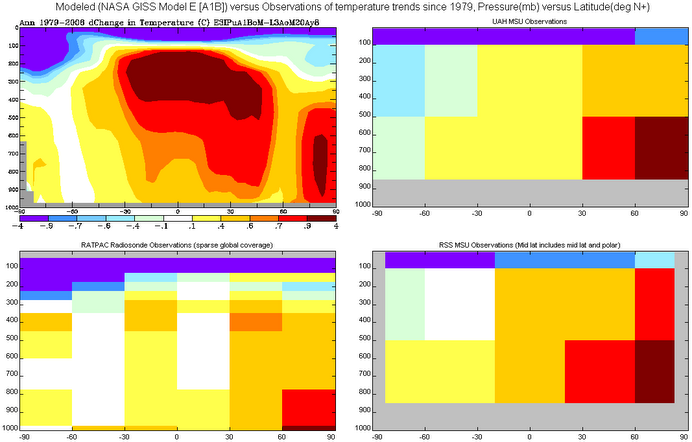 What should I tell her?
-
Alexandre at 03:20 AM on 22 March 2011The Libertarian Climate Conundrum
actuallythoughtful #4 Cap-and-dividend, as cap-and-trade, are forms to limit emissions using the ability of markets to allocate resources in an efficient manner. It's as close to free-market as it gets. What I meant in my first post was a 100% government-free solution. If you have a cap, someone has to set it - the market won't do it by itself. So a 100% market solution is not known. The next best thing (as freedom goes) would be the cap, I think. Personaly, I think the cap is complicated to control, and therefore vulnerable to cheating and corruption. I like the industry-based approach best. Some industries may work well with caps, others with a fuel tax, others (like our Brazilian rainforest) will need direct regulation and enforcement. If businessmen were more participant in this, instead of just hiding their heads in the sand (I'm one, btw), each industry could be self-regulating itself in this sense. -
Rob Honeycutt at 03:18 AM on 22 March 2011The Libertarian Climate Conundrum
Lou... Economics is fascinating stuff! Along side the climate issue economics is one I've been studying a lot on my own. That, and peppering an old friend who is an economics professor with questions. I can't remember where it was but I saw a documentary a while back on the Chicago School of Econ (which to a certain extent, as I gather, you can equate with Libertarianism). They were showing how the Chicago School is built on the "rationality of markets" and how they naturally self correct. But the documentary showed how this is not actually true. More like Keynes' ideas, markets are rational to an extent but can act in very irrational ways. The example they used was auctioning off a $100 bill to a class of economics students. As the auction went on the bid price of the $100 bill went above $100. Why would someone pay over $100 for a $100 bill? Just the natural human desire to win at any cost. I get the sense that is what is going on right now with climate. Conservatives today have this drive to win at any cost. -
ClimateWatcher at 03:17 AM on 22 March 2011Preventing Misinformation
We should also prevent these myths: 1. Global warming is 'worse than expected' Since 1979, satellite and surface measurements indicate warming trends at less than the IPCC best estimate for the "low" scenario. 2. Global warming is 'unprecedented' The period from 1910 to 1945 ( thirty five years ) had the same surface temperature trends ( CRU and GISS ) as the period since 1979. 3. Global warming is accelerating. Temperature trends for most of the satellite and surface records are lower from 1995 to present than they are for the period 1979 to present. Temperature trends for ALL of the satellite and surface records (RSS,UAH,CRU.GISS)are lower from 2001 to present than they are for the period 1995 to present. -
Alexandre at 03:09 AM on 22 March 2011The Libertarian Climate Conundrum
Rob Honeycutt #3 I don't think the market is so limited in planning the long term. There are examples of projects and investments done with decades ahead in mind. The problem is the externality, specially the diffuse ones. It's hard to convince a CEO or shareholder to cut some of its own result to mitigate a cost they would not pay for anyway. Having said that, I agree with all the rest you've said. Market's creativity is hard to beat. No one central planner would come up with so many ideas as thousands of individuals seeking solutions for themselves, driven by the right price signals. That's where the government role comes in: to set a price for the externality. -
JMurphy at 03:06 AM on 22 March 2011Those who contribute the least greenhouse gases will be most impacted by climate change
Gilles wrote : "Again, I'm just looking at facts." Sorry, but I must have missed those "facts" you refer to - did you include some in any of your recent posts ? If so, please be so good as to point me to them. Thanks. -
between the lines at 03:05 AM on 22 March 2011The Libertarian Climate Conundrum
Rob Honeycutt wrote: " ... governments, by definition, have multi-generational horizons. This is why climate change is an issue that is best managed through governments." If only governments did have long horizons, Rob. The unfortunate fact is, however, that governments have very short horizons, ie only as far as the next election. This is the failure of democracy. -
Lou Grinzo at 02:38 AM on 22 March 2011The Libertarian Climate Conundrum
Rob: Nicely put. Speaking as an economist (no one hate me; I'm one of the good ones), I would add that a useful way to view this question of roles of the government and the market is: The government should set the overall strategy, as in "get off coal as quickly as possible" or (here in the US) "reduce oil dependence as quickly as possible". The market can be astonishingly good at resource allocation, including R&D funding, and to the greatest extent possible that's still consistent with achieving those strategies and more general goals of social justice, etc., it should be allowed to do its thing. This is why either a cap and trade or carbon tax and rebate program would be so effective; it creates a disincentive to emit more carbon, which is another way of saying it creates an incentive to find lower carbon ways of doing things as well as using old and new techniques and technologies. But the very idea of government "forcing" individuals and businesses to do anything, even when it is demonstrably in their own best interest in the long run, is so repellent to some libertarians that they find any excuse possible not to support it. -
Gilles at 02:35 AM on 22 March 2011Those who contribute the least greenhouse gases will be most impacted by climate change
Michael sweet : just a reminding. In the sixties, some people wrote that nuclear energy could produce so much electricity that it would be too cheap to meter . I'm not young enough to believe in fairy tales, sorry. Again, I'm just looking at facts. -
Gilles at 02:29 AM on 22 March 2011The True Cost of Coal Power
if you have children, of course. -
Anderson at 02:29 AM on 22 March 2011Maximum and minimum monthly records in global temperature databases
Charlie A: Your last observation gets to the heart of interpreting that paper: "I note that the paper took the GHCN monthly record as it stands, and there is no discussion of whether the observed 10% decrease in variability in the GHCN monthly temperature record is due to a true reduction in variability of temperatures or whether the observed decrease is merely an artifact of changes in measurement and record keeping." Further research is currently being done with the goal of answering that question. Shoyemore: Indeed, Wergen(2010) also contains "reversible time" analysis. It has been used occasionally throughout the history of record-breaking analysis, e.g. Benestad, RE. 2004. Record-values, nonstationarity tests and extreme value distributions. Global and Planetary Change 44:11–26. I think Benestad may have been the first to use "reversible time" analysis in studying temperature, though it was proposed as a statistical technique prior to this. -
Gilles at 02:29 AM on 22 March 2011The True Cost of Coal Power
Marcus :"Also, I don't see anything in those graphs to suggest they're exponential extrapolations either-" Well, if you don't understand that saying "And indeed, it follows a nearly straight line on a log scale... What do these trends mean for the future? If the 7 percent decline in costs continues (and 2010 and 2011 both look likely to beat that number), then in 20 years the cost per watt of PV cells will be just over 50 cents." IS an exponential extrapolation (i.e. linear extrapolation in log scale), you could benefit from some refreshment of your mathematics courses. As an exercise, you could plot the growth curve of your children in log scale during their first 15 years, and then extrapolate linearly in log scale ... -
actually thoughtful at 02:28 AM on 22 March 2011The Libertarian Climate Conundrum
Thank you for introducing peer reviewed literature into the political debate. Give the overwhelming evidence, we clearly need to focus on solutions, and providing libertarians a face saving path to agreeing with progressives (the two groups find agreement in many, many areas) is a great start. Alexandre - the cap and dividend system www.capanddividend.org IS the free market solution! Adding the missing price information is a valid and useful role for government, and that notion is accepted by conservatives and libertarians - you need only look to the building code. It would be cheaper to build poorly constructed buildings (first costs) - the building codes ensure roof trusses can support the weight of the roof, the snow load, the guy shoveling the snow off the roof (as well as a the odd solar panel). Without this code buildings would be cheaper (and unsafe), thus it is a "tax" (to use Tea Party nomenclature). But there is no outcry or concern. The same logic gets a libertarian or conservative into a cap and dividend system. The question I wrestle with is how do you ensure logic and facts are the basis for the actions and policy? -
dana1981 at 02:16 AM on 22 March 2011Pre-1940 Warming Causes and Logic
Gilles #15 - the equilibrium warming from the CO2 increase from pre-industrial levels to 1970 is 0.64°C. So I'm really not seeing your logic as to how pre-1970 warming was only natural. Clearly there was a major anthropogenic component over that period. -
Rob Honeycutt at 02:13 AM on 22 March 2011The Libertarian Climate Conundrum
I always find one fundamental flaw with the whole Libertarian mindset. Markets just plainly have different time horizons that does broader society. Markets, and specifically publicly traded companies have very short time horizons, often limited to the next quarterly report. Private companies have slightly longer horizons, as long as the next CEO lasts. Family run companies can have a generational horizon. But governments, by definition, have multi-generational horizons. This is why climate change is an issue that is best managed through governments. Because it mostly affects the sovereignty of each nation in the future; the world our grandchildren must inhabit. Markets are fantastic and dealing with solutions, today. But it's the government that must set up the proper incentives that drive the solutions today to solve the problems of tomorrow. To have a Libertarian government is to remove exactly what governments are established for and puts it into the hands of those who should least have those powers. A Libertarian government is a contradiction in terms. -
dana1981 at 02:13 AM on 22 March 2011Pre-1940 Warming Causes and Logic
HR and Kooti - it's entirely possible that less than 0.15°C of the early 20th century warming is due to solar effects. I don't see that as problematic. -
Alexandre at 02:12 AM on 22 March 2011Pre-1940 Warming Causes and Logic
Kooiti Masuda #14 If the solar forcing was less important in the early 20th century, does it mean that that warming was more due to GHG? -
Gilles at 02:07 AM on 22 March 2011Pre-1940 Warming Causes and Logic
DB#9, Marcus#11 : my question wasn't about the post-70 instrumental rise, but about the "hockey-stick" shape of all proxy curves, that start rising much before the 70's. Does it mean, yes, or not, that the pre-70 rise of proxies temperature reconstructions can only be natural and NOT anthropogenic, and if not, what can it be ?
Response:[DB] Now I must ask you if you have actually read the source post for this thread. Pre-1940 warming is multi-factorial, per the referenced forcings. Do not conflate that somehow into "all proxies"; simply waving your arms in strawman fashion will not overturn the hockey stick shape of multiple temperature reconstructions. Keep in mind what Tamino had to say about hockeystick reconstructions in his guest post over at Real Climate:
"The truth is that whichever version of PCA you use, the hockey-stick shaped PC is one of the statistically significant patterns. There’s a reason for that: the hockey-stick shaped pattern is in the data, and it’s not just noise it’s signal."
"The hockey stick is so thoroughly imprinted on the actual data that what’s truly impressive is how many things you have to get rid of to eliminate it. There’s a scientific term for results which are so strong and so resistant to changes in data and methods: robust."
Peer-reviewed reconstructions and studies have consistently shown a multifactorial warming of the globe, with the graphed data taking the shape of a hockey stick. That natural factors post-1970 or so do not explain the rise in temperatures measured since then does not also mean the converse: that only natural factors explain the rise before it. That is a strawman and wrong.
-
Kooiti Masuda at 01:41 AM on 22 March 2011Pre-1940 Warming Causes and Logic
I think the conclusion is correct, but there is a weak point in the demonstration. Meehl et al. (2004) used the reconstruction of solar irradiance by Hoyt and Schatten (1993, J. Geophys. Res. 98, 18895-18906) as their solar forcing. As shown in the Figure 7 of the review article by Gray et al. (2010, Reviews of Geophysics 40, RG4001), the amplitude of centennial variability of Hoyt and Schatten (1993) is similar to that of Lean (2000), though not exactly the same. On the other hand, Wang, Lean and Sleeley (2005) estimate much smaller variability, and it seems that the more recent estimate is more plausible. Then, logically, the simulations by Meehl et al. (2004) likely over-estimate the role of solar forcing in the real world (assuming that the solar forcing is due to the total solar irradiance). -
Ken Lambert at 01:05 AM on 22 March 2011Zero Carbon Australia: We can do it
Marcus #58 I did not hear of any power blackouts during the flood crisis in Queensland due to unavailability of coal fired plant. Last time I checked, wind energy generated through an axial turbine was proportional to the wind speed cubed. If a turbine is optimized for a wind speed of say 20 knots, when the wind blows at 10 knots you get 1/8th of the power from the unit. If it blows at 30 knots you have to feather the blades and shut the unit down. The average availability of coal fired plant is over 90% - ie; the output/installed capacity. For Wind it is below 30% and I have seen numbers in Victoria which suggest at low as 12%. That means you have to install 3MW+ of Wind capacity to get an average of 1MW output. I trust is taken into account in all Wind power comparisons with coal, nuclear & geothermal. Again in Australia, particularly in winter - a large slow moving high pressure system can reduce wind speeds to below 5 knots for a day or two over large areas of the continent, and strong cold fronts between can cause shutdown due to excessive wind speed. Wind therefore needs significant back-up capacity or storage capacity when it does not blow over a wide area. BERN #67 Where can I invest in your ZCA systems?....readers must be knocking down your door to do so..on your numbers. One question - do 3.5 of your ZCA's have the same availability as 1 x Kogan Creek? -
Alexandre at 01:01 AM on 22 March 2011The Libertarian Climate Conundrum
For some time I have persued a truly free-market solution for Climate Change. I mean a truly libertarian one, without any interviniance from government. Apart from the self-regulated common resource management studied by Ostrom, I did not find any. And none of these apply to air pollution, which usually involves many users and the impossibility to limit new appropriators. For air-related environmental issues, I don't know one single example of solution that goes without any kind of proper legislation. When you turn to these think tanks, the usual tactic is to deny or downplay the problem, again suggesting that this would be their only way out. The sad part is that by doing so, they simply keep themselves out of the debate. Cap-and-trade relies on market properties of efficient resource allocation, and neither libertarians nor conservatives are there to defend it. A carbon tax is also more a "free-market"(ish) solution than simply a Project Manhattan, government dictated industry. The presence of libertarians and conservatives in the debate could (in principle) help make it less "vulnerable to special interest pleading". But they're absent, unfortunately. -
bibasir at 00:30 AM on 22 March 2011The Libertarian Climate Conundrum
The same argument can be made to Libertarians on the need to ban smoking in public places. But you don't hear them acknowledging it. Cato is more anti government than true Libertarian. -
Bern at 00:01 AM on 22 March 2011Zero Carbon Australia: We can do it
John Chapman - using currently disused car factories for heliostat manufacture is, in fact, suggested in the ZCA report, if I recall correctly. As for the rest of it - a quick search reveals the 750MW Kogan Creek power station (750MW coal) took about 3.5 years from a "go" decision to full commercial operation. A "first of a kind" solar thermal unit would obviously take a bit longer, but probably not too much, as all the required technologies are off-the-shelf. The problem is where to get the funding? It'd probably have to be a government-backed project, at least for the first one (to "prove" the product to the market, given how risk-averse investors can be in Oz). I did some more quick sums. ZCA estimates ~$739m or so for a 217MW plant. The Kogan Crk coal plant cost $1,200m for 750MW, but burns 2.8million tons of coal per year (for which it's probably paying minimal royalties plus the cost of digging it out of the ground at the adjacent mine). Assuming it cost about $40/t (about a third of the market rate for good quality thermal coal), that's another $112m per year for coal. Doing the sums, it takes ~3.5 of ZCA's solar towers to equal Kogan Creek. So that's $1.2billion vs $2.59billion in up-front cost. If you assume operation & maintenance costs are a wash, and when you add in the cost of the coal (ignoring inflation), it takes 12 years for the total cost of the coal plant to equal the solar tower. But over a nominal 30-year life, the solar towers end up ~$2billion cheaper - almost enough to pay for the solar towers in the first place! Factor in a $20/t price on CO2, and the price difference increases to ~$6.2billion (assuming 2.5t CO2 / 1.0t coal) i.e. enough to pay you back for the initial 3.5 solar towers, and build another five to cope for future demand! Now, discounting of future coal prices makes a big difference (how much is $112m/year for 30 years worth today?), but the cost equation will probably still favour the ZCA proposal, based on their numbers, especially when a carbon tax is thrown into the mix. If you count the benefit of avoiding ~200 million tons of extra CO2 in the atmosphere, then things really start to look positive... -
les at 23:29 PM on 21 March 20112nd law of thermodynamics contradicts greenhouse theory
712 RickG I guess there are several issues. The one I have with this form of argumentation (not particularly this one, but ones like it) is that it's very often to appear to knock down an argument using broad bush-strokes, appeal to "common experience", focusing on missing details etc. What is harder, and rarely done, is to build up an argument - and specifically to build an argument up to the level to be usable for policy... that is the role, e.g. of the IPCC. Now, "do nothing" is a policy. It just isn't good enough to base this policy - which is potentially very very expensive and life threatening - on a level of analysis which is no more than waffle-words. Something much stronger must be built to attack the science as shown on a site like this... ... you just cannot cut steal with chewing-gum. The tools need to be sharper and harder than the thing you're attacking;you need maths, detail, consistency etc. And these things are, by and large, the unknown-unknowns of a lot of "denilists" - all the stuff along the road that ends in a diagram, a graph or a couple of numbers. -
CBDunkerson at 23:07 PM on 21 March 2011Zero Carbon Australia: We can do it
ranyl #55, there is no contradiction between the passages you cite and what I had stated. The 2 ppm drop per year which I calculated would not continue on the century scale examined by the Lowe paper. That is, if we stopped emitting CO2 today we would not drop 200 ppm and find ourselves at the coldest point of a glaciation (190 ppm atmospheric CO2) by 2111. Currently we are releasing about 30 gigatons of CO2 into the atmosphere each year and carbon sinks are extracting a net of about 17 gigatons. Each additional 7.81 gigatons in the atmosphere corresponds to another 1 ppm. Thus, atmospheric concentration is currently growing at about (30 - 17) / 7.81 = 1.66 ppm per year. If our CO2 emissions dropped to zero the carbon sinks would continue sequestering about 17 gigatons per year (17/7.81 = 2.18 ppm decrease per year)... there is no logical reason that this would change radically right away. However, this amount would decline on a decadal scale as atmospheric and oceanic concentrations approached equilibrium. The prior equilibrium was at ~280 ppm so we would certainly hit zero decrease some time before that point... exactly when depending largely on the rate at which carbonic acid will mix throughout the world's oceans. Note that some of the values you cite from Lowe involve unfettered CO2 emissions through 2050 or 2100... resulting in vastly higher atmospheric levels and potential oceanic saturation. The -0.2 ppm figure based on 404 ppm in 2012 was again looking at the mean over a century... so by 2112 we'd have dropped to 384 ppm. I think (and other papers such as Meehl 2007, Plattner 2008, and Solomon 2009 cited in the Lowe paper seem to agree) that the equilibrium point would likely be much lower. In any case, Lowe agrees that there would be a quick drop after cessation of emissions and then a very long slow decline. Only how far the initial drop would be is in question. However, as I'd stated... hitting 450 ppm does not mean we are stuck there. It is only if we go significantly over that mark or continue significant emissions even after converting to alternative energy sources that we need to worry about the long term impacts of 450 ppm (or any other level) atmospheric CO2. Stopping emissions will yield positive results / we are not yet 'locked in' to devastating climate change. -
IanC at 22:47 PM on 21 March 2011Pre-1940 Warming Causes and Logic
HR, That will only work if magnetic variation is the primary driver of total solar irradiation, and from the language used in the paper this seems to be largely speculative. Now I am curious to see where you are going with this. Are you arguing that neither CO2 nor the sun drives our climate? -
Marcus at 22:36 PM on 21 March 2011The True Cost of Coal Power
So I guess my point is this-if the cost of solar cells can fall by more than 1/7th in the space of less than 30 years, then I'd hardly call the extrapolations in that article "undue". Also, I don't see anything in those graphs to suggest they're exponential extrapolations either-though you've proven already your total inability to read a graph, so I guess I shouldn't be surprised at such an error on your part. -
Marcus at 22:32 PM on 21 March 2011The True Cost of Coal Power
Gilles, between 1982 & 2006, the average cost of PV's fell from US$25 per Watt to less than US$ per Watt-yet in that same time period, average conversion efficiency has risen from less than 8% to more than 20%. Whether you choose to accept those facts or not, Gilles, it *shows* clearly that the potential of PV Cells-in both cost & efficiency terms-has barely been tapped, in spite of the much smaller amount of public funds enjoyed by the PV sector when compared to your beloved fossil fuels. -
Marcus at 22:26 PM on 21 March 2011Pre-1940 Warming Causes and Logic
Ah yes, HR, "Watts Up With That"-the bastion of truth & decency in the Climate Change debate.....*not*. The fact is that directly measured sunspot numbers rose significantly over most of the first half of the 20th century, but sunspot numbers have been *falling* over the last 30 years-yet the fastest warming has been over the latter 30 year period. So how do your mates over at WUWT explain this obvious discrepancy? -
Marcus at 22:23 PM on 21 March 2011Pre-1940 Warming Causes and Logic
Gilles, are you just being deliberately blind or *what*? Take a look at the graph-you've got a slight warming trend in the first 40 years of the 20th century, then a leveling off between 1950 & roughly 1980, then a much faster rise in temperatures between 1980 & 2010. This is odd given the fact that TSI/Sunspots have been trending downwards from 1980-2010. So no, I'd suggest it *doesn't* imply that the growth is natural. If it is natural, then please tell us what the cause of it is. -
michael sweet at 21:15 PM on 21 March 2011Those who contribute the least greenhouse gases will be most impacted by climate change
Gilles: If you were citing known facts you would not be controversial. You are citing your unsupported and uninformed opinion as fact. This article describes how to replace all FF consumption world wide with renewables. Electricity, transportation, heating and all other uses of energy. Perhaps if you read it you would not have to say "I don't know" so much. Papers start out with ideas which develop into accepted explainations over time. The facts they contain are screened to weed out the problems. Your postings, unfortunately, are not screened and the "facts" are only your uninformed opinion. -
scaddenp at 19:48 PM on 21 March 20112nd law of thermodynamics contradicts greenhouse theory
L.J. Ryan. We have measures (ie real world) of 341W/m2 incoming at TOA and 396W/m2 being irradiated from surface. Wow, 1st law violation? Are you trying to say nature is breaking the 1st law? The measurement must wrong? Well no. Tom and others have very patiently been explaining to what is really happening. Ditto, this whole thread on 2nd law where you are jumping on the premise that atmosphere is heating the planet. Nope. Thermodynamics is not flawed. Understanding is. -
HumanityRules at 18:51 PM on 21 March 2011Pre-1940 Warming Causes and Logic
Dana, Over at WUWT they recently highlighted a paper that suggest TSI may be even smaller than you are assuming here. Maunder Minimum to present would be something like 0.33-0.66 W/M2. I think that would mean solar forcing for the period you're interested in here is ~1/3 what you are suggesting. Which seems problematic for your calculations. -
Marcus at 18:27 PM on 21 March 2011Zero Carbon Australia: We can do it
OK Bern. According to a deal signed by the builders of the Sorne Hill Wind Farm in Ireland, a 12MWh VRB's was going to cost just under $6.3 million-back in 2007. Of course that's with the older technology. In 2009, German Scientists claimed that they managed to boost the energy density of the VRB's from around 30Wh/L of electrolyte to 150Wh/L of electrolyte-which would substantially reduce the cost of new VRB's. The advances linked to by The Ville will almost certainly bring the price down further still. Of course the important thing is that it would effectively double the capacity factor of the 30MW Wind farm to which its attached.
Prev 1851 1852 1853 1854 1855 1856 1857 1858 1859 1860 1861 1862 1863 1864 1865 1866 Next






