



 Arguments







Recent Comments
Prev 1989 1990 1991 1992 1993 1994 1995 1996 1997 1998 1999 2000 2001 2002 2003 2004 Next
Comments 99801 to 99850:
-
gallopingcamel at 18:08 PM on 16 January 2011Global Warming and Cold Winters
garythompson (@53), GISS and GHCN have experienced a great loss of thermometers since 1975. The losses have been spectacular at high latitudes even though we are told that climate change should be easier to measure near the poles. Some see this as a plot to introduce a "warming bias" into the ground station records. Personally I doubt this kind of conspiracy theory. More likely it is the result of human fallibilities such as laziness, incompetence and changing priorities. James Hansen (GISS) has pointed out that there is a good correlation between stations separated by over 1,000 km and my own studies of raw data confirm this. However, one still wonders why there should be huge numbers of stations in the USA while much larger land masses such as Russia and Canada have diminishing representation. Here are a couple of links that discuss these issues: http://diggingintheclay.wordpress.com/2010/01/21/the-station-drop-out-problem/ http://diggingintheclay.wordpress.com/2010/01/21/the-station-drop-out-problem/ain-part-1/ -
Marcus at 17:13 PM on 16 January 2011What is the Potential of Wind Power?
@ actually thoughtful. Its abundantly clear to me that shifting to a low to zero CO2 economy is going to require changes at both the Demand & Supply side of the energy supply equation-some local (like locally sourced bio-gas, photo-voltaic electricity & wind power) & some multi-national (like the idea to use equatorial-based solar power to meet significant amounts of the electricity needs of Europe & Africa. What I definitely do *not* believe is that these shifts will do medium to long term damage to our economies-that's just a myth put about by those who have a vested interest in maintaining the status quo. -
gallopingcamel at 17:07 PM on 16 January 2011Global Warming and Cold Winters
You folks who think that 2009 was a cold winter and that 2010 may be even colder fail to realize that the climate has (thankfully) warmed over the last two centuries. The last really cold winter in the northern hemisphere was in 1814 and before that 1795, 1788, 1776 (a year to remember) and 1740. The winters I list make our current "cold winters" look positively balmy.Moderator Response: [Daniel Bailey] "Thankfully"? You've been pointed to this before but seemed to have ignored it, so here it is again: The negative impacts of global warming on agriculture, health, economy and environment far outweigh any positives. Please try to read it - and understand it - this time. -
garythompson at 16:42 PM on 16 January 2011Global Warming and Cold Winters
#49 muoncounter my point was.....GISS makes a large area deep red (as shown in the upper left of the figure on this post) but they do this based on 3 weather stations. my analysis of my local area shows great variability in the trends in various weather stations. so why does GISS assume that thousands of square km can be represented by 3 weather stations when it is obvious that there is great variability in weather stations within a radius of 150 km? -
Marcus at 16:32 PM on 16 January 2011Global Warming and Cold Winters
....Oh Yooper, that is *hilarious*-it really highlights the alternate universe inhabited by the majority of contrarians. Weather does *not* equal climate. Yet funny how the contrarians only accept that simple fact when *heat* records are getting broken! -
Daniel Bailey at 15:24 PM on 16 January 2011Global Warming and Cold Winters
All the jabber-jawing about weather events and micro-climates is very tiresome. As muoncounter points out, absent a crystal ball and a detailed analysis vetted by peer-review (which takes time, unlike anything published by the day in a SCIRP pub), continuing to focus on the winter of 2010/11 is ruminating on the weather. To illustrate this myopia: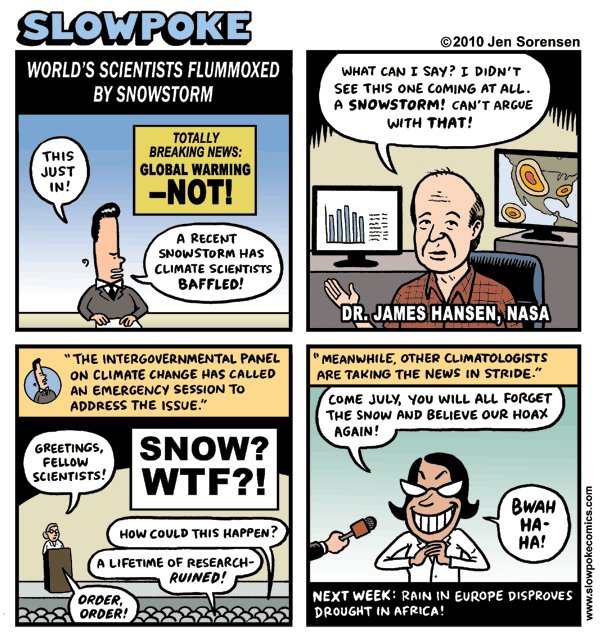 The Yooper
-
villabolo at 15:11 PM on 16 January 2011Global Warming and Cold Winters
Berenyi Peter @46: "Cold caused by warmth is..." I'm not a physics major but I know that cold is not caused by warmth. In the case of NAO the warmth is simply relocating the cold. "Those red-hot areas in the Arctic are still well below freezing, therefore it cools any open water that may be there..." Water is a thousand times thicker than air therefore it can absorb and release a lot more energy than thin air. Therefore it's the ocean that warms up the air, not the air cooling off those warm waters. If the ocean water is at 0 Celsius it's going to be transferring heat to the air even if that air is -10C. Temperature is not the same as total energy. -
muoncounter at 15:00 PM on 16 January 2011Global Warming and Cold Winters
#45: "an equal number of stations that exhibit warming as those stations that exhibit cooling and flat trends" Not sure what your point is, but you might look here for a continent-wide warming trend. -
muoncounter at 14:58 PM on 16 January 2011Global Warming and Cold Winters
#43: "the winter was nothing unusual." Winter is DJF, so its hard to make such a statement without a crystal ball. But if your prediction does prove correct, that would make a very unusual summer with a no-big-deal winter. Where's that new ice age, or the much promised cooling trend that we hear so much about? -
Esop at 14:56 PM on 16 January 2011Global Warming and Cold Winters
#46: Not all these red hot areas are below freezing. Parts of western greenland (north of the Arctic circle) were well above freezing until just a few weeks ago. Same for areas in the Barents sea like Bjørnøya, at 75degs latitude thas has been above freezing for extended periods in December. Temps dropped in the first half of January, but are headed above freezing again. http://www.yr.no/place/Norway/Svalbard/Bjørnøya_radio/ 8 day forecast is not very chilly either: http://www.yr.no/place/Norway/Svalbard/Bjørnøya_radio/long.html Average temp for January is -8.1C. -
Berényi Péter at 14:17 PM on 16 January 2011Global Warming and Cold Winters
"That harsh winter that we are experiencing, it is not proof that global warming is not happening, but rather serves as proof that it is indeed happening, and even a bit faster than we might like to think." Cold caused by warmth is called a negative feedback. It slows down warming a bit more than you might like to think. Those red-hot areas in the Arctic are still well below freezing, therefore it cools any open water that may be there and transfers the heat to outer space as that's the only heat reservoir around which is colder than the currently "hot" Arctic. I guess Dr. Trenberth would miss this heat extracted from the ocean badly. Also, there's not much sunlight in the Arctic winter, but there is some in lower NH latitudes covered by record snow extent. Most of this light is simply reflected back to space without having a chance to get thermalized - another negative feedback. On top of that this winter is not even particularly unusual, I can remember both much worse and better in the past. -
garythompson at 14:09 PM on 16 January 2011Global Warming and Cold Winters
i had a typo in post 44 - the next to the last sentence should have stated 3 stations instead of 2. to further my question - in my little corner of South Carolina (USA) you can see that in a range of 150 km there is a great deal of difference in weather stations. For the most part, there is an equal number of stations that exhibit warming as those stations that exhibit cooling and flat trends. below i'll paste a few links to demonstrate this. and to clarify, i'm looking at trends from 1950 to 2010, the following links show warming trends here, here, here and here the following links show cooling trends here, here, here and here the following links show flat trends here, here, here, here, here and here -
garythompson at 13:39 PM on 16 January 2011Global Warming and Cold Winters
i love the GISS website as it allows a lay person to plot graphs while manipulating the various time periods. that big red blob of dark red in the upper left of the figure in this post is interesting. i picked a point in the middle and found all the weather stations that were within 1400 km of the center that have recorded temps from 1950 to 2010. i got a total of 3. how can we reasonably state that that entire region can be characterized by 2 weather stations? here is the link to the list of stations in the center of that blob. -
barry1487 at 13:35 PM on 16 January 2011Climate Change: The 40 Year Delay Between Cause and Effect
Should be "much of the heat transfer occurs during the day." from atmosphere to oceans. But I'm reaching beyond my ken with these details. Any help appreciated. -
The Inconvenient Skeptic at 12:56 PM on 16 January 2011Global Warming and Cold Winters
The Rutgers snow lab data has 2010 right at the statistical average for the period that there is accurate data. That would indicate that the winter was nothing unusual. http://theinconvenientskeptic.com/2011/01/snow-extent-for-2010/Moderator Response: [Daniel Bailey] The jury is still out on this winter. Per your Rutgers link, the long-term trend is still down: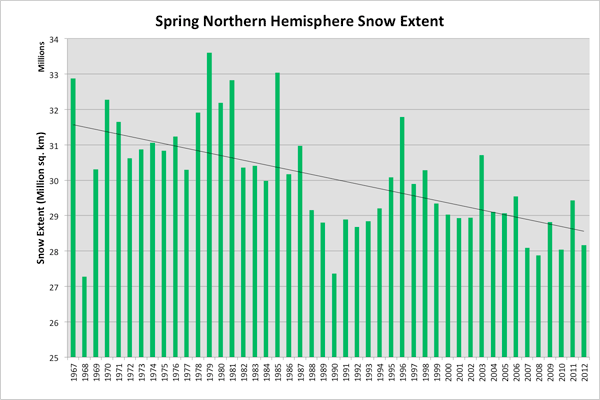
-
yulsman at 12:27 PM on 16 January 2011Northern hemisphere warming rates: More than you may have heard
Daniel: Many thanks for crediting that graphic to me at CEJournal. Through the use of color, that modification of the NASA GISTEMP graphic dramatically conveys what's happening, at least to me.Moderator Response: [Daniel Bailey] Thanks for sharing it. I've used it to great effect with several denying friends and relatives. The visual impact is staggering, once they realize what they're looking at. -
Rob Painting at 12:19 PM on 16 January 2011Coral: life's a bleach... and then you die
Albatross - Re your sea urchin question. Ran across this by chance: Sea Urchins Destroy Reef Building Algae in Overfished Sites on Kenya's Coast The relevant portions: The authors found that reefs with large numbers of grazing sea urchins reduced the abundance of crustose coralline algae, a species of algae that produce calcium carbonate. Coralline algae contribute to reef growth, specifically the kind of massive flat reefs that fringe most of the tropical reef systems of the world. Overall, reefs with more sea urchins grew significantly slower than ones with more complete fish communities. -
muoncounter at 12:14 PM on 16 January 2011Global Warming and Cold Winters
#41: "If the ocean is naked it gives up heat by convection" Yes, that's the heat that the open ocean absorbed during that time when there wasn't as much ice as there used to be, what's it called? Oh, summer. Warmer water -> warmer air. And that says nothing about 'bypassing' CO2, whatever that means. Apparently there's something about the numbers attached to that ominous red that you're not seeing? "once again another good graphic showing ... " Graphic? Showing CO2 not a big player? Must be a verrrry tiny graphic, 'cause I don't see it. -
actually thoughtful at 12:07 PM on 16 January 2011What is the Potential of Wind Power?
I am having trouble with the heat pump diagram in the original post. I think you are suggesting localized CHP (sort of)? A better use of the same CO2 cutting money would be 1) Reduce building losses. R30 minimum walls/floor, R-50 roof 2) R-8 windows or better 3) ground source heat pump 4) solar thermal for cheap winter heat All of the above are cheaper than a site built wind tower, with incentives equal (ie everything incentivized, or nothing). The options are presented in order of their economy. Items 2&3 are roughly equal in payback times. Item 4 moves above item 2 in a heat only climate, stays where it is when you are dealing with heating and cooling loads. So once all that is done, add wind. Now, because the ground source heat pump is taking advantage of your average, year round temperature, you can match your ANNUAL wind generation to your ANNUAL building load and save the local natural gas backup generator (extra pieces are expensive). And it is noisy. And a local device is not going to be as efficient as a centralized device (I am forgiving our history of coal here...). Unless you find yourself very frequently putting energy into the grid at a low point in demand (ie producing power when no one needs it) you will be better off having your wind power reduce coal than you will replacing your natural gas boiler with a natural gas generator, which then uses another device to deliver heat. I bring it up because design is important. It is easy to gloss over details that make renewable proponents look silly. Please let me know if I have missed something in the analysis. -
TOP at 12:02 PM on 16 January 2011Global Warming and Cold Winters
I've been watching the models this winter. Seems like warm air is being sucked up from farther south especially around the Sahara. Solar heating of the Arctic can't happen in winter. There is no sun. If the ocean is naked it gives up heat by convection bypassing the effect of CO2 in removing heat to space. And once again another good graphic showing that CO2 is not as big a player as imagined. @7. A good call on the distortion in area due to the projection used to depict a sphere. NASA should use an equal area projection.Moderator Response: [Daniel Bailey] Try this one then:
-
pteranodon at 12:00 PM on 16 January 2011A detailed look at the Little Ice Age
Showing that use of the phrase "recovering from the LIA" is meaningless does not prove that warming is caused by man-made carbon dioxide (as your post implies). And your hand-waving speculation that human die-offs may have caused the LIA doesn't counter the fact that no-one knows why there was a LIA or why it ended, nor what caused the Roman Warm Period, the Dark Ages Cold Period, and the Medievel Warm Period. Studies done by reputable scientists conclude that the RWP and the MWP were global and warmer than today (yes, I know that other scientists disagree; that's the nature of scientific debate). If we don't know what has caused the major climate cycles of the near past, how can we now say that the warming of the last 20-50 years can only be caused by mad-made CO2? I know this doesn't prove AGW wrong; but it raises enough doubt--reasonable doubt--to tell me that the debate is far from over. So, as any good scientist should be, I am skeptical.Moderator Response: [Daniel Bailey] Please provide links to those studies you refer to that indicate the RWP and MWP were global and warmer than today, as I'm not familiar with them. The last part of your comment basically devolves into "it's not us" so I would suggest reading The human fingerprint in global warming, spending time perusing all 3 versions of the post there to get your answer to that. Thanks! -
Nick Palmer at 11:30 AM on 16 January 2011Global Warming and Cold Winters
"The heat from the warmed ocean flows upward into the polar air, creating a high pressure system." This bit in the article needs rewriting. Warmed air rising creates a low pressure system. When that air comes back down again it then creates a high pressure system (in a different location). -
dhogaza at 10:18 AM on 16 January 2011Global Warming and Cold Winters
#32 William: "It is cold in North America as well as in Europe." We're having a pineapple express here in OR/WA. (hint: pineapples don't grow in cold climates) -
Esop at 09:58 AM on 16 January 2011Global Warming and Cold Winters
#32 (William): No, it is not cold in Europe. Temperatures in most areas well above average with major flooding as the result. The Arctic above 80 degs is way above average: http://ocean.dmi.dk/arctic/meant80n.uk.php Please provide links for your other claims -
muoncounter at 09:50 AM on 16 January 2011Northern hemisphere warming rates: More than you may have heard
New 2005: Arctic climate change with a 2 degC global warming The geography of the Arctic (land-sea distribution) and snow/ice albedo feedbacks, along with minor changes in cloud and ocean heat transport, lead to an amplified regional warming over the Arctic that ranges from between 3.2 and 6.6 degC for a global change of +2 degC. ... The Arctic temperature change amplification means that these rates of warming are likely to be between 0.45 deg to 0.75 degC/decade, and possibly even as large as 1.55 degC/decade. I suppose the good news is that with these rates, we won't have long to wait. -
Eric (skeptic) at 08:00 AM on 16 January 2011Global Warming and Cold Winters
Re: Gavin Schmidt's paper listed in #30. The interesting and relevant part of the paper is the linkage from lowered TSI to low AO/NAO through increases in planetary wave propagation and a warmer polar stratosphere. Seems that they found same "wave feedback" as the paper in #25 except in the other direction in their model. Conclusions from #30: lower TSI (although not relevant to today) and corresponding drops in SST (also not relevant) caused weather changes resulting in increased planetary wave propagation and polar stratospheric warming, thus negative AO/NAO. Useful part of those conclusions: AO sign is determined by factors that change planetary wave propagation into the Arctic and factors that vary stratospheric temperatures in the Arctic (and both of those effects are linked through some feedback). AGHG warming cools the stratosphere and increases AO, but that is only a long term, broad effect. That may be offset in the short term by Arctic hot spots that force ripples in the polar jet and corresponding wave penetration, warming stratosphere (probably very uneven warming) and negative AO (cold winters, etc). Natural factors are also at work in both directions. The "solar" link is interesting and I've speculated on other threads about "solar" factors, but solar TSI factor from the paper in #30 is not relevant to today's situation (present TSI change is too small). -
David Horton at 07:47 AM on 16 January 2011Monckton Myth #1: Cooling oceans
#23 funglestrumpet Great idea but I will make an instant prediction. Within hours, probably within minutes, of the announcement of such a body, the attacks would begin. "Nobel laureates" what would they know, scumbag scientists? Computer hackers would go to work discrediting the group and the individuals. The disinformation campaign by Monckton and the rest would continue and continue to be given equal if not more than equal weight in the media (Murdoch will not permit any action on CO2 while he lives, and, I suspect, beyond the grave). And while the Hague is a nice idea America (where so much of this disinformation campaign originates) does not recognise the International Court and would certainly not allow its citizens to be tried there. In short, whatever new body was created (and a body created by the UN would have seemed above the lies and smears originally, in the same way as your suggested "Nobel Committee" does) the campaign to prevent action on global warming would continue unabated. Perhaps might gain new vigour with a new target. This is a war for the future of the planet that we are in - it has nothing to do (on one side) with science, facts, analysis, authority, credibility. -
tobyjoyce at 07:24 AM on 16 January 2011Global Warming and Cold Winters
If I looked out my window a month ago, it would have been a snowy, white carpet, at about -5C. Today, we have a warm, wet, south-westerly gale, and I measured a 13C in early afternoon. After the December snows in Ireland and the UK, January has crept up to average, and now there is a definite hint of early spring as we enter its second half. Green is starting to show through fields that were a pale, wasted yellow a week ago. The point is that the "coldest winter for 1,000 years" has turned into a pussycat. Well, ok, it is too soon to say, but the signs are good. Feb 1st (2 weeks away) is the first day of the Celtic Spring. I know there are global warming theories that "explain" the weather phenomenon - but there are alternative theories also. There are the solar minimum theories, and there is natural variability. There is also solar minimum, natural variabiity and global warming all acting together. While there may be more than one plausible explanation, we need a scientific evaluation ... and that is not quick and simple. Here is an article from today's Irish Times that tries make sense of it, by a UCD Professor of Meteorology. Icy Winter -
muoncounter at 07:23 AM on 16 January 2011Global Warming and Cold Winters
#30: "the current happenings are caused by the sun" Camburn, oh Camburn: The article you cite in #30 is from 2001, entitled Solar Forcing of Regional Climate Change During the Maunder Minimum, says nothing about either 'current happenings' or AGW. -
muoncounter at 07:17 AM on 16 January 2011Global Warming and Cold Winters
#32: "look at all of the observation." Just wondering if we could get a look at where your observations are coming from: -it's not anomalously warmer in the Arctic? -low ice extent due to late freezing in only Hudson's Bay? -Arctic ice thickness doubled? If you have sources for these, please post them. -
muoncounter at 07:10 AM on 16 January 2011Northern hemisphere warming rates: More than you may have heard
#44: Peter, Thanks, those are beautiful graphs. "enhanced NH Ocean/atmosphere heat exchange, as well as Arctic amplification" If the NH heat flow cycle is dependent on tropical heat moving north in the oceans and Arctic waters are growing steadily warmer, does this result in amplification effectively spreading into the lower latitudes? It would be interesting to know if anyone has modeled that effect. -
Mila at 06:57 AM on 16 January 2011Global Warming and Cold Winters
#30 If you are really interested in attribution, Gavin Smith's RC article On attribution is a very good one. The article Abstract: We examine the climate response to solar irradiance changes between the late 17th-century Maunder Minimum and the late 18th century. Global average temperature changes are small (about 0.3° to 0.4°C) in both a climate model and empirical reconstructions. However, regional temperature changes are quite large. In the model, these occur primarily through a forced shift toward the low index state of the Arctic Oscillation/North Atlantic Oscillation as solar irradiance decreases. This leads to colder temperatures over the Northern Hemisphere continents, especially in winter (1° to 2°C), in agreement with historical records and proxy data for surface temperatures. Science 7 December 2001: Vol. 294 no. 5549 pp. 2149-2152 10.1126/science.1064363 and a few citations: Both paleoclimate reconstructions and the GCM thus indicate in a remarkably consistent manner that solar forcing affects regional scales much more strongly than global or hemispheric scales through forcing of the AO/NAO. and conclusion These results provide evidence that relatively small solar forcing may play a significant role in century-scale NH winter climate change. This suggests that colder winter temperatures over the NH continents during portions of the 15th through the 17th centuries (sometimes called the Little Ice Age) and warmer temperatures during the 12th through 14th centuries (the putative Medieval Warm Period) may have been influenced by long-term solar variations. -
William at 06:14 AM on 16 January 2011Global Warming and Cold Winters
It is cold in North America as well as in Europe. The Arctic is not anomalously warm. Northern Hemisphere sea ice extent is low due to the late freezing of the Hudson Bay ice, however, Arctic sea ice thickness (at high latitudes) has doubled. This La Nina is unusually strong. My point is look at all of the observation. I do not understood how a polar blocking mechanism can explain what is observed. A polar blocking mechanism cannot cause a strong La Nina. I agree with Camburn's comment. Solar cycle 24 is unusual. It should be considered as possible explanation. -
villabolo at 06:06 AM on 16 January 2011Global Warming and Cold Winters
"If you were to look out most windows as of this writing, there is a good chance that you would be presented with an image of winter." There is a fly in what is otherwise a superb soup. That opening line unknowingly reinforces the solipsistic concept that what is going in our backyards or outside of our windows is a measure of reality. Is it really "most windows" on Earth that this spectacle is visible from; especially in the November Anomaly image? I would rephrase the perceptual bias in terms of media coverage versus global occurences. I would do so in a way that tells the reader in the first paragraph that what he sees outside of his window is a very limited portion of what's going on. I would also delete the second paragraph's mention of phraseology as well as any mention of proof until the anomaly image is presented. A better introduction would be: If you were to look at your television as of this writing you would be presented with an image of a cold winter. More than a few of you might be asking yourself, "What happened to global warming?" Would it surprise you to know that only 15%(?) of the Earth has experienced cooler than average temperatures while the other 90% was warmer than average? Greenland, most of the Arctic and east Siberia were up to 10C warmer than average. -
Camburn at 05:48 AM on 16 January 2011Global Warming and Cold Winters
It would appear that the current happenings are caused by the sun rather than agw. At least Mr. Schmidt thinks so. http://www.sciencemag.org/content/294/5549/2149.abstract -
Camburn at 05:44 AM on 16 January 2011Global Warming and Cold Winters
An interesting paper on solar cycles and holocene. http://www.sciencemag.org/content/294/5549/2130.abstract -
hfranzen at 05:17 AM on 16 January 2011Seawater Equilibria
I have redone my calculation and found that a better (perhaps more careful) calculation yields a result that is not quite so discouraging. The result depends upon how deep the surface is taken to be, i.e. to what depth the ocean is in equilibrium with the surface, and the time allowed for eqilibration. Since the numbers are generally considered on an earth-year basis I think that is the relevant time scale. For the ratio of actual ppm decrease that would occur to the decrease that would result from a decrease in our production in the absence of the ocean I get the relation 1/(1+5.2d) where d is the depth (in meters in the ocean of average depth 3790 meters (from Wikipedia)). This yields a 22% return for a depth 200 meters. Of course there will be other response mechanisms as well, but this is one that is easily calculated. This result also means that 22% of our current increase in production is going into the surface ocean if it can be taken to be equilibrated to a depth of 200 meters. Since 22% is in the right ball-park I would guess that 200 meters is not too far off the mark. -
ClimateWatcher at 05:07 AM on 16 January 2011Global Warming and Cold Winters
"The heat from the warmed ocean flows upward into the polar air, creating a high pressure system." This statement is egregiously in error and does not reveal an understanding of meteorology. -
Mila at 05:01 AM on 16 January 2011Monckton Myth #1: Cooling oceans
In my RC backreading I have just arrived to a RealClimate article of some interest in this context: Science Story: the Making of a Sea Level Study 6 April 2010 This suggested to me that, in addition to a proportionality to temperature T, sea level rise would also contain a term proportional to the time derivative of temperature, dT/dt. In other words, global sea level would be a good global thermometer, but with a ‘quirk’. I could even think of a physical mechanism for such behaviour. ... Wow. Introducing the b term had already improved the Pearson correlation r of fit from 90% for Stefan’s original relationship to 97%; nice, but hardly on its own compelling. Bringing in the Chao et al. man-made reservoir correction brought it up to 99.2%! Slowly it dawned upon me that, hey, maybe I’m on to something real here, something based in physics: it seems the world ocean can be a remarkably good global thermometer, once you get to know its quirks. ... about article: Global sea level linked to global temperature; PNAS December 22, 2009 vol. 106 no. 51 21527-21532 doi: 10.1073/pnas.0907765106 -
Phila at 04:35 AM on 16 January 2011Could global warming be caused by natural cycles?
apirate: The entire point of my post, and I will try to be extremely direct, is that there are institutions with more liberal leanings and those that are more conservative. For example in the USA, Cal-Berkeley, or Occidental (very liberal) vs. West Point or Texas A&M (very conservative). If all things are considered, and all of the above institutions had equal sized science departments, equal research resources, equal funding, etc..., which would you gravitate toward? I may get moderated for this, but why are you wasting our time with yet more idle speculation? You've been asked again and again and again to provide some evidence to back up your claims, and you've delivered virtually nothing but opinion, speculation and situational ad hominem. You either understand the science or you don't. And almost everything you've posted here strongly suggests that you don't understand it, and are therefore trying to drive the conversation toward ideology. Adding insult to injury, you don't have evidence or good arguments for your views on that subject, either: all you have are question-begging appeals to "common sense," prejudice and -- inevitably -- situational ad hominem. People here have been incredibly patient with you. Why don't you return the favor by making a substantive, coherent, scientific argument, instead of continually changing the subject and moving the goalposts?Moderator Response: [Daniel Bailey] Agreed. This has gone on long enough. Future off-topic comments will be deleted. Thanks in advance to all for your compliance! -
Bibliovermis at 04:12 AM on 16 January 2011Could global warming be caused by natural cycles?
What is the point of youp point - ideology trumps science? It seems that you are putting the cart ahead of the horse and declaring if all things were equal that the cart could pull the horse just as well as vice versa. -
apiratelooksat50 at 03:57 AM on 16 January 2011Could global warming be caused by natural cycles?
Archiesteel @ 112 "If you're going to go with Argument from Popularity, you should consider that 97% of publishing climate scientists support AGW theory. I'd argue you're basically saying that only 3% of climate scientists are both onest and competent. That's an extraordinary accusation, and one made without evidence. How is that not smearing the good names of thousands of hard-working scientists?" I am going to politely ask you not to put words in my mouth. Your statement reflects your own biases, and emotions. If you read my original statement that you quoted, but apparently failed to digest, it states, "most researchers are honest people." The entire point of my post, and I will try to be extremely direct, is that there are institutions with more liberal leanings and those that are more conservative. For example in the USA, Cal-Berkeley, or Occidental (very liberal) vs. West Point or Texas A&M (very conservative). If all things are considered, and all of the above institutions had equal sized science departments, equal research resources, equal funding, etc..., which would you gravitate toward?Moderator Response: [Daniel Bailey] Please refrain from making ideological statements. Try to adhere to the topic of the post. Thanks! -
Grim_Reaper at 03:45 AM on 16 January 2011What is the Potential of Wind Power?
Here is a useful guide to grid scale energy storage. On the subject of high altitude wind power, I believe Magenn are still looking to roll out their MARS rotary balloon system to remote rural villages in India this year. This will allow them to iron out any technical issues before they go commercial in the years to come. Interesting Magenn presentation here. -
perseus at 03:35 AM on 16 January 2011What is the Potential of Wind Power?
Marcus at 13:40 PM on 14 January, 2011 Whatever its current potential, it can definitely be increased via application of suitable storage technologies-to alleviate the issues of supply-demand offset curves. The most promising technology I've seen in this regard are Vanadium Flow cells, which can store quite significant amounts of power for release when wind speeds drop. This might hopefully mean that Wind-farms can supply a larger number of homes-but be of a smaller size
If we could connect a vehicle battery charging network up to the grid this storage medium would then be provided for free (above that required for battery electric vehicles), although I would expect energy losses to be large if this was regenerated back to the grid. -
perseus at 03:26 AM on 16 January 2011What is the Potential of Wind Power?
gallopingcamel at 17:30 PM on 14 January, 2011 "Brave New Climate" is an excellent source of information on energy issues. Here is a link on wind power: http://bravenewclimate.com/2010/09/01/wind-power-emissions-counter/ archiesteel at 17:43 PM on 14 January, 2011 @gc: Brave New Climate is heavily biased towards nuclear power.
In fact have referenced Brave New Climate. However, rather than nuclear and wind being in direct competition I like to see these sources as being complementary. The former would use excess overnight capacity for charging batteries or compressing air for vehicle propulsion, whilst the latter would be more directed towards space heating, although with a substantial contribution still coming from natural gas. Eventually, it is hoped that a substantial proportion of this latter component could be replaced with biogas or complementary passive solar and thermal insulation in new build. -
Camburn at 03:20 AM on 16 January 2011Global Warming and Cold Winters
Frm historical evidence in my region, and it seems, Europe as well, the link between AGW and winter is a shallow one at best. -
apiratelooksat50 at 03:20 AM on 16 January 2011Could global warming be caused by natural cycles?
Actually thoughtful @122 Working on your request... -
funglestrumpet at 03:15 AM on 16 January 2011Monckton Myth #1: Cooling oceans
While it may be good fun for this hereditary peer to flit around the world on the denial bandwagon, there is an important issue here. Many people in the world have a psychological need to believe in what the likes of Lord Monckton say rather than face up to making the necessary changes to the way we live in order to combat Climate Change. Others obviously are aware of the changes that we need to make, but prefer to continue with the status quo because it is more profitable for them to do so. Unfortunately, the IPCC has been discredited by the email incident. Not because they did anything wrong - we know they didn't - but those seeking a reason not to accept the seriousness of the situation will not trust the IPCC. Excellent as your rebuttals are, they are unlikely to change the mind of someone with a ‘Don’t confuse me with the facts, my mind is made up’ attitude. We need a new scientific initiative. Perhaps we can persuade those scientists in possession of a Nobel Prize to form a directorate tasked with analyzing the current state of affairs and likely outcomes for a series of scenarios ranging from ‘do nothing’ to ‘stop the maximum possible amount of human CO2 production’. Their reports should cover the impact on all flora and fauna, especially the human species (both direct impacts such as sea level rise and food production and indirect ones such as limits to development). This exercise should be funded by the UN. With a clearly defined position by such an illustrious group it should be possible to consider prosecution (probably in The Hague) of any who can be shown to deliberately publish disinformation i.e. information that contradicts anything published by the Nobel Prize directorate, and in the process hinder urgent action being taken. If hindering action to combat something with the potential to kill millions is not a crime against humanity, I have no idea what is. Assuming that the directorate finds agreement with the IPCC, it would reinstate the credibility of that body and free it from having to combat the current output of the denial industry. In the process it would remove a crutch from those members of the public who, for whatever reason, refuse to face the reality of what seems to be fast becoming a dangerous situation. One thing that should not happen is the silencing of the deniers; they act as an excellent check on any desire to publish material that is not ‘flameproof’. Of course, it follows that their material would also have to be ‘flameproof’ or they would risk prosecution. In those circumstances it should be possible to improve the quality of public debate from ‘If’ to ‘When?’ and ‘How much?’ -
Camburn at 03:02 AM on 16 January 2011Global Warming and Cold Winters
http://www.absoluteastronomy.com/topics/Armistice_Day_Blizzard My Grandmother remembered this one well. A link to those of us who live in the upper MidWest of the USA consider normal: http://climate.umn.edu/doc/historical/winter_storms.htm Once again, regional, but the current winter is certainly not out of the ordinary in this area. -
Eric (skeptic) at 02:51 AM on 16 January 2011Global Warming and Cold Winters
Here's an interesting paper showing how Pinatubo may have made AO go positive by "wave feedback" http://envsci.rutgers.edu/~gera/papers_pin/StenchikovEtAl2002JD002090.pdf It is basically a strengthening of the polar vortex due to inhibiting planetary waves from reaching the polar stratosphere which further enhances stratospheric cooling. The flip side is the recent suggestion that planetary waves are enhanced by Arctic warmth in particular local areas (e.g. NE Canada). That explanation was used for European cooling but could also allow temporary but significant polar stratospheric warming or at least high contrast.
Prev 1989 1990 1991 1992 1993 1994 1995 1996 1997 1998 1999 2000 2001 2002 2003 2004 Next






