



 Arguments







Unprecedented Warming in Lake Tanganyika and its impact on humanity
Posted on 20 May 2010 by John Cook
Lake Tanganyika, in East Africa, is the second largest lake in the world (by volume). The lake supports a prodigious sardine fishery which provides a major source of animal protein for the region as well as employment for around 1 million people. Direct observations over past 90 years find that Lake Tanganyika has warmed significantly. At the same time, there's been a drop in primary productivity in the lake impacting sardine populations. To further explore this matter, geologists took lake cores to determine the lake's surface temperature back to 500 AD (Tierney 2010). They found that warming in the last century is unprecedented over the last 1500 years.
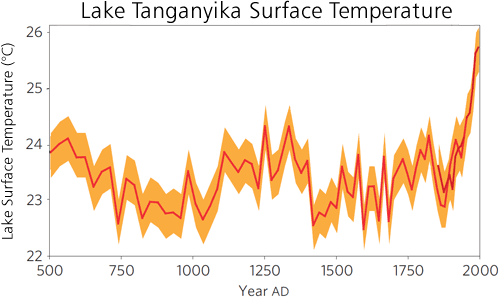
Figure 1: Lake Surface Temperature from Lake Tanganyika palaeorecord for the past 1,500 years, measured in core KH1 (red line) and MC1 (dark red line). Orange shading is 95% error bars.
What effect does temperature have on the lake's sardine population? To answer this question, a proxy for primary productivity was also reconstructed from the lake cores. Primary productivity was determined from the percentage of biogenic silica in the sediment. They found that over the last 1500 years, when temperature rose, primary productivity fell. In the last 150 years, productivity plummeted from relatively high levels during the early 1800s to some of the lowest sustained values during the past 1,500 years.
How does temperature affect primary productivity? When the surface of the lake warms, the waters become more stratified. This makes it harder for cold currents to rise from the bottom. These currents carry nutrients from the depths toward the surface as food for algae. Sardine then feed off the algae. A less productive lake means fewer fish and therefore less food and income for those living in the region.
The stratification is confirmed by deep-water instrumental measurements which find less warming at deeper layers, revealing an increased temperature gradient. Nevertheless, another possible cause in changing rainfall is explored. Higher rates of precipitation may increase primary productivity. Charcoal levels in the lake cores were used as a proxy for humidity (eg - low humidity leads to drought which corresponds with more bushfires). However, they found a weak correlation between charcoal levels and productivity. The stronger relationship between temperature and productivity led the authors to conclude that it's temperature, not rainfall, that is largely controlling primary productivity.
There's also a strong match between Northern Hemisphere temperature reconstructions and the Lake Surface Temperature reconstruction. Temperatures on Lake Tanganyika have largely followed global trends over the past 1500 years as well as the past half-century. From this, the authors infer that surface temperatures in this region vary in concert with the global average and that the recent anomalous warming is a response to anthropogenic greenhouse-gas forcing. As lake temperature and primary productivity are closely related, this is evidence of another impact of man-made global warming on humanity - in this case, the communities and regional economy around Lake Tanganyika.


 0
0  0
0 FIVE: non-representativeness of a single core. Similar arguments apply to Antarctic cores. Single cores give data that are representative of particular spatial regime as long as an appropriate proxy is used. Thus a single core can give good insight into CO2 levels worldwide since CO2 levels are well averaged globally on the timescales of core resolution. Temperature proxies also give good representation of a wider spatial extent since it is well known that temporally-averaged temperature variations are correlated across significant distances (up to 1200 km). In this particular case (Tierney et al, 2010) analysis of lake surface temperatures and temperature profies through the water column indicate that single sites within Lake Tanganyika are likely to be more widely representative (see Figure just above).
SIX: The warming not due to man-made global warming. Since the site chosen for coring was in an isolated area with little human population, little deforestation or agriculture (which could impact on nutrient loading by runoff), there is little evidence that local direct human impacts affect the analyses. The observation is that the Lake Tanganyika surface has warmed very considerably especially in the last 50 years, and is likely warmer than it has been for 1500 years. The warming of the last 50 years has been directly measured and is in line with the wider understanding of enhanced greenhouse-induced warming both locally and more widely. The attribution of the warming to anthropogenic global warming is a pretty reasonable one in the context of what we know.
SEVEN: General point. This paper seems like a pretty good analysis of paleoproxies for lake surface temperatures, primary productivity (and charcoal deposition as a proxy for local forest fires). However (and with greatest respect to Dr. Tierney and her coauthors) its interpretations and conclusions are a small input to our broad understanding of the Earth response to human enhancement of the grrenhouse effect. It really isn't worth a frenzy of attempted trashing!
FIVE: non-representativeness of a single core. Similar arguments apply to Antarctic cores. Single cores give data that are representative of particular spatial regime as long as an appropriate proxy is used. Thus a single core can give good insight into CO2 levels worldwide since CO2 levels are well averaged globally on the timescales of core resolution. Temperature proxies also give good representation of a wider spatial extent since it is well known that temporally-averaged temperature variations are correlated across significant distances (up to 1200 km). In this particular case (Tierney et al, 2010) analysis of lake surface temperatures and temperature profies through the water column indicate that single sites within Lake Tanganyika are likely to be more widely representative (see Figure just above).
SIX: The warming not due to man-made global warming. Since the site chosen for coring was in an isolated area with little human population, little deforestation or agriculture (which could impact on nutrient loading by runoff), there is little evidence that local direct human impacts affect the analyses. The observation is that the Lake Tanganyika surface has warmed very considerably especially in the last 50 years, and is likely warmer than it has been for 1500 years. The warming of the last 50 years has been directly measured and is in line with the wider understanding of enhanced greenhouse-induced warming both locally and more widely. The attribution of the warming to anthropogenic global warming is a pretty reasonable one in the context of what we know.
SEVEN: General point. This paper seems like a pretty good analysis of paleoproxies for lake surface temperatures, primary productivity (and charcoal deposition as a proxy for local forest fires). However (and with greatest respect to Dr. Tierney and her coauthors) its interpretations and conclusions are a small input to our broad understanding of the Earth response to human enhancement of the grrenhouse effect. It really isn't worth a frenzy of attempted trashing!







Comments