



 Arguments







Understanding the CO2 lag in past climate change
Posted on 5 January 2011 by Anne-Marie Blackburn
Earth’s climate has varied widely over its history, from ice ages characterised by large ice sheets covering many land areas, to warm periods with no ice at the poles. Several factors have affected past climate change, including solar variability, volcanic activity and changes in the composition of the atmosphere. Data from Antarctic ice cores reveals an interesting story for the past 400,000 years. During this period, CO2 and temperatures are closely correlated, which means they rise and fall together. However, changes in CO2 follow changes in temperatures by about 600 to 1000 years, as illustrated in figure 1 below. This has led some to conclude that CO2 simply cannot be responsible for current global warming.
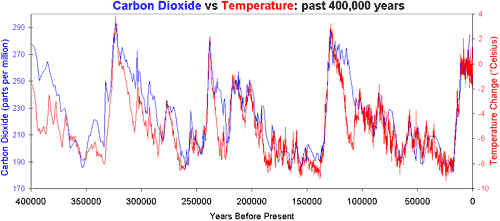
Figure 1: Vostok ice core records for carbon dioxide concentration and temperature change.
This statement does not tell the whole story. The initial changes in temperature during this period are explained by changes in the Earth’s orbit around the sun, which affects the amount of seasonal sunlight reaching the Earth’s surface. In the case of warming, the lag between temperature and CO2 is explained as follows: as ocean temperatures rise, oceans release CO2 into the atmosphere. In turn, this release amplifies the warming trend, leading to yet more CO2 being released. In other words, increasing CO2 levels become both the cause and effect of further warming. This positive feedback is necessary to trigger the shifts between glacials and interglacials as the effect of orbital changes is too weak to cause such variation. Additional positive feedbacks which play an important role in this process include other greenhouse gases, and changes in ice sheet cover and vegetation patterns.
The only conclusion that can be reached from the observed lag between CO2 and temperatures in the past 400,000 years is that CO2 did not initiate the shifts towards interglacials. To understand current climate change, scientists have looked at many factors, such as volcanic activity and solar variability, and concluded that CO2 and other greenhouse gases are the most likely factor driving current climate change. This conclusion is not based on the analysis of past climate change, though this provides key insights into the way climate responds to different forcings and adds weight to the several lines of evidence that strongly support the role of greenhouse gases in recent warming.
This post is the Basic version (written by Anne-Marie Blackburn) of the skeptic argument "CO2 lags temperature". This argument actually peeped its way into the top ten during December but then "We're heading into an ice age" shouldered its way back to the #10 spot (so there's a real dog fight between those two to climb over each other in the rankings).


 0
0  0
0 Says it all really....
Now moving on, please!?
Says it all really....
Now moving on, please!?
 For over 400,000 years atmospheric CO2 has never been over 300 PPM...until now
The Yooper
For over 400,000 years atmospheric CO2 has never been over 300 PPM...until now
The Yooper
 "Nothing should be ignored, but instead should be considered in reality and not in gross projections of worst-case scenarios."
Hope for the best, prepare for the worst is the better survival strategy.
I'll add that most projections are in fact conservatives, and that apathy is a much bigger threat than alarmism right now.
"What!?!? Isn't this whole thread about orbital forcings and didn't we agree on the abilitiy of orbital cycles to initiate both warming and cooling phases?"
Sure, but orbital forcings aren't responsible for the current warming phase. That is pretty easy to prove, considering we have a pretty good grasp of the Earth's current orbital parameters.
"CO2 is a factor, but the major title is still disputed."
Not really.
"I can trot out as many peer reviewed papers as can you that differ with each other."
97% of publishing Climate Scientists support the idea of CO2 being the major driver of the current temperature increase. That's pretty far away from 50-50...
"It's the magnitude of these effects that are in legitimate question."
It's not really in question. Just about the only "scientists" contesting this are financed by conservative think tanks, themselves bankrolled by the like of David Koch and his ilk.
Seriously, there's not much to debate. Deniers and contrarians have failed time and time again to provide scientific evidence to support their challenge - and don't make any mistakes about it, the burden of proof is on them to show that the established science is wrong, not the other way around.
"Nothing should be ignored, but instead should be considered in reality and not in gross projections of worst-case scenarios."
Hope for the best, prepare for the worst is the better survival strategy.
I'll add that most projections are in fact conservatives, and that apathy is a much bigger threat than alarmism right now.
"What!?!? Isn't this whole thread about orbital forcings and didn't we agree on the abilitiy of orbital cycles to initiate both warming and cooling phases?"
Sure, but orbital forcings aren't responsible for the current warming phase. That is pretty easy to prove, considering we have a pretty good grasp of the Earth's current orbital parameters.
"CO2 is a factor, but the major title is still disputed."
Not really.
"I can trot out as many peer reviewed papers as can you that differ with each other."
97% of publishing Climate Scientists support the idea of CO2 being the major driver of the current temperature increase. That's pretty far away from 50-50...
"It's the magnitude of these effects that are in legitimate question."
It's not really in question. Just about the only "scientists" contesting this are financed by conservative think tanks, themselves bankrolled by the like of David Koch and his ilk.
Seriously, there's not much to debate. Deniers and contrarians have failed time and time again to provide scientific evidence to support their challenge - and don't make any mistakes about it, the burden of proof is on them to show that the established science is wrong, not the other way around.








Comments