



 Arguments
Software
Resources
Comments
The Consensus Project
Translations
About
Support
Arguments
Software
Resources
Comments
The Consensus Project
Translations
About
Support







Latest Posts
- New Publication: Identifying Flawed Reasoning in Contrarian Claims about Climate Change
- The Merchants of Doubt are coming for Extreme Event Attribution science
- 2026 SkS Weekly Climate Change & Global Warming News Roundup #25
- Cooking up the Climate Stripes, with Ed Hawkins
- Skeptical Science New Research for Week #25 2026
- How ‘balcony solar’ could help fight rising utility costs
- Fact brief - Does solar energy need subsidies to compete with fossil fuels?
- Plateauing CO2 emissions have slowed atmospheric growth
- 2026 SkS Weekly Climate Change & Global Warming News Roundup #24
- Skeptical Science New Research for Week #24 2026
- June update: Help still needed to get translations prepared for our website relaunch!
- How many people does heat actually kill?
- Check out the brand-new hurricane ‘cone of uncertainty’ graphics arriving this season
- 2026 SkS Weekly Climate Change & Global Warming News Roundup #23
- SkS Housekeeping: Updating the Comments Policy
- Skeptical Science New Research for Week #23 2026
- Nobody knows the future of energy
- Fact brief - Do electric vehicles almost always have a lower carbon footprint than gasoline-powered cars?
- Solar, wind, and EVs have knocked out a doomsday climate scenario
- 2026 SkS Weekly Climate Change & Global Warming News Roundup #22
- Skeptical Science New Research for Week #22 2026
- The next era of Atlantic hurricanes could be far more destructive
- On the death of RCP8.5
- RCP8.5 Update
- 2026 SkS Weekly Climate Change & Global Warming News Roundup #21
- Skeptical Science New Research for Week #21 2026
- What’s a ‘super El Niño’? And other El Niño questions, answered
- Fact brief - Does electromagnetic radiation from wind turbines pose a threat to human health?
- Five things you need to know about El Niño’s likely comeback
- 2026 SkS Weekly Climate Change & Global Warming News Roundup #20

Comment Search Results
Search for arctic ice
Comments matching the search arctic ice:
- Solar, wind, and EVs have knocked out a doomsday climate scenario
prove we are smart at 17:50 PM on 2 June, 2026Well, that is a welcome headline, so, the CO2 emissions released by us in the 20th century and continuing this 21st century isn't going to doom us.
Because of rapidly increasing renewables, ev's and a slow down in fossil fuel use, there is now a new Business As Usual scenario, but still a very dangerous course to follow.
This new path we are on-( imho )-is a medium emission scenario, ( the new BAU ).
????️ "1. What “new business as usual” actually means
The phrase has shifted over the last decade. Historically, BAU meant something like RCP8.5 — runaway fossil‑fuel expansion. Today, because renewables have grown and coal is declining, BAU is more like:
Emissions plateauing or declining slowly, not rapidly
Warming continuing toward ~2.3–2.7 °C by 2100
Carbon budgets for 1.5 °C exhausted within a few years
Planetary boundaries for climate, biosphere integrity, freshwater, and novel entities pushed further into the danger zone
In other words: not worst‑case, but still deeply unsafe.
A BAU world doesn’t just “get warmer.”
It pushes multiple planetary boundaries further into the red, increasing the probability of tipping cascades:
AMOC slowdown
Amazon dieback
West Antarctic Ice Sheet collapse
Permafrost thaw
Coral reef collapse
Monsoon destabilisation
Once tipping elements begin to interact, the climate system becomes non‑linear — meaning human control diminishes.
This is the real risk of BAU:
we lose the ability to steer the Earth system back into a stable state.
???? 5. What it means for “us”
For humanity, BAU means:
A more dangerous, less predictable climate
Shrinking safe zones for agriculture and habitation
Higher economic volatility
Greater geopolitical tension
Increasing pressure on democratic institutions
A world where adaptation becomes permanent, expensive, and unevenly distributed
For the biosphere, it means:
Reduced resilience
Accelerated extinction
Loss of ecosystem services that civilisation depends on
A shift toward a hotter, less biodiverse, less stable Earth".
"Approximately one-seventh of the world's primary energy is now sourced from renewable technologies. This is based on renewable energy's share in the energy mix. Energy consumption represents the sum of electricity, transport, and heating". Here is the link to that-we desperately need to move past that 15% , even if it hurts our GDP's now instead of a warming world forcing a lowering of GDP on us later. ourworldindata.org/renewable-energy
- CO2 is not increasing
scaddenp at 07:37 AM on 30 April, 2026Not to mention that ice core bubbles from Antarctica and Greenland are sampling the atmosphere in two extremely different parts of the world and yet come up with remarkable similar estimates of CO2 concentration at the same times.
- Human-caused climate change is unmistakably distinct from Earth’s natural climate variability
Eric (skeptic) at 12:33 PM on 19 April, 2026I remember the diagram from an earlier thread and I'd like to revisit it. The diagram shows 600 ppm and roughly 22C on the black curve and overlayed text says thermal lag and slow feedback mechanisms. Thernal lag: yes, certainly. But feedback increases CO2. It does not lead to the black curve, it "merely" extends the red curve to the right.
As the author, Dean, points out, that's even worse because we can potentially get further up via the black curve. But that will require oceans to warm from their current 2-3C to 15 C or more. Dean points out feedbacks take millenia. But again that's rightward not upward on the chart. The omnipotent AI says that equilibrium response of the deep ocean is approx 1500 years. But that's simply the turbulent mixing timescale.
The much discussed AMOC is connected to the SMOC. AMOC changes could affect SMOC and vice versa. SMOC overall is 2-3x AMOC as measured in Sv (million cubic meters / sec of water movement). Ironically it is the slowdown of SMOC in particular that would extend the 1500 years. AMOC is more complex with weaker AMOC increasing heat storage efficiency.
I find if I pound on the AI enough it will finally find some (admittedly tentative) support for my claim:
Yes, increased winter sea ice formation in a seasonally ice-free Arctic, particularly in key regions like the Laptev and Kara Seas, can enhance brine rejection and cold, dense water formation, potentially acting as a negative feedback to slow the overall decline of deep water formation
Basically that's due to more open water in autumn leading to a larger heat loss along with the ability of (projected) fresher Arctic surface water to freeze faster. Bottom line is we are talking millenia of thermal lag. My own professional use of nascent AI leads me to the conclusion that millenia simply do not matter at all anymore. I used to think a century mattered, but even before current AI I recognized the acceleration of technology. As of now, the only thing slowing AI down is slow humans. AI itself will solve that problem for better or worse. I think for the better, but I've always been an optimist.
- Why Science Communication Fails: How to Break Down Misleading Arguments and Inoculate Against Misinformation
Eric (skeptic) at 09:19 AM on 15 March, 2026Just Dean, the dashed black line in the diagram in justdean.substack.com/p/how-one-diagram-reveals-the-climate comes from geographic changes that drive both temperatuire and CO2. CO2 is an amplifier of temperature and temperature is an amplifier of CO2, but geography dictates global temperature. Prominent examples are Antarctica cooling with opening of Drake Passage www.researchgate.net/publication/256822123_Influence_of_the_opening_of_the_Drake_Passage_on_the_Cenozoic_Antarctic_Ice_Sheet_A_modeling_approach Arctic glaciation with closing of Isthmus of Panama: www.sciencedirect.com/science/article/pii/S0012821X05004048 There are others.
The steepness of the purple dots is due to the combination of CO2 and temperature mutual feedback added to albedo feedback from the forming and retreat of the continental ice sheets.
So we are left with the green and red lines. In the text they assert that CO2 stays high centuries after net zero (" even 700 years after emissions cease, roughly 85–99 percent of peak warming persists. Atmospheric CO₂ remains at more than half its peak value") I beat up the AI to get current numbers:
"Thus, the ocean absorbs ~9.2 Gt of CO₂ per year from the ~1,191 Gt excess currently in the atmosphere." or 0.77% per year. That 0.77% per year will drop as the excess atmospheric CO2 drops and the ocean saturates, but it suggests less than a century to drop to half, not multiple centuries. All hypothetical of course, but it also suggests we can start to see a drop before net zero.
- Why Science Communication Fails: How to Break Down Misleading Arguments and Inoculate Against Misinformation
Just Dean at 19:47 PM on 10 March, 2026John's discussion of cherrypicking — one of the five FLICC techniques — resonated with me in a specific way. One of the most effective forms of cherrypicking in climate communication isn't the deliberate kind; it's the inadvertent kind. When we present the modern instrumental record of CO₂ and temperature in isolation — as most data visualizations do — we're unintentionally handing skeptics an opening. The data is hanging out in parameter space with no reference point, vulnerable to the response: "the climate has always been changing."
As an engineer and former experimental physicist, my instinct when evaluating any measurement is to overlay independent diagnostics. If they converge, you have something real. Applied to climate, that means placing three completely independent datasets on the same CO₂–temperature axes: the deep-time equilibrium relationship from Cenozoic reconstructions spanning 66 million years (Judd et al., Science 2024), glacial–interglacial variability from Antarctic ice cores covering the past 800,000 years, and the modern instrumental record since 1850. These datasets were developed by different scientific communities, using different methods, to answer different questions. When plotted together, they don't just approximately agree. They land on top of each other.
What this ensemble makes structurally harder is cherrypicking. To dismiss the composite, a skeptic must simultaneously discredit three independent lines of evidence — geological proxies, ice cores, and direct measurement — each developed without reference to the others. More importantly, the composite provides a direct visual answer to the "climate has always been changing" myth. Yes — and here are 66 million years of it on one plot. What it shows is that nowhere in that entire record does Earth evidence the specific combination of CO₂ concentration and global temperature that exists today. It is not the individual values that are unprecedented. It is the combination.
At the end of the episode, Nate asked John what individuals can do. His answer — that we each bring something different to the table — struck me as both honest and important. I'm not a climate scientist. But the instinct to overlay independent diagnostics, standard practice in experimental physics, turned out to be useful here.
For anyone interested, the most recent post developing these arguments is here: [link]
- Climate skeptics have new favorite graph; it shows the opposite of what they claim
Bob Loblaw at 03:21 AM on 28 November, 2025RegalNose @ 26:
The OP mentions the concern about rapid changes. Do not dismiss that concern lightly.
...but with regard to the long-term record, and the Mesozoic period in particular:
- What evidence exists that human civilization in its current form was doing well in those warmer Mesozoic climates? Will our agricultural systems work for us?
- Temperatures similar to the Mesozoic would result in major reductions in land-based ice (especially Greenland and Antarctica). That will lead to sea level rise.
In the next 75 years or so, a metre of sea level rise is a reasonable expectation. That will lead to a lot of new coastal flooding (already beginning), at significant cost (either to prevent, mitigate, or move away from).
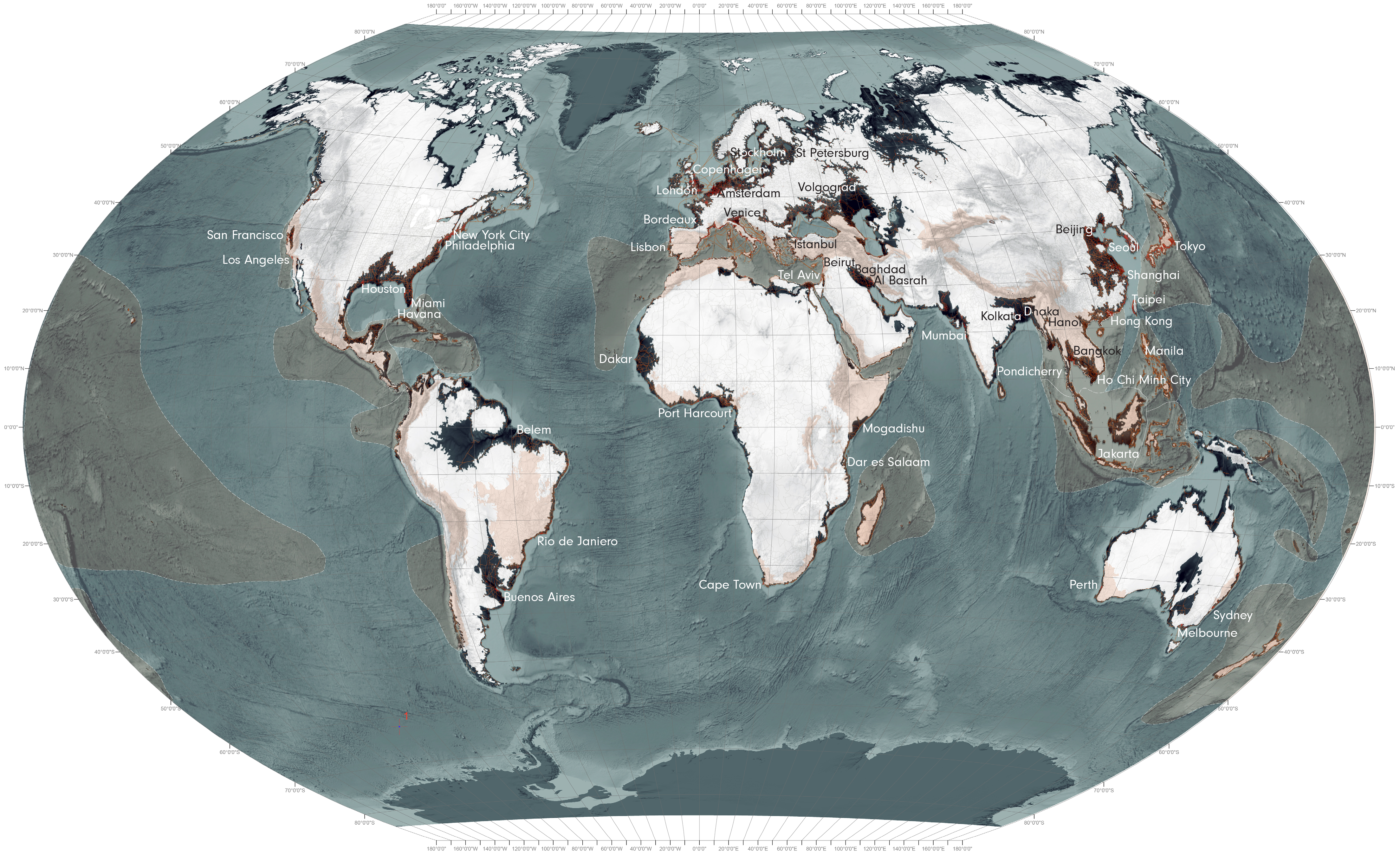
In the longer term (centuries), a complete loss of land ice in a Cenozoic-like climate would lead to an 80m rise in sea levels. Here is a map (from this web site, where you can see a larger image) of how much flooding is likely. Are there any portions of that flooded coastal zone that you would like to see preserved?
- Debunking Joe Rogan, Dick Lindzen, and Will Happer
One Planet Only Forever at 07:03 AM on 7 November, 2025Because of Lindzen's past history of contributions to climate science, I find it very difficult to grant him any benefit-of-doubt regarding his statement in the first point raised (repeated below):
Lindzen @ 6:02: “global mean temperature doesn't change much, but you know you focus on one degree, a half degree, so it looks like something”
Lindzen @ 22:06: “Gutierrez (sic) at the UN says the next half degree and we're done for. I mean, doesn't anyone ask, a half degree? I mean, I deal with that between, you know, 9:00 a.m. and 10:00 a.m [laughs]. Rogan: "it does seem crazy. It's just that kind of fear of minute change that they try to put into people.”
To start, Lindzen seriously misrepresents what Gutierres has said. A quick internet search finds the following UN News item: There is an exit off ‘the highway to climate hell’, Guterres insists. It includes the following selected quotes:
“It’s climate crunch time” when it comes to tackling rising carbon emissions, the UN Secretary-General said on Wednesday, stressing that while the need for global action is unprecedented, so too are the opportunities for prosperity and sustainable development.
...
Question of degrees
He said a half degree difference in global warming could mean some island States or coastal communities disappearing forever.
Scientists point out that the Greenland ice sheet and West Antarctic ice sheet could collapse and cause catastrophic sea level rise. Whole coral reef systems could disappear along with 300 million livelihoods if the 1.5℃ goal is not met.
Extreme weather from East Asia to the western seaboard of the US has been turbocharged by climate chaos, “destroying lives, pummelling economies and hammering health”, said the Secretary-General.
It is very challenging to excuse someone like Lindzen saying those types of things (and all the other cases of misleading manipulative messaging by him and Happer that have been pointed out).
Rogan can be excused for being a gullible desperate pursuer of popularity who is easily impressed and therefore potentially is unwittingly massively harmfully misleading. No such excuse comes to mind for Lindzen (or Happer).
I look forward to the follow-up mentioned by Dana that will "...look at the underlying psychology in a separate article in the near future."
- Ice age predicted in the 70s
Philippe Chantreau at 03:34 AM on 3 November, 2025To elaborate on the previous post, I'll add that I was somewhat lucky in being able to access that "paper" at my first try. Multiple other attempts on different pieces led to broken links or paywalls. One paywalled let me read a first page that did not suggest it was taking a strong position on forecasting future trends.
Another one was accessible but hardly relevant: "Summary of Soviet publications on weather modification." It nonetheless contained this bit: "Budyko, Drozdov and Yudin (1966) stated that in
less than 200 years the heat released by man's activities will have a greater influence on climate change than solar radiation changes." I recommend reading through it so that nobody accuses me of cherry picking. The bulk of it is about cloud seeding for agricultural purposes. Some parts reflect the insane arrogance of the Soviet approach to inhabiting this planet, especially the getting rid of Arctic ice ideas near the end. A fun read, but it's still hard to see how it could be construed as a research paper forecasting cooling of the Earth climate.
I am not sure I will have the patience to continue wading through this. So far, I am profoundly unimpressed with this "57 cooling papers" claim.
- Medieval Warm Period was warmer
Dick van der Wateren at 21:23 PM on 12 May, 2025Another paper by some of the same authors shows evidence of MCA warming in Antarctica. See https://www.sciencedirect.com/science/article/abs/pii/S0031018219303190.
A more problematice paper stating evidence of Antarctic medieval warming appeared in Nature https://www.nature.com/articles/s43247-025-02259-4. It has already been picked up by denialists.
So, where does that leave us? Are there any good recent reports of the global temperature distribution during the MWP?
- Medieval Warm Period was warmer
Eclectic at 08:29 AM on 7 May, 2025Dick van der Wateren @ 273 / 274 :-
Your third reference (the Nature paper) leads off by saying: "The Antarctic landscape is one of the most stable environments on Earth ... [for] approximately 14 million years"
Which is what you would rather expect, seeing that the Antarctic ice-sheet is simply a super-colossal block of ice. The 14 million year period is not an intuitive matter ~ but the task of finding a slight variation of temperature (probably less than 1 degree) occurring at some stage during recent millennia . . . would be a daunting and ultimately pointless task.
I ran into a "blockage" seeking your earlier references, and will therefore fall back on my old memories of a study of coastal temperatures on a portion of (eastern) South America. That study was (IIRC) rather unimpressive in validity ~ especially since it covered only a tiny part of the planet. Can you supply a detailed discussion of those earlier papers you mentioned?
- Medieval Warm Period was warmer
Dick van der Wateren at 21:29 PM on 6 May, 2025Another paper by some of the same authors shows evidence of MCA warming in Antarctica. See https://www.sciencedirect.com/science/article/abs/pii/S0031018219303190.
A more problematice paper stating evidence of Antarctic medieval warming appeared in Nature https://www.nature.com/articles/s43247-025-02259-4. It has already been picked up by denialists.
So, where does that leave us? Are there any good recent reports of the global temperature distribution during the MWP?
- 2025 SkS Weekly Climate Change & Global Warming News Roundup #14
wilddouglascounty at 09:23 AM on 7 April, 2025This is a request:
In light of the overwhelming amount of research and analytics being done regarding the many, many facets of the climate, your Weekly Climate Change News has in the past been very helpful for the reader to find vetted journal news to sort through the tsunami of coverage that is almost impossible to sort out. Kudos for your editorial staff to sort through this firehose of information in order to glean it down to semi-digestible quantities!
Maybe it has been there along and I have noticed it, and perhaps it is because of your system of categorization that you are now using, but I have been noticing an inflation of news articles that are inundating the research based articles published in vetted journals. While there is nothing inherently wrong with reporting the "news" in the Climate Change Impacts category, for instance, I can easily find these news articles elsewhere, whereas the journal articles are more difficult to retrieve. Given the huge volume of articles available, you could greatly turn down the "news" volume in order to make it easier to take in the research end of the category. For instance in this week's "Climate Change Impacts" section, the following represent the kind of analytic and research articles I'm interested in finding out about:
- -If sea levels are rising, why is the Maldives still above water?
- -Losing Forest Carbon Stocks Could Put Climate Goals Out Of Reach
- -Big Banks Quietly Prepare for Catastrophic Warming
- -Global warming of more than 3°C this century may wipe 40% off the world’s economy, new analysis reveals
- -Climate crisis on track to destroy capitalism, warns top insurer
- -Forecasters predict another active 2025 Atlantic hurricane season
- -On the Edge: The people and polar bears of a warming arctic
The rest of the articles in the Climate Change Impacts category are merely news headlines about unfolding weather events, and we all know that intensity and frequency of these are increasing due to increased capacities of weather systems in an atmosphere juiced by increasing carbon levels. But I'm looking more for research and analyses of those weather pattern changes, instead of reportage of the weather events themselves, which I can find elsewhere. Burying the 7 analyses/research papers amongst the 11 weather news reports makes it more, not less difficult to study Climate Change Impacts, at least for me. Perhaps this might make it easier for you as well!
- Climate skeptics have new favorite graph; it shows the opposite of what they claim
Eric (skeptic) at 03:06 AM on 31 March, 2025Evan, your comment #3 is valid, that the effects matter more than the magnitude of warming or the rate of warming. But then in comment #5 you make a million year claim about warming (rate or magnitude or both). That claim is based on a single location using a single ice core, and there are many counterexamples like this:sa.indiaenvironmentportal.org.in/files/Evidence%20for%20warmer%20interglacials%20in%20East%20Antarctic.pdf
I have some issues with Holocene reconstructions that nigelj is alluding to in #4 but those quibbles (regarding spatial and temporal resolution) are not pertinent to the curve argument that this posting is about.
In general longer term claims like Post made (Post authors, not the scientists) such the 450 million year curve compared to present rate of warming are abstractions. They sound impressive until they are given a bit of scrutiny and then are very easily dismissed. Instead I would use a combo of your #3 and nigelj's #4.
- Antarctica is gaining ice
John Hartz at 08:19 AM on 13 February, 2025Suggested supplemental reading:
Introductory text:
"Social media posts sharing a graphic comparing sea ice levels in the Antarctic on the same date 45 years apart misrepresent the data to suggest climate change is a hoax.
The graphic, opens new tab depicts two authentic maps of the continent from the University of Colorado Boulder’s National Snow and Ice Data Center (NSIDC), one labelled as 'Sea Ice Extent, 24 Dec 1979' and the other 'Sea Ice Extent, 24 Dec 2024,' with white regions indicating sea ice.
'Antarctic sea ice extent is 17% higher today than it was in 1979. Ice doesn’t lie, but climate scientists do,' the text reads."
Verdict:
"Misleading. The posts cherry-pick specific dates that misrepresent Antarctic sea ice trends and ice dynamics that are influenced by multiple factors beyond global warming."
by Staff, Reuters Fact Check, Feb 11, 2025
- January sets an unexpected temperature record
Jim Hunt at 16:24 PM on 11 February, 2025In related news the air temperature at the North Pole rose above zero degrees Celsius for several hours on February 2nd:
https://GreatWhiteCon.info/2025/02/facts-about-the-arctic-in-february-2025/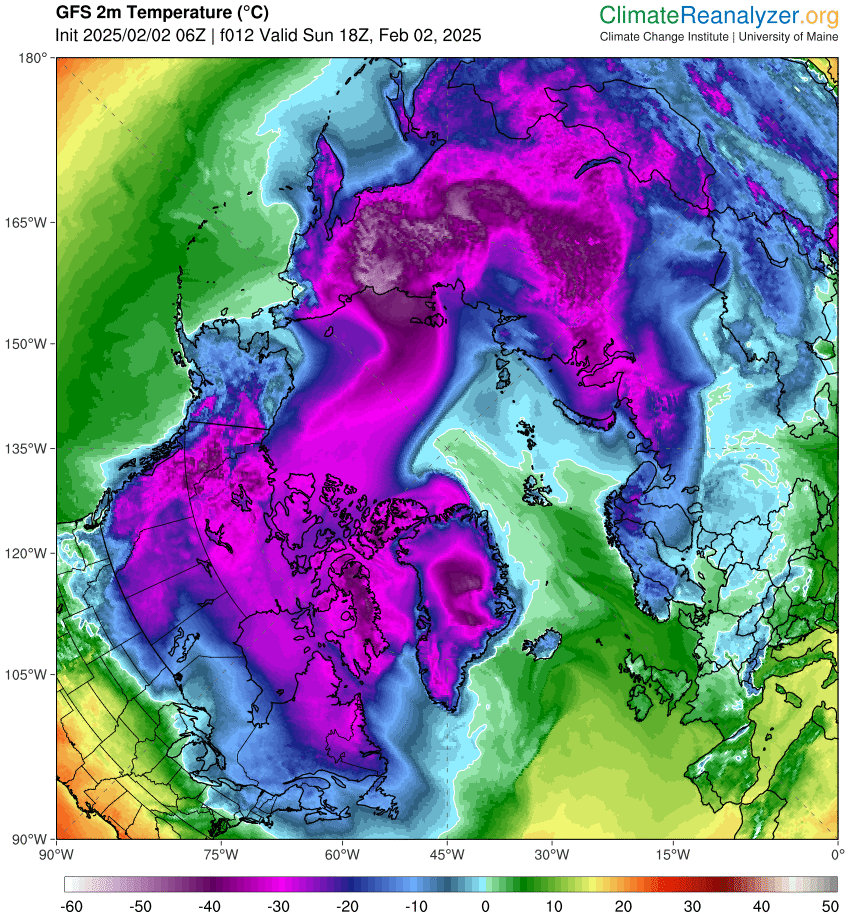
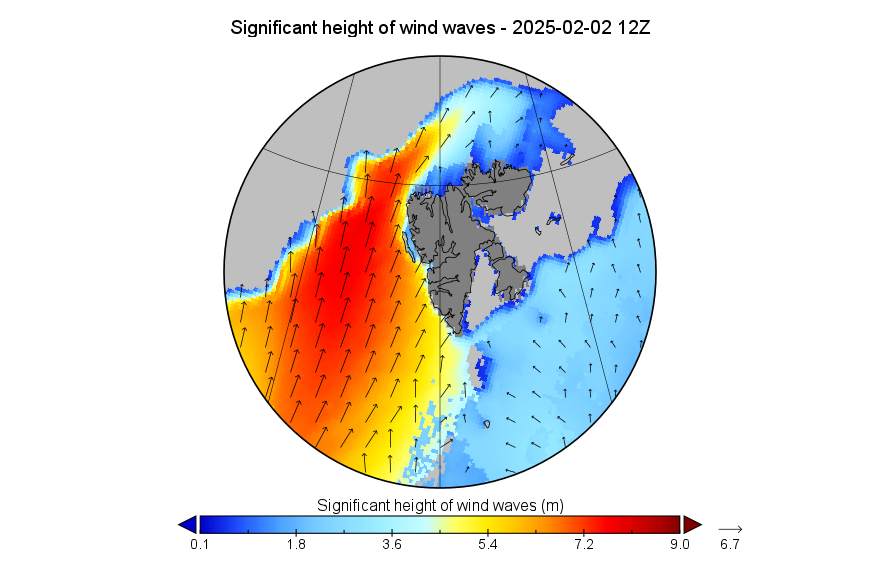
Huge waves north of Svalbard pushed back the sea ice edge on the Atlantic side of the Arctic Ocean:
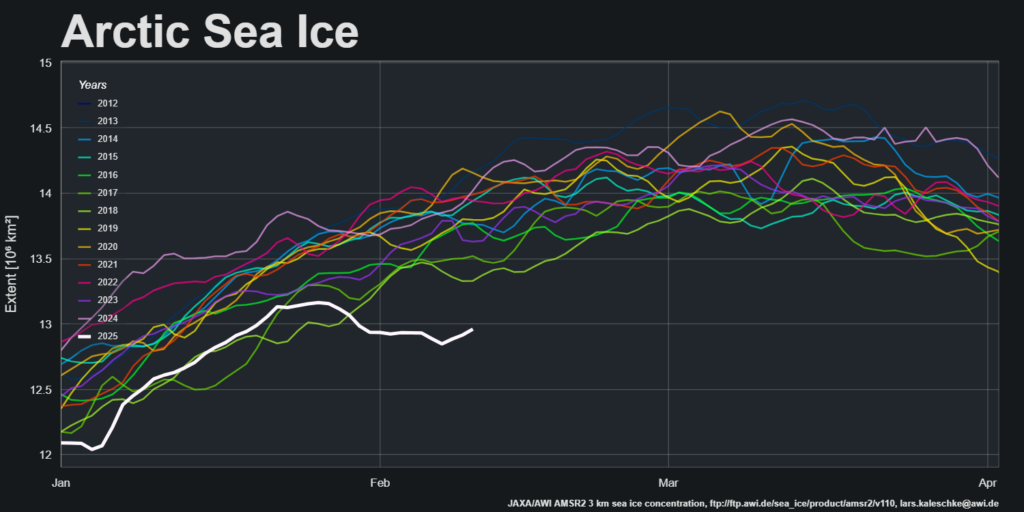
Sea ice extent is only just starting to recover from the shock:
- Skeptical Science News: The Rebuttal Update Project
Cedders at 19:08 PM on 6 October, 2024I'm glad to read that the articles are getting a systematic refresh. Anything to make the rebuttals more accessible can help effectiveness in countering myths, misunderstanding and misinformation.
There are two reasons I can think of for the new intros. People are looking for shorter tl:dr abstracts. Secondly, information can be too technical for some audiences. Unfortunately it's hard for scientifically literate writers to know what is likely to be misunderstood, deliberately or accidentally (we know frequent examples like Greenland surface mass balance). Is the new text being tested against actual occurrences of myths?
I hope there's no need to delete much text from the passage of time and it can be edited instead. Historical perspectives can help transparency. As a hypothetical example: 'Loss of Arctic sea ice seemed in the early 2010s to be happening far faster than projections, leading some people to conclude at the time that summer sea ice would be virtually gone by 2020/whenever and headlines. Ice loss has since slowed bringing it more into line with projections.'
- Just have a think: Arctic Sea Ice minimum 2024. Three degrees Celsius warming now baked in?
Jim Hunt at 23:10 PM on 27 September, 2024Eclectic @3,
I was indeed, but the UKMO's Tony Banton described Anthony's flock of faithful followers as "attack-dogs"!
Even when I point them at scientific explanations for the alleged "hiatus" in the wiggly line of Arctic sea ice extent they respond with "ROFLMAO" and similar astonishing insights:
https://GreatWhiteCon.info/2024/09/the-2024-arctic-sea-ice-minimum-extent-in-the-cryodenialosphere/
I'll be publishing a more "scientific" article on the subject, as and when the overdue sea ice age data for August are released. In the meantime, there wasn't much "thick, old ice" left in the Arctic Ocean at the beginning of August: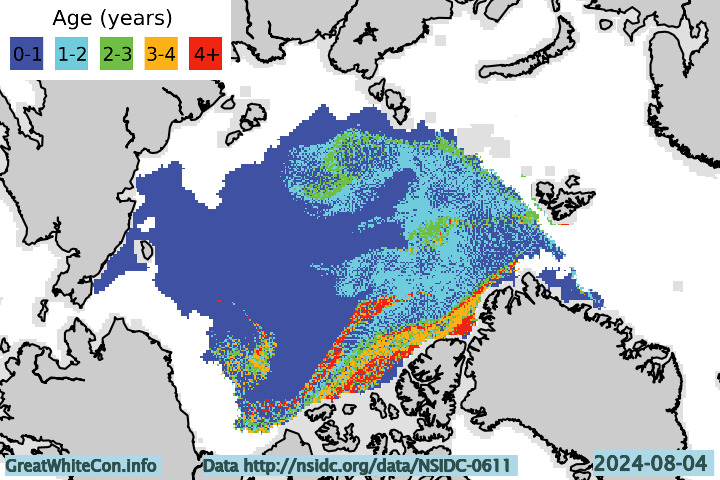
- Just have a think: Arctic Sea Ice minimum 2024. Three degrees Celsius warming now baked in?
Eclectic at 12:50 PM on 27 September, 2024Jim Hunt @2 ,
you were, two or three days ago, crossing swords with the amiable skeptics at WUWT blog, about Arctic ice.
It seems they feel that a sort-of flat-lining of minimum Arctic sea-ice extent during the past decade . . . is a disproof of the contemporary reduction in Arctic sea-ice volume . . . which in turn demonstrates that there will be no further ice melt as sea-level continues to rise ~ the ongoing rise which in turn disproves that global warming is occurring. (If I have understood their argument correctly.)
And since global warming is not continuing, despite rising measurements by worldwide thermometers, then the whole AGW thing is a hoax and can be ignored.
Or something like that.
And if Plan Denial eventually crumbles, then the WUWT skeptics will develop "concepts of a plan" to deal with the non-problem. [Please excuse contemporary 2024 political joke.]
- Just have a think: Arctic Sea Ice minimum 2024. Three degrees Celsius warming now baked in?
Jim Hunt at 10:28 AM on 27 September, 2024"Ice of this age is now mostly confined to a narrow strip extending from north of Greenland along the north-west edge of the Canadian archipelago."
The most recent PIOMAS thickness data suggests that it is now mostly confined to a small area within the CAA:
https://GreatWhiteCon.info/2024/09/facts-about-the-arctic-in-september-2024/#Sep-21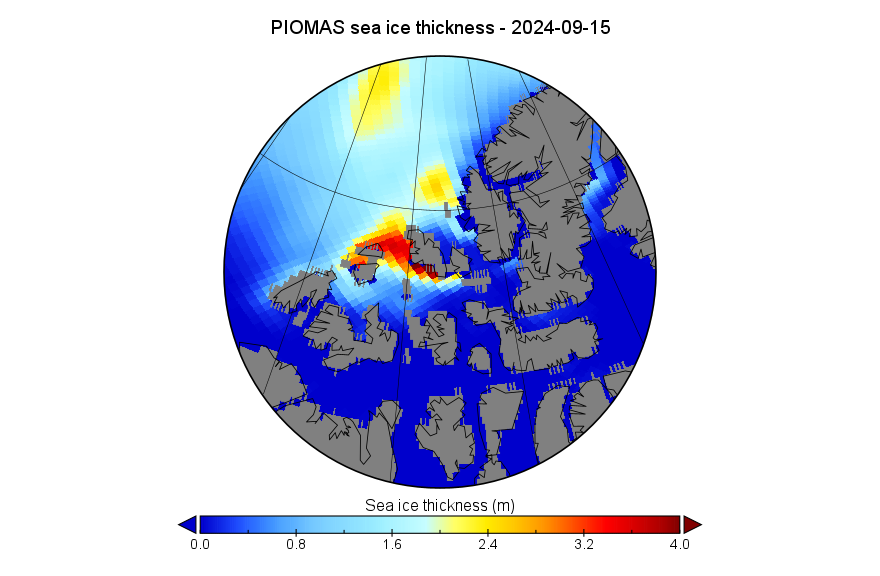
- Just have a think: Arctic Sea Ice minimum 2024. Three degrees Celsius warming now baked in?
sailrick at 13:16 PM on 25 September, 2024From the World Meteorology Organization's report; The Global Climate 2011-2020
"Reduced sea ice extent was accompanied by a decrease in thickness and volume, although data for these indicators are more limited. There has also been a marked decrease in the extent of ice which lasted for
more than one year.
In March 1985, old ice (four years or more) accounted for 33% of the total ice cover of the Arctic Ocean, but that figure had fallen below 10% by 2010, and in March 2020 it had dropped to 4.4%..
Ice of this age is now mostly confined to a narrow strip extending from north of Greenland along the north-west edge of the Canadian archipelago." - The doom spiral
Jan at 19:49 PM on 20 September, 2024Sadly, climate scientist have no time to follow the path single discussions on feedbacks take. Therefore, they think models can in anyway predict what is comming. Unfortunately they can't! So many models errors of Earth system developments now amerging that one can only vomit.
Thererby, models miss way too many feedbacks which are now soming into motion.
The Amazon is now trapped in the vicious cycle, speeding up its collapse decades earlier then predicted. Antarctic heatwaves and see ice losses also happens decades earlier then predicted.
The methane feedback has started while models did not see a significant signal till 2100 to emerge. The methane modul of models is crap! But do not know if the new one is already deployed.
Be it as it may, the warmings of the Arctic methane bomb are now out and will increase the comming years as recent observational studies are quite worring. Not only Yedoma permafrost emits much more, but the real danger will be geological methane from methane hydrates and gas rich sediment layers, which is a wild card, which is ever more observed and documented - methane of thermogenic origion reaches the atmosphere where measurements have been made, while ground water melts its way downward through cracs driven by osmosis.
Marine heatwaves, a feedback of oceans warming too fast, are also not predicable by models as they are driven by small scale to global circulation patterns in the oceans and atmosphere. We have now the first MHW in the North Pacific reaching in its peak regions some 7-8°C above the 1981-2011 average (one cause: Asian flooding amplifying the subtropical North Pacfic high via hot upper air currents).
Not only that marine heatwaves expanded non-linear, they are also a game changer in terms of ocean heat uptake, circulation patterns, and extreme events. Models were not able to predict their spread which can only be described as nuts.
Next problem we face is that over the oceans first 300m ocean heat is now building up, in the mode water and intermediate water mass regions the heat buildup spreads to deeper layers with subsurface water masses warming, freshening, and expanding. Very bad sign indeed!
First study came now out that vertical mixing of the oceans could already be suppresed by increasing stratification. Further, we see worrying changes in mode water masses in the Northern Hemisphere. At the same time recent changes around Antarctica (e.g. warming and hemispheric temperature gradient declining -oops!) are also worrying as it has been the Southern Ocean that had been mostly responsible for the monotoic trend of incrasing heat uptake the last 20 years - intensfying winds around Antarctica the major reson (Ozone hole supported that development of increasing hemispheric temeprature gradient).
Just now the experts of ocean mxing and ocean heat uptake trying frantically to find out which processes controlls heat uptake of the oceans as we did never really loocked into it. But now the changes become so worrying that our simple assumption that the oceans would continue their monotoic trend in increasing heat uptake like nothing was amiss doesn't matter how fast we warm our planet had been way too simple.
If ocean heat uptake declines from 90% of the extra energy to 80%, the whole goes fast bam, as a too fast warming had been the problem in the first place.
And if oceans should start to take less than 90% of the extrem energy kept in the system, all the other feedbacks will be triggered.
This can go very fast! Doomer? Stupid framing of the system, as the above is in all points a real possibility as we do not know when and how fast feedbacks could start to synchronize.
And if this should happen the only chance humanity will have, will be to reduce GHG conrentrations in the atmsphere as fast as we can do it united as a species figthing for its own survival!
Sadly, many climate scientist have become statisticans and thereby they have lost contact with reality as the discussions deep in the mechanics of our climate systems point something very clear out:
We are now flying blind and even an extinction level event is a possibility whch can progress fast!
- On Hens, Eggs, Temperature and CO2
MA Rodger at 19:27 PM on 4 September, 2024rkcannon @16.
Assuming Mark Johnson @18 is correct and you do refer to the graphic posted @6 (which seems entirely sensible), your question has still not been properly addressed.
And that presumably is to ask why the CO2 fluctuations through recent ice ages (180ppm to 280ppm) are associated with large temperature fluctuations (10ºC peak-to-peak) but the larger recent anthropogenic CO2 (280ppm to 420ppm) doesn't result in any commensurate temperature increase in the graph.
There are a number of factors to consider.
(1) The forcing from changes in CO2 is logarithmic, so the recent CO2 forcing would be slightly smaller than the ice age forcing (2.2Wm^-2 as opposed to 2.4Wm^-2).
(2) It takes time for the temperature to react to an imposed forcing so only about two-thirds of any CO2-forced increase would have occurred in the decades of man-made warming so far.
(3) The ice age CO2 forcing was not the major forcing through ice ages. The change in albedo due to the shrinking ice sheets and the rising oceans would be double the CO2 forcing. Other factors like methane and dust were also in play. (The orbital forcing that triggers ice ages is very minor.) Increasing CO2 contributed perhaps a third of the ice age forcings.
(4) The temperatures being plotted are from the EPIC ice core data and thus Antarctic temperatures which wobbled tiwce as much as global temperatures through the ice ages. (Note the modern CO2 value has been added, marked with an asterisk. Grafting on the modern EPIC temperature record would be difficult, and would not show much as the instrument record is more wobble than rise.)
So taking (1) to (4) into account, the 10ºC ice age cycle in the graphic @6 would be a little smaller, say 90% (1) then a third off (2) then two-thirds off (3) and finally halved (4). So the global temperature should be very roughly something like [10ºC x 0.9 x 0.67 x 0.33 x 0.5 =] +1ºC which is pretty-much what we see globally today. - How extreme was the Earth's temperature in 2023
Jan at 17:45 PM on 19 April, 2024Made it a little bit nicer, as it is important:
On the causes of the exceptional temperature jump in 2023
First things first:
What was special about the warming in 2023 was, that it happened all in the last 6 months, so it was a much larger jump over these months than the mean values of 2023.
Further, only a moderate El Nino existed, so not too much warming came from here.
Reasons where:
SOx reductions over the shipping routes amplified the marine heatwave signal across the mid-latitudes.
The El Nino in combination with a positive Indian Dipole - both lead to a larger heat release of the tropical oceans as a clear and strong circulation cell is supported over the tropical oceans due to the zonal SSTs gradient.
Sea ice reductions around the Antarctic caused circulation changes that led to moist and warm air advection over Antarctica (strong effect on the warming as exceptional heat waves rocked Antarctica), as well as radiative effects of the sea ice reductions and heat release over sea ice-free areas.
Then that climate warming warms the oceans now more than natural variability is often able to produce colder than normal SSTs - at one time only some ocean regions existed with colder than normal temperatures.
Then we had the vast expansion of marine heatwaves across the global oceans, especially across the mid-latitudes reaching a coverage of more than 40% in July.
The warmer-than-normal Oceans created a cloud feedback thereby increasing shortwave absorption (reinforces marine heatwaves).
From 2012 to 2016 we had a non-linear increase of moisture in the marine boundary layer caused by exceptional SSTs. The next jump will have happened in 2023 causing a water vapor feedback over large parts of the oceans to increase. And tropical moist air advection is causing marine heatwaves in the subtropics to mid-latitudes. So also here is another feedback as more water vapor radiates longwave radiation back to the surface.
Further, we had during summer to autumn large areas where the soil-moisture-temperature cascade came into play producing these exceptional continental heat waves. It comes along with a cloud feedback and supports stalled/fixed high-pressure systems as these heat domes redirect the jet around them (higher troposphere).
Then we had the pattern effect of increasing zonal (east/west direction) temperature gradients at the ocean surface and continents which disturb the overlying circulation, often causing blocking patterns (also a reason for the marine heatwaves to build up)
Then we had towards autumn a heat release of the marine heatwaves across the mid-latitudes, as the atmosphere gets colder. Also, cold core and warm cors eddies cause extreme temperature gradients in the western boundary extension regions leading to a larger latent heat releases over these ocean regions (small-scale pattern effect of SSTs increases wind speeds).
Last it has been possible that the oceans released heat from the subsurface that had built up. Across the mid-latitudes warm freshening water masses are accumulating under the surface as shallow as 150m depth. And these heat depots could have been tapped, as the jets speed up during winter, as the density gradient between the tropics and poles increases in the upper atmosphere while it decreases near the surface, especially during winter. More and stronger low-pressure systems due to increased shear are the outcome. And all these extreme low-pressure systems in autumn and winter across the mid-latitudes in 2023/24 could have tapped these subsurface heat depots. But no study here as this is a new development seen in the intensity of the low-pressure systems the last years (e.g. number of atmospheric rivers hitting the US west coast)
Main problem thou is the expansion of marine heatwaves, as they are feedback driven by global warming heating the oceans from the surface too fast (thermal stratification increases non-linear in the upper 300m of the oceans in various regions), in combination with the pattern effect which disturbs global zonal circulation with the result of more stalled high-pressure systems (low wind speeds are in most instances the main precondition for marine heatwaves to form besides thermal stratification and shallow upper mixed layer depth).
Last the warming of the northern latitudes can also be included in the factors driving global warming in 2023.
In short, the warming of 2023 was feedback-driven by various systems forcing each other into a heating mode with the systems of the oceans, atmosphere, and landmasses acting in unison!
The exact series of which contributed to what extent to the heating science has to find out. But it would have to be done on a monthly basis!
The next jump will have devastating consequences as they become larger...
In my opinion, the model spread is now a joke as it is way too large proving the uselessness of models as they will increasingly become unable to predict what is coming as too many parametrizations prevent them from simulating the non-linear character of the mutually reinforcing systems with many processes operating on small scales...
p.s. we warm the oceans too fast from the surface that is our main problem!
- How extreme was the Earth's temperature in 2023
Jan at 16:59 PM on 19 April, 2024What was special about the warming in 2023 was, that it happened all in the last 6 months, so it was a much larger jump over these months then the mean values of 2023.
Further, only a moderate El Nino existed, so not too much warming came from here.
Reasons where:
SOx reductions amplified the marine heatwave signal across the mid-latitudes.
The El Nino in combination with a positive Indian Dipole - both lead to a larger heat release of the tropical oceans as a clear and strong circulation cell is supported over the tropical oceans due to the zonal temperature gradient.
Sea ice reductions around the Antarctic caused circulation changes that led to moist and warm air advection over Antarctica (strong effect on the warming as exceptional heat waves rocked Antarctica), as well as radiative effects of the sea ice reductions and heat release over sea ice-free areas.
Then climate warming warms the oceans now more than natural variability is often able to produce colder than normal SSTs - at one time only some ocean regions existed with colder than normal temperatures.
Then we had the vast expansion of marine heatwaves across the global oceans, especially across the mid-latitudes reaching a coverage of more than 40% in July.
The warmer-than-normal Oceans created a cloud feedback thereby increasing shortwave absorption (reinforces marine heatwaves).
From 2012 to 2016 we had a non-linear increase of moisture in the marine boundary layer caused by exceptional SSTs. The next jump will have happened in 2023 causing a water vapor feedback over large parts of the oceans to increase. And tropical moist air advection is causing marine heatwaves in the subtropics to mid-latitudes. So also here another feedback as more water vapor radiates longwave radiation back to the surface.
Further, we had during summer to autumn large areas where the soil-moisture-temperature cascade came into play producing these exceptional continental heat waves. It comes along with a cloud feedback.
Then we had the pattern effect of increasing temperature gradients in the oceans surface and continents which disturb the overlying circulation, often causing blocking patterns (also a reason for the marine heatwaves to build up)
Then we had towards autumn a heat release of the marine heatwaves across the mid-latitudes, as the atmosphere gets colder.
Last it have been possible that the oceans released heat from the subsurface that had built up. Across the mid-latitudes warm freshening water masses are accumulating under the surface as shallow as 150m depth. And these heat depots could have been tapped, as the jets speed up during winter, as the density gradient between the tropics and poles increases in the upper atmosphere while it decreases near the surface. More and stronger low-pressure systems due to increased shear are the outcome. And all these extreme low-pressure systems in autumn and winter across the mid-latitudes in 2023/24 could have tapped this subsurface heat depot. But now study here as this is new.
Main problem thou is the expansion of marine heatwaves, as they are feedback driven by global warming heating the oceans from the surface too fast (thermal stratification increases non-linear in the upper 300m of the oceans in various regions), in combination with the pattern effect which disturbs global zonal circulation with the result of more stalled high-pressure systems (low wind speeds are in most instances THE precondition for marine heatwaves too form besides thermal stratification and small mixed layer depth).
Last the warming of the northern latitudes can also be included in the factors driving global warming in 2023.
In short the warming of 2023 was feedback-driven by various system forcing each other into a heating mode with the systems of the oceans, atmosphere, and landmasses acting in unison! The exact series of which contributed to what extent to the heating science has to find out. But it would have to do it on a monthly basis!
The next jump will have devastating consequences as they become larger...
Here is my FB page, want now to make my own blog, as the experts lose the oversight and models will be increasingly wrong (the model spread is in my opinion a joke as it is way too large proving the uselessness of models)...
https://www.facebook.com/Erdsystemforschung/
All the best
Jan
p.s. we warm the oceans too fast that is our main problem!
- How extreme was the Earth's temperature in 2023
nigelj at 07:08 AM on 18 April, 2024Some explanations for the unusual global warming levels in 2023:
James Hansen thinks the anomalously high global surface temperature in 2023 are due to AGW + El Nino + Aerosols reductions. I can't find the related commentary, and have to go by memory, but Hansen suggests that the quite abrupt reductions in shipping aerosols in 2023 added to reductions in industrial aerosols over the last ten years warmed the oceans and this energy comes out after a time delay and it all came out in 2023. Perhaps someone has the details of his suggestion and comments on its credibility.
El ninos release ocean heat that has been building up. I note that the high sea surface temperatures are in the northern oceans are away from the centre of el nino activity.
From NASA: Five Factors to Explain the Record Heat in 2023. But what caused 2023, especially the second half of it, to be so hot? Scientists asked themselves this same question. Here is a breakdown of primary factors that scientists considered to explain the record-breaking heat ( I have cut and pasted the key statements only):
The long-term rise in greenhouse gases is the primary driver.
The return of El Niño added to the heat.
Globally, long-term ocean warming and hotter-than-normal sea surface temperatures played a part.
Aerosols are decreasing, so they are no longer slowing the rise in temperatures.
Scientists found that the Hunga Tonga-Hunga Ha‘apai volcanic eruption did not substantially add to the record heat.
earthobservatory.nasa.gov/images/152313/five-factors-to-explain-the-record-heat-in-2023
From PBS News: ‘We’re frankly astonished.’ Why 2023’s record-breaking heat surprised scientists. A range of factors including general warming due to human-caused climate change, the El Niño climate pattern, record-low Antarctic sea ice and others — contributed to 2023’s record-breaking heat, but they don’t tell the full story. Schmidt said more work has to be done to fully understand why the year was so hot.
“In 2024, we’ll be seeing whether this persists or whether it kind of goes back to a normal pattern,” he said. “And that will be kind of telling as to whether 2023 was just a very unusual combination of things that all added up to what we saw, or whether there’s something systematically different going forward.” (Seems like good comments to me)
From Copernicus:
Some alternative suggestions on 2023 warming including changes in regional wind patterns over the northern parts of the oceans bringing heat to the surface:
atmosphere.copernicus.eu/aerosols-are-so2-emissions-reductions-contributing-global-warming
(This is not a reference to el nino, but to other changes in wind patterns to the north. For me it raises the question of caused the changes in wind patterns)
Clearly there is no definitive answer yet on why 2023 was so unusually warm ( ditto 2024 thus far). As scientists say next years data will help illuminate the causes.
- Welcome to Skeptical Science
Eclectic at 09:45 AM on 4 April, 2024Cookclimate @118 :-
You are wrong. When the arctic/Greenland ice-sheets melt, that raises the sea level near the equator, and consequently that slows the Earth's rotation. Basic physics. And you are wrong about so very much of the other stuff you posted.
Where do you get all that wrong info from?
- Welcome to Skeptical Science
cookclimate at 09:28 AM on 4 April, 2024CO2 does not cause Earth’s climate change.
It is estimated that it will cost $62 trillion to eliminate fossil fuels, but eliminating fossil fuels will be a complete waste of our tax and corporate dollars, because it will not stop the warming. You can’t stop Mother Nature.
The IPCC (Intergovernmental Panel on Climate Change) frequently shows that temperature correlates with CO2 for the last 1,000 years as proof that CO2 is causing the warming. But if you extend that to the last 800,000 years, the temperature and CO2 lines do not correlate or fit (Figure 14 in Supplemental Data). If the lines don’t fit, then you must acquit CO2. CO2 is not guilty of causing climate change. CO2 does not control Earth’s temperature. The IPCC has not demonstrated any scientific evidence that CO2 controls Earth’s temperature (they only have unproven theories).
The facts:
• Earth is currently warming (it is still below the normal peak temperature).
• CO2 is increasing (it is above the normal CO2 peak).
• Earth’s current warming is being caused by a 1,470-year astronomical cycle.
The 1,470-year astronomical cycle warms the Earth for a couple of hundred years and melts ice sheets primarily in Greenland and the Arctic. It has repeated every 1,470-years for at least the last 50,000 years. It is normal that it would be happening again. It accelerates Earth’s rotation, stopping length of day increases (Figure 9). It warms the Earth. Based on historical data, the current warming should peak near the year 2060 and then it should start to cool.
For more information, see A 1,470-Year Astronomical Cycle and Its Effect on Earth’s Climate,
and Supplemental Data,
www.researchgate.net/publication/379431497_Supplemental_Data_for_A_1470-Year_Astronomical_Cycle_and_Its_Effect_on_Earth's_Climate#fullTextFileContent - Climate - the Movie: a hot mess of (c)old myths!
jimsteele24224 at 02:05 AM on 4 April, 2024I would also take issue with SkepticalScience claiming Polar bears are in danger of extinction as well as many other species.
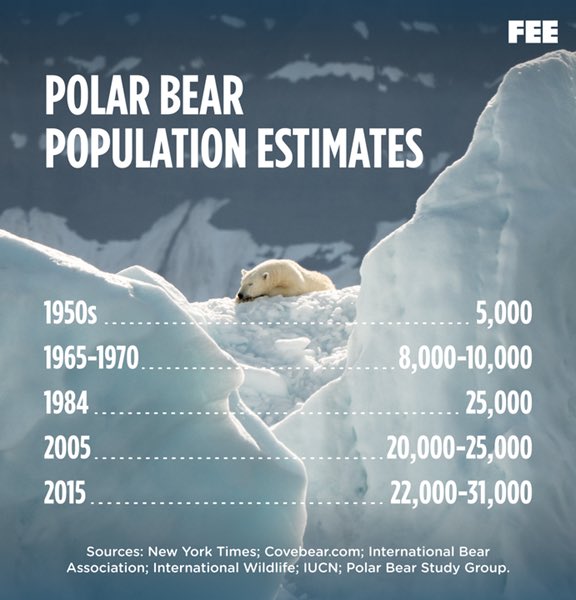
Polar bears are believed to be affected by reduced sea ice because their main prey, the ringed seal, remains in the Arctic all year and they give birth to their pups on the ice where they are very vulnerable to the bears.
• There are 2 types of sea ice. Land-fast ice and pack-ice. Unlike fast-ice, pack ice is mobile. When winds cause pack ice to collide with the shore or other ice slabs, the pack ice thickens as ice slabs are pushed on top of each other. Thick pack ice doesn’t melt completely in the summer. However, shifting winds can blow thick pack ice out of the Arctic, as happened in the 1990s9.
• Ringed seals depend on fast-ice. Thin fast-ice naturally melts completely by July, and then re-forms starting in October.To breathe, ringed seals must create breathing holes by head-butting through any newly forming thin ice. Then gnawing and clawing at the ice as it thickens, keeps their breathing holes open throughout the winter. Multi-year pack ice is too thick for seals to create breathing holes.
• Ringed seals mostly give birth to their pups on land fast-ice in March and April. Pups remain on the ice while nursing and then molting in June. Land-fast ice is thickest during the seals reproduction cycle and remains until late June. Seals then abandon the ice to hunt in open water starting in July and only crawl out on ice unpredictably to bask in the sun for a few hours. Melting ice after July has no effect on how available the seal pups are to bears.
• Polar bears gain almost all of their body fat in the late spring and early summer from feeding on baby ringed seals. In contrast, all bears lose weight during the winter when there is the greatest amount of ice. Feasting on baby seals from March thru June determines if the bears will survive the winter. Unlike feasting on baby seals, any feeding on ice or land after June is purely opportunistic. Pregnant females enter hibernation just as ice begins to reform and emerge only as ringed seals are giving birth
• Ringed Seal are so abundant they are considered a Species of Least Concern, so Arctic climate change does not appear to have had a negative effect.
• More open water from July to September increases sunlight reaching phytoplankton, generating greater photosynthesis and a more productive Arctic Ocean.3 Increased photosynthesis improves the whole Arctic food chain, eventually increasing fish populations that ringed seals depend upon. More ringed seals provide more food for polar bears.
• Since hunting polar bears was restricted, polar bear populations have increased. - Climate - the Movie: a hot mess of (c)old myths!
jimsteele24224 at 06:07 AM on 3 April, 2024A Netherlands journalist, Maarten Keulemans, tried to denigrate Climate the Movie: The Cold Truth in about 50 tweets using much of the same arguments posted to here on SkepticalScience. I successfully debunked all of his arguments in 16 tweets (originally I intended 20) listed below, and so I was just honored with being interviewed for a Dutch TV segment regards how the Climate the Movie promotes vital scientific debate. Too often alarmists try to suppress debate with weak arguments or denigrating the opposition as deniers. However I doubt alarmists can refute any of my arguments, but I will gladly entertain your arguments.
1 Denigrating the Climate Reconstruction graph by Ljungqvist https://twitter.com/JimSteeleSkepti/status/1771929435366940908…
2 Keulemans' Medieval Warm Period lie https://twitter.com/JimSteeleSkepti/status/1771933673488789868…
3 Contamination of Instrumental by Urbanization https://twitter.com/JimSteeleSkepti/status/1771939656504062260…
4 The Best USA temperature Statistic! https://twitter.com/JimSteeleSkepti/status/1771947116631580724…
5 Ocean Warming Facts https://twitter.com/JimSteeleSkepti/status/1771957182407536940…
6 US Heat Waves https://twitter.com/JimSteeleSkepti/status/1771963700951527487…
7 It is the Sun Stupid! https://twitter.com/JimSteeleSkepti/status/1771977013576024282…
8 Alarmists know better than Nobel Prize Winners ! https://twitter.com/JimSteeleSkepti/status/1771987039631921454…
9 Wildfires: Liar Liar Keulemans' Pants on Fire https://twitter.com/JimSteeleSkepti/status/1772000151596572844…
10 The Dangers of CO2 Sequestration and CO2 Starvation https://twitter.com/JimSteeleSkepti/status/1772016867265380795
11 Models Running Hot! Keulemans Disgraceful attack on the most honest Dr John Christy! https://twitter.com/JimSteeleSkepti/status/1772081300884852829…
12 Keulemans’ Blustering Hurricane Fears
https://twitter.com/JimSteeleSkepti/status/1772319957042479298
13. Dishonestly Defining Natural Climate Factors
https://twitter.com/JimSteeleSkepti/status/1773395443864736058
14. Denying Antarctica’s Lack of Warming
https://twitter.com/JimSteeleSkepti/status/1773473481637957758
15. Misinformation on CO2’s Role in Warming Interglacials during our Ice Age.
https://twitter.com/JimSteeleSkepti/status/1773777313924297210
16. Science journalists vs grifting propagandists – Antarctica
https://twitter.com/JimSteeleSkepti/status/1774428539858907444 - At a glance - Human activity is driving retreat of arctic sea ice
gerontocrat at 03:48 AM on 7 March, 2024And some unusual evidence on the NW Passage hot off the press from "The Guardian" newspaper.
https://www.theguardian.com/environment/2024/mar/06/gray-whale-nantucket-extinction
Gray whale sighted off New England 200 years after species’ Atlantic extinction
Scientists confirm cetacean’s presence but cite impact of climate change which has made North-west Passage ice-free in summer
Scientists have confirmed the presence of a whale off New England that went extinct in the Atlantic Ocean two centuries ago – an exciting discovery, but one they said that illustrates the impact of climate change on sea life.
Researchers with the New England Aquarium in Boston found the gray whale while flying 30 miles south of Nantucket, Massachusetts, on 1 March. The whale, which can weigh 60,000 pounds (27,215kg), typically lives in the northern Pacific Ocean.
The gray whale vanished from the Atlantic Ocean by the 18th century, but there have been five observations of the animal in Atlantic and Mediterranean waters in the last 15 years, the aquarium said in a statement. The whale found this month was probably the same animal spotted in Florida late last year, the aquarium said.
The researchers who found the animal off Massachusetts said they were skeptical at first, but after circling the area for 45 minutes, they were able to take photographs that confirmed it was indeed a gray whale.
“I didn’t want to say out loud what it was, because it seemed crazy,” said Orla O’Brien, an associate research scientist with the Anderson Cabot Center for Ocean Life at the New England Aquarium.
Scientists said they were thrilled to see the animal, but its presence probably has to do with the warming of the planet. The North-west Passage, which connects the Atlantic and Pacific Oceans through the Arctic Ocean in Canada, has lacked ice in the summertime in recent years, they said."
- Skeptical Science New Research for Week #49 2023
nigelj at 04:35 AM on 10 December, 2023MS Sweet. Good information to know.
"I note that Dr. Hansen has long held an Earth System Sensitivity of 6 C. The IPCC consensus has been 3C"
The IPCC number is "equilibrium climate sensitivity", a different thing from earth system sensativity as below. Making it hard to compare the two numbers.
"By definition, equilibrium climate sensitivity does not include feedbacks that take millennia to emerge, such as long-term changes in Earth's albedo because of changes in ice sheets and vegetation. It includes the slow response of the deep oceans' warming, which also takes millennia, and so ECS fails to reflect the actual future warming that would occur if CO2 is stabilized at double pre-industrial values.[38] Earth system sensitivity (ESS) incorporates the effects of these slower feedback loops, such as the change in Earth's albedo from the melting of large continental ice sheets, which covered much of the Northern Hemisphere during the Last Glacial Maximum and still cover Greenland and Antarctica)...."
(Climate sensitivity, wikipedia)
We will probably never know any of these numbers for sure because you can't put the planet in the laboratory. (Although I think paleo studies like the one you posted have a lot of credibility - because they are based on real world conditions). But IMHO that uncertainty is not necessarily a crucial problem. Current rates of warming are bad and are having very visible effects, and huge implicatrion in the short to medium term, and so whatever the level of climate sensitivity using whatever definition, we clearly have a huge problem.
- John F. Clauser: the latest climate science-denying physicist
michael sweet at 03:01 AM on 30 November, 2023AB19:
In support of John Mason at 64, here is the carbon dioxide graph:

The graph is from the Royal Society CO2 concentrations from ice cores go back about 800,000 years. As you can see, the last 200 years are completely exceptional. The antarctic temperature has not yet responded as much as global temperatures above.
- 2023 SkS Weekly Climate Change & Global Warming News Roundup #44
MA Rodger at 21:23 PM on 8 November, 2023This Hansen et al (2023) paper was pre-published back in January and did result in a bit of discussion here at SkS. And there was supposed to be a second paper specifically on SLR.
Hansen et al rattle through a pile of stuff, some of which I would agree has merit and some which I find difficult to accept, some very difficult. The high ECS is one of the very difficult ones. (Perhaps the point that the big part of the difference between high ECS values and the IPCC's most likely value ECS=3ºC, [something the IPCC tend not to identify preferring a range of values as in AR6 Fig1.16]: the difference is due to warming that follows the forcing by a century or more. That time-lag is one of the reasons the ECS estimates are not better nailed down and still has its 'fat tail' . It also would give mankind a fighting chance of dodging it.)
SLR is certainly a big subject of concern. It is a long-term problem, multi-century. The equilibrium position for a +1.5ºC is perhaps 3m and the threat of setting Greenland into unstoppable meltdown at higher levels of warming would triple that. I do tend to get irked by the SLR by 2100 being the sole subject of discussion.
Of course, predictions of that 2100 SLR being massive (5m) is one of Hansen's foibles. The worry is, I think, specific to Antarctica and it is a genuine worry. But to achieve 5m by 2100 would need massive numbers of icebergs bobbing around in the southern oceans and result in global cooling. And there is also the awkward point for climatologists that increased snowfall over Greenland/Antarctica could provide a significant reversal of SLR.
The final issue raised by Hansen et al (2023) is the impact of the reduction of aerosols from our falling SO2 emissions. Quantifying the impact of SO2 emissions is not entirely global a thing, so emissions in, say, China may induce more cooling than, say, Europe. But that said, global SO2 emissions data I identify tends to be way out-of-date. The most recent is this one from a Green Peace publication. This shows the reduction in SO2 is well in hand over the last decade. And the CERES data showing EEI does show a drop in albedo (yellow trace in the 2nd graphic) through that period. My own view of these CERES numbers is that they include a lot of bog-standard AGW-feedback-at-work.


There is also the last 5 months of crazy global temperatures (so post-dating Hansen et al's pre-publication). I don't see these as being sign of things to come. I'd suggest it is casued by the January 2022 Hunga Tonga eruption which threw both SO2 and H2O into the stratosphere, the cooling SO2 dropping out leaving the warming H2O to do its thing before eventually it too dropping out.
And the in-the-pipeline thing. Climatology is/has-been saying we need to halve CO2 emissions b 2030, and following the point of net zero in mid century we enter a century-plus of net-negative CO2 emissions. That would see all emissions 2008 to year-of-net-zero removed by human hand and stored away safely. So that is on top of the natural draw-down of CO2 into the oceans. And if we don't do that, it will not be from ignorance of the situation.
- Increasing melting of West Antarctic ice shelves may be unavoidable
Bob Loblaw at 11:38 AM on 5 November, 2023David-acct @ 1:
Oh, my. A paper that shows that there is a geothermal heat flux of 285 milliwatts/m2 at a site in the West Antarctic ice sheet. And 105 milliwatts/m2 flowing up through the ice sheet!
Your "complete analysis" is no such thing. This sort of argument has been discussed previously here in comments on more than one thread. Try reading some of the comments adjacent to these ones:
Is Antarctica losing or gaining ice?
- Increasing melting of West Antarctic ice shelves may be unavoidable
David-acct at 10:35 AM on 5 November, 2023Surprising that there was no mention of the geothermal activity in West Antarctica . The article only mentions warming seas as if global warming was the primary cause of the West antarctica sea ice melting.
Far better to provide a more complete analysis
www.science.org/doi/10.1126/sciadv.1500093
- Antarctica is gaining ice
John Hartz at 07:48 AM on 13 October, 2023Suggested supplemental reading:
Forty percent of Antarctica’s ice shelves are shrinking, worrying scientists by Kasha Patel, Environment, Washington Post, Oct 12, 2023
- Antarctica is too cold to lose ice
John Hartz at 07:44 AM on 13 October, 2023Suggested supplemental reading:
Forty percent of Antarctica’s ice shelves are shrinking, worrying scientists by Kasha Patel, Environment, Washington Post, Oct 12, 2023
- John F. Clauser: the latest climate science-denying physicist
MA Rodger at 21:25 PM on 7 September, 2023Markp @1+,
I think it is wrong to say that the IPCC is not a scientific body. Certainly the SPMs are edited for the political purpose of obtaining unanimity, but the assessment reports do reflect the whole of the science and thus are scientific. If that science is not being done (and in the case of WG2 & WG3 I fear it probably isn't), it is a problem not of the IPCC's making.
The two examples you provide are worthy of discussion.
☻ Spatt & Dunlop (2018) 'What Lies Beneath; The Understatement of Existential Climate Risk' is a bit of a gallop through the subject and today a little dated. It is the product of a think-tank and, apparently, "is not intended as a 'scientific paper'." Perhaps study of missing threats should become a subject set up as a science; the studying of the cracks within AGW science.
Today the science (and thus the IPCC) is addressing tipping points and if the evidence suggests either of them are still underplaying them, then that should be put on record.
And the 'fat tail', our inability at nailing down ECS and partcularly the top end of possible ECSs; if that does continue to remain elusive, isn't that because the 'fat tail' acts so slowly? And if it is slow and also temperature induced, presumably we should be able to dodge it before it arrives.
☻ The second example you cite is a downloadable undergrad thesis and the climatology bit of it is about the rather dated 'Arctic melt-out' warnings of two-decades back. At the time the basis for these warnings was the period of increased melt 2000-07 which saw previous trends in annual Arctic minimum SIE rise from -0.06M sq km/y to -0.24M sq km/y. The idea that the thinning ice would disappear with a rush was at the time** not unfounded but it hasn't been borne out with 2007-on only showing a slow downward trend in the Arctic SIE minimums.
(** I remember at the time the widespread incredulity given to 'official' projections which were suggesting ice-free Arctic summers would arrive more slowly, sometime 2027-50. We are now not far off from the start of that period and no ice-free event yet.)
The other bit of criticism of in the undergrad thesis looks at economic forecasting. This is perhaps off-topic (the numpty Clauser is the topic here & he is a science guy) so I'll try not to wax too lyrically.
I don't think the thesis really scratches the surface in its descriptions of what I consider ligitmate criticism of the pretty awful work in this field. The idea that timely AGW mitigation would (according to denialists) crash the global economy and pauperise the less-developed world but AGW itself would do no more than slow economic growth marginally (global growth reduced by just a third under +4ºC AGW in the doomiest projection here) I find utterly unbelievable. (My usual example is to imagine Madagascar melted into the sea. The loss to global economy would be 0.014% but would the 30M souls who live there just go down with the ship?)
But with the numpty Clauser as the topic here & he a science guy, economic forecasting is not on-topic here. - The difference between land surface temperature and surface air temperature
Jim Hunt at 08:01 AM on 6 August, 2023"People who create and/or circulate such myths are denying plain reality."
There's a lot of it about at the moment John! My own recent article on the creation and circulation of similar myths takes a look at some theory whilst also debunking some specific "skeptical" memes:
https://GreatWhiteCon.info/2023/08/the-information-war-with-the-fossil-fuel-industry/
By way of just one example, if you can spot the difference between these two graphs of Arctic sea ice extent you may well wonder why a certain "Steve Goddard" has been continuously blasting the former data at his flock of faithful followers rather than the latter?
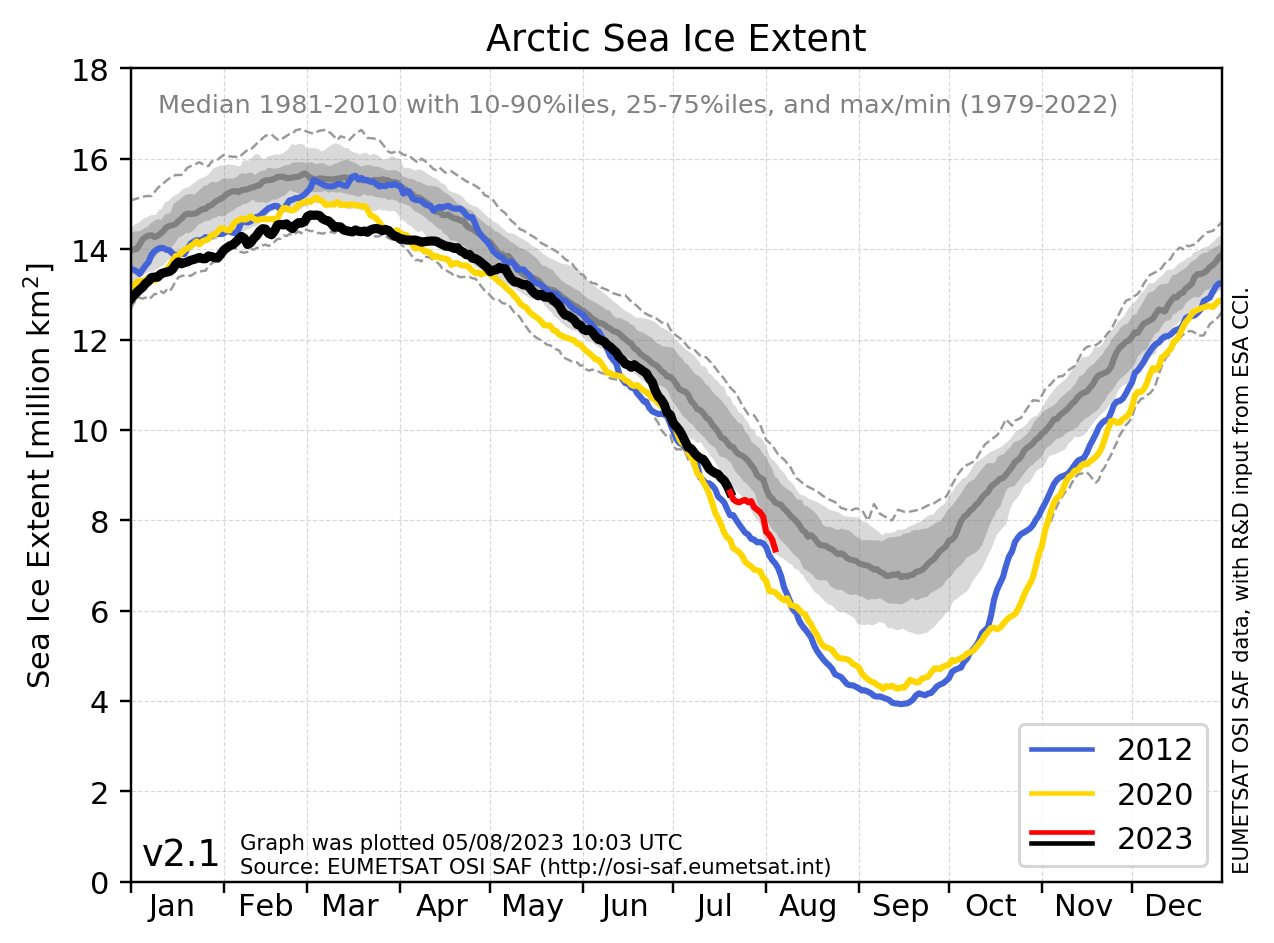
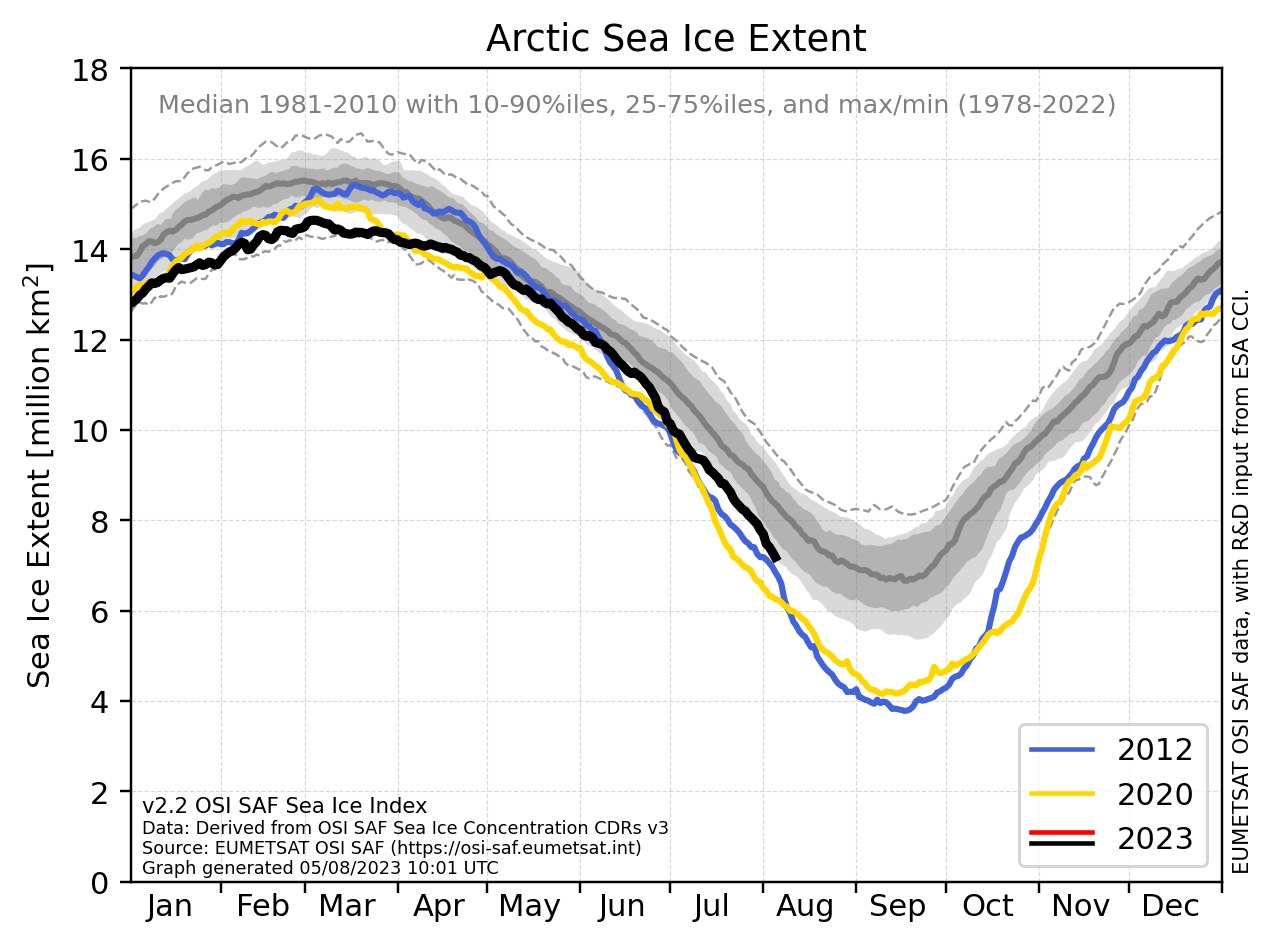
Events, dear Tony, events!
- How big is the “carbon fertilization effect”?
daveburton at 01:45 AM on 14 July, 2023Eclectic wrote, "Daveburton @22 ~ Please explain more of your first chart [ IPCC's decadal Carbon Flux Comparison 1980-2019 ]. The natural sink flux figures… show a rather steady proportionality to the total carbon emissions."
Glad to. Any two things which steadily increase are thereby correlated. There's only a possibility that the relationship might be causal if there's a possible mechanism for such causality.
There's no possible mechanism by which the rate at which CO2 emerges from chimneys could govern the rate at which CO2 is taken up by trees & absorbed by the oceans, or vice-versa, so the relationship cannot be causal — just as this famous relationship is not causal:
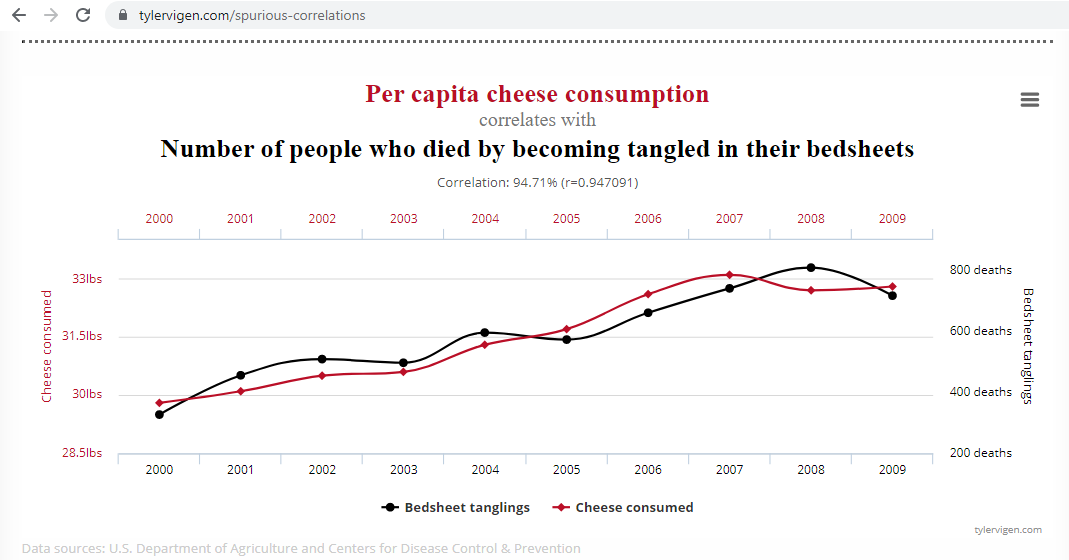
Eclectic wrote, "The land sink shows about 30-35% of total emissions, while the sum of land & ocean remains around 55-60%."
Yes, I usually say "about half," as in, "If our CO2 emissions were cut by more than about half then the atmospheric CO2 level would be falling, rather than rising."
It is important to recognize that the relationship is merely coincidental, not causal.
Eclectic wrote, "as the decades progress, the natural carbon sink flux in absolute terms rises with the rising emissions ~ but does not show a proportional increase."
The rate at which natural processes, such as ocean uptake, uptake by trees and soil ("greening"), and rock weathering, remove CO2 from the air, is affected in minor ways by many factors, but in a major way by only one: the current amount of CO2 in the air.
Our CO2 emission rate does not and cannot affect the natural removal rate, except indirectly, in the long term, by being one of the most important factors which affect the amount of CO2 in the air.
Eclectic wrote, "looking back in time ~ as the atmospheric CO2 level decreases, the size of the natural sink flux decreases also."
That is correct. It will also be correct looking forward in time, when CO2 levels are falling, someday.
Eclectic wrote, "this directly contradicts your hypothesis of 'if emissions were halved ... atmospheric CO2 level would plateau.'"
If you'll allow me to use "halved" as a shorthand for "reduced to the point at which emissions merely equal current natural removals, rather than exceed them," then those two statements are both correct, and perfectly consistent. It's pCO2 (level), not the rate of CO2 emissions, which (mostly) governs the rates of all the natural CO2 removal from the atmosphere.
Of course there are also minor factors which affect the removal rates. For instance, as we've already discussed, a 1°C rise in water temperature slows ocean uptake of CO2 by roughly 3%. Conversely, a rise in air temperature accelerates CO2 removal by rock weathering. (Sorry, I don't have a quantification of that.) But the main factor which controls the rate of CO2 removals is pCO2.
Eclectic wrote, "While the nutritive components of some food crops may reduce slightly as CO2 rises…"
Oh boy, another rabbit hole! That's the Loladze/Myers "nutrition scare."
It is of little consequence. That should be obvious if you consider that crops grown in commercial greenhouses with CO2 levels as high as 1500 ppmv are as nutritious as crops grown outdoors with only 30% as much CO2.

≥1500 ppmv CO2 is optimal for most crops. That's why commercial greenhouses typically use CO2 generators to raise daytime CO2 concentration to well above 1000 ppmv. It is expensive, but they go to that expense because elevated CO2 (eCO2) makes crops much healthier and more productive. (They don't typically supplement CO2 at night unless using grow-lamps, because plants can't use the extra CO2 without light.)
If elevating CO2 by >1000 ppmv doesn't cause crops to be less nutritious, then elevating CO2 by only 140 ppmv obviously doesn't, either.
Better crops yields, due to eCO2 or any other reason, can cause lower levels (but not lower total amounts) of nutrients which are in short supply in the soil. But that doesn't happen to a significant extent when agricultural best practices are employed.
I had an impromptu online debate about the nutrition scare with its most prominent promoter, mathematician Irakli Loladze, in the comments on a Quora answer. If you're not a Quora member you can't read it there, so I saved a copy here. He acknowledged to me that food grown in greenhouses at elevated CO2 levels is as nutritious as food grown outdoors.
Faster-growing, more productive crops require more nutrients per acre, but not more nutrients per unit of production.
Inadequate nitrogen fertilization reduces protein production relative to carbohydrate production, because proteins contain nitrogen, but carbohydrates don't. Likewise, low levels of iron or zinc in soils cause lower levels of those minerals in some crops. So, it is possible, by flouting well-established best agricultural practices, to contrive circumstances under which eCO2, or anything else which improves crop yields, causes reduced levels of protein or micronutrients in crops.
But farmers know that the more productive crops are, the more nutrients they need, per acre. Competent farmers fertilize accordingly.
Or, for nitrogen, they may plant nitrogen-fixing legumes — which benefit greatly from extra CO2.
If you don’t fertilize according to the needs of your crops, negative consequences may include reductions in protein and/or micronutrient levels in the resulting crops. The cause of such reductions isn't eCO2s, it's poor agricultural practices.
The nutrient scare is an attempt to put a negative "spin" on the most important benefit of eCO2: that it improves crop yields.
Eclectic wrote, "it is (as you state) beyond argument that higher CO2 benefits overall crop yield & plant mass."
That's correct. Moreover, agronomy studies show that for most crops the effect is highly linear as CO2 levels rise, until above about 1000 ppmv (which is far higher than we could ever hope to drive outdoor CO2 levels by burning fossil fuels). That linearity is obvious in the green (C3) trace, here:
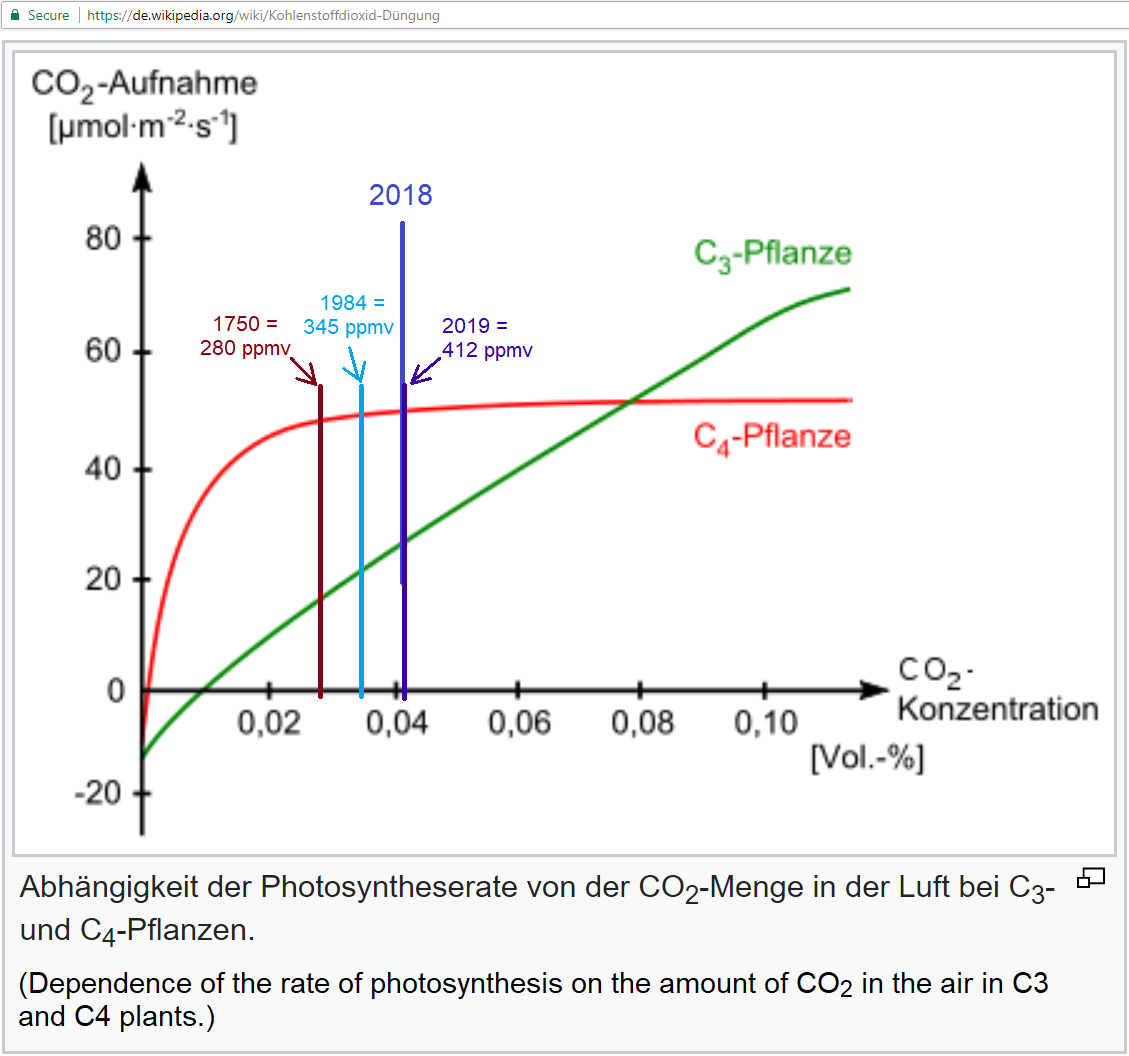
That improvement is one of several major reasons that catastropic famines are fading from living memory.
If you're too young to remember huge, catastrophic famines, count yourself blessed. Through all of human history, until very recently, famine was one of the great scourges of mankind, the "Third Horseman of the Apocalypse." But no more. This is a miracle!
https://ourworldindata.org/famines
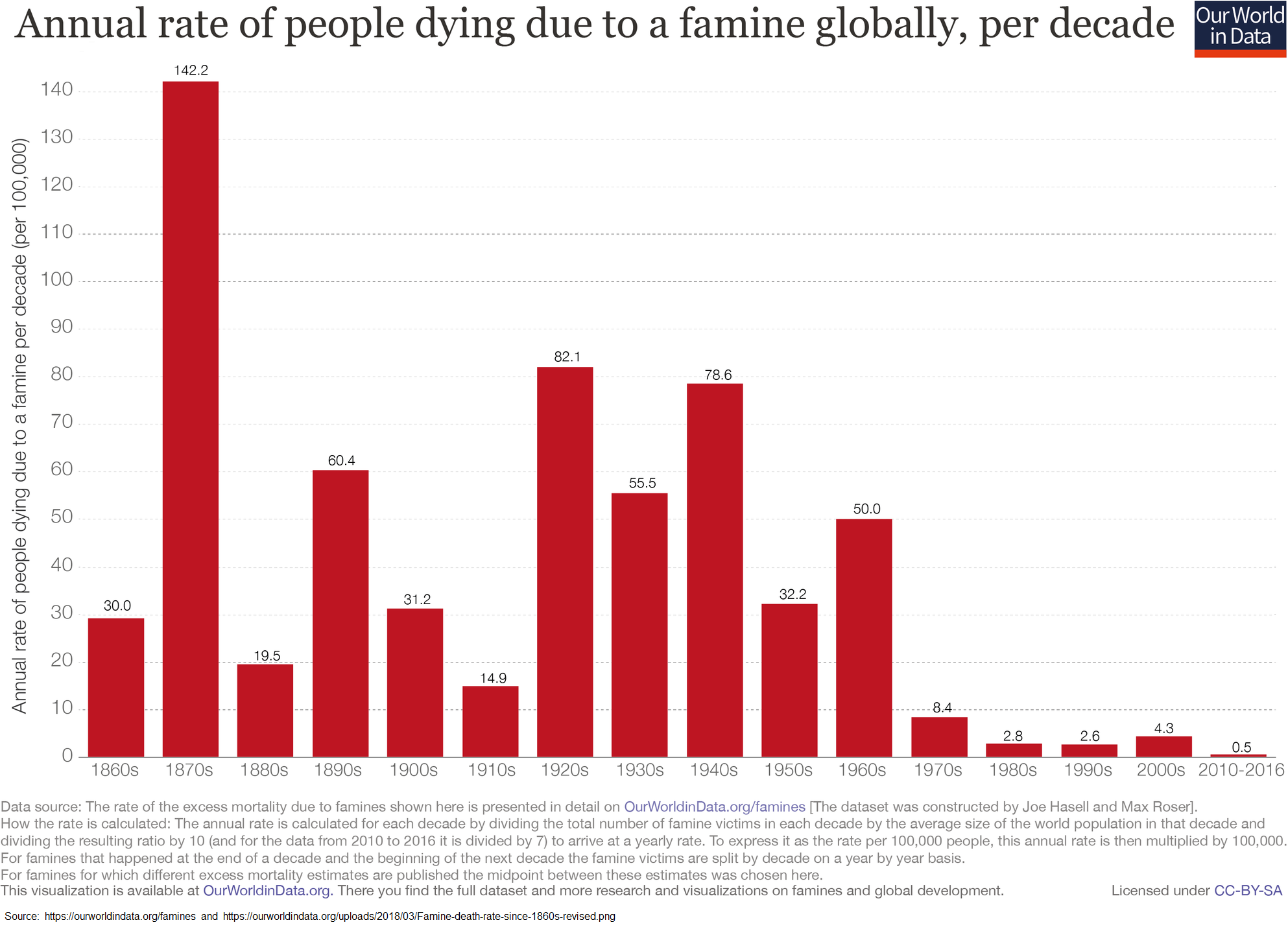
Ending famine is a VERY Big Deal, comparable to ending war and disease. Compare:
● Covid-19 killed 0.1% of world population.
● 1918 flu pandemic killed about 2%.
● WWII killed 2.7%.
● The near-global drought and famine of 1876-78 killed about 3.7% of the world population.
Eclectic wrote, "other CO2/AGW concomitant effects of increased droughts /floods /heat-waves can be harmful to crop yields in open-field agriculture. [And especially so for the staple crop of maize.]"
Well, let's examine those one at a time.
Heat-waves. Overall, temperature extremes are not worsened by the warming trend. Heat waves are slightly worsened, but by less than cold snaps are mitigated. That's because, thanks to "Arctic amplification," warming is disproportionately at chilly high latitudes, and it is greatest at night and in winter. The tropics warm less, which is nice, because they're warm enough already.
1°C is about the temperature change you get from a 500 foot elevation change. (That's calculated from an average lapse rate of 6.5 °C/km.)
On average, 1°C is similar in effect to a latitude change of about sixty miles, as you can see by looking at an agricultural growing zone map. Here's one, from the Arbor Day Foundation:
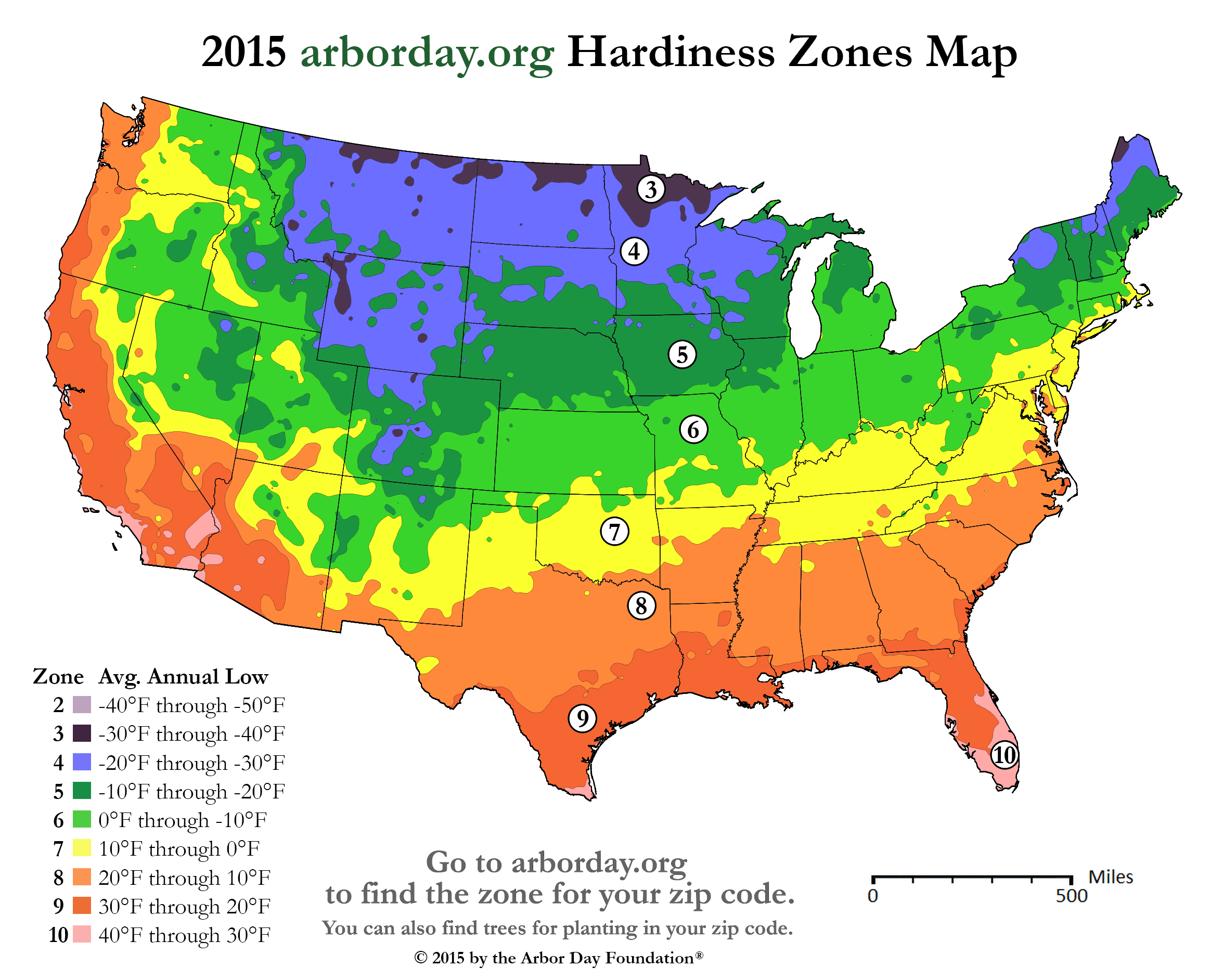
From eyeballing the map, you can see that 1°C (1.8°F) = about 50-70 miles latitude change.
James Hansen and his colleagues reported a similar figure: "A warming of 0.5°C... implies typically a poleward shift of isotherms by 50 to 75 km..."
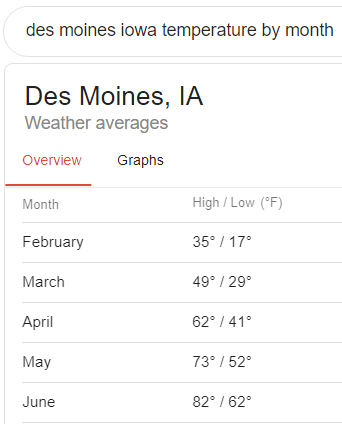
1°C is less than the hysteresis ("dead zone") in your home thermostat, which is the amount that your indoor temperatures go up and down, all day long, without you even noticing.
In the American Midwest, farmers can fully compensate for 1°C of climate change by adjusting planting dates by about six days.
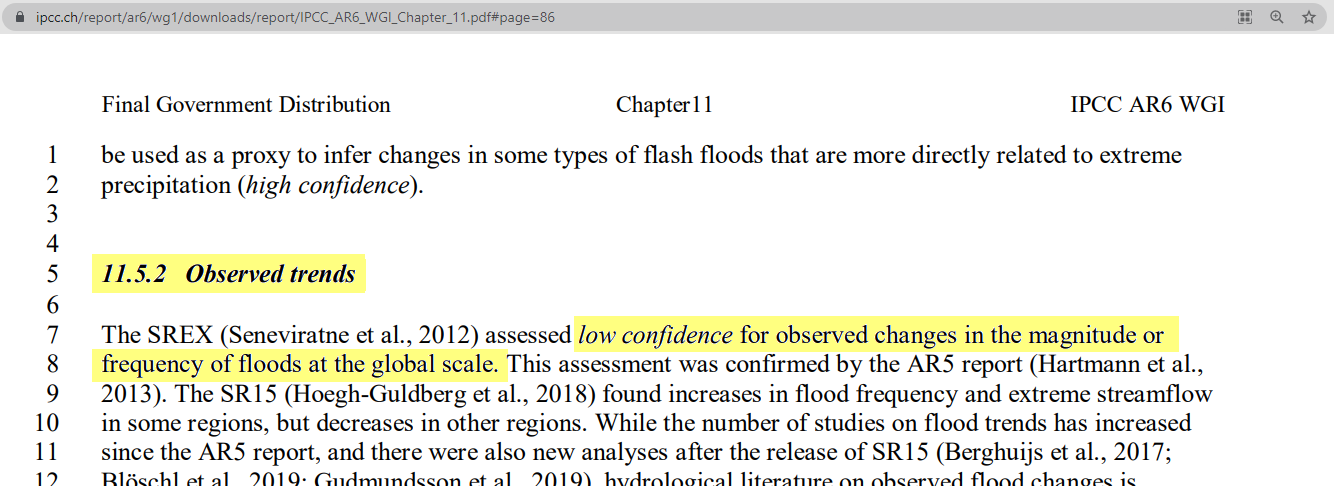
Floods. Theoretically, by accelerating the water cycle, climate change could increase the frequency or severity of floods. But the effect is too slight to be noticeable. AR6 says no change in global flood frequency is detectable:
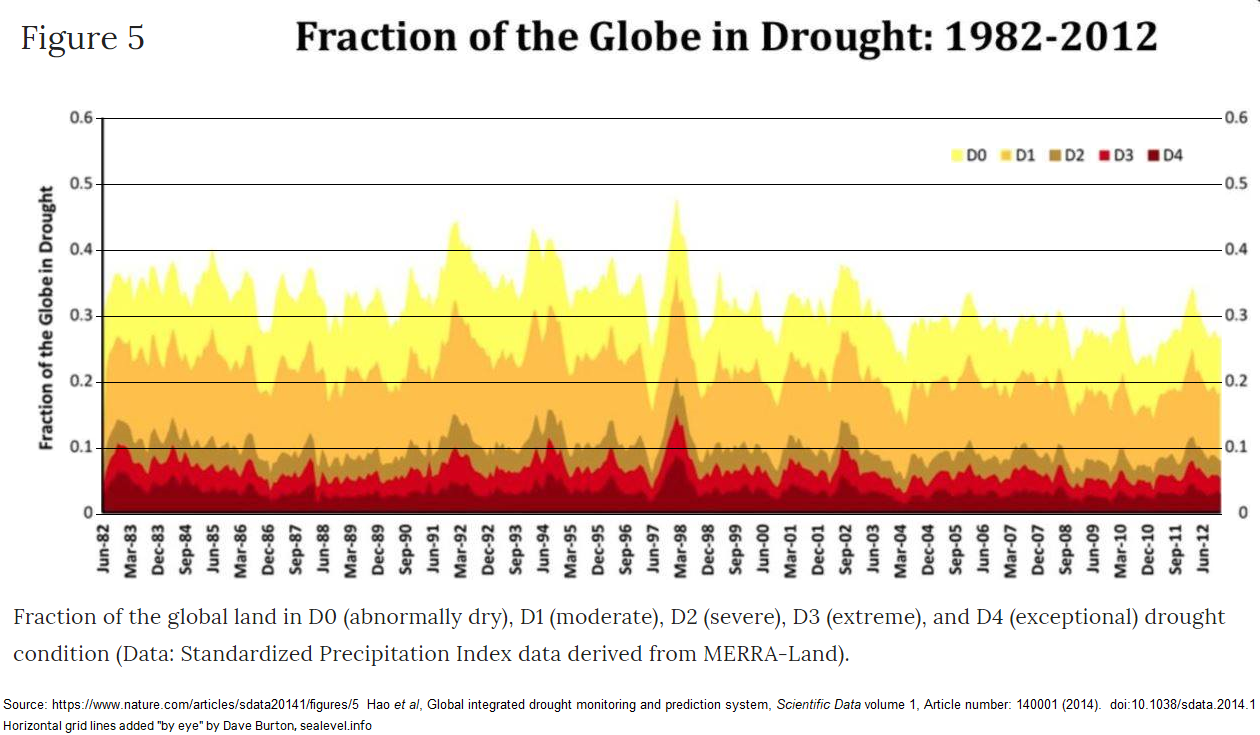
Droughts. Droughts have not worsened. In fact, the global drought trend is slightly down. Here's a study:
Hao et al. (2014). Global integrated drought monitoring and prediction system. Sci Data 1(140001). doi:10.1038/sdata.2014.1
Here's the U.S. drought trend (the bottom/orange side of the graph):
https://www.ncei.noaa.gov/access/monitoring/uspa/wet-dry/0
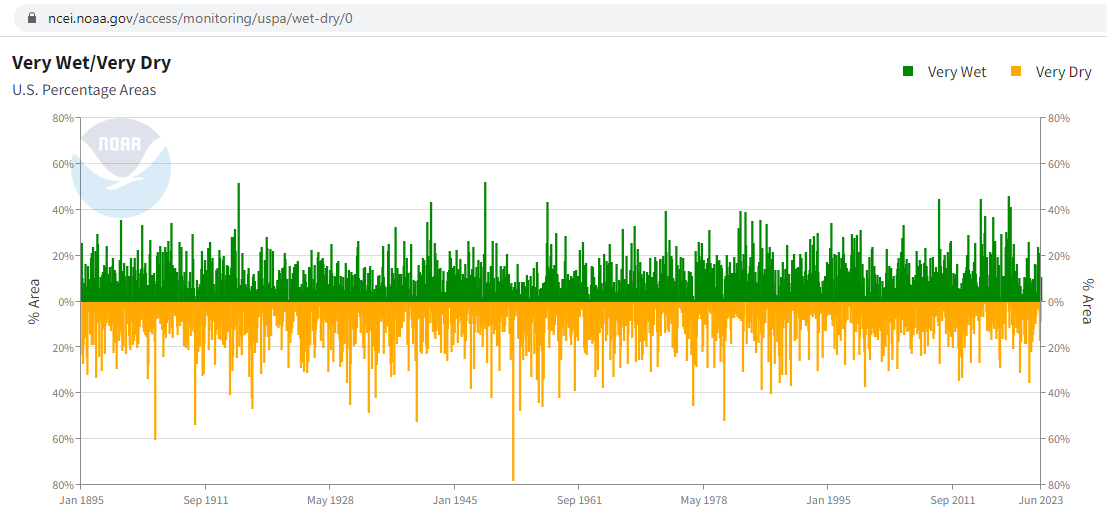
Not only does climate change not worsen droughts, it has long been settled science that eCO2 improves plants' water use efficiency (WUE) and drought resilience, by improving CO2 stomatal conductance relative to transpiration. So eCO2 is especially beneficial in arid regions, and for crops which are under drought stress.
Maize (corn) has been very heavily studied. Even though it is a C4 grass, it benefits greatly from elevated CO2, especially under drought stress. Here's a study (one of many):
Chun et al. (2011). Effect of elevated carbon dioxide and water stress on gas exchange and water use efficiency in corn. Agric For Meteorol 151(3), pp 378-384, ISSN 0168-1923. doi:10.1016/j.agrformet.2010.11.015.
EXCERPT:
"There have been many studies on the interaction of CO2 and water on plant growth. Under elevated CO2, less water is used to produce each unit of dry matter by reducing stomatal conductance."
Here's a similar study about wheat:
Fitzgerald GJ, et al. (2016) Elevated atmospheric [CO2] can dramatically increase wheat yields in semi-arid environments and buffer against heat waves. Glob Chang Biol. 22(6):2269-84. doi:10.1111/gcb.13263.
However, I agree with you that putting a monetary value on the benefits of CO2 for crops is difficult. In part that's because the price of food soars when it's in short supply, and plummets when it's plentiful. So, for example, if we were to attribute, say, 15% of current crop yields to CO2 fertilization & CO2 drought mitigation, and value that 15% using current crop prices, we would be underestimating the true value, because absent that 15% boost the prices would have been much higher.
- Antarctica is gaining ice
scaddenp at 07:41 AM on 25 May, 2023Just for clarification for other readers, as I pointed out above, Bart's conjecture "reduced sea ice mean more snowfall" is not expected given very low sea surface temperatures. To demonstrate that, Bart would need to show that precipatation varies in sync with sea-ice (which has both increased and decreased in recent history). By contrast, there is evidence for variations being due to multiyear weather cycles.
As to ice loss (overwhelmingly calving since most of Antarctica is too cold for melt), while the SAM is positive then continued basal erosion of the ice shelves is expected from warm deep water (eg see "The circum-Antarctic ice-shelves respond to a more positive Southern Annular Mode with regionally varied melting" ) and a useful summary here.
Loss of ice shelves leads to increased calving (see here with its links to relevent papers) as does loss of sea ice. That is why my money is on continued ice loss despite some weather noise. Let's see what an El Nino will bring after three La Nina years.
- Antarctica is gaining ice
Bart Vreeken at 19:51 PM on 24 May, 2023Thank you very much, scaddenp #579
So text was just removed, which is very annoying! I wasn't sure if I had done anything wrong myself.
But indeed, a rising air temperature and reduced sea ice mean more snowfall and a higher Surface Mass Balance according to multiple models. The question is how that relates to the increased melting and calving along the edges. Nobody knows exactly, and therefore it's good to have a close look on what happens.
BL #577 "He's made a big thing about NASA's 149 Gt/yr value"
Huh ...? I simply changed the number, for it was wrong. Bob Loblaw was the one who kept talking about it. And yes, "it ignores all the data in between." But that's not what the discussion was about. Replacing the 'last-first' by 'regression' doesn't make it better, for that still ignores all the data in between.
- Antarctica is gaining ice
scaddenp at 12:51 PM on 24 May, 2023Before Bart was moderated, he made some speculative comments about the contribution from loss of sea ice. At first glance this doesnt sound like something that would have a big effect. The ocean surface temperatures are still very cold so not a lot of scope of increased evaporative water content, especially compared to incursions of moist air due to positive SAM. However, this seems a very testable hypothesis since different parts of Antarctica would have different response to changes in air circulation, whereas arctic seaice has varied a lot (up and down) over past 20 years and if it was a factor, then expect precipation to vary accordingly (and in the regions where change happens).
- Antarctica is gaining ice
scaddenp at 07:54 AM on 23 May, 2023"Nobody knows.." Hmm. Certainly investigated. See "Interannual ice mass variations over the Antarctic ice sheet from 2003 to 2017 were linked to El Niño-Southern Oscillation"
Shows correlation of AP and WAIS with ENSO and anticorrelation of EAIS.

Hmm. ok, only 2017. What about GFO and recent records. There is some detailed analysis in "Spatially heterogeneous nonlinear signal in Antarctic ice-sheet mass loss revealed by GRACE and GPS (2023)"
and another study of links with other quasi-periodic cycles in Antarctica in "Antarctica ice-mass variations on interannual timescale: Coastal Dipole and propagating transports"
Evidence to date - based on correlations of where the changes in ice mass are occurring - links interannual change to short term (2-8 year) quasi-periodic weather cycles (ENSO, Antarctic Circumpolar Wave, Antarctic Occillation) influencing Antartica.
My money (literally) would be on continued long term ice loss. Short term variation as observed here to date would certainly NOT be a reason for change in climate mitigation policy.
- Antarctica is gaining ice
Bart Vreeken at 01:41 AM on 23 May, 2023"Are you suggesting the most recent changes in ice mass are indicative of a substantive change in the trend? And if so, what do you think is driving such a change?"
That might be, yes. The driving force could be the low amount of sea ice, and the rising temperatures. Both of them can produce more snowfall. The question is: how will the discharge of the ice along the edge of the ice sheet react? And how is the balance between these two? Of course, things can be less positive when the climate change goes on. More precipitation can fall in the form of rain than, and the discharge can overrule the gain of ice again. Nowbody knows, that's why it's so interesting to have a close look on what happens.
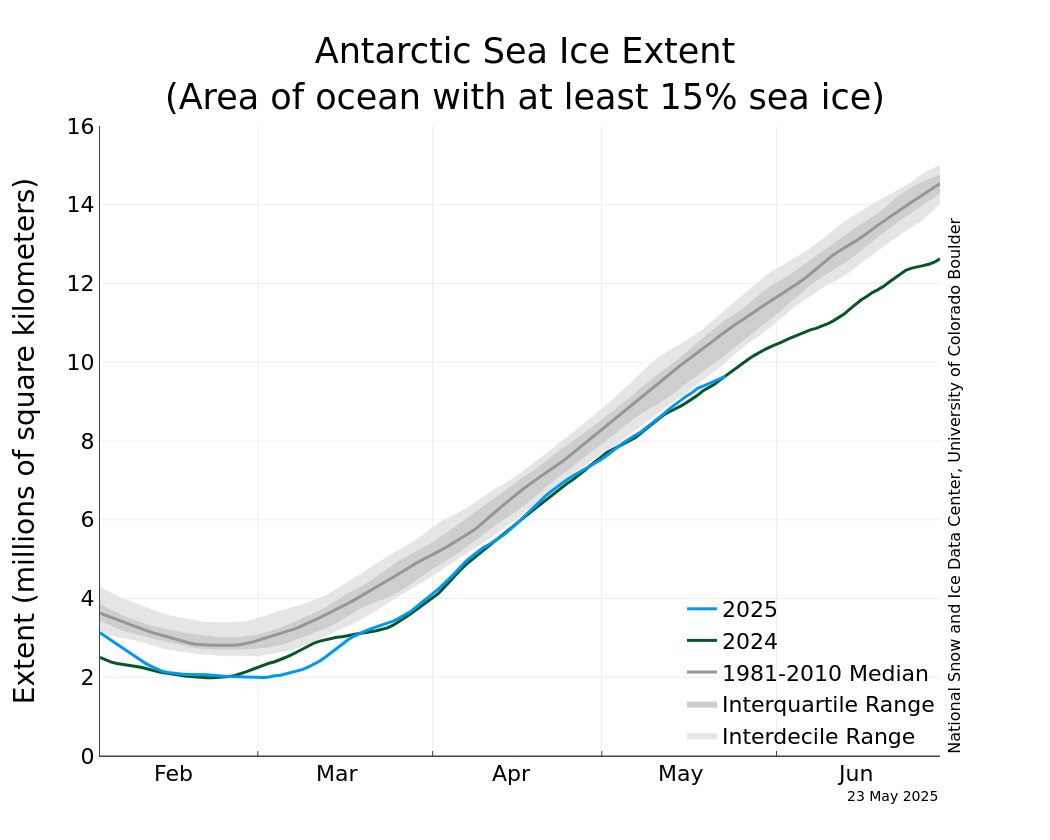
- Antarctica is gaining ice
Bart Vreeken at 18:44 PM on 22 May, 2023There is something wrong with the link above. It should be:
climate.nasa.gov/climate_resources/265/video-antarctic-ice-mass-loss-2002-2020/
- Antarctica is gaining ice
Bart Vreeken at 18:39 PM on 22 May, 2023"Where the 149 Gt/yr number comes from was discussed in March"
OK, let's have a look at the discussion in March. The 149 Gt/yr number comes from a video by NASA, published April 1, 2021.
https://climate.nasa.gov/climate_resources/265/video-antarctic-ice-mass-loss-2002-2020/
The selected data runs from October 2002 (+65 Gt) to February 2020 (-2808 Gt). That's already cherry-picking, for the ice mass tends to be low in February. Why do so? Maybe the publication date gives a hint ;-).
But ignoring the last two years, like Bob Loblaw does, is even more cherry-picking. This is how it looks like:

Is it also cherry-picking to end in February 2023? Not really, for it includes all the available data. Maybe we have a relatively high amount of ice now, according to the trend. But we won't know until afterwards. And remember that these are cumulative data. The amount of ice above the previous trend will first have to melt away again. That makes this figure different from a figure in which the temperature is displayed.
- Antarctica is gaining ice
Bart Vreeken at 18:50 PM on 20 May, 2023 After three months, there is another update of the gravitational measurements of the Antarctic ice sheet. The series now runs until February 13, which includes most of the Antarctic summer. Often in February there is a minimum in the amount of ice, but the pattern is not very tight.
We still see that Antarctica as a whole has a better period. Over the last three years, there has been no net decrease in land ice. The small amount of sea ice must play an important role in this. As a result, more snow falls. Apparently, that was enough to compensate for the increased melting and calving along the edge.
Changes to the floating ice shelves cannot be measured in this way. - CO2 lags temperature
Daniel Bailey at 01:46 AM on 19 May, 2023For a longer view of the correlation between CO2 concentrations and global temperatures, look no further than this reconstruction of the past 540 million years of such from Scotese (Scotese 2021 - Phanerozoic paleotemperatures: The earth’s changing climate during the last 540 million years):
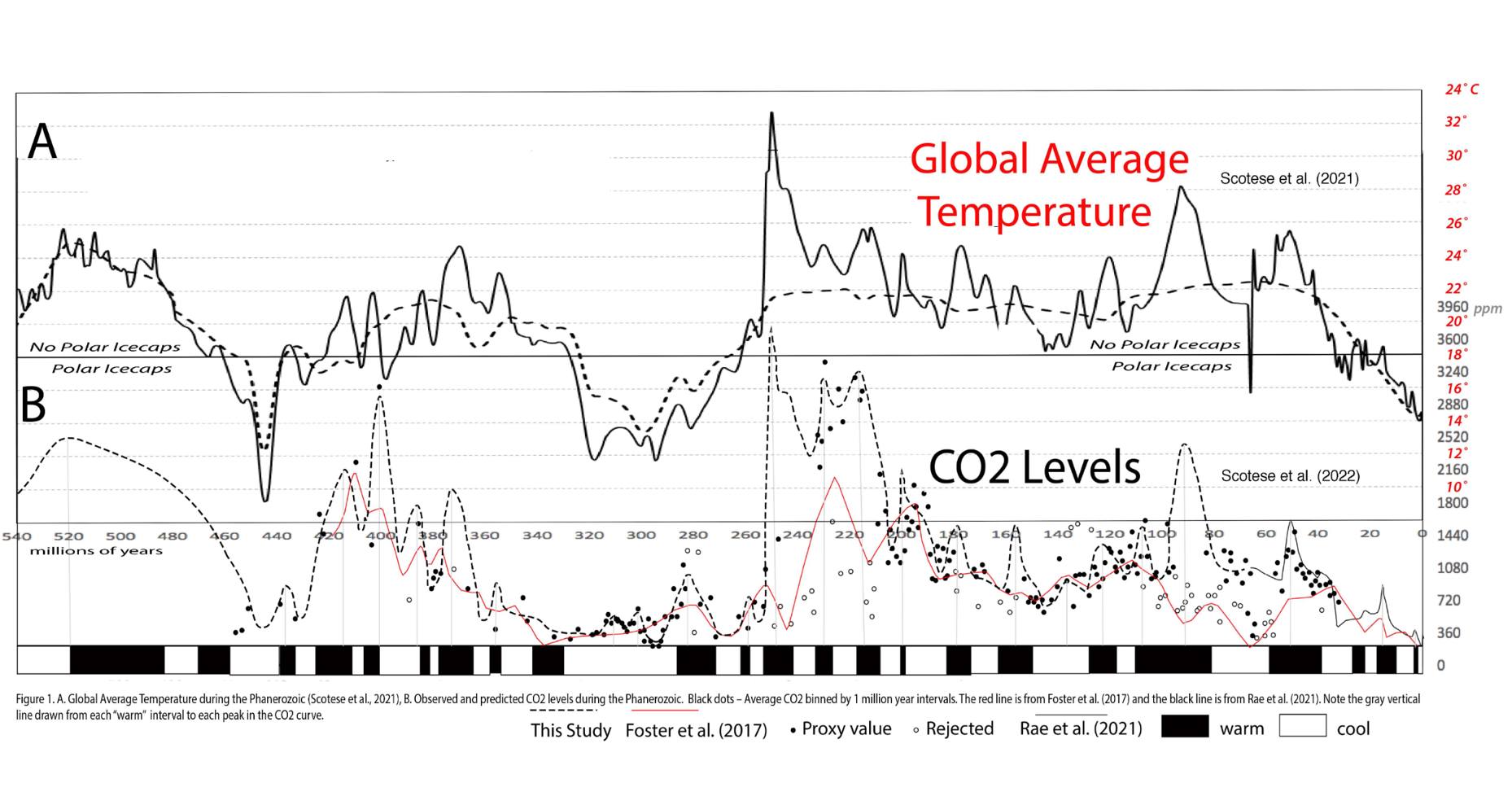
Link to paper
And leaving the last word on the subject to Scotese, a true expert in the field:
"It has been long recognized that the Earth’s climate, in particular the average global temperature, has alternated between ”icehouse” and “hothouse” states. More than 70 years ago, studies recognized that these climatic “modes” varied on short-term, medium-term, and long-term timescales. During the past 20 years, due to much outstanding research, we now stand at the threshold to a deeper, more complete understanding of both the tempo and mode of global temperature change during the Phanerozoic.
The Earth’s long-term temperature change is controlled by multiple tectonic and environmental processes that drive the Earth’s climate from icehouse to hothouse conditions, and vice versa. Many of these factors are interconnected by a complex network of positive and negative feedback loops that can accelerate or decelerate changes in long-term global temperature.
We are currently about halfway through a typical glacial/interglacial cycle. If humans did not inhabit the Earth, about 20,000 years from now, global temperatures would have once again begun to fall and ice sheets would have expanded into the oceans surrounding Antarctica and would have descended from the Arctic to begin a slow and steady march across the northern continents. However, this will not happen. The Earth has entered a “super-interglacial”. The injection of CO2 into the atmosphere as a consequence of the burning of fossil fuels has warmed the Earth more than 1°C and will continue to warm the Earth for another 300 years (~2300 CE).
In conclusion, we are leaving our Ice Age heritage behind. A new, warmer world awaits us. The problem we face is not so much where we are headed, but rather how we will get there."
- CO2 is not the only driver of climate
Eclectic at 05:51 AM on 9 May, 2023Piotr @73 ,
Wind & ocean currents move heat energy around the planet - and so there is a considerable "averaging" effect on global temperatures. Even today, you do not need thousands of observation stations in order to assess changes in global temperature. Analysis shows that less than 100 stations are needed (if well-distributed, of course) to give a closely accurate picture of conditions.
A so-called Grand Solar Minimum is not actually very grand ~ studies such as Feulner & Rahmstorf, 2010 and Anet et al., 2013 indicate that a GSM produces a global cooling of around 0.3 degreesC. (Other studies indicate slightly smaller changes.) And this is because our Sun is a very stable star, with a very stable output of radiation. Very little variation.
Even the Little Ice Age was not spectacularly cold ~ a global cooling around 0.5 degreesC . . . which had been helped along by a number of cold winters from volcanic eruptions.
There have been periods of decades of marked cooling in the neighborhood of Greenland earlier in the Holocene, as a result in temporary changes in ocean currents. But these had little effect on average global temperature (the planet is big, and there is a vast amount of tropical ocean). The one exception is the millennium of strong cooling (the "Younger Dryas" ) about 12,000 years ago ~ and this was a one-off event produced by the single event of melt/discharge of the Laurentide Ice Sheet situated in Canada.
Piotr, you seem to have a wrong idea about earlier warm periods (of the Holocene) such as the so-called Minoan / Roman / Medieval Warm Period ~ these were only very slight changes, around 0.3 degreesC or smaller. These were only tiny "blips" on the general slow cooling from the Holocene Maximum temperature (slow cooling owing to the Milankovitch Cycle).
Possibly you have been misled by reports based on Arctic region temperature estimates (the Arctic shows bigger swings than the average global temperature).
- EGU2023 - Highlights from the last week of April
John Mason at 22:00 PM on 28 April, 2023My take on Friday so far: Baerbel has already covered sessions where we were both present above.
I particularly enjoyed CL1.1.4: Deep-time climate change: insights from models and proxies. This session provided a wide-ranging series of palaeoclimate studies looking at various parts of and the whole Earth at key points in the past such as the Permo-Triassic transition, the K-T extinction and the early Cenozoic hyperthermals.
Some topics were more familiar than others, for example looking at the selective nature of the K-T extinction interval in the oceans: the post-impact 'winter' actually had a positive effect on e.g. siliceous diatom productivity whereas the Deccan Traps large Igneous Province was mostly negative in that instance. Calcareous planktom however suffered greatly. The most though-provoking presentation, "Resilience and implications of an Antarctic monsoon during the Eocene", was something I had not looked at before. It appeasrs there were local ice-sheets even then, but unlike today the continent's periphery supported dense forest.
It's refreshing to be with so many people to whom the key principles of climate forcings are no longer argued over but instead it's the increaingly minute details of past climates that are under investigation and being presented.
One word on presentations: it's a pity that presentation skills are not taught at final year undergraduate level. I've seen talks varying from absolutely outstanding to hard-to-follow this week. The cause of the difficulty variably includes talking at breakneck speed about highly complex topics, large blocks of text in slides too long to read for their display-time and using too small a font size to even screengrab effectively. Some, by no means all people need to learn how to communicate findings more clearly (the EGU Guidelines are quite specific in this respect) and in addition, every author had a Supplementary Material folder in which to upload a more detailed file. Attention to such points would have made an aleady enjoyable event even more so!
- Arctic sea ice has recovered
One Planet Only Forever at 14:53 PM on 21 April, 2023Albert started an interesting discussion with their comment @120.
I have an update of my questioning comment @124.
My updated question for Albert is "What explains the recent reduced rate of Arctic Sea Ice loss given that global ice mass loss has continued to occur?" (in addition to the links @124 see the EGU "Review article: Earth's ice imbalance" here which has the following in its Abstract "The rate of ice loss has risen by 57 % since the 1990s – from 0.8 to 1.2 trillion tonnes per year")
Similar to my question @124, the answer is not that human impacts have stopped significantly affecting the climate. And, as has been painstakingly pointed out by others, the recent lack of rapid reduction of Arctic sea ice does not mean that the recent rapid reduction of Arctic sea ice due to human induced global warming has ended.
That raises another question. "Why is the admittedly unusual temporary reduction of the rate of Arctic Sea Ice loss being focused on so relentlessly when global ice loss has continued to occur rapidly?"
- Arctic sea ice has recovered
Albert22804 at 17:00 PM on 20 April, 2023The Kinnard has Arctic ice extent increasing from about 750 to 1500 which is an absurdity. Vikings colonised Greenland about 980 and farmed some areas that today are permafrost.
But the graph shows 980 ice extent to be about the same as 1700 and by that time the areas farmed were permafrost.
The graph shows ice extent dropping dramatically from about 1400 but the little ice age was ramping up in 1400, not down.
The graph shows ice extent increasing dramatically from about 1600 but the LIA peaked around 1650-1700 and temperatures have risen sporadically ever since. The Central England Temperature database correlates well with this.
Here is a different reconstruction that shows 1940 Arctic ice to be about the same as
[LINK]
See figure 1b
But the guy was italian and what would they know? See, I can be sarcastic as well.
- Arctic sea ice has recovered
Rob Honeycutt at 15:42 PM on 20 April, 2023"The graph above showing Arctic ice just shows reconstructions because there was no accurate way to measure total Arctic ice before satellites."
Oh ye of little faith is the cleverness of smart researchers.
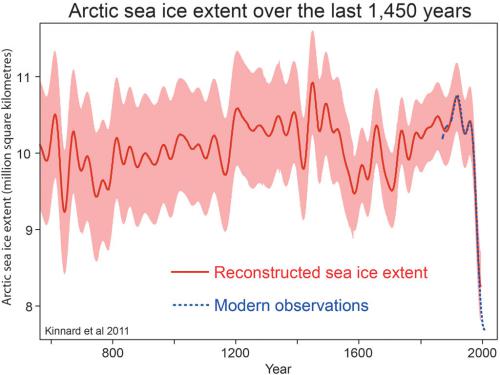
- Arctic sea ice has recovered
Rob Honeycutt at 15:32 PM on 20 April, 2023Second tab says "insert." See the picture of the tree? Click that and... voila!
Your problem is that you need to have a direct link to the image, not just the page. Right click the image (control+click on a Mac), then select open the image in a new tab. Use that URL.
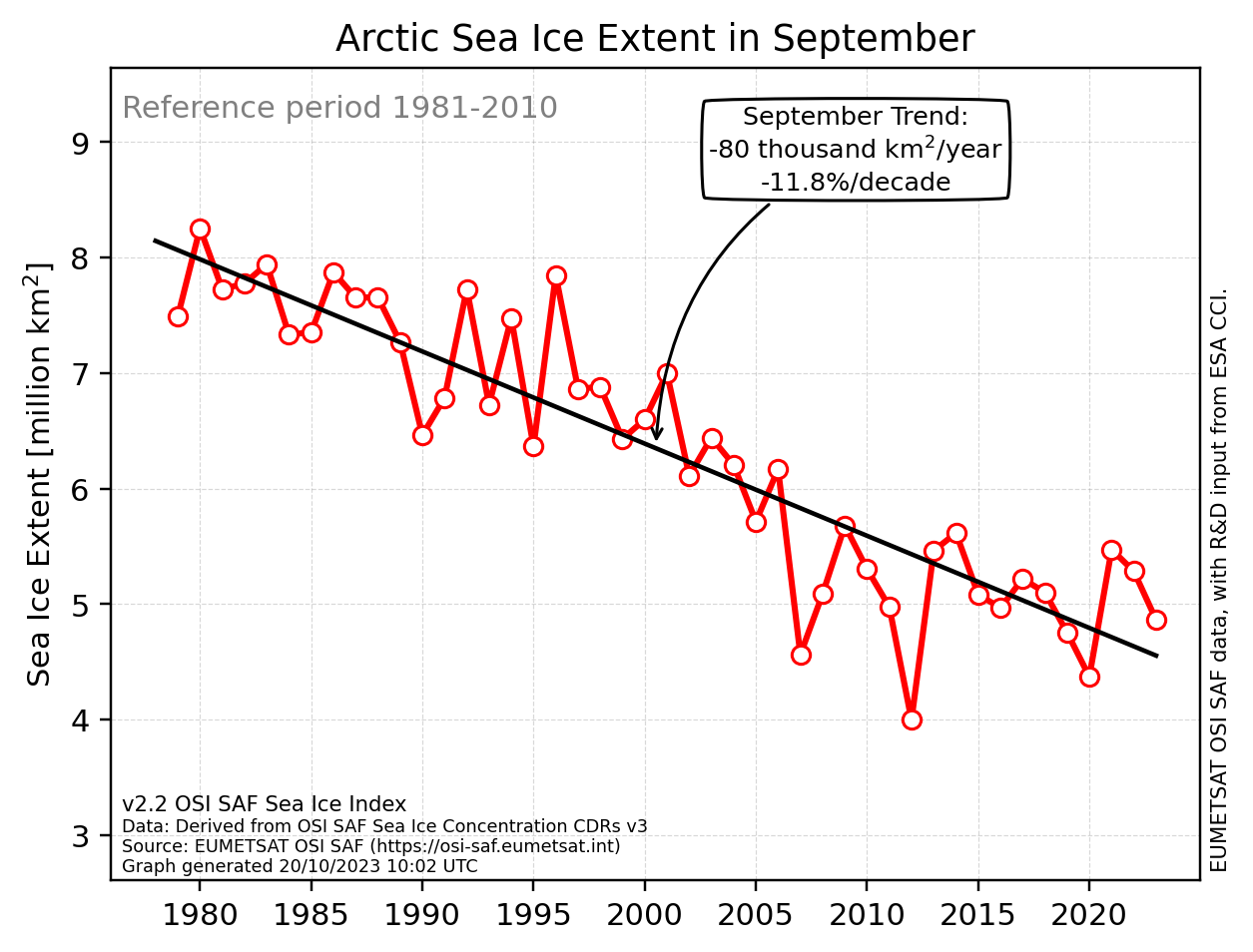
- Arctic sea ice has recovered
Albert22804 at 15:26 PM on 20 April, 2023I tried to insert a graphic from DMI showing Arctic ice extent from 1979 but without success.
https://ocean.dmi.dk/arctic/icecover_30y.uk.php
The URL shows a decline of about 15% from 1979 to about 2012 but unfortunately most warmists only refer to the minimum monthly values rather than all the data.
Its like only giving January rainfall totals instead of the yearly totals.
The graph above showing Arctic ice just shows reconstructions because there was no accurate way to measure total Arctic ice before satellites.
I could show you reconstructions showing significantly different trends but I know it would be a waste of time.
- Arctic sea ice has recovered
Albert22804 at 15:11 PM on 20 April, 2023linear trends have their uses but can be misleading and if the above trend had a 12 month filter, that would give a more realistic interpretation of Arctic ice trend.
the start and stop times of linear trends can heavily influence what a trend looks like and the assumption that Arctic ice is on a permanent downward spiral rather than cyclic is just speculation.
The end of summer Arctic ice has been predicted regularly since 2006 by the top Arctic experts but it never eventuates.
- Arctic sea ice has recovered
Albert22804 at 09:57 AM on 20 April, 2023"BL] In the absence of an argument from you that short-term variations actually indicate a departure from long-term trends, there is nothing to challenge."
You keep misinterpreting the point I am making is that Arctic ice thickness and volume stopped shrinking at least 11 years ago, I made no other claim.
What do you mean by a "long term trend"? the Satellite measuring of Arctic ice and global temperatures started in 1979 and we know that global temperatures reduced from about 1940 until the mid 1970s and we know that Arctic ice is sensitive to global temperature so it is logical to believe that Arctic was low in 1940.
I will find some evidence that scientists believed Arctic ice was low in 1940 but I suspect that even if I did, you wouldn't acknowledge it
- Arctic sea ice has recovered
MA Rodger at 23:43 PM on 19 April, 2023Albert @133/134,
Simply accepting anecdotal evidence from newspapers is not the way to determine historical Arctic ice conditions.
There are serious attempts to create records running back before the instrument era, like Walsh et al (2017) 'A database for depicting Arctic sea ice variations back to 1850' which is the subject of the CarbonBrief article linked @131 with the graphic @132. A little more recently there is Schweiger et al (2019) 'Arctic Sea Ice Volume Variability over 1901–2010: A Model-Based Reconstruction' which reaches similar conclusions, the graphic below from that paper showing rolling annual averages of Arctic SIV and annual red dots.

I would suggest you read the comment @123 if you feel that "no one has challenged the fact that Arctic ice thickness or extent has not dropped since 2012." And I do look at JAXA data and it evidently has "decreased since 2006" in that the JAXA annual average SIE 2006-22 has a linear trend of -0.032M sq km/y, a smaller decline than for the earlier part of the record (-0.51Msq km/y) but still a decline. So it has "dropped."
- Arctic sea ice has recovered
Albert22804 at 21:27 PM on 19 April, 2023But no one has challenged the fact that Arctic ice thickness or extent has not dropped since 2012 and if you look at the University of Bremen, JAXA and MASIE, they say that Arctic ice extent has not decreased since 2006.
Check it out.
- Arctic sea ice has recovered
Albert22804 at 21:24 PM on 19 April, 2023"The NASA presentation of Arctic Sea Ice Extent from 1851 to 2017 does not show an 80 year cycle. It shows a fairly significant recent decline of extent of sea ice."
there is an abundance of evidence from newspapers and other sources that Arctic ice extent in the 1940s was low. If i did provide the evidence I suspect that you would just ignore it.
But I will if you request it.
- Arctic sea ice has recovered
MA Rodger at 17:47 PM on 19 April, 2023The pertinent graphic in scaddenp's link @131 cannot be 'hot' linked directly from CarbonBrief but it is available elsewhere online.
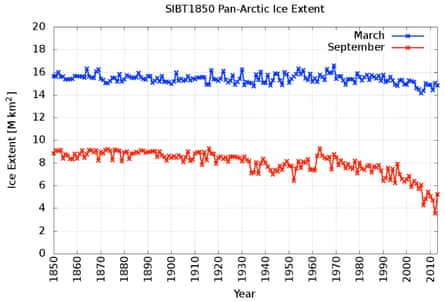
It does show the 1940's being as melty as say 1990 but there is no significant 80-year cycle to be seen. The more usual talk of 'cycle' is seen in Arctic temperature records but the same is also seen outside the Arctic and all across the northern hemisphere. GISTEMP zonal data suggests that up in the Arctic the 1940's were as warm as 2000 but the record 1880-on is not long enough to show the presence of any 80-year cycle. However the Berkeley Earth data for Svalbard dates back to 1800 but shows no sign of such a cycle.
And the assertion that in 2023 we are about to see the Arctic plunge back into some cold icy condition for decades is not born out by any SIE or SIV record. The future of Arctic SIE in a warming world may be one of 'difficult-to-reach' ice hanging on or it could be one of it 'going with a rush'. Take your pick. It will likely be a bit of both. But a reversal of recent declines in ice is no more than wishful thinking.
- Arctic sea ice has recovered
scaddenp at 15:38 PM on 19 April, 2023A better link for extent from 1850 is:
www.carbonbrief.org/guest-post-piecing-together-arctic-sea-ice-history-1850/ Same dataset - Arctic sea ice has recovered
One Planet Only Forever at 14:52 PM on 19 April, 2023Albert @126,
What is the evidence for an 80 year cycle of warm waters being brought to the Arctic?
The NASA presentation of Arctic Sea Ice Extent from 1851 to 2017 does not show an 80 year cycle. It shows a fairly significant recent decline of extent of sea ice.
- Arctic sea ice has recovered
Albert22804 at 13:42 PM on 19 April, 2023Looking at the graph should indicate quite clearly that there is definitely no decline since 2012 and your tabulated data also clearly shows this.
Average Arctic ice extent has also plateaud since 2012 (SII) or 2006(MASIE).
If you look at yearly averages since 1979, Arctic ice has only reduced by about 15% and as I wrote above, all this was prior to 2012.
DMI, JAXA, Bremen uni, and others all say the same.
"i would be curious to learn what you believe explains the observed Arctic Sea Ice Mass changes since 2012."
My guess is the cyclic currents that bring warm waters to the Arctic have reached the top of their cycle and are changing to a cooler mode.
Evidence seems to suggest that the cycle is around 80 years and we know that Arctic ice extent was also low around 1940.
- Arctic sea ice has recovered
Bob Loblaw at 05:12 AM on 19 April, 2023Albert @ 120 is doing an Arctic sea ice volume analysis using the standard "skeptic" analysis techniques that go into The Escalator:
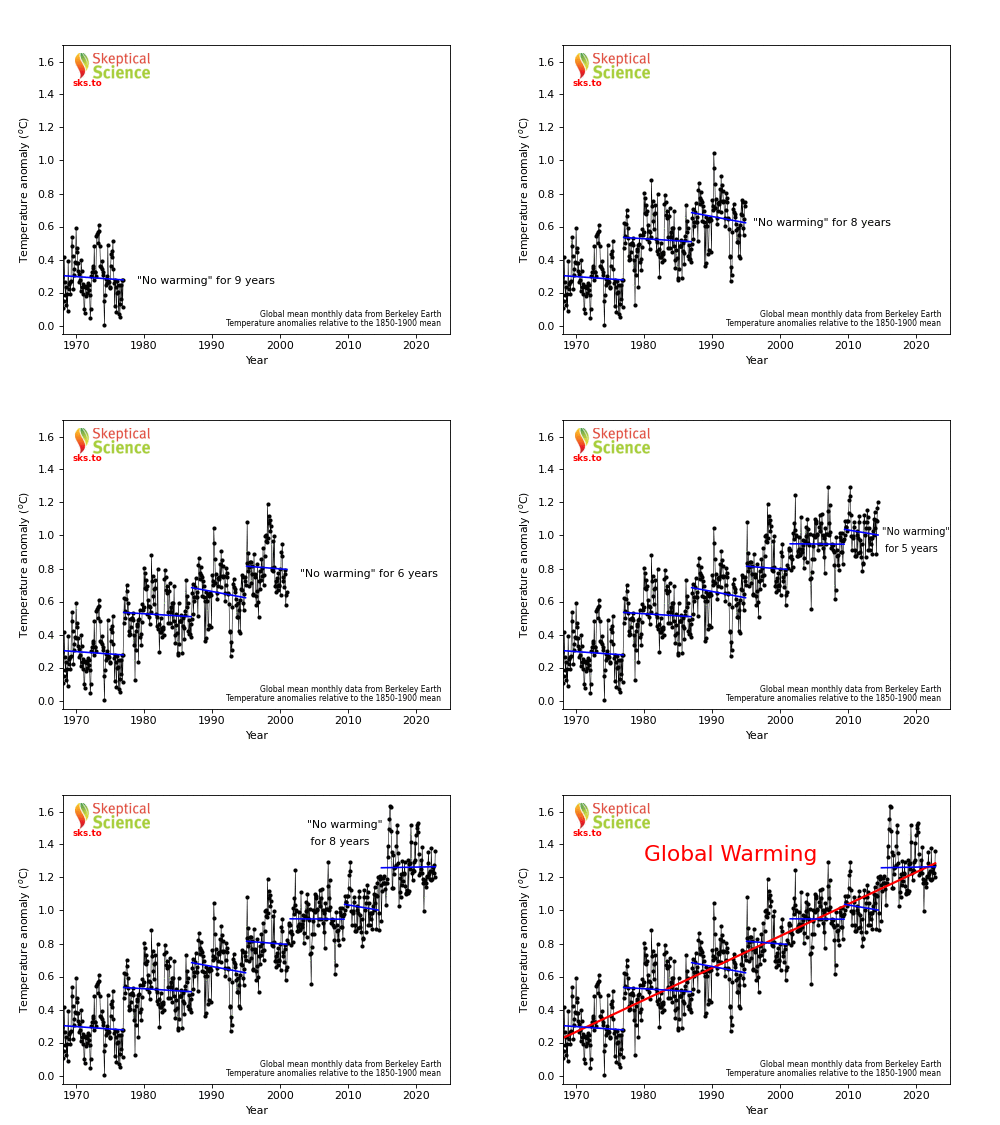
- Arctic sea ice has recovered
One Planet Only Forever at 03:16 AM on 19 April, 2023Albert @121, 122, 123,
I would be curious to learn what you believe explains the observed Arctic Sea Ice Mass changes since 2012.
In addition to MA Roger's clarification that Arctic Sea Ice volume is not 'trending up', the lack of statistically significant decline since 2012 needs to be considered along with other evidence like the continued significant decline of Antactic Ice Mass (NASA presentation here) and Greenland Ice Mass (ESSD Article here - see figure 4).
The lack of significant continued decline of Arctic Sea Ice Mass (volume) requires an explanation. But the explanation is unlikely to be that 'global warming impacts of human activity have not been significant since 2012'.
- Arctic sea ice has recovered
MA Rodger at 00:19 AM on 19 April, 2023Albert @121,
I don't think it is true to say "Arctic ice volume has been trending upwards since 2012," certainly not on the basis of PIOMAS data. The 12-month averages (Apr-to-Mar, so bang up-to-date) run like this:-
2011 - 2012 ... ... 13.83 M sq km
2012 - 2013 ... ... 13.44 M sq km
2013 - 2014 ... ... 14.57 M sq km
2014 - 2015 ... ... 15.62 M sq km
2015 - 2016 ... ... 15.00 M sq km
2016 - 2017 ... ... 13.07 M sq km
2017 - 2018 ... ... 13.22 M sq km
2018 - 2019 ... ... 14.11 M sq km
2019 - 2020 ... ... 13.47 M sq km
2020 - 2021 ... ... 13.40 M sq km
2021 - 2022 ... ... 13.98 M sq km
2022 - 2023 ... ... 14.24 M sq km
And a regression through that lot, even starting 2012-13**, gives a negative (thus decreasing) trend although lacking statistical significance. The PIOMAS anomaly graph you link-to @120 is using the same data. Mind, you could get an upward trend (still statistically insignificant) for a different 12-year period (again Apr-Mar); 1982-93 +0.050M/y +/- 0.125M/y.
(**2012 to 22 -0.064M/y +/- 0.156M/y)
- Arctic sea ice has recovered
Albert22804 at 21:16 PM on 18 April, 2023https://ocean.dmi.dk/arctic/icecover_30y.uk.php
- Arctic sea ice has recovered
Albert22804 at 21:08 PM on 18 April, 2023Arctic ice volume has been trending upwards since 2012
- Arctic sea ice has recovered
Albert22804 at 21:08 PM on 18 April, 2023
- At a glance - Is Antarctica losing or gaining ice?
John Hartz at 04:25 AM on 30 March, 2023Suggested supplemental reading:
Fact check: NASA Antarctic ice sheet data consistent with global warming by Kate S Petersen, Fact Check, USA Today, Mar 24, 2023
- The Big Picture
One Planet Only Forever at 06:34 AM on 22 March, 2023Bart Vreeken @131,
There was no question. I was presenting an understanding based on observations of evidence in your comments. Your presented interpretation of my comments appears to support my observation in my comment @99 that:
"There is a wealth of evidence in Bart’s comment history that appears to indicate that their interests are not Big Picture. Their interests appear to be much smaller/narrower. They appear to be seeking ‘positive perceptions from the perspective of short-term regional interests’."
I have made other comments about the harm of pursuing positive perceptions because it delays learning the Truth about the Big Picture harm being done to the future of Humanity. Arguing for a 'positive, less panicked, perspective' has produced the current serious harm, and risk of more significant harm, to the future of humanity that is presented in the article I pointed to in my comment @130. Another report on that same topic is by NPR "Cut emissions quickly to save lives, scientists warn in a new U.N. report".
The harmful reality you appear try to avoid understanding, even if you present global interpretations, is not altered by speculation based on one year of heavy snow fall on Antarctica and an unsubstantiated perceived correlation between snowfall and sea ice extent, or because Greenland may only melt on its east coast (conclusions you appear to be interested in jumping to).
Also, as I presented in my comment @68, the very negative (panic level severity) of possible outcomes is what the people who benefit most from the harm need to 'mitigate'. It is important to understand that what is referred to as 'climate change impact adaptation' is mitigation required by others because of a failure of harmful people (success from their short-term limited regional interest perspective) to mitigate their harmfulness. And part of how the harmful try to justify being more harmful is by claiming that "It's not that Bad = positive perceptions that the harm is not very significant" or "Harm done is worth it because of the Perceived Positives".
The Big Picture understanding is that it is generally unacceptable to use benefits or potential benefits to excuse harm done or potential harm done. The only case where that 'may be' acceptable is a case where the individual pursuing or obtaining the benefit will be the only one suffering any harm. It does not even apply to a group because different members of a group may obtain different degrees of harm and benefit.
In spite of that undeniable Big Picture understanding regarding the importance of learning to minimize harm and help those who have been harmed, many people today try to excuse continuing to pursue more benefit from being more harmful. And part of their harmful effort is the pursuit of harmful misunderstandings or a focus on 'positive perceptions that minimize the need for helpful mitigation by reducing the perceptions of severity of harm being done' (like claiming that less fortunate people deserve to be less fortunate, or being dismissive of what is happening to places like Bangladesh).
- The Big Picture
Rob Honeycutt at 03:12 AM on 20 March, 2023Bart... At this point I would highly suggest you thoroughly read the paper you're citing because you're just not grasping what they're discussing. In particular take note of the scale of the maps. They're talking about fractions of a millimeter per year. So, at maximum, they're saying the effect around Greenland (deep blue) over the course of the next century would be on the scale of 5 cm, out of a potential of 1-2 meters of SLR.
The region they refer to (northern Europe including the Netherlands, Atlantic coastline of Germany and along theArctic coastline of Russia [Fig. 2a]) would have a negligible effect, meaning neither net positive nor net negative. In other words, no effect.
Here is a link to the paper so you don't have to look it up again. Please read it thoroughly and carefully.
- The Big Picture
One Planet Only Forever at 13:33 PM on 19 March, 2023I find Bart Vreeken’s comments interesting, but not in the same way that Bart appears to be interested.
My interest is the Big Picture of the future of humanity and the development of sustainable ways for humans to share the limited capacity of this planet to be lived on sustainably, to not be compromised by the impacts of human activity. A significant part of that interest is understanding the possible peak effects of the harmful accumulating impacts of continued fossil fuel use.
Bart @84, starts with: “MA Rodger @82 your quote is about the global sea level rise, not the local SLR.” The set of images Bart presents are about ‘global sea level impacts’ of the loss of ice due to global warming. But Bart’s interest is limited to the impact on the Netherlands of ice loss from Greenland. The other presented ice loss evaluations do not ‘interest’ Bart as much. This selective regional, rather than Big Picture, interest can be observed in many of Bart’s comments.
Bart’s comments @533 and @537 on the recently updated SkS Climate Myth “Is Antarctica losing or gaining ice?” appear to be their first presentation (March 9, 2023) of what they find ‘interesting’. It is essentially the following: The most recent heavy snow fall on Antarctica, rather than all the other history of events on Antarctica, may be indicating the future of Antarctica. Why would that be ‘interesting’? Maybe because of what happens to the Netherlands due to ice loss from Antarctica as shown in the image set of Barts’s comment @84 referred to above.
And in Bart’s comment @560 indicates they live in the Netherlands and are concerned about sea level rise but “We have to monitor Antarctica very well, try to understand how it works, try to predict what will happen. But not with panic, that won't help us.” Their ‘interest’ in the potential that the most recent year of heavy snowfall on Antarctica indicating a very different future is like the claims that the lack of warming after 1998 indicated a very different future than the ‘panic about ending the harmful impacts of fossil fuel use, especially the global warming impacts. Many people tried to claim that post 1998 temperatures indicated ‘the end of the warming that some people were panicking about’. And Bart appears to be doing a similar thing by trying to claim that this recent year in Antarctica is a turning point of behaviour in Antarctica (as Bob Loblaw tried to point out in his comment @534 in response to Bart’s comment @533).
There is a wealth of evidence in Bart’s comment history that appears to indicate that their interests are not Big Picture. Their interests appear to be much smaller/narrower. They appear to be seeking ‘positive perceptions from the perspective of short-term regional interests’.
They may be correct about the interpretation of the Green lines of the images in their comment @84 and @87 ... but their lack of interest regarding the potential peak impacts (way beyond 2100 levels) on places like Bangladesh is what I find “Interesting” (and not in a Good Way). See My comment @68.
- The Big Picture
MA Rodger at 21:42 PM on 18 March, 2023Bart Vreeken @80,
That is a curious quote about the Greenland contribution to Netherland SLR given the KNMI Report also says on P22:-
The mass loss of the ice sheets of Antarctica and Greenland and glaciers continues unabated. Since 1993, this component has been the largest contributor to sea level rise.
The idea that the melt water from Greenland, part of the largest contribution to SLR, should somehow choose to avoid the seas off the Netherlands is somewhat silly. I think the idea being expressed is that (as explained within the KNMI Report) SLR is not appearing so much off Netherlands due to altered weather in the North Sea and so the 'Greenland melt' is being used in your quote synonymously for SLR.
- The Big Picture
Bart Vreeken at 20:35 PM on 18 March, 2023Bob Loblow @75 you said:
"Another clue for you: losing ice at lower altitudes around the perimeter of the ice sheet, and gaining ice at the higher altitude is Business As Usual for continental ice sheets. There is this thing called "glacial flow" that moves ice from the accumulation zone to the ablation zone"
Well, that's great. Do you really think I would write about Greenland when I didn't know how it works?
My turn then. The mass change of Greenland by year. Cherry-picking? Maybe, but I use all the available data of GRACE. Over a longer period (altimetry data) there is an increase of mass loss. Don't pay too much attention to the trendline, for the data have a lot of noice. But there is a similarity with Antarctica: more snowfall in the last years, caused by less sea ice.

- The Big Picture
Bart Vreeken at 19:48 PM on 18 March, 2023Thank you michael sweet @72 for the map of Greenland, based on altimetry. I didn't know this one, it's different from what I expected. I was too quick with my map of the SMB anomaly of only this year, it turns out to be untypical. Never the less we don't expect so much contribution from Greenland here. From the KNMI-report we discussed before:
"Many factors have been taken into account in the calculation of sea level rise on the Dutch coast, including the expansion of the oceans due to warming, self-gravitation, the changes in salinity, and the mass loss of glaciers and ice sheets in Greenland and Antarctica. Because the melting of the Greenland Ice Sheet hardly contributes to the sea level rise off the Dutch coast, we expect that the increase here will lag slightly behind the world average."
- The Big Picture
michael sweet at 12:36 PM on 18 March, 2023It is a real phenomenom that when the great ice sheets in Greenland and Antarctia melt that means there is less gravity there and the sea flows away. I remember that around Greenland itself that could be tens of meters less water and more around Antarctia. There are papers describing where in the globe there will be less water and where there will be more water (ths article describes the affect). By looking at the pattern of sea level rise (upthread I posted a map of sea level rise) and seeiing where it is higher and where it is lower scientists can get an idea of where the water is coming from.
Bart Vreeken posted a map upthread, it is probably accurate. They suggested that melting in the Antarctic will result in higher sea level rise than the global average but melting in Greenland will result in less sea level rise than the global average in Holland. Different parts of Greenland affect Holland differently.
There are other effects on sea level rise that are not intuative. The Gulf Stream carries water from North America to Europe. Sea level in Europe is about 1 meter (!!!) hgher than off North America. If the Gulf Stream stopped, sea level in Europe would decrease substantially while the East coast of the USA would flood. Who wudda thunk.
- The Big Picture
Bob Loblaw at 11:28 AM on 18 March, 2023Bart @ 62:
In addition to pointing out what Rob said to you at comment 64 about the error in using Surface Mass Balance, I note that you have also given a map of SMB for a single winter season. Do you not bother looking at the ful captions of the figures you pick up? This one does not need translation from Dutch - it is dated March 16, 2023, and states "Accumulated anomaly since Sep 1, 2022".
You're back to the same basic error that you made in your very first post here at SkS on March 9, regarding Antarctic ice. Treating a single year of data as if it represents a long term trend.
At least you honestly say "...how the Greenland Icesheet reshapes at the moment..." Now all you need to figure out is that "the moment" is not enough to make predictions about the future.
Another clue for you: losing ice at lower altitudes around the perimeter of the ice sheet, and gaining ice at the higher altitude is Business As Usual for continental ice sheets. There is this thing called "glacial flow" that moves ice from the accumulation zone to the ablation zone. You should read about it some time.
- The Big Picture
michael sweet at 10:24 AM on 18 March, 2023Here is a map of surface height change in Greenland. That includes snowfall, melt runoff, ocean melting and iceberg calving.

The caption reads:
Maps of elevation change from satellite altimetry reveal where the Greenland Ice Sheet is changing mass. Map created using data acquired by the CryoSat-2 satellite radar altimeter. Credit: CPOM
I note that the major areas of ice loss are on the west and northwest side of the island, the opposite of Holland.
- The Big Picture
One Planet Only Forever at 08:58 AM on 18 March, 2023The comments have improved my understanding of sea level rise.
Thank you Rob, Bob and Michael.
Though I lack detailed background knowledge regarding sea level rise I feel confident about pointing out that the 'peak sea level rise', not 'sea level rise by 2100', is what the future of humanity will have to deal with.
From an ethical and moral perspective, the people who benefit(ed) most from causing the harmful result should be responsible for paying for the required mitigation and adaptation. The more that they suffer because of the 'mitigation actions to rapidly end the harmful impact' the less they will have to pay in advance for the required adaptations. This avoids the problem of 'benefiting from harm done while evading the consequences of the harm done'.
What is happening today is serious unethical and immoral attempts to make the future impacts worse and avoid paying for the required repairs and adaptations. The 'highest harming' portion of the global population is not building CO2 removal devices now required to bring harmful impacts back down to 1.5 C levels of warming. And that group is also not planning to pay for the required adaptation in places like Bangladesh (or the island nations being submerged).
I will go one step further on the point of the real problem being the peak impact that has to be adapted to. There is uncertainty regarding how much adaptation is 'enough'. As a structural engineer I am very familiar with the requirements for all load resisting aspects of a structure to have a very low probability (less than 2%) that very severe potential future impacts would exceed the performance capability of the aspects of the structure. And aspects of the structure that are Primary, where their failure would cause significant overall structure failures, would have redundant mechanisms that would keep the structure system from collapsing due to the failure of a Primary element.
Sea level rise impacts would be equivalent to impacts on Primary Structure elements. So the sea level rise that the biggest beneficiaries of fossil fuel use in the current generation are ethically obligated to build globally, for all of the inhabited areas affected by the future sea level rise that they benefited from causing, would be the 'peak sea level increase' that has far less than 2% chance of being exceeded.
The big question is not the different evaluations (uncertainty) regarding the ways that Greenland and Antarctica will respond to human caused global warming. The big question is: What level of warming is almost certain to be the maximum level of the harmful human impacts.
- The Big Picture
michael sweet at 00:27 AM on 18 March, 2023Bart Vreeken:
According to the Dutch Weather Institute (KNMI),
"sea levels will rise 1.2 to 2 meters (3.3 feet-4 feet) over the next 79 years if greenhouse gas emissions are not reduced immediately and the melting of the Antarctic ice sheet accelerates."
I found a description of the Dutch Weather Institute as the national weather authority in the Netherlands. Certainly there are projections of up to 2 meters of sea level rise in the Netherlands. Can you provide a link to support your claims? I cannot read most of your graph but it appears to be dated 2005. More recent projections have been much higher than older projectins.
- Antarctica is gaining ice
Bart Vreeken at 02:57 AM on 17 March, 2023Pfff, it looks like knowledge of psychology is more useful here then knowledge of Antarctica and climate change. How to react? A person called 'One Planet only forever' makes his or her own analyzation about 'people like me'. But isn't even willing to tell his or her own name. Why is that? I think an open discussion without hide-and-seek is more effectful and respective. About my motivation: my only motivation is trying to understand Antarctica and sharing information on that. And discussing that, but in a positive way. OK, lets stay on topic.
We had a discussion about the the collapse of the Conger glacier's ice shelf. Here's an article on Change in Antarctic Ice Shelf Area from 2009 to 2019. In this period the ice shelves around Antarctica have gained a modest 0.4 %, or 5,304.5 km2 the study says. The study does not include the last three years. A low sea ice extent won't be good for the ice shelves, so I think we can expect that they lost some of there area.
egusphere.copernicus.org/preprints/2022/egusphere-2022-1087/egusphere-2022-1087.pdf
And then a rectification. I made calculations on the total discharge of Antarctica, based on the Surface Mass Balance (SMB) and the GRACE data. But the SMB calculated here also includes the ice shelves, and that part does not count for the mass change of the ice sheet. So, the SMB for the grounded ice will be less, and the discharge of the grounded ice will be less. In the literature I found numbers like 1750 Gt/yr.
- Antarctica is gaining ice
Bart Vreeken at 05:06 AM on 15 March, 2023"Did you happen to notice the title of the article John posted?"
Well I did! I have the strange habit to start with the title when I read an article ;-). And here it's about sea level rise. That item has my attention. I live in The Netherlands, which is a very low lying country. Large parts of it have a certain risk for flooding, by the sea of by rivers. My own house is only at 10 centimetres above sea level! But for centuries, the land is well protected by dikes. So, the risk is not so very high. But we have to be prepared for the future. The land will sink further, the sea level will rise higher, the rainfall will be more irregular and so on. So yes, sea level rise is a big issue here.
About the article. The disappearance of the ice shelf itself is no good news. But when I look at the position of it, I don't see a lot of ice from the ice sheet that will be on the move now. That's my point.
We have to monitor Antarctica very well, try to understand how it works, try to predict what will happen. But not with panic, that won't help us.
- Antarctica is gaining ice
Rob Honeycutt at 04:09 AM on 15 March, 2023Bart... Did you happen to notice the title of the article John posted?
"Why East Antarctica is a 'sleeping giant' of sea level rise"
Don't you think that's interesting?
- Antarctica is gaining ice
Bart Vreeken at 02:09 AM on 15 March, 2023Ah, thank you John Hartz @557
Yes, I noticed the article too. Indeed, the iceshelfs are the missing part of information and indeed, they are more vulnerable when the sea ice extent is low. But when we look at the position of the Conger's ice shelf (it's in the red circle on the map below) there is something strange. There isn't much inflow of ice from the ice sheet above. And when there isn't inflow, an ice shelf will disappear sooner or later. Maybe the pattern of the ice flow has changed during the years?
So, let's hope that the other ice shelfs are doing better. At least, the collapse of the Conger's ice shelf didn't influence the mass balance of the total ice sheet (the non-floating part) too much last year. It showed an increase of mass.
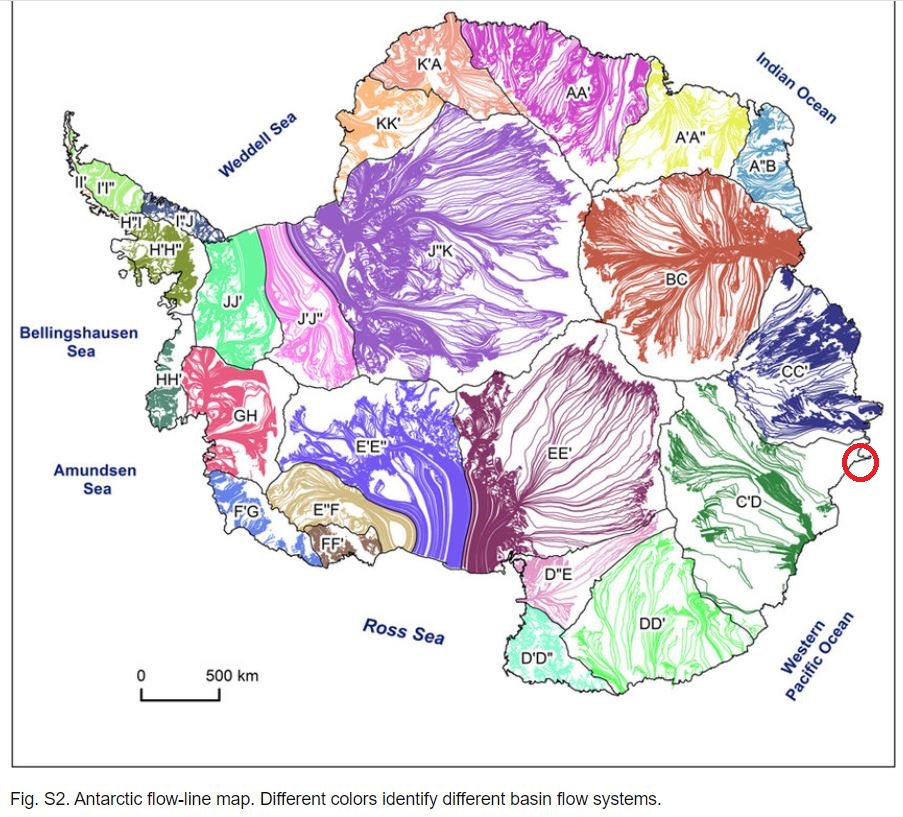
- Antarctica is gaining ice
John Hartz at 12:01 PM on 14 March, 2023Bart @ 556:
"More information" does cometh rather quickly. The following in-depth artice was posted on BBC's Future feature yesterday:
Why East Antarctica is a 'sleeping giant' of sea level rise by Alec Luhn. Future, BBC, Mar 12, 2023
The lede for the above article:
Scientists once thought the East Antarctic ice sheet, which contains enough water to raise sea levels 52m (170ft), was stable. But now its ice shelves are beginning to melt.
A key pragraph from the article related to your comments on this thread:
Usually, glaciers move at a glacial pace. The speedy collapse of the Conger's ice shelf came after some of the most dramatically warm weather ever observed in Antarctica. For the first time since satellite monitoring began in 1979, the sea ice extent around Antarctica dropped below 2 million sq km (770,000 sq miles). Less sea ice means more waves battering the ice shelves in front of the glaciers. Massive fields of sea ice off of Adelie Land, Wilkes Land and Princess Elizabeth Land in East Antarctica completely disappeared.
- Climate Science Denial Explained
michael sweet at 03:40 AM on 14 March, 2023Foster:
Fortunately Dr. Inferno at the Denial Depot site wrote a summary of this issue way back in November 2010. How thngs never change! They just blow up the Y axis and say there is no change.
How To Cook A Graph SkepticalScience.com Style
He even has Skeptical Science in the title of the post!! (Dr. Inferno is a tounge in cheek satire site). Unfortunately, Dr. Inferno has not posted since 2016. If anyone knows who Dr Inferno is tell him that his fans are waiting his next post with eagerness.
This is my favorite graph (link to blog post explaining the tilted baseline) from Dr Inferno showing that Arctic Sea Ice is increasing. Monckton actually used a graph in a presentation that had a tilted baseline like this.

- Antarctica is gaining ice
Bart Vreeken at 07:09 AM on 13 March, 2023As I said, I was hoping for a more serious discussion on this site.
What went wrong: in my first post I wanted to show the graph with the SMB as well. I must have done something wrong, for it didn't came up. Sorry for that. But this information is not so hard to find. MA Rodger succeeded in doing this, Bob Loblaw preferred to show a stupid graph about cherry-picking. Well, that's not the point here.
Anyhow. The correlation between SMB and mass change was not clear, so I put them together in one table. The SMB is calculated over November - November. The original graph gives the anomaly of the SMB. The average mass of the anomaly seems to be some 2700 Gigaton, so I added that to the anomaly. Then the discharge of the ice sheet can be calculated as the difference between the GRACE data and the SMB.
The result is interesting: there don't seem to be much correlation between SMB and discharge. Strange enough, in the last year with little sea ice the discharge was even less then normal.
An important thing could be that GRACE isn't measuring the total amount of ice, but only the amount above the sea level. So, increased calving from floating iceshelfs isn't noticed.

- Antarctica is gaining ice
Bart Vreeken at 03:32 AM on 11 March, 2023Bob @545
I expected a more serious discussion here.
Of course, snowfall is not SMB. There is also surface melting, runoff, wind blow, evaporation. In the figure i posted above you can see the difference between the SMB and the snowfall (dashed line). But of course, there is a big corralation between SMB and snowfall.
And SMB is not the same as the total Mass Balance. I never said the the mass loss has stopped. (OK, last year incidentely).
The SMB of the last seven years is showed in the figure I posted above. Source:
www.climato.uliege.be/cms/c_5652669/fr/climato-antarctica
As you can see, the SMB of season 2022-2023 ended ca 310 Gt above average. And so on.
And yes, its not completly consistent with the diagram in comment 533. The diagram shows the mass change between 2021/11/14 and 14 2022/11/14, based on gravimetry. The SMB is calculated over 2022/03/01 until 2023/03/01 based on weather models.
With a close look to the SMB figure you can also derive a SMB over the same period as the GRACE data.

- Antarctica is gaining ice
Bob Loblaw at 00:26 AM on 11 March, 2023Bart @ 544:
You are really presenting a scrambled set of statements that lack clarity and consistency.
The link you provide does not mention any increase in SMB - it discusses small increases in snowfall, and how this has made the decreases in the SMB less than they would have been otherwise. The opening of the second paragraph is [emphasis added]:
"Our findings don’t mean that Antarctica is growing; it’s still losing mass, even with the extra snowfall"
The second-last paragraph says [emphasis added]:
“Snowfall plays a critical role in Antarctic mass balance and it will continue to do so in the future,” Medley said. “Currently it is helping mitigate ice losses, but it’s not entirely compensating for them. We expect snowfall will continue to increase into the 21st century and beyond, but our results show that future increases in snowfall cannot keep pace with oceanic-driven ice losses in Antarctica.
So, your reference provides no support for your claim that the 2022 increase in SMB "started last century". Snowfall is not SMB - it is only part of it. Stop jumping from one measure to another, as if they are equivalent.
When you refer to "the last seven years then five of them were above average; four of them were far above average and none of them were far below average" you completely fail to tell us what "them" are. The article you link to provides no annual numbers for anything. This description does not appear to be consistent with the diagram you presented originally in comment 533, and I have no idea what data set you are talking about.
You appear to be taking small bits from articles that you read, misunderstanding what they say, and interpreting them (incorrectly) as evidence that supports your position.
- Antarctica is gaining ice
Bart Vreeken at 06:01 AM on 10 March, 2023Bob Loblaw @ 539
I don't think focussing on the noise is a good idea ;-)
When we just look at the GRACE data then the year 2022 is one in a row of 20. After last year the average has changed, which is interesting by itself.
But during this 20 years things have changed. The extent of the sea ice has declined. So more water vapour comes to the continent, which gives more precipitation. The question is how this works out. The last year gave us a hint that it can add a lot to the Surface Mass Balance. The next question is: how much will the SMB increase, and how much will the discharge increase. Of course, that's very uncertain. In the paper I called it says in the abstract:
The surface mass balance in SSP5–8.5 simulations shows a pattern of strong decrease on ice shelves, caused by increased melting, and strong increase on grounded ice, caused by increased snowfall. Despite strong surface and basal melting of the ice shelves, increased snowfall dominates the mass budget of the grounded ice, leading to an ensemble mean Antarctic contribution to global mean sea level of a fall of 22 mm by 2100 in the SSP5–8.5 scenario. We hypothesise that this signal would revert to sea-level rise on longer timescales, caused by the ice sheet dynamic response to ice shelf thinning. These results demonstrate the need for fully coupled ice–climate models in reducing the substantial uncertainty in sea-level rise from the Antarctic Ice Sheet.
- Antarctica is gaining ice
MA Rodger at 01:05 AM on 10 March, 2023Bart Vreeken @533,
You appear to be plotting out the GRACE/GRACE-FO data as per this NASA web page (which shows data to Oct 2022). This gravity data does not measure Sea Ice which is floating. And for clarity, it is not Surface Mass Balance which you correctly say had an exceptional year last year (as per this NSIDC post of January 2023, snowfall being high enough to "completely offset recent net ice losses from faster ice flow off the ice sheet for this assessment period. Most of the past decade has seen annual net losses of 50 to 150 billion tons."

So a record year for the 2023 Antarctic Sea Ice Extent minimum as well as a record year for the 2022 Antarctic Surface Mass Balance.
Antarctica doesn't get a lot of attention, compared to the Arctic cryosphere. Certainly for Antarctic Sea Ice, the mechanisms driving the variations is a lot less straightforward in the Antarctic.
- Antarctica is gaining ice
Bob Loblaw at 00:33 AM on 10 March, 2023Bart Vreeken @533:
What exactly is your point? The links between sea ice area and land ice mass are not simple, and have been discussed in the detailed sections of the blog post and earlier comments.
In your graphic, it is obvious that the two major years of land ice gain (2016, 2022) follow several years of strong mass ice loss. This is easily explained as a rebound effect.
This web page on Grace data has an embedded video with data to 2020. Rather than portraying the annual changes it shows the overall trend in the absolute value from year to year. Clearly, Antarctic land ice is losing mass in the long term - with short terms ups and downs.
Are you perhaps over-analyzing the significance of short-term changes, as is often done with temperature changes? (As seen in The Escalator).
- Antarctica is gaining ice
Bart Vreeken at 23:07 PM on 9 March, 2023
It looks like the Antartican Ice Sheet had a very good year, as far as we can see. At least, the mass balance over the period november 2021 - november 2022 was far positive. This can be due to the very low extend of the sea ice. The Surface Mass Balance over the melting period of last year turned out very positive. I don't read much about this, the focus in de media is on the low extent of the sea ice. Any thoughts about this?
I did expect a new update of de GRACE data of December 2022, but it comes late again.
- At a glance - Is Antarctica losing or gaining ice?
gerontocrat at 05:26 AM on 9 March, 2023The CO2 615ppm limit for the East Antarctic ice sheet remaining stable seems to me somewhat optimistic.
One of the 25 drainage basins used to measure ice sheet mass loss in East Antarctica (Wilkes land) has lost 400 Gigatons (i.e. 400 Cubic Kilometres) of ice in the last 20 years, the fourth highest of all the basins, and comprising about 15% of the total ice mass loss of 2,500GT. The highest three are in West Antarctica.
Every time a new field survey is undertaken, it generally seems to come up with more bad news about the vulnerability of this apparently solid ice sheet.
- Methane emissions from Siberian sinkholes
DennisHorne at 08:11 AM on 8 March, 2023@scaddenp
https://uaf.edu/news/nova-episode-explores-arctic-methane-explosions.php
https://www.bbc.com/future/article/20201130-climate-change-the-mystery-of-siberias-explosive-craters
- It's the sun
Jim Hunt at 00:42 AM on 13 February, 2023As blind chance etc. would have it I currently find myself engaging with Judith Curry's denizens under her article about the recent joint venture with Jordan Peterson.
This is presumably the cause of some or all of the "it's the sun, stupid!" nonsense currently being promulgated in the Twittodenialosphere?
As a consequence my Arctic alter ego felt compelled to bring the following NASA article to the attention of one such Dunning-Kruger sufferer:
https://climate.nasa.gov/ask-nasa-climate/2949/why-milankovitch-orbital-cycles-cant-explain-earths-current-warming/
Elon's new thought police helpfully suggested that I might want to reconsider my attempted violation of Twitter's community guidelines:
The allegedly "offensive language" was merely echoing that of the DK sufferer in question.
What a "Brave New World" we currently inhabit!
- It's Urban Heat Island effect
HamletsGhost at 00:51 AM on 25 January, 2023In my view, the most important — and understudied — effect of UHI as it relates to global warming is the fact that large expanses of macadam act as heat sinks. This resuts in the phenomenon where by cities create their own weather: on the coast, UHI-expanses like that of Houston increase the effect of the landbreeze; stack moisture in clouds at a higher rate, and, eventually, drop more water onto the heat sinks. The rain cools these heat sinks off and, in the process, transfers warmer water into aquifers that feed the Gulf Stream.
Our senses, higher summer temperature readings at airports, and the chart above showing no significant difference over time between the temperature increase in rural and urban areas tells us this heat transfer is significant.
The UHI heat-transfer model explains both the effect on the polar ice cap and the warming of tropical waters. The Gulf Stream, now warmer than otherwise, leads up to the arctic polar ice cap and melts it. In the summer months, the Gulf Stream slows its transfer of warmer water into cooler water so that warmer water remains in Caribbean to develop into storm.
The Greenhouse Gas model does not account for any heat transfer arising from rain-cooled macadam. In omitting the fact of transfer, the Greenhouse Gas model must be inaccurate.
Within a model that takes into account UHI-created weather patterns and rain-cooled macadam, atmospheric increase in carbon dioxide is less as the cause of global warming than an index of burning.
More than 100 comments found. Only the most recent 100 have been displayed.
More than 100 comments found. Only the most recent 100 have been displayed.






THE ESCALATOR
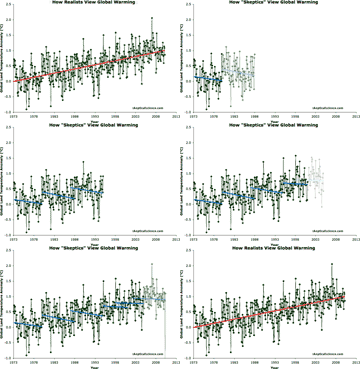
(free to republish)