



 Arguments
Software
Resources
Comments
The Consensus Project
Translations
About
Support
Arguments
Software
Resources
Comments
The Consensus Project
Translations
About
Support







Latest Posts
- The government canceled this nature study. Scientists finished it anyway.
- Fact brief - Do solar plants require backup from fossil fuels?
- Hot days, cold thermometers
- 2026 SkS Weekly Climate Change & Global Warming News Roundup #30
- Skeptical Science New Research for Week #30 2026
- Canada's boreal wildfires aren't just bad forest management
- Dangerous and historic wildfire smoke pollution event engulfs the U.S. and Canada
- The Strongest El Niño Ever
- 2026 SkS Weekly Climate Change & Global Warming News Roundup #29
- Skeptical Science New Research for Week #29 2026
- Home batteries could become the next must-have household appliance
- Fact brief - Do electric vehicles stop working in extreme heat?
- Deadly heat wave in France shows the future of climate risk
- 2026 SkS Weekly Climate Change & Global Warming News Roundup #28
- Skeptical Science New Research for Week #28 2028
- Six charts show how clean power was world’s largest source of new energy in 2025
- Eastern U.S. broils after heat wave kills over 1,300 in Europe
- How climate change influences extreme weather
- 2026 SkS Weekly Climate Change & Global Warming News Roundup #27
- Skeptical Science New Research for Week #27 2026
- Climate Adam - Is Climate Change Ramping Up El Niño Risks?
- Fact brief - Are injuries from wind turbines common?
- How bad is AI for the environment?
- 2026 SkS Weekly Climate Change & Global Warming News Roundup #26
- Skeptical Science New Research for Week #26 2026
- What Americans can learn from London’s war on cars
- New Publication: Identifying Flawed Reasoning in Contrarian Claims about Climate Change
- The Merchants of Doubt are coming for Extreme Event Attribution science
- 2026 SkS Weekly Climate Change & Global Warming News Roundup #25
- Cooking up the Climate Stripes, with Ed Hawkins

Comment Search Results
Search for global warming stopped in 2000
Comments matching the search global warming stopped in 2000:
- 2024 SkS Weekly Climate Change & Global Warming News Roundup #09
One Planet Only Forever at 13:04 PM on 6 March, 2024Efforts to fight disinformation and the resulting tragic popularity of harmful misunderstanding, especially the application of Cranky Uncle beyond the important climate science matters (as highlighted in The Story of the Week), are highly valuable (tragically not valued by all leadership competitors). They help promote learning to improve the future for all children on this amazing planet which may be the only viable place for children to continue to be born to live on as sustainable parts of an amazing robust diversity of life. (tragically not the objective of all leadership competitors)
This new CBC News article: After Mulroney, being a 'green' PM got a lot tougher presents a history lesson about the need for the development of Cranky Uncle, and more like it, to try to counter-act tragically popular and profitable harmful developments and resistance to correction of damaging unsustainable misunderstandings over the past 30 years.
The CBC story is about a major political group in Canada, a nation that many people would currently mistakenly consider to be quite advanced. Before the early-1990s the group that Mulroney led pursued ‘learning to develop improvements for all children, including leadership actions to limit Canada’s ghg emissions’. But the group was rapidly captured (taken-over) by interests that oppose leadership actions that are being learned to be required to ‘develop sustainable improvements for all children’. (Note that the related concern about ‘harmful capture’ of potentially helpful learning institutions is highlighted in Academic capture in the Anthropocene: a framework to assess climate action in higher education, Lachapelle et al., Climatic Change:, the 3rd open access notable item on Skeptical Science New Research for Week #9 2024.)
The following quote from the CBC article highlights this tragic transition:
Mulroney's Progressive Conservative government also enacted the Canadian Environmental Protection Act to manage toxic substances in the environment, and the Canadian Environmental Assessment Act to review the environmental impacts of major projects.
It established the International Institute for Sustainable Development — still a leading voice on global environmental policy — and launched the National Roundtable on the Economy and the Environment (NRTEE), an expert advisory body that published analysis until Stephen Harper's Conservative government abolished it in 2013.
The Harper Conservatives were what the Mulroney PCs had transformed into. And the opposition to learning to be less harmful and more helpful has increased in the Conservative Party of Canada since Harper stopped being its leader. See the following string of quotes from the article:
In 1990, the federal government released "Canada's Green Plan," a 174-page statement of intent to deal with a host of environmental problems, including global warming. That plan set a lofty goal of stabilizing Canada's greenhouse gas emissions at 1990 levels by 2000 — the first of several targets Canada would announce and fail to pursue seriously between 1990 and 2015.
...
The Green Plan touted the possibility of pursuing an emissions "trading" program — what we would now call a cap-and-trade system, one of two primary methods for establishing a price on harmful emissions.
"There is evidence that a market-based approach to the problem can be quicker, more efficient and more effective in reducing emissions and the costs of achieving these reductions," the PC government wrote.
...
It would be another 29 years before the federal government [Liberal-led] finally applied a "market-based" approach to carbon emissions, through the current government's carbon tax. But now the future of that policy is very much in doubt — Conservative Leader Pierre Poilievre, Mulroney's [and Harper’s] political heir, has loudly and repeatedly vowed that a government led by him will "axe the tax."
This tragic transition of a major political group that was ‘striving to be more helpful and less harmful’ into ‘harmful disinformation producers’ trying to ‘oppose and delay learning to develop improvements for all children’ can be seen to have happened (still happening) in many other nations.
The undeniably high-value leadership goal of ‘Learning to improve the future for all children’ is tragically opposed by special interest groups with ‘Other interests they consider to be important enough (to them) to justify being damaging rather than improving the future for all children’.
- It's albedo
coolmaster at 01:54 AM on 5 September, 2021@Bob Loblaw
"useful extension"
They are not only a useful extension of the understanding of climate - but also the basis for recognizing where and how humans intervene (or could intervene) in the climate.
Fighting the causes of an evil (GHG emissions) is important and right - but is it actually enough? - I would say - NO. After decades of meditation on Mauna Loa Observatory / Hawaii GHG concentrations are still rising steeply.
So we urgently need a second, additional strategy that is potent enough to stop further global warming.
All possibilities that humans could have available are shown in the changing global radiation balances. There you not only find the disturbed carbon cycle, but also the energy flow of the global water cycle.
When looking at the actual problems (decreasing biodiversity, SLR, droughts, record temperatures, floods, ...) that humans and creation have to suffer with global warming, it is noticeable that they all mainly have to do with the presence or absence of water. The idea of influencing the climate via the water cycle is therefore only logical, more direct and, above all, much faster. (All firefighters in this world nod their heads understandingly)
Let me now briefly explain this alternative climate protection strategy, which does not care much about the causes (mainly CO² & other warming GHG), but should at least noticeably alleviate the above-mentioned effects and problems of climate change:
- 3.7mm SLR = 9mm over the land area = 1335km³ of water = 2.7% of the global runoff via the rivers.
- This volume can be retained by a wide variety of measures before it flows into the oceans and converted into evaporation.
- 9L / m² corresponds to ~ 1% of the average annual rainfall over land and should therefore create ~ 1% additional clouds over the land mass. Also a multiplication effect arises because there is a high probability that these clouds will in turn rain down again over a (different) area of land.
- The net effect of the clouds(CRE) is given by Prof. M. Wild (ETH Zurich) as -19W / m². + 1% additional cloud cover over land (-0.19W / m²) corresponds globally to -0.07W / m² and is therefore a lot more than the current annual increase in radiative forcing.
!!! The rise in sea level and the rise in earth temperature would thus (in theory) be stopped. !!!
In the graphic below I tried to show the simulated additional amount of clouds and water(red numbers) in the radiation balance. I look forward to your criticism and assessment. - Thanks

- SkS Analogy 7 - Christmas Dinner and the Faux Pause
jgnfld at 17:15 PM on 11 June, 2017After reading Rahmstorf, Foster, and Cahill (2017) link I wrote up a Monte Carlo program to look at the same GISS annual 1972-2000 data from a slightly different perspective: Given a trend and random variation around that trend, how many significant findings would one expect to see if one intentionally started (cherrypicked) at a start value within certain ranges from the trend line. All distributions are generated randomly using the parameters from the GISS data (trend=.017/yr, s.d.=.1033), it is only that this analysis binned and studied start value ranges individually (i.e. cherrypicked them) rather than allowing the start value to occur randomly and normally as standard regression assumptions would dictate. Series lengths of 14 to 20 years were examined.
The resulting graph looks as follows:
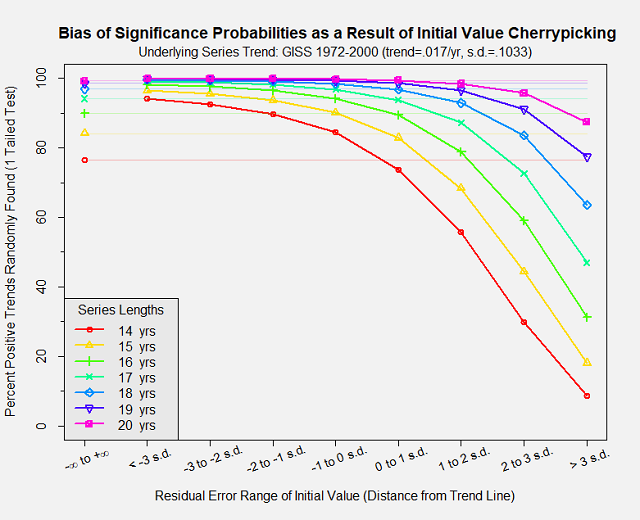
Nothing at all surprising in the results. The left hand column of values shows the significance probabilities resulting from using the whole distribution. Cherrypicking start values well below the trend line greatly increases the likelihood if seeing a significant result. Cherrypicking high start values greatly decreases the likelihood. Longer series are less subject to cherypicking the initial value than are shorter series. In particular, choosing a start value equal to the 1998 el Nino deviation showed that one would then expect to see findings of significance in a 17 year series about 84% of the time. That is, the denier claim that a period with no warming this long is a significant observation is false. It may be an interesting observation to explore further with ever more detailed models, but it in no way shows global warming has "stopped".
- Whistleblower: ‘I knew people would misuse this.’ They did - to attack climate science
citizenschallenge at 23:58 PM on 9 March, 2017Speaking of communicating clearly - what responsiblity do scientists have in that regard? Specifically I've spent a lot of time looking at Fyfe 2016 and it is about a poorly and counter-productively written as I can imagine - but better not call them on it. All ya get is hurt feelings and slammed doors, no matter how carefully or constructively one constructs their arguments.
Fyfe et al. 2016: stamp collecting vs informing and clarifying. Examining a failure to communicate
... and a question of perspective.
Alternately, Behold Seepage in Action.(Skipping my introduction here)
Fyfe 2016 introduction:
It has been claimed that the early-2000s global warming (b) slowdown or hiatus (a)(e), characterized by a reduced rate of global surface warming (c), has been overstated, lacks sound scientific basis, or is unsupported by observations. The evidence presented here contradicts these claims (d).
_______________________________________________________The problem >>>
Why the labyrinthian phrasing? Simplify wording. Clarify meaning.
(a) Creates a false equivalence between “slowdown” and “hiatus” - hiatus means STOPPED! But, Global Warming never stopped!
(b) Creates a false equivalence between “global warming” and “global mean surface warming.”
(c) Furthermore: “early-2000s global warming slowdown or hiatus, characterized by a reduced rate of global surface warming” - implies “surface” warming slowdown (or faux hiatus) is a symptom of a “global” warming slowdown.
(d) “Evidence presented here contradicts these claims.” Given the paragraph's convoluted wording one could easily conclude this is saying: the “hiatus” (that is global warming stopping) is not contradicted
… which is exactly what the contrarian PR machine was hoping they could twist any science into. Why make it so easy?
(e) Why even use the politically charged term “hiatus” beyond a footnote? What possible purpose does it serve other than to fatally wound clarity and invite gross misinterpretation?
This paper seems a textbook example of “seepage” in action. Or as I would phrase it, unconsciously adapting the contrarian’s script. Please keep this in mind as you continue.
_______________________________________________________________________
Fyfe: ¶1 A large body of scientific evidence — amassed before and since the Fifth Assessment Report of the Intergovernmental Panel on Climate Change (IPCC AR5)1 — indicates that the so-called surface warming slowdown, also sometimes referred to in the literature as the hiatus,
__________________________________________________________
“sometimes referred to...” ? What purpose is there in reinforcing the faux “hiatus” meme?
_______________________________________________________________________
Fyfe: was due to the combined effects of internal decadal variability and natural forcing (volcanic and solar) superimposed on human-caused warming2.
__________________________________________________________“internal decadal variabilities” - that would be heat transport?
Why not get explicit and point out that Atmospheric Physics are what's causing Global Warming - not Heat Transport between the oceans and the surface?
_______________________________________________________________________But that's just the beginning highlights. For the entire exercise in futility visit: http://whatsupwiththatwatts.blogspot.com/2017/03/fyfe2016-stampcollecting-vs-informing.html
- Prepare for reanimation of the zombie myth ‘no global warming since 2016’
Daniel Mocsny at 09:21 AM on 8 January, 2017We might see a "global warming stopped in 2016" denier argument, but maybe only if we get another 10-year or longer pause in surface warming. The argument worked better the first time around, since before 1998 the global warming argument was fairly new. Public awareness of climate change was still new enough in the 2000s that people didn't have a memory of an earlier version of the denier argument that had been destroyed in 1998. (Such as "warming stopped in 1988" or whatever the previous hot outlying year was.)
We might not get another 10-year pause in the near future. The odds went down with Trump getting elected. If positive feedbacks start kicking in, the base rate of warming might increase, shortening the time before the trend overrides short-term noise.
Plus we have many other indicators of warming that aren't subject to similar pauses, such as sea level rise. Every year the king tides along America's east coast get higher. Flooding under a clear sky is pretty definitive, since there's nothing abstract or relying on complex models about it. Anybody can see that the familiar road, pier, seawall, etc. that people built to stay above water is now routinely getting submerged in fine weather.
Eventually the deniers will quit trying to deny on the basis of any scientifically testable claim - because they can't, and they don't need to. They'll retreat to their last and insurmountable line of defense: jobs.
Despite the hypothetical promise of green jobs, we still have an 85% fossil fueled economy. The only way to shrink emissions fast enough to avoid cooking civilization - since we've left it for so long now - is to shrink the economy. This is easy to see living on your carbon fair share (the globally equitable individual greenhouse gas emission allowance), or less than two tonnes of carbon dioxide equivalent per year. You just can't buy most of the stuff you see advertised. You'll save gobs of money - fixing the climate is not "expensive", but if everybody does this then most of the economy goes poof. For starters, there can't be any flying. A single jet flight can blow your entire carbon allowance for the year, leaving nothing for, say, eating food. Since the overwhelming bulk of flying is unnecessary, the first tiny measure of our willingness to take climate change seriously is to shut down all the airports. If we won't even take that first baby step, then we're just marking days off the calendar on our way to cooking civilization into nonexistence.
People are greedy and selfish. That's why the climate gets destroyed. If selfish people could get more of what they want by not destroying the climate, then they wouldn't destroy it. It's easy to focus on explicit deniers, but the climate gets just as destroyed by the person who pays lip service to scientific reality and then jets off to the holiday spot or scientific conference anyway.
- Record growth of atmospheric CO2 in 2013
ranyl at 18:04 PM on 23 May, 2014Therefore seems to imply the hotter we get the less carbon drawn down by biosphere.
Do models represent that well?
Clearly CO2 has been introduced very quickly into the system so there si some lag before euqilibrium between the sinks for sure and thus theoretical if we stopped emitting CO2 the redistribution would lower CO2 in atmosphere. However we are going to still warm as still in radiative imbalance at these CO2 levels and the sinks do buffer 50% of the full release immediate;y, and natural drawn down takes millenia due to weathering, so where is the balance point, 75% drawn down and the reminaing 25% take eons what?
It is just that so many seem to actually beleive that if CO2 emissions stopped CO2 woudl fall rapidly and this seems not quite right for me, the buffer has already taken up 50% and keep in mind that Nitrogen fertilization has helped that quite alot (not in models often) and the sinks from this get less as we heat up and we aren't cooling any time soon due the inherent heat lags and a now the albedo drivers.
Also many of the sinks seem to be under threat, forest fires, permafrost, peat fires, droughts in Brazil, old tree die off and the warming ocean etc, etc...
And although emissions are increasing year on year, can't help feeling th esinks are waining in their effect.
This for implies that even stopping CO2 today CO2 will not fall that quickly and may even still rise, indeed in this study showed if climate sensititivity 4C, then goes up and let's face it recent evidence is in line with a CS of 4C, indeed even IPCC CS 4.5C or above is a 1:3 chance.
Who said we had a carbon budget???
Last time CO2 was 350ppm (and we aren't getting back to that unless we remove CO2 from the atmosphere somehow for at least 200-300 years even if stopped all emissions today), sea levels were 20-25m higher on average and temperature were 3-5C higher, although probably even higher considering the West Pacific warm pool was actually much hotter than prweviously thought and covers ~1/10th of the ocean.
What carbon budget??
Basically from the evidence shows we don't have a carbon budget we have a huge debt and if we don't repay it very soon by going carbon negative asap we won't be able to to adapt even.
Therefore isn't every ounce of carbon a huge gamble now?
Shouldn't the questions be how on earth are going toget to 350ppm by 2100, and even that means 2-3C warming by then if the 60-80% of the full warming proposed by Hansen is correct.
350ppm for millenia, earth 3-5C hotter, therefore 350ppm 100 years, we get 60-80% of that, so 1.8C to 2.4C being optimistic.
Anyway lets pretend and elts emit loads more carbon and think 450ppm is safe in some way!
And just how standard deviations shift of the mean is a 2C rise in temperature?

Looking at the bottom graph, excluding the last 30 years, it seems the range is 0.8C max arround the mean, implying a Standard deviation of ~0.4C.
That means 2C is a 5SD shift in mean.
That is equivalent to increasing the average height of man to 7'1", and means a 1/20 year warm year is 7SD from pre-industrial, and that means we are going very extreme in our weather does it not!
So 2C is well miore dangerous than policy makers have any clue of.
Therefore isn't the question now, how can we get carbon negative asap to give us any chance at all, becuase lets face, a 10SD shift in mean temperature (4C) means things so extreme we have no chance of avoiding human civilization choas.
So what doe sthat mean.
Well it means serioulsy thinking is that flight really worth such an outcome?
And as for solutions, scale is everything, and all renewables have extensive environmental imapcts that are just dismissed, like toxic waste, rare earth metals, etc,etc, and all becuase coal is worse or somethign else we do is worse, you wouldn't think the biosphere was on its kbneees becasue of toxic waste, land use etc....
And the sinks are declining and we have to stop using nitrogen fertilizers so they wilol reudce further.
When is this the scale of this problem going to stop it being abstract dinner party talk to oh shit, lets get on, rebuild the earth's ecosystem and stop using power asap, inhcluding the car!
- Why climate change contrarians owe us a (scientific) explanation
Eric (skeptic) at 05:05 AM on 13 October, 2013...the change in energy levels – required to increase the global temperatures rapidly over three decades, to melt glaciers, to warm oceans...
Referring to this diagram:
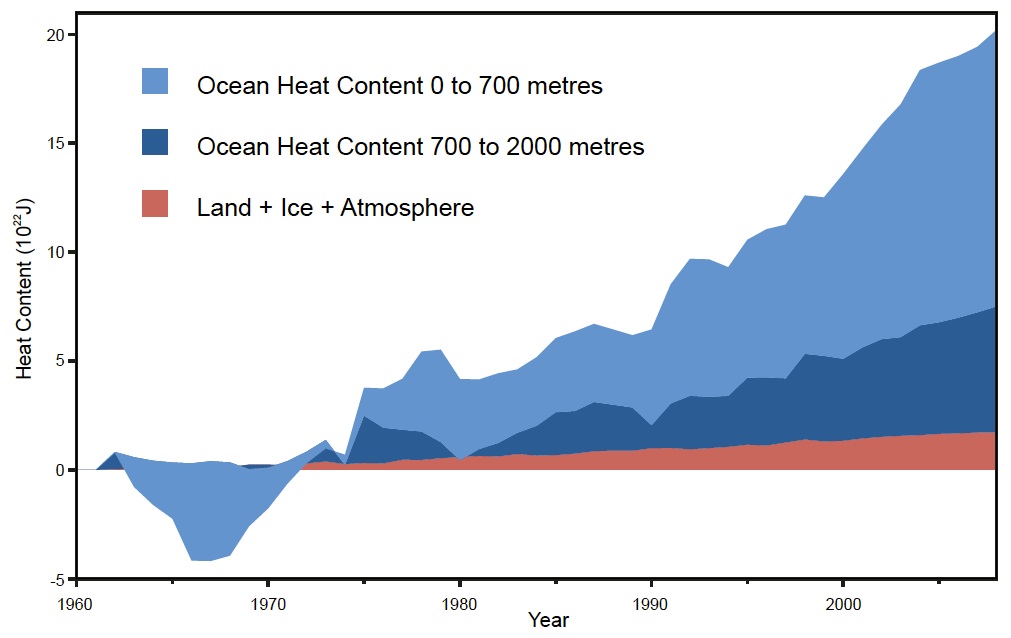
Glacier melting did and does not use much of the assumed change in energy levels. The warming oceans are supposed to account for most of the recent lull in the atmospheric temperature rise, but is the heat transfer to the oceans adequately modeled? This paper http://www.sciencemag.org/content/308/5722/685.full.pdf suggests it is not. As they say in their conclusion, the mixing described in the paper is a major uncertainty in the parameterization of mixing (in climate models). The bottom line is we don't really know how much "missing" atmospheric heat has wound up in the oceans.
Here's a climate model that won't satisfy rader5:
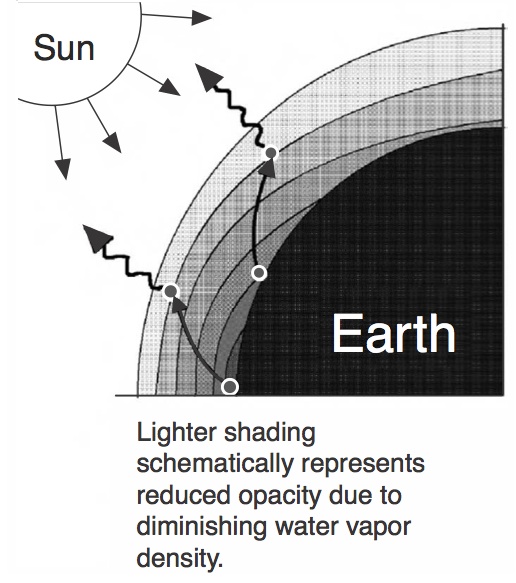
The key point in the diagram (which is from Lindzen 2007 Energy&Environment) is that the angle of the arrows representing latitudinal heat transfer is a function of parameters, not physics, in all climate models. But AFAIK, Lindzen has not provided an alternative GCM with his own cherry-picked parameters to make that point.
Matt Fitzpatrick leaves out of his list (ending with "pirates") the "weather", specifically weather that increases or decreases latitudinal heat transfer. He probably leaves it out in the belief that it affects the short run and can't explain decades of change. But I don't think that is completely correct. I would suggest to Alexandre that a potential "magical negative feedback" is weather insofar as the increased in meridional flow and consequential increased in storminess (neither are true IMO) are supposed to be from Arctic Amplification. But wouldn't that increase latitudinal heat transfer and slow global warming?
But Alexandre is correct that we ought not believe "magical negative feedback" until we see some evidence for it. I believe that long term increases and decreases in meridional flow and latitudinal heat transfer come from long term natural factors, mostly solar.
Here's a quantification of meridional heat flux journals.ametsoc.org/doi/pdf/10.1175/JCLI3539.1 (Carl Wunsch: The Total Meridional Heat Flux and Its Oceanic and Atmospheric Partition, 2005) of about 5 PW atmospheric. Dana's diagram at the top of my post shows about 1022 Joules of increase per year. 5 PW equals about 1023 Joules per year. Obviously only a small part of the 5 PW is going to be lost to space as Lindzen's simple climate model implies. But the 5PW and fluctuations in that amount are clearly a factor in earth's energy balance.
Here's an old paper showing adsabs.harvard.edu/full/1981SoPh...74..399B showing how variations in solar UV could influence climate by changing planetary waves through photochemical changes in the stratosphere. The lower stratosphere has stopped cooling in the last 15-20 years:

(Note: the middle stratosphere is still cooling substantially). I believe these variations in the lower stratosphere are part of the explanation in the lull. If I am correct we should see substantial warming in that TLS graph in the coming solar minimum as the high frequency solar UV decreases causing an overall ozone increase causing TLS warming. The TLS warming is not a direct factor in the meridional heat flux, but it represents strong variations in stratospheric temperature which lead to greater meridional heat flux.
Here's a possible explanation of high sensitivity of early 2000's climate models: journals.ametsoc.org/doi/pdf/10.1175/1520-0442(2002)015%3C1659%3AIADVOP%3E2.0.CO%3B2 (Hu: Interannual and Decadal Variations of Planetary Wave Activity, Stratospheric Cooling, and Northern Hemisphere Annular Mode) which notes the stratospheric cooling to that point (paper is from 2001) potentially caused by GHG increases (plus ozone depletion) and asks whether the stratospheric cooling causes or is caused by an increase in NAM (Arctic Oscillation). (Note that AO has been trending negative since the mid 2000's after this paper was written).
Essentially high sensitivity in the models up to the early 2000's comes from a stronger polar jet which comes from a cooling stratosphere. This decreases meridional flow and meridional heat flux and thus enhances global warming. In more recent models the polar jet is weaker and consequently sensitivity is lower. Whether Arctic Amplification plays a role in the strength of the polar jet (e.g. as explained by Jennifer Francis and others) is still undetermined. My preferred theory is that external solar factors control it although the real answer is undoubtedly a mixture of external, internal natural and anthropogenic factors.
- David Rose Hides the Rise in Global Warming
John Russell at 09:17 AM on 20 March, 2013I just came across another recent quote from Prof Myles Allen (University of Oxford) that shows how grossly Rose distorts his views ...
“While every new year brings in welcome new data to help us rule out the more extreme (good and bad) scenarios for the future, it would be equally silly to interpret what has happened since the early-2000s as evidence that the warming has stopped.”
That link also contains statements from a number of other climate scientists who reject any suggestion that ‘global warming has stopped’.
- Did Murdoch's The Australian Misrepresent IPCC Chair Pachauri on Global Warming?
KR at 06:45 AM on 1 March, 2013AndyS - Reading Hansen in context (which I would strongly recommend), he states:
...the standstill has led to a widespread assertion that "global warming has stopped"
[...]
Indeed, the current stand-still of the 5-year running mean global temperature may be largely a consequence of the fact that the first half of the past 10 years had predominately El Nino conditions, while the second half had predominately La Nina conditions (...). Comparing the global temperature at the time of the most recent three La Ninas (1999-2000, 2008, and 2011-2012), it is apparent that global temperature has continued to rise between recent years of comparable tropical temperature, indeed, at a rate of warming similar to that of the previous three decades.
(Emphasis added)
In other words, Hansen is well aware of the erroneous conclusions 'skeptics' have drawn from recent temperatures, and is correcting them. Again, as with Pachauri, the problem lies in 'skeptical' errors of interpretation and (as seen in the opening post) the misrepresentation of scientists views in certain media outlets.
- Met Office decadal forecasting explained: the reality
John Mason at 19:49 PM on 13 January, 2013
Ray, I'd guess that's the case; HadGEM3 seems to do a better job in general though both fail to nail the 1997-8 super El Nino - as I said in the post such things are notoriously awkward in terms of predictability, despite the level of scientific knowledge today.
In turn, that creates an interesting possibility. What if there was another super El Nino in a few years' time? Looking at the temperature records, the difference between 1996 and 1998 is around 0.3C: given the mean HadGEM3 forecast figure of 0.43C relative to 1971-2000 climatology, such an event in the next 5 years could produce a spike of getting on for 0.75C.
At that point, of course, the temperature would be blamed by the usual suspects on natural variation, followed in the years to come by Daily Mail articles proclaiming how global warming stopped in 2015!! - Met Office decadal forecasting explained: the reality
Tom Curtis at 15:09 PM on 12 January, 2013
newairly @8, The Australian is a disgrace. Its repeated inaccuracies in reporting, not just on climate change, make it little more than a propaganda rag, IMO.
With regard to that particular article, they write:
"On one analysis, the forecast confirms what many people have been saying for some time. Global warming effectively stopped 17 years ago and, if the new forecast is accurate, that "pause" will be extended to 20 years."
By my analysis, made not by simply eyeballing the chart, but by digitizing it and analyzing it, the new predictions while lower than the previous predictions, predict that 4 out of the next 5 years will break the current HadCRUT3v annual global temperature record. Not only that, but the temperature trend from December 1996 will increase by a factor of five relative to the current trend from that period, said trend being much ballyhooed as "no warming".
The only possible way these figures can be treated as extending "the pause in global warming" to twenty years is by pure spin. The deniers are taking us for fools; and in the Australian's "Environment Editor" have found a fool ready to swallow any claptrap they put out without analysis and without thought.
Year 1961-1990 1971-2000
1998 0.529 0.411
2013 0.503 0.385
2014 0.544 0.426
2015 0.578 0.46
2016 0.587 0.469
2017 0.541 0.423 - Resolving Confusion Over the Met Office Statement and Continued Global Warming
shoyemore at 18:17 PM on 11 January, 2013
smerby #33,
How can global warming have stopped when well over half of the "Top 10" warmest ever years have occurred since 2000? 2010 was in the Top 2 warmest ever in all the records.
It would be a big mistake to hang such sweeping conclusions on a weak statistical argument.
And if "global warming has stopped", why are we wasting time before it inevitably starts again? - Resolving Confusion Over the Met Office Statement and Continued Global Warming
DSL at 15:01 PM on 11 January, 2013
smerby, it depends on the context in which you say it. If you are saying it publicly and in the context of trying to say that global warming has stopped, you're misrepresenting the science and misinforming the public on a serious issue.
If you say it amongst a group of climate scientists, they'll say, "what's your point? Ten year trends are meaningless where climate is concerned."
Note that the trend from 2000-2011 (Had4) is .102C per decade. That's hardly a flatline. It's about 24x the warming of the PETM event rate. The trend moved up just one year is slightly negative. What's the point? - Michaels Misrepresents Nordhaus and Scientific Evidence in General
Albatross at 13:35 PM on 9 February, 2012
Oamoe,
One should look at all the metrics and consider the big picture. But given that people have been speaking about OHC. Here is the 0-700 m and the 0-2000 m OHC data from NOAA-- note this represents the analysis from one of about seven groups who analyze the OHC data. Nevertheless, these figures refute claims made by Pielke and fake skeptics that the oceans have not been accumulating heat in recent years-- global warming continues, albeit it at varying rates (as it is expected to do).
It is interesting Pielke Senior insists that THE metric for quantifying global warming is the OHC (well that is when he thought it supported the argument that the warming had stopped and by cherry picking a short time window). In contrast though, Michaels is using the error plagued satellite estimates of lower tropospheric temperature and he too has had to cherry pick a statistically insignificant short time window starting with a super El Nino and ending with a moderate/strong La Nina to hide the incline.
So the fake skeptics cannot even decide amongst themselves which metric to use to quantify global warming. What they they are consistent in doing and what they are in agreement on is cherry pick those data which at any give time support their ideological agenda and cherry picking statistically insignificant short time windows.

With error bars for 0-2000 m:

With error bars for 0-700 m:

[Source] - Foster and Rahmstorf Measure the Global Warming Signal
KR at 07:33 AM on 20 December, 2011
John Hartz - Takeaways?
My personal opinion here, but I see the takeaways as:
* Major portions of mid-term climate variability can be attributed to (with statistical significance) various exogenous (outside) factors.
* Accounting for those exogenous factors shows a very clear linear warming trend over the last 32+ years, with all temperature records in agreement.
* Not incidentally, accounting for the exogenous factors shows a warming trend demonstrating statistical significance of warming over periods as short as 11 years, since 2000!
* Related skeptic memes that this is evidence against: It hasn't warmed since 1998, Climate is chaotic, "It's internal variability", It's a natural cycle, etc. - Baked Curry: The BEST Way to Hide the Incline
Tom Curtis at 20:49 PM on 1 November, 2011
Rickoxo @41:
1) I am uncertain what Muller "admitted" about the last 13 years of BEST data, because the claim is made by David Rose who has a reputation for gross distortions and inaccuracy. Nor does Rose give us the complete quote, but only partial quotes as part of his narrative, a classic method of spinning quotes out of context to give a false impression.
2) Assuming Muller "admitted" that "world temperatures have not risen for about 13 years" (Rose's words), then he admitted a falsehood, which would strongly suggest he is not even familiar with his own data, which I find highly unlikely.
Below is a detail of the last few years of the BEST temperature index taken from the methods paper (PDF):

The BEST data is given in black, with HadCRU (blue), GISS (green) and NOAA (red) also shown. The grey vertical line is 2000. The inner yellow box shows the data plotted by the GWPF, while the outer yellow box shows the last 13 years. Very clearly, had the plot by the GWPF included data from 1997 (13 years), it would have shown a significant positive trend. Indeed, a termination at 2001 is the longest interval they could have included and still retained near zero trend. This gives the lie to David Whitehouse's claim that,"Incidently you could extend the graph back a few years before 2001 and it doesn't make much difference because the 'super el nino' of 1998 and the two subsequent cooler years of 1999 and 2000 do not show up as dramatically in the Best land data as they do in HadCrut3."
More importantly it shows that claims that "world temperatures have not risen for about 13 years" (David Rose) are simply false, whether Muller concurred or not.
3) Muller's purported claim that "this might not be ‘statistically significant’, although, he added, it was equally possible that it was" (David Rose) are hardly mystifying. If that is indeed what Muller said, it merely means he has not calculated the statistical significance of the trend for what ever interval of data Rose asked him about. If he has not made that calculation, or seen it done, his claims about global warming having stopped for 10 years are not made based on the full available evidence. But that is irrelevant to discussion here, because Tamino has made the calculation, and made the results publicly available so we know that Muller's claim (about the 10 years) was true regardless of whether he himself was justified in making it.
These possibilities do not paint Muller in an attractive light, but his character flaws are nothing new in the climate change debate. Regardless of his known flaws, given the source of the truncated quotes, I would be very loath to assume Muller had not made the relevant analysis to justify his comments without verification from his own mouth.
4) Muller's statement about the 10 years was made on October 21 to the BBC. The purported statements about the 13 year period where made sometime on October 29th, or later. Therefore those later comments provide no context from which to understand his earlier comments. Any inference from the later comment that in the earlier comment he was speaking about the 10 years data to the exclusion of any other relevant information is unwarranted.
5) Curry's statement as quoted by the Mail (and explicitly not disavowed by her on her blog) was:
"There is no scientific basis for saying that warming hasn’t stopped"
As copiously shown by Tamino, there is a scientific basis for saying the warming hasn't stopped. That scientific basis is that:
a) The period 2001-2011 is a sub-period of an interval with a statistically significant positive trend of approx 0.27 degrees C per decade; and
b) The period 2001-2011 is not a sub-period of any interval with a statistically significant zero or negative trend.
(a) provides a sound scientific reason to believe the underlying trend in that period is positive, and near 0.27 degrees C per decade. (b) shows that the sound scientific reason in (a) is not defeated by any counter-evidence. The two combined give us a very sound scientific reason for saying the warming has not stopped. In fact, the case is stronger when known physics is included, but that is beside the point. Based purely on the statistics, Curry is not wrong. She is egregiously in error. Sufficiently so that we must either doubt her competence or honesty to explain the error.
6) (And finally), you are corect that Curry did not prepare the graph, and I apologize for my error. However, Curry was shown the graph, and does not disavow it. Further, her comments where made in reference to the graph. Consequently my points made above still stand. - Baked Curry: The BEST Way to Hide the Incline
Tom Curtis at 14:51 PM on 1 November, 2011
Rickoxo @34, taking your questions in order:
1) Yes, Muller made his statement first.
2) No, Muller was (probably) talking about the whole body of evidence. The trend from 1975 to current is just as much evidence about what will happen in the future as the trend from 2000 to present. Muller chose not to ignore that evidence, and to make his statement based on the whole of the evidence before him.
3) No. Curry explicitly only talks about the period from January 2001 to May 2010, a period of just under 10 years. It is important to her case that she uses just under 10 years, rather than 10 years or 12 years. Had she used either of the longer periods, a clear (but not statistically significant) positive trend would have been present.
Finally even if we confine ourselves to consideration of just the last 12 years data, we can only conclude that global warming has stopped by ignoring the physics. We know from evidence in the last 12 years that early in that period we had frequent El Nino's, whereas since 2008 ENSO has tended to La Nina's. We know that El Nino's result in warmer years, and La Nina's result in cooler years. We know that solar activity has reduced over the last 12 years to levels not seen since 1910, so much so that some solar physicists are predicting a new maunder minimum. Therefore we know that without an significant warming factor temperatures would have declined drastically over the last 12 years, instead of remaining fairly constant. That they have not is clear evidence of a countervailing warming force that will restore warming once the ENSO cycle switches to neutral or El Nino's.
In essence, Curry has taken a line with troughs and peaks, and drawn a line from a peak to a trough and insisted that that is the trend. We don't need to know statistics to know that that is garbage. - Baked Curry: The BEST Way to Hide the Incline
Tom Curtis at 12:43 PM on 1 November, 2011
Commenting on Dikran Marsupial @1 (who knows all this), he raises an interesting point. I prefer to use a definition of evidence by which:
x is evidence of y if and only if the probability of y given that x is true > the probability of y given that x is false.
By this definition, the slope of the BEST temperature data from January 2001 to May 2010 is certainly evidence that global temperatures will not continue to rise in the near to medium future. I think it is important to recognize that if we are to be guided by the whole body of evidence, but it is even more important to recognize the weight of the recent temperature record as evidence.
The importance of recognizing this is illustrated by the paradox of the raven. The paradox of the raven, pointed out by Carl Hempel, is one of many paradoxes of induction. Hempel pointed out that "All ravens are black" is logically equivalent to "All things which are not black are not ravens". It follows that discovering something which is both not black, and not a raven is evidence that all ravens are black.
As paradoxical as it seems, that result is sound. Finding a green apple does indeed make it more likely that you will never discover a raven which is not black - by an imperceptible amount. This can even be shown with Bayes theorem, so it cannot be denied without logical inconsistency. But while the green apple is evidence that all ravens are black, it is not significant evidence.
Scientists, who only have a limited time on Earth to discover a great many things, try to work efficiently. Consequently, if a scientist was trying to test the hypothesis, "all ravens are black", she would go around examining ravens, not apples. In like manner, when examining temperature series for evidence of future behavior, they concentrate on those series long enough to have a narrow error range. By convention, they focus only on those results which lie within the 95% confidence interval, a standard temperature trends with less than 10 years data do not achieve.
Not only are there issues of significance involved; there is also the issue of using all the available data. The temperature series from January, 2001 to May 2010 is not the only evidence that bears on the issue of future temperature rises. The series from December 2000 to May 2010 is also relevant. So is the series from November 2000 to May 2010, and so on. If we were to take all possible trends from the BEST data terminating in May 2010, and weight them according to statistical significance to determine what the balance of evidence shows, it would show a rising trend.
In fact, that is the point of Tamino's post. The slope of the temperature data between January 2001 and May 2010 isn't significant evidence of anything much, because of the very wide error bars on the regression. But that does not cause the slope on the data from January 1975 to May 2010 to stop being evidence of future behavior of the temperature series. On the contrary, it remains evidence, and highly significant evidence.
Consequently we can categorically state that the balance of scientific evidence indicates that global warming is continuing unabated. This does not mean that there is no evidence, which taken in isolation, and no matter how weak, does not indicate the opposite. But it does mean the great bulk of the evidence strongly favours that hypothesis.
It is not clear that this long discussion really adds anything to what Dikran said. However, given the experience of Phil Jones on "statistical significant warming", I think it necessary to be absolutely clear when you say things like "There is evidence that global warming has slowed down", or that somebody is incorrect in denying that. In fact, the response to Muller's claim shows clearly that so called "climate skeptics" will roll rough shod over any subtleties to extract the message they want to hear, regardless of what the data shows. Given that, I fully understand Muller's shorthand expression. What he should have said is that, "There is no significant evidence that global warming has stopped", and "The balance of evidence shows global warming to be continuing unabated". But for a popular audience, that is correctly summed up with the claim that, "There is no evidence global warming has stopped" - to which, were the faux-skeptics not trying to manufacture faux-controversy, nobody would have demurred. - Trenberth on Tracking Earth’s energy: A key to climate variability and change
David Lewis at 09:24 AM on 14 July, 2011
One thing that seems certain in all this are these words from Dr. Trenberth's above post:
"we have observing systems in place that nominally can measure the major storage and flux terms but due to errors and uncertainty, it remains a challenge to track anomalies with confidence".
In Trenberth's original "Perspectives" paper published in Science Tracking Earth's Energy, he was clear that the "missing energy" he was discussing was "due to either inadequate measurement accuracy or inadequate data processing".
However, Dr. Trenberth often talks or writes as if there is some actual "missing energy" he expects to find one day, as opposed to tracking down measurement or processing errors, which may lead to confusion for some.
What Trenberth wrote in his original Science paper appears to place him very close to Hansen's view, i.e. that this is at present murky territory, except Hansen appears to be questioning how much heat models should be allocating to the deep ocean when Trenberth appears not to be.
Hansen discusses how difficult he thinks it is to measure Earth's energy imbalance accurately, starting on page 44 in Earth's Energy Imbalance and Implications.
Hansen says he thinks the Argo float system, if extended and maintained for the long term, added to other data on the smaller heat reservoirs, could provide "potentially accurate" data on Earth's energy balance, where it is less likely, in his view, that current or proposed satellites can.
Trenberth has written about the Argo system which, with some other fairly new items in the data collection arsenal, constitutes a "revolutionary" change in what scientists have available for analysis.
In the meantime, I think many are taking too much away from their reading of Dr. Trenberth. It seems to me he's using "missing energy" in the way particle physicists use the term, when their calculations involving the latest data prove to them, because nothing can be missing, that they're mistaken somewhere. Trenberth assessed the data available, added it up, and found what should not be able to be found if the data was complete and good, i.e., that something was "missing". He published his findings and went back to the drawing board, or computer model as it turned out.
Some seem to have problems with Dr. Trenberth's way of expressing himself. Most famously is the way his "missing energy" email was seized by deniers. But James Lovelock illustrates how badly someone can misunderstand Dr. Trenberth even if wilful distortion is not the goal. See Stewart Brand's online Afterword
In this Afterword, Brand quotes Lovelock telling him that after reading Trenberth's "missing energy" paper he decided that"something unknown appears to be slowing the rate of global warming", which caused Brand in his subsequent public speeches to describe a possibility that by 2050 "nothing" will have happened to Earth's climate. Further discussion of Brand's thought here Brand and Lovelock are wandering around touting the work of Garth Paltridge, specifically, this "sensible skeptic"s (Brand's words) book with its Foreword by Lord Monckton.
It seems Lovelock, via Trenberth, ended up at Monckton's front door. Yow.
Dr. Trenberth is clear when he talks about whether when describing things using this "missing energy" concept it means he thinks global warming has stopped - "the AGW signature is not large enough to overwhelm natural variability and so the trend from increased GHGs is only clear on time scales of 25 or more years. We used 25 years in Chapter 3 of IPCC as the lowest trend we provided that was meaningful.... So any pause in sfc T increase from 2000 to 2008 is not unexpected and the first 8 months of this year were the warmest on record and have restored the upward trend. So there is no evidence of a reduction in trend" (personal communication).
P.S. There are some great graphics N.O.A.A. provides that may make it clearer to some who wonder what El Nino/La Nina a.k.a. ENSO is. Imagine we've sliced into the ocean so we can get a 3D view of its heat content at various times during the ENSO cycle:

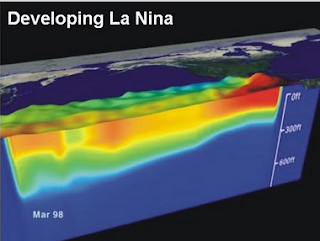

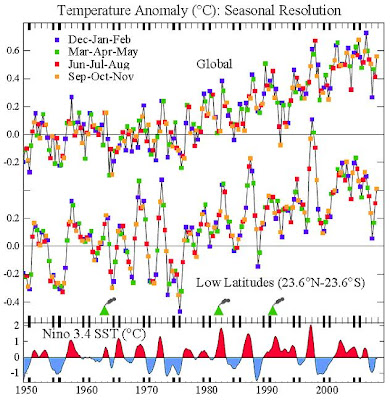
Hansen describes ENSO as heat "sloshing around" in the planetary system. As the hotter water spreads out its heat is more available for transfer into the atmosphere. When the hotter water forms a deeper pool there is less surface area for heat to come out of it into the air. Since by far most heat entering the planetary system is going into the ocean, and it sloshes around like this, it becomes more apparent how El Nino/La Nina can influence the average global surface temperature chart in the way it appears to do.
Hansen's Bjerknes Lecture had a chart showing the correlation between El Nino/La Nina (depicted at the bottom of his chart) and the average global surface temperature chart depicted at the top:
- The Critical Decade - Part 1: The Science
Ken Lambert at 23:31 PM on 28 May, 2011
Why don't we take a hard look at the latest report from Messrs Flannery, Steffan and Karoly et al - three vocal advocates for the AGW position with a lot of professional skin in the game:
"1) The average air temperature at the Earth’s surface continues on an upward trajectory at a rate of 0.17°C per decade over the past three decades."
Note that they don't mention the last decade, where the warming has flattened by all measures.
"2) The temperature of the upper 700 meters of the ocean continues to increase, with most of the excess heat generated by the growing energy imbalance at the Earth’s surface stored in this compartment of the system."
"A growing energy imbalance at the surface stored in this compartment of the system." A carefully compartmentalized description indeed. What about the flattening OHC for the last 7-8 years in the top 0-700m and the overall TOA imbalance?
"3) The alkalinity of the ocean is decreasing steadily as a result of acidification by anthropogenic CO2 emissions."
It seems that the latest argument is that heat is transported to the 700-2000m depths by a yet undescribed short term deep mixing mechanism - but CO2 does not travel with it, otherwise the pH effect would be infinitesimal.
"4) Recent observations confirm net loss of ice from the Greenland and West Antarctic ice sheets; the extent of Arctic sea ice cover continues on a long-term downward trend. Most land-based glaciers and ice caps are in retreat."
With 90% of the planet's ice in Antarctica, should not the vast majority in East Antarctica be mentioned?
"5) Sea-level has risen at a higher rate over the past two decades, consistent with ocean warming and an increasing contribution from the large polar ice sheets."
Last time I looked, Jason 1 and 2 were giving a 1.7-2.0mm/year SLR globally. If the ice melt is an increasing contribution then steric rise is a decreasing contribution, which fits with a flattening OHC increase. By far the greater energy is absorbed in a 1mm steric rise than a 1mm ice melt rise.
"6) The biosphere is responding in a consistent way to a warming Earth, with observed changes in gene pools, species ranges, timing of biological patterns and ecosystem dynamics."
Evidence of warming is not evidence of AGW.
"7) The report notes that the past decade (2001-2010) was the hottest on record, 0.46°C above the 1961-1990 average."
If warming has flattened and approached a plateau, this decade will be 'Hotter' than the last decade and the last decade 'Hotter' than the decade before that. Even if warming has stopped, this decade will remain the 'hottest on record'.
And as a general comment, Jim Hansen (a major IPCC AR4 author and seminal AGW theorist) in his latest effort "Earth's Energy Imbalance and Inplications" suggests that the 2005-10 planetary imbalance has reduced from a pre-2005 estimate of 0.9W/sq.m to 0.59W/sq.m. His reasons are a prolonged Solar Minimum, largely underestimated Aerosol cooling, and a delayed rebound effect from Mt Pinitubo aerosols.
While his reasons are debatable, he has abandoned the 'its there but be can't measure it' argument for maintaining the 0.9W/sq.m imbalance which in theory should be increasing since 2005 due to greater CO2GHG concentrations in the atmosphere and a growing induced positive WV and ice albedo feedback. - Crux of a Core, Part 3... Dr. Ole Humlum
Bjarne Mikael Torkveen at 05:46 AM on 2 April, 2011
Being a Norwegian citizen, I know how the Norwegian climate deniers operate. Ole Humlum is a climate denier in the true meaning of the term. He is not as flexible as Rob Honeycutt might think. Don't be fooled by his "charm", Rob. He likes to spread confusion and misrepresentations. His favourite arguments are: "Global warming stopped in 2000", "it's the sun" and "it's cosmic rays". As the majority of the audience on this site speaks English, I can only supply a limited amount of articles featuring Humlum, but here's one: "Another Unfortunate Truth – Global Warming Stopped" - Hockey Stick Own Goal
muoncounter at 14:15 PM on 23 February, 2011
Albatross,
"Why do some people insist on being stuck in circa 2000? "
Surely you know the answer to that: It's when warming stopped. - New temperature reconstruction vindicates ...
Ned at 03:31 AM on 2 October, 2010
In addition to this back-and-forth about climate forcings, earlier in this thread Ken got very interested in the fact that, taking each decade on its own, neither the 1990s nor the 2000s had a statistically significant warming trend. Nor did the 1980s, nor the 1970s.
That's right -- if you only look at ten-year periods, none of the past four decades has had statistically significant warming when taken on its own. But over the entire four-decade period, the warming has been very highly significant.
The lack of a statistically significant warming trend at decadal time scales does not mean "global warming has stopped", any more than the lack of a statistically significant warming trend at weekly time scales means that "the seasonal cycle has stopped".
I've done some simulations, using an underlying quadratic warming trend that matches the past four decades and rises smoothly to a very extreme warming of +6C (above 1970 values) in 2100.
I de-trended the last decade's temperature record, and then added it to each future decade, thus giving each decade a similar kind of "noise" superimposed on top of an ever-increasing trend.
The first decade where we would see a statistically significant decadal trend is the 2020s. In other words, it's not until 2030 -- nearly halfway through the period of 1970-2100 -- that we would have experienced a decade where there actually was a statistically significant trend within the decade itself.
If you use the 1990s as a model for "noise", the 10-year warming trend first becomes significant in the 2010-2019 decade. So we could potentially see this in the 2010s, or it might not be until the 2020s. By the 2030s, pretty much any previous decade's "noise" would show a statistically significant 10-year trend.
Thus, even with a strong underlying warming trend, you have to go through the fifth or sixth decade before you are able to detect a statistically significant decadal trend.
I think this very nicely disposes of Ken's claims that the non-statistical significance of warming in individual decades is evidence that temperatures have "flattened". - The contradictory nature of global warming skepticism
JMurphy at 01:18 AM on 14 September, 2010
Baz : "Because when warming didn't continue at the same pace (around 2005) I began to question if I was right about my beliefe in warming."
What pace ? Since when ?
What belief ? Didn't you accept the facts, then ? You just believed ?
What figures do you remember from that time, which made you doubt ?
Baz : "As I have said on here, I don't deny the facts - the physics of GHGs, but what I do deny is that we 'know' what the overall result will be (pos/neg feedbacks)."
We don't 'know' anything about the future, in fact, but scientists can make projections and suppositions based on scientific work. What, among all that scientific output, leads you to believe that the "overall result" will be better than the consensus states ?
Baz : "AGAIN(!) I'm not sceptical of warming thus far. I'm sceptical that warming will continue - that there will be a postive feedback from contuing with our release of CO2 etc."
For what reason are you sceptical ? Why do you think that warming has stopped or will stop, or that the feedbacks will be of little consequence in total ?
Baz : "The HadCRUt global series shows remarkable stability over the past 10 years despite an ever-increasing CO2 release. So five years ago I questioned if my belief was correct."
I can't see that stability, myself : what with all the peaks and troughs showing between the beginning of 2000 and the most recent figure (shown here). It also shows a positive trend, although small (data here).
I find it even stranger that you had such doubts, when you compare the 10 year trend up to 2005 - when you say you had your doubts. Still lots of peaks and troughs but the trend is much more positive.
So, what exactly made you doubt the evidence ?
As for your question, I would give it between 20 and 30 years before being able to even determine any sort of significant flat or downward trend because we have had those in the past, as has already been noted, and we would have to understand why it was happening before throwing away any theories. It would also be nice to have a replacement theory... - Has Global Warming Stopped?
Dikran Marsupial at 09:47 AM on 15 August, 2010
fydijkstra
"Yes, the oscillation in Akasofu’s model is super-imposed on a linear trend. We don’t know how long this trend will continue. Not to infinity of course, because nothing in the climate goes on to infinity."
Yes, and the same could be said of a linear model used to determine more recent trends. It seems to me that you are being a little inconsistent there.
"Here we see a multi century oscillation with a wavelength of about 1400 years"
The human eye is great at picking out cycles that are merely the result of random variation. That is why science has developed the use of probability and statistics to guard against such mistakes of intuition. Again there isn't even two full cycles shown in the graph, so projecting forward on that basis is a guess, nothing more.
BTW, Roy Spencer isn't the only person to have come up with a 2000 temperature reconstruction - what do the others say?
"It is not possible to calculate error bars with only 10 points on a flattening curve."
Nonsense, if you were fitting using maximum likelihood based methods, of course it is possible to calculate error bars.
"I used this flattening function only to show, that the data fit better to a flattening curve than to a straight line."
I think I may have mentioned that fitting the calibration data better doesn't mean the model is better because of over-fitting. This is especially relevant when there are only a handful of data.
"When it is said that ‘global warming has stopped’ this is only about the data onto the present. Nobody denies that it is possible that global warming will resume."
The principal cause of variability is ENSO, which involves a transfer of heat between the oceans to the atmosphere. That means you can't unequivocally tell if global waring has stopped by looking at air temperatures alone, as there may still be a net warming of the Earth as a whole but a transfer of heat from the atmosphere to the oceans. The test does show that air temperatures haven't risen much (if you choose the start date in the right place). - Has Global Warming Stopped?
fydijkstra at 05:48 AM on 15 August, 2010
Dikran (#65) your 5th remark: “but it is super-imposed on a linear function of time, so it too goes on to infinity.”
Yes, the oscillation in Akasofu’s model is super-imposed on a linear trend. We don’t know how long this trend will continue. Not to infinity of course, because nothing in the climate goes on to infinity. We can look at Roy Spencers reconstruction of 2000 years of global temperatures. I gave the link in my previous posting, but here is the graph.
 Here we see a multi century oscillation with a wavelength of about 1400 years. The Little Ice Age was the last minimum, the Medieval Warm Period the last maximum. We are now in the on going phase after the LIA. The next maximum could be in 2200, if the cycle goes on undisturbed. If this model is correct, the ‘recovery from the LIA’ could continue until 2200.
There are several mechanisms that could explain such a multi century cycle: (1) the combination of ocean cycles can explain a cycle of 1470 years (see Braun et al, Nature 38, 208-211), (2) the Dansgaard Oescher solar cycle could also explain a cycle of about that length.
Dikran (#65) your last remark: “it would be interesting to see the error bars on your flattening model. I suspect there are not enough observations to greatly constrain the behaviour of the model beyond the calibration period, in which case the model [is] not giving useful predictions.”
It is not possible to calculate error bars with only 10 points on a flattening curve. I used this flattening function only to show, that the data fit better to a flattening curve than to a straight line. This is only about the data onto the present, it is not a prediction. When it is said that ‘global warming has stopped’ this is only about the data onto the present. Nobody denies that it is possible that global warming will resume.
SNRatio (#69): “The simple Akasofu formula "anomaly = LIA recovery + MDO" predicts falling temperatures now - and therefore I wonder if it is not already partly falsified.”
No, the Akasofu model does not exactly predict the year when the falling temperatures should continue. Moreover, just as with the model of ever rising temperatures, there is noise in the data. Akasofu’s model perfectly fits with the data so far.
“The trend also seems rather speculative: What is the physical basis for this continuing "LIA recovery" in the 21st century?” See my above given reply to Dikran. - On Statistical Significance and Confidence
muoncounter at 01:57 AM on 13 August, 2010
#32: "the sum of all these warming and cooling forcings is highly likely to be non-linear - so the polynomial curve fit seems to make good sense of a complex relationship between energy imbalance and measured global temperatures."
A single polynomial is just as arbitrary as a single straight line. The question remains -- what is the meaning of any curve fit, other than as a physical descriptor of what has already taken place?
Look back at this graph from On Statistical Significance.

It is certainly reasonable to say 'the straight line is a 30 year trend of 0.15 dec/decade'. But this straight line is about as good a predictor as a stopped clock, which is correct twice a day. Superimposed on that trend are more rapid cooling and warming events, which are clearly biased towards warming. - Has Global Warming Stopped?
fydijkstra at 20:43 PM on 11 August, 2010
In my comment #20 I showed that the data fit better to a flattening curve than to a linear line. This is true for the last 15 years, but also for the last 50 years. I also suggested a reason why a flattening curve could be more appropriate than a straight line: most processes in nature follow saturation patterns instead of continuing ad infinitum.
Several comments criticized the polynomial function that I used. ‘There is no physical base for that!’ could be the shortest and most friendly summary of these comments. Well, that’s true! There is no physical basis for using a polynomial function to describe climatic processes, regardless of which order the function is, first (linear), second (quadratic) of higher. Such functions cannot be used for predictions, as Aldin also states: we are only speaking about the trend ‘to the present’. Aldin did not use any physical argument in his trend analysis, and neither did I, apart from the suggestion about ‘saturation.’
A polynomial function of low order can be very convenient to reduce the noise and show a smoothed development. Nothing more than that. It has nothing to do with ‘manipulating [as a] substitute of knowing what one is doing’ (GeorgeSP, #61). A polynomial function should not be extrapolated.
So far about the statistical arguments. Is there really no physical argument why global warming could slow down or stop? Yes there are such arguments. As Akasofu has shown, the development of the global temperature after 1800 can be explained as a combination of the multi-decadal oscillation and a recovery from the Little Ice Age. See the following figure.

The MDO has been discussed in several peer-reviewed papers, and they tend to the conclusion, that we could expect a cooling phase of this oscillation for the coming decades. So, the phrase ‘global warming has stopped’ could be true for the time being. The facts do not contradict this.
What causes this recovery from the Little Ice Age, and how long will this recovery proceed? That could be a multi century oscillation. When we look at Roy Spencers ‘2000 years of global temperatures’ we see an oscillation with a wavelength of about 1400 years: minima in 200 and 1600, maximum in 800. The next maximum could be in 2200. - Confidence in climate forecasts
chris at 06:52 AM on 5 August, 2010
Dappledwater at 05:26 AM on 5 August, 2010
angusmac at 02:43 AM on 5 August, 2010
We need to be a little bit careful here. Remember that Hansen’s model was constructed and parameterized almost 30 years ago. The computational run under discussion used a 100 year control equilibration with no forcings, and simulated the earth global temperature from 1958 to 2020 according to a number of scenarios [*].
Dappledwaters picture (Figure 2 from Hansen et al. 2006) shows that the simulation has done a good job of simulating the actual earth surface temperature through around 2005. Angusmac’s figure updates the data through 2009. The simulation and measured surface temperature data now converge a bit.
What do we make of this? I’d say the following are relevant:
(i) There’s no question that Hansen’s simulation B has tracked the real world temperature from 1958 through 2005 pretty well. Scenario B is a little above the real world observations. However as Hansen et al. 1988 state [**] their model is parameterized according to a climate sensitivity of 4.2 oC (equilibrium surface warming per doubling of [CO2]). Since the mid-range best climate sensitivity estimate is 3.0 oC, we’re not surprised if the model is a little “over warm”.
(ii) Since 2005, the global temperatures haven’t risen much whereas the model has increased. So there is a divergence as indicated in angusmacs picture. However if a model of Earth temperature matches reality quite well up to 2005, the fact that it diverges somewhat during the subsequent 4 years isn’t a reason to consider the model a poor one. As Alden Griffiths discusses elsewhere on this site, short term events can easily result in temporary shifts of observables from long term trends. There’s no expectation that the Hansen model should accurately track reality since stochastic variability is differently represented in reality and in the models.
(iii) Is there anything we might say about the period 2005-2009? Yes, it’s a period that has seen the sun drop to an anomalous extended solar minimum, and that has had a largish cooling La Nina that greatly suppressed temperatures in 2008. So we’re not surprised that temperatures haven’t risen since 2005.
(iv) Is there anything significant about the fact that scenario B and C are rather similar right now? Not really. Scenario B is a scenario that roughly matches the extant emissions and (serendipitiously) includes a significant volcanic eruption in the 1990s (1995 in the model; 1991 Pinatubo in reality). In scenario C greenhouse emissions were “switched off” after 2000. However since the Earth surface continues to warm under a (non-supplemented) forcing for some time due to inertial elements (the oceans) of the climate system, we don’t expect scenarios B and C to differ to much for a while following 2000.
[*] from Hansen et al. (2006)“Scenario A was described as ‘‘on the high side of reality,’’ because it assumed rapid exponential growth of GHGs and it included no large volcanic eruptions during the next half century. Scenario C was described as ‘‘a more drastic curtailment of emissions than has generally been imagined,’' specifically GHGs were assumed to stop increasing after 2000. Intermediate scenario B was described as ‘‘the most plausible.’’ Scenario B has continued moderate increase in the rate of GHG emissions and includes three large volcanic eruptions sprinkled through the 50-year period after 1988, one of them in the 1990s.”
[**] from Hansen et al. (1988)“The equilibrium sensitivity of this model for doubledC O2 (315 ppmv - 630 ppmv) is 4.2 oC for global mean surface air temperature (Hansen et al. [1984], hereafter referred to as paper 2). This is within, but near the upper end of, the range 3 o +/- 1.5 oC estimated for climate sensitivity by National Academy of Sciences committees [Charney, 1979; Smagorinsky, 1982], where their range is a subjective estimate of the uncertainty based on climate-modeling studies and empirical evidence for climate sensitivity.”
J. Hansen et al. (1988) Global Climate Changes as Forecast by Goddard Institute for Space Studies Three-Dimensional Model J. Geophys. Res. 93, 9341–9364
J. Hansen et al. (2006) Global temperature change Proc. Natl. Acad. Sci. USA 103, 14288-14293 - Confidence in climate forecasts
angusmac at 02:43 AM on 5 August, 2010
Your statement that climate models are accurate does not appear to be correct.
The NASA GISS data up to December 2009 are shown in Figure 1. They are compared with the global warming scenarios presented by Hansen (2006).
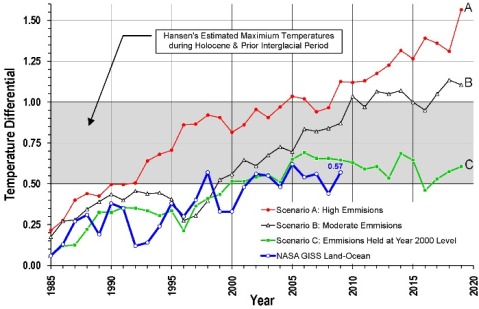
Figure 1: Scenarios A, B and C Compared with Measured NASA GISS Land-Ocean Temperature Data (after Hansen, 2006)
The blue line in Figure 1 denotes the NASA GISS Land-Ocean data and Scenarios A, B and C describe various CO2 emission outcomes. Scenarios A and C are upper and lower bounds. Scenario A is “on the high side of reality” with an exponential increase in emissions. Scenario C has “a drastic curtailment of emissions”, with no increase in emissions after 2000. Scenario B is described as “most plausible” which is expected to be closest to reality. The original diagram can be found in Hansen (2006).
It is evident from Figure 1 that the best fit for actual temperature measurements is the emissions-held-at-year-2000-level Scenario C. This suggests that global warming has slowed down significantly when compared with the “most plausible” prediction Scenario B.
A similar study comparing HADCRUT3 with AR4 may be found here
CONCLUSIONS
It is evident that computer models over-predict global temperatures when compared with observed temperatures.
Global warming may not have stopped but it is certainly following a trajectory that is much lower than that predicted by computer models. Indeed, it is following the zero-increase-in-emissions scenarios from the computer models - Astronomical cycles
chris at 21:30 PM on 18 June, 2010
Ken Lambert at 20:58 PM on 18 June, 2010
"Unless this 'imbalance' heat shows up in the oceans; warming is not happening.."
That's an extraordinary bit of flawed deductive reasoning Ken. Since global warming clearly is happening (all years of the 2000's warmer than all but one of the 1990's; Jan-May 2010 temperature average the highest on record), even despite the fact that the solar cycle has only just come out of a very prolonged minimum and we're in a supposed cooling ocean fluctuation "cycle"....and sea levels are continuing to rise at a rate that cannot be accounted for by land ice and glacier melt...there's something very wrong with your logic.
Usually when deductive reasoning leads to conclusions that oppose extant reality, it's pertinent to look at the premises that drive the logic. In your case these are clearly flawed. There is no question that OHC has risen "during the last 16 years". Has OHC stopped rising "for the last 6 years"? Probably not. The sea level data and land ice melt data are incompatible with that conclusion. As usual in science we should wait until these apparent discrepancies have been sorted out before attempting ground-breaking interpretations..... - We're coming out of the Little Ice Age
michaelkourlas at 09:45 AM on 25 January, 2010
No, I'm not just looking at the CRU measurements. Take a look at NASA's Goddard Institute for Space Studies measuements (http://data.giss.nasa.gov/gistemp/graphs/). They also show global warming slowing down and almost stopping at about 2000.
At the very least, if global warming has not stopped, it has definitely slowed down quite a bit, against what the IPCC has predicted. - We're coming out of the Little Ice Age
michaelkourlas at 02:25 AM on 25 January, 2010
Mr. Cook:
I think the whole flaw in the climate change argument can be expressed examining the words you have just used when saying "What the science really says":
"The main driver of the warming from the Little Ice Age to 1940 was the warming sun with a small contribution from volcanic activity. However, solar activity leveled off after 1940 and the net influence from sun and volcano since 1940 has been slight cooling."
OK, fine. While I don't necessarily agree with the sun portion (see Reply to Lockwood and Fröhlich - The persistent role of the Sun in climate forcing here - http://www.spacecenter.dk/publications/scientific-report-series/Scient_No._3.pdf/view), let's say everything you have said there is true. Even so, that does NOT automatically mean:
"Greenhouse gases have been the main contributor of warming since 1970."
Do we have any direct proof of that? Do we know exactly how much radiative forcing the greenhouse gases we emit produce? And do we know how much they produce when within the extremely complex climate system, as opposed to within laboratory conditions? Or is it just an assumption, considering we have exhausted all the possible natural causes that we can think of?
I think that there may be other natural causes (maybe even ones we have not yet discovered) causing this kind of warming, at least to a certain extent. Syun-Ichi Akasofu here (http://people.iarc.uaf.edu/~sakasofu/little_ice_age.php) wrote about the possibility that much of the current warming could be simplified down to a natural 0.5 degrees C linear trend, with superimposed fluctuations and oscillations.
Most importantly, he also notices that global warming has essentially stopped since 2000. This lack of warming does not agree with IPCC predictions. Instead it gives more credibility to this theory, as it could be explained as the most recent oscillation winding down and continuing on the 0.5 degrees C linear trend. - Why does CO2 lag temperature?
boba10960 at 03:09 AM on 11 January, 2010
First I’d like to commend John for a great blog. This is a fabulous resource and your careful, thorough, and prompt explanations of new science papers is very impressive. Thanks!
Temperature’s lead over CO2 in Antarctic ice core records keeps getting mentioned as proof against human impacts on climate, so it’s good to have an objective discussion of the issue. Here I present some additional perspective from the paleoclimate community I’m sorry this comment is so long, but it’s a complex issue.
John - It seems that the link to Shemesh et al., 2002 is still broken. At least I get a damaged file. Presumably this is:
Shemesh, A., Hodell, D., Crosta, X., Kanfoush, S., Charles, C. and Guilderson, T., 2002. Sequence of events during the last deglaciation in Southern Ocean sediments and Antarctic ice cores. Paleoceanography, 17(4): 10.1029/2000PA000599.
Turboblocke - Henry’s law absolutely applies to CO2, as it does to all gases. The CO2SYS document from the CDIAC web site doesn’t support that claim. The main difference between CO2 and other gases is that once CO2 dissolves from air into seawater it undergoes further reactions, dissociating into bicarbonate and carbonate ions. This makes the chemistry of carbon dissolved in seawater complex, but CO2 gas still obeys Henry’s Law.
Dennis, Riccardo - Yes, the uncertainty in the overall age model for an ice core gets larger further back in time, as does the uncertainty in the difference between the ages of gas and of ice at any given depth. For those who aren’t familiar, at any given depth in an ice core the ice is at least a few hundred years, and sometimes a few thousand years, older than the gas. This is because gases diffuse through firn (packed snow) before it is sealed off as ice. The age offset between gas and ice increases as the accumulation rate of snow decreases. Therefore, the ice-gas age difference is much greater during ice ages, when there is less snow accumulation, than during interglacials. Uncertainty in the ice-gas age difference has been a big problem in establishing reliable lead-lag relationships between temperature and CO2.
People have done statistical analyses of gas-ice age differences, but the best statistics still produce meaningless results if the age models for ice and/or gas are inaccurate. This applies to the data set cited by Ari Jokimäki. Age models for ice cores are constantly being revised. See:
Bénédicte et al., Consistent dating for Antarctic and Greenland ice cores. In Press, Quaternary Science Reviews, Available online 3 December 2009
The uncertainty between gas age and ice age can be virtually eliminated at glacial terminations (i.e., at the end of an ice age) when the initial warming is recorded by the isotopic composition of argon gas, which can then be compared directly against CO2 concentration. Since both temperature and CO2 come from the gas phase, there is no age offset in need of correction. This is how Caillon et al. 2003 (cited by John) was able to show that temperature started to rise in Antarctica before CO2 began to increase. This direct evidence is more robust in my opinion than the statistical comparison of CO2 and temperature on different age models, each with their own uncertainty. I think Caillon et al convinced paleoclimate scientists that the initial increase in temperature in Antarctica leads the initial rise in atmospheric CO2 at the end of an ice age by several hundred years.
This leads to the main point that I wanted to make, namely: Why did temperature start to rise in Antarctica before concentrations of CO2 began to increase at the end of an ice age? Does this mean that CO2 does not have an impact on climate?
Two hypotheses have already been described. I will summarize those and add a third.
The first hypothesis invokes changes in earth’s orbit (Milankovitch) and its effect on spring insolation around Antarctica. Increasing insolation in spring is suggested to cause sea ice to melt back earlier in the year, which allows more CO2 to escape from the ocean to the atmosphere. A scenario like this was invoked by Shemesh et al. (2002) and would follow from the conclusions of Huybers and Denton (2008; cited by Chris). The general principles are described in a paper by Stephens and Keeling: (Stephens, B.B. and Keeling, R.F., 2000. The influence of Antarctic sea ice on glacial-interglacial CO2 variations. Nature, 404(6774): 171-174.). However, if you read the papers that comment on Stephens and Keeling, you will find skepticism in the paleoclimate community about whether or not sea ice can truly serve as a “lid” holding CO2 in the ocean.
Second, Chris described a hypothesis that is commonly invoked for the sequence of events at the end of an ice age, namely:
1) Changes in Earth’s orbit (Milankovitch again) led to warmer summers in the Northern Hemisphere.
2) Warmer summers started melting the large northern ice sheets that built up during the ice age.
3) Freshwater from melting ice flowed into the North Atlantic. Because of its lower density, the freshwater slowed or stopped the overturning circulation that transports heat northward.
4) This had a global impact, but here some hypotheses diverge (denoted A and B below).
According to the ocean bi-polar seesaw hypothesis described by Chris:
A5) Reduced northward flow in the Atlantic allowed heat to build up in the Southern Hemisphere, a phenomenon known as the bipolar seesaw.
A6) Warming of the Southern Ocean caused CO2 to be released from the ocean due to the lower solubility of gases in warmer water. Rising CO2 followed the initial warming of the Southern Ocean and of Antarctica, and also contributed to warming of the Earth as a positive feedback. (See Chris - Post 6, point 2c)
A problem with this hypothesis is that the temperature dependence of CO2 solubility in seawater is well known, and the rise in ocean temperatures during deglaciation is not nearly large enough to have caused the observed rise in CO2. This was pointed out long ago by Broecker and others. The principle is firmly established in the scientific literature.
Broecker, W.S., 1982. Glacial to interglacial changes in ocean chemistry. Progress in Oceanography, 2: 151-197.
Something other than warming must have caused CO2 to be released from the oceans. This is why some people invoke the melting of sea ice to allow more CO2 to escape (see above). However, (a) as noted above, others have argued that sea ice is not sufficiently effective as a barrier to gas exchange and (b) changes in sea ice driven by orbital forcing cannot explain the tight correlation between CO2 and Antarctic temperatures on the millennial time scales that are shown in Figure 1 of:
Ahn, J. and Brook, E.J., 2008. Atmospheric CO2 and climate on millennial time scales during the last glacial period. Science, 322(5898): 83-85.
A third hypothesis not yet described in this thread of comments involves a reorganization of global wind systems toward conditions more favorable for mixing in the Southern Ocean that drives CO2 from the ocean to the atmosphere. The process begins as above, with changes in Earth’s orbit melting northern ice sheets and slowing Atlantic overturning circulation (Points 1 - 4). Then the emphasis switches from the ocean to the atmosphere:
B5) When freshwater shuts down Atlantic overturning circulation, winter sea ice expands over the North Atlantic, causing severely cold winter conditions.
B6) Cold winters cause changes in atmospheric circulation, which are well documented for the Intertropical Convergence Zone and for the Asian Monsoons (see Cheng et al., 2009, cited by Chris, and references therein).
B7) Reorganization of the winds extends all the way to Antarctica, strengthening the Southern Hemisphere westerlies so that they are more effective at driving CO2 out of the ocean.
According to this hypothesis, intense cooling in the northern hemisphere causes warming in the southern hemisphere by changing wind patterns. The initial warming in Antarctica is caused more by a redistribution of heat from north to south than by a global rise in temperature. The winds then drive CO2 out of the ocean so that the observed rise in CO2 lags slightly the initial warming detected in Antarctic ice cores. It takes a few thousand years to melt the northern ice sheets. During this time when meltwater is being dumped onto the North Atlantic, the winds are shifted and CO2 is being driven out of the Southern Ocean. These conditions can experience brief reversals, as happened 14,500 years ago during the Bolling period. After the Bolling warm period, the conditions resumed during the Younger Dryas period.
Increased atmospheric CO2 together with reduced albedo following the meltback of the northern hemisphere ice sheets provided the feedbacks to Milankovitch forcing that brought the earth out of the last ice age into a warmer interglacial period.
The principles underlying the forcing of CO2 by shifting winds over the Southern Ocean are described by Toggweiler (2006). Evidence to support the principles, but modifying the timing, are described by Anderson (2009). See also comment by Toggweiler (2009).
Toggweiler, J.R., Russell, J.L. and Carson, S.R., 2006. Midlatitude westerlies, atmospheric CO2, and climate change during the ice ages. Paleoceanography, 21(2): doi10.1029/2005PA001154.
Anderson, R.F., Ali, S., Bradtmiller, L.I., Nielsen, S.H.H., Fleisher, M.Q., Anderson, B.E. and Burckle, L.H., 2009. Wind-driven upwelling in the Southern Ocean and the deglacial rise in atmospheric CO2. Science, 323(5920): 1443-1448.
Toggweiler, J.R., 2009. Shifting Westerlies. Science, 323(5920): 1434-1435.
These hypotheses all need to be investigated further. Each has strengths and weaknesses. Given the complexity of Earth’s climate system and its connection to the global carbon cycle, the correct answer is likely to be “all of the above”. - An overview of glacier trends
chris at 06:19 AM on 18 November, 2009
#20
HR you're throwing out everything that we know about the phenomenon (glacier responses to forcings), and then trashing a simplistic caricature (your "simple relationhips"), which no one considers to be valid (i.e. that there should be a one-one contemporaneous correspondence between temperature variation and glacier response measurement).
So in considering the relationship between glacier advance/retreat and global temperature, at least three relevant factors should be considered: (i) glacier response times to temperature change, (ii) the levels of volcanic aerosols to which glaciers are particularly sensitive and (iii) local geometric and climatic conditions that influence local glacier responses.
Just considering glacier response times (since you tried to "head off" discussion of this rather obvious point!):
Glacier recession will occur well after temperatures have levelled off from a warming phase, and recession can continue for a long time afterwards. This is because the glacier response is to the temperature difference from the previous "equilibrium", rather than to the temperature as it changes (see my post #15). Oerlemans recently estimated glacier length response times (which is somewhat similar to the time constant for an e-fold change for an exponential decay/rise), for several European glaciers, to be in the range between 4 years and 36 years (partly depending on the steepness of the glacial valley) [*] It's likely that the post 1940's glacial retreat that you mention was a continuing response to the warming to the 1940's, as the glaciers continued to respond to the temperature rise above the early 20th century temperature, even as the temperature rise stopped.
Likewise, speaking of the European Alps, Solomina et al. (2007) [**] state:
After a transitional time of modest gain since the 1960s, mass balances become strongly negative after about 1980. Most glacier tongues have started to react to this signal but are still far from a full dynamic response. Today – here in the sense of the year 2005 – tongues of medium-sized valley glaciers still reflect climatic conditions towards the end of the past century. In the meantime, average volume loss of Alpine glaciers has increased to about 2 to 3% per year. For a full geometric adjustment to the climatic conditions of 2000–2005, most glacier tongues and ice margins would require a farther retreat of a kilometer or more; and with repeated conditions of the extreme summer of 2003, most glaciers would disappear completely.
"Simple relationships" do "begin to breakdown" if we pretend not to know what we know about them!
[*] J. Oerlemans (2007) Estimating response times of Vadret da Morteratsch, Vadret da Palu¨, Briksdalsbreen and Nigardsbreen from their length records. Journal of Glaciology, Vol. 53, No. 182, 2007
[**] O. Solomina et al. (2008) Historical and Holocene glacier–climate variations: General concepts and overview. Global and Planetary Change 60, 1-9 - Does ocean cooling disprove global warming?
chris at 05:24 AM on 8 July, 2009
re #41
Robert, the Goode and Palle data you cited which shows an apparent continuing ("cooling") contribution from an apparent reduction in SISR reaching the surface (increasing albedo) from 1998 through 2005 has been reassessed by the same authors (abstract below [***]), and found to be inconsistent with new data and analysis.
http://www.agu.org/pubs/crossref/2009/2008JD010734.shtml
Goode and Palle now find a consistent interpretation with the CERES and ISCCP cloud analyses in which there has been no change in albedo from the period 2000 through 2007. In other words their previous large apparent negative forcing that you describe isn't actually correct. Although their new analysis suggests that there has been a small increased albedo in the period 1998-2000, there has been no detectable change since then.
This reassessment is consistent with the data on ocean warming which shows large increases in upper ocean heat since 1998 (see John Cook's top post, for example), even if there is some question about the last few years. One shouldn't be fooled into thinking that the land-ocean surface warming under enhanced greenhouse forcing has "stopped" just because 1998 was a very anomalously warm year due to a large El Nino! It's likely that the very recent period of lower temperature anomalies are the result of the strong La Nina episode of 2008 and the fact that the sun is at the bottom of its solar cycle. Palle and Goode's reassessment of surface incident solar radiation indicates that that metric is unlikely to be very important outwith the small reduction in total solar irradiance at the solar minimum (and not forgetting the effects of aerosols on reduced surface insolation).
Easterling and Wehner (2009) [*****] have recently highlighted (again) the fallacies in the assumption that the earth will not undergo significant periods of temperature statis or even cooling on a long term warming trajectory under the influence of an enhanced greenhouse radiative imbalance. Of course when this happens it should be possible to adress the significant causal elements in hindsight (solar metrics, volcanos, La Nina's etc.). In this case the change in albedo doesn't seem to be important at least according to Goode and Palle's reanalysis. Incidentally you said on another thread that sea levels haven't risen "in years". That's incorrect.
http://www.agu.org/pubs/crossref/2009/2009GL037810.shtml
[***]E. Pallé, P. R. Goode and P. Montañés-Rodríguez (2009) Interannual variations in Earth's reflectance 1999–2007 J. Geophys. Res. 114art #D00D03
abstract: The overall reflectance of sunlight from Earth is a fundamental parameter for climate studies. Recently, measurements of earthshine were used to find large decadal variability in Earth's reflectance of sunlight. However, the results did not seem consistent with contemporaneous independent albedo measurements from the low Earth orbit satellite, Clouds and the Earth's Radiant Energy System (CERES), which showed a weak, opposing trend. Now more data for both are available, all sets have been either reanalyzed (earthshine) or recalibrated (CERES), and they present consistent results. Albedo data are also available from the recently released International Satellite Cloud Climatology Project flux data (FD) product. Earthshine and FD analyses show contemporaneous and climatologically significant increases in the Earth's reflectance from the outset of our earthshine measurements beginning in late 1998 roughly until mid-2000. After that and to date, all three show a roughly constant terrestrial albedo, except for the FD data in the most recent years. Using satellite cloud data and Earth reflectance models, we also show that the decadal-scale changes in Earth's reflectance measured by earthshine are reliable and are caused by changes in the properties of clouds rather than any spurious signal, such as changes in the Sun-Earth-Moon geometry.
[*****]D. R. Easterling and M. F. Wehner (2009) Is the climate warming or cooling? Geophys. Res. Lett., 36, L08706
abstract: Numerous websites, blogs and articles in the media have claimed that the climate is no longer warming, and is now cooling. Here we show that periods of no trend or even cooling of the globally averaged surface air temperature are found in the last 34 years of the observed record, and in climate model simulations of the 20th and 21st century forced with increasing greenhouse gases. We show that the climate over the 21st century can and likely will produce periods of a decade or two where the globally averaged surface air temperature shows no trend or even slight cooling in the presence of longer‐term warming.






THE ESCALATOR

(free to republish)