



 Arguments







Is the U.S. Surface Temperature Record Reliable?
Posted on 31 August 2009 by John Cook
The reliability of the surface temperature record has previously been questioned due to urban heat island effect. This is when weather stations are positioned in urban areas which tend to be warmer than rural areas. However, it has been shown that urban warming has little to no effect on the long term temperature trend, particularly when averaging out over large regions. However, another factor affecting the temperature record is microsite influences. This refers to the placement of weather stations near features that might influence the readings. For example, placing weather stations near objects or areas that absorb and radiate heat (eg - a parking lot) can give higher temperature data.
One of the more extensive efforts in cataloging instances of microsite influences is surfacestations.org. Created by meteorologist Anthony Watts, it features an army of volunteers who travel the U.S. photographing weather stations. They found stations located next to air conditioning units, near asphalt parking lots and on hot rooftops. The work is summarised in a report Is the U.S. Surface Temperature Record Reliable? Anthony Watts concludes no, it's not reliable.
Watts rates the stations using the same metric employed by the National Climatic Data Center (section 2.2.1). There are five ratings depending on how well sited the station is. Class 1 stations are the most reliable, located at least 100 metres from artificial heating or reflecting surfaces (eg - buildings, parking lots). Class 5 stations are the least reliable, located next to or above artificial heating surfaces.
Of the 1221 stations in the U.S., the surfacestation.org volunteers had rated 865 at the time the report was written (the website currently reports 1003 stations examined). They classified only 3% of stations as the most reliable Class 1. Most stations (58%) are rated Class 4 (artificial heating sources less than 10 metres from weather station).
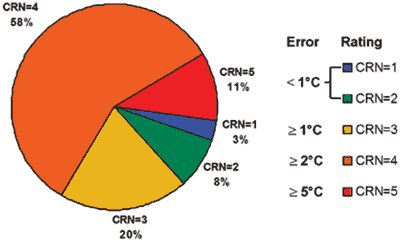
Figure 1: Station Site Quality by Rating (Watts 2009)
These numbers highlight the need to improve the quality of temperature measurement. Indeed, this had already been recognised by the NCDC when they released the Site Information Handbook in 2003. This report was designed to address shortcomings in documentation, changes to observing networks and the observing sites themselves.
The key question to the global warming debate is whether microsite influences actually add to the overall warming trend over the U.S. Anthony Watt's report doesn't answer this question directly. However, the NOAA have published Talking Points related to concerns about whether the U.S. temperature record is reliable. The NOAA used the site ratings by surfacestations.org to construct two national time series. One was the full data set, using all weather stations. The other used only Class 1 or Class 2 weather stations, classified as good or best.
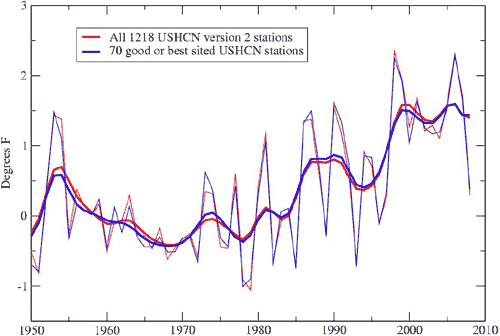
Figure 2: annual temperature anomaly (thin lines) and smoothed data (thick lines) for all U.S. weather stations (red) and Class 1/Class 2 weather stations (blue).
The two data sets cover different areas so some differences might be expected. The top rating stations only covered 43% of the country with some states not included (eg - New Mexico, Kansas, Nebraska, Iowa, Illinois, Ohio, West Virginia, Kentucky, Tennessee or North Carolina).
Nevertheless, the two data sets show practically identical trends. The work of surfacestations.org is useful in clarifying one point - microsite influence has imparted little to no warming bias in the U.S. temperature record.









       Local average temperature (oC)
Site     1985          1995

1       13.1       13.3
2       8.3        8.5
3       9.5        9.7
4       18.6       18.9
5       12.4       12.6
6       10.6       10.8
7       17.4       17.6
8       9.2        9.5
9       21.3       21.4
10      11.0       11.2
If we take the change in temperature at each site as the anomaly (that’s what an anomaly is, although in reality it is relative to a base year range) then we can calculate the (meaningless) “global temperature” and the global anomaly: “global temperature” (1985) = 13.14 oC “global temperature” (1995) = 13.35 oC global anomaly (1995) = 0.21 oC (relative to 1985). Now we remove the five coldest sites from the 1995 data set due to “collapse” of the Soviet Union (say) in 1990: “global temperature” (1985) = 13.14 oC “global temperature” (1995) = 16.76 oC global anomaly (1995) = 0.20 oC (relative to 1985) Interesting, yes? The world has apparently got hotter while the global temperature anomaly is essentially unchanged. Do you see why one doesn’t use the meaningless “global average temperature”, but rather the temperature anomaly Mizimi? The temperature anomaly has a number of other excellent qualities. One of these is that while absolute temperature between distant sites is non-correlated (some might be at higher altitudes or in different local environments) the temperature change over time between sites is highly correlated even at high distances (up to 1200 km). Therefore the temperature anomaly allows one to get a rather accurate global scale assessment of temperature change even without full surface coverage. And (as we’ve just seen) the use of the temperature anomaly means that changes in coverage (loss or gain of stations) doesn’t materially affect the measured global temperature change so long as there are sufficient overall stations. Another quality is that additional temperature measures (e.g. from satellites) can be seamlessly incorporated into the temperature anomaly analysis.