



 Arguments









Global warming and the El Niño Southern Oscillation
What the science says...
| Select a level... |
 Basic
Basic
|
 Intermediate
| |||
|
El Nino has no trend and so is not responsible for the trend of global warming. |
|||||
It's El Niño
"Three Australasian researchers have shown that natural forces are the dominant influence on climate, in a study just published in the highly-regarded Journal of Geophysical Research. According to this study little or none of the late 20th century global warming and cooling can be attributed to human activity. The close relationship between ENSO and global temperature, as described in the paper, leaves little room for any warming driven by human carbon dioxide emissions. The available data indicate that future global temperatures will continue to change primarily in response to ENSO cycling, volcanic activity and solar changes." (Climate Depot)
At a glance
This particular myth is distinguished by the online storm that it stirred up back in 2009. So what happened?
Three people got a paper published in the Journal of Geophysical Research. It was all about ENSO - the El Nino Southern Oscillation in the Pacific Ocean. ENSO has three modes, El Nino, neutral and La Nina. In El Nino, heat is transferred from the ocean to the atmosphere. In La Nina, the opposite happens. So within ENSO's different modes, energy is variously moved around through the planet's climate system, but heat is neither added nor subtracted from the whole. As such, in the long term, ENSO is climate-neutral but in the short term it makes a lot of noise.
The paper (link in further details) looked at aspects of ENSO and concluded that the oscillation is a "major contributor to variability and perhaps recent trends in global temperature". First point, sure. Second point, nope, if you accept climate trends are multidecadal things, which they are.
That might have been the end of it had the authors not gone full-megaphone on the media circuit, promoting the paper widely in a certain way. "No scientific justification exists for emissions regulation", they loudly crowed. "No global warming", the denizens of the echo-chamber automatically responded, all around the internet. This is how climate science denial works.
Conversely, the way that science itself works is that studies are submitted to journals, peer-reviewed, then some of them get published. Peer review is not infallible - some poor material can get through on occasion - but science is self-correcting. So other scientists active in that field will read the paper. They may either agree with its methods, data presentation and conclusions or they may disagree. If they disagree enough - such as finding a major error, they respond. That response goes to peer-review too and in this case that's exactly what happened. An error so fundamental was found that the response was published by the same journal. The error concerned one of the statistical methods that had been used, called linear detrending. If you apply this method to temperature data for six months of the Austral year from winter to summer (July-December), it cannot tell you that during that period there has been a seasonal warming trend. So what happens if you apply it to any other dataset? No warming! Bingo!
A response to the response, from the original authors, followed but was not accepted for publication, having failed peer-review. At this point, the authors of the rejected response-to-the-response started to screech, "CENSORSHIP" - and the usual blogosphere battles duly erupted.
It was not censorship. Dodgy statistical techniques were picked up by the paper's highly knowledgeable readership, some of whom joined forces to prepare a rebuttal that corrected the errors. The response of the original paper's authors to having their errors pointed out was so badly written that it was rejected. That's not censorship. It's about keeping garbage out of the scientific literature.
Quality control is what it's all about.
Please use this form to provide feedback about this new "At a glance" section. Read a more technical version below or dig deeper via the tabs above!
Further details
ENSO, the El Nino Southern Oscillation, is an irregular but well-understood phenomenon that affects the Eastern and Central Pacific Oceans. It is important both on a local and global basis, since it not only causes changes in sea-surface temperatures. It also affects the thermal profile of the ocean and both coastal and upwelling ocean currents.
Such changes can and do affect the diversity and abundance of important edible seafood species. Cold and warm-water forms are forced to migrate to where they find the conditions more to their liking. El Nino events in particular, where warm waters prevail close to the sea surface, can inflict a temporary loss of commercially important species of fish and squid from where they are traditionally fished. Some coastal communities along the Pacific seaboard of South America have a strong dependency on such fisheries. As such, prolonged El Nino conditions can be seriously problematic.
The warm El Nino mode of ENSO also affects global temperatures, as heat energy is transferred from ocean surface to the atmosphere. A strong El Nino is easily capable of raising temperatures above the upward slope that represents the change in radiative forcing caused by our increasingly vast greenhouse gas emissions - global warming, in other words. Conversely, the opposite to El Nino, La Nina, suppresses global temperatures. When several La Nina years occur in a row, climate science deniers are given the opportunity to insist that the world is cooling. This has happened before, most notably in the post-1998 period.
However, as fig. 1 shows, global temperature is rising independently of the short-term ENSO noise. Fig. 1 also shows that 2022 was the warmest La Nina year in the observational record. In fact, El Nino, La Nina and neutral years are all getting warmer.
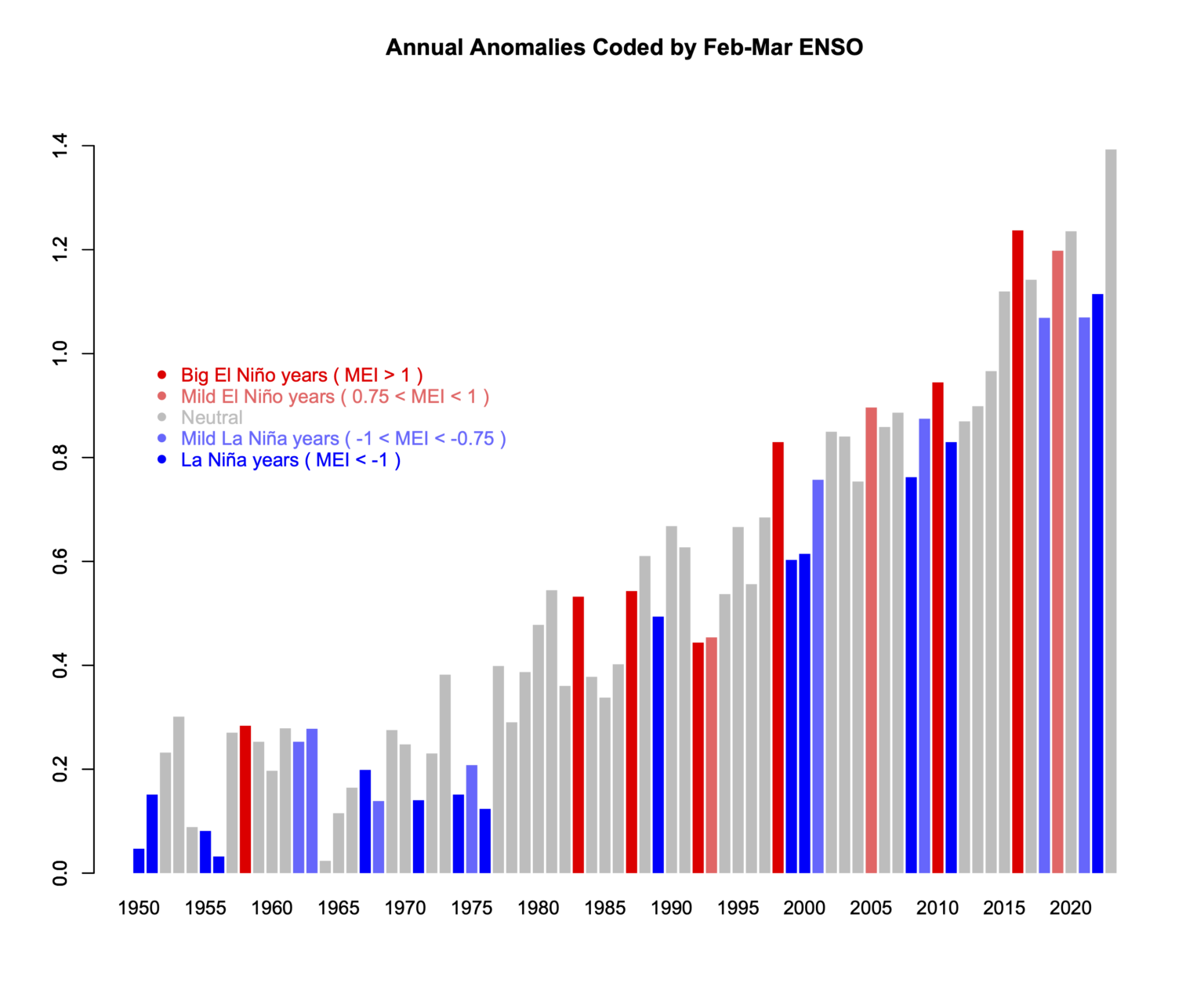
Fig. 1: variations in ENSO in a warming world. This plot therefore shows two independent phenomena that affect climate: the noisy ENSO and the underlying relentless upward climb in temperatures caused by our rapidly-increasing emissions of CO2 and other greenhouse gases. Temperature records typically get broken in El Nino years because the temperature is given an extra boost. 2016, a major El Nino year, held the global temperature record for a few years, but 2023 saw that record fall again. 2023 is in grey because that El Nino did not develop until later in the year. Graphic: Reaclimate.
The reader should by now be in no doubt about the difference between the long term global temperature trend caused by increased greenhouse gas forcing and the noise that shorter-term wobbles like ENSO provide. You would have seen something similar during the descents into and climbs out of ice-ages too. That's because ENSO has likely been with us for a very long time indeed. Ever since the Pacific Ocean came close to its present day geography, millions of years ago, it has likely been there.
The reader should by now be in no doubt about the difference between the long term global temperature trend caused by increased greenhouse gas forcing and the noise that shorter-term wobbles like ENSO provide. You would have seen something similar during the descents into and climbs out of ice-ages too. That's because ENSO has likely been with us for a very long time indeed. Ever since the Pacific Ocean came close to its present day geography, millions of years ago, it has likely been there.
Nevertheless, here we have something that warms the planet, even if that's on a temporary basis. As a consequence, some people with ulterior motives might just become interested. Over a decade ago now, that's what happened. A paper, 'Influence of the Southern Oscillation on tropospheric temperature' (Mclean et al. 2009) was published in the Journal of Geophysical Research. One of its co-authors, a well-known climate contrarian, commented:
"The close relationship between ENSO and global temperature, as described in the paper, leaves little room for any warming driven by human carbon dioxide emissions."
If you enter the above quote, complete with its quotation marks, into a search engine, you will get lots of exact matches. Strange? Not really, if you have studied the techniques of climate science denial.
- a paper is published that barely mentions global warming.
- its authors go on to distribute slogans implying that they have put yet another Final Nail in the global warming coffin.
- right-wing media of all sorts from newspapers to blogs ensure wide distribution of the talking-points.
- individuals serve to fill in the circulation-gaps.
This is how it works, time and again. However, glaring errors were soon noticed in the paper, leading a group of specialists to offer a rebuttal, published in the same journal a year later (Foster et al. 2010).
Statistics is not everyone's cup of tea, but a very straightforward explanation of the key error was provided by Stephen Lewandowsky, writing at ABC (archived):
"This is best explained by an analogy involving daily temperature readings between, say, July and December anywhere in Australia. Suppose temperature is recorded twice daily, at midday and at midnight, for those 6 months. It is obvious what we would find: Most days would be hotter than nights and temperature would rise from winter to summer. Now suppose we change all monthly readings by subtracting them from those of the following month—we subtract July from August, August from September, and so on. This process is called "linear detrending" and it eliminates all equal increments. Days will still be hotter than nights, but the effects of season have been removed. No matter how hot it gets in summer, this detrended analysis would not and could not detect any linear change in monthly temperature."
Anyone can do this in Excel. First input a series of representative temperatures for the transition from Austral winter into summer:
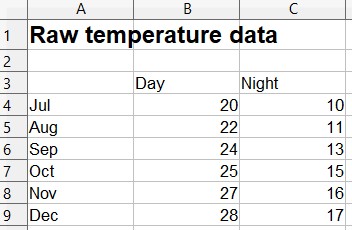
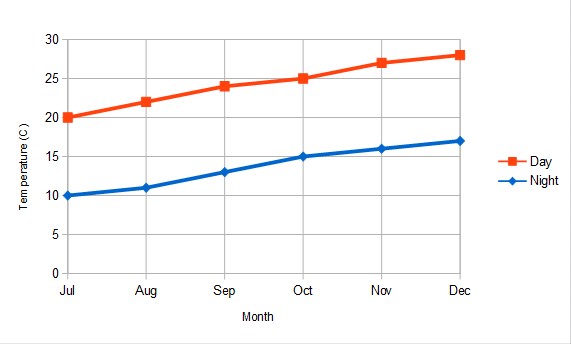
Reasonable? OK, then let's plot them. Still looks like what we'd expect. It gets warmer in Australia from July to December and nights are usually colder than days, right?
Now, let's do that detrending. This is what you get:
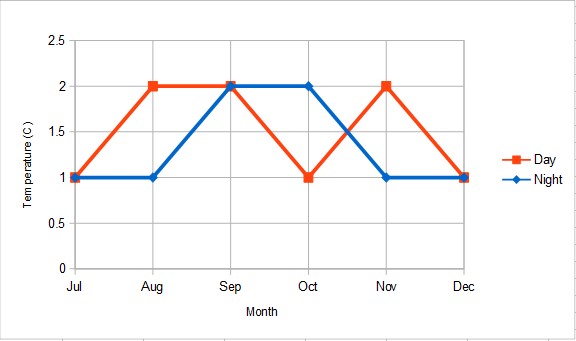
As Lewandowsky pointed out in his ABC article:
"Astonishingly, McLean and colleagues applied precisely this detrending to their temperature data. Their public statements are thus equivalent to denying the existence of summer and winter because days are hotter than nights."
In other words: Fail.
Last updated on 24 March 2024 by John Mason. View Archives

 Notice that the units for the top panel (the EOF) is in degrees per standard deviation. The PC (PDO index) is given in standard deviation, so to recover the SSTA you indeed have to multiply the two to get the right units.
The average of the EOF in the N. Pacific definitely negative (<0), but probably no smaller than -0.4. Taking the average you get -0.2 degrees C per SD, which is exactly the scaling factor you found.
You are technically correct in saying that "PDI index is not SSTA", but you are completely missing the point: the PDI index, in conjunction with the EOF, does in fact describe SST variations.
In the eastern pacific (as you defined it), if you average the EOF you probably get 0.3 degree per SD. Between 1980-1985 and 2005-2010, the PDO index went from +1 to -0.5, so
ΔSST= -1.5 * 0.3 = -0.45 degrees C
you can probably argue for a couple of tenths either way, but the key is that the change in eastern Pacific due to PDO is large enough to explain the lack of warming in the eastern pacific.
You said "There’s no flaw in my reasoning or understanding of what causes the PDO. Using different methods, Di Lorenzo came to the same conclusion."
In your blog post, the crux of your argument is fig7, where you plotted 85-month smoothed PDO - Nino3.4 as well as N. Pacific air pressure index (NPI). The figure shows a good correlation between the two series, which you then said "Is The Difference Between NINO3.4 SST Anomalies And The PDO A Function Of Sea Level Pressure?, the answer appears to be yes."
(1) Nowhere in your analysis did you present an argument of causality..
(2) In addition, you applied a 85-month filter, which will likely wipe out any signal in ENSO. In fact if you plot a 85-month smoothed PDO index against the NPI I suspect you will get just as good of a result, so likely what you have found is a good correlation between PDO index and NPI.
Can you post the reference to di Lorenzo?
Final point:
In your original post, you said ‘According to numerous peer-reviewed papers, surface temperatures respond proportionally to El Niño and La Niña events'. I think the reasonable interpretation, based on your wording, is that numerous papers concluded that surface temperatures respond proportionally to El Niño and La Niña events; this is very different from papers assuming the same.
Notice that the units for the top panel (the EOF) is in degrees per standard deviation. The PC (PDO index) is given in standard deviation, so to recover the SSTA you indeed have to multiply the two to get the right units.
The average of the EOF in the N. Pacific definitely negative (<0), but probably no smaller than -0.4. Taking the average you get -0.2 degrees C per SD, which is exactly the scaling factor you found.
You are technically correct in saying that "PDI index is not SSTA", but you are completely missing the point: the PDI index, in conjunction with the EOF, does in fact describe SST variations.
In the eastern pacific (as you defined it), if you average the EOF you probably get 0.3 degree per SD. Between 1980-1985 and 2005-2010, the PDO index went from +1 to -0.5, so
ΔSST= -1.5 * 0.3 = -0.45 degrees C
you can probably argue for a couple of tenths either way, but the key is that the change in eastern Pacific due to PDO is large enough to explain the lack of warming in the eastern pacific.
You said "There’s no flaw in my reasoning or understanding of what causes the PDO. Using different methods, Di Lorenzo came to the same conclusion."
In your blog post, the crux of your argument is fig7, where you plotted 85-month smoothed PDO - Nino3.4 as well as N. Pacific air pressure index (NPI). The figure shows a good correlation between the two series, which you then said "Is The Difference Between NINO3.4 SST Anomalies And The PDO A Function Of Sea Level Pressure?, the answer appears to be yes."
(1) Nowhere in your analysis did you present an argument of causality..
(2) In addition, you applied a 85-month filter, which will likely wipe out any signal in ENSO. In fact if you plot a 85-month smoothed PDO index against the NPI I suspect you will get just as good of a result, so likely what you have found is a good correlation between PDO index and NPI.
Can you post the reference to di Lorenzo?
Final point:
In your original post, you said ‘According to numerous peer-reviewed papers, surface temperatures respond proportionally to El Niño and La Niña events'. I think the reasonable interpretation, based on your wording, is that numerous papers concluded that surface temperatures respond proportionally to El Niño and La Niña events; this is very different from papers assuming the same.
 HP: the EOF and PC shows that this is the usual ENSO mode. You can check the PC and it follows ENSO indices quite well. The spatial EOF also shows good agreement with ENSO: the hot spot on the east corresponds to 0.7 degrees per SD, the response in NW pacific is much weaker: -0.2 degrees per SD.
LP: This is the PDO mode:comparing the PC (bottom) to the PDO index(top):
HP: the EOF and PC shows that this is the usual ENSO mode. You can check the PC and it follows ENSO indices quite well. The spatial EOF also shows good agreement with ENSO: the hot spot on the east corresponds to 0.7 degrees per SD, the response in NW pacific is much weaker: -0.2 degrees per SD.
LP: This is the PDO mode:comparing the PC (bottom) to the PDO index(top):
 You can see they agree reasonably well.
Looking at the EOF, you can see that the response in the NW pacific (-0.3 degrees per SD) is comparable to the responds in the eastern pacific (0.4 degrees per SD).
Your comment " Additionally, you’d need to analyze the dataset being discussed, which is the East Pacific, not the North Pacific or the Pacific as a whole." is puzzling.
One of the central question here is whether PDO is a basin wide phenomena, and thus can account for the lack of warming on the eastern pacific. Can you elaborate on why using data from the entire pacific to determine the existence of a basin wide mode is inappropriate.
##########################################
You said " Why not simply compare the East Pacific to a scaled ENSO index and say that the East Pacific has mimicked the NINO3.4 sea surface temperature anomalies over the past 30 years? It’s much easier for people reading this thread to understand"
What that will accomplish exactly? NINO3.4 is part of the east Pacific so the fact that they vary similarly should not come to a surprise. How does that say anything about the long term decadal trend of the east pacific?
#############################################
In your original post, the following quote appeared:
“According to numerous peer-reviewed papers, surface temperatures respond proportionally to El Niño and La Niña events, but it’s obvious they do not.”
The last sentence is largely irrelevant because it is clear that you are disputing something. The question is what are you disputing? My point is from what you've written you are disputing conclusions of papers (which is surprising so I asked for references), whereas in reality you are disputing the assumptions.
You can see they agree reasonably well.
Looking at the EOF, you can see that the response in the NW pacific (-0.3 degrees per SD) is comparable to the responds in the eastern pacific (0.4 degrees per SD).
Your comment " Additionally, you’d need to analyze the dataset being discussed, which is the East Pacific, not the North Pacific or the Pacific as a whole." is puzzling.
One of the central question here is whether PDO is a basin wide phenomena, and thus can account for the lack of warming on the eastern pacific. Can you elaborate on why using data from the entire pacific to determine the existence of a basin wide mode is inappropriate.
##########################################
You said " Why not simply compare the East Pacific to a scaled ENSO index and say that the East Pacific has mimicked the NINO3.4 sea surface temperature anomalies over the past 30 years? It’s much easier for people reading this thread to understand"
What that will accomplish exactly? NINO3.4 is part of the east Pacific so the fact that they vary similarly should not come to a surprise. How does that say anything about the long term decadal trend of the east pacific?
#############################################
In your original post, the following quote appeared:
“According to numerous peer-reviewed papers, surface temperatures respond proportionally to El Niño and La Niña events, but it’s obvious they do not.”
The last sentence is largely irrelevant because it is clear that you are disputing something. The question is what are you disputing? My point is from what you've written you are disputing conclusions of papers (which is surprising so I asked for references), whereas in reality you are disputing the assumptions.
 "Indian Ocean" refers to a band between 5 degrees North and 5 degrees South in the Indian Ocean having the same area as Nino 3.4, and as you can see correlates better both with the globe minus the East Pacific, and the globe than does Nino 3.4
Given this data, your response that you lagged the rest of the world vs East Pacific data is an evasion rather than an answer. Doing so provides less justification for the lag you have chosen, not more. This leaves you in the position where your only justification of the lag that you have chosen is that it helps you make your point. That is, you have a rhetorical, not a scientific justification for your chosen manipulation of the data.
As an aside, I was considering the first of your graphs reproduced by Kayell here, which I now realize is not lagged (final clause added in edit). Correctly lagged it looks like this:
"Indian Ocean" refers to a band between 5 degrees North and 5 degrees South in the Indian Ocean having the same area as Nino 3.4, and as you can see correlates better both with the globe minus the East Pacific, and the globe than does Nino 3.4
Given this data, your response that you lagged the rest of the world vs East Pacific data is an evasion rather than an answer. Doing so provides less justification for the lag you have chosen, not more. This leaves you in the position where your only justification of the lag that you have chosen is that it helps you make your point. That is, you have a rhetorical, not a scientific justification for your chosen manipulation of the data.
As an aside, I was considering the first of your graphs reproduced by Kayell here, which I now realize is not lagged (final clause added in edit). Correctly lagged it looks like this:
 (Both detrended)
What also becomes clear using the proper lag is that the way in which global temperatures track ENSO events is noisy. Focusing on just one or two such events will simply focus on noise in the system. It is, in other words, simply cherry picking.
(Edited to delete faulty analysis, TC)
(Both detrended)
What also becomes clear using the proper lag is that the way in which global temperatures track ENSO events is noisy. Focusing on just one or two such events will simply focus on noise in the system. It is, in other words, simply cherry picking.
(Edited to delete faulty analysis, TC)
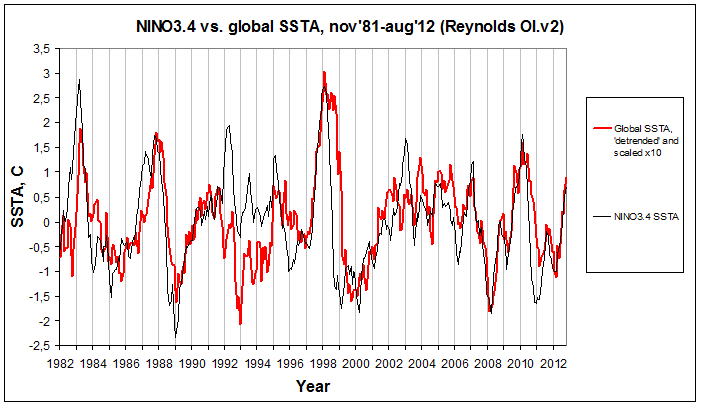 Here is mine, pretty much randomly using spots in various La Niñas (no, there's no real, objective justification for my selection of points, any more than there is for yours):
 And here is the data detrended properly, over time, using a linear coefficient (courtesy of Tom Curtis):







Climate Myth...